Social and emotional development
• Social and emotional development refers to the process
through which individuals learn to understand and manage
emotions, establish positive relationships, and develop
empathy, self-awareness, and social skills. This development
is critical from infancy through adulthood and is shaped by
various factors, including biological, environmental, and
cultural influences. Theories of social and emotional
development provide a framework for understanding how
these skills evolve over time.
Social Development
•Social development is the process by which individuals learn the values, knowledge, and
skills necessary to interact effectively with others and participate in society. This includes:
 Learning Social Skills: such as sharing, cooperating, listening, and communicating.
 Building Relationships: developing attachments, friendships, and other social bonds.
 Understanding Social Norms: recognizing and adhering to societal rules, cultural
values, and group expectations.
 Developing Empathy: the ability to understand and respond to the feelings of others.
 Conflict Resolution: learning to manage disagreements and resolve conflicts
constructively.
•Social development is influenced by various factors such as family, peer relationships,
school environment, community, and cultural background.
Emotional Development
•Emotional development involves the ability to recognize, understand, express, and regulate
one's emotions effectively. Key aspects include:
 Emotional Awareness: recognizing and naming one's own emotions and those of others.
 Emotional Regulation: managing and controlling emotional responses in different
situations.
 Self-Esteem and Confidence: developing a positive sense of self-worth and self-efficacy.
 Attachment: forming secure and healthy attachments with caregivers or significant others.
 Coping Skills: developing strategies to handle stress, adversity, and challenges.
•Emotional development is essential for mental well-being, resilience, and adaptive behavior.
.
Interplay Between Social and Emotional Development
•Social and emotional development are interdependent;
emotional skills enable individuals to interact socially, while
social experiences shape emotional growth. For example:
A child who learns to empathize (emotional skill) is more
likely to form meaningful friendships (social skill).
Positive social interactions, such as praise and encouragement,
help build self-esteem and emotional well-being.
Importance of Social and Emotional Development
Mental Health: Promotes psychological resilience and
coping mechanisms.
Academic Success: Enhances concentration, motivation, and
a positive attitude toward learning.
Workplace Success: Improves collaboration,
communication, and adaptability in professional settings.
Interpersonal Relationships: Strengthens the ability to form
and maintain healthy relationships.
Factors Affecting Social and Emotional Development
Biological Factors: Genetics, brain development, and
temperament.
Environmental Factors: Family dynamics, school
environment, peer relationships, and cultural context.
Experiential Factors: Life experiences, such as
trauma, support systems, and opportunities for social
interaction.
Theories of social and emotional development
• John Bowlby and Mary Ainsworth's Attachment Theory
• Emphasizes the importance of a secure relationship
• Secure Attachment, Insecure Attachment (Avoidant, Ambivalent, Disorganized)
• Albert Bandura's Social Learning Theory
• Observational Learning, Self efficacy: the belief in one's abilities to succeed
• Jean Piaget's Cognitive Development Theory
• Emotional and social skills are intertwined with cognitive development
- Egocentric to Sociocentric Shift
• Lev Vygotsky's Sociocultural Theory
• Zone of Proximal Development (ZPD), Scaffolding
• Daniel Goleman’s Emotional Intelligence Theory
• Self-Awareness:, Self-Regulation, Motivation, Empathy, Social Skills.
•Lawrence Kohlberg's Theory of Moral Development
• pre-conventional, conventional, and post-conventional
Erik Erikson's theory of social and emotional development, known as the "Psychosocial Development Theory,"
outlines eight stages of psychological growth that span from infancy to adulthood. Each stage presents a
fundamental conflict or challenge that individuals must resolve to develop a healthy personality and acquire basic
virtues.
The Eight Stages of Psychosocial Development
1. Trust vs. Mistrust (Infancy: 0-1 year)
o Crisis: The infant must develop a sense of trust when caregivers provide
reliability, care, and affection. A lack of this leads to mistrust.
o Virtue: Hope
o Outcome: Successful resolution fosters a sense of security and trust in the world.
Failure leads to fear and suspicion.
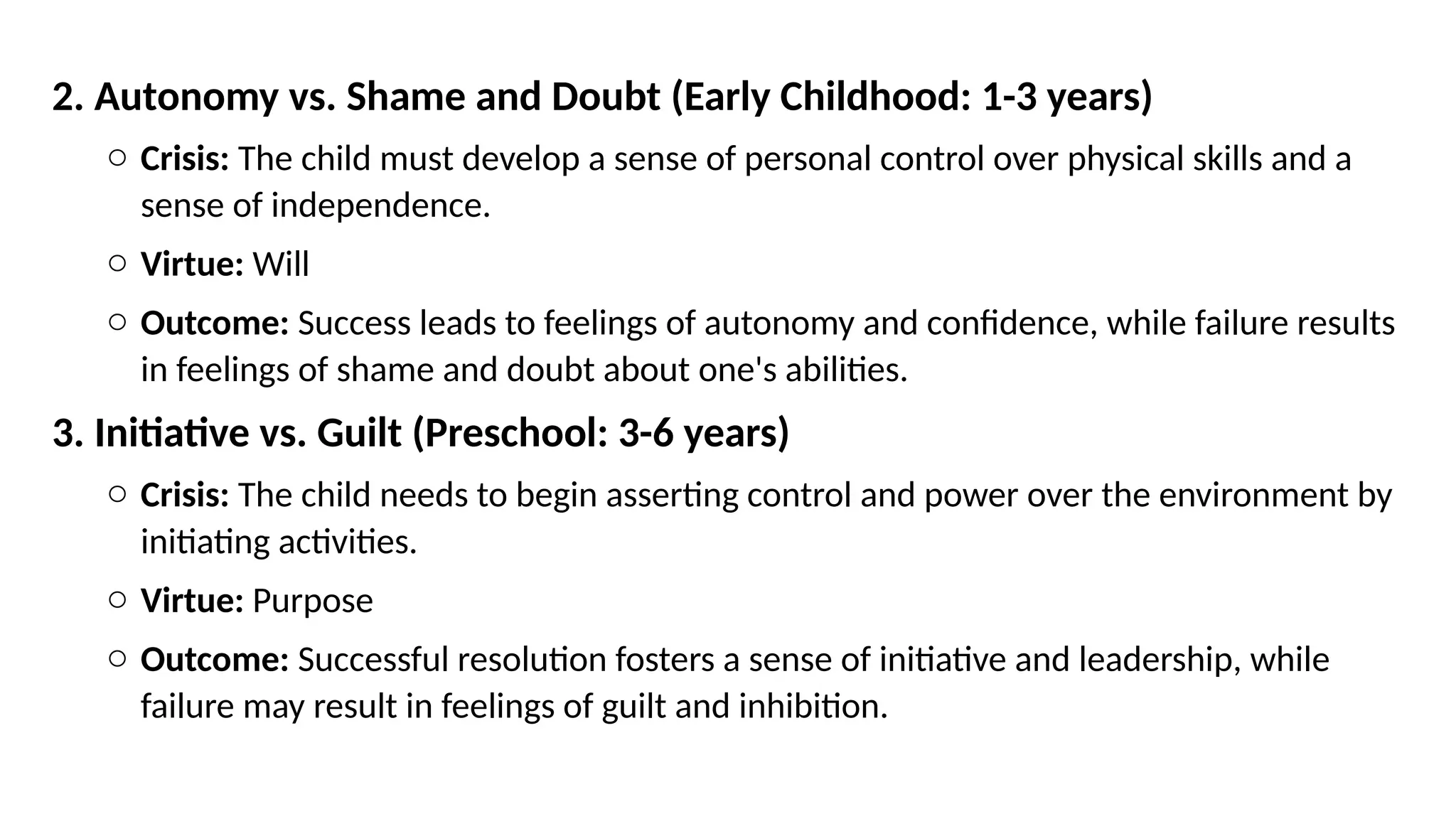
2. Autonomy vs. Shame and Doubt (Early Childhood: 1-3 years)
o Crisis: The child must develop a sense of personal control over physical skills and a
sense of independence.
o Virtue: Will
o Outcome: Success leads to feelings of autonomy and confidence, while failure results
in feelings of shame and doubt about one's abilities.
3. Initiative vs. Guilt (Preschool: 3-6 years)
o Crisis: The child needs to begin asserting control and power over the environment by
initiating activities.
o Virtue: Purpose
o Outcome: Successful resolution fosters a sense of initiative and leadership, while
failure may result in feelings of guilt and inhibition.
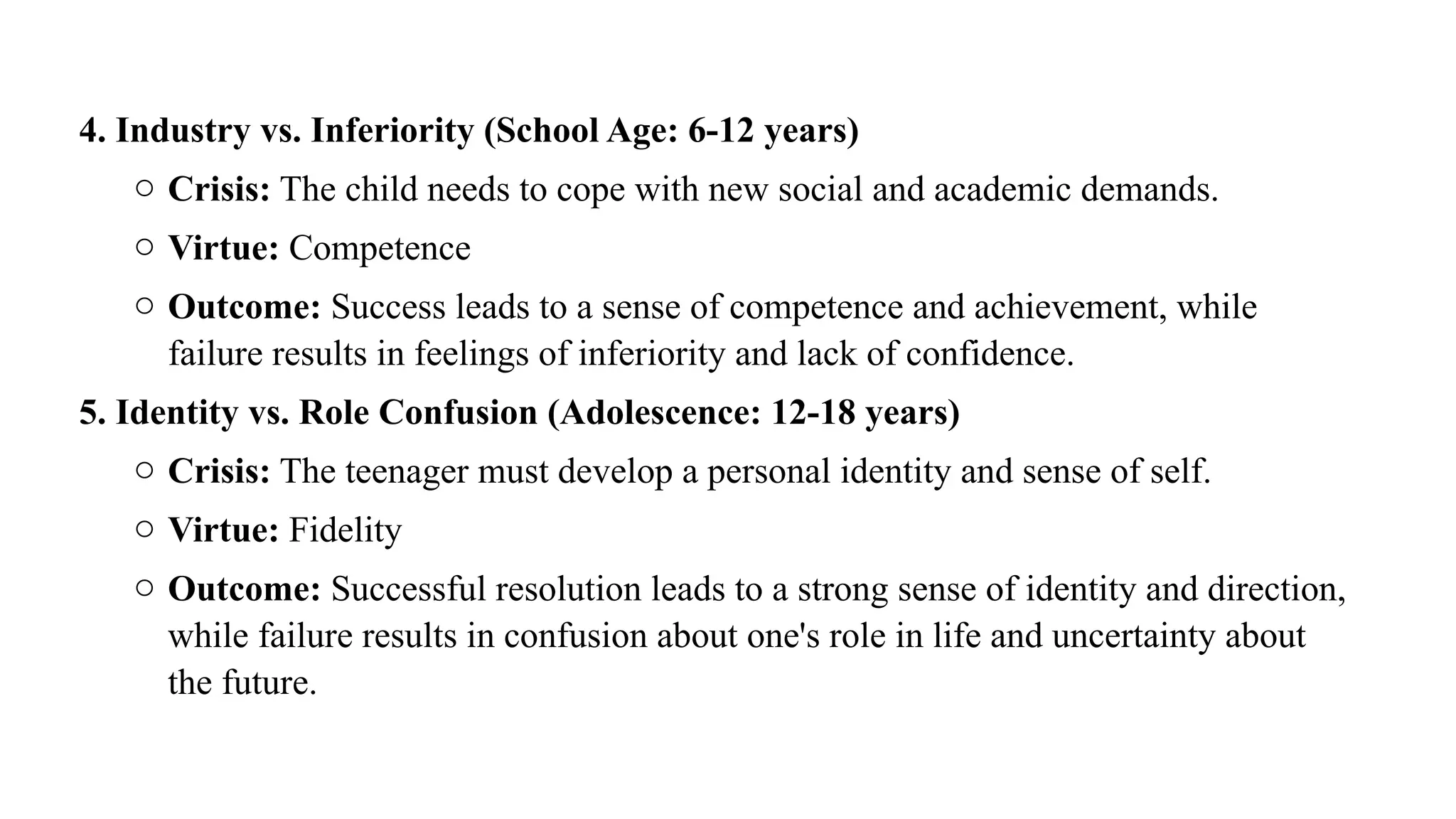
4. Industry vs. Inferiority (School Age: 6-12 years)
o Crisis: The child needs to cope with new social and academic demands.
o Virtue: Competence
o Outcome: Success leads to a sense of competence and achievement, while
failure results in feelings of inferiority and lack of confidence.
5. Identity vs. Role Confusion (Adolescence: 12-18 years)
o Crisis: The teenager must develop a personal identity and sense of self.
o Virtue: Fidelity
o Outcome: Successful resolution leads to a strong sense of identity and direction,
while failure results in confusion about one's role in life and uncertainty about
the future.
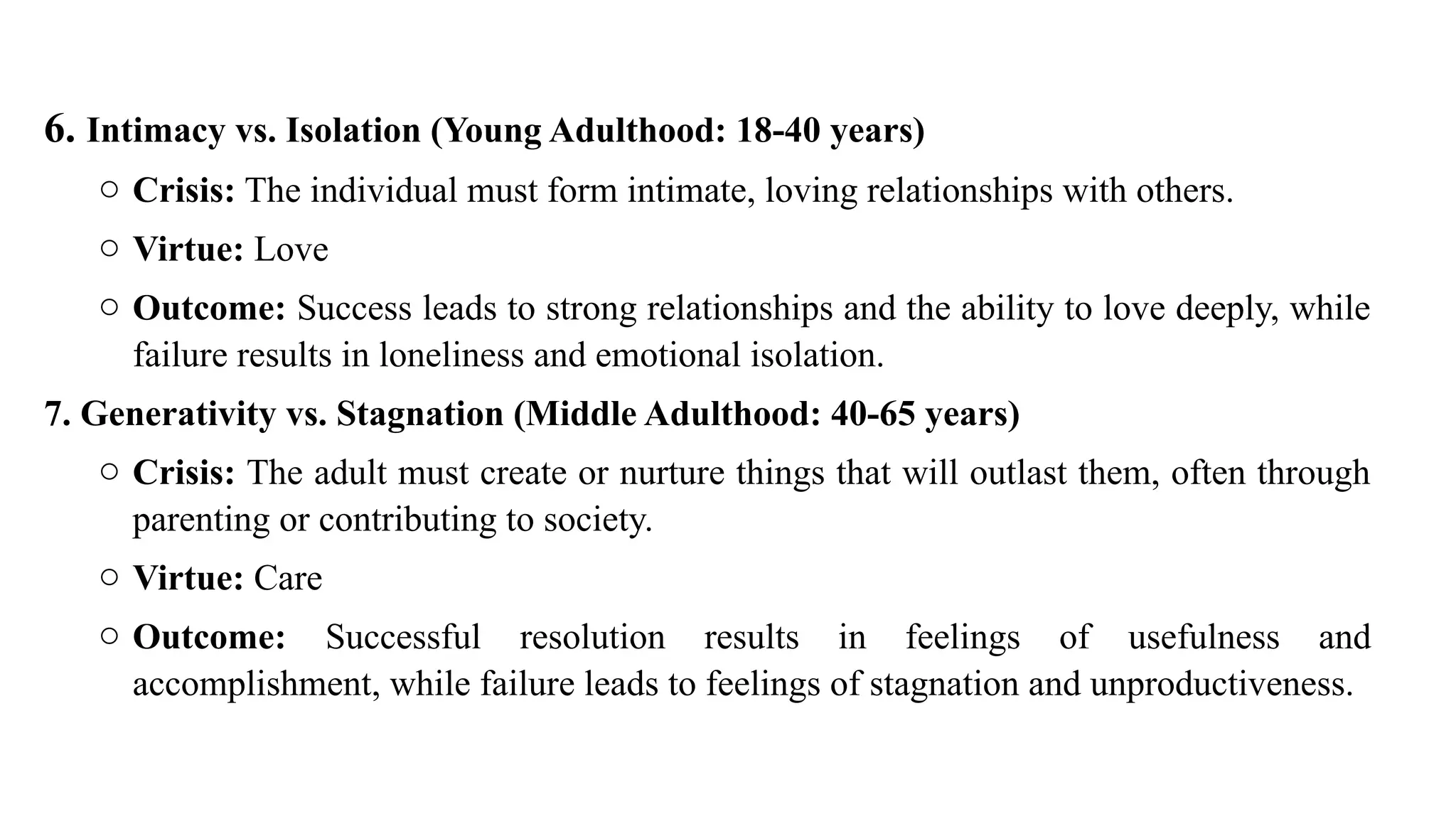
6. Intimacy vs. Isolation (Young Adulthood: 18-40 years)
o Crisis: The individual must form intimate, loving relationships with others.
o Virtue: Love
o Outcome: Success leads to strong relationships and the ability to love deeply, while
failure results in loneliness and emotional isolation.
7. Generativity vs. Stagnation (Middle Adulthood: 40-65 years)
o Crisis: The adult must create or nurture things that will outlast them, often through
parenting or contributing to society.
o Virtue: Care
o Outcome: Successful resolution results in feelings of usefulness and
accomplishment, while failure leads to feelings of stagnation and unproductiveness.
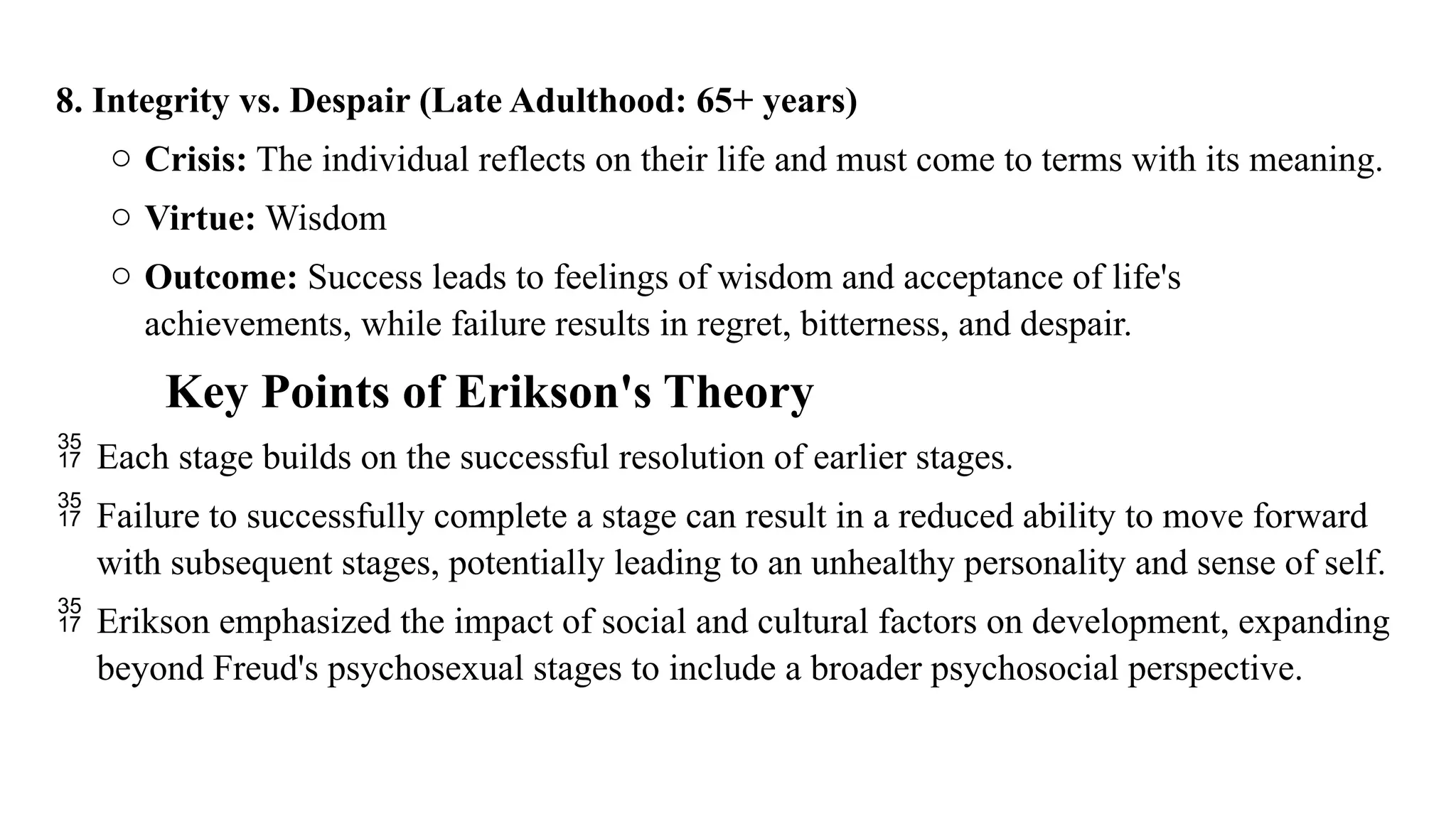
8. Integrity vs. Despair (Late Adulthood: 65+ years)
o Crisis: The individual reflects on their life and must come to terms with its meaning.
o Virtue: Wisdom
o Outcome: Success leads to feelings of wisdom and acceptance of life's
achievements, while failure results in regret, bitterness, and despair.
Key Points of Erikson's Theory
 Each stage builds on the successful resolution of earlier stages.
 Failure to successfully complete a stage can result in a reduced ability to move forward
with subsequent stages, potentially leading to an unhealthy personality and sense of self.
 Erikson emphasized the impact of social and cultural factors on development, expanding
beyond Freud's psychosexual stages to include a broader psychosocial perspective.
Educational Implications of Erikson's Theory in the
Indian Context
1. At infancy stage, caregiving practices should focus on building trust through
a secure and supportive environment. Teachers and caregivers can foster trust
by being responsive to children's needs, providing consistent care, and
offering a warm and affectionate atmosphere. This can help children feel
safe, develop secure attachments, and positively impact their future learning
experiences.
In many Indian families, extended family members often play a significant role
in caregiving. Schools and preschools can work to involve family members in
educational activities to strengthen this foundation of trust.
2. Encourage independence and autonomy at early
childhood stage by allowing children to make choices,
such as selecting their activities or participating in
decision-making processes. This can help develop a sense
of self-confidence and independence. Teachers should
avoid over-criticism or strict control, which may lead to
feelings of shame or doubt in their abilities.
Indian society often values obedience and conformity,
which may sometimes limit opportunities for autonomy.
Educators should balance cultural expectations with the
need for fostering independence in young learners.
3. During early years of schooling, encourage curiosity and initiative by
creating a stimulating learning environment that allows children to
explore, ask questions, and engage in creative play. Activities that promote
imagination, such as storytelling, drama, and art, can be particularly
beneficial. It is important to avoid excessive punishment or criticism when
children make mistakes, as this could lead to a sense of guilt.
Traditional Indian schooling can sometimes emphasize rote learning
and discipline over creativity. Schools should aim to incorporate more
play-based and exploratory learning methods.
4. At late childhood stage, it is crucial to provide opportunities for children
to develop skills and achieve success in tasks, thereby fostering a sense of
industry and competence. Teachers should recognize and appreciate
individual strengths, provide constructive feedback, and encourage
collaborative learning to build a positive self-concept.
The Indian education system often focuses heavily on academic
achievement and competition, which can lead to feelings of inferiority in
students who may not perform well in conventional subjects. Schools should
diversify learning approaches to include multiple intelligences and value
diverse talents.
5. During adolescence, students are exploring their identity, values,
and beliefs. Educational institutions should provide a supportive
environment where students can explore various roles, try out
different interests, and express themselves. Career counseling,
mentorship programs, and opportunities for extracurricular
activities can help students form a strong sense of identity.
In the Indian context, societal expectations, parental pressures,
and cultural norms can heavily influence identity formation. Schools
should encourage open dialogue and critical thinking to help students
navigate these pressures and develop a balanced self-concept.
6. Although young adulthood (18-40) stage is beyond the typical
school years, educational institutions, especially higher education,
can foster the development of meaningful relationships and
collaborative skills. Group projects, discussions, and social
activities can help young adults form intimate connections, trust,
and empathy, which are critical for personal and professional
success.
Societal norms often play significant importance on family and
marital relationships. Educational institutions can support students in
understanding and balancing both personal and professional
relationships.
7. Continuing professional development, mentorship opportunities,
and community involvement are key for the Middle adulthood
stage (40-65). Schools can benefit from fostering environments
where experienced educators can mentor younger colleagues and
contribute to the community.
In India, middle-aged adults often balance multiple
responsibilities, including work, family, and social roles. Schools can
provide flexible opportunities for educators to continue growing
professionally while managing these responsibilities.
8. For older educators or community members i.e. Late
Adulthood (65+ years), schools can create opportunities
for involvement in educational activities, such as
storytelling, sharing life experiences, or mentoring. This
can help promote a sense of fulfillment and integrity.
Indian culture traditionally respects elders and values
their experience. Schools can incorporate these cultural
values by creating intergenerational programs that connect
students with older adults.
9. Culturally Relevant Curriculum: Incorporate culturally relevant
materials and examples in the curriculum to help students relate Erikson's
concepts to their own lives.
10. Teacher Training: Train educators to understand the psychosocial needs
of different age groups and to apply appropriate strategies in their teaching
practices.
11. Parental Involvement: Encourage parental involvement and education to
align home and school practices, fostering a supportive environment for
children's social and emotional development.
12. Emotional Well-being Programs: Introduce programs that focus on
mental health, emotional intelligence, and social skills, especially in the face
of increasing academic pressures.

Eric Erikson Social and emotion development.pptx

  • 2.
    Social and emotionaldevelopment • Social and emotional development refers to the process through which individuals learn to understand and manage emotions, establish positive relationships, and develop empathy, self-awareness, and social skills. This development is critical from infancy through adulthood and is shaped by various factors, including biological, environmental, and cultural influences. Theories of social and emotional development provide a framework for understanding how these skills evolve over time.
  • 3.
    Social Development •Social developmentis the process by which individuals learn the values, knowledge, and skills necessary to interact effectively with others and participate in society. This includes:  Learning Social Skills: such as sharing, cooperating, listening, and communicating.  Building Relationships: developing attachments, friendships, and other social bonds.  Understanding Social Norms: recognizing and adhering to societal rules, cultural values, and group expectations.  Developing Empathy: the ability to understand and respond to the feelings of others.  Conflict Resolution: learning to manage disagreements and resolve conflicts constructively. •Social development is influenced by various factors such as family, peer relationships, school environment, community, and cultural background.
  • 4.
    Emotional Development •Emotional developmentinvolves the ability to recognize, understand, express, and regulate one's emotions effectively. Key aspects include:  Emotional Awareness: recognizing and naming one's own emotions and those of others.  Emotional Regulation: managing and controlling emotional responses in different situations.  Self-Esteem and Confidence: developing a positive sense of self-worth and self-efficacy.  Attachment: forming secure and healthy attachments with caregivers or significant others.  Coping Skills: developing strategies to handle stress, adversity, and challenges. •Emotional development is essential for mental well-being, resilience, and adaptive behavior.
  • 5.
    . Interplay Between Socialand Emotional Development •Social and emotional development are interdependent; emotional skills enable individuals to interact socially, while social experiences shape emotional growth. For example: A child who learns to empathize (emotional skill) is more likely to form meaningful friendships (social skill). Positive social interactions, such as praise and encouragement, help build self-esteem and emotional well-being.
  • 6.
    Importance of Socialand Emotional Development Mental Health: Promotes psychological resilience and coping mechanisms. Academic Success: Enhances concentration, motivation, and a positive attitude toward learning. Workplace Success: Improves collaboration, communication, and adaptability in professional settings. Interpersonal Relationships: Strengthens the ability to form and maintain healthy relationships.
  • 7.
    Factors Affecting Socialand Emotional Development Biological Factors: Genetics, brain development, and temperament. Environmental Factors: Family dynamics, school environment, peer relationships, and cultural context. Experiential Factors: Life experiences, such as trauma, support systems, and opportunities for social interaction.
  • 8.
    Theories of socialand emotional development • John Bowlby and Mary Ainsworth's Attachment Theory • Emphasizes the importance of a secure relationship • Secure Attachment, Insecure Attachment (Avoidant, Ambivalent, Disorganized) • Albert Bandura's Social Learning Theory • Observational Learning, Self efficacy: the belief in one's abilities to succeed • Jean Piaget's Cognitive Development Theory • Emotional and social skills are intertwined with cognitive development - Egocentric to Sociocentric Shift • Lev Vygotsky's Sociocultural Theory • Zone of Proximal Development (ZPD), Scaffolding • Daniel Goleman’s Emotional Intelligence Theory • Self-Awareness:, Self-Regulation, Motivation, Empathy, Social Skills. •Lawrence Kohlberg's Theory of Moral Development • pre-conventional, conventional, and post-conventional
  • 9.
    Erik Erikson's theoryof social and emotional development, known as the "Psychosocial Development Theory," outlines eight stages of psychological growth that span from infancy to adulthood. Each stage presents a fundamental conflict or challenge that individuals must resolve to develop a healthy personality and acquire basic virtues. The Eight Stages of Psychosocial Development 1. Trust vs. Mistrust (Infancy: 0-1 year) o Crisis: The infant must develop a sense of trust when caregivers provide reliability, care, and affection. A lack of this leads to mistrust. o Virtue: Hope o Outcome: Successful resolution fosters a sense of security and trust in the world. Failure leads to fear and suspicion.
  • 10.
    2. Autonomy vs.Shame and Doubt (Early Childhood: 1-3 years) o Crisis: The child must develop a sense of personal control over physical skills and a sense of independence. o Virtue: Will o Outcome: Success leads to feelings of autonomy and confidence, while failure results in feelings of shame and doubt about one's abilities. 3. Initiative vs. Guilt (Preschool: 3-6 years) o Crisis: The child needs to begin asserting control and power over the environment by initiating activities. o Virtue: Purpose o Outcome: Successful resolution fosters a sense of initiative and leadership, while failure may result in feelings of guilt and inhibition.
  • 11.
    4. Industry vs.Inferiority (School Age: 6-12 years) o Crisis: The child needs to cope with new social and academic demands. o Virtue: Competence o Outcome: Success leads to a sense of competence and achievement, while failure results in feelings of inferiority and lack of confidence. 5. Identity vs. Role Confusion (Adolescence: 12-18 years) o Crisis: The teenager must develop a personal identity and sense of self. o Virtue: Fidelity o Outcome: Successful resolution leads to a strong sense of identity and direction, while failure results in confusion about one's role in life and uncertainty about the future.
  • 12.
    6. Intimacy vs.Isolation (Young Adulthood: 18-40 years) o Crisis: The individual must form intimate, loving relationships with others. o Virtue: Love o Outcome: Success leads to strong relationships and the ability to love deeply, while failure results in loneliness and emotional isolation. 7. Generativity vs. Stagnation (Middle Adulthood: 40-65 years) o Crisis: The adult must create or nurture things that will outlast them, often through parenting or contributing to society. o Virtue: Care o Outcome: Successful resolution results in feelings of usefulness and accomplishment, while failure leads to feelings of stagnation and unproductiveness.
  • 13.
    8. Integrity vs.Despair (Late Adulthood: 65+ years) o Crisis: The individual reflects on their life and must come to terms with its meaning. o Virtue: Wisdom o Outcome: Success leads to feelings of wisdom and acceptance of life's achievements, while failure results in regret, bitterness, and despair. Key Points of Erikson's Theory  Each stage builds on the successful resolution of earlier stages.  Failure to successfully complete a stage can result in a reduced ability to move forward with subsequent stages, potentially leading to an unhealthy personality and sense of self.  Erikson emphasized the impact of social and cultural factors on development, expanding beyond Freud's psychosexual stages to include a broader psychosocial perspective.
  • 14.
    Educational Implications ofErikson's Theory in the Indian Context 1. At infancy stage, caregiving practices should focus on building trust through a secure and supportive environment. Teachers and caregivers can foster trust by being responsive to children's needs, providing consistent care, and offering a warm and affectionate atmosphere. This can help children feel safe, develop secure attachments, and positively impact their future learning experiences. In many Indian families, extended family members often play a significant role in caregiving. Schools and preschools can work to involve family members in educational activities to strengthen this foundation of trust.
  • 15.
    2. Encourage independenceand autonomy at early childhood stage by allowing children to make choices, such as selecting their activities or participating in decision-making processes. This can help develop a sense of self-confidence and independence. Teachers should avoid over-criticism or strict control, which may lead to feelings of shame or doubt in their abilities. Indian society often values obedience and conformity, which may sometimes limit opportunities for autonomy. Educators should balance cultural expectations with the need for fostering independence in young learners.
  • 16.
    3. During earlyyears of schooling, encourage curiosity and initiative by creating a stimulating learning environment that allows children to explore, ask questions, and engage in creative play. Activities that promote imagination, such as storytelling, drama, and art, can be particularly beneficial. It is important to avoid excessive punishment or criticism when children make mistakes, as this could lead to a sense of guilt. Traditional Indian schooling can sometimes emphasize rote learning and discipline over creativity. Schools should aim to incorporate more play-based and exploratory learning methods.
  • 17.
    4. At latechildhood stage, it is crucial to provide opportunities for children to develop skills and achieve success in tasks, thereby fostering a sense of industry and competence. Teachers should recognize and appreciate individual strengths, provide constructive feedback, and encourage collaborative learning to build a positive self-concept. The Indian education system often focuses heavily on academic achievement and competition, which can lead to feelings of inferiority in students who may not perform well in conventional subjects. Schools should diversify learning approaches to include multiple intelligences and value diverse talents.
  • 18.
    5. During adolescence,students are exploring their identity, values, and beliefs. Educational institutions should provide a supportive environment where students can explore various roles, try out different interests, and express themselves. Career counseling, mentorship programs, and opportunities for extracurricular activities can help students form a strong sense of identity. In the Indian context, societal expectations, parental pressures, and cultural norms can heavily influence identity formation. Schools should encourage open dialogue and critical thinking to help students navigate these pressures and develop a balanced self-concept.
  • 19.
    6. Although youngadulthood (18-40) stage is beyond the typical school years, educational institutions, especially higher education, can foster the development of meaningful relationships and collaborative skills. Group projects, discussions, and social activities can help young adults form intimate connections, trust, and empathy, which are critical for personal and professional success. Societal norms often play significant importance on family and marital relationships. Educational institutions can support students in understanding and balancing both personal and professional relationships.
  • 20.
    7. Continuing professionaldevelopment, mentorship opportunities, and community involvement are key for the Middle adulthood stage (40-65). Schools can benefit from fostering environments where experienced educators can mentor younger colleagues and contribute to the community. In India, middle-aged adults often balance multiple responsibilities, including work, family, and social roles. Schools can provide flexible opportunities for educators to continue growing professionally while managing these responsibilities.
  • 21.
    8. For oldereducators or community members i.e. Late Adulthood (65+ years), schools can create opportunities for involvement in educational activities, such as storytelling, sharing life experiences, or mentoring. This can help promote a sense of fulfillment and integrity. Indian culture traditionally respects elders and values their experience. Schools can incorporate these cultural values by creating intergenerational programs that connect students with older adults.
  • 22.
    9. Culturally RelevantCurriculum: Incorporate culturally relevant materials and examples in the curriculum to help students relate Erikson's concepts to their own lives. 10. Teacher Training: Train educators to understand the psychosocial needs of different age groups and to apply appropriate strategies in their teaching practices. 11. Parental Involvement: Encourage parental involvement and education to align home and school practices, fostering a supportive environment for children's social and emotional development. 12. Emotional Well-being Programs: Introduce programs that focus on mental health, emotional intelligence, and social skills, especially in the face of increasing academic pressures.