Demonstration Leroy Alicea-Cabassa June 2009 Maya West Writing Project Picture Word Inductive Model PWIM
Where do you Teach? Regional Bilingual School [10 years] Middle School 7 th , 8 th  & 9 th English Añasco
Where do you Teach? Upward Bound Program [15 years] InterAmerican University San German English Teacher Spelling Bee Oratory
Where do you Teach? SUAGM [4 years] Turabo Ponce UMET Aguadilla UNE Cabo Rojo
English Teacher  BA Teaching English as a Second Language  Secondary Level MA T.E.S.L. Bilingual Education Supervision and Administration of Schools Ed. D  [Doctoral Candidate]  or  [ABD] Curriculum and Teaching
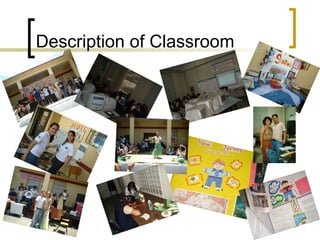
Description of Classroom
Description of School
English
Description of Community
Filosofía Educativa  “ El hombre no es más que lo que él mismo se hace.” Jean-Paul Sartre [Existencialista> Humanista ] “ Realidad cambiante experimentación constante” John Dewey [Pragmatismo> Progresivismo >Constructivismo]
DEMO aligned  with approaches  Whole Language Approach  Goodman and Chomsky Goodman emphasized that pronouncing individual words will involve the use of all three systems (letter clues, meaning clues from context, and syntactical structure of the sentence).  Part of his rationale was that reading and writing were ideas that should be considered as wholes, learned by experience and exposure more than analysis and didactic instruction.
DEMO aligned  with approaches DE Constructivist Humanistic Theory (cooperative learning)  (1) Suitable for small groups (2) teachers must possess superior knowledge of the subject matter (3) people change their perceptions when they are ready  (4) teachers must believe that all learners can learn, can find their own best way to learn, and will learn the things that hold meaning for them  (5) a healthy and creative student-teacher relationship is very important  (6) the outcomes of such education will be unique.
Models of Teaching Authors Bruce Joyce Marsha Weil Emily Calhoun
PWIM Picture Word Inductive Model Emily F. Calhoun
PWIM The PWIM is an inquiry-oriented language arts strategy that uses pictures containing familiar objects and actions to elicit words from children's listening and speaking vocabularies.
PWIM Teachers use the PWIM with classes, small groups, and individuals to lead them into inquiring about words, adding words to their sight-reading and writing vocabularies, discovering phonetic and structural principles, and using observation and analysis in their study of reading, writing, comprehending, and composing.
PWIM The picture word inductive model can be used to teach phonics and spelling both inductively and explicitly.  The model is designed to capitalize on children's ability to think inductively.  The PWIM enables them to build generalizations that form the basis of writing structure and phonetic analysis respecting their ability to think.
PWIM Remember: The full sequence of a PWIM unit may take three days or two months:  The length of units and number of lessons within a unit depend on the richness of the picture, the age and language development of the students, and the language objectives of the teacher.
Objective Students will be able to write a descriptive creative story promoted by the use of the Picture Word Inductive Model Identify new words of vocabulary
 
 
table chair leaf fan cutter pot clock window refrigerator bottles light stove plant faucet sink oven glasses paper knives drawers tiles candle knot cabinets door spoons freezer
Sentences using vocabulary from the picture We found a  table  in the picture. We mentioned a  plant  that was in the picture. The teacher and the students saw a  candle  in the picture. We saw a  clock  next to the  window . We found a  freezer  on top of the  refrigerator . We mentioned that the  pot  was under the  cutter .
Sentences with blanks in order to use new word of voc. from the picture We found a _______ in the picture. We mentioned a ________ that was in the picture. The teacher and the students saw a __________ in the picture. We saw a ______ next to the _______. We found a _______ on top of the ________. We mentioned that the ________ was under the _______.
Develop paragraph It was my first day at this  kitchen  I was going to have some guest coming home. My in laws were coming to eat my special meat loaf. I was late and I could not find my favorite  pan  which was supposed to be underneath the  cutter . I turn on the light but I could not find the switch for the  fan . ……….
Title: __________ ? ___________
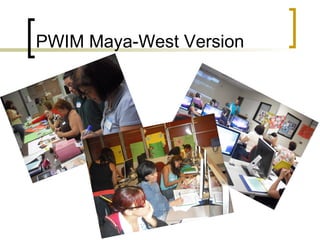
PWIM Maya-West Version
Maya West Advanced Level PWIM Write a descriptive paragraph (s) of a fictional event using the key words from the picture provided Write using the 3 rd  person You could ask you classmates for feedback. [collaboration] Be creative and feel free to add details and more words. Title your story Before sharing the Story Read Three Key Words [any, your favorite ones] Spell them Share the story with the class and community
 

Picture Word Inductive Model

  • 1.
    Demonstration Leroy Alicea-CabassaJune 2009 Maya West Writing Project Picture Word Inductive Model PWIM
  • 2.
    Where do youTeach? Regional Bilingual School [10 years] Middle School 7 th , 8 th & 9 th English Añasco
  • 3.
    Where do youTeach? Upward Bound Program [15 years] InterAmerican University San German English Teacher Spelling Bee Oratory
  • 4.
    Where do youTeach? SUAGM [4 years] Turabo Ponce UMET Aguadilla UNE Cabo Rojo
  • 5.
    English Teacher BA Teaching English as a Second Language Secondary Level MA T.E.S.L. Bilingual Education Supervision and Administration of Schools Ed. D [Doctoral Candidate] or [ABD] Curriculum and Teaching
  • 6.
  • 7.
  • 8.
  • 9.
  • 10.
    Filosofía Educativa “ El hombre no es más que lo que él mismo se hace.” Jean-Paul Sartre [Existencialista> Humanista ] “ Realidad cambiante experimentación constante” John Dewey [Pragmatismo> Progresivismo >Constructivismo]
  • 11.
    DEMO aligned with approaches Whole Language Approach Goodman and Chomsky Goodman emphasized that pronouncing individual words will involve the use of all three systems (letter clues, meaning clues from context, and syntactical structure of the sentence). Part of his rationale was that reading and writing were ideas that should be considered as wholes, learned by experience and exposure more than analysis and didactic instruction.
  • 12.
    DEMO aligned with approaches DE Constructivist Humanistic Theory (cooperative learning) (1) Suitable for small groups (2) teachers must possess superior knowledge of the subject matter (3) people change their perceptions when they are ready (4) teachers must believe that all learners can learn, can find their own best way to learn, and will learn the things that hold meaning for them (5) a healthy and creative student-teacher relationship is very important (6) the outcomes of such education will be unique.
  • 13.
    Models of TeachingAuthors Bruce Joyce Marsha Weil Emily Calhoun
  • 14.
    PWIM Picture WordInductive Model Emily F. Calhoun
  • 15.
    PWIM The PWIMis an inquiry-oriented language arts strategy that uses pictures containing familiar objects and actions to elicit words from children's listening and speaking vocabularies.
  • 16.
    PWIM Teachers usethe PWIM with classes, small groups, and individuals to lead them into inquiring about words, adding words to their sight-reading and writing vocabularies, discovering phonetic and structural principles, and using observation and analysis in their study of reading, writing, comprehending, and composing.
  • 17.
    PWIM The pictureword inductive model can be used to teach phonics and spelling both inductively and explicitly. The model is designed to capitalize on children's ability to think inductively. The PWIM enables them to build generalizations that form the basis of writing structure and phonetic analysis respecting their ability to think.
  • 18.
    PWIM Remember: Thefull sequence of a PWIM unit may take three days or two months: The length of units and number of lessons within a unit depend on the richness of the picture, the age and language development of the students, and the language objectives of the teacher.
  • 19.
    Objective Students willbe able to write a descriptive creative story promoted by the use of the Picture Word Inductive Model Identify new words of vocabulary
  • 20.
  • 21.
  • 22.
    table chair leaffan cutter pot clock window refrigerator bottles light stove plant faucet sink oven glasses paper knives drawers tiles candle knot cabinets door spoons freezer
  • 23.
    Sentences using vocabularyfrom the picture We found a table in the picture. We mentioned a plant that was in the picture. The teacher and the students saw a candle in the picture. We saw a clock next to the window . We found a freezer on top of the refrigerator . We mentioned that the pot was under the cutter .
  • 24.
    Sentences with blanksin order to use new word of voc. from the picture We found a _______ in the picture. We mentioned a ________ that was in the picture. The teacher and the students saw a __________ in the picture. We saw a ______ next to the _______. We found a _______ on top of the ________. We mentioned that the ________ was under the _______.
  • 25.
    Develop paragraph Itwas my first day at this kitchen I was going to have some guest coming home. My in laws were coming to eat my special meat loaf. I was late and I could not find my favorite pan which was supposed to be underneath the cutter . I turn on the light but I could not find the switch for the fan . ……….
  • 26.
  • 27.
  • 28.
    Maya West AdvancedLevel PWIM Write a descriptive paragraph (s) of a fictional event using the key words from the picture provided Write using the 3 rd person You could ask you classmates for feedback. [collaboration] Be creative and feel free to add details and more words. Title your story Before sharing the Story Read Three Key Words [any, your favorite ones] Spell them Share the story with the class and community
  • 29.