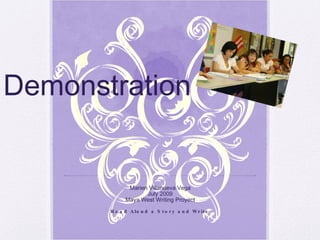
Demonstration


              Marien Villanueva Vega
                    July 2009
             Maya West Writing Proyect
       R e a d A lo u d a S t o r y a n d W r it e
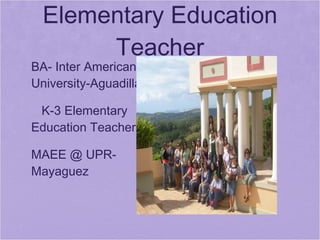
Elementary Education
          Teacher
• BA- Inter American
  University-Aguadilla

•    K-3 Elementary
    Education Teacher

• MAEE @ UPR-
  Mayaguez


•
Experience
• I worked in a private catholic school in
  Isabela for three years and one semester.

• I started working in this school on the
  second semester of 2003-2004 school year
  as a 7th grade Spanish teacher, and as a
  Social Studies teacher of students of 4th, 5th,
  and 6th grade.

• The next three years, from year 2004 – 2007
  I worked as a First grade teacher. I taught
Experience
• Now I am not working as a teacher in any
  school. I decided to study full time two years
  ago. I am a full time student and mom.
Teaching Philosophy
• “Knowledge emerges only through invention and
  re-invention, through the restless, impatient,
  continuing, hopeful inquiry human beings pursue
  in the world, with the world, and with each other”
  (Freire 72). The teacher becomes a guide who
  helps her students to discover knowledge, love,
  and liberty.

• I am a teacher because that is one of my biggest
  passions in life. For me, education is the
  cooperation between two important components
  of a never ending process, those components are
• The students learn from each other and the world
  around them.

• They discover love when they realize that their
  knowledge is useful not only for them but for helping
  others as well.

• They discover liberty when they see that knowledge
  will give them the power to fight for their rights, for
  their country, their dignity and the dignity of their
  compatriots.

• In this sense, education is revolutionary because we
  use human qualities to transform our experiences
  and our knowledge into something productive,
  something that is useful to us.
Writing Teacher
• I believe that writing is a big part of who
  students are, it shows their personality.

• Writing is not an asocial process in which
  they follow some steps in order to create
  pieces of writing.

• Society plays a big role in the way students
  write because of the influence it has in the
  topics they choose when they have to write.
• Ryuko Kubota, a “post-process” theorist,
  highlights the important connections that need to
  be made between L2 writing and issues of race,
  class, and gender. In his article “New
  approaches to gender, class, and race in second
  language writing” he stresses that gender, class,
  and race are constitutive elements essential to
  writers’ agency and identity. I believe in this too
  because this makes writing more interesting,
  engaging and pertinent to students.
• “Post – process” writing theory explains that
  writing is a social act.

• “Post- process” writing teachers are liberating
  students because they are reflecting upon reality
  and that gives the chance to change things.

• I believe that my position as a writing teacher is
  “post- process” because of the holistic way in
  which “post-process” deals with education and
  writing specifically.
Connection of my Writing
 Activity with Current Research
• Raymond Morrow (1990) found in a study
  that adding books and writing materials
  resulted in more writing behaviors in their
  classrooms (David Cooker 2007).

• In another study, students with access to
  writing materials were found to write longer
  descriptions in first through third grades
  (Cooker 2006).
Writing Activity
• The teacher will read a story to the students.

• The students will have the opportunity to talk
  with their peers about what happened in that
  story.

• They will reflect about the issues presented
  in that story using some guide questions
  that the teacher will provide to them.
• The students will draw a picture of the story, the
  way they imagine that one of the events in the
  story was like. They are going to write a
  description about their picture.

• They will draw and write a different solution for
  the story that the teacher read to them.
Questions
• How many characters are in this story?

• What are the main characters of this story?

• What is the problem in this story?

• Who is the person that is living the problem?

• How does that person feels?

• Who is responsible of causing the problem?

• Who are some of the people that could have helped
  the kid who owns the ball?
Questions
• Who are the persons that are not having an
  acceptable behavior in the story? Why?

• How does this situation makes you feel?

• Do you think there is anything that can be
  done?

Read Aloud

  • 1.
    Demonstration Marien Villanueva Vega July 2009 Maya West Writing Proyect R e a d A lo u d a S t o r y a n d W r it e
  • 2.
    Elementary Education Teacher • BA- Inter American University-Aguadilla • K-3 Elementary Education Teacher • MAEE @ UPR- Mayaguez •
  • 3.
    Experience • I workedin a private catholic school in Isabela for three years and one semester. • I started working in this school on the second semester of 2003-2004 school year as a 7th grade Spanish teacher, and as a Social Studies teacher of students of 4th, 5th, and 6th grade. • The next three years, from year 2004 – 2007 I worked as a First grade teacher. I taught
  • 4.
    Experience • Now Iam not working as a teacher in any school. I decided to study full time two years ago. I am a full time student and mom.
  • 5.
    Teaching Philosophy • “Knowledgeemerges only through invention and re-invention, through the restless, impatient, continuing, hopeful inquiry human beings pursue in the world, with the world, and with each other” (Freire 72). The teacher becomes a guide who helps her students to discover knowledge, love, and liberty. • I am a teacher because that is one of my biggest passions in life. For me, education is the cooperation between two important components of a never ending process, those components are
  • 6.
    • The studentslearn from each other and the world around them. • They discover love when they realize that their knowledge is useful not only for them but for helping others as well. • They discover liberty when they see that knowledge will give them the power to fight for their rights, for their country, their dignity and the dignity of their compatriots. • In this sense, education is revolutionary because we use human qualities to transform our experiences and our knowledge into something productive, something that is useful to us.
  • 7.
    Writing Teacher • Ibelieve that writing is a big part of who students are, it shows their personality. • Writing is not an asocial process in which they follow some steps in order to create pieces of writing. • Society plays a big role in the way students write because of the influence it has in the topics they choose when they have to write.
  • 8.
    • Ryuko Kubota,a “post-process” theorist, highlights the important connections that need to be made between L2 writing and issues of race, class, and gender. In his article “New approaches to gender, class, and race in second language writing” he stresses that gender, class, and race are constitutive elements essential to writers’ agency and identity. I believe in this too because this makes writing more interesting, engaging and pertinent to students.
  • 9.
    • “Post –process” writing theory explains that writing is a social act. • “Post- process” writing teachers are liberating students because they are reflecting upon reality and that gives the chance to change things. • I believe that my position as a writing teacher is “post- process” because of the holistic way in which “post-process” deals with education and writing specifically.
  • 10.
    Connection of myWriting Activity with Current Research • Raymond Morrow (1990) found in a study that adding books and writing materials resulted in more writing behaviors in their classrooms (David Cooker 2007). • In another study, students with access to writing materials were found to write longer descriptions in first through third grades (Cooker 2006).
  • 11.
    Writing Activity • Theteacher will read a story to the students. • The students will have the opportunity to talk with their peers about what happened in that story. • They will reflect about the issues presented in that story using some guide questions that the teacher will provide to them.
  • 12.
    • The studentswill draw a picture of the story, the way they imagine that one of the events in the story was like. They are going to write a description about their picture. • They will draw and write a different solution for the story that the teacher read to them.
  • 13.
    Questions • How manycharacters are in this story? • What are the main characters of this story? • What is the problem in this story? • Who is the person that is living the problem? • How does that person feels? • Who is responsible of causing the problem? • Who are some of the people that could have helped the kid who owns the ball?
  • 14.
    Questions • Who arethe persons that are not having an acceptable behavior in the story? Why? • How does this situation makes you feel? • Do you think there is anything that can be done?