


The Origins
of Language
Curriculum
Development
CONTENTS :

THE ORIGINS
OF
LANGUAGE

CURRICULUM
DEVELOPMENT

1/ INTRODUCTION HISTORICAL
BACKGROUND
2/ VOCABULARY
SELECTION
3/ GRAMMAR
SELECTION AND
GRADATION
4/ ASSUMPTIONS
LANGUAGE CURRICULUM
DEVELOPMENT
• Is an aspect of a broader field of educational
activity known as curriculum development or
curriculum studies.
• Curriculum development focuses on
determining what knowledge, skills, and
values students learn in schools or educational
systems can be planned, measured and
evaluated.
LANGUAGE CURRICULUM
DEVELOPMENT
• It refers to the field of applied linguistics that
addresses these issues. It describes the
interrelated set of processes that focuses on
designing, revising, implementing and
evaluating language program.
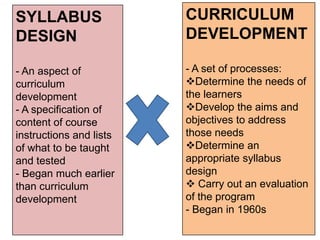
SYLLABUS
DESIGN

CURRICULUM
DEVELOPMENT

- An aspect of
curriculum
development
- A specification of
content of course
instructions and lists
of what to be taught
and tested
- Began much earlier
than curriculum
development

- A set of processes:
Determine the needs of
the learners
Develop the aims and
objectives to address
those needs
Determine an
appropriate syllabus
design
 Carry out an evaluation
of the program
- Began in 1960s
A syllabus is a specification of the
content of a course of instruction and
lists what will be taught and tested.
Thus, the syllabus for a speaking
course might specify what kinds of
oral skills that will be taught and
practiced during the course, the
functions, topics, or other aspects of
conversations that will be taught, and
the order in which they will appear in
the course.
Syllabus design is the process of
developing a syllabus.
Curriculum Development is more
comprehensive process than syllabus
design. It includes the processes that are
used to determine the needs of a group of
learners, to develop aims or objectives for
a program to address those needs, to
determine the appropriate syllabus,
course structure, teaching methods, and
materials, to carry out an evaluation of the
language program that result from these
processes.
Teaching methods in 19th – 20th
century
Grammar Translation Method (1800
- 1900)
Direct Method (1890 - 1930)
Structural Method (1930 - 1960)
Reading Method (1920 - 1950)
Audio-lingual Method (1950 - 1970)
Situational Method (1950 - 1970)
Communicative Approach (1970 present)
Teaching methods in 19th – 20th century
Grammar Translation Method (1800 - 1900)
The grammar-translation method is a method of
teaching foreign languages derived from the
classical (sometimes called traditional) method of
teaching Greek and Latin. In grammar-translation
classes, students learn grammatical rules and then
apply those rules by translating sentences between
the target language and their native language.
Advanced students may be required to translate
whole texts word-for-word. The method has two
main goals: to enable students to read and translate
literature written in the target language, and to
further students‟ general intellectual development
Teaching methods in 19th – 20th century
Direct Method (1890 - 1930)
The direct method of teaching was developed as a
response to the Grammar-Translation method. It
sought to immerse the learner in the same way as
when a first language is learnt. All teaching is done
in the target language, grammar is taught
inductively, there is a focus on speaking and
listening, and only useful „everyday' language is
taught. The weakness in the Direct Method is its
assumption that a second language can be learnt in
exactly the same way as a first, when in fact the
conditions under which a second language is learnt
are very different.
Teaching methods in 19th – 20th century
Direct Method (1890 - 1930)
Example
The teacher explains new vocabulary using
realia, visual aids or demonstrations.
In the classroom
Aspects of the Direct Method are still evident in
many ELT classrooms, such as the emphasis on
listening and speaking, the use of the target
language for all class instructions, and the use
of visuals and realia to illustrate meaning.
Teaching methods in 19th – 20th century
Audio-lingual Method (1950 - 1970)

The audio-lingual method was developed in the USA around World
War II when governments realized that they needed more people
who could conduct conversations fluently in a variety of languages,
work as interpreters, code-room assistants, and translators.
However, since foreign language instruction in that country was
heavily focused on reading instruction, no textbooks, other materials
or courses existed at the time, so new methods and materials had to
be devised. For example, the U.S. Army Specialized Training
Program created intensive programs based on the techniques
Leonard Bloomfield and other linguists devised for Native American
languages, where students interacted intensively with native
speakers and a linguist in guided conversations designed to decode
its basic grammar and learn the vocabulary. This "informant method
had great success with its small class sizes and motivated learners
Situational Method (1950 - 1970)
The oral approach or situational method
was developed from the 1930s to the 1960s
by British applied linguists such as Harold
Palmer and A.S. Hornsby.
It was discovered that languages have a
core basic vocabulary of about 2,000 words
that occurred frequently in written texts, and it
was assumed that mastery of these would
greatly aid reading comprehension. Parallel to
this was the notion of "grammar control",
emphasizing the sentence patterns mostcommonly found in spoken conversation.
Communicative Approach (1970 - present)
 Communicative language teaching(CLT), also
known as the Communicative Approach,
emphasizes interaction as both the means and
the ultimate goal of learning a language. Despite
a number of criticisms[15] it continues to be
popular, particularly in Europe, where
constructivist views on language learning and
education in general dominate academic
discourse. Although the 'Communicative
Language Teaching' is not so much a method on
its own as it is an approach.
Principles of Structural Method
(Palmer, 1922)
Initial preparation
Habit-forming
Accuracy
Gradation
Proportion
Concreteness
Interest
Order of progression
Multiple line of approach
Principles of Structural Method (Palmer,
1922)
Initial preparation- orienting the
students towards language learning.
Habit- forming- establishing correct
habits.
Accuracy- avoiding inaccurate
language
Gradation- each stage prepares the
student for the next
. Proportion- each aspect of language
given emphasis.
Principles of Structural Method (Palmer,
1922)
Concreteness- movement from the
abstract to concrete.
Interest- arousing student‟s interest at
all times.
Order of progression- hearing before
speaking, and both before writing.
Multiple line approach- many different
ways used to teach the language.
Structural Method (Palmer, 1922)
The content and syllabus underlying.
Determining the vocabulary and grammatical
content of a language course—selection and
gradation.

Is it possible to teach the whole of the
language?
Two aspects of Selection
Vocabulary selection
Grammar selection
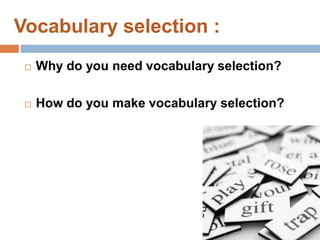
Vocabulary selection :


Why do you need vocabulary selection?



How do you make vocabulary selection?
A. Why do you need vocabulary
selection ?
17,000
Native speakers 

words (Richards, 2001, pp. 5)

-So MANY
-Limited time

What words should be taught in
a second language?
B. How to make selection vocabulary
Vocabulary Selection


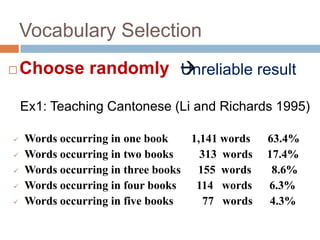
Choose randomly 
Unreliable result
Ex1: Teaching Cantonese (Li and Richards 1995)








Words occurring in one book
1,141 words
Words occurring in two books
313 words
Words occurring in three books 155 words
Words occurring in four books
114 words
Words occurring in five books
77 words

63.4%
17.4%
8.6%
6.3%
4.3%
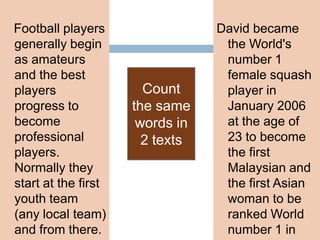
Football players
generally begin
as amateurs
and the best
players
progress to
become
professional
players.
Normally they
start at the first
youth team
(any local team)
and from there.

Count
the same
words in
2 texts

David became
the World's
number 1
female squash
player in
January 2006
at the age of
23 to become
the first
Malaysian and
the first Asian
woman to be
ranked World
number 1 in
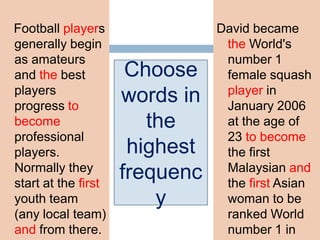
Football players
generally begin
as amateurs
and the best
players
progress to
become
professional
players.
Normally they
start at the first
youth team
(any local team)
and from there.

Choose
words in
the
highest
frequenc
y

David became
the World's
number 1
female squash
player in
January 2006
at the age of
23 to become
the first
Malaysian and
the first Asian
woman to be
ranked World
number 1 in
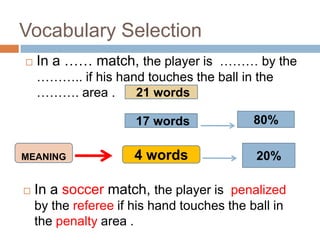
Vocabulary Selection


In a …… match, the player is ……… by the
……….. if his hand touches the ball in the
21 words
………. area .
17 words

MEANING



80%

4 words

20%

In a soccer match, the player is penalized
by the referee if his hand touches the ball in
the penalty area .
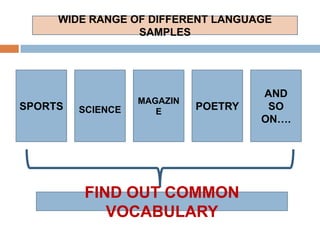
WIDE RANGE OF DIFFERENT LANGUAGE
SAMPLES

SPORTS

SCIENCE

MAGAZIN
E

POETRY

FIND OUT COMMON
VOCABULARY

AND
SO
ON….
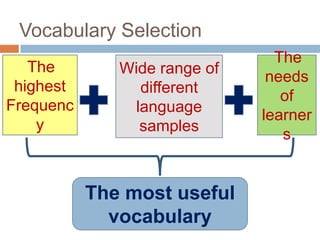
Vocabulary Selection
The
highest
Frequenc
y

Wide range of
different
language
samples

The most useful
vocabulary

The
needs
of
learner
s
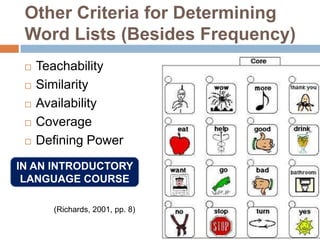
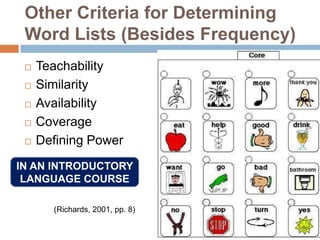
Other Criteria for Determining
Word Lists (Besides Frequency)







Teachability
Similarity
Availability
Coverage
Defining Power

IN AN INTRODUCTORY
LANGUAGE COURSE
(Richards, 2001, pp. 8)
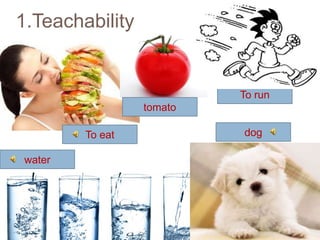
1.Teachability

To run
tomato
To eat

water

dog
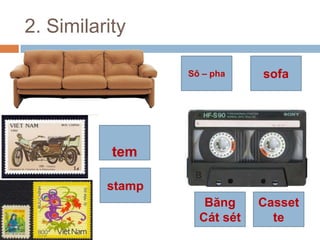
2. Similarity
Sô – pha

sofa

tem
stamp
Băng
Cát sét

Casset
te
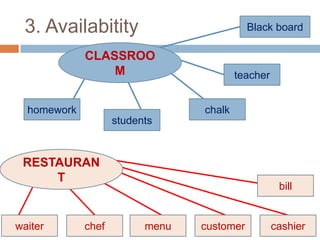
3. Availabitity

Black board

CLASSROO
M
homework

teacher
chalk

students

RESTAURAN
T

waiter

chef

bill

menu

customer

cashier
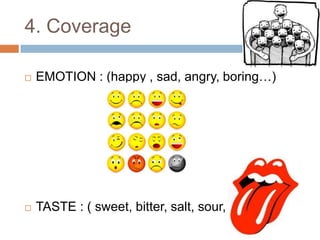
4. Coverage


EMOTION : (happy , sad, angry, boring…)



TASTE : ( sweet, bitter, salt, sour, …)
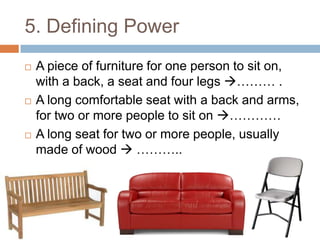
5. Defining Power






A piece of furniture for one person to sit on,
with a back, a seat and four legs ……… .
A long comfortable seat with a back and arms,
for two or more people to sit on …………
A long seat for two or more people, usually
made of wood  ………..
5. Defining Power


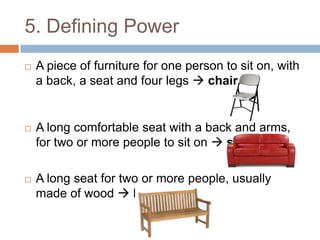
A piece of furniture for one person to sit on, with
a back, a seat and four legs  chair



A long comfortable seat with a back and arms,
for two or more people to sit on  sofa



A long seat for two or more people, usually
made of wood  bench
5. Defining Power






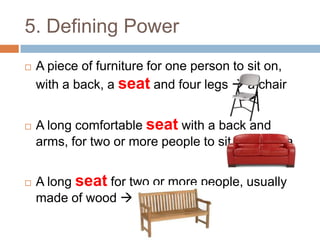
A piece of furniture for one person to sit on,
with a back, a seat and four legs  a chair
A long comfortable seat with a back and
arms, for two or more people to sit on  sofa
A long seat for two or more people, usually
made of wood  bench
Other Criteria for Determining
Word Lists (Besides Frequency)







Teachability
Similarity
Availability
Coverage
Defining Power

IN AN INTRODUCTORY
LANGUAGE COURSE
(Richards, 2001, pp. 8)
Vocabulary selection DEPENDS
ON :





The needs of target learners
ASKING PERMISSION ?
Please let me use …
Do you mind if I use…
Is it all right to use …
Do you mind me using…
Would you mind me using…
Would you permit me to use…
Would you be so kind as to allow me to
use …
Would it be possible for me to use…
Would you be so kind as to allow
me to use..
Grammar Selection & Gradation
HOW WE CAN DETERMINE
What kinds of sentences
structures would be useful to
teach?
Teaching method
Items of purposes and
Materials
Available time of
teaching
Suggested principles for developing
grammatical syllabus
Simplicity & Centrality
Frequency
Learnability
Suggested principles for developing
grammatical syllabus
Simplicity & Centrality: basic simple and
central structure of language.
S + V—She runs.
S + V + Complement—He is a teacher.
S + V + Adverb—The boy plays outside
S + V + Object + Adverb—I put the book
in the bag.
Suggested principles for developing
grammatical syllabus
Frequency: frequency of occurrence in
conversational language( not of
grammatical items in texts)
(McCarthy
& Carter, 1995)
Subject and verb ellipsis—Let’s go
Tails—And you?
Reporting verbs—I was telling…
Suggested principles for developing
grammatical syllabus
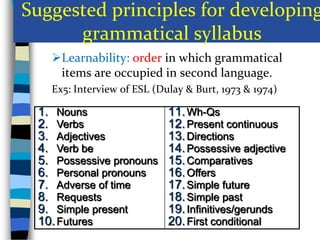
Learnability: order in which grammatical
items are occupied in second language.
Ex5: Interview of ESL (Dulay & Burt, 1973 & 1974)

1. Nouns
2. Verbs
3. Adjectives
4. Verb be
5. Possessive pronouns
6. Personal pronouns
7. Adverse of time
8. Requests
9. Simple present
10. Futures

11. Wh-Qs
12. Present continuous
13. Directions
14. Possessive adjective
15. Comparatives
16. Offers
17. Simple future
18. Simple past
19. Infinitives/gerunds
20. First conditional
IN CASE OF GRAMMAR

SELECTION

GRADATION
The approaches to gradation
Linguistic :structures similar to those in native language
should be taught first .
 I love you
 I am a doctor
 I want to buy a dress

Intrinsic difficulty: simple structures taught
before complex one.
 He taught me a lesson
 The lesson (which) he taught me is very valuable
 I love that girl
 The girl who I love is the most beautiful one in my class
The approaches to gradation
Communicative need: despite difficulty, some
structures are needed early on in acquisition.
• I went on holiday in Da Lat last summer.
• Thank you! I had breakfast.
• He failed the exam.

Frequency: occurrence in the target language
but if something easy to demonstrate and
practice in a classroom context.
•
•
•
•

What are you doing?
I am writing.
He is reading.
They are talking to each other.
Gradation approaches
Sequencing of gradation
Linear gradation: introduce one at a time and
practiced intensively before moving on
Cyclical /Spiral gradation: Repetition, old to new,
items reintroduce throughout course
4. Assumptions
underlying early
approaches to
Syllabus Design
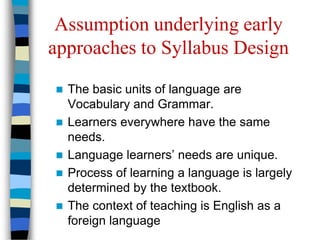
Assumption underlying early
approaches to Syllabus Design






The basic units of language are
Vocabulary and Grammar.
Learners everywhere have the same
needs.
Language learners‟ needs are unique.
Process of learning a language is largely
determined by the textbook.
The context of teaching is English as a
foreign language
1. The basic units of language are
Vocabulary and Grammar


Teaching of English largely through its
vocabulary and grammar.



These were seen as the main building blocks
of language development.
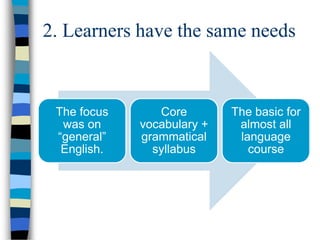
2. Learners have the same needs

The focus
was on
“general”
English.

Core
vocabulary +
grammatical
syllabus

The basic for
almost all
language
course
3. Learner’s needs are
identified exclusively in terms
of language needs


Teaching English is to teach English



Not to teach to solve their problem thru
English
4. The process of learning a
language is largely determined
by the textbook.

Selection

Gradation

Control
the
content of
the
textbook
5. The context of teaching is
English as a foreign language.


Students study English as a formal subject
but they have no immediate need to use it
outside of the classroom



Classroom and textbook provided the primary
input to the language learning process.



Goal of syllabus developer was to simplify
and rationalize the input as far as possible
thru process of selection and gradation.
References
 Richards,

J. C. (2002). The Origins of
Language Curriculum Development. In
Richards, J.D. (2002) Curriculum
development in language teaching .
Cambridge: Cambridge University Press
(pp. 1-22).
 Google Images (n.d.). Retrieved from
http://www.google.com/imghp?hl
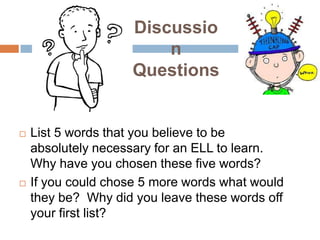
Discussio
n
Questions





List 5 words that you believe to be
absolutely necessary for an ELL to learn.
Why have you chosen these five words?
If you could chose 5 more words what would
they be? Why did you leave these words off
your first list?
Curriculum Development Lecture (Language)

Curriculum Development Lecture (Language)

  • 1.
  • 2.
    CONTENTS : THE ORIGINS OF LANGUAGE CURRICULUM DEVELOPMENT 1/INTRODUCTION HISTORICAL BACKGROUND 2/ VOCABULARY SELECTION 3/ GRAMMAR SELECTION AND GRADATION 4/ ASSUMPTIONS
  • 3.
    LANGUAGE CURRICULUM DEVELOPMENT • Isan aspect of a broader field of educational activity known as curriculum development or curriculum studies. • Curriculum development focuses on determining what knowledge, skills, and values students learn in schools or educational systems can be planned, measured and evaluated.
  • 4.
    LANGUAGE CURRICULUM DEVELOPMENT • Itrefers to the field of applied linguistics that addresses these issues. It describes the interrelated set of processes that focuses on designing, revising, implementing and evaluating language program.
  • 6.
    SYLLABUS DESIGN CURRICULUM DEVELOPMENT - An aspectof curriculum development - A specification of content of course instructions and lists of what to be taught and tested - Began much earlier than curriculum development - A set of processes: Determine the needs of the learners Develop the aims and objectives to address those needs Determine an appropriate syllabus design  Carry out an evaluation of the program - Began in 1960s
  • 7.
    A syllabus isa specification of the content of a course of instruction and lists what will be taught and tested. Thus, the syllabus for a speaking course might specify what kinds of oral skills that will be taught and practiced during the course, the functions, topics, or other aspects of conversations that will be taught, and the order in which they will appear in the course.
  • 8.
    Syllabus design isthe process of developing a syllabus. Curriculum Development is more comprehensive process than syllabus design. It includes the processes that are used to determine the needs of a group of learners, to develop aims or objectives for a program to address those needs, to determine the appropriate syllabus, course structure, teaching methods, and materials, to carry out an evaluation of the language program that result from these processes.
  • 9.
    Teaching methods in19th – 20th century Grammar Translation Method (1800 - 1900) Direct Method (1890 - 1930) Structural Method (1930 - 1960) Reading Method (1920 - 1950) Audio-lingual Method (1950 - 1970) Situational Method (1950 - 1970) Communicative Approach (1970 present)
  • 10.
    Teaching methods in19th – 20th century Grammar Translation Method (1800 - 1900) The grammar-translation method is a method of teaching foreign languages derived from the classical (sometimes called traditional) method of teaching Greek and Latin. In grammar-translation classes, students learn grammatical rules and then apply those rules by translating sentences between the target language and their native language. Advanced students may be required to translate whole texts word-for-word. The method has two main goals: to enable students to read and translate literature written in the target language, and to further students‟ general intellectual development
  • 11.
    Teaching methods in19th – 20th century Direct Method (1890 - 1930) The direct method of teaching was developed as a response to the Grammar-Translation method. It sought to immerse the learner in the same way as when a first language is learnt. All teaching is done in the target language, grammar is taught inductively, there is a focus on speaking and listening, and only useful „everyday' language is taught. The weakness in the Direct Method is its assumption that a second language can be learnt in exactly the same way as a first, when in fact the conditions under which a second language is learnt are very different.
  • 12.
    Teaching methods in19th – 20th century Direct Method (1890 - 1930) Example The teacher explains new vocabulary using realia, visual aids or demonstrations. In the classroom Aspects of the Direct Method are still evident in many ELT classrooms, such as the emphasis on listening and speaking, the use of the target language for all class instructions, and the use of visuals and realia to illustrate meaning.
  • 13.
    Teaching methods in19th – 20th century Audio-lingual Method (1950 - 1970) The audio-lingual method was developed in the USA around World War II when governments realized that they needed more people who could conduct conversations fluently in a variety of languages, work as interpreters, code-room assistants, and translators. However, since foreign language instruction in that country was heavily focused on reading instruction, no textbooks, other materials or courses existed at the time, so new methods and materials had to be devised. For example, the U.S. Army Specialized Training Program created intensive programs based on the techniques Leonard Bloomfield and other linguists devised for Native American languages, where students interacted intensively with native speakers and a linguist in guided conversations designed to decode its basic grammar and learn the vocabulary. This "informant method had great success with its small class sizes and motivated learners
  • 14.
    Situational Method (1950- 1970) The oral approach or situational method was developed from the 1930s to the 1960s by British applied linguists such as Harold Palmer and A.S. Hornsby. It was discovered that languages have a core basic vocabulary of about 2,000 words that occurred frequently in written texts, and it was assumed that mastery of these would greatly aid reading comprehension. Parallel to this was the notion of "grammar control", emphasizing the sentence patterns mostcommonly found in spoken conversation.
  • 15.
    Communicative Approach (1970- present)  Communicative language teaching(CLT), also known as the Communicative Approach, emphasizes interaction as both the means and the ultimate goal of learning a language. Despite a number of criticisms[15] it continues to be popular, particularly in Europe, where constructivist views on language learning and education in general dominate academic discourse. Although the 'Communicative Language Teaching' is not so much a method on its own as it is an approach.
  • 16.
    Principles of StructuralMethod (Palmer, 1922) Initial preparation Habit-forming Accuracy Gradation Proportion Concreteness Interest Order of progression Multiple line of approach
  • 17.
    Principles of StructuralMethod (Palmer, 1922) Initial preparation- orienting the students towards language learning. Habit- forming- establishing correct habits. Accuracy- avoiding inaccurate language Gradation- each stage prepares the student for the next . Proportion- each aspect of language given emphasis.
  • 18.
    Principles of StructuralMethod (Palmer, 1922) Concreteness- movement from the abstract to concrete. Interest- arousing student‟s interest at all times. Order of progression- hearing before speaking, and both before writing. Multiple line approach- many different ways used to teach the language.
  • 19.
    Structural Method (Palmer,1922) The content and syllabus underlying. Determining the vocabulary and grammatical content of a language course—selection and gradation. Is it possible to teach the whole of the language? Two aspects of Selection Vocabulary selection Grammar selection
  • 21.
    Vocabulary selection :  Whydo you need vocabulary selection?  How do you make vocabulary selection?
  • 22.
    A. Why doyou need vocabulary selection ?
  • 23.
    17,000 Native speakers  words(Richards, 2001, pp. 5) -So MANY -Limited time What words should be taught in a second language?
  • 24.
    B. How tomake selection vocabulary
  • 25.
    Vocabulary Selection  Choose randomly Unreliable result Ex1: Teaching Cantonese (Li and Richards 1995)      Words occurring in one book 1,141 words Words occurring in two books 313 words Words occurring in three books 155 words Words occurring in four books 114 words Words occurring in five books 77 words 63.4% 17.4% 8.6% 6.3% 4.3%
  • 26.
    Football players generally begin asamateurs and the best players progress to become professional players. Normally they start at the first youth team (any local team) and from there. Count the same words in 2 texts David became the World's number 1 female squash player in January 2006 at the age of 23 to become the first Malaysian and the first Asian woman to be ranked World number 1 in
  • 27.
    Football players generally begin asamateurs and the best players progress to become professional players. Normally they start at the first youth team (any local team) and from there. Choose words in the highest frequenc y David became the World's number 1 female squash player in January 2006 at the age of 23 to become the first Malaysian and the first Asian woman to be ranked World number 1 in
  • 28.
    Vocabulary Selection  In a…… match, the player is ……… by the ……….. if his hand touches the ball in the 21 words ………. area . 17 words MEANING  80% 4 words 20% In a soccer match, the player is penalized by the referee if his hand touches the ball in the penalty area .
  • 29.
    WIDE RANGE OFDIFFERENT LANGUAGE SAMPLES SPORTS SCIENCE MAGAZIN E POETRY FIND OUT COMMON VOCABULARY AND SO ON….
  • 30.
    Vocabulary Selection The highest Frequenc y Wide rangeof different language samples The most useful vocabulary The needs of learner s
  • 31.
    Other Criteria forDetermining Word Lists (Besides Frequency)      Teachability Similarity Availability Coverage Defining Power IN AN INTRODUCTORY LANGUAGE COURSE (Richards, 2001, pp. 8)
  • 32.
  • 33.
    2. Similarity Sô –pha sofa tem stamp Băng Cát sét Casset te
  • 34.
  • 35.
    4. Coverage  EMOTION :(happy , sad, angry, boring…)  TASTE : ( sweet, bitter, salt, sour, …)
  • 36.
    5. Defining Power    Apiece of furniture for one person to sit on, with a back, a seat and four legs ……… . A long comfortable seat with a back and arms, for two or more people to sit on ………… A long seat for two or more people, usually made of wood  ………..
  • 37.
    5. Defining Power  Apiece of furniture for one person to sit on, with a back, a seat and four legs  chair  A long comfortable seat with a back and arms, for two or more people to sit on  sofa  A long seat for two or more people, usually made of wood  bench
  • 38.
    5. Defining Power    Apiece of furniture for one person to sit on, with a back, a seat and four legs  a chair A long comfortable seat with a back and arms, for two or more people to sit on  sofa A long seat for two or more people, usually made of wood  bench
  • 39.
    Other Criteria forDetermining Word Lists (Besides Frequency)      Teachability Similarity Availability Coverage Defining Power IN AN INTRODUCTORY LANGUAGE COURSE (Richards, 2001, pp. 8)
  • 40.
    Vocabulary selection DEPENDS ON:    The needs of target learners
  • 42.
    ASKING PERMISSION ? Pleaselet me use … Do you mind if I use… Is it all right to use … Do you mind me using… Would you mind me using… Would you permit me to use… Would you be so kind as to allow me to use … Would it be possible for me to use… Would you be so kind as to allow me to use..
  • 43.
    Grammar Selection &Gradation HOW WE CAN DETERMINE What kinds of sentences structures would be useful to teach? Teaching method Items of purposes and Materials Available time of teaching
  • 44.
    Suggested principles fordeveloping grammatical syllabus Simplicity & Centrality Frequency Learnability
  • 45.
    Suggested principles fordeveloping grammatical syllabus Simplicity & Centrality: basic simple and central structure of language. S + V—She runs. S + V + Complement—He is a teacher. S + V + Adverb—The boy plays outside S + V + Object + Adverb—I put the book in the bag.
  • 46.
    Suggested principles fordeveloping grammatical syllabus Frequency: frequency of occurrence in conversational language( not of grammatical items in texts) (McCarthy & Carter, 1995) Subject and verb ellipsis—Let’s go Tails—And you? Reporting verbs—I was telling…
  • 47.
    Suggested principles fordeveloping grammatical syllabus Learnability: order in which grammatical items are occupied in second language. Ex5: Interview of ESL (Dulay & Burt, 1973 & 1974) 1. Nouns 2. Verbs 3. Adjectives 4. Verb be 5. Possessive pronouns 6. Personal pronouns 7. Adverse of time 8. Requests 9. Simple present 10. Futures 11. Wh-Qs 12. Present continuous 13. Directions 14. Possessive adjective 15. Comparatives 16. Offers 17. Simple future 18. Simple past 19. Infinitives/gerunds 20. First conditional
  • 48.
    IN CASE OFGRAMMAR SELECTION GRADATION
  • 49.
  • 50.
    The approaches togradation Linguistic :structures similar to those in native language should be taught first .  I love you  I am a doctor  I want to buy a dress Intrinsic difficulty: simple structures taught before complex one.  He taught me a lesson  The lesson (which) he taught me is very valuable  I love that girl  The girl who I love is the most beautiful one in my class
  • 51.
    The approaches togradation Communicative need: despite difficulty, some structures are needed early on in acquisition. • I went on holiday in Da Lat last summer. • Thank you! I had breakfast. • He failed the exam. Frequency: occurrence in the target language but if something easy to demonstrate and practice in a classroom context. • • • • What are you doing? I am writing. He is reading. They are talking to each other.
  • 52.
    Gradation approaches Sequencing ofgradation Linear gradation: introduce one at a time and practiced intensively before moving on Cyclical /Spiral gradation: Repetition, old to new, items reintroduce throughout course
  • 53.
  • 54.
    Assumption underlying early approachesto Syllabus Design      The basic units of language are Vocabulary and Grammar. Learners everywhere have the same needs. Language learners‟ needs are unique. Process of learning a language is largely determined by the textbook. The context of teaching is English as a foreign language
  • 55.
    1. The basicunits of language are Vocabulary and Grammar  Teaching of English largely through its vocabulary and grammar.  These were seen as the main building blocks of language development.
  • 56.
    2. Learners havethe same needs The focus was on “general” English. Core vocabulary + grammatical syllabus The basic for almost all language course
  • 57.
    3. Learner’s needsare identified exclusively in terms of language needs  Teaching English is to teach English  Not to teach to solve their problem thru English
  • 58.
    4. The processof learning a language is largely determined by the textbook. Selection Gradation Control the content of the textbook
  • 59.
    5. The contextof teaching is English as a foreign language.  Students study English as a formal subject but they have no immediate need to use it outside of the classroom  Classroom and textbook provided the primary input to the language learning process.  Goal of syllabus developer was to simplify and rationalize the input as far as possible thru process of selection and gradation.
  • 60.
    References  Richards, J. C.(2002). The Origins of Language Curriculum Development. In Richards, J.D. (2002) Curriculum development in language teaching . Cambridge: Cambridge University Press (pp. 1-22).  Google Images (n.d.). Retrieved from http://www.google.com/imghp?hl
  • 61.
    Discussio n Questions   List 5 wordsthat you believe to be absolutely necessary for an ELL to learn. Why have you chosen these five words? If you could chose 5 more words what would they be? Why did you leave these words off your first list?