Knee Talk 
Physiotherapy Management of Common Knee Problems 
Cameron Bulluss 
c.bulluss@advancedphysio.com.au
Take 
• ROM Brace 
• EMG 
• Goniometer 
• Ipad 
• Clinical Sports Medicine 
• Business Cards 
• Compex
Useful Resources 
• AAOS website www.aaos.org 
• Advanced physio website 
www.newcastle-physiotherapy.com.au/newcastle-physiotherapy- 
referrers/patient-handout-sheets
Pre-requisites for effective knee 
rehabilitation 
• Interest in this area 
• EMG 
• Rehabilitation area 
• HD slow motion video 
• Regular review 
• Access to braces, splints if needed
Contemporary Physiotherapy Model 
• Diagnosis 
• Goal setting 
• Pain Management and education 
• Protection of Injured Structure 
• Psychosocial Management 
• Restoration of Movement 
• Restoration of Motor control and Strength 
• Restoration of Proprioception 
• Prevention of Re-injury 
• Ergonomics and biomechanics 
• Fitness and functional testing
Modern Physio Skills 
• Pathology and diagnosis 
• Anatomy, functional anatomy and biomechanics 
• Manual therapy 
• Strapping 
• Psychology 
• Goal Setting and communication 
• Strength and conditioning 
• Fitness and functional testing 
• Literature searching and evaluation
Phases of Treatment 
• Acute 
• Functional Recovery 
• Prevention
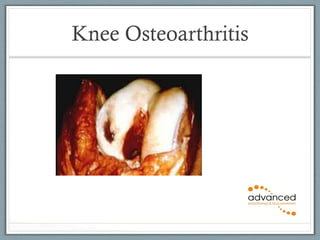
Knee Osteoarthritis
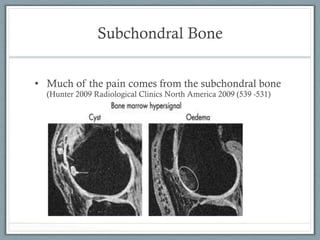
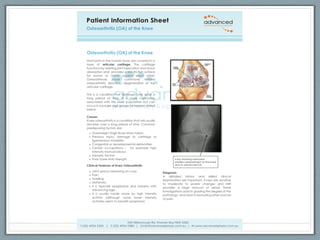
Subchondral Bone 
• Much of the pain comes from the subchondral bone 
(Hunter 2009 Radiological Clinics North America 2009 (539 -531)
Osteoarthritis 
• Acute Phase 
• Protect injured structures 
• Strapping, Bracing, Crutches 
• Modalities for pain relief – ?TENS, ?Ultrasound 
• Advice/Education
Osteoarthritis 
• Functional Recovery Phase 
• Exercises and Mobilisation to restore range of motion 
• Exercises to restore local muscle function in particular 
quadriceps (especially VMO) 
• Exercises to restore other muscles – load sharing 
throughout kinetic chain 
• Advice and Education 
• Substitution of impact activity for lower impact
Osteoarthritis 
• Prevention 
• Exercises to strengthen whole kinetic chain 
• Instruction in non-risky exercise 
• Weight loss measures 
• For every 2 units of BMI increase there is a 36% increase 
in the risk of developing knee OA 
• For every 5 kg decrease in body weight during the 
preceeding 10 years the risk of OA of the knee declines by 
more than 50%. (MJA 2004)
Weight Loss Programs 
• Diet + Exercise 
• Exercise needs to be of a low impact nature 
• Low-med intensity bike 
• Swimming 
• Upper body 
• ?walking
AAOS Recommedations for 
OA Knee 
• RECOMMENDATION 1 
• We recommend that patients with symptomatic 
osteoarthritis of the knee participate in self-management 
programs, strengthening, low-impact 
aerobic exercises, and neuromuscular education; and 
engage in physical activity consistent with national 
guidelines. 
Strength of Recommendation: Strong
AAOS Recommendations for 
OA Knee 
• RECOMMENDATION 2 
• We suggest weight loss for patients with 
symptomatic osteoarthritis of the knee and a BMI ≥ 
25. 
• Implications: Practitioners should generally follow a 
Moderate recommendation but remain alert to new 
information and be sensitive to patient preferences.
Tendinopathies 
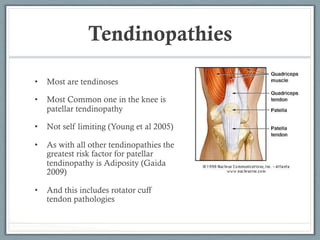
• Most are tendinoses 
• Most Common one in the knee is 
patellar tendinopathy 
• Not self limiting (Young et al 2005) 
• As with all other tendinopathies the 
greatest risk factor for patellar 
tendinopathy is Adiposity (Gaida 
2009) 
• And this includes rotator cuff 
tendon pathologies
Physiotherapy Treatment of 
Patellar Tendinopathy 
• BMI optimisation 
• Rest is not always required 
• Improve biomechanics and technique 
• Exercises to produce adaptive changes in the tendon 
• 100 days to produce a new tenocyte 
• 3 – 12 months to treat a tendon
Ligament Injuries
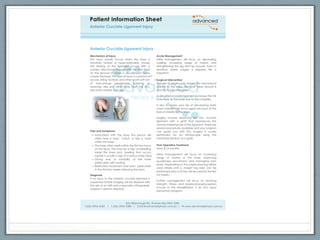
Anterior Cruciate Ligament 
Tears 
Common 
• 50% of patients will have OA changes at 10 years 
• Natural history 
• Reconstruction dependent on 
• Degree of functional instability 
• Physical condition of rest of knee 
• Age of patient 
• Ability or willingness of patient to undergo 12 months 
rehabilitation 
• Surgical Philosophy
Pre-operative Physio 
• Restore range of motion 
• Improve function 
• And will result in lower post surgical 
morbidity 
• Faster Recovery
Post-operative Physiotherapy 
ACL Tear 
• 6 -12 months 
• Approximately 150 rehab sessions to restore range, 
strength and neuromuscular control of which 
approximately 20 - 30 should be fully supervised 
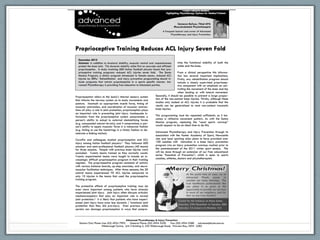
• Preventative program very important 
• PEP 
• FIFA 11+
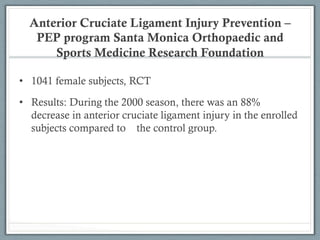
Anterior Cruciate Ligament Injury Prevention – 
PEP program Santa Monica Orthopaedic and 
Sports Medicine Research Foundation 
• 1041 female subjects, RCT 
• Results: During the 2000 season, there was an 88% 
decrease in anterior cruciate ligament injury in the enrolled 
subjects compared to the control group.
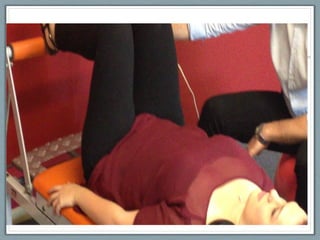
Compex Demsonstration
Collateral Ligament Tears 
• Medial Collateral ligament is most common 
• These do not require reconstruction in most cases 
and will heal well with a conservative approach in 4 
– 16 weeks
Show ROM Brace
Acute Meniscal Tears 
Adolescent 
• Place on crutches NWB 
and refer for immediate 
orthopaedic opinion 
• These are repairable in 
some situations if seen early 
Adult 
• Unless acute locked knee 
(indicating bucket handle 
tear) , refer to Physio with 
concurrent orthopaedic 
referral
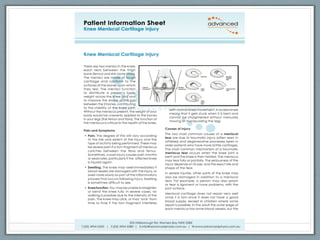
Degenerative Meniscal Tears 
• Older patient (> 45 yo) 
• Slow onset of symptoms 
• Trial 6 weeks of Physio first 
• Strengthening 
• BMI/adiposity optimisation 
• Menisectomy followed by 6-8 weeks of exercises if 
conservative care fails
Meniscal Tear with 
Osteoarthritis – Evidence 
• Katz (2013) 351 patients Surgery + Physio and Physio 
Only 
• Both groups showed improvement, but not statistically 
significant 
• 35% of Physio only patients elected for surgery due at 12 
months 
• Surgery is always an option but 65% may not need it 
• Even if they do pre-operative Physio is likely to assist 
surgical outcomes
Patellofemoral Pain 
• Variety of causes 
• Generally Physiotherapy referral will suffice and 
treatment typically consists of 
• Quadriceps strengthening 
• Stretching exercises 
• Patella tape 
• Biomechanical correction 
• Hip strengthening 
• Correction of sporting technique
Physiotherapy management of some common knee problems

Physiotherapy management of some common knee problems

  • 1.
    Knee Talk PhysiotherapyManagement of Common Knee Problems Cameron Bulluss c.bulluss@advancedphysio.com.au
  • 2.
    Take • ROMBrace • EMG • Goniometer • Ipad • Clinical Sports Medicine • Business Cards • Compex
  • 3.
    Useful Resources •AAOS website www.aaos.org • Advanced physio website www.newcastle-physiotherapy.com.au/newcastle-physiotherapy- referrers/patient-handout-sheets
  • 4.
    Pre-requisites for effectiveknee rehabilitation • Interest in this area • EMG • Rehabilitation area • HD slow motion video • Regular review • Access to braces, splints if needed
  • 5.
    Contemporary Physiotherapy Model • Diagnosis • Goal setting • Pain Management and education • Protection of Injured Structure • Psychosocial Management • Restoration of Movement • Restoration of Motor control and Strength • Restoration of Proprioception • Prevention of Re-injury • Ergonomics and biomechanics • Fitness and functional testing
  • 6.
    Modern Physio Skills • Pathology and diagnosis • Anatomy, functional anatomy and biomechanics • Manual therapy • Strapping • Psychology • Goal Setting and communication • Strength and conditioning • Fitness and functional testing • Literature searching and evaluation
  • 7.
    Phases of Treatment • Acute • Functional Recovery • Prevention
  • 8.
  • 9.
    Subchondral Bone •Much of the pain comes from the subchondral bone (Hunter 2009 Radiological Clinics North America 2009 (539 -531)
  • 10.
    Osteoarthritis • AcutePhase • Protect injured structures • Strapping, Bracing, Crutches • Modalities for pain relief – ?TENS, ?Ultrasound • Advice/Education
  • 11.
    Osteoarthritis • FunctionalRecovery Phase • Exercises and Mobilisation to restore range of motion • Exercises to restore local muscle function in particular quadriceps (especially VMO) • Exercises to restore other muscles – load sharing throughout kinetic chain • Advice and Education • Substitution of impact activity for lower impact
  • 12.
    Osteoarthritis • Prevention • Exercises to strengthen whole kinetic chain • Instruction in non-risky exercise • Weight loss measures • For every 2 units of BMI increase there is a 36% increase in the risk of developing knee OA • For every 5 kg decrease in body weight during the preceeding 10 years the risk of OA of the knee declines by more than 50%. (MJA 2004)
  • 13.
    Weight Loss Programs • Diet + Exercise • Exercise needs to be of a low impact nature • Low-med intensity bike • Swimming • Upper body • ?walking
  • 16.
    AAOS Recommedations for OA Knee • RECOMMENDATION 1 • We recommend that patients with symptomatic osteoarthritis of the knee participate in self-management programs, strengthening, low-impact aerobic exercises, and neuromuscular education; and engage in physical activity consistent with national guidelines. Strength of Recommendation: Strong
  • 17.
    AAOS Recommendations for OA Knee • RECOMMENDATION 2 • We suggest weight loss for patients with symptomatic osteoarthritis of the knee and a BMI ≥ 25. • Implications: Practitioners should generally follow a Moderate recommendation but remain alert to new information and be sensitive to patient preferences.
  • 19.
    Tendinopathies • Mostare tendinoses • Most Common one in the knee is patellar tendinopathy • Not self limiting (Young et al 2005) • As with all other tendinopathies the greatest risk factor for patellar tendinopathy is Adiposity (Gaida 2009) • And this includes rotator cuff tendon pathologies
  • 20.
    Physiotherapy Treatment of Patellar Tendinopathy • BMI optimisation • Rest is not always required • Improve biomechanics and technique • Exercises to produce adaptive changes in the tendon • 100 days to produce a new tenocyte • 3 – 12 months to treat a tendon
  • 21.
  • 22.
    Anterior Cruciate Ligament Tears Common • 50% of patients will have OA changes at 10 years • Natural history • Reconstruction dependent on • Degree of functional instability • Physical condition of rest of knee • Age of patient • Ability or willingness of patient to undergo 12 months rehabilitation • Surgical Philosophy
  • 23.
    Pre-operative Physio •Restore range of motion • Improve function • And will result in lower post surgical morbidity • Faster Recovery
  • 24.
    Post-operative Physiotherapy ACLTear • 6 -12 months • Approximately 150 rehab sessions to restore range, strength and neuromuscular control of which approximately 20 - 30 should be fully supervised • Preventative program very important • PEP • FIFA 11+
  • 25.
    Anterior Cruciate LigamentInjury Prevention – PEP program Santa Monica Orthopaedic and Sports Medicine Research Foundation • 1041 female subjects, RCT • Results: During the 2000 season, there was an 88% decrease in anterior cruciate ligament injury in the enrolled subjects compared to the control group.
  • 28.
  • 29.
    Collateral Ligament Tears • Medial Collateral ligament is most common • These do not require reconstruction in most cases and will heal well with a conservative approach in 4 – 16 weeks
  • 30.
  • 31.
    Acute Meniscal Tears Adolescent • Place on crutches NWB and refer for immediate orthopaedic opinion • These are repairable in some situations if seen early Adult • Unless acute locked knee (indicating bucket handle tear) , refer to Physio with concurrent orthopaedic referral
  • 32.
    Degenerative Meniscal Tears • Older patient (> 45 yo) • Slow onset of symptoms • Trial 6 weeks of Physio first • Strengthening • BMI/adiposity optimisation • Menisectomy followed by 6-8 weeks of exercises if conservative care fails
  • 33.
    Meniscal Tear with Osteoarthritis – Evidence • Katz (2013) 351 patients Surgery + Physio and Physio Only • Both groups showed improvement, but not statistically significant • 35% of Physio only patients elected for surgery due at 12 months • Surgery is always an option but 65% may not need it • Even if they do pre-operative Physio is likely to assist surgical outcomes
  • 34.
    Patellofemoral Pain •Variety of causes • Generally Physiotherapy referral will suffice and treatment typically consists of • Quadriceps strengthening • Stretching exercises • Patella tape • Biomechanical correction • Hip strengthening • Correction of sporting technique