Physiotherapy in
Reconstructive Surgery
BY DR/ KHALED ALSAYANI
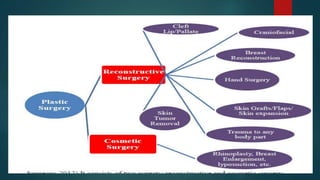
 Plastic Surgery: The word ‘plastic’ comes from the Greek word ‘plastikos’
meaning to mould or to sculpt: therefore, plastic surgery refers to
procedures which involve moulding or sculpting tissues to achieve
reconstruction or cosmetic effect
General Principles of Reconstructive
Surgery
Pre-op requirements:
 Prior to surgery the PT should carry out an assessment of and treatment where
indicated:
- Range of Motion (ROM)
- Muscle strength
- Mobility status
- General functional ability
- Respiratory assessment
- Pre-op exercise programme
- Sensory component (for nerve involvement)
- Education: regarding the post-op rehabilitation process, answering patient
questions and concerns
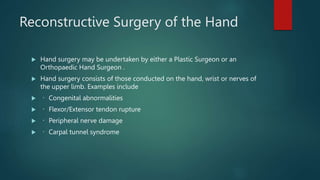
Reconstructive Surgery of the Hand
 Hand surgery may be undertaken by either a Plastic Surgeon or an
Orthopaedic Hand Surgeon .
 Hand surgery consists of those conducted on the hand, wrist or nerves of
the upper limb. Examples include
 Congenital abnormalities
 Flexor/Extensor tendon rupture
 Peripheral nerve damage
 Carpal tunnel syndrome
Conditions of the wrist and finger tendons e.g.
o Trigger finger/thumb
o Boutonnieres disease
o De Quervains Tenosynovitis
Dupuytrens Contracture
Amputations
Arthritis
 Tendon Rupture and Repair: These injuries require significant input from
physiotherapists in the rehabilitation process.
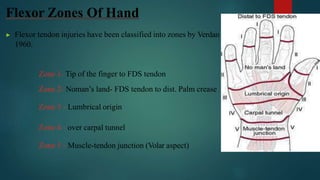
Flexor Zones Of Hand
▶ Flexor tendon injuries have been classified into zones by Verdan
1960.
Zone 1- Tip of the finger to FDS tendon
Zone 2- Noman’s land- FDS tendon to dist. Palm crease
Zone 3 - Lumbrical origin
Zone 4 - over carpal tunnel
Zone 5 - Muscle-tendon junction (Volar aspect)
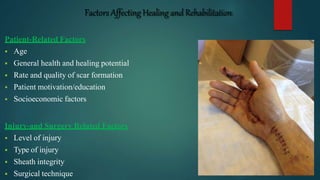
FactorsAffecting Healing and Rehabilitation
Patient-Related Factors
 Age
 General health and healing potential
 Rate and quality of scar formation
 Patient motivation/education
 Socioeconomic factors
Injury-and Surgery Related Factors
 Level of injury
 Type of injury
 Sheath integrity
 Surgical technique
Therapy Related Factors
 Timing
 Technique
 Expertise
POSTOPERATIVE MANAGEMENT
Flexor tendon injuries of hand is divided into three groups on the basis of the exercises
instituted during the first 3 to 4 weeks after tendon repair
(1) Immobilization
(2) Early passive mobilization
(3) Early active mobilization
POSTOPERATIVE MANAGEMENT
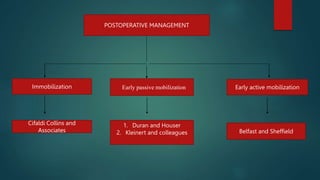
Immobilization Early passive mobilization Early active mobilization
Cifaldi Collins and
Associates
1. Duran and Houser
2. Kleinert and colleagues Belfast and Sheffield
Treating the Immobilized tendon Repair
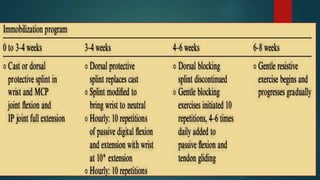
Cifaldi Collins andAssociates developed sufficiently aggressive therapy after immobilization.
Early Stage (from 0 to 3 or 4 weeks):
Orthosis :-
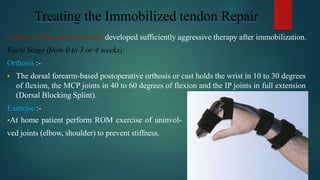
 The dorsal forearm-based postoperative orthosis or cast holds the wrist in 10 to 30 degrees
of flexion, the MCP joints in 40 to 60 degrees of flexion and the IP joints in full extension
(Dorsal Blocking Splint).
Exercise :-
At home patient perform ROM exercise of uninvol-
ved joints (elbow, shoulder) to prevent stiffness.
Intermediate stage (starting at 3 to 4 weeks):
Orthosis :-
 At 3 to 4 weeks- the orthosis is modified to bring the wrist to neutral.
Patient taught to remove the orthosis hourly for exercise.
Exercise :-
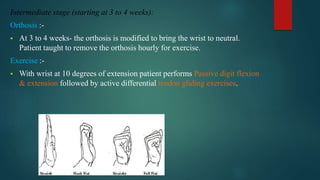
 With wrist at 10 degrees of extension patient performs Passive digit flexion
& extension followed by active differential tendon gliding exercises.
 After 3 to 4 days of these exercises the tendon function has to be
evaluated.- measure active and passive flexion of MCP and IP joints. If
there is discrepancy of more than 50 degrees between total active and
passive flexion suggests poor gliding and heavy adhesion formation.
Late Stage( Starting at 4 week or later, depending on the tendon glide):
Orthosis :-
 The dorsal blocking orthosis will be discontinued. If flexor muscle-tendon
unit shortening is a problem then patient can wear forearm based palmar
nigh time orthosis, which hold the wrist and fingers in maximum
comfortable extension.
Exercise :-
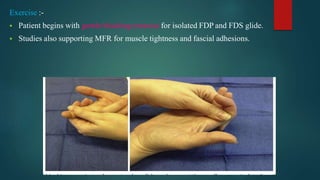
 Patient begins with gentle blocking exercise for isolated FDP and FDS glide.
 Studies also supporting MFR for muscle tightness and fascial adhesions.
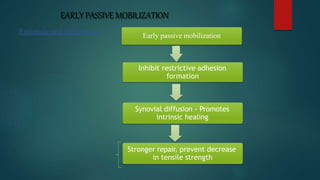
EARLYPASSIVEMOBILIZATION
Rationale and Indications Early passive mobilization
Inhibit restrictive adhesion
formation
Synovial diffusion - Promotes
intrinsic healing
Stronger repair, prevent decrease
in tensile strength
Published Protocols
2 basic types of early mobilization programs
1. Duran and Houser
2. Kleinert and colleagues
Duran and Houser :-
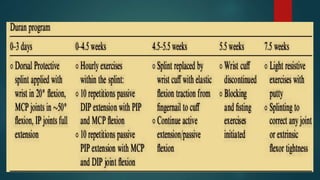
Early stage (from 0 to 4.5 weeks)
Orthosis – wrist 20 degree flexion and MCP in relaxed position
Exercise – Duran and Houser demonstrated – 3-5mm glide is sufficient to prevent adhesion
formation
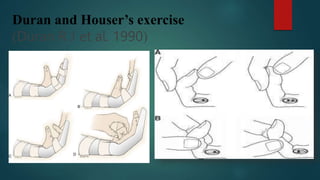
 6-8 reps twice a day– Duran and Houser’s exercises
Duran and Houser’s exercise
(Duran R J et al. 1990)
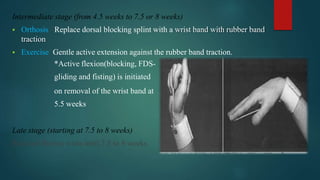
Intermediate stage (from 4.5 weeks to 7.5 or 8 weeks)
 Orthosis : Replace dorsal blocking splint with a wrist band with rubber band
traction.
 Exercise :Gentle active extension against the rubber band traction.
*Active flexion(blocking, FDS-
gliding and fisting) is initiated
on removal of the wrist band at
5.5 weeks.
Late stage (starting at 7.5 to 8 weeks)
Resisted flexion waits until 7.5 to 8 weeks.
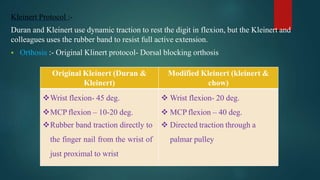
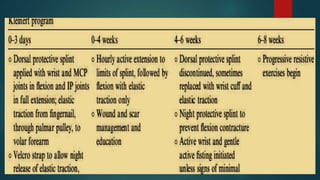
Kleinert Protocol :-
Duran and Kleinert use dynamic traction to rest the digit in flexion, but the Kleinert and
colleagues uses the rubber band to resist full active extension.
 Orthosis :- Original Klinert protocol- Dorsal blocking orthosis
Original Kleinert (Duran &
Kleinert)
Modified Kleinert (kleinert &
chow)
Wrist flexion- 45 deg.
MCP flexion – 10-20 deg.
Rubber band traction directly to
the finger nail from the wrist of
just proximal to wrist.
 Wrist flexion- 20 deg.
 MCP flexion – 40 deg.
 Directed traction through a
palmar pulley
 Exercises :-
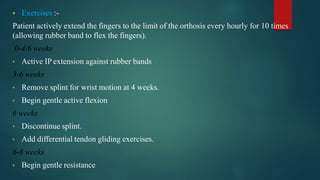
Patient actively extend the fingers to the limit of the orthosis every hourly for 10 times
(allowing rubber band to flex the fingers).
0‐4/6 weeks
• Active IP extension against rubber bands
3‐6 weeks
• Remove splint for wrist motion at 4 weeks.
• Begin gentle active flexion
6 weeks
• Discontinue splint.
• Add differential tendon gliding exercises.
6‐8 weeks
• Begin gentle resistance
EARLYACTIVEMOBILIZATION
Rationale
 Applied to recently injured, oedematous tendon with added bulk at the suture site.
 Active contraction of injured flexor muscle, pulling the tendon proximally, produce
better glide.
 Horbie et.al in 1993 found that passive IP joint flexion does not provide much of passive
FDP glide.
 Do with proper clinical reasoning in cooperation with surgeons.
Published Protocols
Belfast and Sheffield :- (Harris S, 2008)
Early stage (from 0-4 or 3 weeks)
Orthosis :- Post operative cast
• Wrist- 20 deg. flexion
• MCP- 80-90 deg. flexion
• IP- full extension
The cast extends 2 cm beyond the finger tips to prevent hand movements.
Exercises :-
For zone 3 – 24 hours after repair
For zone 2 - 48 hours after sx.
 Exercises perform every 4 hours within the orthosis consist of full passive flexion, active
flexion and active extension.
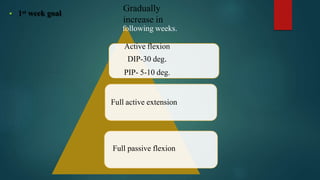
 1st week goal
Full passive flexion
Gradually
increase in
following weeks.
Active flexion
DIP-30 deg.
PIP- 5-10 deg.
Full active extension
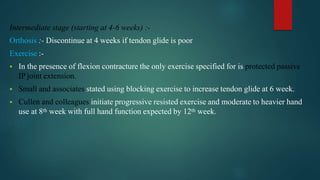
Intermediate stage (starting at 4-6 weeks) :-
Orthosis :- Discontinue at 4 weeks if tendon glide is poor
Exercise :-
 In the presence of flexion contracture the only exercise specified for is protected passive
IP joint extension.
 Small and associates stated using blocking exercise to increase tendon glide at 6 week.
 Cullen and colleagues initiate progressive resisted exercise and moderate to heavier hand
use at 8th week with full hand function expected by 12th week.
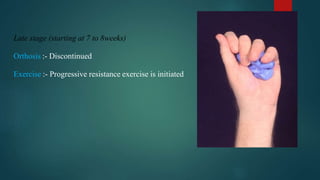
Late stage (starting at 7 to 8weeks)
Orthosis :- Discontinued
Exercise :- Progressive resistance exercise is initiated
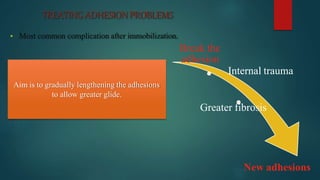
TREATINGADHESIONPROBLEMS
 Most common complication after immobilization.
Break the
adhesion
Internal trauma
Aim is to gradually lengthening the adhesions
to allow greater glide.
Greater fibrosis
New adhesions
 Blocking exercises
 Tendon gliding exercises
 Sustained grip activities
 Therapy putty squeezing
 Therapeutic Ultrasound
 Orthotic positioning and gentle passive extension
 Myofascial release
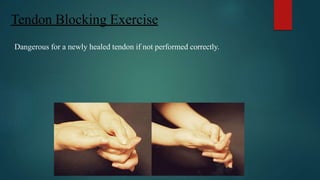
Tendon Blocking Exercise
Dangerous for a newly healed tendon if not performed correctly.
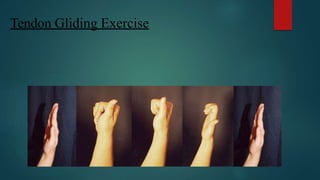
Tendon Gliding Exercise

Physiotherapy in Reconstructive Surgery .pptx

  • 1.
  • 2.
     Plastic Surgery:The word ‘plastic’ comes from the Greek word ‘plastikos’ meaning to mould or to sculpt: therefore, plastic surgery refers to procedures which involve moulding or sculpting tissues to achieve reconstruction or cosmetic effect
  • 4.
    General Principles ofReconstructive Surgery Pre-op requirements:  Prior to surgery the PT should carry out an assessment of and treatment where indicated: - Range of Motion (ROM) - Muscle strength - Mobility status - General functional ability - Respiratory assessment - Pre-op exercise programme - Sensory component (for nerve involvement) - Education: regarding the post-op rehabilitation process, answering patient questions and concerns
  • 5.
    Reconstructive Surgery ofthe Hand  Hand surgery may be undertaken by either a Plastic Surgeon or an Orthopaedic Hand Surgeon .  Hand surgery consists of those conducted on the hand, wrist or nerves of the upper limb. Examples include  Congenital abnormalities  Flexor/Extensor tendon rupture  Peripheral nerve damage  Carpal tunnel syndrome
  • 6.
    Conditions of thewrist and finger tendons e.g. o Trigger finger/thumb o Boutonnieres disease o De Quervains Tenosynovitis Dupuytrens Contracture Amputations Arthritis  Tendon Rupture and Repair: These injuries require significant input from physiotherapists in the rehabilitation process.
  • 7.
    Flexor Zones OfHand ▶ Flexor tendon injuries have been classified into zones by Verdan 1960. Zone 1- Tip of the finger to FDS tendon Zone 2- Noman’s land- FDS tendon to dist. Palm crease Zone 3 - Lumbrical origin Zone 4 - over carpal tunnel Zone 5 - Muscle-tendon junction (Volar aspect)
  • 8.
    FactorsAffecting Healing andRehabilitation Patient-Related Factors  Age  General health and healing potential  Rate and quality of scar formation  Patient motivation/education  Socioeconomic factors Injury-and Surgery Related Factors  Level of injury  Type of injury  Sheath integrity  Surgical technique
  • 9.
    Therapy Related Factors Timing  Technique  Expertise
  • 10.
    POSTOPERATIVE MANAGEMENT Flexor tendoninjuries of hand is divided into three groups on the basis of the exercises instituted during the first 3 to 4 weeks after tendon repair (1) Immobilization (2) Early passive mobilization (3) Early active mobilization
  • 11.
    POSTOPERATIVE MANAGEMENT Immobilization Earlypassive mobilization Early active mobilization Cifaldi Collins and Associates 1. Duran and Houser 2. Kleinert and colleagues Belfast and Sheffield
  • 12.
    Treating the Immobilizedtendon Repair Cifaldi Collins andAssociates developed sufficiently aggressive therapy after immobilization. Early Stage (from 0 to 3 or 4 weeks): Orthosis :-  The dorsal forearm-based postoperative orthosis or cast holds the wrist in 10 to 30 degrees of flexion, the MCP joints in 40 to 60 degrees of flexion and the IP joints in full extension (Dorsal Blocking Splint). Exercise :- At home patient perform ROM exercise of uninvol- ved joints (elbow, shoulder) to prevent stiffness.
  • 13.
    Intermediate stage (startingat 3 to 4 weeks): Orthosis :-  At 3 to 4 weeks- the orthosis is modified to bring the wrist to neutral. Patient taught to remove the orthosis hourly for exercise. Exercise :-  With wrist at 10 degrees of extension patient performs Passive digit flexion & extension followed by active differential tendon gliding exercises.
  • 14.
     After 3to 4 days of these exercises the tendon function has to be evaluated.- measure active and passive flexion of MCP and IP joints. If there is discrepancy of more than 50 degrees between total active and passive flexion suggests poor gliding and heavy adhesion formation. Late Stage( Starting at 4 week or later, depending on the tendon glide): Orthosis :-  The dorsal blocking orthosis will be discontinued. If flexor muscle-tendon unit shortening is a problem then patient can wear forearm based palmar nigh time orthosis, which hold the wrist and fingers in maximum comfortable extension.
  • 15.
    Exercise :-  Patientbegins with gentle blocking exercise for isolated FDP and FDS glide.  Studies also supporting MFR for muscle tightness and fascial adhesions.
  • 17.
    EARLYPASSIVEMOBILIZATION Rationale and IndicationsEarly passive mobilization Inhibit restrictive adhesion formation Synovial diffusion - Promotes intrinsic healing Stronger repair, prevent decrease in tensile strength
  • 18.
    Published Protocols 2 basictypes of early mobilization programs 1. Duran and Houser 2. Kleinert and colleagues Duran and Houser :- Early stage (from 0 to 4.5 weeks) Orthosis – wrist 20 degree flexion and MCP in relaxed position Exercise – Duran and Houser demonstrated – 3-5mm glide is sufficient to prevent adhesion formation  6-8 reps twice a day– Duran and Houser’s exercises
  • 19.
    Duran and Houser’sexercise (Duran R J et al. 1990)
  • 20.
    Intermediate stage (from4.5 weeks to 7.5 or 8 weeks)  Orthosis : Replace dorsal blocking splint with a wrist band with rubber band traction.  Exercise :Gentle active extension against the rubber band traction. *Active flexion(blocking, FDS- gliding and fisting) is initiated on removal of the wrist band at 5.5 weeks. Late stage (starting at 7.5 to 8 weeks) Resisted flexion waits until 7.5 to 8 weeks.
  • 22.
    Kleinert Protocol :- Duranand Kleinert use dynamic traction to rest the digit in flexion, but the Kleinert and colleagues uses the rubber band to resist full active extension.  Orthosis :- Original Klinert protocol- Dorsal blocking orthosis Original Kleinert (Duran & Kleinert) Modified Kleinert (kleinert & chow) Wrist flexion- 45 deg. MCP flexion – 10-20 deg. Rubber band traction directly to the finger nail from the wrist of just proximal to wrist.  Wrist flexion- 20 deg.  MCP flexion – 40 deg.  Directed traction through a palmar pulley
  • 23.
     Exercises :- Patientactively extend the fingers to the limit of the orthosis every hourly for 10 times (allowing rubber band to flex the fingers). 0‐4/6 weeks • Active IP extension against rubber bands 3‐6 weeks • Remove splint for wrist motion at 4 weeks. • Begin gentle active flexion 6 weeks • Discontinue splint. • Add differential tendon gliding exercises. 6‐8 weeks • Begin gentle resistance
  • 25.
    EARLYACTIVEMOBILIZATION Rationale  Applied torecently injured, oedematous tendon with added bulk at the suture site.  Active contraction of injured flexor muscle, pulling the tendon proximally, produce better glide.  Horbie et.al in 1993 found that passive IP joint flexion does not provide much of passive FDP glide.  Do with proper clinical reasoning in cooperation with surgeons.
  • 26.
    Published Protocols Belfast andSheffield :- (Harris S, 2008) Early stage (from 0-4 or 3 weeks) Orthosis :- Post operative cast • Wrist- 20 deg. flexion • MCP- 80-90 deg. flexion • IP- full extension The cast extends 2 cm beyond the finger tips to prevent hand movements.
  • 27.
    Exercises :- For zone3 – 24 hours after repair For zone 2 - 48 hours after sx.  Exercises perform every 4 hours within the orthosis consist of full passive flexion, active flexion and active extension.
  • 28.
     1st weekgoal Full passive flexion Gradually increase in following weeks. Active flexion DIP-30 deg. PIP- 5-10 deg. Full active extension
  • 29.
    Intermediate stage (startingat 4-6 weeks) :- Orthosis :- Discontinue at 4 weeks if tendon glide is poor Exercise :-  In the presence of flexion contracture the only exercise specified for is protected passive IP joint extension.  Small and associates stated using blocking exercise to increase tendon glide at 6 week.  Cullen and colleagues initiate progressive resisted exercise and moderate to heavier hand use at 8th week with full hand function expected by 12th week.
  • 30.
    Late stage (startingat 7 to 8weeks) Orthosis :- Discontinued Exercise :- Progressive resistance exercise is initiated
  • 31.
    TREATINGADHESIONPROBLEMS  Most commoncomplication after immobilization. Break the adhesion Internal trauma Aim is to gradually lengthening the adhesions to allow greater glide. Greater fibrosis New adhesions
  • 32.
     Blocking exercises Tendon gliding exercises  Sustained grip activities  Therapy putty squeezing  Therapeutic Ultrasound  Orthotic positioning and gentle passive extension  Myofascial release
  • 33.
    Tendon Blocking Exercise Dangerousfor a newly healed tendon if not performed correctly.
  • 34.