DATTA MEGHE COLLEGE OF
PHYSIOTHERAPY.
DEPARTMENT OF CARDIOPULMONARY
SCIENCES
PHYSIOTHERAPEUTIC MANAGEMENT
POST- RADICAL MASTECTOMY.
DR. SACHIN CHAUDHARY
MPT (Cardio-Respi. Physiotherapy)
PROFESSOR & HEAD
DATTA MEGHE COLLEGE OF PHYSIOTHERAPY
NEHA INGALE CHAUDHARY
MPT (Neuro)
PROFESSOR & HEAD
DATTA MEGHE COLLEGE OF PHYSIOTHERAPY
PREFACE
 This PPT is intended primarily for Bachelor of Physiotherapy
(BPTh) Final year students those are under preparation for their
University Examination.
 I have attempted to cover different areas of mastectomy
management.
 Despite my best efforts there might have some errors.
 I like to thank all those who have helped me.
Dr. Sachin Chaudhary ,Dr. Neha Ingale Chaudhary
CONTENT
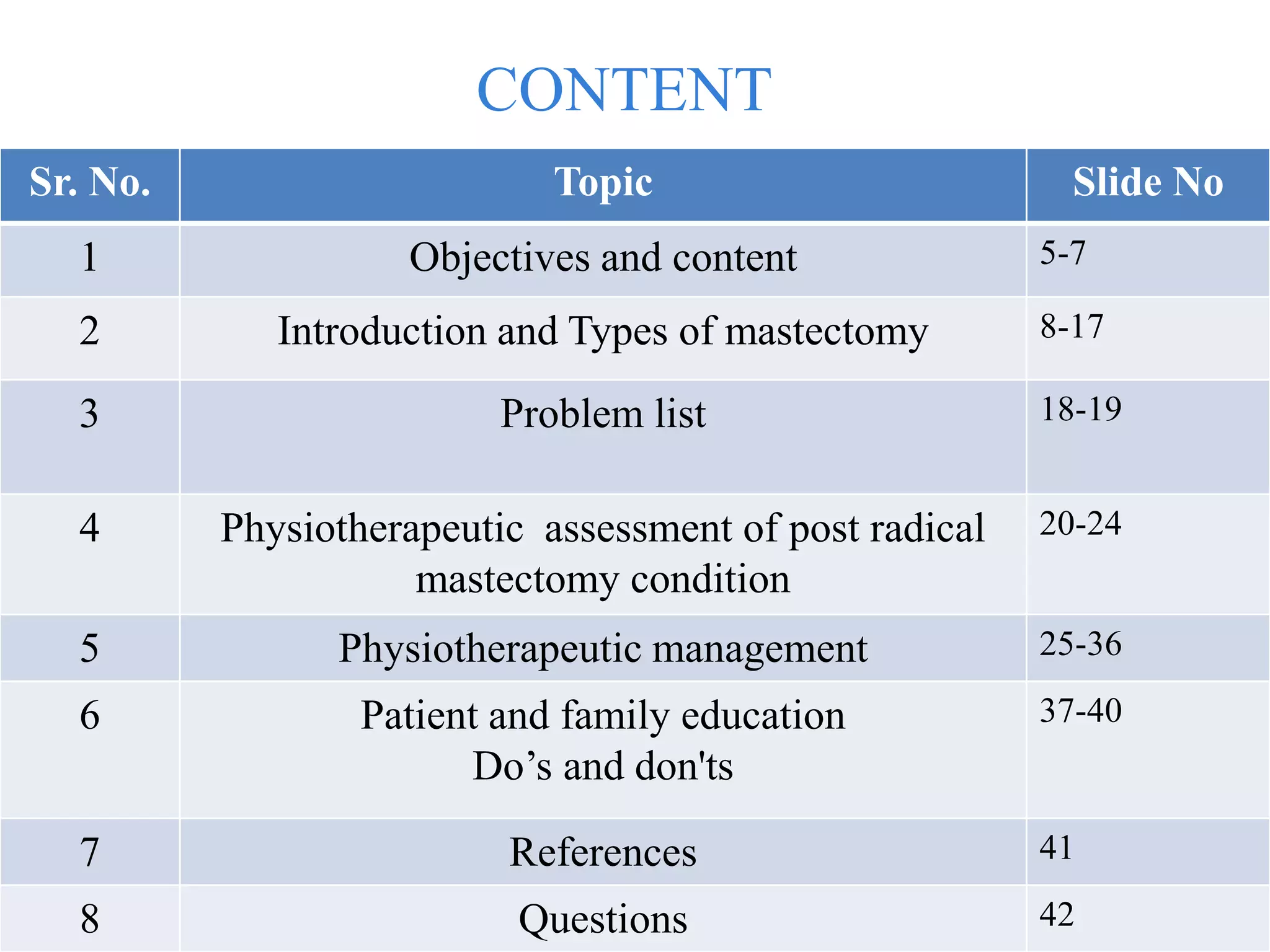
Sr. No. Topic Slide No
1 Objectives and content 5-7
2 Introduction and Types of mastectomy 8-17
3 Problem list 18-19
4 Physiotherapeutic assessment of post radical
mastectomy condition
20-24
5 Physiotherapeutic management 25-36
6 Patient and family education
Do’s and don'ts
37-40
7 References 41
8 Questions 42
GENERAL OBJECTIVES OF THE
SYLLABUS
At the end of the session student should be able to understand -
 Various assessment skills used to evaluate post mastectomy
status.
 Various measures of physiotherapeutic management skills used
for post radical mastectomy.
 The points for Patient/family education regarding do’s and
don’ts.
Learning objectives
Sr.no Learning objectives domain level criteria
1 Explain clinical
assessment methods
for physiotherapy in
post mastectomy
cases.
Cognitive &
Psychomotor
Must
know
All
2 Explain therapeutic
methods used for
post mastectomy
management.
Cognitive &
Psychomotor
Must
know
All
3 Explain do’s and
don’s followed by
Cognitive &
Psychomotor
Must
know
All
Chapter Content
Sr. No. Topic Slide No
1 Introduction and Types of mastectomy 8-17
2 Problem list 18-19
3 Physiotherapeutic assessment of post radical
mastectomy status.
20-24
4 Physiotherapeutic management 25-36
5 Patient and family education
Do’s and don'ts
37-40
6 References 41
7 Questions 42
INTRODUCTION
• Mastectomy is the surgical removal of breast.
• Indications-
– Carcinoma of breast
• Surgery is presently the most common treatment for
breast cancer.
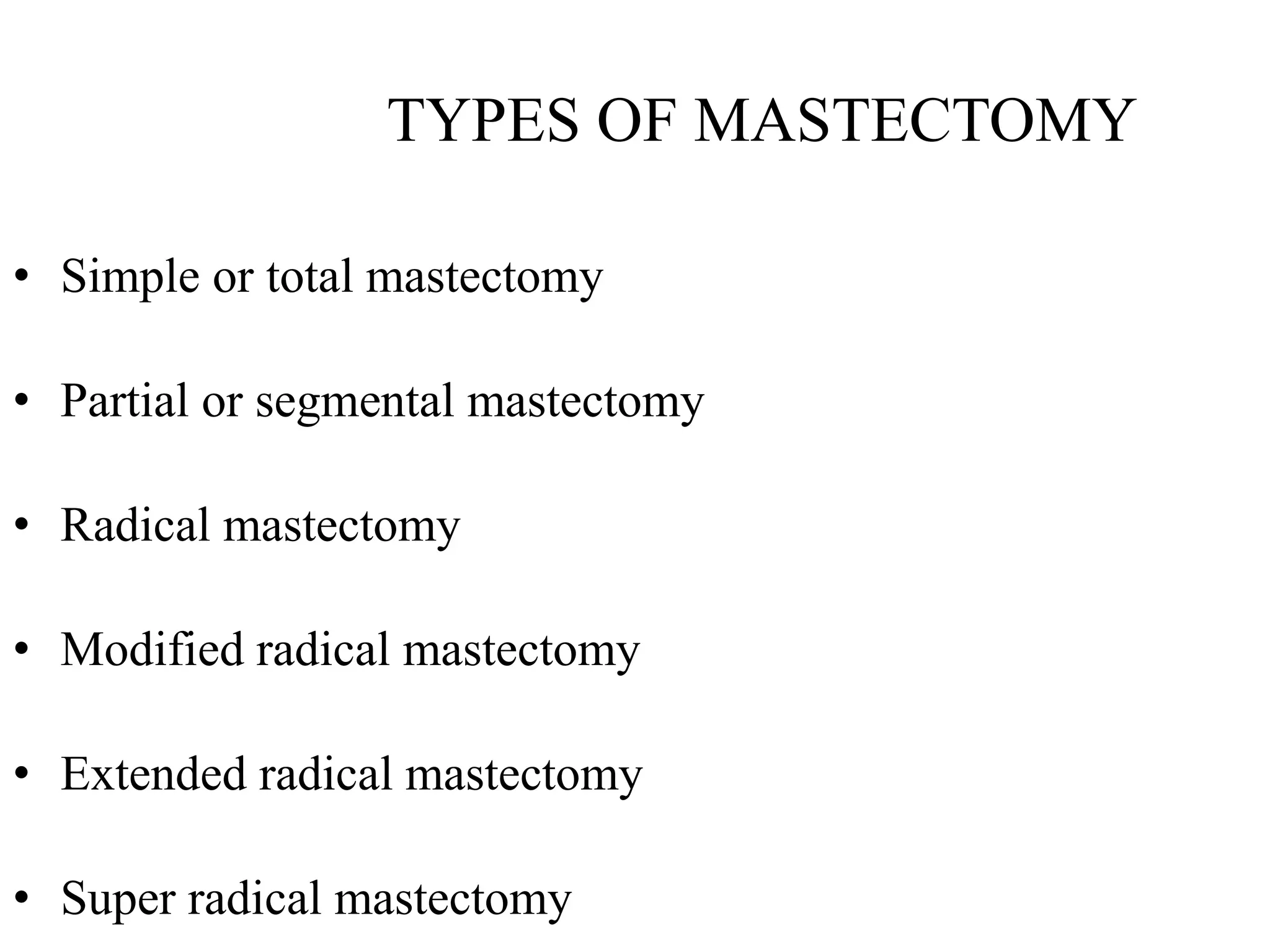
TYPES OF MASTECTOMY
• Simple or total mastectomy
• Partial or segmental mastectomy
• Radical mastectomy
• Modified radical mastectomy
• Extended radical mastectomy
• Super radical mastectomy
Simple Or Total Mastectomy
• Removal of the breast, with its skin and nipple, but
no lymph nodes.
• Greater cosmetic disadvantage
• Needs skin grafting
Partial Or Segmental Mastectomy
• Removal of a portion of breast tissue
and
• A margin of normal breast tissue.
Radical Mastectomy
Removal of:
• entire breast,
• nipple /areolar region,
• pectoralis Major & minor muscles
• clavipectoral fascia & axillary lymph nodes
Radical Mastectomy
Preserved structures:
• Axillary vein
• Nerve to lattissimus dorsi
• Nerve to serratus anterior
Modified Radical Mastectomy
Removal of
• entire breast,
• nipple/ areolar region,
• axillary lymph nodes.
Pectoralis
muscle
remains intact
Extended Radical Mastectomy
• Done to remove tumors involving internal mammary
lymph nodes.
• Tumors involving outer 21% and inner 43% quadrant.
Super Radical Mastectomy
Removal of :
• Ipsilateral half of sternum
• Adjacent Portion of 2nd to 5th ribs to sternum
• Internal mammary lymph nodes, mediastinal lymph nodes,
supraclavicular lymph nodes & axillary lymph nodes.
• Adjcent pleura
PROBLEM LIST
• Postoperative incisional pain
• Lymphoedema
• Postoperative pulmonary complications
• Restricted mobility of upper limb
Contd…
• Weakness & restricted functional use of upper
extremity
• Postural deformities
• Reduced exercise tolerence
• Psychological considerations
POST OPERATIVE ASSESSMENT
• Inspection
• Palpation
• Auscultation
INSPECTION
• Suture site
• Extent of suture
• Healthy/ unhealthy:
Discharge, redness
• Drain: present/ not
present
• lymphoedema
• Chest wall movements
• Breathing pattern
• Use of acc. muscles
PALPATION
 No. of sutures
 Length of suture line
 Local temperature
 Tenderness at suture site
 Mobility of scar (after suture
removal)
 Posture assessment
 Girth measurement of
Upper Extremity
 Range of Motion of Upper
Extremity
 Strength assessment of UE
AUSCULTATION
• Breath sounds
• Foreign sounds
OTHER ASSESSMENT…
• Functional capacity assessment
• Functional activities / health related quality of life.
PHYSIOTHERAPY MANAGEMENT
• Preoperative phase
• Post- operative phase
PRE OPERATIVE MANAGEMENT
Teach the patient aspects of self management:
• Deep breathing,
• Coughing,
• Positioning of upper extremity so patient is familiar
with it postoperatively.
POSTOPERATIVE
MANAGEMENT
GOALS
• Patient education
• Pain Relief
• Prevent or minimize postoperative lymphoedema
• Prevent postoperative pulmonary & circulatory
complications
CONTD…
• Prevent postural deformities
• Prevent muscle tension & guarding in cervical
musculature
• Prevent restricted mobility of UE
• Regain strength & functional use of involved UE
• Improve exercise tolerance & reduce fatigue
MANAGEMENT
1.Patient’s Education
2.Pain Relief :
• Cryotherapy
• TENS
3. Prevention of lymphoedema
• Elevation of involved upper extremity.
on pillows about 30 deg
• Bandaging-Elastic bandage
• ROM exercises
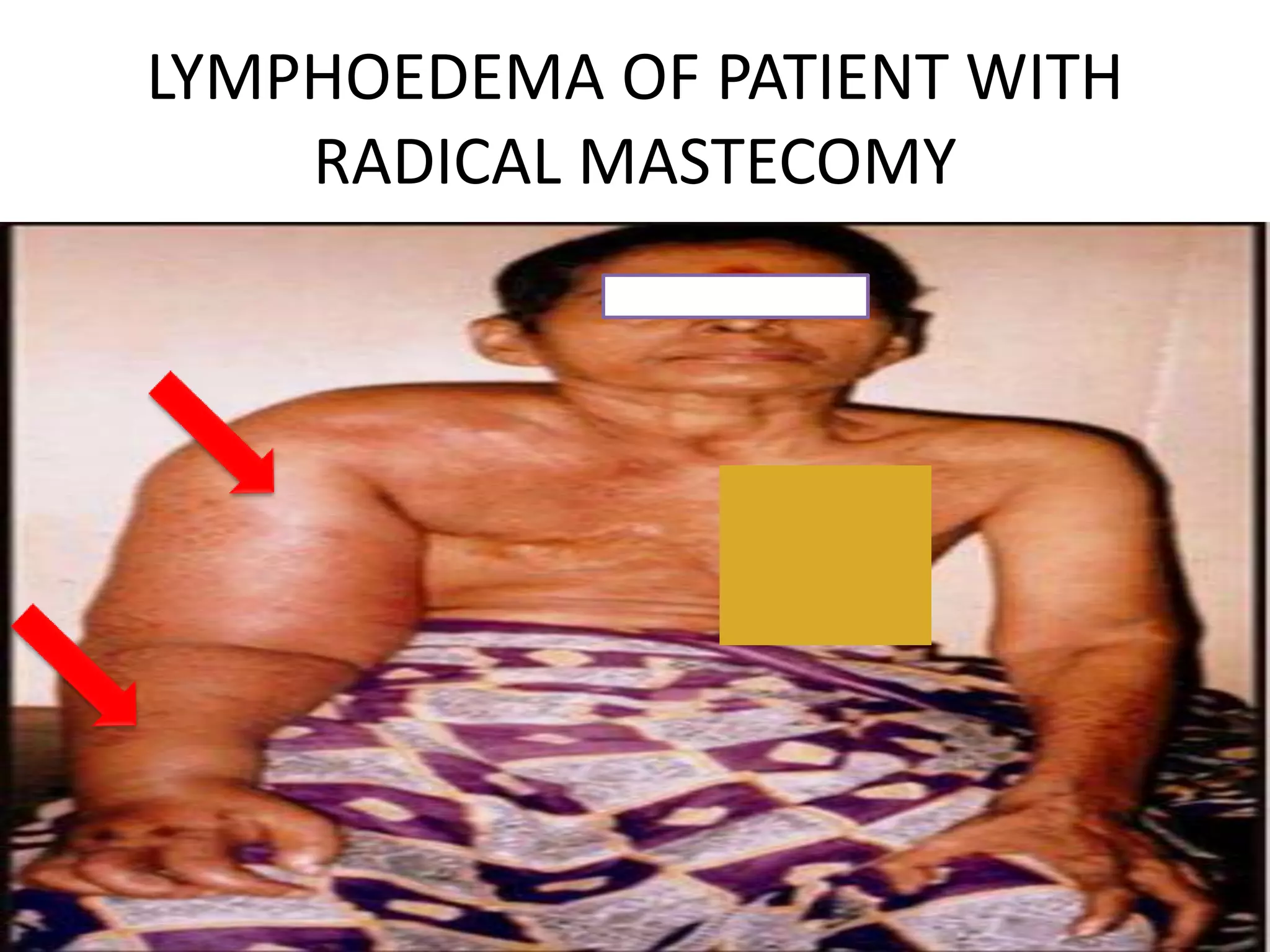
LYMPHOEDEMA OF PATIENT WITH
RADICAL MASTECOMY
IF LYMPHOEDEMA DEVELOPES ????
• Elevation
• Manual lymphatic
drainage
• Compression: Low
stretch bandages or
custom fitted garments
• Skin care****
• Lymphoedema
exercises
Lymphoedema exercises:
• Active Circumduction of arm
• Exercises on a foam roll (axillary lymph nodes)
• Bilateral hand press(isometric pectoral contraction)
• Unilateral arm exercises with arm elevated
• Overhead wall press ups
• Wrist & finger exercises
4. Upper limb mobility exercise to prevent restricted mobility.
• Active assisted exercises for shoulder, elbow and wrist.
• Progress to active exercises.
• Then start with Low intensity isometric exercises of
shoulder
• Progress to Resistance exercises with light handheld weight
• Shoulder ROM-not more than 90 deg until removal of
drains
5. Postural correction exercises:
• Chin tucked in
• Pectoral stretching
• Scapula retractor strengthening exercises.
• Encourage the patient to maintain erect posture during
activities.
6. To improve exercise tolerance
• Graded, low intensity aerobic exercises such as
walking and cycling
DO'S & DONT’S
• Before exercising actively, be sure that the surgical wounds
are healing.
• Do try to start moving the affected arm as soon as possible,
do these movements slowly and gently
• Do practice deep breathing and relaxation techniques
Contd…
• Do Keep arm elevated after surgery to prevent swelling. Use
two pillows to support arm when lying down or sitting.
• After surgery, try to walk around (indoors) for a few
minutes 2 - 3 times daily.
• Avoid lifting anything over 2-3 pounds, particularly with the
involved arm
• Don’t let mastectomy arm hang down, especially when
holding or carrying objects.
• Don’t move arm quickly, or with jerking, pulling motions.
Learn to move slowly and smoothly, especially when
changing positions, lifting bags, opening doors, etc.
• Don’t Wear shoulder bags on involved arm. The pressure of
the strap on the shoulder can cause lymphedema.
• Don’t Continue an exercise upon persistent pain &
unusual fatigue.
• Rest for a moment, breathe, relax, and then continue
slowly and carefully. If fatigue persists, stop
exercising.
REFERENCES
• Carolyn Kisner and Colby. Therapeutic Exercise.
Foundation and techniques. Seventh edition. Chapter
26.P(1027-1035)
• Cash textbook of general medical and surgical conditions
for physiotherapists. Second edition. Chapter P(103-105)
QUESTIONS
• Explain in detail the physiotherapeutic assessment and
management of post operative radical mastectomy.
• Enlist the types of mastectomy.
PHYSIOTHERAPEUTIC MANAGEMENT POST RADICAL MASTECTOMY.pptx

PHYSIOTHERAPEUTIC MANAGEMENT POST RADICAL MASTECTOMY.pptx

  • 1.
    DATTA MEGHE COLLEGEOF PHYSIOTHERAPY. DEPARTMENT OF CARDIOPULMONARY SCIENCES
  • 2.
    PHYSIOTHERAPEUTIC MANAGEMENT POST- RADICALMASTECTOMY. DR. SACHIN CHAUDHARY MPT (Cardio-Respi. Physiotherapy) PROFESSOR & HEAD DATTA MEGHE COLLEGE OF PHYSIOTHERAPY NEHA INGALE CHAUDHARY MPT (Neuro) PROFESSOR & HEAD DATTA MEGHE COLLEGE OF PHYSIOTHERAPY
  • 3.
    PREFACE  This PPTis intended primarily for Bachelor of Physiotherapy (BPTh) Final year students those are under preparation for their University Examination.  I have attempted to cover different areas of mastectomy management.  Despite my best efforts there might have some errors.  I like to thank all those who have helped me. Dr. Sachin Chaudhary ,Dr. Neha Ingale Chaudhary
  • 4.
    CONTENT Sr. No. TopicSlide No 1 Objectives and content 5-7 2 Introduction and Types of mastectomy 8-17 3 Problem list 18-19 4 Physiotherapeutic assessment of post radical mastectomy condition 20-24 5 Physiotherapeutic management 25-36 6 Patient and family education Do’s and don'ts 37-40 7 References 41 8 Questions 42
  • 5.
    GENERAL OBJECTIVES OFTHE SYLLABUS At the end of the session student should be able to understand -  Various assessment skills used to evaluate post mastectomy status.  Various measures of physiotherapeutic management skills used for post radical mastectomy.  The points for Patient/family education regarding do’s and don’ts.
  • 6.
    Learning objectives Sr.no Learningobjectives domain level criteria 1 Explain clinical assessment methods for physiotherapy in post mastectomy cases. Cognitive & Psychomotor Must know All 2 Explain therapeutic methods used for post mastectomy management. Cognitive & Psychomotor Must know All 3 Explain do’s and don’s followed by Cognitive & Psychomotor Must know All
  • 7.
    Chapter Content Sr. No.Topic Slide No 1 Introduction and Types of mastectomy 8-17 2 Problem list 18-19 3 Physiotherapeutic assessment of post radical mastectomy status. 20-24 4 Physiotherapeutic management 25-36 5 Patient and family education Do’s and don'ts 37-40 6 References 41 7 Questions 42
  • 8.
    INTRODUCTION • Mastectomy isthe surgical removal of breast. • Indications- – Carcinoma of breast • Surgery is presently the most common treatment for breast cancer.
  • 9.
    TYPES OF MASTECTOMY •Simple or total mastectomy • Partial or segmental mastectomy • Radical mastectomy • Modified radical mastectomy • Extended radical mastectomy • Super radical mastectomy
  • 10.
    Simple Or TotalMastectomy • Removal of the breast, with its skin and nipple, but no lymph nodes. • Greater cosmetic disadvantage • Needs skin grafting
  • 11.
    Partial Or SegmentalMastectomy • Removal of a portion of breast tissue and • A margin of normal breast tissue.
  • 12.
    Radical Mastectomy Removal of: •entire breast, • nipple /areolar region, • pectoralis Major & minor muscles • clavipectoral fascia & axillary lymph nodes
  • 13.
    Radical Mastectomy Preserved structures: •Axillary vein • Nerve to lattissimus dorsi • Nerve to serratus anterior
  • 14.
    Modified Radical Mastectomy Removalof • entire breast, • nipple/ areolar region, • axillary lymph nodes. Pectoralis muscle remains intact
  • 16.
    Extended Radical Mastectomy •Done to remove tumors involving internal mammary lymph nodes. • Tumors involving outer 21% and inner 43% quadrant.
  • 17.
    Super Radical Mastectomy Removalof : • Ipsilateral half of sternum • Adjacent Portion of 2nd to 5th ribs to sternum • Internal mammary lymph nodes, mediastinal lymph nodes, supraclavicular lymph nodes & axillary lymph nodes. • Adjcent pleura
  • 18.
    PROBLEM LIST • Postoperativeincisional pain • Lymphoedema • Postoperative pulmonary complications • Restricted mobility of upper limb
  • 19.
    Contd… • Weakness &restricted functional use of upper extremity • Postural deformities • Reduced exercise tolerence • Psychological considerations
  • 20.
    POST OPERATIVE ASSESSMENT •Inspection • Palpation • Auscultation
  • 21.
    INSPECTION • Suture site •Extent of suture • Healthy/ unhealthy: Discharge, redness • Drain: present/ not present • lymphoedema • Chest wall movements • Breathing pattern • Use of acc. muscles
  • 22.
    PALPATION  No. ofsutures  Length of suture line  Local temperature  Tenderness at suture site  Mobility of scar (after suture removal)  Posture assessment  Girth measurement of Upper Extremity  Range of Motion of Upper Extremity  Strength assessment of UE
  • 23.
  • 24.
    OTHER ASSESSMENT… • Functionalcapacity assessment • Functional activities / health related quality of life.
  • 25.
    PHYSIOTHERAPY MANAGEMENT • Preoperativephase • Post- operative phase
  • 26.
    PRE OPERATIVE MANAGEMENT Teachthe patient aspects of self management: • Deep breathing, • Coughing, • Positioning of upper extremity so patient is familiar with it postoperatively.
  • 27.
    POSTOPERATIVE MANAGEMENT GOALS • Patient education •Pain Relief • Prevent or minimize postoperative lymphoedema • Prevent postoperative pulmonary & circulatory complications
  • 28.
    CONTD… • Prevent posturaldeformities • Prevent muscle tension & guarding in cervical musculature • Prevent restricted mobility of UE • Regain strength & functional use of involved UE • Improve exercise tolerance & reduce fatigue
  • 29.
  • 30.
    3. Prevention oflymphoedema • Elevation of involved upper extremity. on pillows about 30 deg • Bandaging-Elastic bandage • ROM exercises
  • 31.
    LYMPHOEDEMA OF PATIENTWITH RADICAL MASTECOMY
  • 32.
    IF LYMPHOEDEMA DEVELOPES???? • Elevation • Manual lymphatic drainage • Compression: Low stretch bandages or custom fitted garments • Skin care**** • Lymphoedema exercises
  • 33.
    Lymphoedema exercises: • ActiveCircumduction of arm • Exercises on a foam roll (axillary lymph nodes) • Bilateral hand press(isometric pectoral contraction) • Unilateral arm exercises with arm elevated • Overhead wall press ups • Wrist & finger exercises
  • 34.
    4. Upper limbmobility exercise to prevent restricted mobility. • Active assisted exercises for shoulder, elbow and wrist. • Progress to active exercises. • Then start with Low intensity isometric exercises of shoulder • Progress to Resistance exercises with light handheld weight • Shoulder ROM-not more than 90 deg until removal of drains
  • 35.
    5. Postural correctionexercises: • Chin tucked in • Pectoral stretching • Scapula retractor strengthening exercises. • Encourage the patient to maintain erect posture during activities.
  • 36.
    6. To improveexercise tolerance • Graded, low intensity aerobic exercises such as walking and cycling
  • 37.
    DO'S & DONT’S •Before exercising actively, be sure that the surgical wounds are healing. • Do try to start moving the affected arm as soon as possible, do these movements slowly and gently • Do practice deep breathing and relaxation techniques
  • 38.
    Contd… • Do Keeparm elevated after surgery to prevent swelling. Use two pillows to support arm when lying down or sitting. • After surgery, try to walk around (indoors) for a few minutes 2 - 3 times daily. • Avoid lifting anything over 2-3 pounds, particularly with the involved arm
  • 39.
    • Don’t letmastectomy arm hang down, especially when holding or carrying objects. • Don’t move arm quickly, or with jerking, pulling motions. Learn to move slowly and smoothly, especially when changing positions, lifting bags, opening doors, etc. • Don’t Wear shoulder bags on involved arm. The pressure of the strap on the shoulder can cause lymphedema.
  • 40.
    • Don’t Continuean exercise upon persistent pain & unusual fatigue. • Rest for a moment, breathe, relax, and then continue slowly and carefully. If fatigue persists, stop exercising.
  • 41.
    REFERENCES • Carolyn Kisnerand Colby. Therapeutic Exercise. Foundation and techniques. Seventh edition. Chapter 26.P(1027-1035) • Cash textbook of general medical and surgical conditions for physiotherapists. Second edition. Chapter P(103-105)
  • 42.
    QUESTIONS • Explain indetail the physiotherapeutic assessment and management of post operative radical mastectomy. • Enlist the types of mastectomy.

Editor's Notes

  • #30 Cryotherapy is useful when the condition is acute. It reduces inflammation by decreasing blood flow to the localised area, decreases inflammatory response & minimizes haemorrhage. Its is observed that ncv decreases due to cooling . Hence muscle responsiveness to stretch decreases, Thus reduces muscle gurding and promotes pain relief. High freq short duration tens(conventional) is beneficial. It produces mild to mod. Paresthesia without msl contraction.the onset of relief is fast but its effect is short lived (few hours).