PHYSIOLOGY OF PAIN AND
PAIN PATHWAYS
Dr. Divvi Anusha
1st year MDS
Department of Public Health Dentistry
CONTENTS
• Introduction
• History of pain
• Definition of pain
• Characteristics of pain
• Factors affecting pain
• Components of pain sensation
• Receptors of pain
• Theories of pain
• Pain pathways
• Inhibition of pain transmission
• Referred pain
• Conclusion
• References
INTRODUCTION
• Pain is an intensely subjective experience, and is
therefore difficult to describe.
• It has two features which are nearly universal.
 It is an unpleasant experience
 It is evoked by a stimulus which is actually
or potentially damaging to living tissues.
• Pain has two components:
 awareness of a painful stimulus
 emotional impact (or effect) evoked by the
experience.
• Awareness is localized to the area stimulated, the
experience involves the whole being.
• Even a finger is hurt, the whole person suffers.
HISTORY
• Derived from Latin word “POENA”
• Homer – Arrows shot by God
• Aristotle – Passion of the soul
• Plato – within the body
• Bible – anguish of the soul
DEFINITION OF PAIN
• Pain is defined as “an unpleasant sensory and
emotional experience associated with actual or
potential tissue damage, or described in terms of
such damage.”
(The International Association for the Study of Pain)
• According to Monheim, pain is “ an unpleasant
emotional experience usually initiated by noxious
stimulus and transmitted over a specialized neural
network to the CNS where it is interpreted as
such.”
CHARACTERISTICS OF PAIN
1. Threshold and intensity
2. Adaptation
3. Localization of pain
4. Rate of tissue damage
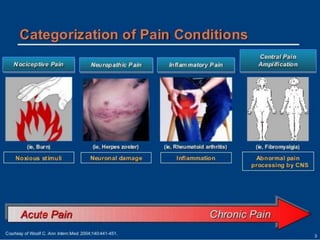
CLASSIFICATION OF PAIN
• Based on pathophysiology pain can be classified
in to four categories:
 Nociceptive pain
 Inflammatory pain
 Neuropathic pain
 Functional pain
Nociceptive pain
 Transient pain in response to noxious stimulus
 Arises from the stimulus outside of nervous
system
 Protective as it prevents further injury.
Inflammatory pain
 Initiated by tissue damage or inflammation
 Arises from a stimulus outside of the nervous
system
 It is mal-adaptive
 Ex. Osteoarthritis, Rheumatoid arthritis
Neuropathic pain
 Caused by the dysfunction in the nervous
system
 Ex. Diabetic neuropathy
Functional pain
Associated with abnormal neural processing
Ex. Fibromyalgia
FACTORS AFFECTING PAIN
1. Emotional status
2. Fatigue
3. Age
4. Racial and nationality characteristics
5. Sex
6. Fear and apprehension
COMPONENTS OF PAIN SENSATION
• Pain sensation has two components
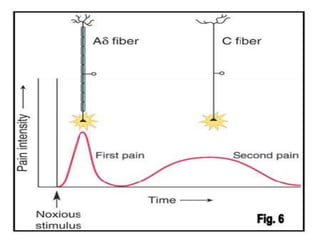
 Fast pain
 Slow pain
• Receptors for both the components of pain are
same but the afferent nerve fibers are different.
• Fast pain is carried by Aδ fibers and slow pain is
carried by C type of nerve fibers
RECEPTORS OF PAIN
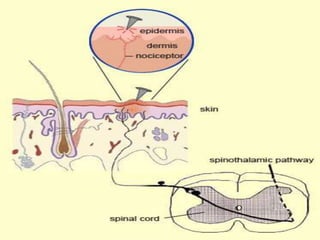
• Free nerve endings (nociceptors)
• Widespread in superficial layers of skin and in
certain internal organs.
• Deep tissues are weakly supplied with nerve
endings.
• Three different types of stimuli excite pain
receptors:
 Mechanical
 Thermal
 Chemical
• Fast pain is elicited by the mechanical and thermal
types of receptors
• Slow pain can be elicited by all three types
THEORIES OF PAIN
Intensity theory
 Pain is produced when any sensory nerve is
stimulated beyond a certain level
 Trigeminal system provides an example against
this theory
Specificity theory
 Pain is a specific modality equivalent to vision and
hearing etc.
 But concept of specific nerve ending s is no long
tenable.
Pattern theory
 1894 – Goldscheider
 Stimulus intensity and central summation are the
critical determinants
 Summation of sensory input
 Pain results when the total output of cells exceeds
a critical level.
Gate control theory
 1965 - Ronald Melzack and Patrick Wall
 Considered to be one of the most influential
theories of pain
 Asserts that non-painful input closes the "gates" to
painful input, preventing pain sensation from
travelling to CNS
• Stimulation by non noxious input is able to
suppress pain
• Two destinations – transmission cells and the
inhibitory interneurons
• The more the large fiber activity at the inhibitory
cell, the less pain is felt.
• This theory offers physiological explanation
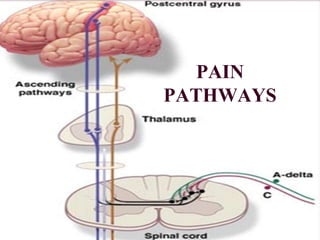
PAIN
PATHWAYS
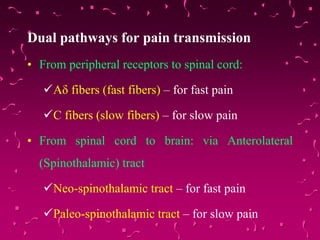
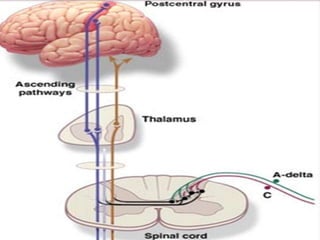
Dual pathways for pain transmission
• From peripheral receptors to spinal cord:
Aδ fibers (fast fibers) – for fast pain
C fibers (slow fibers) – for slow pain
• From spinal cord to brain: via Anterolateral
(Spinothalamic) tract
Neo-spinothalamic tract – for fast pain
Paleo-spinothalamic tract – for slow pain
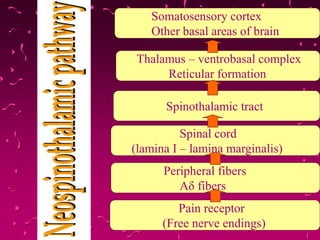
Thalamus – ventrobasal complex
Reticular formation
Spinothalamic tract
Spinal cord
(lamina I – lamina marginalis)
Peripheral fibers
Aδ fibers
Pain receptor
(Free nerve endings)
Somatosensory cortex
Other basal areas of brain
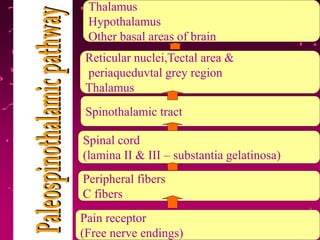
Reticular nuclei,Tectal area &
periaqueduvtal grey region
Thalamus
Spinothalamic tract
Spinal cord
(lamina II & III – substantia gelatinosa)
Peripheral fibers
C fibers
Pain receptor
(Free nerve endings)
Thalamus
Hypothalamus
Other basal areas of brain
DESCENDING PAIN PATHWAY
• Descending Pain Modulation
(Descending Pain Control Mechanism)
• Transmit impulses from the brain (corticospinal
tract in the cortex) to the spinal cord (lamina)
• Periaquaductal Gray Area (PGA) – release
enkephalins
• Nucleus Raphe Magnus (NRM) – release
serotonin
• Release of these neurotransmitters inhibit
ascending neurons
• Endogenous opioid peptides - endorphins &
enkephalins causes analgesia.
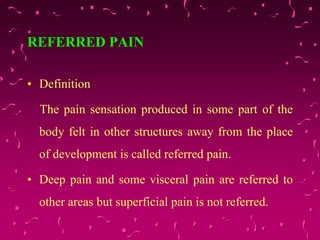
REFERRED PAIN
• Definition
The pain sensation produced in some part of the
body felt in other structures away from the place
of development is called referred pain.
• Deep pain and some visceral pain are referred to
other areas but superficial pain is not referred.
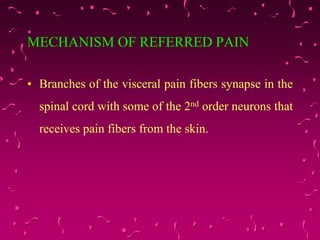
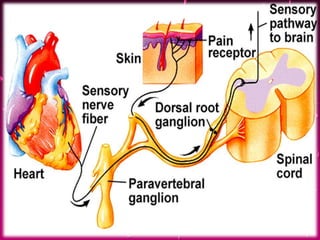
MECHANISM OF REFERRED PAIN
• Branches of the visceral pain fibers synapse in the
spinal cord with some of the 2nd order neurons that
receives pain fibers from the skin.
APPLIED PHYSIOLOGY
• Analgesia
• Paralgesia
• Phantom limb pain
• Hyperalgesia
• Allodynia.
CLINICAL ABNORMALITIES OF PAIN
• Thalamic syndrome
• Herpes zoster
• Tic douloureux
• The brown – sequard syndrome
• Atypical facial pain
THALAMIC SYNDROME
• Thrombosis of posterior cerebellar artery
• Posterior nuclear group of thalamus becomes
degenerated
• Medial and anterior nuclei remain intact
• Loss of sensations from the opposite side of body
• Ataxia
• After few weeks sensory perception of opposite
side of body returns
HERPES ZOSTER
• The cause of pain is presumably by the excitation
of the neuronal cells of the dorsal root ganglion by
the virus infection
• Along with pain, also causes rash
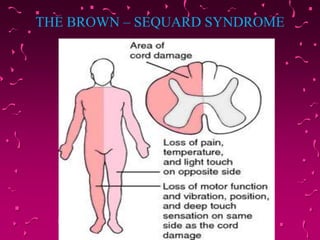
THE BROWN – SEQUARD SYNDROME
ATYPICAL ODONTALGIA
• Atypical facial pain, phantom tooth pain, or
neuropathic orofacial pain.
• Characterized by chronic pain in a tooth or teeth,
or in a site where teeth have been extracted or
following endodontic treatment.
• Over time, the pain may spread to involve wider
areas of the face or jaws.
• The pain is called “atypical” because it is a
different type of pain than that of a typical
toothache.
• Treated by using a variety of medications
• Tricyclic antidepressants are used most frequently.
• Amitriptyline is more commonly prescribed
• Microvascular decompression
• Glycerol injection
• Balloon compression
• Stereotactic radiosurgery
• Generally, treatment is successful in reducing the
pain but not eliminating it completely.
INHIBITION OF PAIN TRANSMISSION
• Pain sensations may be controlled by interrupting
the pain impulse
• may be done chemically, surgically
• Pain sensations respond to pain reducing
drugs/analgesics
• Occasionally pain may be controlled only by
surgery.
• Sympathectomy – excision of portion of neural
tissue from autonomic nervous system.
• Cordotomy – severing of spinal cord tract, usually
the lateral spinothalamic.
• Rhizotomy – cutting of sensory nerve roots.
• Prefrontal lobotomy – destruction of tracts that
connect the thalamus with prefrontal and frontal
lobes of cerebral cortex.
Newer Approaches
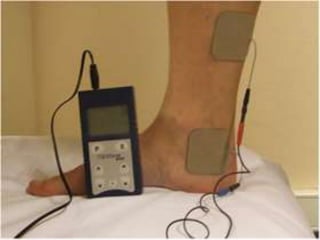
Transcutaneous Neural Stimulation (TNS)
• Cutaneous bipolar surface electrodes are placed in
the painful body regions
• Low voltage electric currents are passed.
• Intense stimulation is maintained for at least an
hour daily for 3 weeks.
• Acupuncture is also used to relieve pain.
• This is based upon the pain inhibitory mechanism
of encephalins and endorphins
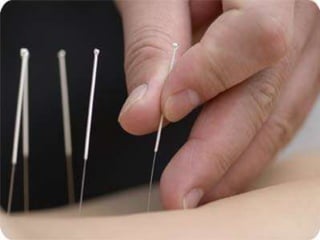
• Needles are inserted through selected areas of skin
and then twirled.
• After 20-30 minutes, pain is deadened for 6-8
hours
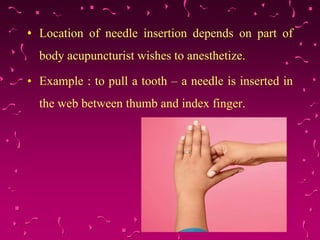
• Location of needle insertion depends on part of
body acupuncturist wishes to anesthetize.
• Example : to pull a tooth – a needle is inserted in
the web between thumb and index finger.
CONCLUSION
• Pain is bad, but not feeling pain can be worse
• Individuals with congenital absence of pain
receptors are extremely rare but not unknown
• Such individuals are very poor at avoiding
accidental injuries
• As a result, their life span is usually short
• Thus pain, although unpleasant, is a protective
sensation with enormous survival value.
• Managing pain is by understanding the problem
and cause of pain
REFERENCES
1. Text book of Medical Physiology, 2nd edition,
Chaudhari.
2. Text book of Medical Physiology, 8th edition,
Arther C Gyton.
3. Textbook of medical physiology,3rd edition,
Chatterjee
4. Pain – Wikipedia, the free encyclopedia
THANKYOU

Pain pathways

  • 1.
    PHYSIOLOGY OF PAINAND PAIN PATHWAYS Dr. Divvi Anusha 1st year MDS Department of Public Health Dentistry
  • 2.
    CONTENTS • Introduction • Historyof pain • Definition of pain • Characteristics of pain • Factors affecting pain • Components of pain sensation
  • 3.
    • Receptors ofpain • Theories of pain • Pain pathways • Inhibition of pain transmission • Referred pain • Conclusion • References
  • 4.
    INTRODUCTION • Pain isan intensely subjective experience, and is therefore difficult to describe. • It has two features which are nearly universal.  It is an unpleasant experience  It is evoked by a stimulus which is actually or potentially damaging to living tissues.
  • 5.
    • Pain hastwo components:  awareness of a painful stimulus  emotional impact (or effect) evoked by the experience. • Awareness is localized to the area stimulated, the experience involves the whole being. • Even a finger is hurt, the whole person suffers.
  • 6.
    HISTORY • Derived fromLatin word “POENA” • Homer – Arrows shot by God • Aristotle – Passion of the soul • Plato – within the body • Bible – anguish of the soul
  • 7.
    DEFINITION OF PAIN •Pain is defined as “an unpleasant sensory and emotional experience associated with actual or potential tissue damage, or described in terms of such damage.” (The International Association for the Study of Pain)
  • 8.
    • According toMonheim, pain is “ an unpleasant emotional experience usually initiated by noxious stimulus and transmitted over a specialized neural network to the CNS where it is interpreted as such.”
  • 9.
    CHARACTERISTICS OF PAIN 1.Threshold and intensity 2. Adaptation 3. Localization of pain 4. Rate of tissue damage
  • 10.
    CLASSIFICATION OF PAIN •Based on pathophysiology pain can be classified in to four categories:  Nociceptive pain  Inflammatory pain  Neuropathic pain  Functional pain
  • 11.
    Nociceptive pain  Transientpain in response to noxious stimulus  Arises from the stimulus outside of nervous system  Protective as it prevents further injury.
  • 12.
    Inflammatory pain  Initiatedby tissue damage or inflammation  Arises from a stimulus outside of the nervous system  It is mal-adaptive  Ex. Osteoarthritis, Rheumatoid arthritis
  • 13.
    Neuropathic pain  Causedby the dysfunction in the nervous system  Ex. Diabetic neuropathy
  • 14.
    Functional pain Associated withabnormal neural processing Ex. Fibromyalgia
  • 16.
    FACTORS AFFECTING PAIN 1.Emotional status 2. Fatigue 3. Age 4. Racial and nationality characteristics 5. Sex 6. Fear and apprehension
  • 17.
    COMPONENTS OF PAINSENSATION • Pain sensation has two components  Fast pain  Slow pain • Receptors for both the components of pain are same but the afferent nerve fibers are different. • Fast pain is carried by Aδ fibers and slow pain is carried by C type of nerve fibers
  • 19.
    RECEPTORS OF PAIN •Free nerve endings (nociceptors) • Widespread in superficial layers of skin and in certain internal organs. • Deep tissues are weakly supplied with nerve endings.
  • 21.
    • Three differenttypes of stimuli excite pain receptors:  Mechanical  Thermal  Chemical • Fast pain is elicited by the mechanical and thermal types of receptors • Slow pain can be elicited by all three types
  • 22.
    THEORIES OF PAIN Intensitytheory  Pain is produced when any sensory nerve is stimulated beyond a certain level  Trigeminal system provides an example against this theory
  • 23.
    Specificity theory  Painis a specific modality equivalent to vision and hearing etc.  But concept of specific nerve ending s is no long tenable.
  • 24.
    Pattern theory  1894– Goldscheider  Stimulus intensity and central summation are the critical determinants  Summation of sensory input  Pain results when the total output of cells exceeds a critical level.
  • 25.
    Gate control theory 1965 - Ronald Melzack and Patrick Wall  Considered to be one of the most influential theories of pain  Asserts that non-painful input closes the "gates" to painful input, preventing pain sensation from travelling to CNS
  • 26.
    • Stimulation bynon noxious input is able to suppress pain • Two destinations – transmission cells and the inhibitory interneurons • The more the large fiber activity at the inhibitory cell, the less pain is felt. • This theory offers physiological explanation
  • 27.
  • 28.
    Dual pathways forpain transmission • From peripheral receptors to spinal cord: Aδ fibers (fast fibers) – for fast pain C fibers (slow fibers) – for slow pain • From spinal cord to brain: via Anterolateral (Spinothalamic) tract Neo-spinothalamic tract – for fast pain Paleo-spinothalamic tract – for slow pain
  • 29.
    Thalamus – ventrobasalcomplex Reticular formation Spinothalamic tract Spinal cord (lamina I – lamina marginalis) Peripheral fibers Aδ fibers Pain receptor (Free nerve endings) Somatosensory cortex Other basal areas of brain
  • 31.
    Reticular nuclei,Tectal area& periaqueduvtal grey region Thalamus Spinothalamic tract Spinal cord (lamina II & III – substantia gelatinosa) Peripheral fibers C fibers Pain receptor (Free nerve endings) Thalamus Hypothalamus Other basal areas of brain
  • 32.
    DESCENDING PAIN PATHWAY •Descending Pain Modulation (Descending Pain Control Mechanism) • Transmit impulses from the brain (corticospinal tract in the cortex) to the spinal cord (lamina)
  • 33.
    • Periaquaductal GrayArea (PGA) – release enkephalins • Nucleus Raphe Magnus (NRM) – release serotonin • Release of these neurotransmitters inhibit ascending neurons • Endogenous opioid peptides - endorphins & enkephalins causes analgesia.
  • 34.
    REFERRED PAIN • Definition Thepain sensation produced in some part of the body felt in other structures away from the place of development is called referred pain. • Deep pain and some visceral pain are referred to other areas but superficial pain is not referred.
  • 35.
    MECHANISM OF REFERREDPAIN • Branches of the visceral pain fibers synapse in the spinal cord with some of the 2nd order neurons that receives pain fibers from the skin.
  • 37.
    APPLIED PHYSIOLOGY • Analgesia •Paralgesia • Phantom limb pain • Hyperalgesia • Allodynia.
  • 38.
    CLINICAL ABNORMALITIES OFPAIN • Thalamic syndrome • Herpes zoster • Tic douloureux • The brown – sequard syndrome • Atypical facial pain
  • 39.
    THALAMIC SYNDROME • Thrombosisof posterior cerebellar artery • Posterior nuclear group of thalamus becomes degenerated • Medial and anterior nuclei remain intact • Loss of sensations from the opposite side of body • Ataxia • After few weeks sensory perception of opposite side of body returns
  • 40.
    HERPES ZOSTER • Thecause of pain is presumably by the excitation of the neuronal cells of the dorsal root ganglion by the virus infection • Along with pain, also causes rash
  • 41.
    THE BROWN –SEQUARD SYNDROME
  • 42.
    ATYPICAL ODONTALGIA • Atypicalfacial pain, phantom tooth pain, or neuropathic orofacial pain. • Characterized by chronic pain in a tooth or teeth, or in a site where teeth have been extracted or following endodontic treatment. • Over time, the pain may spread to involve wider areas of the face or jaws.
  • 43.
    • The painis called “atypical” because it is a different type of pain than that of a typical toothache. • Treated by using a variety of medications • Tricyclic antidepressants are used most frequently. • Amitriptyline is more commonly prescribed
  • 44.
    • Microvascular decompression •Glycerol injection • Balloon compression • Stereotactic radiosurgery • Generally, treatment is successful in reducing the pain but not eliminating it completely.
  • 45.
    INHIBITION OF PAINTRANSMISSION • Pain sensations may be controlled by interrupting the pain impulse • may be done chemically, surgically • Pain sensations respond to pain reducing drugs/analgesics • Occasionally pain may be controlled only by surgery.
  • 46.
    • Sympathectomy –excision of portion of neural tissue from autonomic nervous system. • Cordotomy – severing of spinal cord tract, usually the lateral spinothalamic. • Rhizotomy – cutting of sensory nerve roots. • Prefrontal lobotomy – destruction of tracts that connect the thalamus with prefrontal and frontal lobes of cerebral cortex.
  • 47.
    Newer Approaches Transcutaneous NeuralStimulation (TNS) • Cutaneous bipolar surface electrodes are placed in the painful body regions • Low voltage electric currents are passed. • Intense stimulation is maintained for at least an hour daily for 3 weeks.
  • 49.
    • Acupuncture isalso used to relieve pain. • This is based upon the pain inhibitory mechanism of encephalins and endorphins • Needles are inserted through selected areas of skin and then twirled. • After 20-30 minutes, pain is deadened for 6-8 hours
  • 50.
    • Location ofneedle insertion depends on part of body acupuncturist wishes to anesthetize. • Example : to pull a tooth – a needle is inserted in the web between thumb and index finger.
  • 52.
    CONCLUSION • Pain isbad, but not feeling pain can be worse • Individuals with congenital absence of pain receptors are extremely rare but not unknown • Such individuals are very poor at avoiding accidental injuries • As a result, their life span is usually short
  • 53.
    • Thus pain,although unpleasant, is a protective sensation with enormous survival value. • Managing pain is by understanding the problem and cause of pain
  • 54.
    REFERENCES 1. Text bookof Medical Physiology, 2nd edition, Chaudhari. 2. Text book of Medical Physiology, 8th edition, Arther C Gyton. 3. Textbook of medical physiology,3rd edition, Chatterjee 4. Pain – Wikipedia, the free encyclopedia
  • 55.