COLLEGE OF DENTAL SCIENCE AND HOSPITAL
DADH PRESENTATION
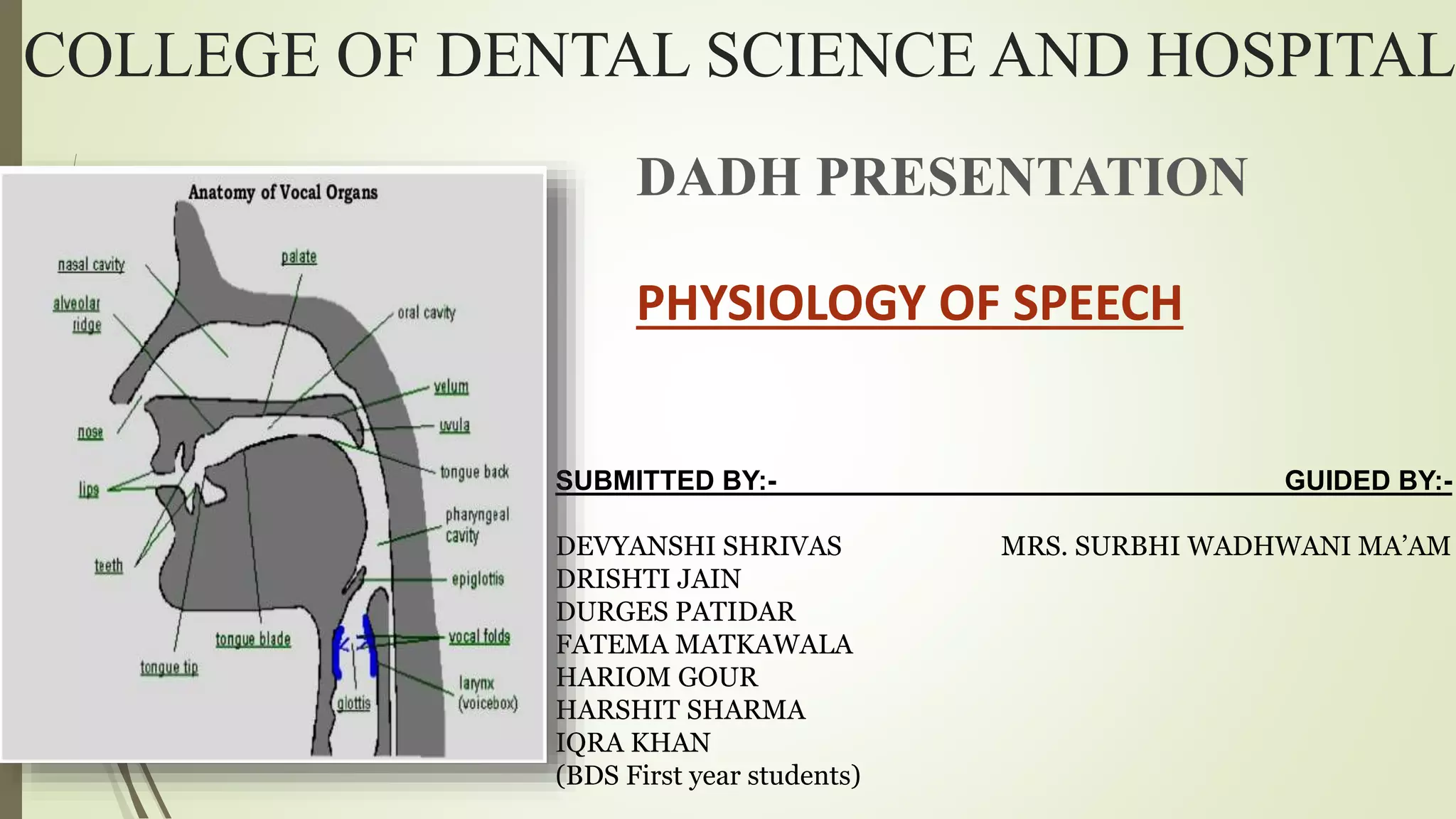
PHYSIOLOGY OF SPEECH
SUBMITTED BY:- GUIDED BY:-
DEVYANSHI SHRIVAS MRS. SURBHI WADHWANI MA’AM
DRISHTI JAIN
DURGES PATIDAR
FATEMA MATKAWALA
HARIOM GOUR
HARSHIT SHARMA
IQRA KHAN
(BDS First year students)
BASIC ANATOMY OF LARYNX
AND VOCAL CORDS
“God has given us two ears and one mouth; to hear more,
contemplate and speak less according to time and need.”
ANATOMY OF LARYNX
INTRODUCTION
• The larynx(Latin upper
windpipe) is the organ for
production of voice and
phonation.
• It also acts as a
sphincter at the inlet of
lower respiratory
passages.
SITUATION AND EXTENT
• The larynx lies in the anterior midline of
the neck, extending from the root of the
tongue to the trachea.
• In adult male ~Lies in front of 3rd to 6th
cervical vertebrae.
In children and adult female~ lies at a
little higher level.
 SIZE
• Length of larynx in
Males- 44mm
Females-36mm
• At puberty, the male larynx grows
rapidly as a prominent angle of thyroid
cartilage(ADAM’S APPLE).
• While pubertal growth of female larynx
in negligible.
•CONSTITUTION OF LARYNX
UNPAIRED CARTILAGES
1. Thyroid (Greek shield like)
2. Cricoid (Greek ring like)
3. Epiglottis(Greek leaf like)
PAIRED CARTILAGES
1. Arytenoid (Greek cup shaped)
2. Corniculate(Latin horn shaped)
3. Cuneiform (Latin wedge shaped)
CAVITY OF LARYNX
1. The cavity of larynx extends from the inlet of the
larynx to the lower border of the cricoid cartilage.
• The inlet is bounded
anteriorly- epiglottis
posteriorly- interarytenoid fold of mucous
membrane
on each side- aryepiglottic fold.
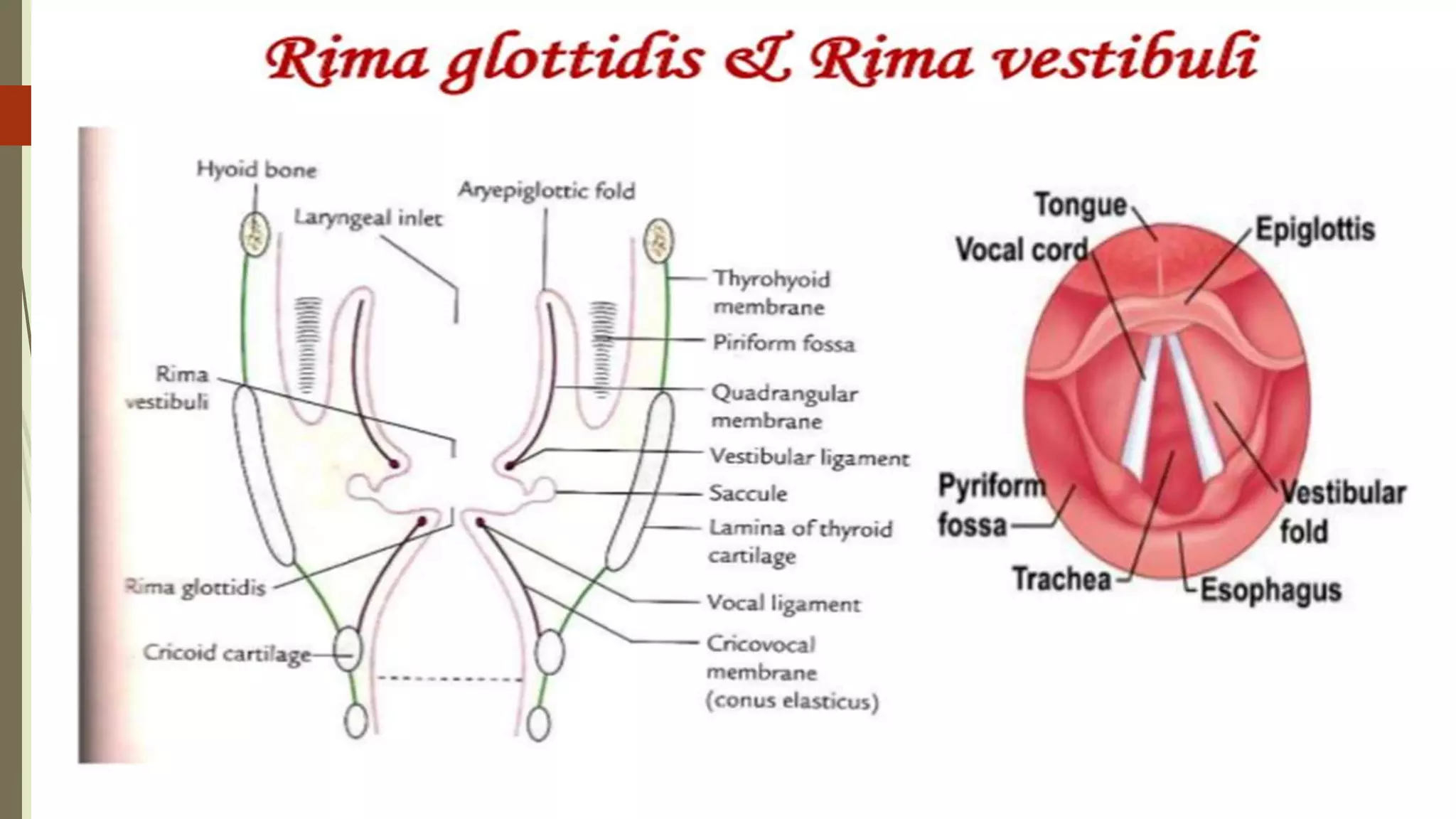
2. Within the cavity, there are two folds on each side.
Upper fold – VESTIBULAR FOLD
Lower fold – VOCAL FOLD
The space between the vestibular folds-RIMA VESTIBULI
The space between the vocal folds- RIMA GLOTTIDIS.
3. The vestibular and vocal fold divide the cavity into three
parts.
a. The part above the vestibular fold is called the
vestibule of the larynx or supraglottis.
b. The part between the vestibular and vocal folds is called
the sinus or ventricle of larynx.
c. The part below the vocal fold is called infraglottis.
 The anterior part of the sinus is
prolonged upwards as a diverticulum
between the vestibular fold and
lamina of the thyroid cartilage. This
extension is known as saccule of
larynx.
 It is often called oil can of larynx.
EXTRINSIC LARYNGEAL MUSCLES
4 Suprahyoids (laryngeal elevators)
• Include the digastricus, stylohyoid,
geniohyoyoid, and mylohyoid muscles.
4 Infrahyoids (laryngeal depressors)
• Include the omohyoid, sternohyoid,
sternothyroid, and thyrohyoid muscles.
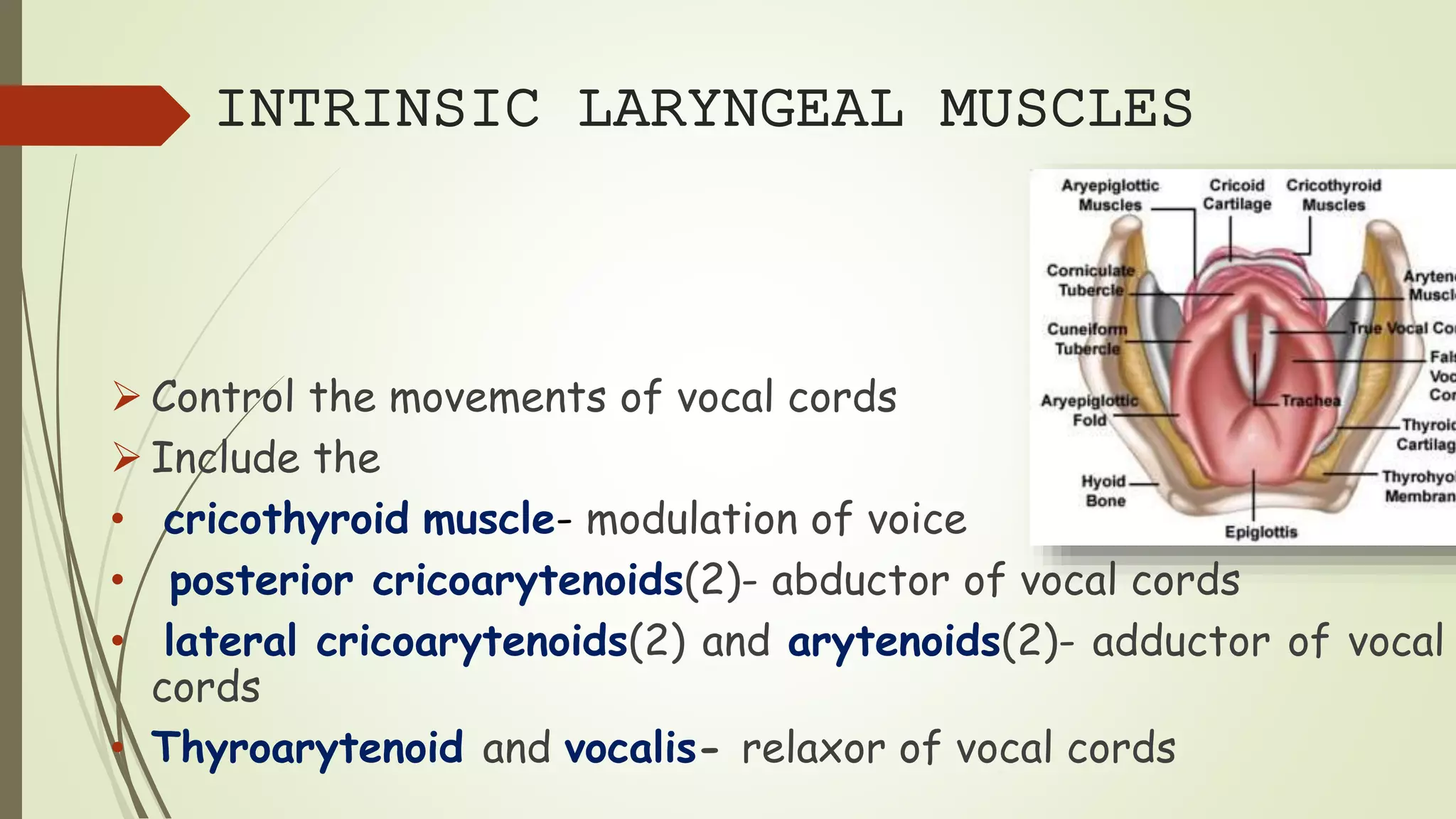
INTRINSIC LARYNGEAL MUSCLES
 Control the movements of vocal cords
 Include the
• cricothyroid muscle- modulation of voice
• posterior cricoarytenoids(2)- abductor of vocal cords
• lateral cricoarytenoids(2) and arytenoids(2)- adductor of vocal
cords
• Thyroarytenoid and vocalis- relaxor of vocal cords
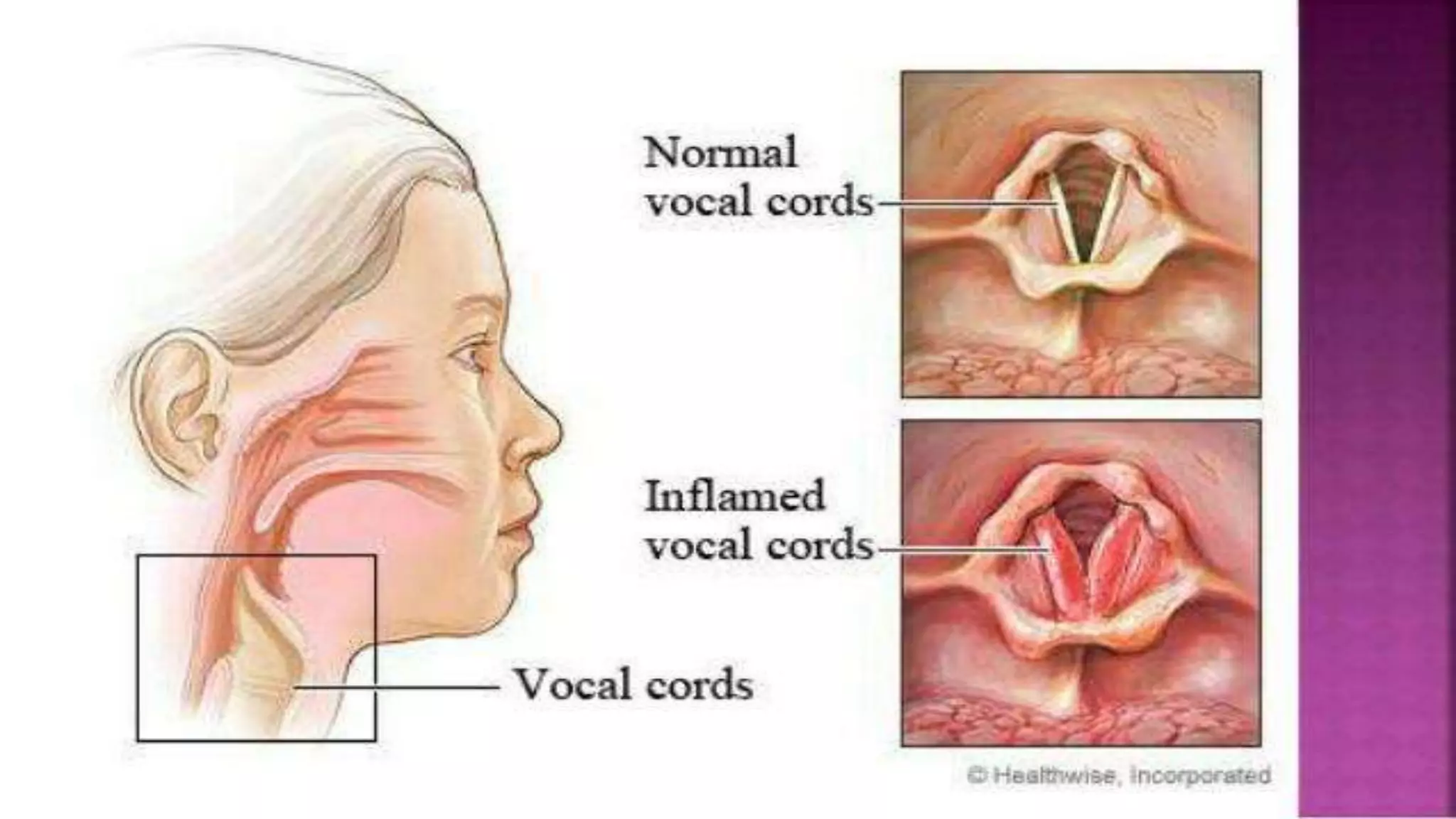
Vocal Folds
 Two thin sheets of tissue(mucosa-line
ligaments), connected on their outer
edge to inside of the thyroid cartilage.
 Horizontally, they stretch from the
arytenoid cartilages to the thyroid
cartilage.
 A thin layer of muscle (vocalis muscle)
lies within the tissue of the vocal folds.
MOVEMENTS OF VOCAL FOLD
During breathing, the
intermembranous part is
triangular and intercartilagenous
part is quadrangular.
During speech, the glottis is
reduced by the adduction of the
vocal folds.
 During forced inspiration, the vocal folds are
fully abducted.
 During whispering, the intermembranous
part is closed, but the intercartilagenous
part is widely open.
ARTERIAL SUPPLY AND VENOUS DRAINAGE
Up to the vocal folds: By the superior laryngeal
artery. The superior laryngeal vein drains into
superior thyroid vein.
Below the vocal folds: By the inferior laryngeal
artery. The inferior laryngeal vein drains into the
inferior thyroid vein.
•Motor nerves: Recurrent laryngeal nerve supplies all
muscles except cricothyroid, which is supplied by external
laryngeal nerve.
•Sensory nerves: The internal laryngeal nerve supplies
the mucous membrane up to the level of vocal folds. The
recurrent laryngeal nerve supplies it below the level of the
vocal folds.
NERVE SUPPLY
Before we speak we inhale air. When we speak
,we exhale air.
The exhaled air is the raw material out of which
we make the finished product.
Tidal air :- The minimum amount of air we inhale
for speaking purposes.
Complementary air :- The additional air we
inhale for breathing purposes.
Stages Of Voice Production
Compression
Vibration
Amplification
Modification
Compression
• The air we inhale is compressed for
exhalation .
• Movement begins from the lungs, the place
where air eventually goes after inhalation.
• The air then passes through a pair of
bronchial tubes.
•Muscles contract and expand the
space occupied by the lungs.
•This compression is done with
the help of diaphragm.
Vibration
• Air hits the wind pipe and passes through the
larynx .
•Larynx is known as vibrator.
•Vocal folds inside larynx vibrate when air
passes through it.
•The vibration results in production of the initial
sound of the voice.
Amplification
• The initial sound is made loud and amplified into
our true voice by air chambers also known as
RESONATORS.
•When the sound enters air chambers, it
reverberates and is consequently multiplied
before leaving air chambers .
•The air chambers of our body that
serve as resonators are:
The vestibule
The Pharynx or throat
The nasal cavities
The mouth
Modification
• The sound made loud by the resonator is
carved out into intelligible sound, the vowels
and consonants by the modifiers .
•The modifiers are those parts of the body that
forms speech sound .
-Lips : Enunciate the bilabial sounds like
P,B,W.
-Teeth : Are used for the S.
-Tongue : It shapes out the vowels and helps
consonants.
- Jaw : It does not produce specific sound
but it is an important modifier. If we do not
use it we tend to mumble.
Fundamentals Of Voice Production
The foundation for an effective voice is
based on the coordination of three factors:
• Breathing
• Phonation
• Resonance
1.Breathing
• The breath is taken in through the mouth and
nose, passes down the trachea (or windpipe),
and is inhaled into the lungs.
• For air to be inhaled into the lungs, the
ribcage needs to expand and the dome-like
diaphragm which forms the base of the chest,
needs to flatten downwards.
• Breathing is accomplished by
changing in the size of chest cavity in
two ways:
i. Downward movement of diaphragm
to lengthen the chest cavity
ii. Elevation of the ribs to increase the
front to back thickness
• Two muscle group are used :
i. External and internal intercostals that
expand and contract the rib cage.
ii. Abdominal wall and diaphragm which
change the abdominal cavity.
• Exhaled air then res turns up through the
trachea and then through the larynx where
it encounters the closing vocal fold.
2.Phonation
Air coming up from lungs
Closed vocal folds
Sets vocal folds into pattern of rapid vibrations
Produces soundwaves
Basic tones of our voice
Vocal folds are the source of sound:
 The basic tone of the voice can be varied in
many different ways, depending on the way in
which we use the vocal folds and other parts of
the voice mechanism.
 The main aspects of the voice that can be
varied are:
• pitch
• loudness
• quality
Pitch refers to how high or low the
voice sounds. It is determine mainly by
the speed of vibration of the vocal folds,
the thickness of the edge of the folds,
and the length of the folds. The higher
the voice, the faster is the rate of
vibration of the vocal folds.
Loudness refers to how loud or soft a
voice is. It is dependent on the amount of
air pressure from the lungs and the muscle
tension in the vocal folds. The greater the
air pressure and the more tense the vocal
folds, the louder the sound will be
Quality refers to how clear the voice sounds. Voice
quality is determined by many complex factors
including how relaxed the muscles of the larynx are,
how moist the cover of the vocal folds is, how
smoothly the vocal folds vibrate, and whether or not
the vocal folds are able to close sufficiently during
phonation.
3.Resonance
The sound waves produced by the vocal
folds in the larynx are too weak to be
recognised as voice and so this basic tone
must be amplified or resonated as it travels
up through the spaces of the throat, mouth
and nose
RESONANCE
• It’s a term derived from the physics of sound,
and used in acoustic phonetics to refer to those
vibrations of air movement in vocal tract
• Pharynx is the primary resonator.
• There are 3 parts of the pharynx (nasopharynx,
oropharynx, laryngopharynx)
The nasopharynx and oropharynx are
the two resonating systems
These two systems provide
resonance to sounds that pass
through the oral and nasal cavities.
TYPES OF RESONANCE
There are two basic kinds of
resonance:
a) Sympathetic resonance (or free
resonance).
b) Conductive resonance (or forced
resonance).
The essential difference between
both types is what causes the
resonator to start vibrating
In sympathetic resonance there is
no physical contact between the two
bodies.
The resonator start functioning because it
receives vibration through air and responds
to them sympathetically
In conductive resonance the resonator
starts vibrating because it is in physical
contact with vibrating body
VOCAL RESONATION
The process by which the basic
product of phonation is enhanced in
timber.
VOCAL RESONATORS
There are seven areas that may be listed as
possible vocal resonators.
i) Chest
ii) Tracheal tree
iii) Larynx
iv) Pharynx
v) Oral cavity
vi) Nasal cavity
vii) Sinuses
i) CHEST
The chest is not an effective resonator
 It can strong vibratory sensations may be
experienced in the upper chest
 It can make no significant contribution to the
resonance system of the voice, simply by
virtue of its structure and location.
ii) TRACHEAL TREE
The tracheal tree makes no significant
contribution to the resonance system
 Except for a negative effect around its resonant
frequency.
iii) LARYNX
The larynx acts as a resonator only for high
frequencies.
iv) PHARYNX
The pharynx is the most important resonator by
virtue of its position, size, and degree of
adjustability.
It is the first cavity of any size through which the
product of the laryngeal vibrator passes.
v) ORAL CAVITY
The oral cavity is the second most effective
resonator.
vi) NASAL CAVITY
The nasal cavity is the third most effective
resonator.
vii) SINUSES
The sinuses are extremely important to voice
modulation.
Role of Palate Teeth and Tongue in
Voice Production
HOW DO WE PRODUCE SOUND
When we speak, we push air out of our lungs, up
through our throat and out of our mouth or nose.
 The vibrations of our vocal cords, along with
movement of our tongue and lips, changes the air
flow and produce different sound.
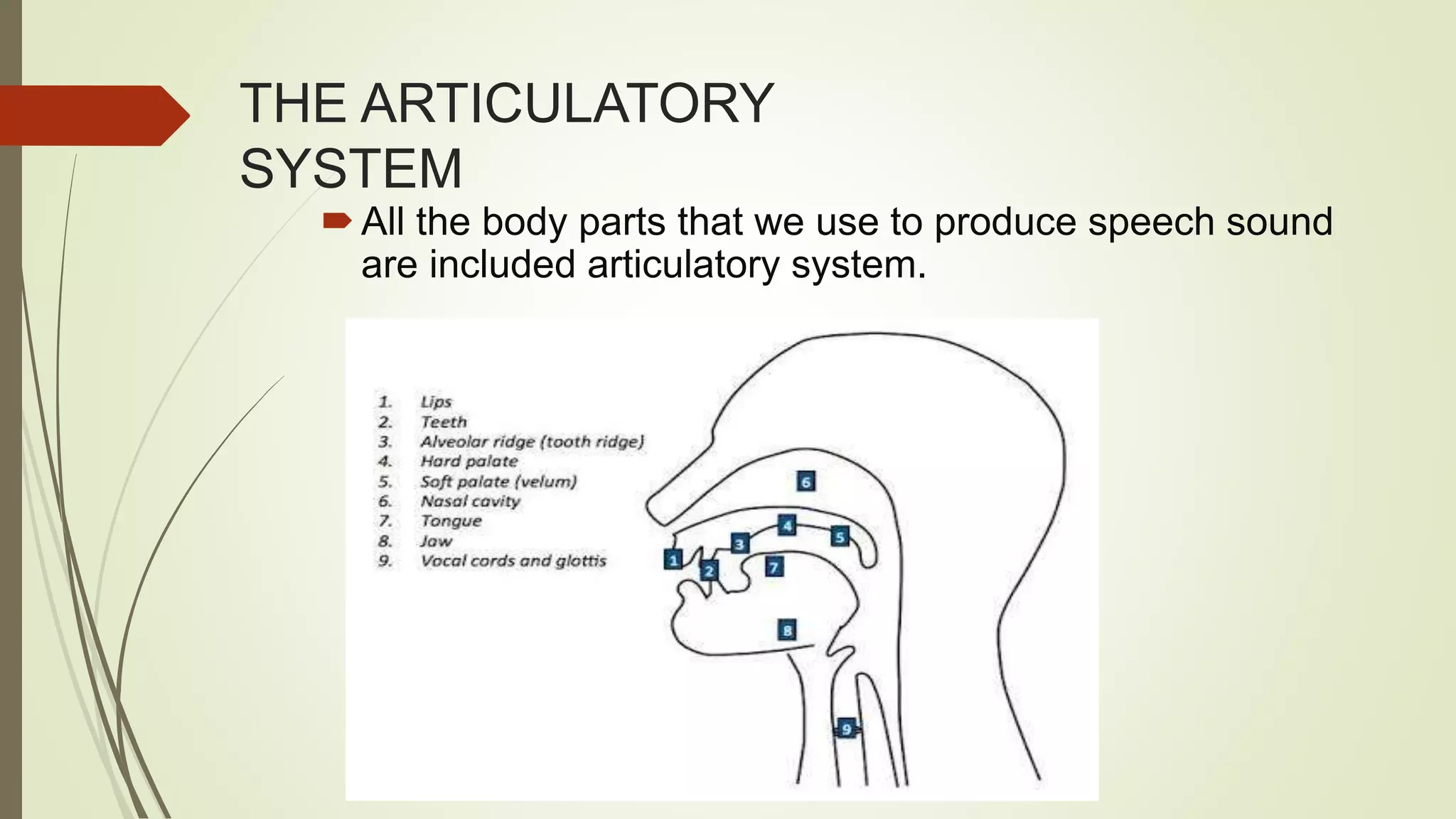
THE ARTICULATORY
SYSTEM
All the body parts that we use to produce speech sound
are included articulatory system.
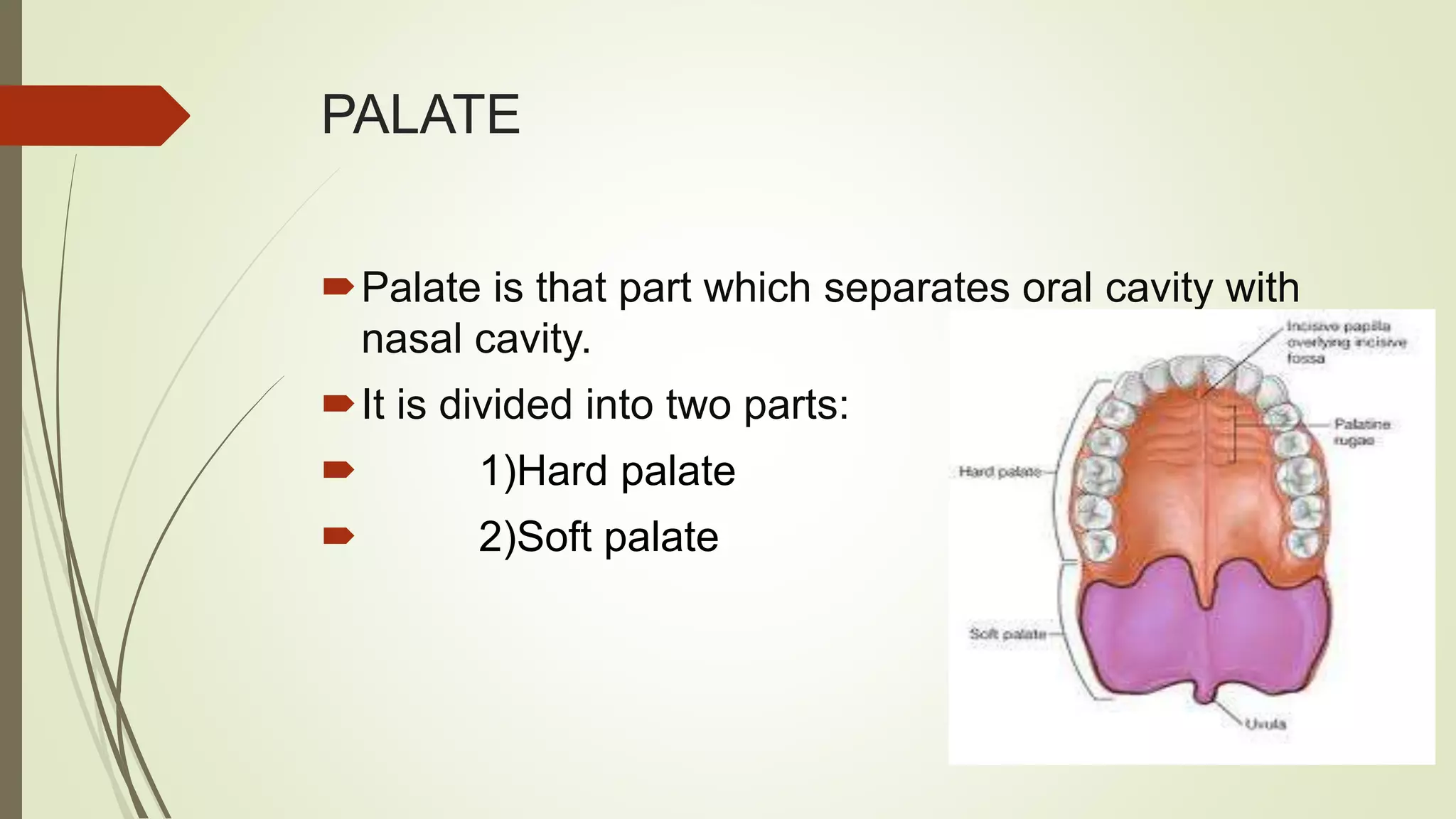
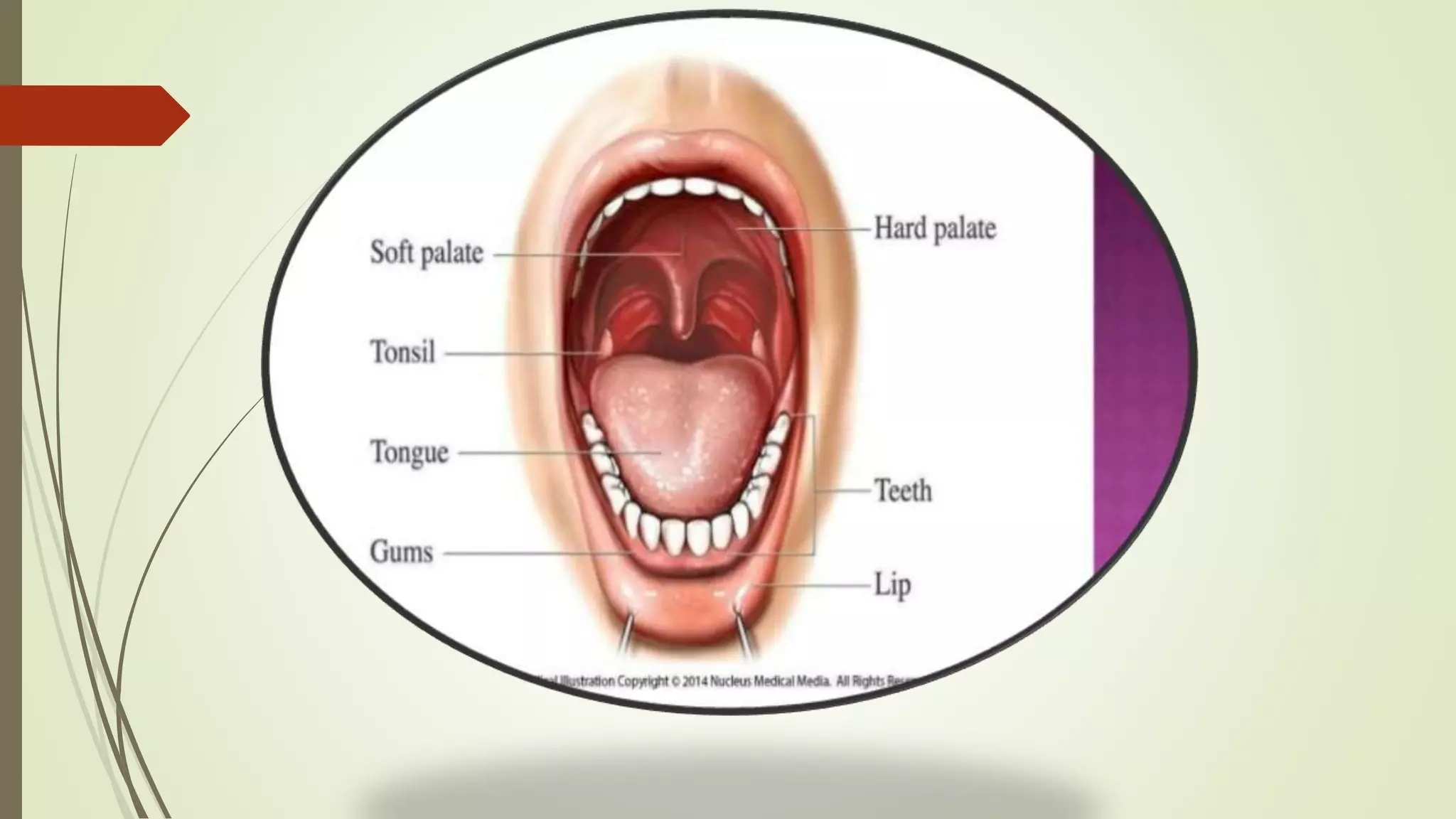
PALATE
Palate is that part which separates oral cavity with
nasal cavity.
It is divided into two parts:
 1)Hard palate
 2)Soft palate
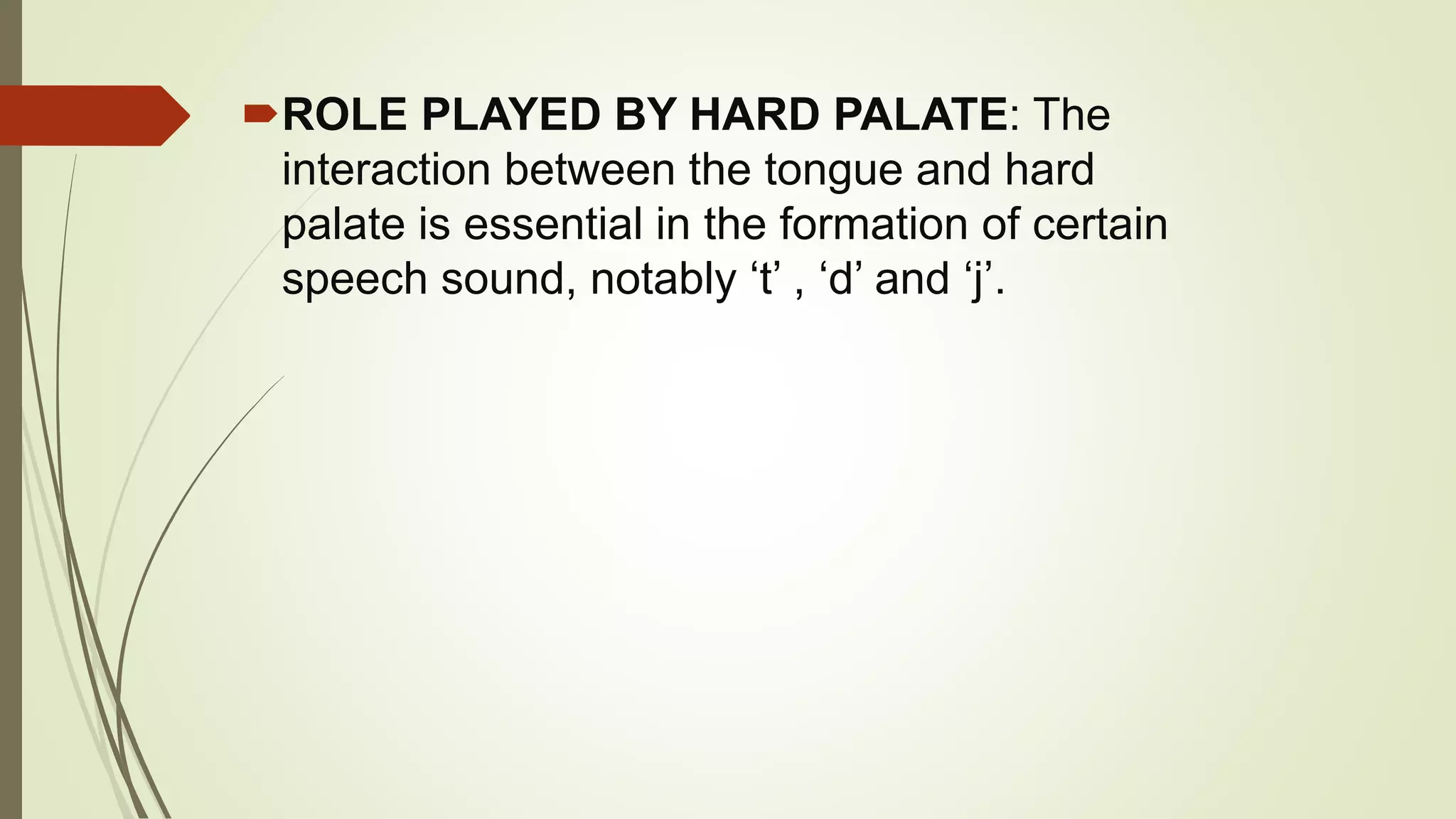
ROLE PLAYED BY HARD PALATE: The
interaction between the tongue and hard
palate is essential in the formation of certain
speech sound, notably ‘t’ , ‘d’ and ‘j’.
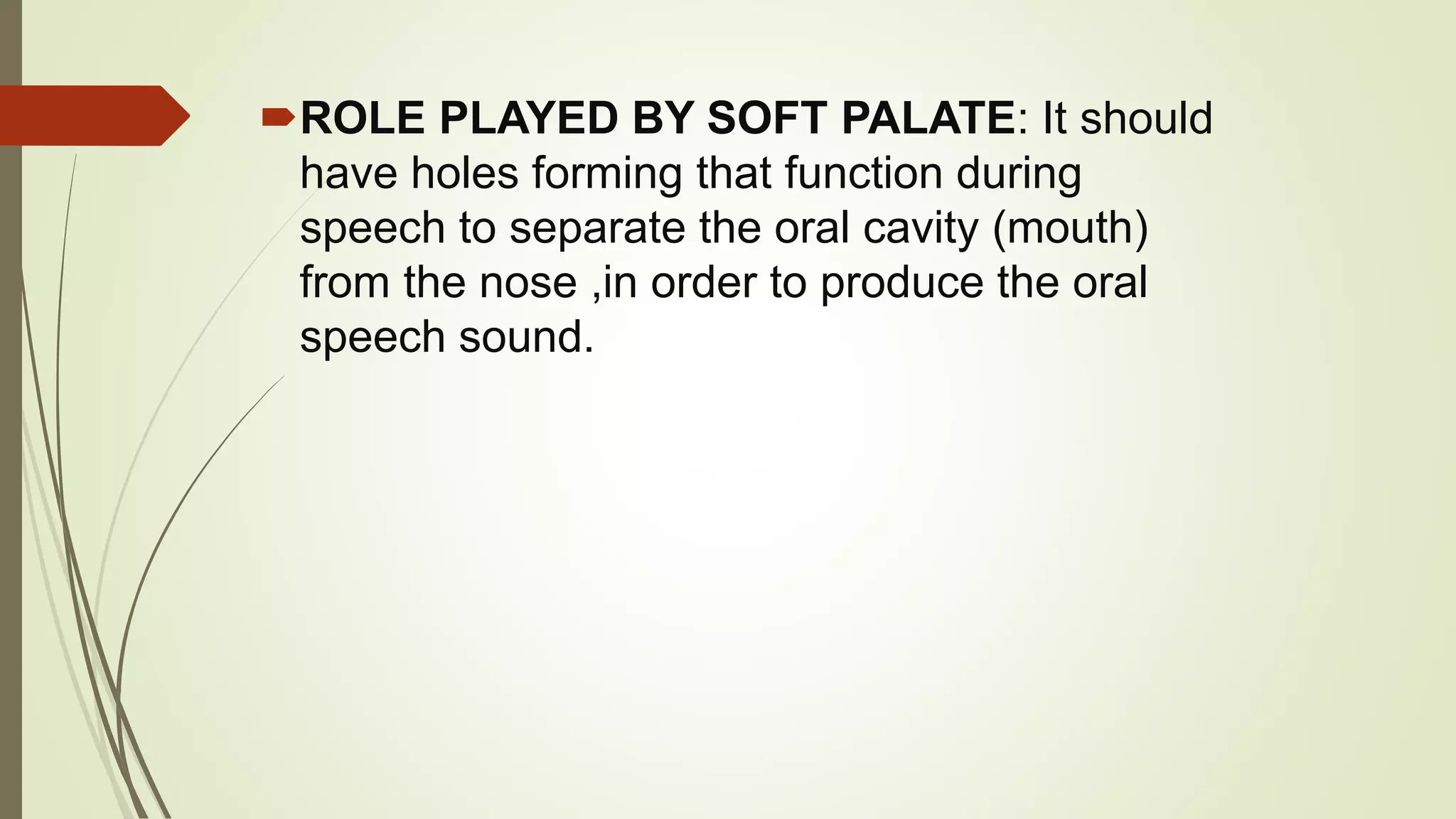
ROLE PLAYED BY SOFT PALATE: It should
have holes forming that function during
speech to separate the oral cavity (mouth)
from the nose ,in order to produce the oral
speech sound.
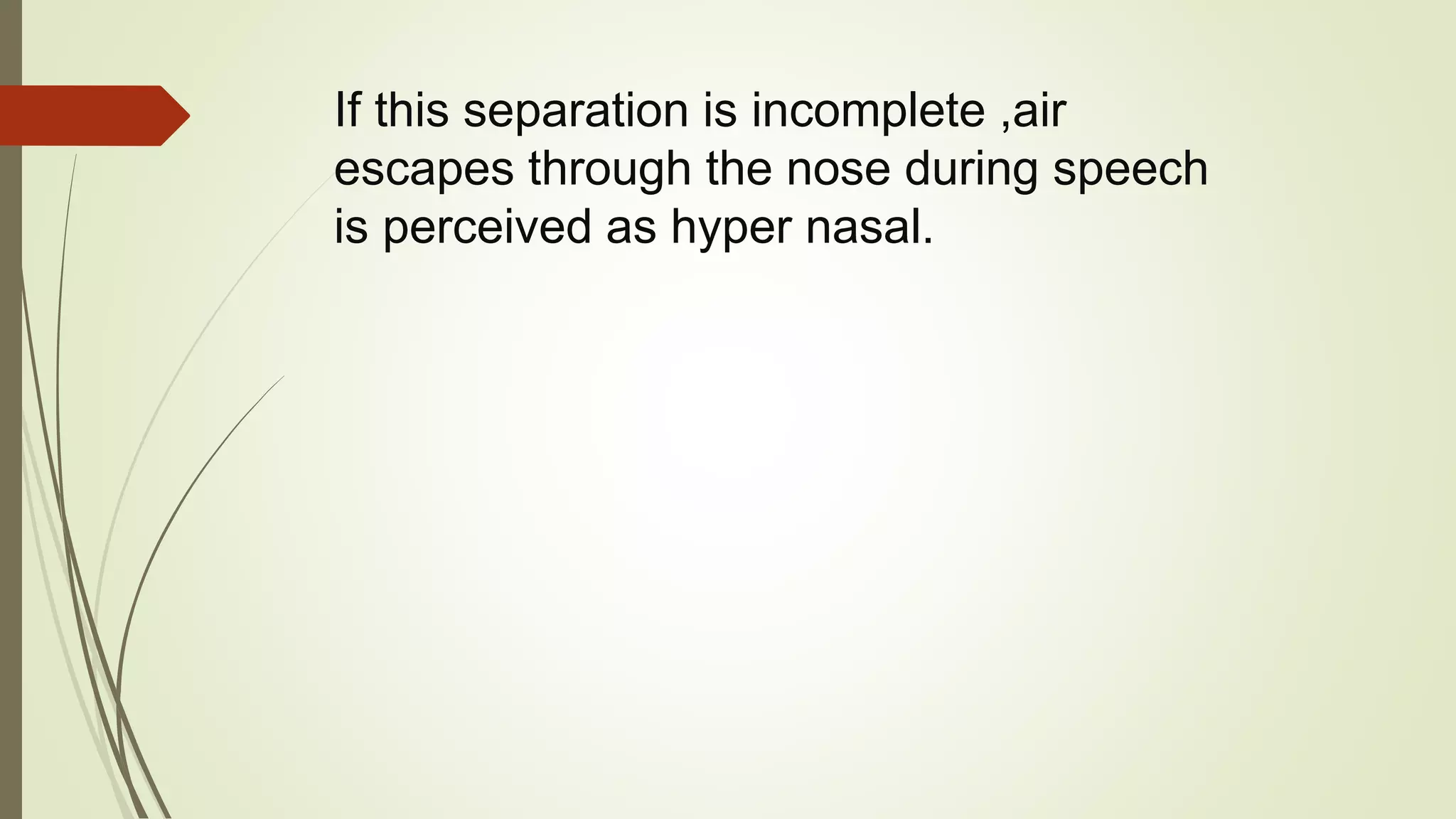
If this separation is incomplete ,air
escapes through the nose during speech
is perceived as hyper nasal.
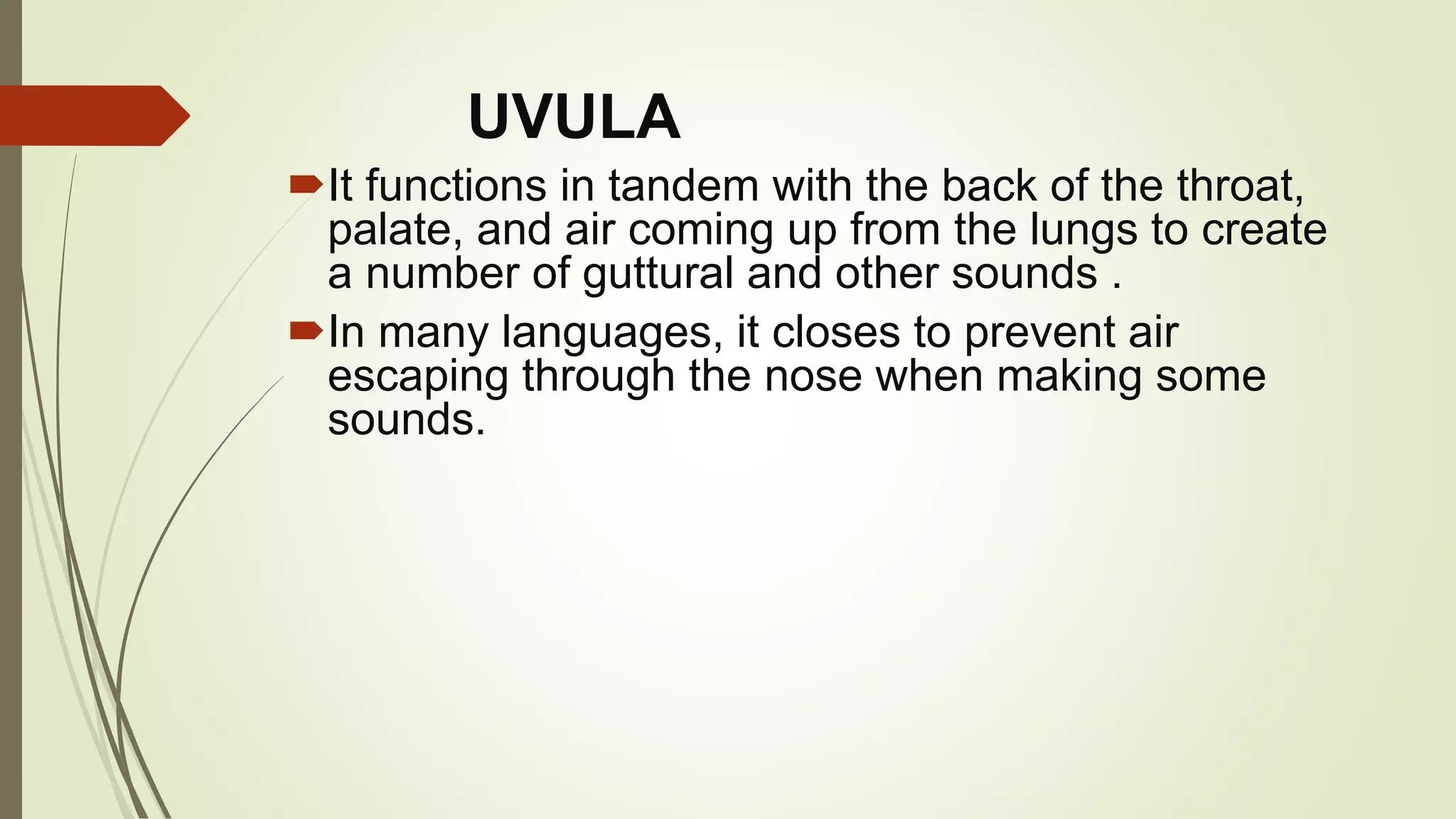
UVULA
It functions in tandem with the back of the throat,
palate, and air coming up from the lungs to create
a number of guttural and other sounds .
In many languages, it closes to prevent air
escaping through the nose when making some
sounds.
TEETH
Teeth are hard calcified
structures found in jaws of
vertebrates to used to break
down food.
Teeth play important role in
proper speech.
The upper and lower teeth are used to
produce a lot of speech sound,
specially in labiodentals consonants.
These are responsible for creating
sounds mainly the labio-dental (e.g. ‘f’
and ‘v’ lingua-dental(e.g. Alfa and
Theta).
It works with lips, with the tongue
and palate to form sounds.
 In some instances, the teeth form
a solid wall to mark out the inner
boundary of mouth, and the facial
muscles pull the lips taught over
the teeth.
The ‘B’ sound normally has the lips
curling over the shape of the teeth to
form the sound.
In forming the ‘F’ and ‘V’ sounds, the
lower lip is actually pressed to upper
teeth to shape them.
In the ‘S’ sound, the teeth trap
the air and work with the tongue
to form it.
The ‘Z’ sound is made with the
teeth together and some help
from the tongue.
TONGUE
The tongue is most important articulator of
speech .
The muscles are extremely strong as it must
move food around mouth as we chew.
Speech on other hand, requires a very different
approach. For the sound to resonate effectively,
the less tongue root tension sound is better.
For speech you want to relax the tongue up
and forward the opposite of swallowing.
The quick movements of tongue, necessary
for rapid delivery of tongue twisters for e.g. ,
require very delicate control of the action of
the tongue.
WHAT IS A SPEECH PROSTHESIS?
A speech prosthesis is an removable plastic
plate.
It fits over the hard and soft palate and is
anchored to some of the upper teeth by metal
clips.
At the back of the plate there is an extension of
plastic, which is an part of prosthesis that acts to
improve speech.
•Speech prosthesis are similar to removable
braces used by orthodontist to straiten teeth.
WHY DO WE NEED A SPEECH
PROSTHESIS?
We recommend speech prosthesis when other
options such as surgery, have failed or are not
advisable for medical and other reasons.
Sometimes when surgery is being considered as
an option to improve nasal speech, a prosthesis
may be used on trail basis to gauge how
successful an operation might be.
Usually speech therapy will not help to
reduce the nasal sound in your speech.
WHAT ARE THE DIFFERENT TYPES OF
PROSTHESIS?
There are two types of speech prosthesis. Each
has a different purpose and works in a different
way.
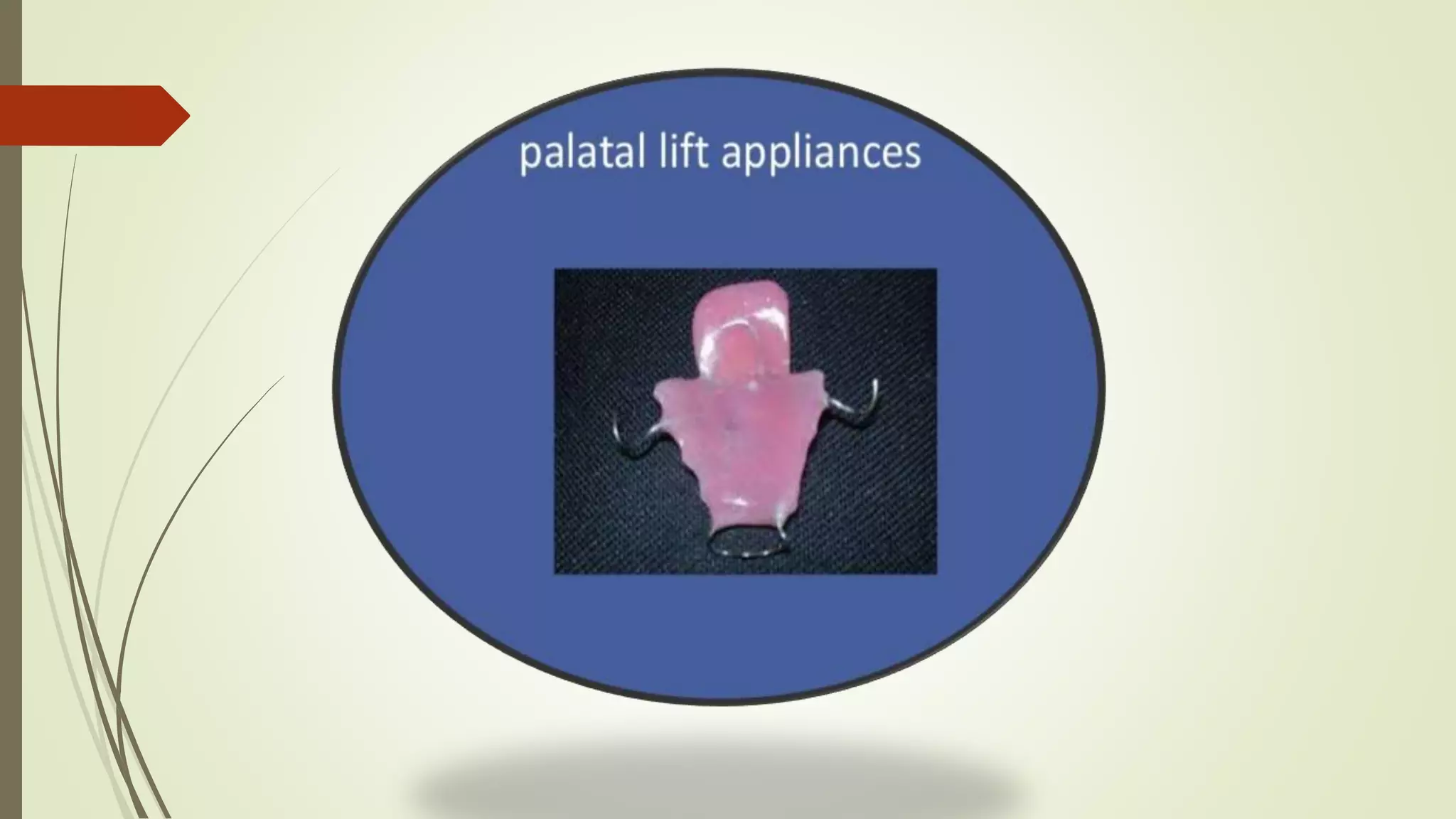
I. PALATAL LIFT APPLIANCE.
II. SPEECH BULBS.
I. PALATAL LIFT APPLIANCE
This acts by lifting the soft palate upwards and
backwards.
This may help to encourage movement of soft
palate and the back of throat.
Doctors recommend this type of device if the soft
palate does not move during speech but appears
long enough to reach the back of the throat.
2. SPEECH BULBS
If there is a significant gap between your soft palate
and your throat when you speak, doctors may
suggest attaching a speech bulb or speech
obturator to the basic plate appliance.
The aim of this is to block up the space
• The important part of speech bulb is made
by placing a layer of impression material
onto the back of the plate.
 And actively molding it to extend into the full
area of the gap behind the soft palate.
The active part of a lift appliance differs in that
the lift procedure involves the gradual building up
of layers of the plastic in order to lift up the soft
palate towards the back of throat.
SPEECH BULB
SOME OF THE FREQUENTLY ASKED
QUESTIONS????
 HOW LONG WILL IT TAKE USUALLY TO GET
USED TO IT?
The prosthesis may be a little uncomfortable for a
few days, but with persistent and continuous
daytime wear, it should feel comfortable within a
week
SHOULD ONE WEAR IT DURING
SLEEP?
No it is very important that one should not wear it
during sleep.
HOW IT IS MAINTAINED ?
The prosthesis should be cleaned using a
toothbrush and warm water
Avoid scrubbing the metal clips as this may
cause the to distort, which can affect the fit of the
prosthesis
If any person have any problem, he or she must
contact the maxillofacial department.
IS IT VISIBLE TO OTHER PEOPLE?
No. The clips are on the back teeth so no one will
be able to see the prosthesis.
EFFECTS ON PHONETICS IN COMPLETE DENTURE
&
PRECAUTIONS
PALATOLINGUAL SOUND
Formed by tongue and hard palate & soft palate.
Words like S,T,D,N,K& L belong to this category.
The sound S as in sixty six is formed by a hiss of air
•As it escapes from the median groove of the
tongue when the tongue is behind the upper
incisors.
If groove is deep then whistling will be
heard when S is pronounced.
If groove is decreased S is softened
towards SH
CLINICAL SIGNIFICANCE
Thus we can say that the sound S can be used to
Check the proper placement of the anterior teeth.
Also the thickness of denture base can be altered
if sound S in not produced correctly.
• If teeth too lingual – T will sound like D
if teeth too forward- D will sound like T
If the posterior borders are over extended or if
there is no tissue contact K becomes CH
sound.
LINGUODENTAL SOUNDS
Consonants TH is representative of linguodental
group of sounds.
The dental sounds are made with the tip of the
tongue extending slightly between the upper and
lower anterior teeth.
•Careful observation of the amount of tongue
that can be seen with the words
This, that, these, those, will provide information
as to the LABIO-LINGUAL position of the anterior
teeth.
CLINICAL SIGNIFICANCE
If about 3mm of the tip of the tongue is not
visible, the anterior teeth are probably too far
forward.
If more than 6mm of the tongue extends out
between the teeth such sounds are made, the
teeth are probably too lingual.
LINGUOALVEOLAR SOUNDS
T, D, S, Z, V & I are representative of this group
of sound.
Produced when the tip of the tongue comes in
contact with the most anterior part of the palate or
the lingual sides of the anterior teeth.
CLINICAL SIGNIFICANCE
Upper and lower incisors should approach end to
end but not touch.
Failure indicates a possible error in the horizontal
overlap of the anterior teeth.
LABIODENTAL SOUNDS
F & V are representatives of this group of sound.
Formed by raising the lower lip into contact with
the incisal edge of the maxilliary anterior teeth.
CLINICAL SIGNIFICANCE
If upper anterior teeth are too short, V sound will
be more like F.
If they are too long set F sound will be more like
V.
BILABIAL SOUNDS
B, P & M are representative of this group of
sound.
Formed by the stream of air coming from the
lungs which meets with no resistance along its
entire path until it reaches lips.
CLINICAL SIGNIFICANCE
It is used to asses the correct interarch space.
For this to be proper there should be correct
positioning of the anterior teeth.
From it labial fullness of the rims can also be
checked.
CLINICAL SIGNIFICANCE
OF SPEECH
(speech disorder)
What is speech disorder ?
When a person is unable to produce speech sounds
correctly or fluently or has a problem with his or her voice .
Then he or she has a speech disorder
Classification
Stuttering
Cluttering
Dysporody
Muteness
Articulation disorder
Phonemic disorder
Voice disorder
Dystharia
Apraxia
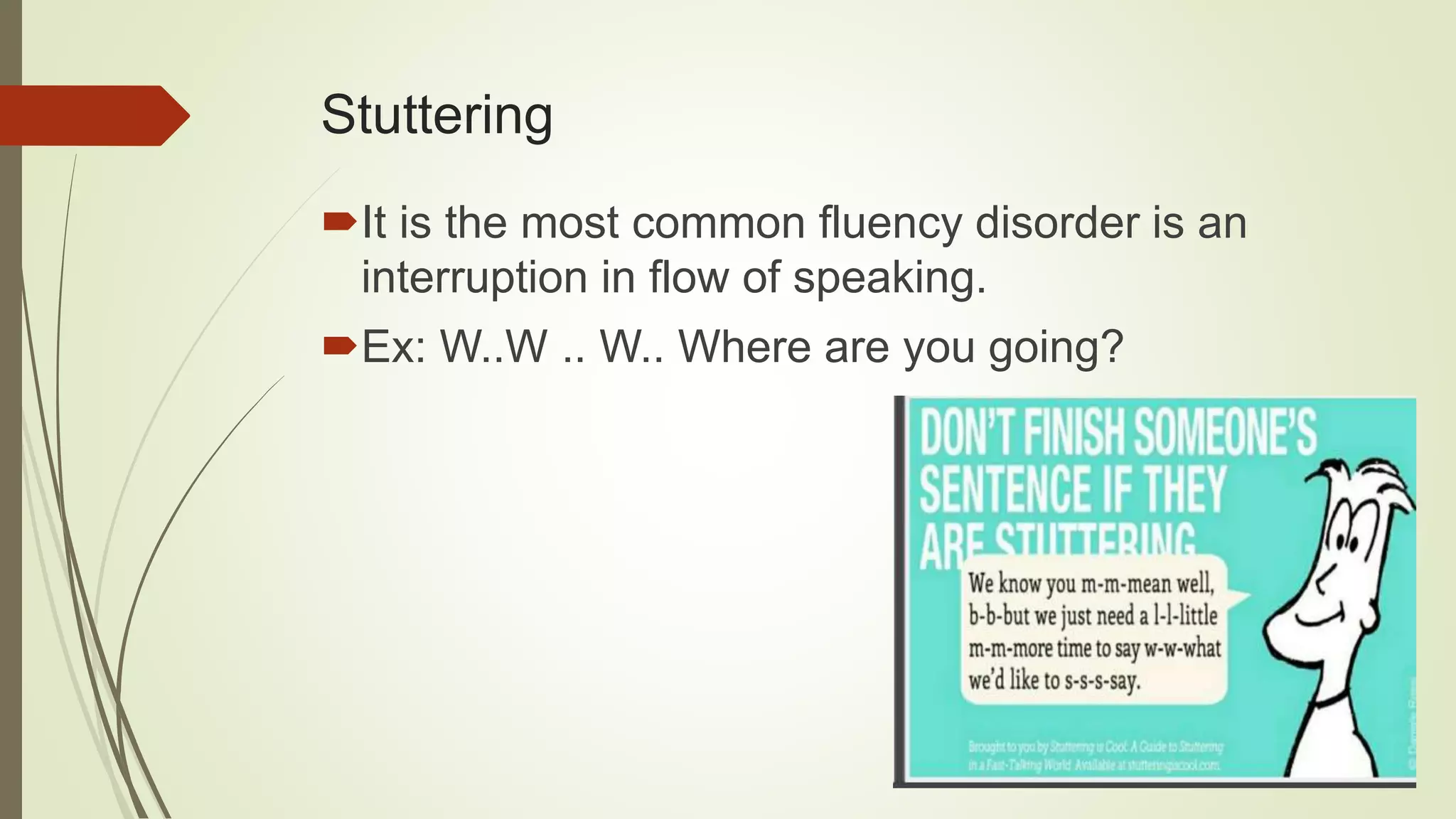
Stuttering
It is the most common fluency disorder is an
interruption in flow of speaking.
Ex: W..W .. W.. Where are you going?
Cluttering
It is an extension of normal
speech disfluency.
Ex: I...I W..I.. Want I.....Want
to go to the..... I need to go...
The store is over .... To the
store.
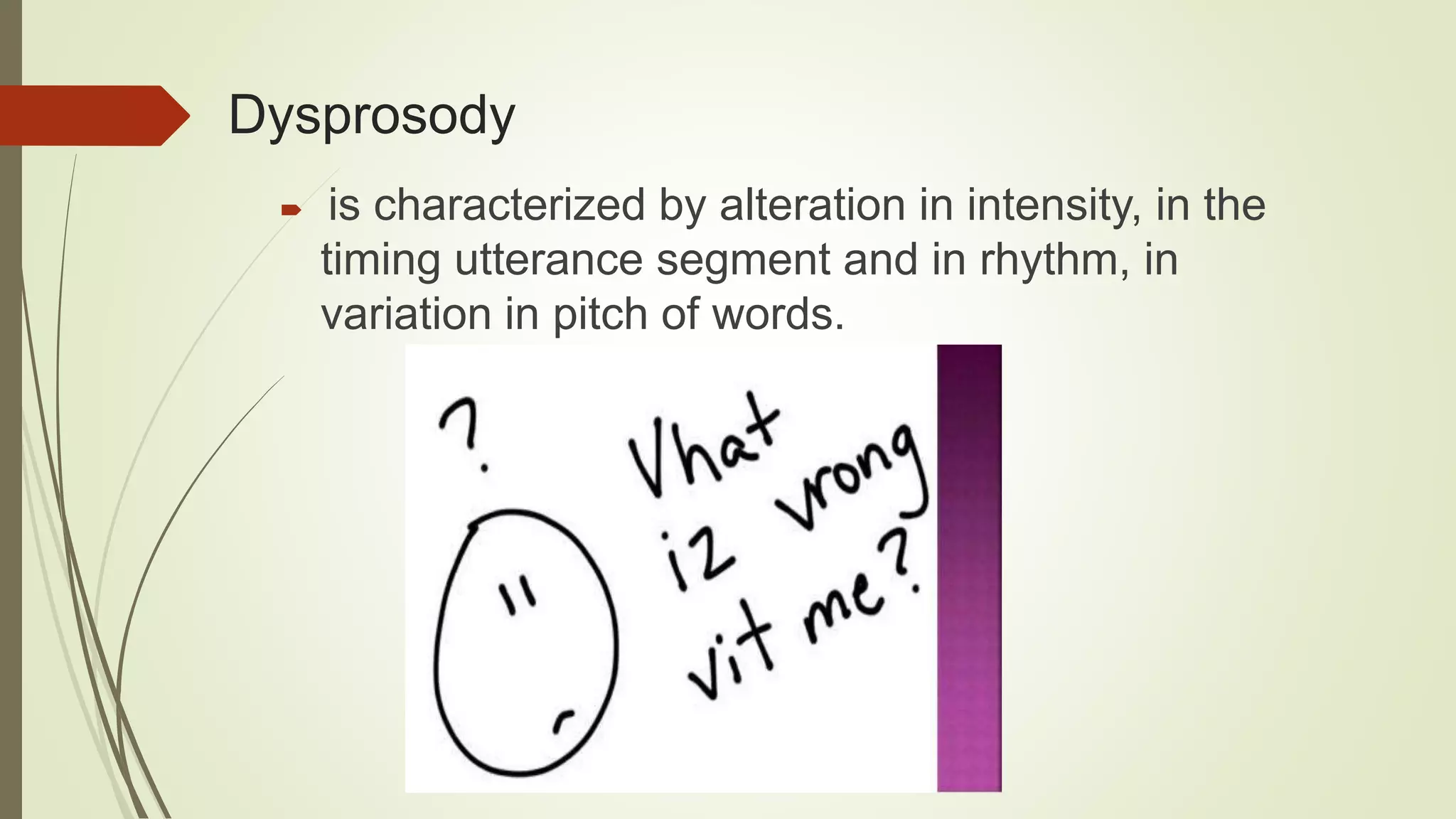
Dysprosody
 is characterized by alteration in intensity, in the
timing utterance segment and in rhythm, in
variation in pitch of words.
Muteness
It is Completely inability speak.
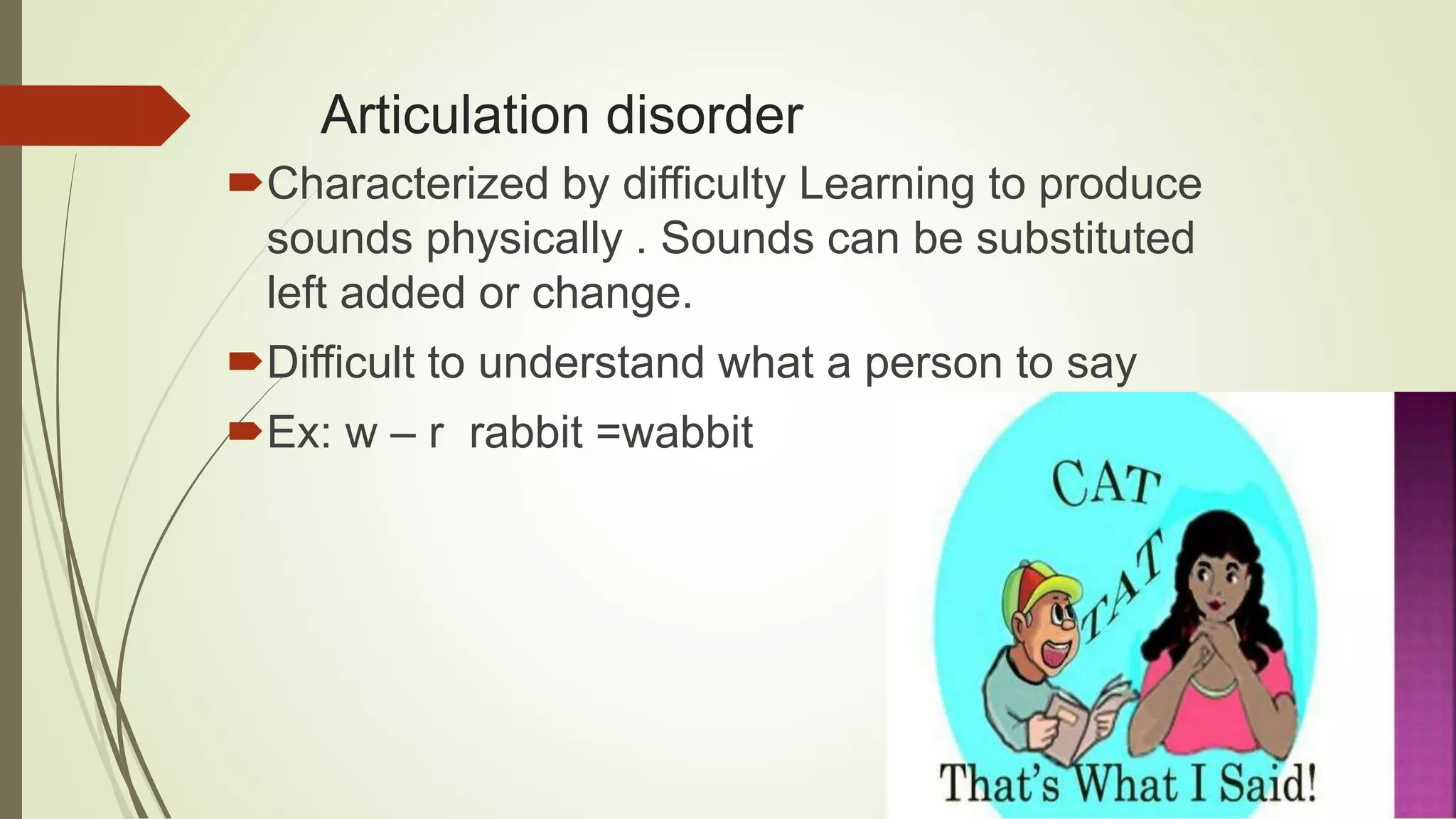
Articulation disorder
Characterized by difficulty Learning to produce
sounds physically . Sounds can be substituted
left added or change.
Difficult to understand what a person to say
Ex: w – r rabbit =wabbit
Phonemic disorder
Characterized by difficulty
in learning the sound
distinction of language so
that one sound may be
used in place of many.
Ex: Cup = Tup Or Das =
Gas
Voice disorder
Impairment often physically that involves the
function of the larynx or vocal rosanance.
Mostly characterized by:
Hoarness
Vocal fold nodules
Vocal misuse and abuse
Dysarthria
Defects in the production of sounds
Weakness or Paralysis of speech muscle caused
by damage to the nerves and or brain.
Causes
Laryngeal disease ex : laryngitis
Vocal cord lesion
10 cranial nerve palsy
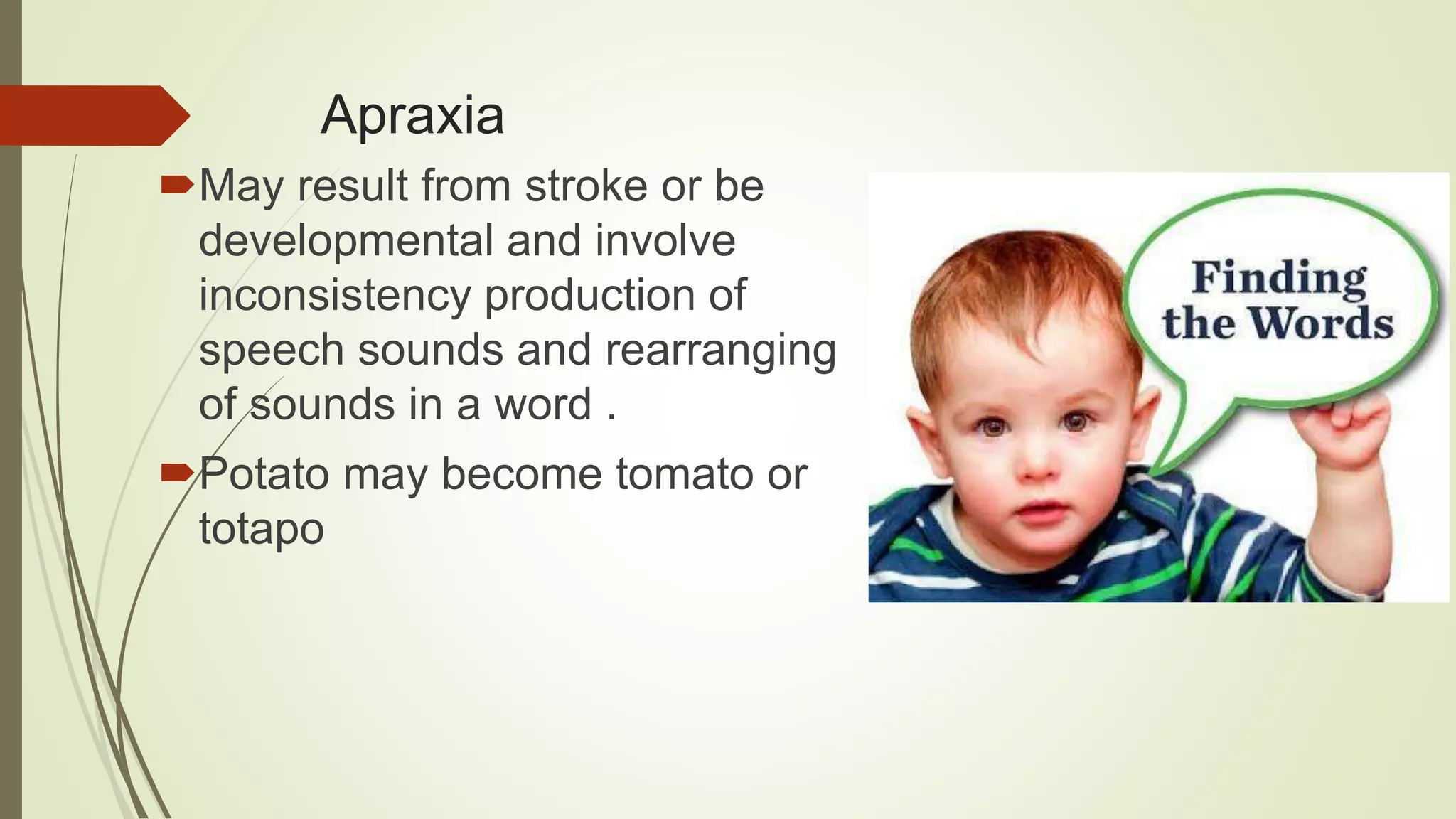
Apraxia
May result from stroke or be
developmental and involve
inconsistency production of
speech sounds and rearranging
of sounds in a word .
Potato may become tomato or
totapo
Causes
Unknown
Hearing loss
Neurological disorder
Brain injury
Drug abuse
Vocal abuse
Mental retardation
Symptoms
Depending on the cause of the speech disorder.
Common symptoms are repeating sounds or
adding extra sounds and words.
Distorting sound
 Hoarness
Making jerk movement while talking
Diagnosis
Denver Articulation screening exam :only for 2 to
7 year old
Early language Milestones scale 2 : determine
child language development.
Peabody picture vocabulary test revised
Treatment
Speech therapy 【SLP】 Sleep language
Pathologist

Physiology of speech

  • 1.
    COLLEGE OF DENTALSCIENCE AND HOSPITAL DADH PRESENTATION PHYSIOLOGY OF SPEECH SUBMITTED BY:- GUIDED BY:- DEVYANSHI SHRIVAS MRS. SURBHI WADHWANI MA’AM DRISHTI JAIN DURGES PATIDAR FATEMA MATKAWALA HARIOM GOUR HARSHIT SHARMA IQRA KHAN (BDS First year students)
  • 2.
    BASIC ANATOMY OFLARYNX AND VOCAL CORDS “God has given us two ears and one mouth; to hear more, contemplate and speak less according to time and need.”
  • 3.
    ANATOMY OF LARYNX INTRODUCTION •The larynx(Latin upper windpipe) is the organ for production of voice and phonation. • It also acts as a sphincter at the inlet of lower respiratory passages.
  • 4.
    SITUATION AND EXTENT •The larynx lies in the anterior midline of the neck, extending from the root of the tongue to the trachea. • In adult male ~Lies in front of 3rd to 6th cervical vertebrae. In children and adult female~ lies at a little higher level.
  • 5.
     SIZE • Lengthof larynx in Males- 44mm Females-36mm • At puberty, the male larynx grows rapidly as a prominent angle of thyroid cartilage(ADAM’S APPLE). • While pubertal growth of female larynx in negligible.
  • 6.
    •CONSTITUTION OF LARYNX UNPAIREDCARTILAGES 1. Thyroid (Greek shield like) 2. Cricoid (Greek ring like) 3. Epiglottis(Greek leaf like) PAIRED CARTILAGES 1. Arytenoid (Greek cup shaped) 2. Corniculate(Latin horn shaped) 3. Cuneiform (Latin wedge shaped)
  • 7.
    CAVITY OF LARYNX 1.The cavity of larynx extends from the inlet of the larynx to the lower border of the cricoid cartilage. • The inlet is bounded anteriorly- epiglottis posteriorly- interarytenoid fold of mucous membrane on each side- aryepiglottic fold.
  • 8.
    2. Within thecavity, there are two folds on each side. Upper fold – VESTIBULAR FOLD Lower fold – VOCAL FOLD The space between the vestibular folds-RIMA VESTIBULI The space between the vocal folds- RIMA GLOTTIDIS.
  • 10.
    3. The vestibularand vocal fold divide the cavity into three parts. a. The part above the vestibular fold is called the vestibule of the larynx or supraglottis. b. The part between the vestibular and vocal folds is called the sinus or ventricle of larynx. c. The part below the vocal fold is called infraglottis.
  • 11.
     The anteriorpart of the sinus is prolonged upwards as a diverticulum between the vestibular fold and lamina of the thyroid cartilage. This extension is known as saccule of larynx.  It is often called oil can of larynx.
  • 12.
    EXTRINSIC LARYNGEAL MUSCLES 4Suprahyoids (laryngeal elevators) • Include the digastricus, stylohyoid, geniohyoyoid, and mylohyoid muscles. 4 Infrahyoids (laryngeal depressors) • Include the omohyoid, sternohyoid, sternothyroid, and thyrohyoid muscles.
  • 13.
    INTRINSIC LARYNGEAL MUSCLES Control the movements of vocal cords  Include the • cricothyroid muscle- modulation of voice • posterior cricoarytenoids(2)- abductor of vocal cords • lateral cricoarytenoids(2) and arytenoids(2)- adductor of vocal cords • Thyroarytenoid and vocalis- relaxor of vocal cords
  • 14.
    Vocal Folds  Twothin sheets of tissue(mucosa-line ligaments), connected on their outer edge to inside of the thyroid cartilage.  Horizontally, they stretch from the arytenoid cartilages to the thyroid cartilage.  A thin layer of muscle (vocalis muscle) lies within the tissue of the vocal folds.
  • 15.
    MOVEMENTS OF VOCALFOLD During breathing, the intermembranous part is triangular and intercartilagenous part is quadrangular. During speech, the glottis is reduced by the adduction of the vocal folds.
  • 16.
     During forcedinspiration, the vocal folds are fully abducted.  During whispering, the intermembranous part is closed, but the intercartilagenous part is widely open.
  • 17.
    ARTERIAL SUPPLY ANDVENOUS DRAINAGE Up to the vocal folds: By the superior laryngeal artery. The superior laryngeal vein drains into superior thyroid vein. Below the vocal folds: By the inferior laryngeal artery. The inferior laryngeal vein drains into the inferior thyroid vein.
  • 18.
    •Motor nerves: Recurrentlaryngeal nerve supplies all muscles except cricothyroid, which is supplied by external laryngeal nerve. •Sensory nerves: The internal laryngeal nerve supplies the mucous membrane up to the level of vocal folds. The recurrent laryngeal nerve supplies it below the level of the vocal folds. NERVE SUPPLY
  • 20.
    Before we speakwe inhale air. When we speak ,we exhale air. The exhaled air is the raw material out of which we make the finished product. Tidal air :- The minimum amount of air we inhale for speaking purposes. Complementary air :- The additional air we inhale for breathing purposes.
  • 21.
    Stages Of VoiceProduction Compression Vibration Amplification Modification
  • 22.
    Compression • The airwe inhale is compressed for exhalation . • Movement begins from the lungs, the place where air eventually goes after inhalation. • The air then passes through a pair of bronchial tubes.
  • 23.
    •Muscles contract andexpand the space occupied by the lungs. •This compression is done with the help of diaphragm.
  • 24.
    Vibration • Air hitsthe wind pipe and passes through the larynx . •Larynx is known as vibrator. •Vocal folds inside larynx vibrate when air passes through it. •The vibration results in production of the initial sound of the voice.
  • 26.
    Amplification • The initialsound is made loud and amplified into our true voice by air chambers also known as RESONATORS. •When the sound enters air chambers, it reverberates and is consequently multiplied before leaving air chambers .
  • 27.
    •The air chambersof our body that serve as resonators are: The vestibule The Pharynx or throat The nasal cavities The mouth
  • 28.
    Modification • The soundmade loud by the resonator is carved out into intelligible sound, the vowels and consonants by the modifiers . •The modifiers are those parts of the body that forms speech sound .
  • 29.
    -Lips : Enunciatethe bilabial sounds like P,B,W. -Teeth : Are used for the S. -Tongue : It shapes out the vowels and helps consonants. - Jaw : It does not produce specific sound but it is an important modifier. If we do not use it we tend to mumble.
  • 30.
    Fundamentals Of VoiceProduction The foundation for an effective voice is based on the coordination of three factors: • Breathing • Phonation • Resonance
  • 31.
    1.Breathing • The breathis taken in through the mouth and nose, passes down the trachea (or windpipe), and is inhaled into the lungs. • For air to be inhaled into the lungs, the ribcage needs to expand and the dome-like diaphragm which forms the base of the chest, needs to flatten downwards.
  • 32.
    • Breathing isaccomplished by changing in the size of chest cavity in two ways: i. Downward movement of diaphragm to lengthen the chest cavity ii. Elevation of the ribs to increase the front to back thickness
  • 33.
    • Two musclegroup are used : i. External and internal intercostals that expand and contract the rib cage. ii. Abdominal wall and diaphragm which change the abdominal cavity. • Exhaled air then res turns up through the trachea and then through the larynx where it encounters the closing vocal fold.
  • 34.
    2.Phonation Air coming upfrom lungs Closed vocal folds Sets vocal folds into pattern of rapid vibrations Produces soundwaves Basic tones of our voice
  • 35.
    Vocal folds arethe source of sound:  The basic tone of the voice can be varied in many different ways, depending on the way in which we use the vocal folds and other parts of the voice mechanism.  The main aspects of the voice that can be varied are: • pitch • loudness • quality
  • 36.
    Pitch refers tohow high or low the voice sounds. It is determine mainly by the speed of vibration of the vocal folds, the thickness of the edge of the folds, and the length of the folds. The higher the voice, the faster is the rate of vibration of the vocal folds.
  • 37.
    Loudness refers tohow loud or soft a voice is. It is dependent on the amount of air pressure from the lungs and the muscle tension in the vocal folds. The greater the air pressure and the more tense the vocal folds, the louder the sound will be
  • 38.
    Quality refers tohow clear the voice sounds. Voice quality is determined by many complex factors including how relaxed the muscles of the larynx are, how moist the cover of the vocal folds is, how smoothly the vocal folds vibrate, and whether or not the vocal folds are able to close sufficiently during phonation.
  • 39.
    3.Resonance The sound wavesproduced by the vocal folds in the larynx are too weak to be recognised as voice and so this basic tone must be amplified or resonated as it travels up through the spaces of the throat, mouth and nose
  • 40.
    RESONANCE • It’s aterm derived from the physics of sound, and used in acoustic phonetics to refer to those vibrations of air movement in vocal tract • Pharynx is the primary resonator. • There are 3 parts of the pharynx (nasopharynx, oropharynx, laryngopharynx)
  • 41.
    The nasopharynx andoropharynx are the two resonating systems These two systems provide resonance to sounds that pass through the oral and nasal cavities.
  • 42.
    TYPES OF RESONANCE Thereare two basic kinds of resonance: a) Sympathetic resonance (or free resonance). b) Conductive resonance (or forced resonance).
  • 43.
    The essential differencebetween both types is what causes the resonator to start vibrating In sympathetic resonance there is no physical contact between the two bodies.
  • 44.
    The resonator startfunctioning because it receives vibration through air and responds to them sympathetically In conductive resonance the resonator starts vibrating because it is in physical contact with vibrating body
  • 45.
    VOCAL RESONATION The processby which the basic product of phonation is enhanced in timber.
  • 46.
    VOCAL RESONATORS There areseven areas that may be listed as possible vocal resonators. i) Chest ii) Tracheal tree iii) Larynx iv) Pharynx v) Oral cavity vi) Nasal cavity vii) Sinuses
  • 47.
    i) CHEST The chestis not an effective resonator  It can strong vibratory sensations may be experienced in the upper chest  It can make no significant contribution to the resonance system of the voice, simply by virtue of its structure and location.
  • 48.
    ii) TRACHEAL TREE Thetracheal tree makes no significant contribution to the resonance system  Except for a negative effect around its resonant frequency. iii) LARYNX The larynx acts as a resonator only for high frequencies.
  • 49.
    iv) PHARYNX The pharynxis the most important resonator by virtue of its position, size, and degree of adjustability. It is the first cavity of any size through which the product of the laryngeal vibrator passes. v) ORAL CAVITY The oral cavity is the second most effective resonator.
  • 50.
    vi) NASAL CAVITY Thenasal cavity is the third most effective resonator. vii) SINUSES The sinuses are extremely important to voice modulation.
  • 51.
    Role of PalateTeeth and Tongue in Voice Production
  • 52.
    HOW DO WEPRODUCE SOUND When we speak, we push air out of our lungs, up through our throat and out of our mouth or nose.  The vibrations of our vocal cords, along with movement of our tongue and lips, changes the air flow and produce different sound.
  • 53.
    THE ARTICULATORY SYSTEM All thebody parts that we use to produce speech sound are included articulatory system.
  • 54.
    PALATE Palate is thatpart which separates oral cavity with nasal cavity. It is divided into two parts:  1)Hard palate  2)Soft palate
  • 55.
    ROLE PLAYED BYHARD PALATE: The interaction between the tongue and hard palate is essential in the formation of certain speech sound, notably ‘t’ , ‘d’ and ‘j’.
  • 56.
    ROLE PLAYED BYSOFT PALATE: It should have holes forming that function during speech to separate the oral cavity (mouth) from the nose ,in order to produce the oral speech sound.
  • 57.
    If this separationis incomplete ,air escapes through the nose during speech is perceived as hyper nasal.
  • 58.
    UVULA It functions intandem with the back of the throat, palate, and air coming up from the lungs to create a number of guttural and other sounds . In many languages, it closes to prevent air escaping through the nose when making some sounds.
  • 59.
    TEETH Teeth are hardcalcified structures found in jaws of vertebrates to used to break down food. Teeth play important role in proper speech.
  • 60.
    The upper andlower teeth are used to produce a lot of speech sound, specially in labiodentals consonants. These are responsible for creating sounds mainly the labio-dental (e.g. ‘f’ and ‘v’ lingua-dental(e.g. Alfa and Theta).
  • 61.
    It works withlips, with the tongue and palate to form sounds.  In some instances, the teeth form a solid wall to mark out the inner boundary of mouth, and the facial muscles pull the lips taught over the teeth.
  • 62.
    The ‘B’ soundnormally has the lips curling over the shape of the teeth to form the sound. In forming the ‘F’ and ‘V’ sounds, the lower lip is actually pressed to upper teeth to shape them.
  • 63.
    In the ‘S’sound, the teeth trap the air and work with the tongue to form it. The ‘Z’ sound is made with the teeth together and some help from the tongue.
  • 64.
    TONGUE The tongue ismost important articulator of speech . The muscles are extremely strong as it must move food around mouth as we chew. Speech on other hand, requires a very different approach. For the sound to resonate effectively, the less tongue root tension sound is better.
  • 65.
    For speech youwant to relax the tongue up and forward the opposite of swallowing. The quick movements of tongue, necessary for rapid delivery of tongue twisters for e.g. , require very delicate control of the action of the tongue.
  • 67.
    WHAT IS ASPEECH PROSTHESIS? A speech prosthesis is an removable plastic plate. It fits over the hard and soft palate and is anchored to some of the upper teeth by metal clips. At the back of the plate there is an extension of plastic, which is an part of prosthesis that acts to improve speech.
  • 68.
    •Speech prosthesis aresimilar to removable braces used by orthodontist to straiten teeth.
  • 69.
    WHY DO WENEED A SPEECH PROSTHESIS? We recommend speech prosthesis when other options such as surgery, have failed or are not advisable for medical and other reasons. Sometimes when surgery is being considered as an option to improve nasal speech, a prosthesis may be used on trail basis to gauge how successful an operation might be.
  • 70.
    Usually speech therapywill not help to reduce the nasal sound in your speech.
  • 71.
    WHAT ARE THEDIFFERENT TYPES OF PROSTHESIS? There are two types of speech prosthesis. Each has a different purpose and works in a different way. I. PALATAL LIFT APPLIANCE. II. SPEECH BULBS.
  • 72.
    I. PALATAL LIFTAPPLIANCE This acts by lifting the soft palate upwards and backwards. This may help to encourage movement of soft palate and the back of throat. Doctors recommend this type of device if the soft palate does not move during speech but appears long enough to reach the back of the throat.
  • 74.
    2. SPEECH BULBS Ifthere is a significant gap between your soft palate and your throat when you speak, doctors may suggest attaching a speech bulb or speech obturator to the basic plate appliance. The aim of this is to block up the space
  • 75.
    • The importantpart of speech bulb is made by placing a layer of impression material onto the back of the plate.  And actively molding it to extend into the full area of the gap behind the soft palate. The active part of a lift appliance differs in that the lift procedure involves the gradual building up of layers of the plastic in order to lift up the soft palate towards the back of throat.
  • 76.
  • 77.
    SOME OF THEFREQUENTLY ASKED QUESTIONS????  HOW LONG WILL IT TAKE USUALLY TO GET USED TO IT? The prosthesis may be a little uncomfortable for a few days, but with persistent and continuous daytime wear, it should feel comfortable within a week
  • 78.
    SHOULD ONE WEARIT DURING SLEEP? No it is very important that one should not wear it during sleep.
  • 79.
    HOW IT ISMAINTAINED ? The prosthesis should be cleaned using a toothbrush and warm water Avoid scrubbing the metal clips as this may cause the to distort, which can affect the fit of the prosthesis If any person have any problem, he or she must contact the maxillofacial department.
  • 80.
    IS IT VISIBLETO OTHER PEOPLE? No. The clips are on the back teeth so no one will be able to see the prosthesis.
  • 81.
    EFFECTS ON PHONETICSIN COMPLETE DENTURE & PRECAUTIONS PALATOLINGUAL SOUND Formed by tongue and hard palate & soft palate. Words like S,T,D,N,K& L belong to this category. The sound S as in sixty six is formed by a hiss of air
  • 82.
    •As it escapesfrom the median groove of the tongue when the tongue is behind the upper incisors. If groove is deep then whistling will be heard when S is pronounced. If groove is decreased S is softened towards SH
  • 83.
    CLINICAL SIGNIFICANCE Thus wecan say that the sound S can be used to Check the proper placement of the anterior teeth. Also the thickness of denture base can be altered if sound S in not produced correctly.
  • 84.
    • If teethtoo lingual – T will sound like D if teeth too forward- D will sound like T If the posterior borders are over extended or if there is no tissue contact K becomes CH sound.
  • 85.
    LINGUODENTAL SOUNDS Consonants THis representative of linguodental group of sounds. The dental sounds are made with the tip of the tongue extending slightly between the upper and lower anterior teeth.
  • 86.
    •Careful observation ofthe amount of tongue that can be seen with the words This, that, these, those, will provide information as to the LABIO-LINGUAL position of the anterior teeth.
  • 87.
    CLINICAL SIGNIFICANCE If about3mm of the tip of the tongue is not visible, the anterior teeth are probably too far forward. If more than 6mm of the tongue extends out between the teeth such sounds are made, the teeth are probably too lingual.
  • 88.
    LINGUOALVEOLAR SOUNDS T, D,S, Z, V & I are representative of this group of sound. Produced when the tip of the tongue comes in contact with the most anterior part of the palate or the lingual sides of the anterior teeth.
  • 89.
    CLINICAL SIGNIFICANCE Upper andlower incisors should approach end to end but not touch. Failure indicates a possible error in the horizontal overlap of the anterior teeth.
  • 90.
    LABIODENTAL SOUNDS F &V are representatives of this group of sound. Formed by raising the lower lip into contact with the incisal edge of the maxilliary anterior teeth.
  • 91.
    CLINICAL SIGNIFICANCE If upperanterior teeth are too short, V sound will be more like F. If they are too long set F sound will be more like V.
  • 92.
    BILABIAL SOUNDS B, P& M are representative of this group of sound. Formed by the stream of air coming from the lungs which meets with no resistance along its entire path until it reaches lips.
  • 93.
    CLINICAL SIGNIFICANCE It isused to asses the correct interarch space. For this to be proper there should be correct positioning of the anterior teeth. From it labial fullness of the rims can also be checked.
  • 94.
  • 95.
    What is speechdisorder ? When a person is unable to produce speech sounds correctly or fluently or has a problem with his or her voice . Then he or she has a speech disorder
  • 96.
  • 97.
    Stuttering It is themost common fluency disorder is an interruption in flow of speaking. Ex: W..W .. W.. Where are you going?
  • 98.
    Cluttering It is anextension of normal speech disfluency. Ex: I...I W..I.. Want I.....Want to go to the..... I need to go... The store is over .... To the store.
  • 99.
    Dysprosody  is characterizedby alteration in intensity, in the timing utterance segment and in rhythm, in variation in pitch of words.
  • 100.
  • 101.
    Articulation disorder Characterized bydifficulty Learning to produce sounds physically . Sounds can be substituted left added or change. Difficult to understand what a person to say Ex: w – r rabbit =wabbit
  • 102.
    Phonemic disorder Characterized bydifficulty in learning the sound distinction of language so that one sound may be used in place of many. Ex: Cup = Tup Or Das = Gas
  • 103.
    Voice disorder Impairment oftenphysically that involves the function of the larynx or vocal rosanance. Mostly characterized by: Hoarness Vocal fold nodules Vocal misuse and abuse
  • 105.
    Dysarthria Defects in theproduction of sounds Weakness or Paralysis of speech muscle caused by damage to the nerves and or brain. Causes Laryngeal disease ex : laryngitis Vocal cord lesion 10 cranial nerve palsy
  • 107.
    Apraxia May result fromstroke or be developmental and involve inconsistency production of speech sounds and rearranging of sounds in a word . Potato may become tomato or totapo
  • 108.
    Causes Unknown Hearing loss Neurological disorder Braininjury Drug abuse Vocal abuse Mental retardation
  • 109.
    Symptoms Depending on thecause of the speech disorder. Common symptoms are repeating sounds or adding extra sounds and words. Distorting sound  Hoarness Making jerk movement while talking
  • 110.
    Diagnosis Denver Articulation screeningexam :only for 2 to 7 year old Early language Milestones scale 2 : determine child language development. Peabody picture vocabulary test revised
  • 111.
    Treatment Speech therapy 【SLP】Sleep language Pathologist