
A PROJECT REPORT ON
“ Folding Bicycle With Chainless Transmission”
A
MAJOR PROJECT
Submitted in Partial fulfillment of the requirements
For the award of the Diploma in
Mechanical (Automobile) Engineering
Rudrapur Institute of Technology
(An Institute Affiliated to UBTER)
Submitted by
Mandeep Singh
Ajay Kumar Maurya
Shashank Upadhyay
Under the Guidance of
Ms. Honey Banga
Lecturer
Department of Mechanical (Automobile) Engineering
Rudrapur Institute of Technology
2017-18
Acknowledgement
It is our great pleasrue to present the Project Report on “Folding Bicycle with Chainless
Transmission”. First of all we want to thanks Mr. A. N. Verma (Principal) for allowing us
to use the college resources in preparing the Project.
I wish to express my deep gratitude to my project guide Ms. Honey Banga,(Lecturer)
Department of Mechanical (Automobile)Engineering for his valuable guidance, consistent
encouragement and thoughtful ideas throughout the execution of this work. This work is simply
the reflection of his thoughts, ideas and concepts and efforts. Working under her guidance was
a privilege and an excellent learning experience that I will cherish for a long time.
I also wish to thank Mr. Sanjay Pathak (Head of Department),Mr.Dharamendra
Kamboj (Lecturer) for their valuable suggestions and fruitful discussions related to this work.
I would like to thank Mr. Yogesh Negi (Workshop Incharge) for all his help and support. I
also like to thank all the Teaching, Technical and Non-Technical staffs of Rudrapur Institute
of Technology. I wish to mention the blessings received from my parents during my Project
work. Lastly I would like to thank all my friends for all their support and help without which
this work could not have been possible.
Ajay Maurya
Mandeep Singh
Shashank Upadhyay
Candidate’s Declaration
We hereby declare that the work, which is being presented in the Project Report entitled
“Folding Bicycle With Chainless Transmission ”, in the partial fulfillment of the
requirements for the award of “Diploma” in Mechanical (Automobile) Engineering with
submitted to the Department of Mechanical (Automobile) Engineering, Rudrapur Institute of
Technology, an Affiliated Institute from UBTER, is an authentic record of our own work
carried out during the period from January 2018 to May 2018 under the guidance of Ms. Honey
Banga, Lecturer, Department of Mechanical (Automobile) Engineering.
The matter and topicspresented in the Project Report has not been submitted by me for
award of any other degree or diploma elsewhere.
Date:
Place:
Ajay Maurya (15105260002)
MandeepSingh (15105260025)
Shashank Upadhyay (15105260045)
This is to certify that above statement made by the candidate is correct to the best of my
knowledge and belief.
Ms. Honey Banga
(Lecturer)
ABSTRACT
Name : Ajay Kumar Maurya
Mandeep Singh
Shashank Uphadhyay
Diploma : Polytechnic
Department : Mechanical Engineering
Project Title : “Folding Bicycle With Chainless
Transmission”
Project Guide : Ms. Honey Banga
The aim is to design of chainless bicycle gets its power from tungsten steel gears is called
“Folding Bicycle With Chainless Transmission” .whilst bicycle design is being continuously
stretched to its limits ,rarely do designers stray too far from the traditional three components –
frame,wheels ,and chain-.the ‘chainless’ bicycle is reinventing the mould of bike design
powered by tungsten steel gears instead of a rusty metal chain, the foldable model offsets the
need to routinely tighten a chain not to mention the problems of broken links, irritating chain
skipping sounds and caught up shoelaces.
Ajay Kumar Maurya
Mandeep Singh
Shashank Uphadhyay
Ms. Honey Banga
Project Guide
CERTIFICATE
This is to certify that Mr. Ajay kumar Maurya, Mandeep Singh, Shashank Uphadyay are
the student of final year Mechanical (Automobile) Engineering from Rudrapur Institute of
Technology, Rudrapur has prepared this project “Folding Bicycle With Chainless
Transmission”. He worked hard to finalize this project with great Zeal & success.
I wish him for his bright future & every success in his career.
Guidance of:-
Ms.Honey Banga
Faculty
Department of Mechanical (Automobile) Engineering
Mr. Prateesh Sharma
Faculty
Department of Mechanical (Automobile) Engineering
Mr. Sanjay Pathak
Head of Department
Department of Mechanical (Automobile) Engineering
CONTENTS
1-ACKNOWLDGEMENT
2-CANDIDATES DECLERATION
3-CERTIFICATE
4-ABSTRACT
5-INTRODUCTION
6-BASIC PRINCIRINCIPLE
7-PADDLIMG RATE
8-PROJECT OVERVIEW
9-APPLICATION OFCHAINLESS CYCLE
10-OBJECTIVES
11-LITERATURE REVIEW
12-METHODOLOGY
13-SPROCKET
14-CHASSIS
15-WELDING
16-LOCK-N-GO TECHNOLOGY
17-STANDING STAND
18-FRAME
19-SADDLE OF BICYCLE
20-BRAKE
21-PEADAL OF BICCLE
22-REFLEVTOR
23-SPROCKET MECHANISM
24-ADVANTAGES
25-DISADVANTAGES
26-LIST OF BICYCLE COMPONENT
27-COST ANALYSIS
28-REFRENCES
29-WEBSITES
INTRODUCTION
Bicycle being continuously stretched to its limits, rarely do designers stray too far from the
traditional three components—frame, wheels, and chain. by forgoing one of those essential
elements—the name is a slight giveaway as to which one—the ‘chainless’ bicycle is
reinventing the mould of bike design. powered by tungsten steel gears instead of a rusty
metal chain, the foldable model offsets the need to routinely tighten a chain, not to
mention the problems of broken links, irritating chain skipping sounds, and caught up
shoelaces.
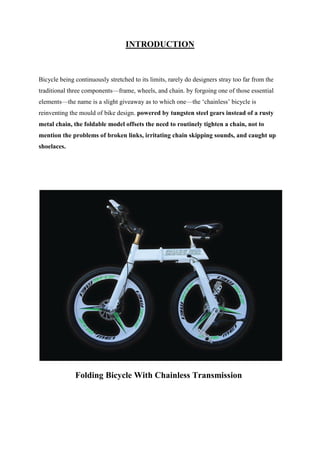
Folding Bicycle With Chainless Transmission
Created by sean chan, the chainless wants to bring back the excitement of riding a
bike. Using shimano gear transition, the model is able to work its way around tiny
corners and sharp turns, even giving the rider the capacity to cycle in a tight, 360 degree
circle. by swapping a traditional chain for abrasion and heat-resistant tungsten steel gears
alongside full system disk brakes, chainless sacrifices unnecessary parts in favor of increased
agility.
the lightweight bike is also available in a foldable version, that can fit into the trunk of any
car yet goes from portability to riding mode in less that 15 seconds. the ‘chainless’ uses
‘lock-n-go’ technology, which does exactly what you’d imagine—simply unfold the bike,
lock it into place, and you’re good to go. with magnesium allow wheels and a built-in
kickstand, the chainless S1 simply reduces the classic bike to its most essential elements.
founder and creator sean chan neatly epitomizes the design, summing up that ’hopping on a
chainless bike will give the rider a sense of freedom where other bikes fail to do.’
Well done sean chan – the only creative mind in a desert of American trash. If I were to talk
to you for an hour you might stop taking this further and start on something even better – one
“secret” is wheel size. Another is parallel wheels. You don’t want to arrive and have to “store
the bike somewhere”. Smart people arrive and have their own seat below them. But as you are
far enough along the track with this invention I don’t want to steal your momentum, I just want
people to waken up to the fact that they have been conned for just 150 years – by the auto
industry who don’t want to see people running around using human power – and they will pay
anything to stop that happening. Musk is allowed to continue because he is also selling crap –
the batteries – junk which will burden you all some day. Think beyond, don’t be limited by
yanky thinking, keep it up and step one stage further – contact
me. https://www.youtube.com/watch?v=5f_B1L_wc1s is where I found your invention and if
you read my comment you will see I am for real.
I am not doing this for money, I am doing it because I see that we are burning the planet and
we don’t need to, we need to connect, we need to grasp what is possible and then someone can
implement the idea and I can at last go whizzing past the dirtbags, on human power.
Basic Principle Of Paddle Power
The power levels that a human being can produce through pedaling depend on how strong the
peddler is and on how long he or she needs to pedal. If the task to be powered will continue
for hours at a time, 75 watts mechanical power is generally considered the limit for a larger,
healthy non-athlete. A healthy athletic person of the same build might produce up to twice
this amount. A person who is smaller and less well nourished, but not ill, would produce less;
the estimate for such a person should Probability be 50 wattfor the same kind of power
production over an extended period.
limits for pedaling under optimum conditions. The meaning of these curves is that any point
on a curve indicates the maximum time that the appropriate class of person could maintain
the given average power level.
Power levels are also directly related to the environment of the person doing the pedaling. To
be able to continue pedaling over an extended period, a person must be able to keep cool--
whether because the ambient temperature is low enough, or because there is adequate breeze
There is a vital difference between pedaling a stationary device and pedaling a bicycle at the
same power output. On a bicycle, much of the pedaling energy goes into overcoming wind
resistance; this wind resistance, however, provides an important benefit: cooling. Because of
the wind, even in hot, humid climates, so long as the bicyclist drinks enough liquids,
dehydration and heat stroke are unlikely to occur.
On the other hand, when pedaling a stationary device on a hot or humid day at more than
about half the maximum possible power output, there is a considerable danger of the
peddler's collapsing because of an excessive rise in body temperature. Therefore, it is
essential that an individual pedaling such a stationary device in hot or humid conditions be
provided with shade from the sun, plenty of water, and preferably some sort of fan. A portion
of the power that the peddler is producing can be used to drive this fan; this is an efficient use
for the power, since it will help prevent damage to the peddler's health.
1.1.1 Paddling Rate
How fast should a person pedal? Human beings are very adaptable and can produce power over
a wide range of pedaling speeds. However, people can produce more power--or the same
amount of power for a longer time--if they pedal at a certain rate. This rate varies from person
to person depending on their physical condition, but for each individual there is a pedaling
speed somewhere between straining and flailing that is the most comfortable, and the most
efficient in terms of power production. (For centuries, this fact was apparently not recognized.
The predominant method of human power production was to strain with maximum strength
against a slowly yielding resistance. This is neither comfortable nor efficient. Neither is the
opposite extreme of flailing at full speed against a very small resistance.
Project Overview
It is based on very simple concept. The new chainless bike has been built with
dedicated sprocket that are driven directly by a crank on the rear wheel. This means that ... We
see particular advantages for commuters; for one thing, removing the chain allows
the bike to fold up into a very compact and portable form factor.
When we apply the force for rotate the paddle of cycle the force is transform in by the
chainless drive and than power of force apply to rotate the rear wheel of the cycle which act
as the flywheel. Rear wheel of the cycle store the energy for minimum rotation input. After
then the energy transform from rear wheel to the sprocket which is connected to the shaft
and shaft is also power transmission of rear wheel. This transmission of the energy produce
the energy like as the energy of giving the rider the capacity to cycle in a tight but in this
project this is work for two thing one is riding the cycle and other one is exercise cycle.
Application of chainless cycle
the chainless wants to bring back the excitement of riding a bike. using
shimano sprocket transition, the model is able to work it's way ar. ... giving the rider the
capacity to cycle in a tight, 360 degree circle. by swapping a traditional chain for abrasion
and heat-resistant steel sprocket .
By forgoing one of those essential elements—the name is a slight giveaway as to which
one—the 'chainless' bicycle is reinventing the mold of bike design. Powered by steel
sprocket instead of a rusty metal chain, the foldable model offsets the need to routinely
tighten a chain,
Objectives
1. To device a concept for a novel product built from specific material.
2. To fabricate such device which operated by human effort (by cycling the paddle), the power
develop is used to ride Chainless Transmission Bicycle.
3. To research the potential sources for the chosen specific material to establish its availability
and quality.
4. To analysis the market and select the market segment/s that the product will be aimed at.
5. To develop a basic design for the product taking into consideration the requirements of the
potential customers from the chosen market segments.
6. To take into consideration the cost, scale and methods used to manufacture the product and
optimize the design accordingly.
Literature review
For years bicycles have been running on the same format. Being chained and ridden like any
bicycle with no excitement. The Chainless is breaking this cycle and bringing a new breed of
riding form to the biking industry. The name says it all, free from chains and giving the rider
the excitement and experience of riding again. Chainless is two forms of bike in one. Changes
from being a traditional bicycle to trick mode in seconds. Utilizing modern technology and
style unseen before on the road , this is the Chainless.or years bicycles have been running on
the same format. Being chained and ridden like any bicycle with no excitement. The Chainless
is breaking this cycle and bringing a new breed of riding form to the biking industry. The name
says it all, free from chains and giving the rider the excitement and experience of riding again.
Chainless is two forms of bike in one. Changes from being a traditional bicycle to trick mode
in seconds.
HISTORY
The Chainless was created by Sean Chan. "I was sick of bicycle chain maintenance and
wanted to develop a chainless bicycle. After several years of prototypes and engineering help
from my father the Chainless was born and ready to be shown to the world.
modern technology and style unseen before on the road , this is the Chainless.
comfortabiliy
We wanted to create a bicycle that was comfortable from front to back. Chainless
is fully adjustable so rider optimization is quick and easy.
versatility
Different riding conditions reuire different types of bikes. From riding in a rainy
city to hitting the sunny trails, Chainless does it all.
portability
Chainless is a full-size bike that is small enough to be put into a compact car, light
enough to be carrier up and down stairs and thin enough to be stored in a closet.
CHAINLESS
Bicycle chains can be a problem for many reasons: Shoelaces get caught, chain links can
break while in operation and the routine need to tighten the chain can leave you stranded
without the proper tools. Chainless is tungsten steel driven so no chains, no worries.
Unfortunately We Did Not Meet Our Funding Goal On Kickstarter. We Will Be Moving
Onto Further Development On The Chainless. The Unreleased Versions Of The Chainless
Are Now Up For Grabs.
HOPPING ON A CHAINLESS BIKE WILL GIVE THE
RIDER A SENSE OF FREEDOM WHERE OTHER BIKES
FAIL TO DO
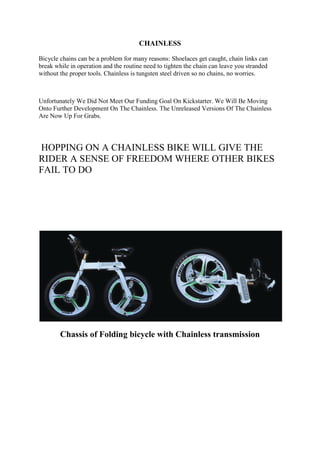
Chassis of Folding bicycle with Chainless transmission
M
Methodology
Bearing
A bearing is a machine element which support another moving machine element (known as
journal). It permits a relative motion between the contact surfaces of the members, while
carrying the load. A little consideration will show that due to the relative motion between the
contact surfaces, a certain amount of power is wasted in overcoming frictional resistance and
if the rubbing surfaces are in direct contact, there will be rapid wear. In order to reduce
frictional resistance and wear and in some cases to carry away the heat generated, a layer of
fluid (known as lubricant) may be provided. The lubricant used to separate the journal and
bearing is usually a mineral oil refined from petroleum, but vegetable oils, silicon oils,
greases etc., may be used.
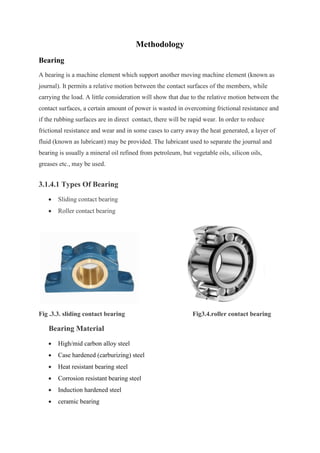
3.1.4.1 Types Of Bearing
 Sliding contact bearing
 Roller contact bearing
Fig .3.3. sliding contact bearing Fig3.4.roller contact bearing
Bearing Material
 High/mid carbon alloy steel
 Case hardened (carburizing) steel
 Heat resistant bearing steel
 Corrosion resistant bearing steel
 Induction hardened steel
 ceramic bearing
Sprocket
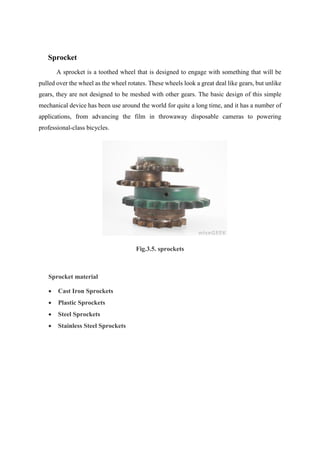
A sprocket is a toothed wheel that is designed to engage with something that will be
pulled over the wheel as the wheel rotates. These wheels look a great deal like gears, but unlike
gears, they are not designed to be meshed with other gears. The basic design of this simple
mechanical device has been use around the world for quite a long time, and it has a number of
applications, from advancing the film in throwaway disposable cameras to powering
professional-class bicycles.
Fig.3.5. sprockets
Sprocket material
 Cast Iron Sprockets
 Plastic Sprockets
 Steel Sprockets
 Stainless Steel Sprockets
Chassis
Chassis is a French term which denotes the whole vehicle except body in case of heavy
vehicles. In case of light vehicles of mono construction it denotes the whole body except
additional fitting in the body. Chassis consists of engine, brakes, steering system & wheel
mounted on the frame, differential, suspension.
Function Of Chassis
 To safety carry the maximum load.
 Holding all components together while driving.
 Accommodate twisting on even road surface.
 Endure shock loading.
 It must absorb engine & driveline torque.
Welding
is a fabrication or sculptural process that joins materials, usually metals or thermoplastics, by
causing fusion, which is distinct from lower temperature metal-joining techniques such as
brazing and soldering, which do not melt the base metal. In addition to melting the base
metal, a filler material is typically added to the joint to form a pool of molten material (the
weld pool) that cools to form a joint that is usually stronger than the base material. Pressure
may also be used in conjunction with heat, or by itself, to produce a weld. Welding also
requires a form of shield to protect the filler metals or melted metals from being
contaminated or oxidized.
Although less common, there are also solid state welding processes such as friction welding
in which metal does not melt.
Some of the best known welding methods include:
 Oxy-fuel welding – also known as oxyacetylene welding or oxy welding, uses fuel
gases and oxygen to weld and cut metals.
 Shielded metal arc welding (SMAW) – also known as "stick welding" or "electric
welding", uses an electrode that is coated in flux to protect the weld puddle. The
electrode holder holds the electrode as it slowly melts away. Slag protects the weld
puddle from atmospheric contamination.
 Gas tungsten arc welding (GTAW) – also known as TIG (tungsten, inert gas), uses a
non-consumable tungsten electrode to produce the weld. The weld area is protected
from atmospheric contamination by an inert shielding gas such as argon or helium.
 Gas metal arc welding (GMAW) – commonly termed MIG (metal, inert gas), uses a
wire feeding gun that feeds wire at an adjustable speed and flows an argon-based
shielding gas or a mix of argon and carbon dioxide (CO2) over the weld puddle to
protect it from atmospheric contamination.
 Flux-cored arc welding (FCAW) – almost identical to MIG welding except it uses a
special tubular wire filled with flux; it can be used with or without shielding gas,
depending on the filler.
 Submerged arc welding (SAW) – uses an automatically fed consumable electrode and
a blanket of granular fusible flux. The molten weld and the arc zone are protected
from atmospheric contamination by being "submerged" under the flux blanket.
 Electroslag welding (ESW) – a highly productive, single pass welding process for
thicker materials between 1 inch (25 mm) and 12 inches (300 mm) in a vertical or
close to vertical position.
 Electric resistance welding (ERW) – a welding process that produces coalescence of
laying surfaces where heat to form the weld is generated by the electrical resistance
of the material. In general, an efficient method, but limited to relatively thin
material.
Many different energy sources can be used for welding, including a gas flame, an electric arc,
a laser, an electron beam, friction, and ultrasound. While often an industrial process, welding
may be performed in many different environments, including in open air, under water, and in
outer space. Welding is a hazardous undertaking and precautions are required to avoid burns,
electric shock, vision damage, inhalation of poisonous gases and fumes, and exposure to
intense ultraviolet radiation.
Until the end of the 19th century, the only welding process was forge welding, which
blacksmiths had used for millennia to join iron and steel by heating and hammering. Arc
welding and oxyfuel welding were among the first processes to develop late in the century,
and electric resistance welding followed soon after. Welding technology advanced quickly
during the early 20th century as the world wars drove the demand for reliable and
inexpensive joining methods. Following the wars, several modern welding techniques were
developed, including manual methods like SMAW, now one of the most popular welding
methods, as well as semi-automatic and automatic processes such as GMAW, SAW, FCAW
and ESW. Developments continued with the invention of laser beam welding, electron beam
welding, magnetic pulse welding (MPW), and friction stir welding in the latter half of the
century. Today, the science continues to advance. Robot welding is commonplace in
industrial settings, and researchers continue to develop new welding methods and gain
greater understanding of weld quality.
Arc welding
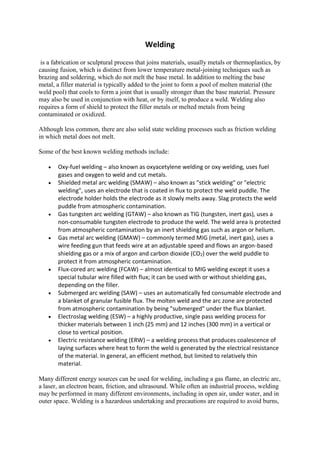
Man welding a metal structure in a newly constructed house in Bengaluru, India
These processes use a welding power supply to create and maintain an electric arc between
an electrode and the base material to melt metals at the welding point. They can use either
direct current (DC) or alternating current (AC), and consumable or non-consumable
electrodes. The welding region is sometimes protected by some type of inert or semi-inert
gas, known as a shielding gas, and filler material is sometimes used as well.
Power supplies
To supply the electrical power necessary for arc welding processes, a variety of different
power supplies can be used. The most common welding power supplies are constant current
power supplies and constant voltage power supplies. In arc welding, the length of the arc is
directly related to the voltage, and the amount of heat input is related to the current. Constant
current power supplies are most often used for manual welding processes such as gas
tungsten arc welding and shielded metal arc welding, because they maintain a relatively
constant current even as the voltage varies. This is important because in manual welding, it
can be difficult to hold the electrode perfectly steady, and as a result, the arc length and thus
voltage tend to fluctuate. Constant voltage power supplies hold the voltage constant and vary
the current, and as a result, are most often used for automated welding processes such as gas
metal arc welding, flux cored arc welding, and submerged arc welding. In these processes,
arc length is kept constant, since any fluctuation in the distance between the wire and the base
material is quickly rectified by a large change in current. For example, if the wire and the
base material get too close, the current will rapidly increase, which in turn causes the heat to
increase and the tip of the wire to melt, returning it to its original separation distance.
The type of current used plays an important role in arc welding. Consumable electrode
processes such as shielded metal arc welding and gas metal arc welding generally use direct
current, but the electrode can be charged either positively or negatively. In welding, the
positively charged anode will have a greater heat concentration, and as a result, changing the
polarity of the electrode affects weld properties. If the electrode is positively charged, the
base metal will be hotter, increasing weld penetration and welding speed. Alternatively, a
negatively charged electrode results in more shallow welds. Nonconsumable electrode
processes, such as gas tungsten arc welding, can use either type of direct current, as well as
alternating current. However, with direct current, because the electrode only creates the arc
and does not provide filler material, a positively charged electrode causes shallow welds,
while a negatively charged electrode makes deeper welds. Alternating current rapidly moves
between these two, resulting in medium-penetration welds. One disadvantage of AC, the fact
that the arc must be re-ignited after every zero crossing, has been addressed with the
invention of special power units that produce a square wave pattern instead of the normal sine
wave, making rapid zero crossings possible and minimizing the effects of the problem.
Processes
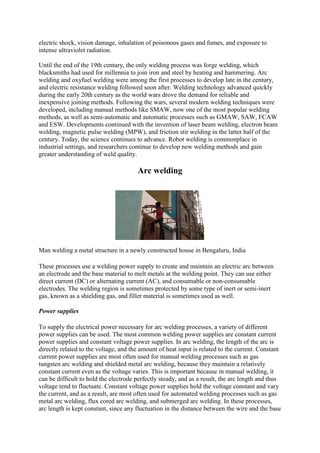
One of the most common types of arc welding is shielded metal arc welding (SMAW) it is
also known as manual metal arc welding (MMA) or stick welding. Electric current is used to
strike an arc between the base material and consumable electrode rod, which is made of filler
material (typically steel) and is covered with a flux that protects the weld area from oxidation
and contamination by producing carbon dioxide (CO2) gas during the welding process. The
electrode core itself acts as filler material, making a separate filler unnecessary.
Shielded metal arc welding
The process is versatile and can be performed with relatively inexpensive equipment, making
it well suited to shop jobs and field work. An operator can become reasonably proficient with
a modest amount of training and can achieve mastery with experience. Weld times are rather
slow, since the consumable electrodes must be frequently replaced and because slag, the
residue from the flux, must be chipped away after welding. Furthermore, the process is
generally limited to welding ferrous materials, though special electrodes have made possible
the welding of cast iron, nickel, aluminum, copper, and other metals.
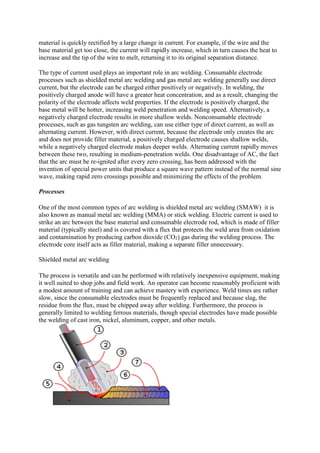
Diagram of arc and weld area, in shielded metal arc welding.
1. Coating Flow
2. Rod
3. Shield Gas
4. Fusion
5. Base metal
6. Weld metal
7. Solidified Slag
Gas metal arc welding (GMAW), also known as metal inert gas or MIG welding, is a semi-
automatic or automatic process that uses a continuous wire feed as an electrode and an inert
or semi-inert gas mixture to protect the weld from contamination. Since the electrode is
continuous, welding speeds are greater for GMAW than for SMAW.
A related process, flux-cored arc welding (FCAW), uses similar equipment but uses wire
consisting of a steel electrode surrounding a powder fill material. This cored wire is more
expensive than the standard solid wire and can generate fumes and/or slag, but it permits even
higher welding speed and greater metal penetration.
Gas tungsten arc welding (GTAW), or tungsten inert gas (TIG) welding, is a manual welding
process that uses a nonconsumable tungsten electrode, an inert or semi-inert gas mixture, and
a separate filler material. Especially useful for welding thin materials, this method is
characterized by a stable arc and high quality welds, but it requires significant operator skill
and can only be accomplished at relatively low speeds.
GTAW can be used on nearly all weldable metals, though it is most often applied to stainless
steel and light metals. It is often used when quality welds are extremely important, such as in
bicycle, aircraft and naval applications. A related process, plasma arc welding, also uses a
tungsten electrode but uses plasma gas to make the arc. The arc is more concentrated than the
GTAW arc, making transverse control more critical and thus generally restricting the
technique to a mechanized process. Because of its stable current, the method can be used on a
wider range of material thicknesses than can the GTAW process and it is much faster. It can
be applied to all of the same materials as GTAW except magnesium, and automated welding
of stainless steel is one important application of the process. A variation of the process is
plasma cutting, an efficient steel cutting process
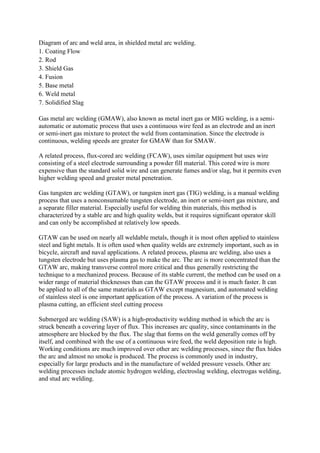
Submerged arc welding (SAW) is a high-productivity welding method in which the arc is
struck beneath a covering layer of flux. This increases arc quality, since contaminants in the
atmosphere are blocked by the flux. The slag that forms on the weld generally comes off by
itself, and combined with the use of a continuous wire feed, the weld deposition rate is high.
Working conditions are much improved over other arc welding processes, since the flux hides
the arc and almost no smoke is produced. The process is commonly used in industry,
especially for large products and in the manufacture of welded pressure vessels. Other arc
welding processes include atomic hydrogen welding, electroslag welding, electrogas welding,
and stud arc welding.
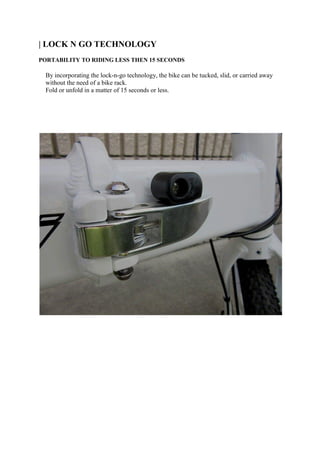
| LOCK N GO TECHNOLOGY
PORTABILITY TO RIDING LESS THEN 15 SECONDS
By incorporating the lock-n-go technology, the bike can be tucked, slid, or carried away
without the need of a bike rack.
Fold or unfold in a matter of 15 seconds or less.
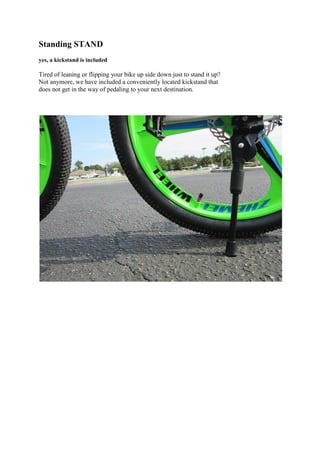
Standing STAND
yes, a kickstand is included
Tired of leaning or flipping your bike up side down just to stand it up?
Not anymore, we have included a conveniently located kickstand that
does not get in the way of pedaling to your next destination.
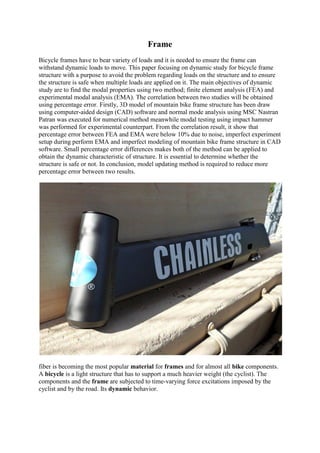
Frame
Bicycle frames have to bear variety of loads and it is needed to ensure the frame can
withstand dynamic loads to move. This paper focusing on dynamic study for bicycle frame
structure with a purpose to avoid the problem regarding loads on the structure and to ensure
the structure is safe when multiple loads are applied on it. The main objectives of dynamic
study are to find the modal properties using two method; finite element analysis (FEA) and
experimental modal analysis (EMA). The correlation between two studies will be obtained
using percentage error. Firstly, 3D model of mountain bike frame structure has been draw
using computer-aided design (CAD) software and normal mode analysis using MSC Nastran
Patran was executed for numerical method meanwhile modal testing using impact hammer
was performed for experimental counterpart. From the correlation result, it show that
percentage error between FEA and EMA were below 10% due to noise, imperfect experiment
setup during perform EMA and imperfect modeling of mountain bike frame structure in CAD
software. Small percentage error differences makes both of the method can be applied to
obtain the dynamic characteristic of structure. It is essential to determine whether the
structure is safe or not. In conclusion, model updating method is required to reduce more
percentage error between two results.
fiber is becoming the most popular material for frames and for almost all bike components.
A bicycle is a light structure that has to support a much heavier weight (the cyclist). The
components and the frame are subjected to time-varying force excitations imposed by the
cyclist and by the road. Its dynamic behavior.
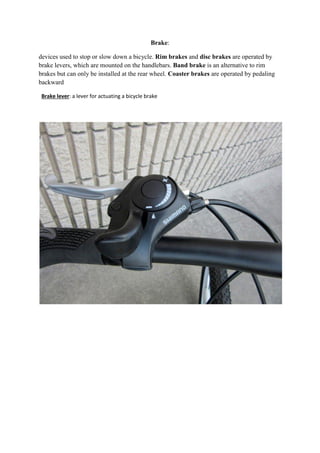
Brake:
devices used to stop or slow down a bicycle. Rim brakes and disc brakes are operated by
brake levers, which are mounted on the handlebars. Band brake is an alternative to rim
brakes but can only be installed at the rear wheel. Coaster brakes are operated by pedaling
backward
Brake lever: a lever for actuating a bicycle brake
Saddle of Bicycle
A bicycle saddle, often called a seat,[1]
is one of three contact points on an upright bicycle,
the others being the pedals and the handlebars. (A bicycle seat in the specific sense also
supports the back.) The bicycle saddle has been known as such since the bicycle evolved
from the draisine, a forerunner of the bicycle.[2][3]
It performs a similar role as a horse's
saddle, not bearing all the weight of the rider as the other contact points also take some of the
load.
A bicycle saddle is commonly attached to the seatpost and the height of the saddle can
usually be adjusted by the seatpost telescoping in and out of the seat tube.
Seat or saddle, which is it?
here are a number of misconceptions about the saddle. The first is calling or thinking of it as
a seat. A seat is designed to bear your entire weight, while a saddle is something that carries
you, but not all of your weight.
Measure the horizontal distance between the nose of the seat and the handlebars.
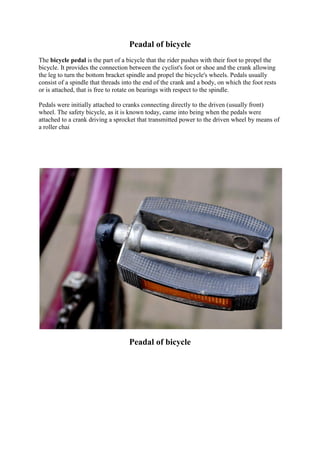
Peadal of bicycle
The bicycle pedal is the part of a bicycle that the rider pushes with their foot to propel the
bicycle. It provides the connection between the cyclist's foot or shoe and the crank allowing
the leg to turn the bottom bracket spindle and propel the bicycle's wheels. Pedals usually
consist of a spindle that threads into the end of the crank and a body, on which the foot rests
or is attached, that is free to rotate on bearings with respect to the spindle.
Pedals were initially attached to cranks connecting directly to the driven (usually front)
wheel. The safety bicycle, as it is known today, came into being when the pedals were
attached to a crank driving a sprocket that transmitted power to the driven wheel by means of
a roller chai
Peadal of bicycle
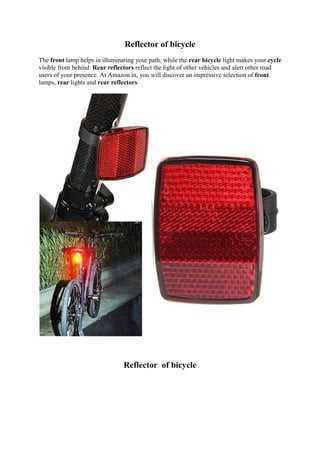
Reflector of bicycle
The front lamp helps in illuminating your path, while the rear bicycle light makes your cycle
visible from behind. Rear reflectors reflect the light of other vehicles and alert other road
users of your presence. At Amazon.in, you will discover an impressive selection of front
lamps, rear lights and rear reflectors
Reflector of bicycle
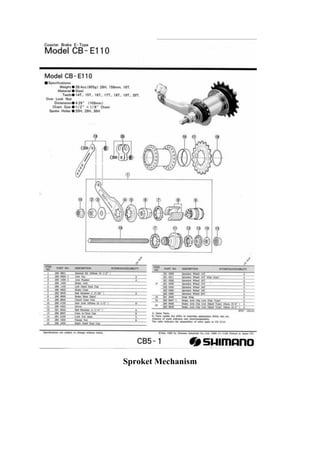
Sproket Mechanism
ADVANTAGE
 Less jamming.
 No chain bite.
 High efficiency than chain drive cycle.
 Greater clearance.
 It protect our cloths better.
 Its turninig radius in less comprassion to another Bicycle.
 It is a exersise Bicycle.
 Its rear wheel rotate on 180 Degree.
 It is a folding cycle and we can easily to carry any places where we can ride.
Disadvantage
 Heavier weight usually 1-2 pounds.
 Wheel removal can be complicated.
 This cycle is not drive easily compare to other cycle.
 Pedal are attached in rear wheel to need high effort to operate the peadl to drive
cyclce.

List of bicycle parts
Axle: as in the generic definition, a rod that serves to attach a wheel to a bicycle and provides
support for bearings on which the wheel rotates. Also sometimes used to describe suspension
components, for example a swing arm pivot axle
Bearing: a device that facilitates rotation by reducing friction
Bell: an audible device for warning pedestrians and other cyclists
Brake: devices used to stop or slow down a bicycle. Rim brakes and disc brakes are operated
by brake levers, which are mounted on the handlebars. Band brake is an alternative to rim
brakes but can only be installed at the rear wheel. Coaster brakes are operated by pedaling
backward
Brake lever: a lever for actuating a bicycle brake.
Freewheel: a ratcheting assembly that incorporates one or more cogs and allows the bicycle
to coast without the pedals turninging a bicycle brake
Frame: the mechanical core of a bicycle, the frame provides points of attachment for the
various components that make up the machine. The term is variously construed, and can refer
to the base section, always including the bottom bracket, or to base frame, fork, and suspension
components such as a shock absorb
Handlebar: a lever attached, usually using an intermediary stem, to the steerer tube of the
fork. Allows steering and provides a point of attachment for controls and accessories
Locknut: a nut designed not to loosen due to vibration
Kickstand: a folding attachment used for assisting a bicycle to stand up on its own. Usually
mounts to frame near bottom bracket, sometimes near rear dropouts
Pedal: mechanical interface between foot and crank arm. There are two general types; one
secures the foot with a mechanical clamp or cage and the other has no connection to lock the
foot to the pedal
Reflector: reflects light to make bicycle evident when the illuminated by headlights of other
vehicles. Usually required by law but held in disdain by many cyclist
Rim: that part of a wheel to which the tire is attached and often forms part of the braking
mechanism
Spindle: an axle around which a pedal rotates; threaded at one end to screw into crank arms
Spoke: connects wheel rim to hub. Usually wire with one end swaged to form a head and one
threaded end. A typical wheel has 36 spoke
Wheel: as in common usage. Traditionally and most commonly spoked
Tire: as in common usage. Usually pneumatic. A tubular tire is glued to the wheel rim; most
tires use tubes, but tubeless tires and rims are increasingly common.
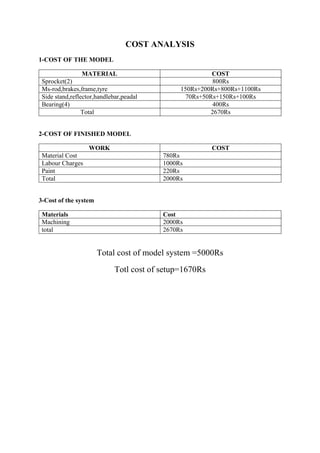
COST ANALYSIS
1-COST OF THE MODEL
MATERIAL COST
Sprocket(2) 800Rs
Ms-rod,brakes,frame,tyre 150Rs+200Rs+800Rs+1100Rs
Side stand,reflector,handlebar,peadal 70Rs+50Rs+150Rs+100Rs
Bearing(4) 400Rs
Total 2670Rs
2-COST OF FINISHED MODEL
WORK COST
Material Cost 780Rs
Labour Charges 1000Rs
Paint 220Rs
Total 2000Rs
3-Cost of the system
Materials Cost
Machining 2000Rs
total 2670Rs
Total cost of model system =5000Rs
Totl cost of setup=1670Rs
Result And Conclusion
 In the beginning,chainless bikes were less efficient than standard bikes but the
changes in technology allowed them to reach a level of efficiency that made them
practical for day by day use.
 The presented work was aimed to reduce the wastage of human power (energy) on
Bicycle riding or any machine ,which employs drive with steel sprocket power which
is connected to the shaft in rear wheels drive.
 In general it is achieved by using light wieght drive chainless bicycle with steel
sprocket which is given shape with the help of lathe machine.
 The design of chainless transmission bicycle is critical as it is subjected to combined
loads.
REFREEFERANCES
Your Opportunity To Grab These Are Bikes For Sale THROUGH UNO BOLT STORE.
 Rs Khurmi JK Gupta‘ A Text Book of Machine Design” S CHAND 2005.
 B.D. Sinalkar “Design Data for Machine Elements” Deneett,2013
 J E Shingle & Bijagrare PG Maher & V.N Mujbaule”Design Optimization & Analysis
of Drive Shaft Vol 2(6) 2012 210-215
Websites
Dynamicbicycle.com
www.engineeringgtoolbox.com
http//www.e-book.com/bicycles-review
http//www.mountaincycle.com/powerbicycle.htm.
Folding cycle with chainless transmission

Folding cycle with chainless transmission

  • 1.
    A PROJECT REPORTON “ Folding Bicycle With Chainless Transmission” A MAJOR PROJECT Submitted in Partial fulfillment of the requirements For the award of the Diploma in Mechanical (Automobile) Engineering Rudrapur Institute of Technology (An Institute Affiliated to UBTER) Submitted by Mandeep Singh Ajay Kumar Maurya Shashank Upadhyay Under the Guidance of Ms. Honey Banga Lecturer Department of Mechanical (Automobile) Engineering Rudrapur Institute of Technology 2017-18
  • 3.
    Acknowledgement It is ourgreat pleasrue to present the Project Report on “Folding Bicycle with Chainless Transmission”. First of all we want to thanks Mr. A. N. Verma (Principal) for allowing us to use the college resources in preparing the Project. I wish to express my deep gratitude to my project guide Ms. Honey Banga,(Lecturer) Department of Mechanical (Automobile)Engineering for his valuable guidance, consistent encouragement and thoughtful ideas throughout the execution of this work. This work is simply the reflection of his thoughts, ideas and concepts and efforts. Working under her guidance was a privilege and an excellent learning experience that I will cherish for a long time. I also wish to thank Mr. Sanjay Pathak (Head of Department),Mr.Dharamendra Kamboj (Lecturer) for their valuable suggestions and fruitful discussions related to this work. I would like to thank Mr. Yogesh Negi (Workshop Incharge) for all his help and support. I also like to thank all the Teaching, Technical and Non-Technical staffs of Rudrapur Institute of Technology. I wish to mention the blessings received from my parents during my Project work. Lastly I would like to thank all my friends for all their support and help without which this work could not have been possible. Ajay Maurya Mandeep Singh Shashank Upadhyay
  • 4.
    Candidate’s Declaration We herebydeclare that the work, which is being presented in the Project Report entitled “Folding Bicycle With Chainless Transmission ”, in the partial fulfillment of the requirements for the award of “Diploma” in Mechanical (Automobile) Engineering with submitted to the Department of Mechanical (Automobile) Engineering, Rudrapur Institute of Technology, an Affiliated Institute from UBTER, is an authentic record of our own work carried out during the period from January 2018 to May 2018 under the guidance of Ms. Honey Banga, Lecturer, Department of Mechanical (Automobile) Engineering. The matter and topicspresented in the Project Report has not been submitted by me for award of any other degree or diploma elsewhere. Date: Place: Ajay Maurya (15105260002) MandeepSingh (15105260025) Shashank Upadhyay (15105260045) This is to certify that above statement made by the candidate is correct to the best of my knowledge and belief. Ms. Honey Banga (Lecturer)
  • 5.
    ABSTRACT Name : AjayKumar Maurya Mandeep Singh Shashank Uphadhyay Diploma : Polytechnic Department : Mechanical Engineering Project Title : “Folding Bicycle With Chainless Transmission” Project Guide : Ms. Honey Banga The aim is to design of chainless bicycle gets its power from tungsten steel gears is called “Folding Bicycle With Chainless Transmission” .whilst bicycle design is being continuously stretched to its limits ,rarely do designers stray too far from the traditional three components – frame,wheels ,and chain-.the ‘chainless’ bicycle is reinventing the mould of bike design powered by tungsten steel gears instead of a rusty metal chain, the foldable model offsets the need to routinely tighten a chain not to mention the problems of broken links, irritating chain skipping sounds and caught up shoelaces. Ajay Kumar Maurya Mandeep Singh Shashank Uphadhyay Ms. Honey Banga Project Guide
  • 6.
    CERTIFICATE This is tocertify that Mr. Ajay kumar Maurya, Mandeep Singh, Shashank Uphadyay are the student of final year Mechanical (Automobile) Engineering from Rudrapur Institute of Technology, Rudrapur has prepared this project “Folding Bicycle With Chainless Transmission”. He worked hard to finalize this project with great Zeal & success. I wish him for his bright future & every success in his career. Guidance of:- Ms.Honey Banga Faculty Department of Mechanical (Automobile) Engineering Mr. Prateesh Sharma Faculty Department of Mechanical (Automobile) Engineering Mr. Sanjay Pathak Head of Department Department of Mechanical (Automobile) Engineering
  • 7.
    CONTENTS 1-ACKNOWLDGEMENT 2-CANDIDATES DECLERATION 3-CERTIFICATE 4-ABSTRACT 5-INTRODUCTION 6-BASIC PRINCIRINCIPLE 7-PADDLIMGRATE 8-PROJECT OVERVIEW 9-APPLICATION OFCHAINLESS CYCLE 10-OBJECTIVES 11-LITERATURE REVIEW 12-METHODOLOGY 13-SPROCKET 14-CHASSIS 15-WELDING 16-LOCK-N-GO TECHNOLOGY 17-STANDING STAND 18-FRAME 19-SADDLE OF BICYCLE 20-BRAKE 21-PEADAL OF BICCLE 22-REFLEVTOR 23-SPROCKET MECHANISM 24-ADVANTAGES 25-DISADVANTAGES 26-LIST OF BICYCLE COMPONENT 27-COST ANALYSIS 28-REFRENCES 29-WEBSITES
  • 8.
    INTRODUCTION Bicycle being continuouslystretched to its limits, rarely do designers stray too far from the traditional three components—frame, wheels, and chain. by forgoing one of those essential elements—the name is a slight giveaway as to which one—the ‘chainless’ bicycle is reinventing the mould of bike design. powered by tungsten steel gears instead of a rusty metal chain, the foldable model offsets the need to routinely tighten a chain, not to mention the problems of broken links, irritating chain skipping sounds, and caught up shoelaces. Folding Bicycle With Chainless Transmission
  • 9.
    Created by seanchan, the chainless wants to bring back the excitement of riding a bike. Using shimano gear transition, the model is able to work its way around tiny corners and sharp turns, even giving the rider the capacity to cycle in a tight, 360 degree circle. by swapping a traditional chain for abrasion and heat-resistant tungsten steel gears alongside full system disk brakes, chainless sacrifices unnecessary parts in favor of increased agility. the lightweight bike is also available in a foldable version, that can fit into the trunk of any car yet goes from portability to riding mode in less that 15 seconds. the ‘chainless’ uses ‘lock-n-go’ technology, which does exactly what you’d imagine—simply unfold the bike, lock it into place, and you’re good to go. with magnesium allow wheels and a built-in kickstand, the chainless S1 simply reduces the classic bike to its most essential elements. founder and creator sean chan neatly epitomizes the design, summing up that ’hopping on a chainless bike will give the rider a sense of freedom where other bikes fail to do.’ Well done sean chan – the only creative mind in a desert of American trash. If I were to talk to you for an hour you might stop taking this further and start on something even better – one “secret” is wheel size. Another is parallel wheels. You don’t want to arrive and have to “store the bike somewhere”. Smart people arrive and have their own seat below them. But as you are far enough along the track with this invention I don’t want to steal your momentum, I just want people to waken up to the fact that they have been conned for just 150 years – by the auto industry who don’t want to see people running around using human power – and they will pay anything to stop that happening. Musk is allowed to continue because he is also selling crap – the batteries – junk which will burden you all some day. Think beyond, don’t be limited by yanky thinking, keep it up and step one stage further – contact me. https://www.youtube.com/watch?v=5f_B1L_wc1s is where I found your invention and if you read my comment you will see I am for real. I am not doing this for money, I am doing it because I see that we are burning the planet and we don’t need to, we need to connect, we need to grasp what is possible and then someone can implement the idea and I can at last go whizzing past the dirtbags, on human power.
  • 10.
    Basic Principle OfPaddle Power The power levels that a human being can produce through pedaling depend on how strong the peddler is and on how long he or she needs to pedal. If the task to be powered will continue for hours at a time, 75 watts mechanical power is generally considered the limit for a larger, healthy non-athlete. A healthy athletic person of the same build might produce up to twice this amount. A person who is smaller and less well nourished, but not ill, would produce less; the estimate for such a person should Probability be 50 wattfor the same kind of power production over an extended period. limits for pedaling under optimum conditions. The meaning of these curves is that any point on a curve indicates the maximum time that the appropriate class of person could maintain the given average power level. Power levels are also directly related to the environment of the person doing the pedaling. To be able to continue pedaling over an extended period, a person must be able to keep cool-- whether because the ambient temperature is low enough, or because there is adequate breeze There is a vital difference between pedaling a stationary device and pedaling a bicycle at the same power output. On a bicycle, much of the pedaling energy goes into overcoming wind resistance; this wind resistance, however, provides an important benefit: cooling. Because of the wind, even in hot, humid climates, so long as the bicyclist drinks enough liquids, dehydration and heat stroke are unlikely to occur. On the other hand, when pedaling a stationary device on a hot or humid day at more than about half the maximum possible power output, there is a considerable danger of the peddler's collapsing because of an excessive rise in body temperature. Therefore, it is essential that an individual pedaling such a stationary device in hot or humid conditions be provided with shade from the sun, plenty of water, and preferably some sort of fan. A portion of the power that the peddler is producing can be used to drive this fan; this is an efficient use for the power, since it will help prevent damage to the peddler's health.
  • 11.
    1.1.1 Paddling Rate Howfast should a person pedal? Human beings are very adaptable and can produce power over a wide range of pedaling speeds. However, people can produce more power--or the same amount of power for a longer time--if they pedal at a certain rate. This rate varies from person to person depending on their physical condition, but for each individual there is a pedaling speed somewhere between straining and flailing that is the most comfortable, and the most efficient in terms of power production. (For centuries, this fact was apparently not recognized. The predominant method of human power production was to strain with maximum strength against a slowly yielding resistance. This is neither comfortable nor efficient. Neither is the opposite extreme of flailing at full speed against a very small resistance.
  • 12.
    Project Overview It isbased on very simple concept. The new chainless bike has been built with dedicated sprocket that are driven directly by a crank on the rear wheel. This means that ... We see particular advantages for commuters; for one thing, removing the chain allows the bike to fold up into a very compact and portable form factor. When we apply the force for rotate the paddle of cycle the force is transform in by the chainless drive and than power of force apply to rotate the rear wheel of the cycle which act as the flywheel. Rear wheel of the cycle store the energy for minimum rotation input. After then the energy transform from rear wheel to the sprocket which is connected to the shaft and shaft is also power transmission of rear wheel. This transmission of the energy produce the energy like as the energy of giving the rider the capacity to cycle in a tight but in this project this is work for two thing one is riding the cycle and other one is exercise cycle.
  • 13.
    Application of chainlesscycle the chainless wants to bring back the excitement of riding a bike. using shimano sprocket transition, the model is able to work it's way ar. ... giving the rider the capacity to cycle in a tight, 360 degree circle. by swapping a traditional chain for abrasion and heat-resistant steel sprocket . By forgoing one of those essential elements—the name is a slight giveaway as to which one—the 'chainless' bicycle is reinventing the mold of bike design. Powered by steel sprocket instead of a rusty metal chain, the foldable model offsets the need to routinely tighten a chain,
  • 14.
    Objectives 1. To devicea concept for a novel product built from specific material. 2. To fabricate such device which operated by human effort (by cycling the paddle), the power develop is used to ride Chainless Transmission Bicycle. 3. To research the potential sources for the chosen specific material to establish its availability and quality. 4. To analysis the market and select the market segment/s that the product will be aimed at. 5. To develop a basic design for the product taking into consideration the requirements of the potential customers from the chosen market segments. 6. To take into consideration the cost, scale and methods used to manufacture the product and optimize the design accordingly.
  • 15.
    Literature review For yearsbicycles have been running on the same format. Being chained and ridden like any bicycle with no excitement. The Chainless is breaking this cycle and bringing a new breed of riding form to the biking industry. The name says it all, free from chains and giving the rider the excitement and experience of riding again. Chainless is two forms of bike in one. Changes from being a traditional bicycle to trick mode in seconds. Utilizing modern technology and style unseen before on the road , this is the Chainless.or years bicycles have been running on the same format. Being chained and ridden like any bicycle with no excitement. The Chainless is breaking this cycle and bringing a new breed of riding form to the biking industry. The name says it all, free from chains and giving the rider the excitement and experience of riding again. Chainless is two forms of bike in one. Changes from being a traditional bicycle to trick mode in seconds. HISTORY The Chainless was created by Sean Chan. "I was sick of bicycle chain maintenance and wanted to develop a chainless bicycle. After several years of prototypes and engineering help from my father the Chainless was born and ready to be shown to the world. modern technology and style unseen before on the road , this is the Chainless. comfortabiliy We wanted to create a bicycle that was comfortable from front to back. Chainless is fully adjustable so rider optimization is quick and easy. versatility Different riding conditions reuire different types of bikes. From riding in a rainy city to hitting the sunny trails, Chainless does it all. portability Chainless is a full-size bike that is small enough to be put into a compact car, light enough to be carrier up and down stairs and thin enough to be stored in a closet.
  • 16.
    CHAINLESS Bicycle chains canbe a problem for many reasons: Shoelaces get caught, chain links can break while in operation and the routine need to tighten the chain can leave you stranded without the proper tools. Chainless is tungsten steel driven so no chains, no worries. Unfortunately We Did Not Meet Our Funding Goal On Kickstarter. We Will Be Moving Onto Further Development On The Chainless. The Unreleased Versions Of The Chainless Are Now Up For Grabs. HOPPING ON A CHAINLESS BIKE WILL GIVE THE RIDER A SENSE OF FREEDOM WHERE OTHER BIKES FAIL TO DO Chassis of Folding bicycle with Chainless transmission M
  • 17.
    Methodology Bearing A bearing isa machine element which support another moving machine element (known as journal). It permits a relative motion between the contact surfaces of the members, while carrying the load. A little consideration will show that due to the relative motion between the contact surfaces, a certain amount of power is wasted in overcoming frictional resistance and if the rubbing surfaces are in direct contact, there will be rapid wear. In order to reduce frictional resistance and wear and in some cases to carry away the heat generated, a layer of fluid (known as lubricant) may be provided. The lubricant used to separate the journal and bearing is usually a mineral oil refined from petroleum, but vegetable oils, silicon oils, greases etc., may be used. 3.1.4.1 Types Of Bearing  Sliding contact bearing  Roller contact bearing Fig .3.3. sliding contact bearing Fig3.4.roller contact bearing Bearing Material  High/mid carbon alloy steel  Case hardened (carburizing) steel  Heat resistant bearing steel  Corrosion resistant bearing steel  Induction hardened steel  ceramic bearing
  • 18.
    Sprocket A sprocket isa toothed wheel that is designed to engage with something that will be pulled over the wheel as the wheel rotates. These wheels look a great deal like gears, but unlike gears, they are not designed to be meshed with other gears. The basic design of this simple mechanical device has been use around the world for quite a long time, and it has a number of applications, from advancing the film in throwaway disposable cameras to powering professional-class bicycles. Fig.3.5. sprockets Sprocket material  Cast Iron Sprockets  Plastic Sprockets  Steel Sprockets  Stainless Steel Sprockets
  • 19.
    Chassis Chassis is aFrench term which denotes the whole vehicle except body in case of heavy vehicles. In case of light vehicles of mono construction it denotes the whole body except additional fitting in the body. Chassis consists of engine, brakes, steering system & wheel mounted on the frame, differential, suspension. Function Of Chassis  To safety carry the maximum load.  Holding all components together while driving.  Accommodate twisting on even road surface.  Endure shock loading.  It must absorb engine & driveline torque.
  • 20.
    Welding is a fabricationor sculptural process that joins materials, usually metals or thermoplastics, by causing fusion, which is distinct from lower temperature metal-joining techniques such as brazing and soldering, which do not melt the base metal. In addition to melting the base metal, a filler material is typically added to the joint to form a pool of molten material (the weld pool) that cools to form a joint that is usually stronger than the base material. Pressure may also be used in conjunction with heat, or by itself, to produce a weld. Welding also requires a form of shield to protect the filler metals or melted metals from being contaminated or oxidized. Although less common, there are also solid state welding processes such as friction welding in which metal does not melt. Some of the best known welding methods include:  Oxy-fuel welding – also known as oxyacetylene welding or oxy welding, uses fuel gases and oxygen to weld and cut metals.  Shielded metal arc welding (SMAW) – also known as "stick welding" or "electric welding", uses an electrode that is coated in flux to protect the weld puddle. The electrode holder holds the electrode as it slowly melts away. Slag protects the weld puddle from atmospheric contamination.  Gas tungsten arc welding (GTAW) – also known as TIG (tungsten, inert gas), uses a non-consumable tungsten electrode to produce the weld. The weld area is protected from atmospheric contamination by an inert shielding gas such as argon or helium.  Gas metal arc welding (GMAW) – commonly termed MIG (metal, inert gas), uses a wire feeding gun that feeds wire at an adjustable speed and flows an argon-based shielding gas or a mix of argon and carbon dioxide (CO2) over the weld puddle to protect it from atmospheric contamination.  Flux-cored arc welding (FCAW) – almost identical to MIG welding except it uses a special tubular wire filled with flux; it can be used with or without shielding gas, depending on the filler.  Submerged arc welding (SAW) – uses an automatically fed consumable electrode and a blanket of granular fusible flux. The molten weld and the arc zone are protected from atmospheric contamination by being "submerged" under the flux blanket.  Electroslag welding (ESW) – a highly productive, single pass welding process for thicker materials between 1 inch (25 mm) and 12 inches (300 mm) in a vertical or close to vertical position.  Electric resistance welding (ERW) – a welding process that produces coalescence of laying surfaces where heat to form the weld is generated by the electrical resistance of the material. In general, an efficient method, but limited to relatively thin material. Many different energy sources can be used for welding, including a gas flame, an electric arc, a laser, an electron beam, friction, and ultrasound. While often an industrial process, welding may be performed in many different environments, including in open air, under water, and in outer space. Welding is a hazardous undertaking and precautions are required to avoid burns,
  • 21.
    electric shock, visiondamage, inhalation of poisonous gases and fumes, and exposure to intense ultraviolet radiation. Until the end of the 19th century, the only welding process was forge welding, which blacksmiths had used for millennia to join iron and steel by heating and hammering. Arc welding and oxyfuel welding were among the first processes to develop late in the century, and electric resistance welding followed soon after. Welding technology advanced quickly during the early 20th century as the world wars drove the demand for reliable and inexpensive joining methods. Following the wars, several modern welding techniques were developed, including manual methods like SMAW, now one of the most popular welding methods, as well as semi-automatic and automatic processes such as GMAW, SAW, FCAW and ESW. Developments continued with the invention of laser beam welding, electron beam welding, magnetic pulse welding (MPW), and friction stir welding in the latter half of the century. Today, the science continues to advance. Robot welding is commonplace in industrial settings, and researchers continue to develop new welding methods and gain greater understanding of weld quality. Arc welding Man welding a metal structure in a newly constructed house in Bengaluru, India These processes use a welding power supply to create and maintain an electric arc between an electrode and the base material to melt metals at the welding point. They can use either direct current (DC) or alternating current (AC), and consumable or non-consumable electrodes. The welding region is sometimes protected by some type of inert or semi-inert gas, known as a shielding gas, and filler material is sometimes used as well. Power supplies To supply the electrical power necessary for arc welding processes, a variety of different power supplies can be used. The most common welding power supplies are constant current power supplies and constant voltage power supplies. In arc welding, the length of the arc is directly related to the voltage, and the amount of heat input is related to the current. Constant current power supplies are most often used for manual welding processes such as gas tungsten arc welding and shielded metal arc welding, because they maintain a relatively constant current even as the voltage varies. This is important because in manual welding, it can be difficult to hold the electrode perfectly steady, and as a result, the arc length and thus voltage tend to fluctuate. Constant voltage power supplies hold the voltage constant and vary the current, and as a result, are most often used for automated welding processes such as gas metal arc welding, flux cored arc welding, and submerged arc welding. In these processes, arc length is kept constant, since any fluctuation in the distance between the wire and the base
  • 22.
    material is quicklyrectified by a large change in current. For example, if the wire and the base material get too close, the current will rapidly increase, which in turn causes the heat to increase and the tip of the wire to melt, returning it to its original separation distance. The type of current used plays an important role in arc welding. Consumable electrode processes such as shielded metal arc welding and gas metal arc welding generally use direct current, but the electrode can be charged either positively or negatively. In welding, the positively charged anode will have a greater heat concentration, and as a result, changing the polarity of the electrode affects weld properties. If the electrode is positively charged, the base metal will be hotter, increasing weld penetration and welding speed. Alternatively, a negatively charged electrode results in more shallow welds. Nonconsumable electrode processes, such as gas tungsten arc welding, can use either type of direct current, as well as alternating current. However, with direct current, because the electrode only creates the arc and does not provide filler material, a positively charged electrode causes shallow welds, while a negatively charged electrode makes deeper welds. Alternating current rapidly moves between these two, resulting in medium-penetration welds. One disadvantage of AC, the fact that the arc must be re-ignited after every zero crossing, has been addressed with the invention of special power units that produce a square wave pattern instead of the normal sine wave, making rapid zero crossings possible and minimizing the effects of the problem. Processes One of the most common types of arc welding is shielded metal arc welding (SMAW) it is also known as manual metal arc welding (MMA) or stick welding. Electric current is used to strike an arc between the base material and consumable electrode rod, which is made of filler material (typically steel) and is covered with a flux that protects the weld area from oxidation and contamination by producing carbon dioxide (CO2) gas during the welding process. The electrode core itself acts as filler material, making a separate filler unnecessary. Shielded metal arc welding The process is versatile and can be performed with relatively inexpensive equipment, making it well suited to shop jobs and field work. An operator can become reasonably proficient with a modest amount of training and can achieve mastery with experience. Weld times are rather slow, since the consumable electrodes must be frequently replaced and because slag, the residue from the flux, must be chipped away after welding. Furthermore, the process is generally limited to welding ferrous materials, though special electrodes have made possible the welding of cast iron, nickel, aluminum, copper, and other metals.
  • 23.
    Diagram of arcand weld area, in shielded metal arc welding. 1. Coating Flow 2. Rod 3. Shield Gas 4. Fusion 5. Base metal 6. Weld metal 7. Solidified Slag Gas metal arc welding (GMAW), also known as metal inert gas or MIG welding, is a semi- automatic or automatic process that uses a continuous wire feed as an electrode and an inert or semi-inert gas mixture to protect the weld from contamination. Since the electrode is continuous, welding speeds are greater for GMAW than for SMAW. A related process, flux-cored arc welding (FCAW), uses similar equipment but uses wire consisting of a steel electrode surrounding a powder fill material. This cored wire is more expensive than the standard solid wire and can generate fumes and/or slag, but it permits even higher welding speed and greater metal penetration. Gas tungsten arc welding (GTAW), or tungsten inert gas (TIG) welding, is a manual welding process that uses a nonconsumable tungsten electrode, an inert or semi-inert gas mixture, and a separate filler material. Especially useful for welding thin materials, this method is characterized by a stable arc and high quality welds, but it requires significant operator skill and can only be accomplished at relatively low speeds. GTAW can be used on nearly all weldable metals, though it is most often applied to stainless steel and light metals. It is often used when quality welds are extremely important, such as in bicycle, aircraft and naval applications. A related process, plasma arc welding, also uses a tungsten electrode but uses plasma gas to make the arc. The arc is more concentrated than the GTAW arc, making transverse control more critical and thus generally restricting the technique to a mechanized process. Because of its stable current, the method can be used on a wider range of material thicknesses than can the GTAW process and it is much faster. It can be applied to all of the same materials as GTAW except magnesium, and automated welding of stainless steel is one important application of the process. A variation of the process is plasma cutting, an efficient steel cutting process Submerged arc welding (SAW) is a high-productivity welding method in which the arc is struck beneath a covering layer of flux. This increases arc quality, since contaminants in the atmosphere are blocked by the flux. The slag that forms on the weld generally comes off by itself, and combined with the use of a continuous wire feed, the weld deposition rate is high. Working conditions are much improved over other arc welding processes, since the flux hides the arc and almost no smoke is produced. The process is commonly used in industry, especially for large products and in the manufacture of welded pressure vessels. Other arc welding processes include atomic hydrogen welding, electroslag welding, electrogas welding, and stud arc welding.
  • 24.
    | LOCK NGO TECHNOLOGY PORTABILITY TO RIDING LESS THEN 15 SECONDS By incorporating the lock-n-go technology, the bike can be tucked, slid, or carried away without the need of a bike rack. Fold or unfold in a matter of 15 seconds or less.
  • 25.
    Standing STAND yes, akickstand is included Tired of leaning or flipping your bike up side down just to stand it up? Not anymore, we have included a conveniently located kickstand that does not get in the way of pedaling to your next destination.
  • 26.
    Frame Bicycle frames haveto bear variety of loads and it is needed to ensure the frame can withstand dynamic loads to move. This paper focusing on dynamic study for bicycle frame structure with a purpose to avoid the problem regarding loads on the structure and to ensure the structure is safe when multiple loads are applied on it. The main objectives of dynamic study are to find the modal properties using two method; finite element analysis (FEA) and experimental modal analysis (EMA). The correlation between two studies will be obtained using percentage error. Firstly, 3D model of mountain bike frame structure has been draw using computer-aided design (CAD) software and normal mode analysis using MSC Nastran Patran was executed for numerical method meanwhile modal testing using impact hammer was performed for experimental counterpart. From the correlation result, it show that percentage error between FEA and EMA were below 10% due to noise, imperfect experiment setup during perform EMA and imperfect modeling of mountain bike frame structure in CAD software. Small percentage error differences makes both of the method can be applied to obtain the dynamic characteristic of structure. It is essential to determine whether the structure is safe or not. In conclusion, model updating method is required to reduce more percentage error between two results. fiber is becoming the most popular material for frames and for almost all bike components. A bicycle is a light structure that has to support a much heavier weight (the cyclist). The components and the frame are subjected to time-varying force excitations imposed by the cyclist and by the road. Its dynamic behavior.
  • 27.
    Brake: devices used tostop or slow down a bicycle. Rim brakes and disc brakes are operated by brake levers, which are mounted on the handlebars. Band brake is an alternative to rim brakes but can only be installed at the rear wheel. Coaster brakes are operated by pedaling backward Brake lever: a lever for actuating a bicycle brake
  • 28.
    Saddle of Bicycle Abicycle saddle, often called a seat,[1] is one of three contact points on an upright bicycle, the others being the pedals and the handlebars. (A bicycle seat in the specific sense also supports the back.) The bicycle saddle has been known as such since the bicycle evolved from the draisine, a forerunner of the bicycle.[2][3] It performs a similar role as a horse's saddle, not bearing all the weight of the rider as the other contact points also take some of the load. A bicycle saddle is commonly attached to the seatpost and the height of the saddle can usually be adjusted by the seatpost telescoping in and out of the seat tube. Seat or saddle, which is it? here are a number of misconceptions about the saddle. The first is calling or thinking of it as a seat. A seat is designed to bear your entire weight, while a saddle is something that carries you, but not all of your weight. Measure the horizontal distance between the nose of the seat and the handlebars.
  • 29.
    Peadal of bicycle Thebicycle pedal is the part of a bicycle that the rider pushes with their foot to propel the bicycle. It provides the connection between the cyclist's foot or shoe and the crank allowing the leg to turn the bottom bracket spindle and propel the bicycle's wheels. Pedals usually consist of a spindle that threads into the end of the crank and a body, on which the foot rests or is attached, that is free to rotate on bearings with respect to the spindle. Pedals were initially attached to cranks connecting directly to the driven (usually front) wheel. The safety bicycle, as it is known today, came into being when the pedals were attached to a crank driving a sprocket that transmitted power to the driven wheel by means of a roller chai Peadal of bicycle
  • 30.
    Reflector of bicycle Thefront lamp helps in illuminating your path, while the rear bicycle light makes your cycle visible from behind. Rear reflectors reflect the light of other vehicles and alert other road users of your presence. At Amazon.in, you will discover an impressive selection of front lamps, rear lights and rear reflectors Reflector of bicycle
  • 31.
  • 32.
    ADVANTAGE  Less jamming. No chain bite.  High efficiency than chain drive cycle.  Greater clearance.  It protect our cloths better.  Its turninig radius in less comprassion to another Bicycle.  It is a exersise Bicycle.  Its rear wheel rotate on 180 Degree.  It is a folding cycle and we can easily to carry any places where we can ride.
  • 33.
    Disadvantage  Heavier weightusually 1-2 pounds.  Wheel removal can be complicated.  This cycle is not drive easily compare to other cycle.  Pedal are attached in rear wheel to need high effort to operate the peadl to drive cyclce. 
  • 34.
    List of bicycleparts Axle: as in the generic definition, a rod that serves to attach a wheel to a bicycle and provides support for bearings on which the wheel rotates. Also sometimes used to describe suspension components, for example a swing arm pivot axle Bearing: a device that facilitates rotation by reducing friction Bell: an audible device for warning pedestrians and other cyclists Brake: devices used to stop or slow down a bicycle. Rim brakes and disc brakes are operated by brake levers, which are mounted on the handlebars. Band brake is an alternative to rim brakes but can only be installed at the rear wheel. Coaster brakes are operated by pedaling backward Brake lever: a lever for actuating a bicycle brake. Freewheel: a ratcheting assembly that incorporates one or more cogs and allows the bicycle to coast without the pedals turninging a bicycle brake Frame: the mechanical core of a bicycle, the frame provides points of attachment for the various components that make up the machine. The term is variously construed, and can refer to the base section, always including the bottom bracket, or to base frame, fork, and suspension components such as a shock absorb Handlebar: a lever attached, usually using an intermediary stem, to the steerer tube of the fork. Allows steering and provides a point of attachment for controls and accessories Locknut: a nut designed not to loosen due to vibration
  • 35.
    Kickstand: a foldingattachment used for assisting a bicycle to stand up on its own. Usually mounts to frame near bottom bracket, sometimes near rear dropouts Pedal: mechanical interface between foot and crank arm. There are two general types; one secures the foot with a mechanical clamp or cage and the other has no connection to lock the foot to the pedal Reflector: reflects light to make bicycle evident when the illuminated by headlights of other vehicles. Usually required by law but held in disdain by many cyclist Rim: that part of a wheel to which the tire is attached and often forms part of the braking mechanism Spindle: an axle around which a pedal rotates; threaded at one end to screw into crank arms Spoke: connects wheel rim to hub. Usually wire with one end swaged to form a head and one threaded end. A typical wheel has 36 spoke Wheel: as in common usage. Traditionally and most commonly spoked Tire: as in common usage. Usually pneumatic. A tubular tire is glued to the wheel rim; most tires use tubes, but tubeless tires and rims are increasingly common.
  • 36.
    COST ANALYSIS 1-COST OFTHE MODEL MATERIAL COST Sprocket(2) 800Rs Ms-rod,brakes,frame,tyre 150Rs+200Rs+800Rs+1100Rs Side stand,reflector,handlebar,peadal 70Rs+50Rs+150Rs+100Rs Bearing(4) 400Rs Total 2670Rs 2-COST OF FINISHED MODEL WORK COST Material Cost 780Rs Labour Charges 1000Rs Paint 220Rs Total 2000Rs 3-Cost of the system Materials Cost Machining 2000Rs total 2670Rs Total cost of model system =5000Rs Totl cost of setup=1670Rs
  • 37.
    Result And Conclusion In the beginning,chainless bikes were less efficient than standard bikes but the changes in technology allowed them to reach a level of efficiency that made them practical for day by day use.  The presented work was aimed to reduce the wastage of human power (energy) on Bicycle riding or any machine ,which employs drive with steel sprocket power which is connected to the shaft in rear wheels drive.  In general it is achieved by using light wieght drive chainless bicycle with steel sprocket which is given shape with the help of lathe machine.  The design of chainless transmission bicycle is critical as it is subjected to combined loads.
  • 38.
    REFREEFERANCES Your Opportunity ToGrab These Are Bikes For Sale THROUGH UNO BOLT STORE.  Rs Khurmi JK Gupta‘ A Text Book of Machine Design” S CHAND 2005.  B.D. Sinalkar “Design Data for Machine Elements” Deneett,2013  J E Shingle & Bijagrare PG Maher & V.N Mujbaule”Design Optimization & Analysis of Drive Shaft Vol 2(6) 2012 210-215
  • 39.