REVIEW
What is heat transfer?
What are the 3 forms of heat transfer?
Learning Goal/s
1. Describe how simple machines make work
easier and faster.
2. Enumerate the different kinds of simple
machines.
3. Manipulate simple machines to describe their
characteristics and uses.
Through the centuries, humans have been
challenged to make life easier. Humans have
invented tools to make work less difficult. These
tools are commonly known as machines.
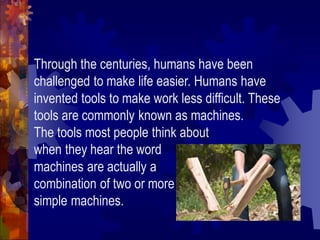
The tools most people think about
when they hear the word
machines are actually a
combination of two or more
simple machines.
Machines are devices that make your everyday
tasks easier. They make you do more work with
least effort.
Look around your house, can you identify the
machines that you use everyday?
Lesson Presentation
Simple machines are mechanical
devices that are used to make work easier,
faster and more accurate. They help save
time and effort. They are not expensive and
are easily available when needed. It is good
to keep them around for your convenience.
Work may be defined as force acting
through a distance.
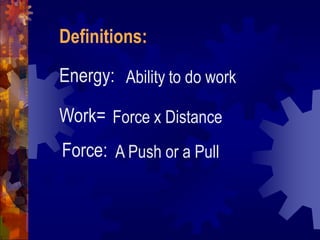
Energy: Ability to do work
Work= Force x Distance
Force: A Push or a Pull
Definitions:
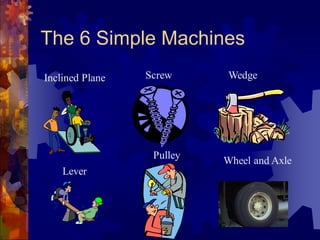
The 6 Simple Machines
Lever
Pulley Wheel and Axle
Wedge
Screw
Inclined Plane
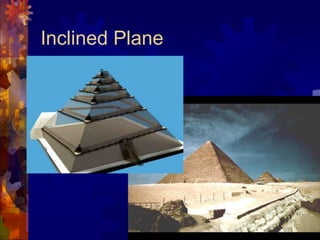
Inclined Plane
Inclined Plane
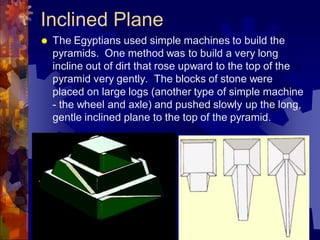
 The Egyptians used simple machines to build the
pyramids. One method was to build a very long
incline out of dirt that rose upward to the top of the
pyramid very gently. The blocks of stone were
placed on large logs (another type of simple machine
- the wheel and axle) and pushed slowly up the long,
gentle inclined plane to the top of the pyramid.
Inclined Planes
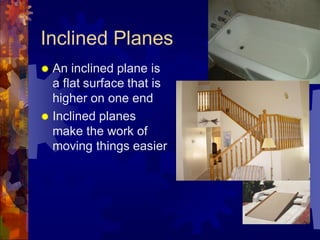
 An inclined plane is
a flat surface that is
higher on one end
 Inclined planes
make the work of
moving things easier
Screw
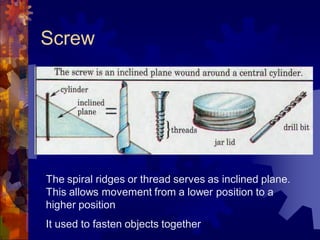
The spiral ridges or thread serves as inclined plane.
This allows movement from a lower position to a
higher position
It used to fasten objects together
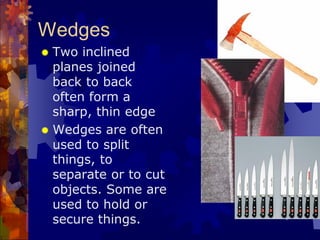
Wedges
 Two inclined
planes joined
back to back
often form a
sharp, thin edge
 Wedges are often
used to split
things, to
separate or to cut
objects. Some are
used to hold or
secure things.
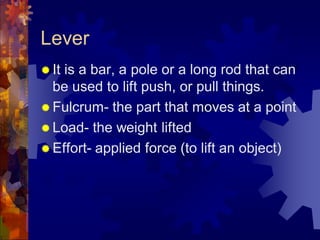
Lever
 It is a bar, a pole or a long rod that can
be used to lift push, or pull things.
 Fulcrum- the part that moves at a point
 Load- the weight lifted
 Effort- applied force (to lift an object)
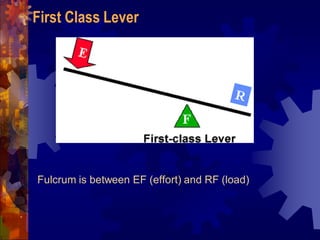
Fulcrum is between EF (effort) and RF (load)
.
First Class Lever
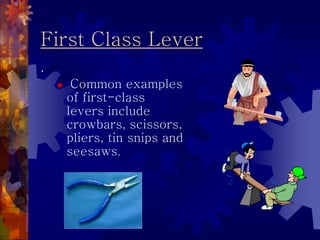
First Class Lever
.
 Common examples
of first-class
levers include
crowbars, scissors,
pliers, tin snips and
seesaws.
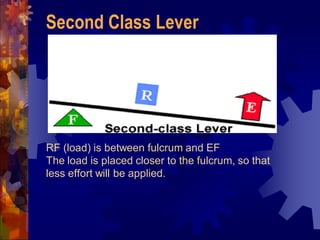
RF (load) is between fulcrum and EF
The load is placed closer to the fulcrum, so that
less effort will be applied.
Second Class Lever
Second Class Lever
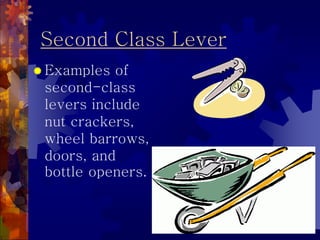
 Examples of
second-class
levers include
nut crackers,
wheel barrows,
doors, and
bottle openers.
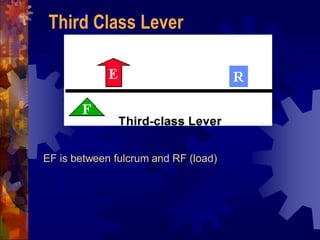
EF is between fulcrum and RF (load)
Third Class Lever
Third Class Lever
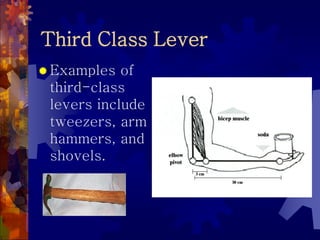
 Examples of
third-class
levers include
tweezers, arm
hammers, and
shovels.
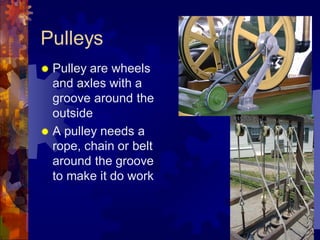
Pulleys
 Pulley are wheels
and axles with a
groove around the
outside
 A pulley needs a
rope, chain or belt
around the groove
to make it do work
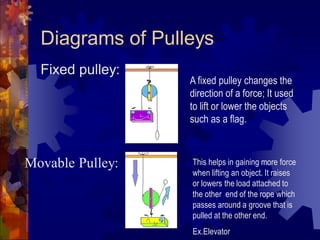
Diagrams of Pulleys
Fixed pulley:
A fixed pulley changes the
direction of a force; It used
to lift or lower the objects
such as a flag.
Movable Pulley: This helps in gaining more force
when lifting an object. It raises
or lowers the load attached to
the other end of the rope which
passes around a groove that is
pulled at the other end.
Ex.Elevator
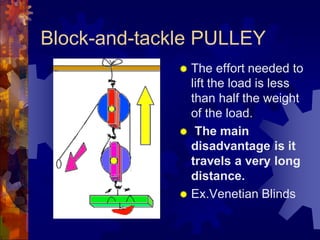
Block-and-tackle PULLEY
 The effort needed to
lift the load is less
than half the weight
of the load.
 The main
disadvantage is it
travels a very long
distance.
 Ex.Venetian Blinds
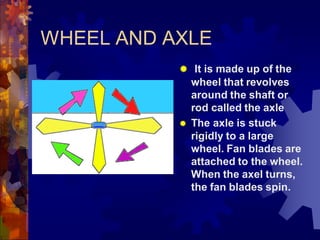
WHEEL AND AXLE
 It is made up of the
wheel that revolves
around the shaft or
rod called the axle
 The axle is stuck
rigidly to a large
wheel. Fan blades are
attached to the wheel.
When the axel turns,
the fan blades spin.
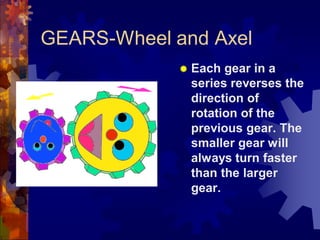
GEARS-Wheel and Axel
 Each gear in a
series reverses the
direction of
rotation of the
previous gear. The
smaller gear will
always turn faster
than the larger
gear.
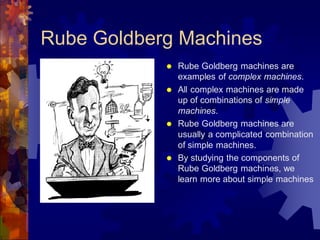
Rube Goldberg Machines
 Rube Goldberg machines are
examples of complex machines.
 All complex machines are made
up of combinations of simple
machines.
 Rube Goldberg machines are
usually a complicated combination
of simple machines.
 By studying the components of
Rube Goldberg machines, we
learn more about simple machines
Project: Simple Machine Toy
 Create a simple machine toy using
available materials at home
 Be creative and resourceful
 Take photos/videos while doing the
project.
 Explain the process and discuss the
simple machines used.
 Deadline: March 2, 2022
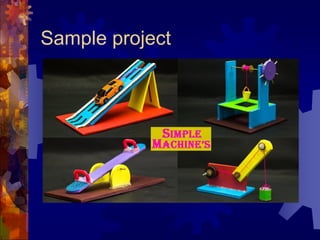
Sample project
Sample project

Simple Machines.pdf

  • 1.
    REVIEW What is heattransfer? What are the 3 forms of heat transfer?
  • 2.
    Learning Goal/s 1. Describehow simple machines make work easier and faster. 2. Enumerate the different kinds of simple machines. 3. Manipulate simple machines to describe their characteristics and uses.
  • 3.
    Through the centuries,humans have been challenged to make life easier. Humans have invented tools to make work less difficult. These tools are commonly known as machines. The tools most people think about when they hear the word machines are actually a combination of two or more simple machines.
  • 4.
    Machines are devicesthat make your everyday tasks easier. They make you do more work with least effort. Look around your house, can you identify the machines that you use everyday?
  • 5.
    Lesson Presentation Simple machinesare mechanical devices that are used to make work easier, faster and more accurate. They help save time and effort. They are not expensive and are easily available when needed. It is good to keep them around for your convenience. Work may be defined as force acting through a distance.
  • 6.
    Energy: Ability todo work Work= Force x Distance Force: A Push or a Pull Definitions:
  • 7.
    The 6 SimpleMachines Lever Pulley Wheel and Axle Wedge Screw Inclined Plane
  • 8.
  • 9.
    Inclined Plane  TheEgyptians used simple machines to build the pyramids. One method was to build a very long incline out of dirt that rose upward to the top of the pyramid very gently. The blocks of stone were placed on large logs (another type of simple machine - the wheel and axle) and pushed slowly up the long, gentle inclined plane to the top of the pyramid.
  • 10.
    Inclined Planes  Aninclined plane is a flat surface that is higher on one end  Inclined planes make the work of moving things easier
  • 11.
    Screw The spiral ridgesor thread serves as inclined plane. This allows movement from a lower position to a higher position It used to fasten objects together
  • 12.
    Wedges  Two inclined planesjoined back to back often form a sharp, thin edge  Wedges are often used to split things, to separate or to cut objects. Some are used to hold or secure things.
  • 13.
    Lever  It isa bar, a pole or a long rod that can be used to lift push, or pull things.  Fulcrum- the part that moves at a point  Load- the weight lifted  Effort- applied force (to lift an object)
  • 14.
    Fulcrum is betweenEF (effort) and RF (load) . First Class Lever
  • 15.
    First Class Lever . Common examples of first-class levers include crowbars, scissors, pliers, tin snips and seesaws.
  • 16.
    RF (load) isbetween fulcrum and EF The load is placed closer to the fulcrum, so that less effort will be applied. Second Class Lever
  • 17.
    Second Class Lever Examples of second-class levers include nut crackers, wheel barrows, doors, and bottle openers.
  • 18.
    EF is betweenfulcrum and RF (load) Third Class Lever
  • 19.
    Third Class Lever Examples of third-class levers include tweezers, arm hammers, and shovels.
  • 20.
    Pulleys  Pulley arewheels and axles with a groove around the outside  A pulley needs a rope, chain or belt around the groove to make it do work
  • 21.
    Diagrams of Pulleys Fixedpulley: A fixed pulley changes the direction of a force; It used to lift or lower the objects such as a flag. Movable Pulley: This helps in gaining more force when lifting an object. It raises or lowers the load attached to the other end of the rope which passes around a groove that is pulled at the other end. Ex.Elevator
  • 22.
    Block-and-tackle PULLEY  Theeffort needed to lift the load is less than half the weight of the load.  The main disadvantage is it travels a very long distance.  Ex.Venetian Blinds
  • 23.
    WHEEL AND AXLE It is made up of the wheel that revolves around the shaft or rod called the axle  The axle is stuck rigidly to a large wheel. Fan blades are attached to the wheel. When the axel turns, the fan blades spin.
  • 24.
    GEARS-Wheel and Axel Each gear in a series reverses the direction of rotation of the previous gear. The smaller gear will always turn faster than the larger gear.
  • 25.
    Rube Goldberg Machines Rube Goldberg machines are examples of complex machines.  All complex machines are made up of combinations of simple machines.  Rube Goldberg machines are usually a complicated combination of simple machines.  By studying the components of Rube Goldberg machines, we learn more about simple machines
  • 26.
    Project: Simple MachineToy  Create a simple machine toy using available materials at home  Be creative and resourceful  Take photos/videos while doing the project.  Explain the process and discuss the simple machines used.  Deadline: March 2, 2022
  • 27.
  • 28.