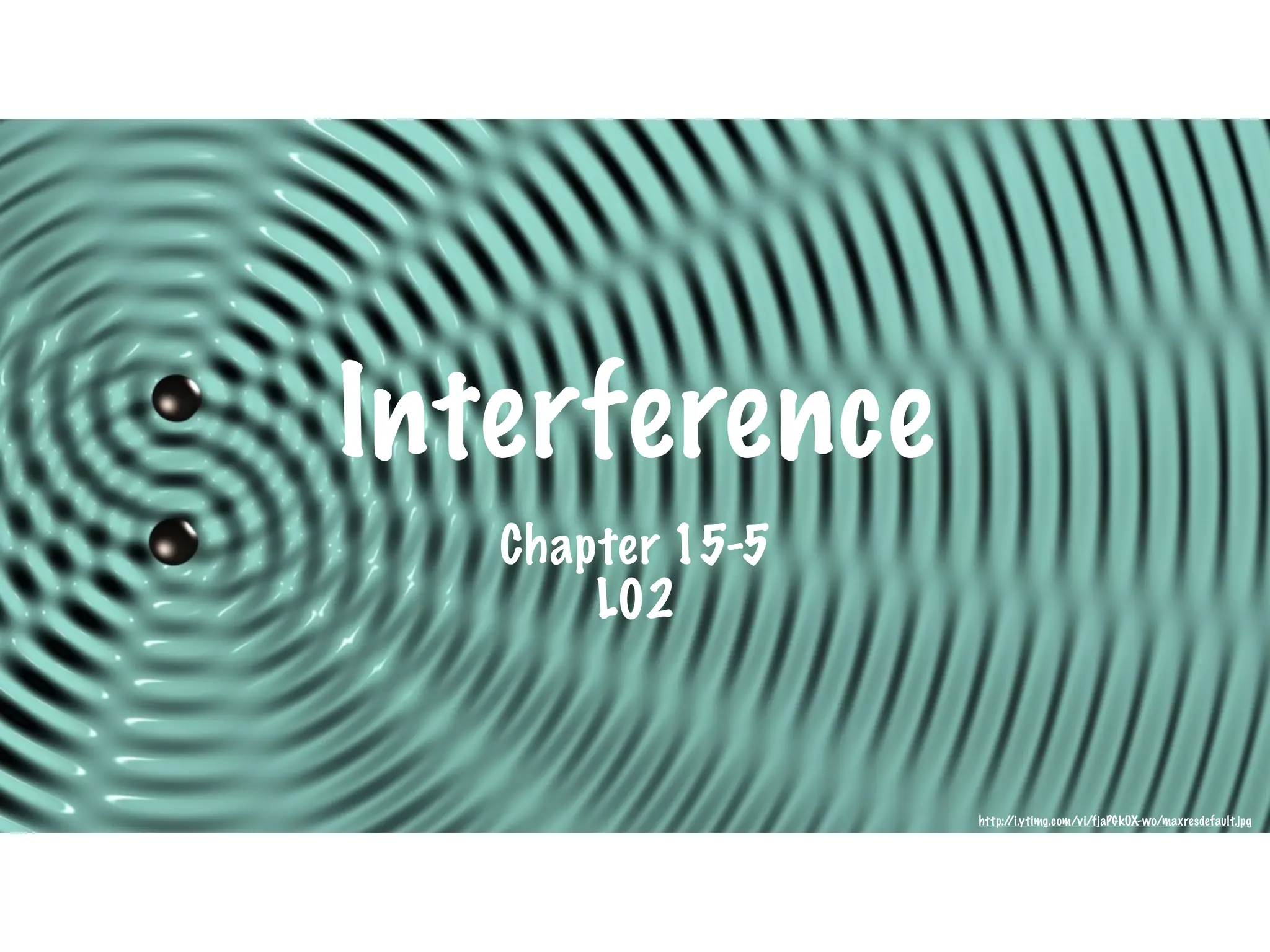
Interference
Chapter 15-5
L02
http://i.ytimg.com/vi/fjaPGkOX-wo/maxresdefault.jpg
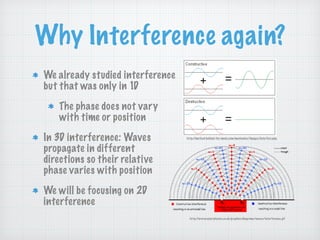
Why Interference again?
We already studied interference
but that was only in 1D
The phase does not vary
with time or position
In 3D interference: Waves
propagate in different
directions so their relative
phase varies with position
We will be focusing on 2D
interference
http://method-behind-the-music.com/mechanics/images/interfere.png
http://www.cyberphysics.co.uk/graphics/diagrams/waves/interference.gif
Constructive/
Destructive
Remember:
When two waves with same wavelength and
frequency are in phase, they are constructive.
The amplitudes add at these points
When two waves with same wavelength and
frequency are out of phase they are destructive
Amplitude usually decreases
Constructive
interference
Two points have to be in phase, regardless of
time
Constructive interference means that both
sources are at the peak positive amplitude (when
both sources are at the peak positive amplitude)
Then, there is an integer number of
wavelengths between each source and the
point under consideration
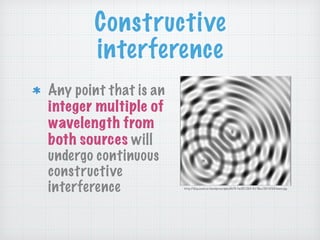
Constructive
interference
Any point that is an
integer multiple of
wavelength from
both sources will
undergo continuous
constructive
interference http://blog.ocad.ca/wordpress/gdes3b78-fw201203-01/files/2013/03/wave.jpg
The Math of Constructive
Interference
If d1 = path length from source 1 and d2 = path length from
source 2 the condition for constructive interference is :
d1 = mλ, m=1,2,3, …
d2 = nλ, n=1,2,3, …
The difference between the distances from the two
sources to the point of constructive interference is given
by:
Δd = d2 -d1 = (n-m)λ = pλ where p = 0, ±1, ±2, ±3, …
Condition for
Constructive Interference
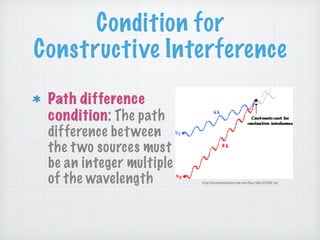
Path difference
condition: The path
difference between
the two sources must
be an integer multiple
of the wavelength http://www.physicsclassroom.com/Class/light/u12l3b11.gif
BUT WAIT
What we just did
demands that both paths
individually be integer
multiples of wavelength.
But this does not have to
be true…
http://1.bp.blogspot.com/-QpnXjGcLfg0/Tw25JfjDQLI/AAAAAAAAAlo/QfGAyNhVR0w/s1600/huh.gif
The path difference
condition
Remember the path
difference condition?
That condition might
be sufficient enough to
produce constructive
interference
https://coherence.files.wordpress.com/2011/10/waves.png
Spherical waves
As spherical waves travel away from its source, it
oscillates in space and time
The amplitude is constant over any spherical
surface centred on the source
Spatial variations are described as a function
of r, the distance from the source. The wave
function becomes:
s(r,t) = sm(r)cos(kr-ωt+ )
The function
s(r,t) = sm(r)cos(kr-ωt+ ) may look familiar
to you
Recall: s(x,t) = sm(r)cos(kx-ωt+ )
The only difference is that our new
equation replaces x with r. This is
because the wave spreads out over a
larger area as it propagates outwards
The Math of Constructive
Interference, Again…
For two waves to be in phase, the arguments
of the cosine function must differ by an
integer multiple of 2∏.
Both waves are in phase so:
(kd2-ωt) - (kd1-ωt) = k(d2-d1) = n2∏
Therefore: (d2-d1) = n(2∏/k) = nλ , n = 0, ±1, ±2,
±3
Confusion?
Remember how in our initial condition
we got:
Δd = d2 -d1 = (n-m)λ = pλ where p = 0, ±1, ±2,
±3, …
But both paths individually had to be
integer multiples of wavelength.
We just demonstrated that this does not
always have to be the case since:
(d2-d1) = n(2∏/k) = nλ , n = 0, ±1, ±2, ±3 http://fc01.deviantart.net/fs70/f/2012/023/3/f/unagi_by_co__existance-d4ndy09.png
Constructive
Interference Formula
Constructive interference occurs
whenever the path difference is an
integer multiple of the wavelength.
In a special case where d2= d1= d, we
can add the two waves together to
find a resultant wave equation:
s(d,t) = 2sm(d)cos(kd-ωt+ )
Destructive Interference
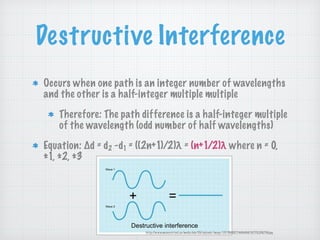
Occurs when one path is an integer number of wavelengths
and the other is a half-integer multiple multiple
Therefore: The path difference is a half-integer multiple
of the wavelength (odd number of half wavelengths)
Equation: Δd = d2 -d1 = ((2n+1)/2)λ = (n+1/2)λ where n = 0,
±1, ±2, ±3
http://www.museevirtuel.ca/media/edu/EN/uploads/image/LO13DA3E7746049674775238736.jpg
Tips for 2-D Interference
The equations discussed may look complex. Try and
understand what each individual variable
represents
Remember, 2D interference is still interference so
if you get confused try and remember 1D
interference. It might help clarify certain
concepts for you.
Interference: Two or more waves combining to
produce a resultant wave

2D wave interference

  • 1.
  • 2.
    Why Interference again? Wealready studied interference but that was only in 1D The phase does not vary with time or position In 3D interference: Waves propagate in different directions so their relative phase varies with position We will be focusing on 2D interference http://method-behind-the-music.com/mechanics/images/interfere.png http://www.cyberphysics.co.uk/graphics/diagrams/waves/interference.gif
  • 3.
    Constructive/ Destructive Remember: When two waveswith same wavelength and frequency are in phase, they are constructive. The amplitudes add at these points When two waves with same wavelength and frequency are out of phase they are destructive Amplitude usually decreases
  • 4.
    Constructive interference Two points haveto be in phase, regardless of time Constructive interference means that both sources are at the peak positive amplitude (when both sources are at the peak positive amplitude) Then, there is an integer number of wavelengths between each source and the point under consideration
  • 5.
    Constructive interference Any point thatis an integer multiple of wavelength from both sources will undergo continuous constructive interference http://blog.ocad.ca/wordpress/gdes3b78-fw201203-01/files/2013/03/wave.jpg
  • 6.
    The Math ofConstructive Interference If d1 = path length from source 1 and d2 = path length from source 2 the condition for constructive interference is : d1 = mλ, m=1,2,3, … d2 = nλ, n=1,2,3, … The difference between the distances from the two sources to the point of constructive interference is given by: Δd = d2 -d1 = (n-m)λ = pλ where p = 0, ±1, ±2, ±3, …
  • 7.
    Condition for Constructive Interference Pathdifference condition: The path difference between the two sources must be an integer multiple of the wavelength http://www.physicsclassroom.com/Class/light/u12l3b11.gif
  • 8.
    BUT WAIT What wejust did demands that both paths individually be integer multiples of wavelength. But this does not have to be true… http://1.bp.blogspot.com/-QpnXjGcLfg0/Tw25JfjDQLI/AAAAAAAAAlo/QfGAyNhVR0w/s1600/huh.gif
  • 9.
    The path difference condition Rememberthe path difference condition? That condition might be sufficient enough to produce constructive interference https://coherence.files.wordpress.com/2011/10/waves.png
  • 10.
    Spherical waves As sphericalwaves travel away from its source, it oscillates in space and time The amplitude is constant over any spherical surface centred on the source Spatial variations are described as a function of r, the distance from the source. The wave function becomes: s(r,t) = sm(r)cos(kr-ωt+ )
  • 11.
    The function s(r,t) =sm(r)cos(kr-ωt+ ) may look familiar to you Recall: s(x,t) = sm(r)cos(kx-ωt+ ) The only difference is that our new equation replaces x with r. This is because the wave spreads out over a larger area as it propagates outwards
  • 12.
    The Math ofConstructive Interference, Again… For two waves to be in phase, the arguments of the cosine function must differ by an integer multiple of 2∏. Both waves are in phase so: (kd2-ωt) - (kd1-ωt) = k(d2-d1) = n2∏ Therefore: (d2-d1) = n(2∏/k) = nλ , n = 0, ±1, ±2, ±3
  • 13.
    Confusion? Remember how inour initial condition we got: Δd = d2 -d1 = (n-m)λ = pλ where p = 0, ±1, ±2, ±3, … But both paths individually had to be integer multiples of wavelength. We just demonstrated that this does not always have to be the case since: (d2-d1) = n(2∏/k) = nλ , n = 0, ±1, ±2, ±3 http://fc01.deviantart.net/fs70/f/2012/023/3/f/unagi_by_co__existance-d4ndy09.png
  • 14.
    Constructive Interference Formula Constructive interferenceoccurs whenever the path difference is an integer multiple of the wavelength. In a special case where d2= d1= d, we can add the two waves together to find a resultant wave equation: s(d,t) = 2sm(d)cos(kd-ωt+ )
  • 15.
    Destructive Interference Occurs whenone path is an integer number of wavelengths and the other is a half-integer multiple multiple Therefore: The path difference is a half-integer multiple of the wavelength (odd number of half wavelengths) Equation: Δd = d2 -d1 = ((2n+1)/2)λ = (n+1/2)λ where n = 0, ±1, ±2, ±3 http://www.museevirtuel.ca/media/edu/EN/uploads/image/LO13DA3E7746049674775238736.jpg
  • 16.
    Tips for 2-DInterference The equations discussed may look complex. Try and understand what each individual variable represents Remember, 2D interference is still interference so if you get confused try and remember 1D interference. It might help clarify certain concepts for you. Interference: Two or more waves combining to produce a resultant wave