Wave Interference
PHYS 101 LO2
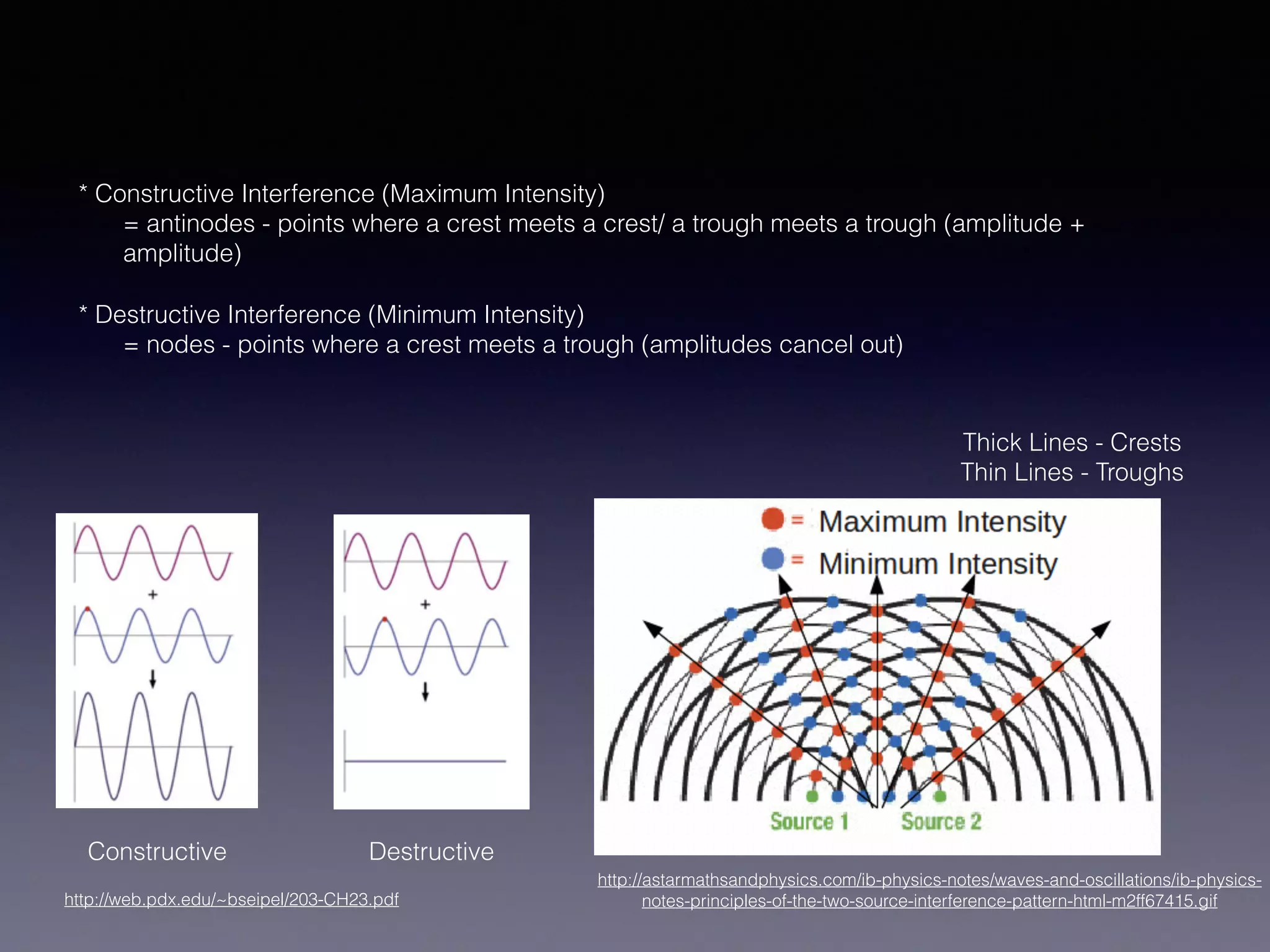
* Constructive Interference (Maximum Intensity)
= antinodes - points where a crest meets a crest/ a trough meets a trough (amplitude +
amplitude)


http://astarmathsandphysics.com/ib-physics-notes/waves-and-oscillations/ib-physics-
notes-principles-of-the-two-source-interference-pattern-html-m2ff67415.gif
Thick Lines - Crests
Thin Lines - Troughs
* Destructive Interference (Minimum Intensity)
= nodes - points where a crest meets a trough (amplitudes cancel out)


Constructive Destructive
http://web.pdx.edu/~bseipel/203-CH23.pdf
Path Difference for Wave Interference
• Constructive Interference

*any point that is an integer multiple of wavelengths from both sources will undergo
constructive interference

(because one period of a wavelength is 2π, any integer multiple will result in the same point)

d1 = mλ m= 1, 2, 3, …

d2 = nλ n = 1, 2, 3, …

path difference = Δd = d2-d1 =pλ p = 0, ±1, ±2, ±3 …
• Destructive Interference

*occurs when one path is an integer number of wavelength and the other is a half-
integer multiple

path difference = Δd = d2-d1 = (n+½)λ n = 0, ±1, ±2, ±3 …
• Question 1)


Two identical speakers, A and B, are in phase with one another.
Speaker A is positioned 10.5m directly to the north of speaker B. A person
listens to the speakers at a distance d= 4.45m directly in front of speaker
B. The speed of sound is 343 m/s. 

a) What is the lowest frequency that gives minimum signal at the
person’s ear?

b) What is the second lowest frequency that gives minimum signal
at the person’s ear?

c) What is the lowest frequency that gives maximum signal at the
person’s ear?
• Solution 1)


Two identical speakers, A and B, are in phase with one another.
Speaker A is positioned 4.5m directly to the north of speaker B. A person
listens to the speakers at a distance d= 7.45m directly in front of speaker
B. The speed of sound is 343 m/s. 

a) What is the lowest frequency that gives minimum signal at the
person’s ear?

minimum signal = destructive interference

Δd = d2-d1 = (n+½)λ -> Δd/λ = 1/2, 3/2, 5/2, …. (n=0,1,2,3,…)

path difference - d2= 8.7m

d2 - d1 = 8.7 m - 7.45m = 1.25 m

λ=v/f (f*d)/v = 1/2

f = (1/2)(v/d)

(1/2)(343/1.25) = 137.2 Hz

b) What is the second lowest frequency that gives minimum signal
at the person’s ear?

(f*d)/v = 3/2

f = (3/2)(343/1.25) = 411.6 Hz

c) What is the lowest frequency that gives maximum signal at the
person’s ear?

maximum signal = constructive interference

Δd = d2-d1 = pλ -> Δd/λ = 0, 1, 2, … 

(f*d)/v = 1

f = (1)(343/1.25) = 274 Hz
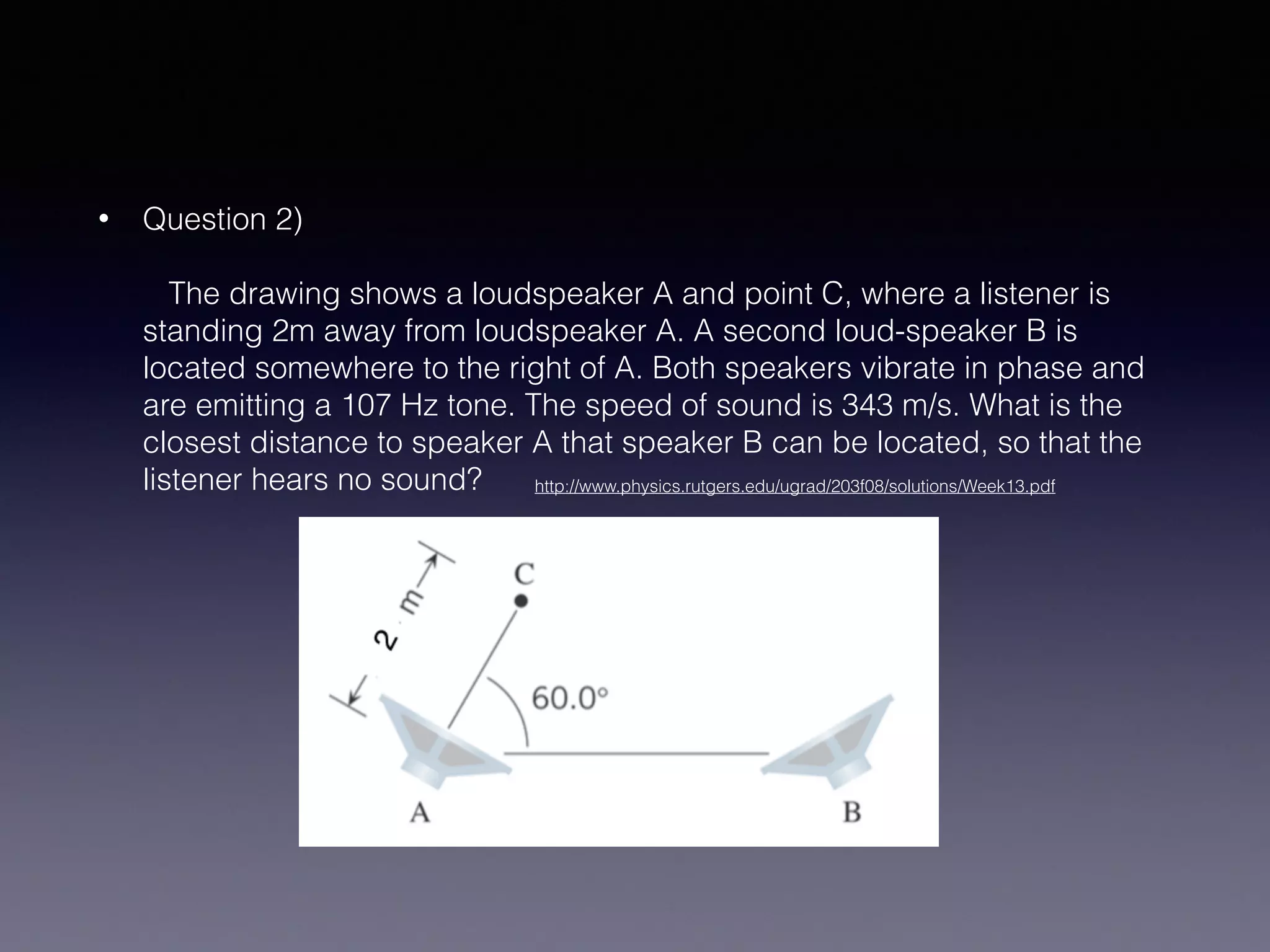
• Question 2)


The drawing shows a loudspeaker A and point C, where a listener is
standing 2m away from loudspeaker A. A second loud-speaker B is
located somewhere to the right of A. Both speakers vibrate in phase and
are emitting a 107 Hz tone. The speed of sound is 343 m/s. What is the
closest distance to speaker A that speaker B can be located, so that the
listener hears no sound?
 http://www.physics.rutgers.edu/ugrad/203f08/solutions/Week13.pdf
• Question 2)


The drawing shows a loudspeaker A and point C, where a listener is positioned. A
second loud-speaker B is located somewhere to the right of A. Both speakers vibrate in
phase and are emitting a 107 Hz tone. The speed of sound is 343 m/s. What is the
closest distance to speaker A that speaker B can be located, so that the listener hears
no sound?

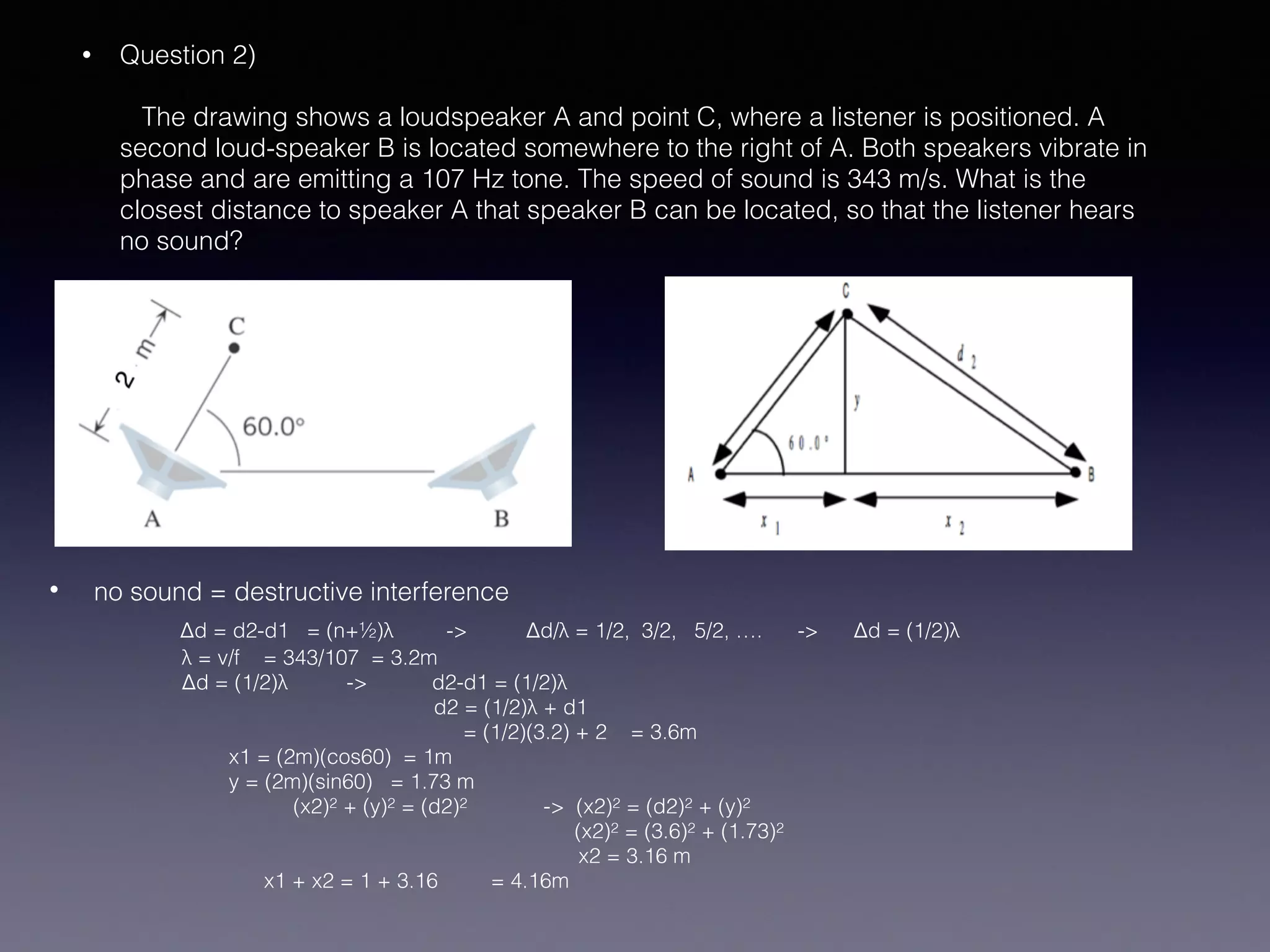
• no sound = destructive interference

Δd = d2-d1 = (n+½)λ -> Δd/λ = 1/2, 3/2, 5/2, …. -> Δd = (1/2)λ 

λ = v/f = 343/107 = 3.2m

Δd = (1/2)λ -> d2-d1 = (1/2)λ

d2 = (1/2)λ + d1

= (1/2)(3.2) + 2 = 3.6m

x1 = (2m)(cos60) = 1m

y = (2m)(sin60) = 1.73 m

(x2)2 + (y)2 = (d2)2 -> (x2)2 = (d2)2 + (y)2

(x2)2 = (3.6)2 + (1.73)2

x2 = 3.16 m

x1 + x2 = 1 + 3.16 = 4.16m

Wave interference

  • 1.
  • 2.
    * Constructive Interference(Maximum Intensity) = antinodes - points where a crest meets a crest/ a trough meets a trough (amplitude + amplitude) 
 http://astarmathsandphysics.com/ib-physics-notes/waves-and-oscillations/ib-physics- notes-principles-of-the-two-source-interference-pattern-html-m2ff67415.gif Thick Lines - Crests Thin Lines - Troughs * Destructive Interference (Minimum Intensity) = nodes - points where a crest meets a trough (amplitudes cancel out) 
 Constructive Destructive http://web.pdx.edu/~bseipel/203-CH23.pdf
  • 3.
    Path Difference forWave Interference • Constructive Interference
 *any point that is an integer multiple of wavelengths from both sources will undergo constructive interference
 (because one period of a wavelength is 2π, any integer multiple will result in the same point)
 d1 = mλ m= 1, 2, 3, …
 d2 = nλ n = 1, 2, 3, …
 path difference = Δd = d2-d1 =pλ p = 0, ±1, ±2, ±3 … • Destructive Interference
 *occurs when one path is an integer number of wavelength and the other is a half- integer multiple
 path difference = Δd = d2-d1 = (n+½)λ n = 0, ±1, ±2, ±3 …
  • 4.
    • Question 1)
 
 Twoidentical speakers, A and B, are in phase with one another. Speaker A is positioned 10.5m directly to the north of speaker B. A person listens to the speakers at a distance d= 4.45m directly in front of speaker B. The speed of sound is 343 m/s. 
 a) What is the lowest frequency that gives minimum signal at the person’s ear?
 b) What is the second lowest frequency that gives minimum signal at the person’s ear?
 c) What is the lowest frequency that gives maximum signal at the person’s ear?
  • 5.
    • Solution 1)
 
 Twoidentical speakers, A and B, are in phase with one another. Speaker A is positioned 4.5m directly to the north of speaker B. A person listens to the speakers at a distance d= 7.45m directly in front of speaker B. The speed of sound is 343 m/s. 
 a) What is the lowest frequency that gives minimum signal at the person’s ear?
 minimum signal = destructive interference
 Δd = d2-d1 = (n+½)λ -> Δd/λ = 1/2, 3/2, 5/2, …. (n=0,1,2,3,…)
 path difference - d2= 8.7m
 d2 - d1 = 8.7 m - 7.45m = 1.25 m
 λ=v/f (f*d)/v = 1/2
 f = (1/2)(v/d)
 (1/2)(343/1.25) = 137.2 Hz
 b) What is the second lowest frequency that gives minimum signal at the person’s ear?
 (f*d)/v = 3/2
 f = (3/2)(343/1.25) = 411.6 Hz
 c) What is the lowest frequency that gives maximum signal at the person’s ear?
 maximum signal = constructive interference
 Δd = d2-d1 = pλ -> Δd/λ = 0, 1, 2, … 
 (f*d)/v = 1
 f = (1)(343/1.25) = 274 Hz
  • 6.
    • Question 2)
 
 Thedrawing shows a loudspeaker A and point C, where a listener is standing 2m away from loudspeaker A. A second loud-speaker B is located somewhere to the right of A. Both speakers vibrate in phase and are emitting a 107 Hz tone. The speed of sound is 343 m/s. What is the closest distance to speaker A that speaker B can be located, so that the listener hears no sound?
 http://www.physics.rutgers.edu/ugrad/203f08/solutions/Week13.pdf
  • 7.
    • Question 2)
 
 Thedrawing shows a loudspeaker A and point C, where a listener is positioned. A second loud-speaker B is located somewhere to the right of A. Both speakers vibrate in phase and are emitting a 107 Hz tone. The speed of sound is 343 m/s. What is the closest distance to speaker A that speaker B can be located, so that the listener hears no sound?
 • no sound = destructive interference
 Δd = d2-d1 = (n+½)λ -> Δd/λ = 1/2, 3/2, 5/2, …. -> Δd = (1/2)λ 
 λ = v/f = 343/107 = 3.2m
 Δd = (1/2)λ -> d2-d1 = (1/2)λ
 d2 = (1/2)λ + d1
 = (1/2)(3.2) + 2 = 3.6m
 x1 = (2m)(cos60) = 1m
 y = (2m)(sin60) = 1.73 m
 (x2)2 + (y)2 = (d2)2 -> (x2)2 = (d2)2 + (y)2
 (x2)2 = (3.6)2 + (1.73)2
 x2 = 3.16 m
 x1 + x2 = 1 + 3.16 = 4.16m