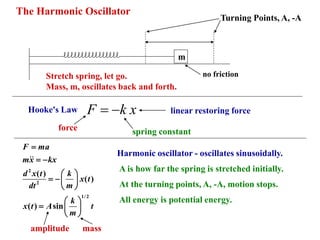
The Harmonic Oscillator
Turning Points, A, -A
no friction
Stretch spring, let go.
Mass, m, oscillates back and forth.
m
Hooke's Law F k x
= − linear restoring force
spring constant
force
2
2
1/ 2
( )
( )
( ) sin
F ma
mx kx
d x t k
x t
dt m
k
x t A t
m
=
= −
 
= − 
 
 
=  
 
amplitude mass
Harmonic oscillator - oscillates sinusoidally.
A is how far the spring is stretched initially.
At the turning points, A, -A, motion stops.
All energy is potential energy.
V
x
Potential is Parabolic
( )
V x
F
x


= −
2
1
( )
2
V x k xdx k x
= =

2 2 2
4
k m m
  
= =
oscillator
frequency, Hz
oscillator
frequency, rad/s
Energy of oscillator is
2
1/ 2
E kA
=
A can take on any value. Energy is continuous, continuous range of values.
A - classical turning point.
A
Quantum Harmonic Oscillator
Simplest model of molecular vibrations
x
E
x
E
Bond dissociation energy
Molecular potential energy
as a function of atomic separation.
Bonds between atoms act as "springs".
Near bottom of molecular potential well,
molecular potential approximately parabolic
Harmonic Oscillator.
V
x
Potential 2
1
( )
2
V x k x
=
Turning point
Kinetic energy
zero; potential
energy max. Turning
point
Turning
point
Classical particle can never
be past turning point.
0
x p
  =
This can't happen for Q.M. harmonic oscillator.
Uncertainty Principle indicates that minimum Q.M. H.O. energy 0

Particle can be stationary at bottom of well,
know position, x = 0; know momentum, p = 0.
One Dimensional Quantum Harmonic Oscillator
in the Schrödinger Representation
H E
 
=
( ) 0
H E 
− =
2 2
2
2
1
2 2
d
H k x
m d x
= − + Schrödinger Representation
kinetic energy potential energy
2
2mE
 =
2 /
m
  
=
Define
2
2 2 2
2 2
( ) 2
2 ( ) 0.
d x m
E m x x
dx

  
 
+ − =
  Substitute H and
definition of k.
Mult. by -2m/2.
( )
2
2 2
2
( )
( ) 0
d x
x x
d x

  
+ − =
( )
2
2 2
2
( )
( ) 0
d x
x x
d x

  
+ − =
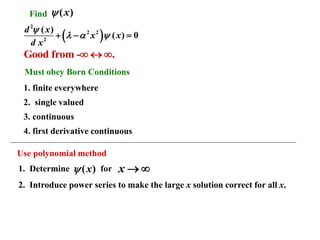
Find ( )
x

Good from - .
  
Must obey Born Conditions
1. finite everywhere
2. single valued
3. continuous
4. first derivative continuous
Use polynomial method
1. Determine for
( )
x
 x → 
2. Introduce power series to make the large x solution correct for all x.
( )
2
2 2
2
( )
( ) 0
d x
x x
d x

  
+ − =
2 2
x
 

2
2 2
2
d
x
dx

 
=
For very large x, as x goes to infinity.
Therefore,  can be dropped.
Try
2 2
2
2 2 2 2
2
x x
d
x e e
dx
 

 
 
= 
2
2
x
e



=
Then,
This is negligible compared to the first term
as x goes to infinity.
2
2mE
 =
Two solutions
2 2
2 2
x x
e e
 
− +
This is O.K. at
x =  x = 
This blows up at
Not finite everywhere.
2
2
( )
x
x e


−
=
Therefore, large x solution is
2
2
( ) ( )
x
x e f x


−
=
For all x
Must find this.
2
2
( ) ( )
x
x e f x


−
=
Need second derivative in Schrödinger equation
2
2
2 2
2
2
( )
( 2 ' '')
x
d x
e x f f x f f
d x


  
−
= − − +
'
d f
f
d x
=
2
2
''
d f
f
d x
=
With and
Substitute
2
2
( )
and ( )
d x
x
d x

 into the original equation
( )
2
2 2
2
( )
( ) 0
d x
x x
d x

  
+ − =
2
2
x
e

−
and divide by gives
( )
2 0
f x f f
  
 
− + − = Equation only in f.
Solve for f and have .
( )
x

1
2 1 0.
f x f f

 
 
 
− + − =
 
 
divide by 
x
 
=
( ) ( )
f x H 
=
substitute
2
2
( ) ( )
2 1 ( ) 0.
d H d H
H
d d
  
 
  
 
− + − =
 
 
Gives
Hermite's equation
0 1 2 3
0 1 2 3
( ) v
H a a a a a


     
= = = + + + +

1 0 1 2
1 2 3
( )
2 3
dH
a a a a
d




    

−
= = + + +

( )
2
2 0 1
2 3
2
1 2 6
d H
a a a
d



    

−
= − = + +

Substitute series expansion for H()
2
2
( ) ( )
2 1 ( ) 0.
d H d H
H
d d
  
 
  
 
− + − =
 
 
substitute in series
0 1 2 3
2 3 4 5
2 6 12 20
a a a a
   
+ + + +
1 2 3
1 2 3
2 4 6
a a a
  
− − − −
0 1 2
0 1 2
1 1 1
a a a
  
  
  
     
+ − + − + −
     
     
3
3
1 0.
a



 
+ − + =
 
 
The sum of these infinite
number of terms in all powers
of  equals 0.
In order for the sum of all the terms in this expression to vanish identically
for any ,
the coefficients of the individual powers of  must vanish separately.
To see this consider an unrelated simpler equation.
5 4 3 2
5 4 3 2 1 0 0
a x a x a x a x a x a
+ + + + + =
Fifth degree equation. For a given set of the ai, there will be 5 values of x
for which this is true. However, if you know this is true for any value of x,
then the ai all must be zero.
2 0
2 1 0
a a


 
+ − =
 
 
3 1
6 3 0
a a


 
+ − =
 
 
4 2
12 5 0
a a


 
+ − =
 
 
5 3
20 7 0
a a


 
+ − =
 
 
0

 
 
1

 
 
2

 
 
3

 
 
Even and odd series.
Pick a0 (a1 = 0), get all even coefficients.
Pick a1 (a0 = 0), get all odd coefficients.
Normalization set a0 and a1 values.
( )
2
2 1
1 ( 2)
a a
 



 
+
 
− −
 
 
= −
+ +
Recursion Formula
Coefficients of like powers of .
In general
2
( +1)( +2) 1 2 0
a a
 

  

+
 
+ − − =
 
 
 is an integer. Index in the expansion.
Have expression in terms of series that satisfy the diff. eq.
But not good wavefunction.
Blows up for large |x| if infinite number of terms. (See book for proof.)
2
2
( ) ( )
e H

  
−
=
2 2 2
/2 /2
e e e
  
−
= =
For infinite number of terms and large |x|.
blows up
( )
x
 
=
Unacceptable as a wavefunction.
Quantization of Energy
2
/2 n
e 

−
If there are a finite number of terms in the series for H(),
wavefunction does not blow up. Goes to zero at infinity.
The exponential goes to zero faster than n blows up.
( )
2
2 1
1 ( 2)
a a
 



 
+
 
− −
 
 
= −
+ +
Then, because
with a0 or a1 set equal to zero (odd or even series),
series terminates after
 = n a finite number of terms.
= (2n + 1)
To make series finite, truncate by choice of .
n is an integer.
Any value of  with
 = (2n + 1)
is O.K. Any other value of  is no good.
2
2
(2 1)2 /
mE
n m
  
= = +
Therefore,
definition of  definition of 
1
2
n
E n h
 
= +
 
 
Solving for E
n is the quantum number
0
0 1/2
n E h
= =
Lowest energy, not zero. Called zero
point energy.
Energy levels equally spaced by h.
1
2
n
E n h
 
= +
 
 
Energy Levels
( )
2
2
( )
n n n
x N e H

 
−
=
1
1 2
2 1
2 !
n n
N
n


 
 
 
=  
 
 
 
 
Wavefunctions
2 /
m
  
=
x
 
=
normalization constant
( )
1 2
H  
=
( ) 2 0
2 4 2
H   
= −
( ) 3
3 8 12
H   
= −
( ) 4 2 0
4 16 48 12
H    
= − +
( ) 5 3
5 32 160 120
H    
= − +
( ) 6 4 2 0
6 64 480 720 120
H     
= − + −
( ) 0
0 1
H  
=
Hermite Polynomials
-4 -2 0 2 4
1
-1 3
-3
 ( )
x

0
Lowest state n = 0
2
2
1 1
4 4
2 2
0 ( )
x
x e e
 
 

 
− −
   
= =
   
   
-4 -2 0 2 4
1
-1 3
-3

( )
 2
Classical turning points 2
1/2 1/2
kx h
=
potential total
energy energy
2
/
h
x
k
x h k

 
 =
=  = 
classical turning points - wavefunction extends into
classically forbidden region.
This is a Gaussian.
Minimum uncertainty.
0
 2
0

-6 -4 -2 0 2 4 -6 -4 -2 0 2 4 -6 -4 -2 0 2 4 6
-6 -4 -2 0 2 4 -6 -4 -2 0 2 4 -6 -4 -2 0 2 4 6
n = 1 n = 2 n = 3
n = 4 n = 5 n = 6
More wavefunctions - larger n, more nodes
-6 -4 -2 0 2 4 6
 
*
Probability for n = 10

Looks increasingly classical.
For large object, nodes so closely spaced because n very large that
can't detect nodes.
Classical turning points
~ =  4.6
Time classical oscillator
spends as a function
of position.

HARMONIC OSCILLATION FOR BTECH 1ST YEAR

  • 1.
    The Harmonic Oscillator TurningPoints, A, -A no friction Stretch spring, let go. Mass, m, oscillates back and forth. m Hooke's Law F k x = − linear restoring force spring constant force 2 2 1/ 2 ( ) ( ) ( ) sin F ma mx kx d x t k x t dt m k x t A t m = = −   = −      =     amplitude mass Harmonic oscillator - oscillates sinusoidally. A is how far the spring is stretched initially. At the turning points, A, -A, motion stops. All energy is potential energy.
  • 2.
    V x Potential is Parabolic () V x F x   = − 2 1 ( ) 2 V x k xdx k x = =  2 2 2 4 k m m    = = oscillator frequency, Hz oscillator frequency, rad/s Energy of oscillator is 2 1/ 2 E kA = A can take on any value. Energy is continuous, continuous range of values. A - classical turning point. A
  • 3.
    Quantum Harmonic Oscillator Simplestmodel of molecular vibrations x E x E Bond dissociation energy Molecular potential energy as a function of atomic separation. Bonds between atoms act as "springs". Near bottom of molecular potential well, molecular potential approximately parabolic Harmonic Oscillator.
  • 4.
    V x Potential 2 1 ( ) 2 Vx k x = Turning point Kinetic energy zero; potential energy max. Turning point Turning point Classical particle can never be past turning point. 0 x p   = This can't happen for Q.M. harmonic oscillator. Uncertainty Principle indicates that minimum Q.M. H.O. energy 0  Particle can be stationary at bottom of well, know position, x = 0; know momentum, p = 0.
  • 5.
    One Dimensional QuantumHarmonic Oscillator in the Schrödinger Representation H E   = ( ) 0 H E  − = 2 2 2 2 1 2 2 d H k x m d x = − + Schrödinger Representation kinetic energy potential energy 2 2mE  = 2 / m    = Define 2 2 2 2 2 2 ( ) 2 2 ( ) 0. d x m E m x x dx       + − =   Substitute H and definition of k. Mult. by -2m/2. ( ) 2 2 2 2 ( ) ( ) 0 d x x x d x     + − =
  • 6.
    ( ) 2 2 2 2 () ( ) 0 d x x x d x     + − = Find ( ) x  Good from - .    Must obey Born Conditions 1. finite everywhere 2. single valued 3. continuous 4. first derivative continuous Use polynomial method 1. Determine for ( ) x  x →  2. Introduce power series to make the large x solution correct for all x.
  • 7.
    ( ) 2 2 2 2 () ( ) 0 d x x x d x     + − = 2 2 x    2 2 2 2 d x dx    = For very large x, as x goes to infinity. Therefore,  can be dropped. Try 2 2 2 2 2 2 2 2 x x d x e e dx        =  2 2 x e    = Then, This is negligible compared to the first term as x goes to infinity. 2 2mE  =
  • 8.
    Two solutions 2 2 22 x x e e   − + This is O.K. at x =  x =  This blows up at Not finite everywhere. 2 2 ( ) x x e   − = Therefore, large x solution is 2 2 ( ) ( ) x x e f x   − = For all x Must find this.
  • 9.
    2 2 ( ) () x x e f x   − = Need second derivative in Schrödinger equation 2 2 2 2 2 2 ( ) ( 2 ' '') x d x e x f f x f f d x      − = − − + ' d f f d x = 2 2 '' d f f d x = With and Substitute 2 2 ( ) and ( ) d x x d x   into the original equation ( ) 2 2 2 2 ( ) ( ) 0 d x x x d x     + − = 2 2 x e  − and divide by gives ( ) 2 0 f x f f      − + − = Equation only in f. Solve for f and have . ( ) x 
  • 10.
    1 2 1 0. fx f f        − + − =     divide by  x   = ( ) ( ) f x H  = substitute 2 2 ( ) ( ) 2 1 ( ) 0. d H d H H d d           − + − =     Gives Hermite's equation 0 1 2 3 0 1 2 3 ( ) v H a a a a a         = = = + + + +  1 0 1 2 1 2 3 ( ) 2 3 dH a a a a d           − = = + + +  ( ) 2 2 0 1 2 3 2 1 2 6 d H a a a d          − = − = + +  Substitute series expansion for H()
  • 11.
    2 2 ( ) () 2 1 ( ) 0. d H d H H d d           − + − =     substitute in series 0 1 2 3 2 3 4 5 2 6 12 20 a a a a     + + + + 1 2 3 1 2 3 2 4 6 a a a    − − − − 0 1 2 0 1 2 1 1 1 a a a                + − + − + −             3 3 1 0. a      + − + =     The sum of these infinite number of terms in all powers of  equals 0. In order for the sum of all the terms in this expression to vanish identically for any , the coefficients of the individual powers of  must vanish separately. To see this consider an unrelated simpler equation. 5 4 3 2 5 4 3 2 1 0 0 a x a x a x a x a x a + + + + + = Fifth degree equation. For a given set of the ai, there will be 5 values of x for which this is true. However, if you know this is true for any value of x, then the ai all must be zero.
  • 12.
    2 0 2 10 a a     + − =     3 1 6 3 0 a a     + − =     4 2 12 5 0 a a     + − =     5 3 20 7 0 a a     + − =     0      1      2      3      Even and odd series. Pick a0 (a1 = 0), get all even coefficients. Pick a1 (a0 = 0), get all odd coefficients. Normalization set a0 and a1 values. ( ) 2 2 1 1 ( 2) a a        +   − −     = − + + Recursion Formula Coefficients of like powers of . In general 2 ( +1)( +2) 1 2 0 a a        +   + − − =      is an integer. Index in the expansion.
  • 13.
    Have expression interms of series that satisfy the diff. eq. But not good wavefunction. Blows up for large |x| if infinite number of terms. (See book for proof.) 2 2 ( ) ( ) e H     − = 2 2 2 /2 /2 e e e    − = = For infinite number of terms and large |x|. blows up ( ) x   = Unacceptable as a wavefunction.
  • 14.
    Quantization of Energy 2 /2n e   − If there are a finite number of terms in the series for H(), wavefunction does not blow up. Goes to zero at infinity. The exponential goes to zero faster than n blows up. ( ) 2 2 1 1 ( 2) a a        +   − −     = − + + Then, because with a0 or a1 set equal to zero (odd or even series), series terminates after  = n a finite number of terms. = (2n + 1) To make series finite, truncate by choice of . n is an integer.
  • 15.
    Any value of with  = (2n + 1) is O.K. Any other value of  is no good. 2 2 (2 1)2 / mE n m    = = + Therefore, definition of  definition of  1 2 n E n h   = +     Solving for E n is the quantum number 0 0 1/2 n E h = = Lowest energy, not zero. Called zero point energy. Energy levels equally spaced by h.
  • 16.
    1 2 n E n h  = +     Energy Levels ( ) 2 2 ( ) n n n x N e H    − = 1 1 2 2 1 2 ! n n N n         =           Wavefunctions 2 / m    = x   = normalization constant ( ) 1 2 H   = ( ) 2 0 2 4 2 H    = − ( ) 3 3 8 12 H    = − ( ) 4 2 0 4 16 48 12 H     = − + ( ) 5 3 5 32 160 120 H     = − + ( ) 6 4 2 0 6 64 480 720 120 H      = − + − ( ) 0 0 1 H   = Hermite Polynomials
  • 17.
    -4 -2 02 4 1 -1 3 -3  ( ) x  0 Lowest state n = 0 2 2 1 1 4 4 2 2 0 ( ) x x e e        − −     = =         -4 -2 0 2 4 1 -1 3 -3  ( )  2 Classical turning points 2 1/2 1/2 kx h = potential total energy energy 2 / h x k x h k     = =  =  classical turning points - wavefunction extends into classically forbidden region. This is a Gaussian. Minimum uncertainty. 0  2 0 
  • 18.
    -6 -4 -20 2 4 -6 -4 -2 0 2 4 -6 -4 -2 0 2 4 6 -6 -4 -2 0 2 4 -6 -4 -2 0 2 4 -6 -4 -2 0 2 4 6 n = 1 n = 2 n = 3 n = 4 n = 5 n = 6 More wavefunctions - larger n, more nodes
  • 19.
    -6 -4 -20 2 4 6   * Probability for n = 10  Looks increasingly classical. For large object, nodes so closely spaced because n very large that can't detect nodes. Classical turning points ~ =  4.6 Time classical oscillator spends as a function of position.