CONTROLLED DRUG DELIVERY
SYSTEM(CRDDS)
Presented By: Mrs. Neha P. Patil
Assistant Professor
M. Pharm (Pharmaceutics)
P. S. G. V. P. Mandal’s College of Pharmacy, Shahada
Dist.- Nandurbar (MS)
1
2.
CONTENTS:
1. Introduction
2. Definitions
3.Rationale of Controlled DDS
4. Advantages of Controlled DDS
5. Disadvantages of Controlled DDS
6. Selection of drug candidate for Controlled DDS
7. Approaches for designing controlled release formulations
8. Physicochemical and Biological properties of drug relevant
to control release formulation.
2
3.
➢ INTRODUCTION:
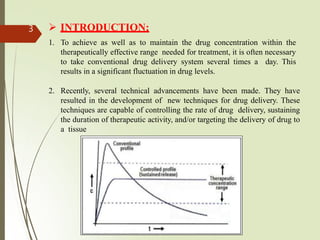
1. Toachieve as well as to maintain the drug concentration within the
therapeutically effective range needed for treatment, it is often necessary
to take conventional drug delivery system several times a day. This
results in a significant fluctuation in drug levels.
2. Recently, several technical advancements have been made. They have
resulted in the development of new techniques for drug delivery. These
techniques are capable of controlling the rate of drug delivery, sustaining
the duration of therapeutic activity, and/or targeting the delivery of drug to
a tissue
3
4.
➢ DEFINITIONS:
4
1. Sustained-release:
•These are dosage forms designed to slow release (liberate) a drug that
maintain a constant drug concentration for a specific period of time
with minimum side effects
• Any of the dosage form that maintains therapeutic blood or tissue levels
of drug by continuous release of medication for a prolonged period of
time, after administration of a single dose.
• Here the absorption rate is equal to the elimination rate over an
extend period of time.
2. Controlled-release:
• Controlled release dosage form is a dosage form that release one or
more drugs continuously in predetermined rate for a prolong period
of time, either systemically or locally to specified target organ.
• Designed to slowly release a drug in the body in a prolonged controlled
fashion.
• The release of drug ingredients from a controlled-release drug
delivery system proceeds at a rate profile that is not only predictable
kinetically, but also reproducible from one unit to another.
5.
5
3. Extended release:
•When absorption of drug is greater than its elimination, the release is
known as extended release.
• These include any dosage form that maintains therapeutic blood or tissue
level of drug for prolong period of time.
4. Delayed release:
• Delayed drug release is commonly achieved via enteric coating of dosage
forms such as tablets, capsules and multiparticulates.
• Typically, enteric coatings are pH activated, wherein they are insoluble at
low pH but dissolved readily at higher pH (e.g., pH 5–7).
• The main function of an enteric coating is to protect the underlying
dosage form and drug substance, enabling it to remain intact the gastric
environment and instead dissolve and undergo drug release in the small
intestine.
5. Site specific targeting:
• Targeted drug delivery system is a special form of drug delivery system
where the medicament is selectively targeted or delivered only to its site
of action or absorption and not to the non-target organs or tissues or cells.
• Targeted drug delivery seeks to concentrate the medication in the tissues
of interest while reducing the relative concentration of the medication in
the remaining tissues.
• This improves efficacy and reduce side effects.
6.
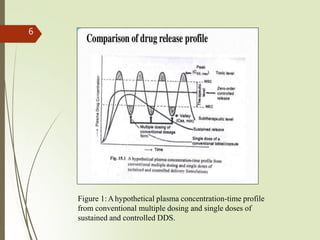
Figure 1:Ahypothetical plasmaconcentration-time profile
from conventional multiple dosing and single doses of
sustained and controlled DDS.
6
7.
➢ RATIONALE OFCONTROLLED DRUG
DELIVERY SYSTEM:
1. The basic rationale of a controlled release drug delivery system
is to optimize the biopharmaceutics, pharmacokinetics, and
pharmacodynamics properties of a drug in such a way that its
utility is maximized through reduction in side effects and cure or
control of disease condition in the shortest possible time by using
smallest quantity of drug, administered by most suitable route.
2. To provide a location specific action within the GIT.
3. To avoid an undesirable local action within the GIT.
4. To provide programmed delivery pattern.
5. To increase the extend of absorption/bioavailability.
6. To extend the time of action of drug after administration.
7
8.
➢ ADVANTAGES:
1. Totaldose is low.
2. Reduced GI side effects and other toxic effects.
3. Reduced dosing frequency
4. Better patient acceptance and compliance.
5. Less fluctuation in plasma drug levels.
6. More uniform drug effect.
7. Better stability of drug.
8. Reduction in total health care cost.
8
9.
➢ DISADVANTAGES:
1. Decreasedsystem availability
2. Poor invitro-invivo correlation
3. Retrieval of drug is difficult in case of toxicity, poison or hyper-sensitivity
reaction.
4. Difficult to optimize the accurate dose and dosing interval.
5. The physician has less flexibility in adjusting the dosage regimen.
6. This is fixed by dosage form design.
7. All drugs are not suitable candidates for controlled release medication.
8. Drugs with long biological half life (e.g. Digoxin-34 hours) are inherently long
acting and thus are viewed as questionable candidates for SR formulations.
9. Drugs with narrow requirements for absorption (e.g. drugs which depend on
position of GIT for optimum absorption are also poor candidates).
10. Drugs like Riboflavin and ferrous salt, which are not effectively absorbed in
lower intestine are poor candidates.
11. Drugs which are having very short half life (Furosemide) are not suitable
candidates.
9
10.
➢ SELECTION OFDRUG CANDIDATE FOR
CONTROLLED DRUG DELIVERY SYSTEM:
i] Oral Route:
The drug should have following properties to be a succesful candidate
• It must get absorbed through the entire length of GIT.
• Main limitation is transit time (mean of 14 hours), which can be extended
for 12-24 hours.
• Dose as high as 1000mg can be given through this route.
ii] Intramuscular/subcutaneous route:
This route is preferred because-
• The action is to be prolonged for 24 hours to 12 months.
• Small amount of drug is administered (2ml/2gm).
• Factors important are solubility of drug in surrounding tissue, molecular
weight, partition coefficient and pKa of drug.
iii] Transdermal route:
This route is selected for drugs which-
• Show extensive first pass metabolism upon oral administration or drugs
with low dose.
• Important factors to be considered are partition coefficient of drugs,
contact area, skin condition, skin permeability of drug, skin
perfusion rate, etc.
10
11.
iv] Characteristics thatmake a drug candidate not suitable for
controlled release dosage forms are listed below:
1. Short elimination half-life
2. Long elimination half-life
3. Poor absorption
4. Active absorption
5. Low or slow absorption
6. Extensive first pass effect.
11
12.
➢ CONTROLRELEASE DOSAGEFORM RELEASE FORMULATION
DESIGNS
1. Dissolution controlled release
• Encapsulation Dissolution control
• Matrix Dissolution control
2. Diffusion controlled release
• Reservoir type devices
• Matrix type devices
3. Diffusion and Dissolution controlled systems
4. Ion exchange resins
5. pH-Independent controlled release systems
6. Osmotically controlled release
7. Hydrodynamically balance system
12
13.
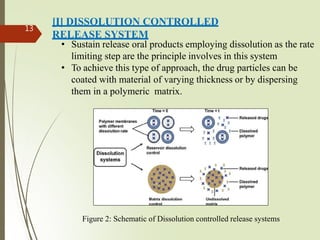
[I] DISSOLUTION CONTROLLED
RELEASESYSTEM
Figure 2: Schematic of Dissolution controlled release systems
13
• Sustain release oral products employing dissolution as the rate
limiting step are the principle involves in this system
• To achieve this type of approach, the drug particles can be
coated with material of varying thickness or by dispersing
them in a polymeric matrix.
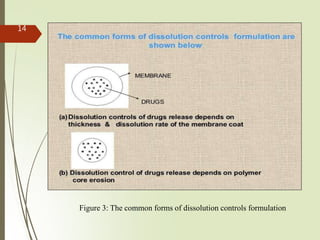
14.
Figure 3: Thecommon forms of dissolution controls formulation
14
15.
Dissolution controlled drugrelease system can be divided in to following
categories:
(1) Encapsulation Dissolution control
(3) Microencapsulation
(2) Seed or Granule coated
(4) Matrix Dissolution control
(1) Encapsulation Dissolution control:
This method involves the coating of particles or granules of drug with slow
dissolving materials
(2) Seed or Granule coated:
There are several ways to prepare a drug coated product
• A common method is to coat the seeds with the drug followed by a coat of
slow dissolving materials such as carbohydrate sugar and cellulose,
polyethylene glycol, polymeric material, and wax.
(3) Microencapsulation
• Coacervation / phase separation techniques
• Interfacial polymerization
• Precipitation
• Hot melt
• Salting out
• Solvent evaporation
• Electrostatic method.
15
16.
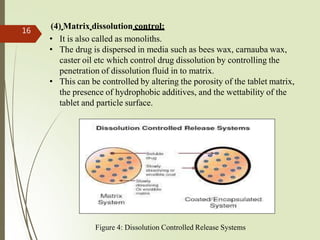
(4) Matrix dissolutioncontrol:
• It is also called as monoliths.
• The drug is dispersed in media such as bees wax, carnauba wax,
caster oil etc which control drug dissolution by controlling the
penetration of dissolution fluid in to matrix.
• This can be controlled by altering the porosity of the tablet matrix,
the presence of hydrophobic additives, and the wettability of the
tablet and particle surface.
Figure 4: Dissolution Controlled Release Systems
16
17.
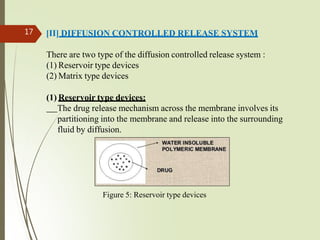
[II] DIFFUSION CONTROLLEDRELEASE SYSTEM
There are two type of the diffusion controlled release system :
(1) Reservoir type devices
(2) Matrix type devices
(1) Reservoir type devices:
The drug release mechanism across the membrane involves its
partitioning into the membrane and release into the surrounding
fluid by diffusion.
Figure 5: Reservoir type devices
17
18.
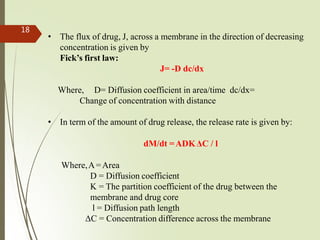
• The fluxof drug, J, across a membrane in the direction of decreasing
concentration is given by
Fick’s first law:
J= -D dc/dx
Where, D= Diffusion coefficient in area/time dc/dx=
Change of concentration with distance
• In term of the amount of drug release, the release rate is given by:
dM/dt =ADKΔC / l
Where,A=Area
D = Diffusion coefficient
K = The partition coefficient of the drug between the
membrane and drug core
l = Diffusion path length
ΔC = Concentration difference across the membrane
18
19.
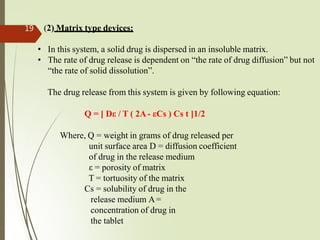
(2) Matrix typedevices:
• In this system, a solid drug is dispersed in an insoluble matrix.
• The rate of drug release is dependent on “the rate of drug diffusion” but not
“the rate of solid dissolution”.
The drug release from this system is given by following equation:
Q = [ Dε / T ( 2A- εCs ) Cs t ]1/2
Where, Q = weight in grams of drug released per
unit surface area D = diffusion coefficient
of drug in the release medium
ε = porosity of matrix
T = tortuosity of the matrix
Cs = solubility of drug in the
release medium A=
concentration of drug in
the tablet
19
20.
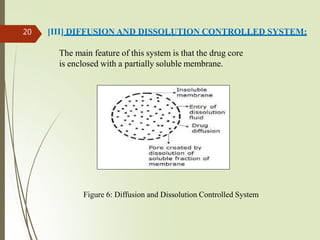
[III] DIFFUSION ANDDISSOLUTION CONTROLLED SYSTEM:
The main feature of this system is that the drug core
is enclosed with a partially soluble membrane.
Figure 6: Diffusion and Dissolution Controlled System
20
21.
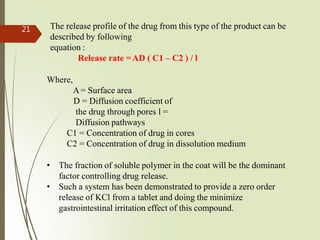
The release profileof the drug from this type of the product can be
described by following
equation :
Release rate =AD ( C1 – C2 ) / l
Where,
A= Surface area
D = Diffusion coefficient of
the drug through pores l =
Diffusion pathways
C1 = Concentration of drug in cores
C2 = Concentration of drug in dissolution medium
• The fraction of soluble polymer in the coat will be the dominant
factor controlling drug release.
• Such a system has been demonstrated to provide a zero order
release of KCl from a tablet and doing the minimize
gastrointestinal irritation effect of this compound.
21
22.
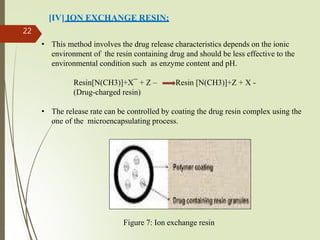
[IV] ION EXCHANGERESIN:
Figure 7: Ion exchange resin
• This method involves the drug release characteristics depends on the ionic
environment of the resin containing drug and should be less effective to the
environmental condition such as enzyme content and pH.
Resin[N(CH3)]+X¯ + Z – Resin [N(CH3)]+Z + X -
(Drug-charged resin)
• The release rate can be controlled by coating the drug resin complex using the
one of the microencapsulating process.
22
23.
• Improvement ofthis ion exchange type drug delivery
system is occurs by the development of the pennkinetic
system.
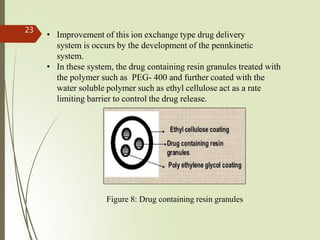
• In these system, the drug containing resin granules treated with
the polymer such as PEG- 400 and further coated with the
water soluble polymer such as ethyl cellulose act as a rate
limiting barrier to control the drug release.
Figure 8: Drug containing resin granules
23
24.
[V] pH –INDEPENDENT CONTROLLED RELEASE SYSTEM:
• This system involves the granules are designed for the oral
controlled release of acidic and basic drugs at the rate that
is independent of the pH in the GI tract.
• They are prepared by mixing a basic or acidic drugs with
one or more buffering agents, granulating with excipients
and finally coating with a GI fluid permeable film forming
polymer.
• When the GI fluid permeates through the membrane , the
buffering agents adjust the suitable constant pH, there by
constant rate of the drugs release occurs.
24
25.
[VI] OSMOTICALLY CONTROLLEDRELEASE SYSTEM
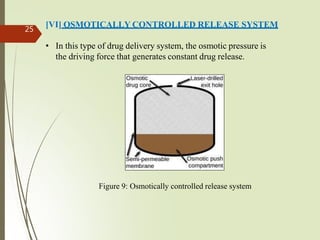
• In this type of drug delivery system, the osmotic pressure is
the driving force that generates constant drug release.
Figure 9: Osmotically controlled release system
25
26.
• To regulatethe flow of GI fluid for penetration through the semi
permeable membrane, a layer of bioerodible polymer can be
applied to the external surface of the semi permeable membrane.
• Several other modification of osmotic pressure controlled drug
delivery have been develop.
• One system consists of two compartments separated by the movable
partition
• Another modified system is one in which delivery orifice is absents.
• In these system, the GI fluid is penetrate, hydraulic pressure is built up
inside until the wall ruptures and the contents are release to the
environments.
• Osmotic controlled release system requires osmotic pressure to be
effective and is independent of its environments.
26
27.
[VII] HYDRODYNAMICALLYBALANCE SYSTEM
•This system is design to prolong GI residence time of drug in area
of the GIT to minimized drug reaching its absorption site in the
solution state.
• This type of the tablet or capsules having the less density compared
to the GI fluid density.
• This type of tablet is prepared by granulating a mixture of drug,
excipients, and hydrocolloids such as hydroxyethylcellulose,
hydroxypropyle cellulose, and hydroxypropylmethylcellulose.
➢ Classification of Hydrodynamically Balance System:
(a) Effervescent Floating Dosage Form
(b) Non effervescent Floating dosage Form
27
28.
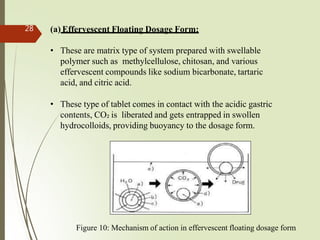
(a) Effervescent FloatingDosage Form:
• These are matrix type of system prepared with swellable
polymer such as methylcellulose, chitosan, and various
effervescent compounds like sodium bicarbonate, tartaric
acid, and citric acid.
• These type of tablet comes in contact with the acidic gastric
contents, CO₂ is liberated and gets entrapped in swollen
hydrocolloids, providing buoyancy to the dosage form.
Figure 10: Mechanism of action in effervescent floating dosage form
28
29.
(b) Non effervescentFloating dosage Form:
• This system is prepared from gel forming or swellable cellulose
type of hydrocolloids, polysaccharides, and matrix forming
polymer like acrylates.
• After the oral administration, this dosage forms swells in
contact with gastric fluid and attain a bulk density of G.I.
• The air entrapped within the swollen matrix imparts buoyancy to
dosage form.
• The formed swollen gel – like structure acts as a reservoir and
allows sustained release of drug through the gelatinous mass.
29
30.
➢ PHYSICOCHEMICALAND BIOLOGICALPROPERTIES
OFDRUG:
[I] PHYSICOCHEMICALPROPERTIES:
a) Aqueous solubility.
b) Partition coefficient
c) Drug stability
d) Molecular size and diffusivity
e) Drug pKa and Ionization at Physiological pH.
30
31.
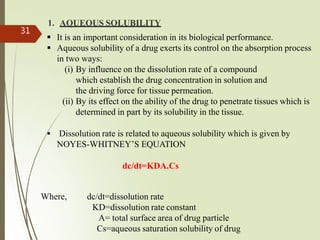
1. AQUEOUS SOLUBILITY
Where,dc/dt=dissolution rate
KD=dissolution rate constant
A= total surface area of drug particle
Cs=aqueous saturation solubility of drug
▪ It is an important consideration in its biological performance.
▪ Aqueous solubility of a drug exerts its control on the absorption process
in two ways:
(i) By influence on the dissolution rate of a compound
which establish the drug concentration in solution and
the driving force for tissue permeation.
(ii) By its effect on the ability of the drug to penetrate tissues which is
determined in part by its solubility in the tissue.
▪ Dissolution rate is related to aqueous solubility which is given by
NOYES-WHITNEY’S EQUATION
dc/dt=KDA.Cs
31
32.
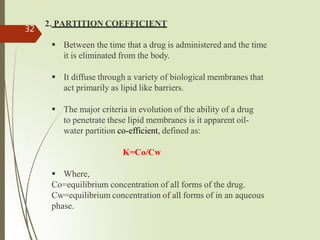
2. PARTITION COEFFICIENT
32
▪Between the time that a drug is administered and the time
it is eliminated from the body.
▪ It diffuse through a variety of biological membranes that
act primarily as lipid like barriers.
▪ The major criteria in evolution of the ability of a drug
to penetrate these lipid membranes is it apparent oil-
water partition co-efficient, defined as:
K=Co/Cw
▪ Where,
Co=equilibrium concentration of all forms of the drug.
Cw=equilibrium concentration of all forms of in an aqueous
phase.
33.
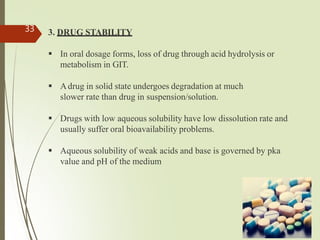
3. DRUG STABILITY
▪In oral dosage forms, loss of drug through acid hydrolysis or
metabolism in GIT.
▪ Adrug in solid state undergoes degradation at much
slower rate than drug in suspension/solution.
▪ Drugs with low aqueous solubility have low dissolution rate and
usually suffer oral bioavailability problems.
▪ Aqueous solubility of weak acids and base is governed by pka
value and pH of the medium
33
34.
4. MOLECULAR SIZEANDDIFFUSIVITY
▪ Ability of drug to diffuse through membrane is called as
diffusivity, is a function of molecular size.
▪ Diffusivity is inversely proportional to molecular size.
▪ Diffusivity depends on size and shape of the cavities of the
membrane.
34
35.
35
5. DRUG pKaAND IONIZATION AT PHYSIOLOGICAL pH
▪ Drug existing largely in ionized form are poor candidates for oral
CRDDS because absorption rate of ionized drug is 3-4 times less
than unionized drug.
▪ pKa range for acidic drug: 3.0-7.5
▪ pKa range for basic drug: 7.0-11.0
are ideal for optimum absorption.
36.
[II] BIOLOGICAL PROPERTIES:
1.Absorption
2. Distribution
3. Protein binding
4. Metabolism
5. Elimination and Biological half-life
6. Side Effects and Safety Considerations
36
37.
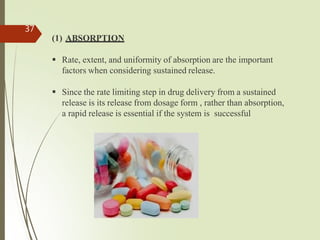
(1) ABSORPTION
▪ Rate,extent, and uniformity of absorption are the important
factors when considering sustained release.
▪ Since the rate limiting step in drug delivery from a sustained
release is its release from dosage form , rather than absorption,
a rapid release is essential if the system is successful
37
38.
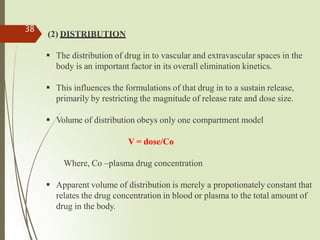
(2) DISTRIBUTION
▪ Thedistribution of drug in to vascular and extravascular spaces in the
body is an important factor in its overall elimination kinetics.
▪ This influences the formulations of that drug in to a sustain release,
primarily by restricting the magnitude of release rate and dose size.
▪ Volume of distribution obeys only one compartment model
V = dose/Co
Where, Co –plasma drug concentration
▪ Apparent volume of distribution is merely a propotionately constant that
relates the drug concentration in blood or plasma to the total amount of
drug in the body.
38
39.
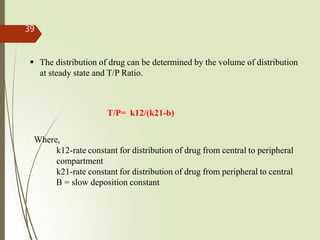
▪ The distributionof drug can be determined by the volume of distribution
at steady state and T/P Ratio.
T/P= k12/(k21-b)
Where,
k12-rate constant for distribution of drug from central to peripheral
compartment
k21-rate constant for distribution of drug from peripheral to central
B = slow deposition constant
39
40.
4. PROTEIN BINDING
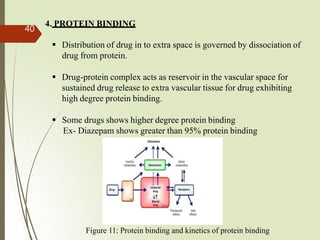
Figure11: Protein binding and kinetics of protein binding
40
▪ Distribution of drug in to extra space is governed by dissociation of
drug from protein.
▪ Drug-protein complex acts as reservoir in the vascular space for
sustained drug release to extra vascular tissue for drug exhibiting
high degree protein binding.
▪ Some drugs shows higher degree protein binding
Ex- Diazepam shows greater than 95% protein binding
41.
3) METABOLISM
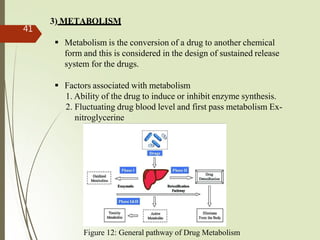
Figure 12:General pathway of Drug Metabolism
41
▪ Metabolism is the conversion of a drug to another chemical
form and this is considered in the design of sustained release
system for the drugs.
▪ Factors associated with metabolism
1. Ability of the drug to induce or inhibit enzyme synthesis.
2. Fluctuating drug blood level and first pass metabolism Ex-
nitroglycerine
42.
4) ELIMINATIONAND BIOLOGICALHALF-LIFE
Therate of elimination of drug is described quantitatively by
its biological half life
Significance of Half life
▪ Drug having shorter half life requires frequent dosing, making it
desirable to develop SDRS.
▪ This will be opposite for drugs with higher half life.
▪ Drug with half life less than 2 hrs and those with more than 8hrs
should not be used.
▪ Ex of drugs with half life less than 2hrs:Ampicillin, furosemide,
penicillin
▪ Ex of drugs with half life more than 8hrs: Diazepam, digitoxin,
digoxin
42
43.
5) SIDE EFFECTSAND SAFETY CONSIDERATIONS
▪ Minimizing side effect for a particular drug done by controlling
its plasma concentration and using less total drug over time
course of therapy.
▪ To measure margin of safety of drug its therapeutic index is
considered.
TI= TD50/ED50
Where,
TD50-Median toxic dose
ED50-Median effective dose
43
 Most read
![➢ SELECTION OF DRUG CANDIDATE FOR
CONTROLLED DRUG DELIVERY SYSTEM:
i] Oral Route:
The drug should have following properties to be a succesful candidate
• It must get absorbed through the entire length of GIT.
• Main limitation is transit time (mean of 14 hours), which can be extended
for 12-24 hours.
• Dose as high as 1000mg can be given through this route.
ii] Intramuscular/subcutaneous route:
This route is preferred because-
• The action is to be prolonged for 24 hours to 12 months.
• Small amount of drug is administered (2ml/2gm).
• Factors important are solubility of drug in surrounding tissue, molecular
weight, partition coefficient and pKa of drug.
iii] Transdermal route:
This route is selected for drugs which-
• Show extensive first pass metabolism upon oral administration or drugs
with low dose.
• Important factors to be considered are partition coefficient of drugs,
contact area, skin condition, skin permeability of drug, skin
perfusion rate, etc.
10](https://image.slidesharecdn.com/controlleddrugdeliverysystemcrdds-251228073601-2a7b9a07/85/CONTROLLED-DRUG-DELIVERY-SYSTEM-CRDDS-pdf-10-320.jpg)
![iv] Characteristics that make a drug candidate not suitable for
controlled release dosage forms are listed below:
1. Short elimination half-life
2. Long elimination half-life
3. Poor absorption
4. Active absorption
5. Low or slow absorption
6. Extensive first pass effect.
11](https://image.slidesharecdn.com/controlleddrugdeliverysystemcrdds-251228073601-2a7b9a07/85/CONTROLLED-DRUG-DELIVERY-SYSTEM-CRDDS-pdf-11-320.jpg)