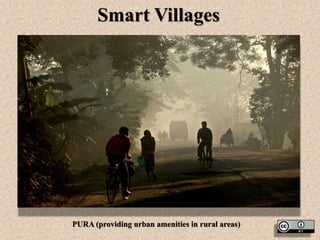
Smart Villages
PURA (providing urban amenities in rural areas)
Introduction
• A rural area is a geographic area that is located outside
cities and towns, while rural areas are also known as
'village' in India. In these villages, agriculture is the chief
source of livelihood along with fishing, cottage industries,
pottery, etc.
• According to the Erstwhile Planning Commission of India,
a settlement with a maximum population of 15,000 is
considered as “Village”. Much of India’s rural population
lives in nucleated villages, which most commonly have a
settlement form described as shapeless agglomerate.
‘Village' in India
Introduction
• Number of rural units or villages in India are approx 6, 38,588.
According to 2011 census, rural area has population of 68.84%,
whereas urban area has population of 31.16% only. In the Indian
context, villages are the heart of the nation.
• Hence, for the overall development of the country the focused
must be given to the grass root level, and that means the focus
areas should be the Indian village.
• There is a large scale migration of the people from rural areas to
urban areas, which has its own risk parameters on the urban areas,
and still there are many villages in India with heavy population.
• So the main aim to smarten the villages by offering basic
facilities, education, employment generation activities,
technology etc.
‘Village' in India
Introduction
• The population inhibit in the rural area needs the same calibre
and status of life as enjoyed by people living in sub urban and
urban areas.
• The government has already accepted this consequence and has
put solemn endeavour through diverse schemes for enhancing
livelihood of rural masses.
• Such rural progressive growth and development not only amend
livelihood in rural area, but also may abridge the migration of
flyaway rural population in urban areas.
• The current modern era of human development is quit ahead
and familiarly known as “Smart age”. Human beings are using
smart phones, smart TVs and live in smart homes.
Smart Village
Introduction
• The concept of smartness is popular in respect
and honour of human development regardless
of rural or urban area, literate or illiterate in
all the countries and India is not omission to it.
Like many developing countries, India too is a
rural dominated country.
• The idea of “Smart Village” will also attention
to multiple challenges such as unplanned
urbanization, under-development of villages,
migration for economic pursuance, improved
standard of living etc.
Introduction
What is Smart Villages?
INTRODUCTION
• As per statistics there are 676 districts in 29 states and 7
Union territories in India with a total number of 6, 38,000
villages. All areas which are not categorized as urban area
are considered as rural area. Numbers of villages in India
are approximately 6, 38,588. According to 2011 census, rural
area has population of 68.84%, whereas urban area has
population of 31.16% only. A rural area is a geographic area
that is located outside cities and towns are also known as
'village' in India.
What is Smart Villages?
• In Smart Villages access to sustainable
energy services acts as a catalyst for
development – enabling the provision of good
education and healthcare, access to clean
water, sanitation and nutrition, the growth
of productive enterprises to boost incomes,
and enhanced security, gender equality and
democratic engagement.
What is Smart Villages?
Vision of Smart Village
• To accomplish the ‘Smart Village/Ward’ status, the
community, individually and collectively, will be empowered
to take smart decisions using smart technologies and with
the support of smart manpower and by managing to be
self-sufficient.
Need for Smart Villages
• At present, one of the major challenges in
India is growing population and rapid
urbanization. This urban growth to certain
expansion is unavoidable, as the economic
pursuits and aspirations of the population
do change and expand. This needs to be
invert and suitably managed through a
balance between rural and urban quality of
life.
Smart Villages
Need for Smart Villages
• A “Smart Village” will furnish long-term social,
economic, and environmental welfare action for
village community which will capable and empower
enhanced involvement in local governance processes,
encourage entrepreneurship and build more lively
communities.
• At the same time, a “Smart Village” will ensure
good education, better infrastructure, proper
sanitation facility, health facilities, waste
management, renewable energy, environment
protection, clean drinking water, resource use
efficiency etc.
Need for Smart Villages
• The village communities are little republics, having
nearly everything that they want within themselves, and
almost independent of any foreign relations. In the
development process, there will be many changes in the
demand and supply of various needs, as rural population
will pass through the process of change. At present, one of
the major challenges in India is growing population and
rapid urbanization. This urban growth to certain extent is
unavoidable, as the economic pursuits and aspirations of the
population do change and evolve. This needs to be
reversed and suitably managed through a balance
between rural and urban quality of life. The concept of
“Smart Village” will address the multiple challenges
faced for sustainable development of rural India.
Need for Smart Villages
• There is an urgent need for designing and developing
“Smart Village”, which are independent in providing the
services and employment and yet well connected to the
rest of the world.
• Based on various programs undertaken taken by Central and
state governments along with further technological
initiatives, the Smart Village can achieve SMART
infrastructure, SMART service delivery, SMART
technology and innovation, SMART institutions along with
optimal mobilization and utilization of available resources,
leading to faster and more inclusive growth.
• A ‘Smart Village’ will encompass a sustainable and
inclusive development of all sections of the village
community, so as they enjoy a high standard of living.
Need for Smart Villages
Concept
• The basic concept of smart village is to collect
community efforts and strength of people from
various streams and integrate it with information
technology to provide benefits to the rural
community.
• According to Mahatma Gandhi’s philosophy and
thoughts smart village project provides, “Global
means to the local needs.”
• The concept of smart village is defined as below,
Concept
Concept
Smart Village and its Importance
• The idea of smart village in the present day context seems more
reasonable as there is a limit of growth of cities which is leading
to creation of urban jungles, where the population ratio per km of
land is way above the desired norms.
• To take baby steps initially would lead to a campaign at
National level once the fruits of this effort start bearing fruits,
which surely would be visible for all to see sooner than expected.
• Just like smart cities, a smart village should be interactive and
multi-functional; there should be active participation of people
in various activities.
• A smart village is one which will automatically link local
production with local procurement and local distribution. A
smart village will also have power, knowledge, healthcare,
technology, entrepreneurship and internet connectivity.
Concept
• A smart village will not only bring Internet connection to the rural
lands, but will also provide support to sustainable agricultural
practices.
• A network of small scale industries linked to agriculture, and a strong
network of rail and road corridors with civic amenities such as education
and health for all, including farmers, will transform the face of real India.
• The National Sample Survey 61st Round results show that among
persons of age 15–29 years, only about 2% are reported to have
received formal vocational training and another 8% reported to have
received non-formal vocational training indicating that very few young
people actually enter the world of work with any kind of formal vocational
training.
• This proportion of trained youth is one of the lowest in the world. The
corresponding figures for industrialized countries are much higher,
varying between 60% and 96% of the youth in the age group of 20–24
years.
Smart Villages
Aims of Smart Village
• Homes with access to toilet, safe drinking
water and regular power.
• A Smart Village knows all information
about its citizens, available resources,
applicable services and schemes.
• Every household has diversified livelihood
opportunities and/or micro enterprise.
Microenterprise a business operating on a
very small scale, esp. one with a sole
proprietor and fewer than six employees.
Smart Village
Aims of Smart Village
• Maintain its Identity, culture and Heritage
• Plans for development based on People, Assets and
• Service Centric information and tracks its progress.
• It works towards Revenue generation.
• Has functional solid/liquid waste management
system.
• End all preventable maternal deaths and infant
deaths
• Which means proving good basic health facilities in
Health care centred
Smart Villages
Aims of Smart Village
• 100% institutional deliveries
• Interacts with Government, NGO’s, Social Entrepreneurs,
Experts for its needs
• Functional toilet, potable water electricity available in
schools, health centres.
• Awareness on new technologies that can be implemented in
villages, farms and nearby places. e.g. Drip Irrigation, Solar
Panels Lighting Systems on streetlights etc.
• Good facilities for Domestic animals like dogs and cattle:
dispensaries, pond for cattle, veterinary hospitals and vets
Smart Villages
Areas of Interest In Smart Villages
• Following are some potential areas, where Smart Village may create
measurable and significant impact:-
• Smart Buildings – security cameras , fire safety, electricity managements
• Smart Dairy-Remote supervision and monitoring in open fields and
barns.
• Smart Farming- Satellite data for farm activities.
• Smart agriculture- Smart agricultural equipment for crop production.
• Smart Weather and Irrigation-Weather forecast water levels in dams.
• Smart health care –Smart beds and equipments to monitor patient.
• Smart Education – Interactive learning through videos
• Smart surveillance system – CC cameras and sensors to detect robbery
Smart Buildings – security cameras ,
fire safety, electricity managements
Smart Dairy
Smart Farming- Satellite data for
farm activities.
Smart agriculture- Smart agricultural
equipment for crop production
Smart Weather and Irrigation-
Weather forecast water levels in dams
Smart health care –Smart beds and
equipments to monitor patient
Smart Education – Interactive
learning through videos
Smart surveillance system – CC
cameras and sensors to detect robbery
Areas of Interest In Smart Villages
• The future of India lies in converting each and
every village into smart villages.
• The concept of smart village will provide the
similar kind of facilities to the villages, so that
the agrarian community will remain in villages
and not migrate to urban areas.
• Future generations will contribute immensely
in development process and enjoy the
traditional agriculture activity with the use of
modern technology
Smart Villages
Objective of Smart Village Programme
• A ‘Smart Village/Ward’ encompasses sustainable
and inclusive development of all sections of its
Community, so. The 100 per cent achievement of the
following basic amenities, they enjoy a high
standard of living.
• 1. Homes for all – with access to toilet, safe-drinking
water, and regular power
• 2. Skills and Village Enterprise development with
bank and market linkages gave more flexible access to
youth.
• 3. Has functional solid/liquid waste management
system.
Objective of Smart Village Programme
Homes for all
Skills and Village Enterprise development with
bank
functional solid/liquid waste management system.
Objective of Smart Village Programme
• 4. End all preventable maternal deaths and infant deaths.
• 5. Zero school drop outs of boys and girls.
• 6. Functional toilet, potable water, electricity available in
Anganwadi Centres, schools.
• 7. Malnutrition free (children below 9 years of age).
• 8. No girl-child marriages (girls below 18 years of age).
• 9. Every village household has a functional bank account/PM Jan
Dhan Bank Account.
• 10. Every GP/Ward has green trees plantations all over its
geographic boundaries.
• 11. Every GP/Ward has functional water conservation and
harvesting structures.
• 12. Every GP/Ward has functional Information Centre, Computer
Lab, and Mee-Seva Centre.
Objective of Smart Village Programme
No girl-child marriages
(girls below 18 years of age).
Zero school drop outs
Functional toilet
PM Jan Dhan Bank Account.
Government Programs for Smart Village
• In maiden independence day speech, Prime Minister
Modi took the opportunity to announce the Saansad
Adarsh Gram Yojna (Parliamentarian's Model Village
Scheme), under the new scheme, each parliamentarian is
mandated to adopt three rural villages and ensure that these
village are transformed in to "Smart Villages" by 2019.
• Villages will be backed up by the provision of basic
amenities that are often only available in urban areas
and a social security system. This new drive will provide
more opportunities to report on exciting developments,
undertake fruitful collaboration with other partners and
disseminate impactful findings that can benefit off-grid
communities far beyond India.
Government Programs for Smart Village
• Major Programs in Agriculture
– National Agricultural Development Program
– Accelerated Irrigation Benefit Program
– Fertilizer Subsidy
– Bank loans, Free Electricity
• Major Programs to Improve Employment
– Public Distribution System
– Mahatma Gandhi National Rural Employment
• Guarantee Scheme
– National Food Security Bill
• Major Programs & Partnerships to Improve Nutrition Security
– Mid Day Meal Scheme
– Integrated Child Development Scheme (ICDS)
– Annapurna Scheme (Ministry of Rural Development) for
– senior citizens
– The Nutritional Program for Adolescent Girls
– Emergency feeding program (in eight districts in Orissa)
Government Programs for Smart Village
Services Required for Smart Village
Services required for smart village
Services required for smart village,
• Food security.
• Democratic engagement
– Good governance,
– Social development.
• Health welfare
– Environmental development ,
– Personal development.
• Education - Basic knowledge for awareness.
• Local business - economic development.
Services required for smart village
• Smart Security.
• Efficient public transportation system.
• Improving sanitation conditions
• Solid and liquid waste management.
• Rain harvesting /Rain water drainage system.
• Safe drinking water facilities.
• Use of renewable energy.
Services required for smart village
Efficient public transportation system.
Improving sanitation conditionsRain harvesting /Rain water drainage system
Use of renewable energy.
Services required for smart village
• Energy conservation.
• Grievance redresser.
• Strengthening CBOs.
• Functional bank account.
• Facilities regarding to the agriculture.
• Latest& affordable medical facilities.
• E-governance.
Use of modern technologies for improvement of
locality.
Improvement on women empowerment.
• Educational facilities.
Services required for smart village
Energy conservation
Grievance redresser
E-governance
The Idea of Smart villages based on
Internet of Things
• The idea of Internet of Things (IoT) is the
future prospect of technology.
• The rationale behind its working is the
amalgamation of web, mobile and Information and
Communications technology.
• It enables various devices in a system to
communicate and interact with each other to
perform their job in a harmonious way.
The Idea of Smart villages based on
Internet of Things
The Idea of Smart villages based on
Internet of Things
• There are certain ideas in smart cities that can
be directly implemented in villages.
• For example, the use of cameras and sensors in
streets for surveillance, sensors for healthcare
etc. On the other hand, there are certain sectors
like agriculture, cattle/livestock rearing etc which
need some improvised ideas for smart working.
• In the following sections, the various aspects of
villages have been considered and how the quality
of life in villages can be made better using the
IoT and Smart village model.
The Idea of Smart villages based on
Internet of Things
The Idea of Smart villages based on
Internet of Things
Smart Buildings
• The homes and buildings can be made smart by the use of
sensors and cameras.
• These will produce real-time data which can be analyzed to take
necessary actions. For example, sensors installed in a home can
detect smoke and hence start the water sprinklers automatically
to combat the fire. Similarly, the sensors can monitor the usage of
electricity in the home or building and switch the lights off when not
in use.
• Efficient energy management is the key need in villages where
the electricity is not available all of the time.
• The security of the building can be monitored using cameras
and appropriate alerts can be generated in case of any
anomalies. The water levels and pressure can be measured in the
water tanks and pipes and used to refill the tanks when necessary as
well as detect any faults in the pipes.
Smart Buildings
The idea of Smart villages based on
Internet of Things
Smart Weather and Irrigation
• Accurate weather information can be of great use to the people
of the village.
• As we know, the majority of population in villages engages in
agriculture for their living. The use of environmental sensors to
predict weather forecasts can help the farmers to a large extent.
Many farming activities like sowing, irrigation and harvesting
depend on the weather.
• Smart irrigation systems can make use of sensors in the fields
and remote satellite data to ensure the optimal use of available
water resources. If it is going to rain the next day, then watering the
fields on that day makes no sense. All this information can be made
available to the farmers through message alerts on their mobile
phones. The level of water in the dams and canals can also be
monitored using sensors and it can be used to predict the future need
of water.
Smart Weather and Irrigation
The Idea of Smart villages based on
Internet of Things
Smart Farming As Agriculture is the backbone of all villages, the
farmers
• need to benefit the most from the system of IoT and Smart
villages. There needs to be the tracking of the farm produce
from the farm to the table. The whole chain of activities can be
monitored and improved using data from sensors and other sources.
• The people involved in the process are the growers, processors
and packers, storage and transport service providers,
distributors, wholesalers and retailers . Sensors deployed in the
fields can help the farmers with information regarding selecting
the crop to sow, yield prediction of crops based on the type of
soil or climate, watering requirements using smart drip-based
irrigation systems, application of fertilizers according to the nutrient
content of the soil etc.
The Idea of Smart villages based on
Internet of Things
The Idea of Smart villages based on
Internet of Things
• The crop diseases and pesticides can also be
predicted using data from sensors and crop leaf
pictures taken by remote satellites. The farmers can
get up to-date information on their mobile phones.
In case of emergencies, alert systems can be
activated and provide immediate actions. For
example, consider the case of wheat crop which is
ready to harvest, a small spark can set the whole field
ablaze and cause huge losses to the farmers.
Environmental sensors can detect smoke on the onset of
fire and start the water sprinklers immediately to
control the fire and avoid extreme loss.
Idea of Smart villages based on Internet
of Things
The idea of Smart villages based on
Internet of Things
Smart Dairy
• The secondary occupation of a large number of farmers
is rearing cattle for dairy products.
• The use of sensors and cameras in the barn or shelter
can help the farmers in better management of their
work. Any changes can be reported instantly through
alert messages and required measures can be taken.
Favourable temperature for the cattle can be maintained
using smart devices.
• The food, water and health necessities of the cattle can
also be monitored in a similar fashion. Grazing the cattle
in the open fields is a risky thing if there is no one to
supervise it. The use of sensors in the fields can eliminate
the job of supervision by a human and it can be done
remotely by the farmers.
Smart Dairy
The idea of Smart villages based on
Internet of Things
Smart Healthcare
• Smart health services are needed to improve the quality
of life in the villages. The village dispensaries and
hospitals need advanced devices which are connected to
each other and the doctors.
• The beds in hospital can be embedded with sensors
which can detect various changes in the patient
including its movements, heartbeat, blood flow from the
wounds and body temperature etc.
• These reports along with the data generated by various
machines like X-rays, CT scans etc. can be sent to the
doctor directly. Such services will upgrade the health care
sector of the villages.
Smart Healthcare
The idea of Smart villages based on
Internet of Things
Smart Surveillance
• System Security is a major concern in villages as there is
lesser number of lights, police stations are far off and the
villages are located away from the main cities. Due to
these factors, the smart surveillance systems are needed
in villages.
• These will work on the basis of the data generated by
sensors and cameras along with emergency buttons
located in different parts of the village.
• In case of a theft or robbery, the nearest emergency
button can be pressed and it will send an alert to the
nearest police station. The data generated by the cameras
can be used to locate the thief thereafter. The data can also
be analyzed to avoid such incidents in the future.
Smart Surveillance
The idea of Smart villages based on
Internet of Things
Smart Education
• Is the basic means to implement all the advancements in life.
Educating people about the use of new technologies facilitates
better implementation.
• It can be the force behind reducing the digital-divide which is
far more prevalent in villages than the cities. The whole idea of
Smart villages revolves around its people and how efficiently
they make use of the components of a Smart village.
• They can be educated to participate in each and every activity of the
village leading to a better lifestyle for its people. and interactive
videos can foster the learning in children and even adults. These can
be used to educate them to use the facilities provided in the Smart
villages in the best way. The village schools can be equipped with
Internet and other devices and learning can be made a fun activity
turning the schools into Smart schools
Smart Education
The Idea of Smart villages based on
Internet of Things
Conclusion
• Smart Villages are the need of the hour as
development is needed for both rural and urban
areas for better livelihood and Information
technology will offer effective solution. There are
successful technologies available, which have been
implemented in urban areas. There is tremendous
pressure on urban landscapes due to migration of
rural people for livelihood. Smart Villages will not
only reduce this migration but also irrigate the
population flow from urban to rural area. ICT/ IT
and GIS are the unbreakable pillars to support the
whole process of village development.
Conclusion
Conclusion
• Smart village concept will have potential to
uplift the grass-root level of the country,
hence adding feather in the overall
development of India.
• Failure to utilize Information Technology
tools for rural development is because of
lack of strategy, unfocused planning and
above all monitoring and execution of the
activities.
Conclusion
• All these activities need to be addressed
based on the varying rural situations. A
specially designed suitable framework for
rural areas on the grounds of Science,
Technology, Engineering, Regulations and
Management will play important role to
build next generation smart villages.
Smart Villages
Conclusion
• Each village is a unique example and having diverse set of
problems and situations.
• It may be difficult to implement the same model of
village development for all the villages. To address this
complex problem, Public Private Partnership (PPP) may
play key role for developing smart villages. Benefits of the
smart village efforts are foreseen to be tremendous.
• Smart village concept is having high replication
potential in other countries of developing world. The
concept of smart village may also be extended to small
towns and also townships surrounding the big Cities.
Public Private Partnership (PPP)
Case Study- Punsari
Gujarat village that puts metros to shame
• Sometimes just a vision for change can
create an ocean of a difference. When
Himanshu Patel was elected Sarpanch of
Punsari, a quaint little village in
Sabarkanth district Gujarat, in 2006 there
was no sewerage connection, no street lights,
no pucca roads and, of course, no source of
income for the gram panchayat except the
grants and funding from various state and
Union government schemes.
Mr. Himanshu Patel,
Sarpanch, Punsari
Case Study- Punsari
Gujarat village that puts metros to shame
• Six years later, the urban village flaunts a Wi-Fi and optical fiber
broadband network, classrooms with CCTV cameras, its own mini-bus
transport system and 25-odd CCTVs located on important junctions to
spot litterbugs.
• There is an RO water treatment plant that supplies 20-litre cans to
houses for a token cost of Rs 4. You also have a school bus to ferry your
wards, and that too on clean RCC roads.
• The gram panchayat also provides facilities of loud speaker covering
entire village, gutter project, clean primary health care center, 8 kinder
garden schools, banking facility, toll free complain receiving phone service,
among others.
• Villagers can buy ticket of Re 1 to use the mini bus service. For female
students, bus service is completely free.
Case Study- Punsari
Gujarat Village that puts Metros to Shame
RO water treatment plant
Mini Bus Service
loud speaker covering entire village
Case Study- Punsari
Gujarat village that puts metros to shame
• Punsri has 120 loud-speakers covering each
corner of the village. Villagers listen to
prabhatiya in the morning and bhajan and
bhakti songs in the evening.
• Also important announcements like telephone bill,
power bill, results of students are made through
these speakers.
• Unique feature is that the village sarpanch can
pass on any announcement from his mobile
phone. To set up this system Rs 4 lakh were
spent from corpus.
Case Study- Punsari
Gujarat Village that puts Metros to Shame
120 loud-speakers covering each corner of
the village.
CCTVs located on important junctions to
spot litterbugs.
Case Study- Punsari
Gujarat village that puts metros to shame
• Punsari is a village located in Sabarkantha district in the state of
Gujarat, India. The village is located at about 80 km from the
state capital, Gandhinagar.
• The village follows the Panchayati raj system. The village has
undergone a transformation under the panchayat. There has
been use of new and advanced technology in education. In this
village have Wi-Fi connection for all people.
• Efforts have been made for the empowerment of women and
increasing security in the village. Some of the facilities provided
by the panchayat include local mineral water supply, sewer &
drainage project, a healthcare centre, banking facilities and toll-
free complaint reception service. Consequently, Punsari received
the award of being the best Gram Panchayat in Gujarat. The village's
model has been appreciated by delegates from Nairobi and they are
keen to replicate this in Kenyan villages
banking facilities and toll-free
complaint reception service
Panchayati raj system
Case Study- Punsari
Gujarat village that puts metros to shame
• There is a 66 KV sub-station that supplies
power to the village.
• Mini-buses are used for transport purpose
within the village. The panchayat has started a
bus facility called the Atal Express for women
which is used for the import of milk.
Case Study- Punsari
Gujarat village that puts metros to shame
Atal Express for women which is used
for the import of milk.
Mini-buses
Case Study- Punsari
Gujarat village that puts metros to shame
Education system
• There are five primary schools in Punsari. All the five schools
have CCTV cameras placed to enable parents check their
wards' performance without interrupting the lectures and also
to keep a watch on the teachers. The school drop-out rate is zero
in Punsari. The village was rated B+ during Ganotsav 2011 which is
an annual education campaign run by the state government.
Water system
• The panchayat has installed a reverse osmosis plant in 2010 to
ensure the supply of clean drinking water to the villagers.
During weddings and other ceremonies, water tankers are
arranged. Drinking water taps are available for all. The village also
has a proper sanitation and drainage system, which is completely
underground
Case Study- Punsari
Gujarat village that puts metros to shame
Education system
Water system
Case Study- Punsari
Gujarat village that puts metros to shame
• If you think this village is drenched in NRI funds,
think again. Not a single rupee has come from
across the seven seas, instead the village managed
its funds over the last five years that it received
from central and state sponsored developmental
schemes.
Case Study- Punsari
Gujarat village that puts metros to shame
• The village panchayat had a capital of Rs
25,000 five years ago. Today, the deposits
have soared to Rs 75 lakh.
• "The turn-around happened when we sold
part of our grazing land as plotted schemes
to various communities. The money is
deposited in government coffers," says Patel.
Case Study- Punsari
Gujarat village that puts metros to shame
Case Study- Punsari
Gujarat village that puts metros to shame
• For his efforts, the Sarpanch Himanshu
Narendrabhai Patel was awarded with the best
Gram Sabha award at the third National Panchayati
Raj Day held at New Delhi. In November 2011, he
received the best Gram Panchayat award in Gujarat
from Chief Minister Narendra Modi. The Punsari
Gram Panchayat has received the prestigious Bharat
Ratna Rajiv Gandhi Best Gram Panchayat National
Award for the Year-2012, conferred by the Academy of
Grassroots Studies and Research of India (AGRASRI),
Tirupati, Andhra Pradesh.<www.agrasri.org.in> at a
function held in New Delhi.
Case Study- Punsari
Gujarat village that puts metros to shame
References
Punsari
https://en.wikipedia.org/wiki/Punsari
Sansad Adarsh Gram Yojana
http://saanjhi.gov.in/
Smart Village
http://smartvillages.org/
Smart Village Inititive
http://e4sv.org/about-us/what-are-smart-villages/
Smart Village & Smart Cities -N. Viswanadham
http://nptel.ac.in/courses/110108056/module5/Lecture35.pdf
Smart Villages through Information Technology
http://ipasj.org/IIJIT/Volume3Issue7/IIJIT-2015-07-10-2.pdf
Study and development of village as a smart village
http://www.ijser.org/researchpaper%5CStudy-and-development-of-village-as-a-smart-village.pdf
The Indian smart village: Foundation for growing India
http://www.allresearchjournal.com/archives/2016/vol2issue3/PartB/2-2-111.pdf
The idea of Smart villages based on Internet of Things (IoT)
https://www.irjet.net/archives/V3/i5/IRJET-V3I535.pdf
http://deshgujarat.com/2011/11/07/why-punsri-is-selected-as-the-best-village-panchayat-in-gujarat/
Thanks…

Smart Villages

  • 1.
    Smart Villages PURA (providingurban amenities in rural areas)
  • 2.
    Introduction • A ruralarea is a geographic area that is located outside cities and towns, while rural areas are also known as 'village' in India. In these villages, agriculture is the chief source of livelihood along with fishing, cottage industries, pottery, etc. • According to the Erstwhile Planning Commission of India, a settlement with a maximum population of 15,000 is considered as “Village”. Much of India’s rural population lives in nucleated villages, which most commonly have a settlement form described as shapeless agglomerate.
  • 3.
  • 4.
    Introduction • Number ofrural units or villages in India are approx 6, 38,588. According to 2011 census, rural area has population of 68.84%, whereas urban area has population of 31.16% only. In the Indian context, villages are the heart of the nation. • Hence, for the overall development of the country the focused must be given to the grass root level, and that means the focus areas should be the Indian village. • There is a large scale migration of the people from rural areas to urban areas, which has its own risk parameters on the urban areas, and still there are many villages in India with heavy population. • So the main aim to smarten the villages by offering basic facilities, education, employment generation activities, technology etc.
  • 5.
  • 6.
    Introduction • The populationinhibit in the rural area needs the same calibre and status of life as enjoyed by people living in sub urban and urban areas. • The government has already accepted this consequence and has put solemn endeavour through diverse schemes for enhancing livelihood of rural masses. • Such rural progressive growth and development not only amend livelihood in rural area, but also may abridge the migration of flyaway rural population in urban areas. • The current modern era of human development is quit ahead and familiarly known as “Smart age”. Human beings are using smart phones, smart TVs and live in smart homes.
  • 7.
  • 8.
    Introduction • The conceptof smartness is popular in respect and honour of human development regardless of rural or urban area, literate or illiterate in all the countries and India is not omission to it. Like many developing countries, India too is a rural dominated country. • The idea of “Smart Village” will also attention to multiple challenges such as unplanned urbanization, under-development of villages, migration for economic pursuance, improved standard of living etc.
  • 9.
  • 10.
    What is SmartVillages? INTRODUCTION • As per statistics there are 676 districts in 29 states and 7 Union territories in India with a total number of 6, 38,000 villages. All areas which are not categorized as urban area are considered as rural area. Numbers of villages in India are approximately 6, 38,588. According to 2011 census, rural area has population of 68.84%, whereas urban area has population of 31.16% only. A rural area is a geographic area that is located outside cities and towns are also known as 'village' in India.
  • 11.
    What is SmartVillages?
  • 12.
    What is SmartVillages? • In Smart Villages access to sustainable energy services acts as a catalyst for development – enabling the provision of good education and healthcare, access to clean water, sanitation and nutrition, the growth of productive enterprises to boost incomes, and enhanced security, gender equality and democratic engagement.
  • 13.
    What is SmartVillages?
  • 14.
    Vision of SmartVillage • To accomplish the ‘Smart Village/Ward’ status, the community, individually and collectively, will be empowered to take smart decisions using smart technologies and with the support of smart manpower and by managing to be self-sufficient.
  • 15.
    Need for SmartVillages • At present, one of the major challenges in India is growing population and rapid urbanization. This urban growth to certain expansion is unavoidable, as the economic pursuits and aspirations of the population do change and expand. This needs to be invert and suitably managed through a balance between rural and urban quality of life.
  • 16.
  • 17.
    Need for SmartVillages • A “Smart Village” will furnish long-term social, economic, and environmental welfare action for village community which will capable and empower enhanced involvement in local governance processes, encourage entrepreneurship and build more lively communities. • At the same time, a “Smart Village” will ensure good education, better infrastructure, proper sanitation facility, health facilities, waste management, renewable energy, environment protection, clean drinking water, resource use efficiency etc.
  • 18.
  • 19.
    Need for SmartVillages • The village communities are little republics, having nearly everything that they want within themselves, and almost independent of any foreign relations. In the development process, there will be many changes in the demand and supply of various needs, as rural population will pass through the process of change. At present, one of the major challenges in India is growing population and rapid urbanization. This urban growth to certain extent is unavoidable, as the economic pursuits and aspirations of the population do change and evolve. This needs to be reversed and suitably managed through a balance between rural and urban quality of life. The concept of “Smart Village” will address the multiple challenges faced for sustainable development of rural India.
  • 20.
  • 21.
    Need for SmartVillages • There is an urgent need for designing and developing “Smart Village”, which are independent in providing the services and employment and yet well connected to the rest of the world. • Based on various programs undertaken taken by Central and state governments along with further technological initiatives, the Smart Village can achieve SMART infrastructure, SMART service delivery, SMART technology and innovation, SMART institutions along with optimal mobilization and utilization of available resources, leading to faster and more inclusive growth. • A ‘Smart Village’ will encompass a sustainable and inclusive development of all sections of the village community, so as they enjoy a high standard of living.
  • 22.
  • 23.
    Concept • The basicconcept of smart village is to collect community efforts and strength of people from various streams and integrate it with information technology to provide benefits to the rural community. • According to Mahatma Gandhi’s philosophy and thoughts smart village project provides, “Global means to the local needs.” • The concept of smart village is defined as below,
  • 24.
  • 25.
    Concept Smart Village andits Importance • The idea of smart village in the present day context seems more reasonable as there is a limit of growth of cities which is leading to creation of urban jungles, where the population ratio per km of land is way above the desired norms. • To take baby steps initially would lead to a campaign at National level once the fruits of this effort start bearing fruits, which surely would be visible for all to see sooner than expected. • Just like smart cities, a smart village should be interactive and multi-functional; there should be active participation of people in various activities. • A smart village is one which will automatically link local production with local procurement and local distribution. A smart village will also have power, knowledge, healthcare, technology, entrepreneurship and internet connectivity.
  • 26.
    Concept • A smartvillage will not only bring Internet connection to the rural lands, but will also provide support to sustainable agricultural practices. • A network of small scale industries linked to agriculture, and a strong network of rail and road corridors with civic amenities such as education and health for all, including farmers, will transform the face of real India. • The National Sample Survey 61st Round results show that among persons of age 15–29 years, only about 2% are reported to have received formal vocational training and another 8% reported to have received non-formal vocational training indicating that very few young people actually enter the world of work with any kind of formal vocational training. • This proportion of trained youth is one of the lowest in the world. The corresponding figures for industrialized countries are much higher, varying between 60% and 96% of the youth in the age group of 20–24 years.
  • 27.
  • 28.
    Aims of SmartVillage • Homes with access to toilet, safe drinking water and regular power. • A Smart Village knows all information about its citizens, available resources, applicable services and schemes. • Every household has diversified livelihood opportunities and/or micro enterprise. Microenterprise a business operating on a very small scale, esp. one with a sole proprietor and fewer than six employees.
  • 29.
  • 30.
    Aims of SmartVillage • Maintain its Identity, culture and Heritage • Plans for development based on People, Assets and • Service Centric information and tracks its progress. • It works towards Revenue generation. • Has functional solid/liquid waste management system. • End all preventable maternal deaths and infant deaths • Which means proving good basic health facilities in Health care centred
  • 31.
  • 32.
    Aims of SmartVillage • 100% institutional deliveries • Interacts with Government, NGO’s, Social Entrepreneurs, Experts for its needs • Functional toilet, potable water electricity available in schools, health centres. • Awareness on new technologies that can be implemented in villages, farms and nearby places. e.g. Drip Irrigation, Solar Panels Lighting Systems on streetlights etc. • Good facilities for Domestic animals like dogs and cattle: dispensaries, pond for cattle, veterinary hospitals and vets
  • 33.
  • 34.
    Areas of InterestIn Smart Villages • Following are some potential areas, where Smart Village may create measurable and significant impact:- • Smart Buildings – security cameras , fire safety, electricity managements • Smart Dairy-Remote supervision and monitoring in open fields and barns. • Smart Farming- Satellite data for farm activities. • Smart agriculture- Smart agricultural equipment for crop production. • Smart Weather and Irrigation-Weather forecast water levels in dams. • Smart health care –Smart beds and equipments to monitor patient. • Smart Education – Interactive learning through videos • Smart surveillance system – CC cameras and sensors to detect robbery
  • 35.
    Smart Buildings –security cameras , fire safety, electricity managements
  • 36.
  • 37.
    Smart Farming- Satellitedata for farm activities.
  • 38.
    Smart agriculture- Smartagricultural equipment for crop production
  • 39.
    Smart Weather andIrrigation- Weather forecast water levels in dams
  • 40.
    Smart health care–Smart beds and equipments to monitor patient
  • 41.
    Smart Education –Interactive learning through videos
  • 42.
    Smart surveillance system– CC cameras and sensors to detect robbery
  • 43.
    Areas of InterestIn Smart Villages • The future of India lies in converting each and every village into smart villages. • The concept of smart village will provide the similar kind of facilities to the villages, so that the agrarian community will remain in villages and not migrate to urban areas. • Future generations will contribute immensely in development process and enjoy the traditional agriculture activity with the use of modern technology
  • 44.
  • 45.
    Objective of SmartVillage Programme • A ‘Smart Village/Ward’ encompasses sustainable and inclusive development of all sections of its Community, so. The 100 per cent achievement of the following basic amenities, they enjoy a high standard of living. • 1. Homes for all – with access to toilet, safe-drinking water, and regular power • 2. Skills and Village Enterprise development with bank and market linkages gave more flexible access to youth. • 3. Has functional solid/liquid waste management system.
  • 46.
    Objective of SmartVillage Programme Homes for all Skills and Village Enterprise development with bank functional solid/liquid waste management system.
  • 47.
    Objective of SmartVillage Programme • 4. End all preventable maternal deaths and infant deaths. • 5. Zero school drop outs of boys and girls. • 6. Functional toilet, potable water, electricity available in Anganwadi Centres, schools. • 7. Malnutrition free (children below 9 years of age). • 8. No girl-child marriages (girls below 18 years of age). • 9. Every village household has a functional bank account/PM Jan Dhan Bank Account. • 10. Every GP/Ward has green trees plantations all over its geographic boundaries. • 11. Every GP/Ward has functional water conservation and harvesting structures. • 12. Every GP/Ward has functional Information Centre, Computer Lab, and Mee-Seva Centre.
  • 48.
    Objective of SmartVillage Programme No girl-child marriages (girls below 18 years of age). Zero school drop outs Functional toilet PM Jan Dhan Bank Account.
  • 49.
    Government Programs forSmart Village • In maiden independence day speech, Prime Minister Modi took the opportunity to announce the Saansad Adarsh Gram Yojna (Parliamentarian's Model Village Scheme), under the new scheme, each parliamentarian is mandated to adopt three rural villages and ensure that these village are transformed in to "Smart Villages" by 2019. • Villages will be backed up by the provision of basic amenities that are often only available in urban areas and a social security system. This new drive will provide more opportunities to report on exciting developments, undertake fruitful collaboration with other partners and disseminate impactful findings that can benefit off-grid communities far beyond India.
  • 50.
  • 51.
    Government Programs forSmart Village • Major Programs in Agriculture – National Agricultural Development Program – Accelerated Irrigation Benefit Program – Fertilizer Subsidy – Bank loans, Free Electricity • Major Programs to Improve Employment – Public Distribution System – Mahatma Gandhi National Rural Employment • Guarantee Scheme – National Food Security Bill • Major Programs & Partnerships to Improve Nutrition Security – Mid Day Meal Scheme – Integrated Child Development Scheme (ICDS) – Annapurna Scheme (Ministry of Rural Development) for – senior citizens – The Nutritional Program for Adolescent Girls – Emergency feeding program (in eight districts in Orissa)
  • 52.
  • 53.
    Services Required forSmart Village
  • 54.
    Services required forsmart village Services required for smart village, • Food security. • Democratic engagement – Good governance, – Social development. • Health welfare – Environmental development , – Personal development. • Education - Basic knowledge for awareness. • Local business - economic development.
  • 55.
    Services required forsmart village
  • 56.
    Services required forsmart village • Smart Security. • Efficient public transportation system. • Improving sanitation conditions • Solid and liquid waste management. • Rain harvesting /Rain water drainage system. • Safe drinking water facilities. • Use of renewable energy.
  • 57.
    Services required forsmart village Efficient public transportation system. Improving sanitation conditionsRain harvesting /Rain water drainage system Use of renewable energy.
  • 58.
    Services required forsmart village • Energy conservation. • Grievance redresser. • Strengthening CBOs. • Functional bank account. • Facilities regarding to the agriculture. • Latest& affordable medical facilities. • E-governance. Use of modern technologies for improvement of locality. Improvement on women empowerment. • Educational facilities.
  • 59.
    Services required forsmart village Energy conservation Grievance redresser E-governance
  • 60.
    The Idea ofSmart villages based on Internet of Things • The idea of Internet of Things (IoT) is the future prospect of technology. • The rationale behind its working is the amalgamation of web, mobile and Information and Communications technology. • It enables various devices in a system to communicate and interact with each other to perform their job in a harmonious way.
  • 61.
    The Idea ofSmart villages based on Internet of Things
  • 62.
    The Idea ofSmart villages based on Internet of Things • There are certain ideas in smart cities that can be directly implemented in villages. • For example, the use of cameras and sensors in streets for surveillance, sensors for healthcare etc. On the other hand, there are certain sectors like agriculture, cattle/livestock rearing etc which need some improvised ideas for smart working. • In the following sections, the various aspects of villages have been considered and how the quality of life in villages can be made better using the IoT and Smart village model.
  • 63.
    The Idea ofSmart villages based on Internet of Things
  • 64.
    The Idea ofSmart villages based on Internet of Things Smart Buildings • The homes and buildings can be made smart by the use of sensors and cameras. • These will produce real-time data which can be analyzed to take necessary actions. For example, sensors installed in a home can detect smoke and hence start the water sprinklers automatically to combat the fire. Similarly, the sensors can monitor the usage of electricity in the home or building and switch the lights off when not in use. • Efficient energy management is the key need in villages where the electricity is not available all of the time. • The security of the building can be monitored using cameras and appropriate alerts can be generated in case of any anomalies. The water levels and pressure can be measured in the water tanks and pipes and used to refill the tanks when necessary as well as detect any faults in the pipes.
  • 65.
  • 66.
    The idea ofSmart villages based on Internet of Things Smart Weather and Irrigation • Accurate weather information can be of great use to the people of the village. • As we know, the majority of population in villages engages in agriculture for their living. The use of environmental sensors to predict weather forecasts can help the farmers to a large extent. Many farming activities like sowing, irrigation and harvesting depend on the weather. • Smart irrigation systems can make use of sensors in the fields and remote satellite data to ensure the optimal use of available water resources. If it is going to rain the next day, then watering the fields on that day makes no sense. All this information can be made available to the farmers through message alerts on their mobile phones. The level of water in the dams and canals can also be monitored using sensors and it can be used to predict the future need of water.
  • 67.
  • 68.
    The Idea ofSmart villages based on Internet of Things Smart Farming As Agriculture is the backbone of all villages, the farmers • need to benefit the most from the system of IoT and Smart villages. There needs to be the tracking of the farm produce from the farm to the table. The whole chain of activities can be monitored and improved using data from sensors and other sources. • The people involved in the process are the growers, processors and packers, storage and transport service providers, distributors, wholesalers and retailers . Sensors deployed in the fields can help the farmers with information regarding selecting the crop to sow, yield prediction of crops based on the type of soil or climate, watering requirements using smart drip-based irrigation systems, application of fertilizers according to the nutrient content of the soil etc.
  • 69.
    The Idea ofSmart villages based on Internet of Things
  • 70.
    The Idea ofSmart villages based on Internet of Things • The crop diseases and pesticides can also be predicted using data from sensors and crop leaf pictures taken by remote satellites. The farmers can get up to-date information on their mobile phones. In case of emergencies, alert systems can be activated and provide immediate actions. For example, consider the case of wheat crop which is ready to harvest, a small spark can set the whole field ablaze and cause huge losses to the farmers. Environmental sensors can detect smoke on the onset of fire and start the water sprinklers immediately to control the fire and avoid extreme loss.
  • 71.
    Idea of Smartvillages based on Internet of Things
  • 72.
    The idea ofSmart villages based on Internet of Things Smart Dairy • The secondary occupation of a large number of farmers is rearing cattle for dairy products. • The use of sensors and cameras in the barn or shelter can help the farmers in better management of their work. Any changes can be reported instantly through alert messages and required measures can be taken. Favourable temperature for the cattle can be maintained using smart devices. • The food, water and health necessities of the cattle can also be monitored in a similar fashion. Grazing the cattle in the open fields is a risky thing if there is no one to supervise it. The use of sensors in the fields can eliminate the job of supervision by a human and it can be done remotely by the farmers.
  • 73.
  • 74.
    The idea ofSmart villages based on Internet of Things Smart Healthcare • Smart health services are needed to improve the quality of life in the villages. The village dispensaries and hospitals need advanced devices which are connected to each other and the doctors. • The beds in hospital can be embedded with sensors which can detect various changes in the patient including its movements, heartbeat, blood flow from the wounds and body temperature etc. • These reports along with the data generated by various machines like X-rays, CT scans etc. can be sent to the doctor directly. Such services will upgrade the health care sector of the villages.
  • 75.
  • 76.
    The idea ofSmart villages based on Internet of Things Smart Surveillance • System Security is a major concern in villages as there is lesser number of lights, police stations are far off and the villages are located away from the main cities. Due to these factors, the smart surveillance systems are needed in villages. • These will work on the basis of the data generated by sensors and cameras along with emergency buttons located in different parts of the village. • In case of a theft or robbery, the nearest emergency button can be pressed and it will send an alert to the nearest police station. The data generated by the cameras can be used to locate the thief thereafter. The data can also be analyzed to avoid such incidents in the future.
  • 77.
  • 78.
    The idea ofSmart villages based on Internet of Things Smart Education • Is the basic means to implement all the advancements in life. Educating people about the use of new technologies facilitates better implementation. • It can be the force behind reducing the digital-divide which is far more prevalent in villages than the cities. The whole idea of Smart villages revolves around its people and how efficiently they make use of the components of a Smart village. • They can be educated to participate in each and every activity of the village leading to a better lifestyle for its people. and interactive videos can foster the learning in children and even adults. These can be used to educate them to use the facilities provided in the Smart villages in the best way. The village schools can be equipped with Internet and other devices and learning can be made a fun activity turning the schools into Smart schools
  • 79.
  • 80.
    The Idea ofSmart villages based on Internet of Things
  • 81.
    Conclusion • Smart Villagesare the need of the hour as development is needed for both rural and urban areas for better livelihood and Information technology will offer effective solution. There are successful technologies available, which have been implemented in urban areas. There is tremendous pressure on urban landscapes due to migration of rural people for livelihood. Smart Villages will not only reduce this migration but also irrigate the population flow from urban to rural area. ICT/ IT and GIS are the unbreakable pillars to support the whole process of village development.
  • 82.
  • 83.
    Conclusion • Smart villageconcept will have potential to uplift the grass-root level of the country, hence adding feather in the overall development of India. • Failure to utilize Information Technology tools for rural development is because of lack of strategy, unfocused planning and above all monitoring and execution of the activities.
  • 84.
    Conclusion • All theseactivities need to be addressed based on the varying rural situations. A specially designed suitable framework for rural areas on the grounds of Science, Technology, Engineering, Regulations and Management will play important role to build next generation smart villages.
  • 85.
  • 86.
    Conclusion • Each villageis a unique example and having diverse set of problems and situations. • It may be difficult to implement the same model of village development for all the villages. To address this complex problem, Public Private Partnership (PPP) may play key role for developing smart villages. Benefits of the smart village efforts are foreseen to be tremendous. • Smart village concept is having high replication potential in other countries of developing world. The concept of smart village may also be extended to small towns and also townships surrounding the big Cities.
  • 87.
  • 88.
    Case Study- Punsari Gujaratvillage that puts metros to shame • Sometimes just a vision for change can create an ocean of a difference. When Himanshu Patel was elected Sarpanch of Punsari, a quaint little village in Sabarkanth district Gujarat, in 2006 there was no sewerage connection, no street lights, no pucca roads and, of course, no source of income for the gram panchayat except the grants and funding from various state and Union government schemes.
  • 89.
  • 90.
    Case Study- Punsari Gujaratvillage that puts metros to shame • Six years later, the urban village flaunts a Wi-Fi and optical fiber broadband network, classrooms with CCTV cameras, its own mini-bus transport system and 25-odd CCTVs located on important junctions to spot litterbugs. • There is an RO water treatment plant that supplies 20-litre cans to houses for a token cost of Rs 4. You also have a school bus to ferry your wards, and that too on clean RCC roads. • The gram panchayat also provides facilities of loud speaker covering entire village, gutter project, clean primary health care center, 8 kinder garden schools, banking facility, toll free complain receiving phone service, among others. • Villagers can buy ticket of Re 1 to use the mini bus service. For female students, bus service is completely free.
  • 91.
    Case Study- Punsari GujaratVillage that puts Metros to Shame RO water treatment plant Mini Bus Service loud speaker covering entire village
  • 92.
    Case Study- Punsari Gujaratvillage that puts metros to shame • Punsri has 120 loud-speakers covering each corner of the village. Villagers listen to prabhatiya in the morning and bhajan and bhakti songs in the evening. • Also important announcements like telephone bill, power bill, results of students are made through these speakers. • Unique feature is that the village sarpanch can pass on any announcement from his mobile phone. To set up this system Rs 4 lakh were spent from corpus.
  • 93.
    Case Study- Punsari GujaratVillage that puts Metros to Shame 120 loud-speakers covering each corner of the village. CCTVs located on important junctions to spot litterbugs.
  • 94.
    Case Study- Punsari Gujaratvillage that puts metros to shame • Punsari is a village located in Sabarkantha district in the state of Gujarat, India. The village is located at about 80 km from the state capital, Gandhinagar. • The village follows the Panchayati raj system. The village has undergone a transformation under the panchayat. There has been use of new and advanced technology in education. In this village have Wi-Fi connection for all people. • Efforts have been made for the empowerment of women and increasing security in the village. Some of the facilities provided by the panchayat include local mineral water supply, sewer & drainage project, a healthcare centre, banking facilities and toll- free complaint reception service. Consequently, Punsari received the award of being the best Gram Panchayat in Gujarat. The village's model has been appreciated by delegates from Nairobi and they are keen to replicate this in Kenyan villages
  • 95.
    banking facilities andtoll-free complaint reception service Panchayati raj system
  • 96.
    Case Study- Punsari Gujaratvillage that puts metros to shame • There is a 66 KV sub-station that supplies power to the village. • Mini-buses are used for transport purpose within the village. The panchayat has started a bus facility called the Atal Express for women which is used for the import of milk.
  • 97.
    Case Study- Punsari Gujaratvillage that puts metros to shame Atal Express for women which is used for the import of milk. Mini-buses
  • 98.
    Case Study- Punsari Gujaratvillage that puts metros to shame Education system • There are five primary schools in Punsari. All the five schools have CCTV cameras placed to enable parents check their wards' performance without interrupting the lectures and also to keep a watch on the teachers. The school drop-out rate is zero in Punsari. The village was rated B+ during Ganotsav 2011 which is an annual education campaign run by the state government. Water system • The panchayat has installed a reverse osmosis plant in 2010 to ensure the supply of clean drinking water to the villagers. During weddings and other ceremonies, water tankers are arranged. Drinking water taps are available for all. The village also has a proper sanitation and drainage system, which is completely underground
  • 99.
    Case Study- Punsari Gujaratvillage that puts metros to shame Education system Water system
  • 100.
    Case Study- Punsari Gujaratvillage that puts metros to shame • If you think this village is drenched in NRI funds, think again. Not a single rupee has come from across the seven seas, instead the village managed its funds over the last five years that it received from central and state sponsored developmental schemes.
  • 101.
    Case Study- Punsari Gujaratvillage that puts metros to shame • The village panchayat had a capital of Rs 25,000 five years ago. Today, the deposits have soared to Rs 75 lakh. • "The turn-around happened when we sold part of our grazing land as plotted schemes to various communities. The money is deposited in government coffers," says Patel.
  • 102.
    Case Study- Punsari Gujaratvillage that puts metros to shame
  • 103.
    Case Study- Punsari Gujaratvillage that puts metros to shame • For his efforts, the Sarpanch Himanshu Narendrabhai Patel was awarded with the best Gram Sabha award at the third National Panchayati Raj Day held at New Delhi. In November 2011, he received the best Gram Panchayat award in Gujarat from Chief Minister Narendra Modi. The Punsari Gram Panchayat has received the prestigious Bharat Ratna Rajiv Gandhi Best Gram Panchayat National Award for the Year-2012, conferred by the Academy of Grassroots Studies and Research of India (AGRASRI), Tirupati, Andhra Pradesh.<www.agrasri.org.in> at a function held in New Delhi.
  • 104.
    Case Study- Punsari Gujaratvillage that puts metros to shame
  • 105.
    References Punsari https://en.wikipedia.org/wiki/Punsari Sansad Adarsh GramYojana http://saanjhi.gov.in/ Smart Village http://smartvillages.org/ Smart Village Inititive http://e4sv.org/about-us/what-are-smart-villages/ Smart Village & Smart Cities -N. Viswanadham http://nptel.ac.in/courses/110108056/module5/Lecture35.pdf Smart Villages through Information Technology http://ipasj.org/IIJIT/Volume3Issue7/IIJIT-2015-07-10-2.pdf Study and development of village as a smart village http://www.ijser.org/researchpaper%5CStudy-and-development-of-village-as-a-smart-village.pdf The Indian smart village: Foundation for growing India http://www.allresearchjournal.com/archives/2016/vol2issue3/PartB/2-2-111.pdf The idea of Smart villages based on Internet of Things (IoT) https://www.irjet.net/archives/V3/i5/IRJET-V3I535.pdf http://deshgujarat.com/2011/11/07/why-punsri-is-selected-as-the-best-village-panchayat-in-gujarat/
  • 106.

Editor's Notes