Physical Evidence and
Servicescape
To Close the service design & Standards Gap
• Service Innova,on and Design
• Customer defined Service Standards
• Physical Evidence and Servicescape
We will discuss
• Marriot Group use of Physical Evidence & Servicescape
• What is Physical Evidence?
• How does Physical Evidence affect the Customer Experience?
• Strategic Role of the Servicescape
• Package
• Facilitator
• Socializer
• Differentiator
• Business Week & Architectural Record Award Winners Examples
• Environmental Dimension of Servicescape
• Ambient Condition
• Spatial Layout and Functionality
• Sign, Symbols & Artifacts
• McDonald’s adaptation of Servicescape to fit the culture
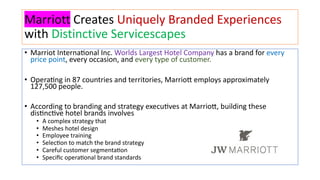
Marriott Creates Uniquely Branded Experiences
with Distinctive Servicescapes
• Marriot Interna+onal Inc. Worlds Largest Hotel Company has a brand for every
price point, every occasion, and every type of customer.
• Opera+ng in 87 countries and territories, MarrioB employs approximately
127,500 people.
• According to branding and strategy execu+ves at MarrioB, building these
dis+nc+ve hotel brands involves
• A complex strategy that
• Meshes hotel design
• Employee training
• SelecGon to match the brand strategy
• Careful customer segmentaGon
• Specific operaGonal brand standards
Marriott Creates Uniquely Branded Experiences
with Distinctive Servicescapes
• High End : Ritz Carlton
• For Ultra High Net worth Individuals
• Motto : Ladies & Gentlemen serving Ladies & Gentlemen, guides employee
attitudes and behaviors.
• The Ritz-Carlton enjoys a global reputation for “setting the gold standards”
• Servicescape of every Ritz-Carlton reinforces its high-end luxury positioning
• It Contains:
• Large Lobby Area
• Acclaimed Restaurants
• Elegant Spas
• Upscale Retail Opportunities
Marriott Creates Uniquely Branded Experiences
with Distinctive Servicescapes
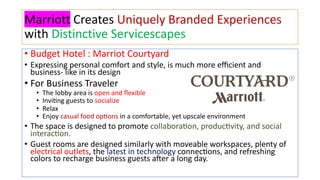
• Budget Hotel : Marriot Courtyard
• Expressing personal comfort and style, is much more efficient and
business- like in its design
• For Business Traveler
• The lobby area is open and flexible
• Invi?ng guests to socialize
• Relax
• Enjoy casual food op?ons in a comfortable, yet upscale environment
• The space is designed to promote collaboraJon, producJvity, and social
interacJon.
• Guest rooms are designed similarly with moveable workspaces, plenty of
electrical outlets, the latest in technology connecJons, and refreshing
colors to recharge business guests aLer a long day.
Marriott Creates Uniquely Branded Experiences
with Distinctive Servicescapes
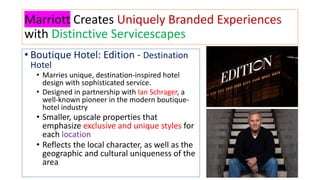
• Boutique Hotel: Edition - Destination
Hotel
• Marries unique, destination-inspired hotel
design with sophisticated service.
• Designed in partnership with Ian Schrager, a
well-known pioneer in the modern boutique-
hotel industry
• Smaller, upscale properties that
emphasize exclusive and unique styles for
each location
• Reflects the local character, as well as the
geographic and cultural uniqueness of the
area
Marriot Different Servicescape for Every
Category
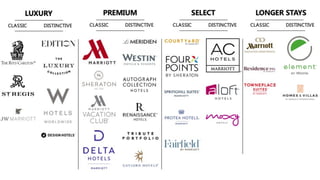
• Highlighted only three of Marrio1’s 18 brands.
• Each of the 18 brands has a dis:nc:ve servicescape design,
reinforcing its posi:oning along the con:nuum from midscale to
luxury hotels.
• Along with the servicescape, Marrio1 also reinforces each brand with
employee training, dress codes, and internal processes that are
consistent with the brand.
What is Physical Evidence
The environment in which the service is
delivered and in which the firm and the
customer interact, and any tangible
commodities that facilitate
performance or communication of the
service.
What is Physical Evidence
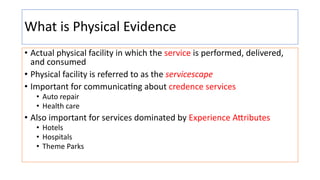
• Actual physical facility in which the service is performed, delivered,
and consumed
• Physical facility is referred to as the servicescape
• Important for communica:ng about credence services
• Auto repair
• Health care
• Also important for services dominated by Experience A1ributes
• Hotels
• Hospitals
• Theme Parks
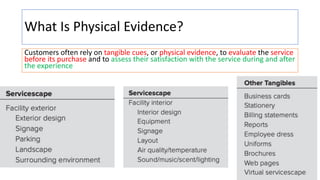
What Is Physical Evidence?
Customers often rely on tangible cues, or physical evidence, to evaluate the service
before its purchase and to assess their satisfaction with the service during and after
the experience
Virtual Servicescape:
Experiencing Services through the Internet
• Web pages are virtual servicescapes
• Online are forms of physical evidence that companies use to
communicate about the service experience
• Making services more tangible for customers both before and aHer
purchase
Virtual Servicescapes:
Experiencing Services through the Internet
• Allow customers to preview service experiences through the Internet
and see tangible evidence of the service without actually being there.
• Allows firms to communicate experiential aspects of their services in
ways that were previously very difficult, if not impossible.
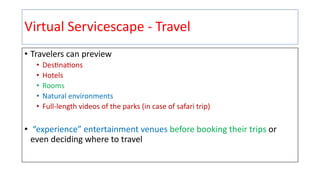
Virtual Servicescape - Travel
• Travelers can preview
• Des+na+ons
• Hotels
• Rooms
• Natural environments
• Full-length videos of the parks (in case of safari trip)
• “experience” entertainment venues before booking their trips or
even deciding where to travel
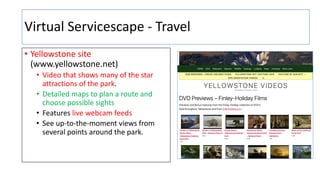
Virtual Servicescape - Travel
• Yellowstone site
(www.yellowstone.net)
• Video that shows many of the star
attractions of the park.
• Detailed maps to plan a route and
choose possible sights
• Features live webcam feeds
• See up-to-the-moment views from
several points around the park.
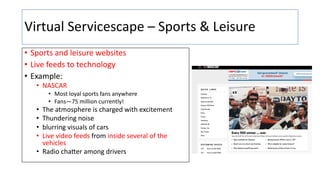
Virtual Servicescape – Sports & Leisure
• Sports and leisure websites
• Live feeds to technology
• Example:
• NASCAR
• Most loyal sports fans anywhere
• Fans—75 million currently!
• The atmosphere is charged with excitement
• Thundering noise
• blurring visuals of cars
• Live video feeds from inside several of the
vehicles
• Radio chaHer among drivers
How does Physical Evidence affect
the Customer Experience ?
How does Physical Evidence affect the
Customer Experience ?
• Whether the experience is
• Mundane (e.g., a bus or subway ride)
• Personally meaningful (e.g., a destination wedding experience)
• Spectacular (e.g., a week-long travel adventure)
• Physical evidence of the service will influence the
• Flow of the experience
• Meaning customers attach to it
• Satisfaction, their
• Emotional connections with the company and their social and personal
interactions with others experiencing the service
How does Physical Evidence affect the
Customer Experience ?
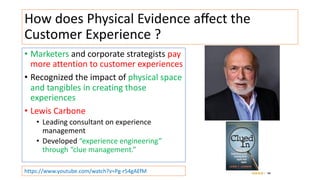
• Marketers and corporate strategists pay
more attention to customer experiences
• Recognized the impact of physical space
and tangibles in creating those
experiences
• Lewis Carbone
• Leading consultant on experience
management
• Developed “experience engineering”
through “clue management.”
https://www.youtube.com/watch?v=Pg-r54gAEfM
Clue Management
• The Process of clearly iden:fying and managing all the various clues
that customers use to form their impressions and feelings about the
company
• Carbone refers to them as mechanics clues, or the physical and
tangible clues
• Other writers and consultants also zero in on the importance of
tangible evidence and physical facili:es in shaping those experiences
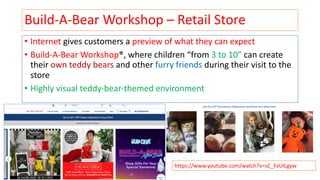
Build-A-Bear Workshop – Retail Store
• Internet gives customers a preview of what they can expect
• Build-A-Bear Workshop®, where children “from 3 to 10” can create
their own teddy bears and other furry friends during their visit to the
store
• Highly visual teddy-bear-themed environment
https://www.youtube.com/watch?v=sC_FvUlLgyw
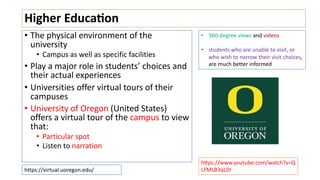
Higher Educa-on
• The physical environment of the
university
• Campus as well as specific facilities
• Play a major role in students’ choices and
their actual experiences
• Universities offer virtual tours of their
campuses
• University of Oregon (United States)
offers a virtual tour of the campus to view
that:
• Particular spot
• Listen to narration
https://virtual.uoregon.edu/
• 360-degree views and videos
• students who are unable to visit, or
who wish to narrow their visit choices,
are much better informed
hLps://www.youtube.com/watch?v=Q
LFMLB3qLDI
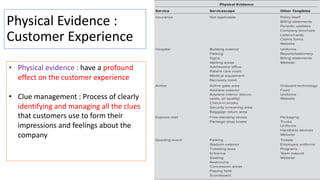
Physical Evidence :
Customer Experience
• Physical evidence : have a profound
effect on the customer experience
• Clue management : Process of clearly
identifying and managing all the clues
that customers use to form their
impressions and feelings about the
company
Types of Servicescapes
• Ideas and Concepts from environmental psychology, a field that
encompasses the study of human beings and their rela:onships with
built (human-made), natural, and social environments.
• The physical se]ng may be more or less important in achieving the
organiza:on’s marke:ng and other goals, depending on certain
factors.
• There are two types of Servicescapes
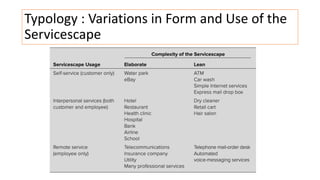
1. Servicescape Usage (Self Service, Remote Service & Interpersonal Service)
2. Servicescape Complexity (Lean & Elaborate)
Servicescape Usage
• Whom the servicescape will affect.
• Who actually comes into the service facility and thus is potentially
influenced by its design—customers, employees, or both groups?
• Three Categories
• Self Service
• Remote Service
• Inter-Personal Service
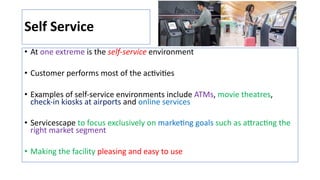
Self Service
• At one extreme is the self-service environment
• Customer performs most of the acJviJes
• Examples of self-service environments include ATMs, movie theatres,
check-in kiosks at airports and online services
• Servicescape to focus exclusively on markeJng goals such as aNracJng the
right market segment
• Making the facility pleasing and easy to use
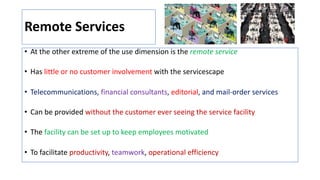
Remote Services
• At the other extreme of the use dimension is the remote service
• Has little or no customer involvement with the servicescape
• Telecommunications, financial consultants, editorial, and mail-order services
• Can be provided without the customer ever seeing the service facility
• The facility can be set up to keep employees motivated
• To facilitate productivity, teamwork, operational efficiency
Interpersonal Services
• Interpersonal services are placed between the two extremes
• Situa:ons in which both the customer and the employee are present
and ac:ve in the servicescape
• Hotels, Restaurants, Hospitals, Educa:onal Se]ngs and Banks
• Servicescape must be designed to a1ract, sa:sfy, and facilitate the
ac:vi:es of both customers and employees simultaneously
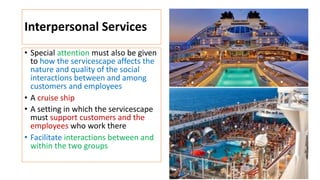
Interpersonal Services
• Special attention must also be given
to how the servicescape affects the
nature and quality of the social
interactions between and among
customers and employees
• A cruise ship
• A setting in which the servicescape
must support customers and the
employees who work there
• Facilitate interactions between and
within the two groups
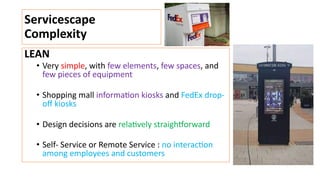
Servicescape
Complexity
LEAN
• Very simple, with few elements, few spaces, and
few pieces of equipment
• Shopping mall informa=on kiosks and FedEx drop-
off kiosks
• Design decisions are rela=vely straighDorward
• Self- Service or Remote Service : no interac=on
among employees and customers
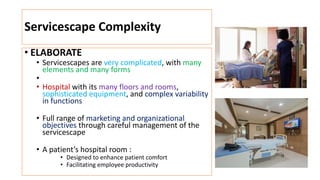
Servicescape Complexity
• ELABORATE
• Servicescapes are very complicated, with many
elements and many forms
•
• Hospital with its many floors and rooms,
sophisticated equipment, and complex variability
in functions
• Full range of marketing and organizational
objectives through careful management of the
servicescape
• A patient’s hospital room :
• Designed to enhance patient comfort
• Facilitating employee productivity
Typology : Variations in Form and Use of the
Servicescape
STRATEGIC ROLES OF THE
SERVICESCAPE
Roles of Servicescape in Strategy
•One of the most important elements used in
positioning a service organization
1. Package
2. Facilitator
3. Socializer
4. Differentiator
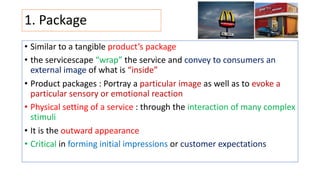
1. Package
• Similar to a tangible product’s package
• the servicescape “wrap” the service and convey to consumers an
external image of what is “inside”
• Product packages : Portray a particular image as well as to evoke a
particular sensory or emotional reaction
• Physical setting of a service : through the interaction of many complex
stimuli
• It is the outward appearance
• Critical in forming initial impressions or customer expectations
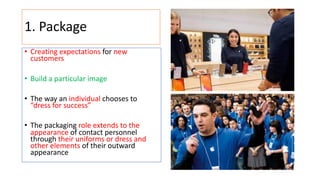
1. Package
• Creating expectations for new
customers
• Build a particular image
• The way an individual chooses to
“dress for success”
• The packaging role extends to the
appearance of contact personnel
through their uniforms or dress and
other elements of their outward
appearance
2. Facilitator
• Facilitates the flow of Service Delivery Process
• Easier or harder for customers and employees to accomplish their
goals
• A well-designed, functional facility can make the service a pleasure to
experience and perform
• Poor and inefficient design may frustrate both customers and
employees.
2. Facilitator
• International air traveller
• A poorly designed airport
• Few signs, poor ventilation, and few places to sit or eat
• Experience quite dissatisfying, and employees unmotivated
• In reality, many airports today are designed for passengers,
• Inviting them to spend time shopping
• Eating in good restaurants
• Working in areas set up with connection stations and Wi-Fi
2. Facilitator
• Seats on the airplane conducive to work and sleep
• The seating has been improved to better facilitate airline travellers'
needs to sleep
• Competition for better seat and aircraft interior design continues
• New designs include business class “suites” with seats that recline
into “skybeds,” leather ottomans in first-class sections, and electronic
partition screens between seats in business class
3. Socializer
• Aids in the socialization of both employees and customers
• It helps convey expected roles, behaviours, and relationships
• A new employee in a professional services firm would
come to understand her position in the hierarchy
• Noting her office assignment
• The quality of her office furnishings
• Location relative to others in the organization
3. Socializer
• The design of the facility suggest to customers what their role is relative to employees
• What parts of the servicescape they are welcome in and which are for employees only
• How they should behave while in the environment
• What types of interactions are encouraged
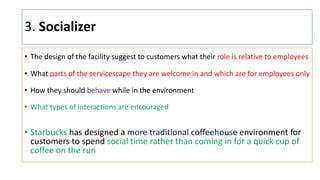
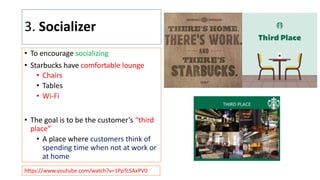
• Starbucks has designed a more traditional coffeehouse environment for
customers to spend social time rather than coming in for a quick cup of
coffee on the run
3. Socializer
• To encourage socializing
• Starbucks have comfortable lounge
• Chairs
• Tables
• Wi-Fi
• The goal is to be the customer’s “third
place”
• A place where customers think of
spending time when not at work or
at home
hLps://www.youtube.com/watch?v=1PpTc5AxPV0
4. Differentiator
• Differentiate a firm from its competitors
• Signal the market segment that the service is intended for
• Changes in the physical environment can be used to reposition a firm
and/or to attract new market segments
• In shopping malls the signage, colours used in decor and displays, and
type of music wafting from a store signal the intended market
segment
4. Differentiator
• DifferenJaJon for PetSmart in the introducJon of its
innovaJve PetsHotel concept
• Offer overnight care as well as day care for pets, are
designed very differently from typical kennels or
veterinary faciliJes
• They feature a lobby area, colorful play areas,
comfortable sleeping rooms, television, a “bone
booth” for calling in, and other ameniJes that give the
faciliJes a more residenJal, homelike appeal than
tradiJonal kennels have.
BusinessWeek and Architectural
Record Award Winners
To identify the best use of architecture that solves strategic business challenges.
APPLE STORE, Vth AVENUE NEW
YORK
APPLE STORES, NEW YORK
• In designing its store in New York’s Soho district
• Apple Computers brought together
• Architects
• Graphic designers
• Product developers
• Merchandising people
• its late CEO Steve Jobs to create a retail space that would both convey
the company’s philosophy and sell computers
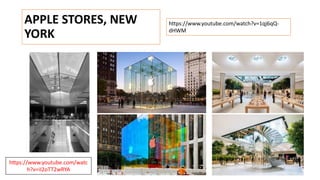
• The result is a clean, open, and spacious store that displays only a few
computers to create the ambience of a museum
APPLE STORES, NEW YORK
• The company establishes a modern feel using a central glass staircase,
white walls, and a large skylight
• A second-floor area encourages children to play with soLware and offers a
large conference room for Apple product demonstraJons
•
• As one judge put it, “the store, like Apple, is all about informaJon,
interacJon, and access”
• Apple’s 5th Avenue store in New York City, its highest volume store, was
also an award winner in a later compeJJon
APPLE STORES, NEW YORK
• This cube-shaped store is free of structural steel and it relies on a taut
glass skin and glass beams to create a sense of a free-floating
structure that sits above the actual retail space.
• Similar to the Soho store, the “cube” is highly effective at drawing
customers in, and its cleanly designed interior provides an inviting
atmosphere to experiment with innovative and futuristic Apple
products.
• The store has very high sales per square foot and the space is
beautiful, functional, and very profitable (award winners in 2003 and
2006).
APPLE STORES, NEW
YORK
hLps://www.youtube.com/watc
h?v=iI2oTT2wRYA
https://www.youtube.com/watch?v=1qj6qQ-
dHWM
EVERSHEDS LAW OFFICES, LONDON,
ENGLAND
EVERSHEDS LAW OFFICES, LONDON, ENGLAND
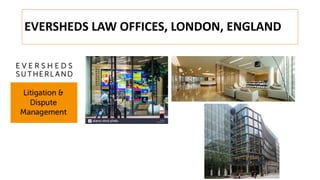
• Eversheds is a global law firm that seeks to aNract the best young talent to
its employee ranks
• When it relocated its London headquarters, it recognized an opportunity to
aNract talent through its workplace design.
• In seeking to build a law office for the future, the designers conducted
extensive research, along with a nine-month prototype trial of the new
design at its exisJng facility
• It involved employees in the process from start to finish
• The result was a radical shiL away from tradiJonal law firm design,
including modular furniture that can be moved as needed to foster
collaboraJon and communicaJon among lawyers and staff
EVERSHEDS LAW OFFICES, LONDON, ENGLAND
• There are also added amenities, including lounges, dining venues,
showers, bicycle storage, and sleeping accommodations
• Sustainability was also at the core of the design
• For example, through centralizing much of its information and
documents, the firm was able to reduce the number of filed
documents by 57 percent and the number of printers by 63 percent
• The project had outstanding results as well, with 96 % of the staff
being more motivated to work due to the design of the new
workplace (award winner in 2009)
EVERSHEDS LAW OFFICES, LONDON, ENGLAND
ST. PAUL SAINTS BALLPARK
• Minor league baseball team of St. Paul, Minnesota, needed a new
ballpark
• Because the team was known for its community involvement, family
orientation, and even its sense of humor, the new design needed to
be in keeping with that low-key and approachable vibe
• After many community meetings to gain input and assure people
about the design, a friendly new ballpark was built
• From the colors and materials to the openness of the design,
everything speaks loudly to the goal of being community-oriented
and approachable
ST. PAUL SAINTS BALLPARK
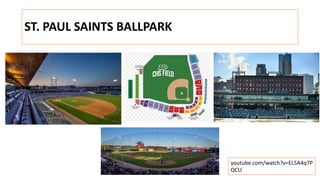
• Open, glass-enclosed concourses to the field
• Fan sea+ng is below the street level, which reinforces the informal and non-
imposing feel
• During off-hours the park is a true community asset, open to the public free of
charge for exercising on a walking track, bringing dogs to the dog park north of
the field, or for events
• The team was always a community treasure, and the new ballpark was designed
and built on that founda+on. Between 2014 and 2015 the new 7,000-seat
stadium increased the team’s revenue by 100 percent, with 400,000 visitors
(award winner 2016)
ST. PAUL SAINTS BALLPARK
youtube.com/watch?v=EL5A4q7P
QCU
SAN FRANCISCO JAZZ SFJAZZ CENTER
• San Francisco Jazz Center aimed to bridge when it created the first
permanent home for SFJAZZ in its 35-year history
• The jazz group wanted a permanent and well-designed, modern
facility; they also wanted the intimacy and character of a jazz club
• A new 700-seat concert venue
• Steep seating around the stage so that no one is more than 45 feet
from the stage
SAN FRANCISCO JAZZ SFJAZZ CENTER
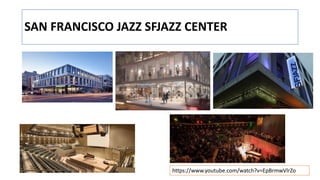
• The theater is set up so the audience can be with the performers in close
proximity
• Glass walls with views into the ground-floor lobby connect those passing by
on the street
• The building itself features a rhythmic- themed façade that is in keeping
with the jazz genre
• (award winner 2015)
SAN FRANCISCO JAZZ SFJAZZ CENTER
https://www.youtube.com/watch?v=EpBrmwVlrZo
SWEDBANK HEADQUARTERS, STOCKHOLM
• Swedbank - located in the heart of Stockholm, for four decades
• The building was very tradi:onal
• Moved from the centre of the city to the suburbs, the company
wanted to match its vision of the future of banking with a new
building and completely new design
• They wanted the new space to be flexible and to foster collabora:on
and crea:vity for its 2,700 employees
SWEDBANK HEADQUARTERS, STOCKHOLM
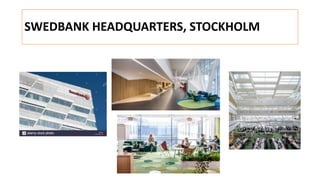
• A dramatic and modern facility, made of steel and concrete, designed with
a zigzagging pattern that forms “folds” in the building
• Within the folds are five atriums with skylights that allow visual
connections among the working groups
• There are almost no private offices and employees are not tied to a specific
desk
• The new building fits the bank’s image of the future and is also efficient in
its use of space and energy (award winner 2015).
SWEDBANK HEADQUARTERS, STOCKHOLM
Individual Behaviours
• Approach behaviours include all positive behaviours that might be
directed at a particular place, such as a desire to stay, explore, work,
and affiliate
• Avoidance behaviours reflect the opposite— a desire not to stay, to
explore, to work, or to affiliate
• Approach behaviours (including shopping enjoyment, returning,
attraction and friendliness toward others, spending money, time
spent browsing the exploration of the store) are influenced by
perceptions of the environment.
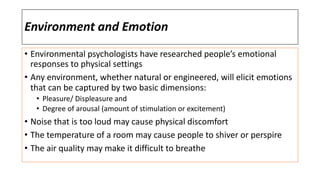
Environment and Emotion
• Environmental psychologists have researched people’s emotional
responses to physical settings
• Any environment, whether natural or engineered, will elicit emotions
that can be captured by two basic dimensions:
• Pleasure/ Displeasure and
• Degree of arousal (amount of stimulation or excitement)
• Noise that is too loud may cause physical discomfort
• The temperature of a room may cause people to shiver or perspire
• The air quality may make it difficult to breathe
Environmental Dimensions of
the Servicescape
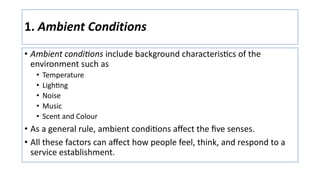
1. Ambient Conditions
• Ambient condi?ons include background characteris:cs of the
environment such as
• Temperature
• Ligh+ng
• Noise
• Music
• Scent and Colour
• As a general rule, ambient condi:ons affect the five senses.
• All these factors can affect how people feel, think, and respond to a
service establishment.
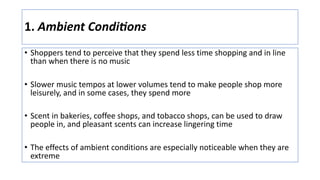
1. Ambient Condi6ons
• Shoppers tend to perceive that they spend less time shopping and in line
than when there is no music
• Slower music tempos at lower volumes tend to make people shop more
leisurely, and in some cases, they spend more
• Scent in bakeries, coffee shops, and tobacco shops, can be used to draw
people in, and pleasant scents can increase lingering time
• The effects of ambient conditions are especially noticeable when they are
extreme
2. Spatial Layout and Functionality
• Refers to the ways in which
• Machinery,
• Equipment
• Furnishings are arranged
• the size and shape of those items; and the spatial relationships
among them
• Functionality refers to the ability of the same items to facilitate the
accomplishment of customer and employee goals
2. Spa6al Layout and Func6onality
• The importance of facility layout is particularly apparent in
• Retail, Hospitality, and Leisure settings
• Where research shows it can influence
• Customer satisfaction,
• Store performance
• Consumer search behaviour
3. Signs, Symbols, and Artifacts
• Physical environment serve as explicit or implicit signals that
communicate about the place to its users
• Signs displayed on the exterior and interior of a structure are
examples of explicit communicators
• They can be used as labels (name of company, name of department,
and so on), for direc:onal purposes (entrances, exits), and to
communicate rules of behavior (no smoking, children must be
accompanied by an adult)
• Adequate signs have even been shown to reduce perceived crowding
and stress
McDonald’s Adapts
Servicescapes to Fit the Culture
McDonald’s Adapts Servicescapes to Fit the
Culture
• McDonald’s Corporation recognizes these culturally defined expectations in
allowing its franchisees around the world tremendous freedom in designing their
servicescapes
• Employees are nationals, and marketing strategies reflect local consumers’ buying
and preference patterns
• In all cases, the restaurant is a “community institution,” involved in social causes
as well as local events
• McDonald’s strategy is to have its restaurants worldwide reflect the cultures and
communities in which they are found—to mirror the communities they serve.
McDonald’s Adapts Servicescapes to Fit the
Culture
• In the United States, drive-through windows are prevalent, reflec:ng
the country’s automobile culture and rela:ve lack of space
constraints
• McDonald’s food delivered to them via cars, motor scooters, and
bicycles.
• Where there is plenty of labor, congested traffic, and li1le space for
stand-alone restau- rants, such as Taipei, Taiwan
Golden Arches variation in McDonald’s face
to the community:
Bologna, Italy
• In Bologna, known as the “City of Arches” for hundreds of years,
McDonald’s took on the weathered, crafted look of the neighbouring
historic arches
• Even the floor in the restaurant was done by hand, using old-world
techniques
• The restaurant used local architects and artists to bring the local
architectural feel to the golden arches
Golden Arches variaVon in McDonald’s face
to the community:
• Paris, France
• Near the Sorbonne in Paris, the local McDonald’s reflects its studious
neighbour
• The servicescape there has the look of a leather-bound library with
books, statues, and heavy wood furniture
Golden Arches variation in McDonald’s face
to the community:
• Salen, Sweden
• On the slopes of Lindvallen Resort in Salen, you can find the world’s first
“ski-thru” restaurant, named McSki, located next to the main ski lift
• The building is different from any other McDonald’s restaurant, built in a
typical mountain style with wood panels and natural stone from the
surroundings
• Skiers can simply glide to the counter without taking off their skis, or they
can be seated indoors or out
Golden Arches variation in McDonald’s face
to the community:
• Beijing, China: McDonald’s restaurants here have become a “place to
hang out,” very different from the truly “fast- food” role they have
historically played in the United States
• They are part of the community, serving young and old, families and
couples
• The emphasis on a Chinese- style family atmosphere is apparent from
the interior walls of local restaurants, which are covered by posters
emphasizing family values
Golden Arches variation in McDonald’s face
to the community:
• Tokyo, Japan: Although some McDonald’s restaurants in Japan are located
in prime real-estate districts such as the Ginza in Tokyo, many others are
situated near major train stations or other high-traffic locations
• The emphasis at these locations is on convenience and speed, not on
comfort or socializing
• Many of these locations have little frontage space and limited seating
• Customers frequently stand while eating, or they may sit on stools at
narrow counters.
Golden Arches variaVon in McDonald’s face
to the community:
• Taupo, New Zealand: The McDonald’s here is a unique site, as the
restaurant has incorporated a decommissioned DC3 plane as part of
the dining area
• The plane has been adorned with the familiar red paint and golden
arches that McDonald’s is famous for
• Customers can eat at seats inside the plane, and patrons are also
welcome to explore the cockpit and experience a piece of New
Zealand history.
To Close the service Design & Standards Gap
• Service Innovation and Design
• Customer defined Service Standards
• Physical Evidence and Servicescape
We have discussed
• Marriot Group use of Physical Evidence & Servicescape
• What is Physical Evidence?
• How does Physical Evidence affect the Customer Experience?
• Strategic Role of the Servicescape
• Package
• Facilitator
• Socializer
• Differen@ator
• Business Week & Architectural Record Award Winners Examples
• Environmental Dimension of Servicescape
• Ambient Condi@on
• Spa@al Layout and Func@onality
• Sign, Symbols & Ar@facts
• McDonald’s adaptaGon of Servicescape to fit the culture
Physical Evidence and Servicescape.pdf

Physical Evidence and Servicescape.pdf

  • 1.
  • 2.
    To Close theservice design & Standards Gap • Service Innova,on and Design • Customer defined Service Standards • Physical Evidence and Servicescape
  • 3.
    We will discuss •Marriot Group use of Physical Evidence & Servicescape • What is Physical Evidence? • How does Physical Evidence affect the Customer Experience? • Strategic Role of the Servicescape • Package • Facilitator • Socializer • Differentiator • Business Week & Architectural Record Award Winners Examples • Environmental Dimension of Servicescape • Ambient Condition • Spatial Layout and Functionality • Sign, Symbols & Artifacts • McDonald’s adaptation of Servicescape to fit the culture
  • 4.
    Marriott Creates UniquelyBranded Experiences with Distinctive Servicescapes • Marriot Interna+onal Inc. Worlds Largest Hotel Company has a brand for every price point, every occasion, and every type of customer. • Opera+ng in 87 countries and territories, MarrioB employs approximately 127,500 people. • According to branding and strategy execu+ves at MarrioB, building these dis+nc+ve hotel brands involves • A complex strategy that • Meshes hotel design • Employee training • SelecGon to match the brand strategy • Careful customer segmentaGon • Specific operaGonal brand standards
  • 5.
    Marriott Creates UniquelyBranded Experiences with Distinctive Servicescapes • High End : Ritz Carlton • For Ultra High Net worth Individuals • Motto : Ladies & Gentlemen serving Ladies & Gentlemen, guides employee attitudes and behaviors. • The Ritz-Carlton enjoys a global reputation for “setting the gold standards” • Servicescape of every Ritz-Carlton reinforces its high-end luxury positioning • It Contains: • Large Lobby Area • Acclaimed Restaurants • Elegant Spas • Upscale Retail Opportunities
  • 6.
    Marriott Creates UniquelyBranded Experiences with Distinctive Servicescapes • Budget Hotel : Marriot Courtyard • Expressing personal comfort and style, is much more efficient and business- like in its design • For Business Traveler • The lobby area is open and flexible • Invi?ng guests to socialize • Relax • Enjoy casual food op?ons in a comfortable, yet upscale environment • The space is designed to promote collaboraJon, producJvity, and social interacJon. • Guest rooms are designed similarly with moveable workspaces, plenty of electrical outlets, the latest in technology connecJons, and refreshing colors to recharge business guests aLer a long day.
  • 7.
    Marriott Creates UniquelyBranded Experiences with Distinctive Servicescapes • Boutique Hotel: Edition - Destination Hotel • Marries unique, destination-inspired hotel design with sophisticated service. • Designed in partnership with Ian Schrager, a well-known pioneer in the modern boutique- hotel industry • Smaller, upscale properties that emphasize exclusive and unique styles for each location • Reflects the local character, as well as the geographic and cultural uniqueness of the area
  • 9.
    Marriot Different Servicescapefor Every Category • Highlighted only three of Marrio1’s 18 brands. • Each of the 18 brands has a dis:nc:ve servicescape design, reinforcing its posi:oning along the con:nuum from midscale to luxury hotels. • Along with the servicescape, Marrio1 also reinforces each brand with employee training, dress codes, and internal processes that are consistent with the brand.
  • 10.
    What is PhysicalEvidence The environment in which the service is delivered and in which the firm and the customer interact, and any tangible commodities that facilitate performance or communication of the service.
  • 11.
    What is PhysicalEvidence • Actual physical facility in which the service is performed, delivered, and consumed • Physical facility is referred to as the servicescape • Important for communica:ng about credence services • Auto repair • Health care • Also important for services dominated by Experience A1ributes • Hotels • Hospitals • Theme Parks
  • 12.
    What Is PhysicalEvidence? Customers often rely on tangible cues, or physical evidence, to evaluate the service before its purchase and to assess their satisfaction with the service during and after the experience
  • 13.
    Virtual Servicescape: Experiencing Servicesthrough the Internet • Web pages are virtual servicescapes • Online are forms of physical evidence that companies use to communicate about the service experience • Making services more tangible for customers both before and aHer purchase
  • 14.
    Virtual Servicescapes: Experiencing Servicesthrough the Internet • Allow customers to preview service experiences through the Internet and see tangible evidence of the service without actually being there. • Allows firms to communicate experiential aspects of their services in ways that were previously very difficult, if not impossible.
  • 15.
    Virtual Servicescape -Travel • Travelers can preview • Des+na+ons • Hotels • Rooms • Natural environments • Full-length videos of the parks (in case of safari trip) • “experience” entertainment venues before booking their trips or even deciding where to travel
  • 16.
    Virtual Servicescape -Travel • Yellowstone site (www.yellowstone.net) • Video that shows many of the star attractions of the park. • Detailed maps to plan a route and choose possible sights • Features live webcam feeds • See up-to-the-moment views from several points around the park.
  • 17.
    Virtual Servicescape –Sports & Leisure • Sports and leisure websites • Live feeds to technology • Example: • NASCAR • Most loyal sports fans anywhere • Fans—75 million currently! • The atmosphere is charged with excitement • Thundering noise • blurring visuals of cars • Live video feeds from inside several of the vehicles • Radio chaHer among drivers
  • 18.
    How does PhysicalEvidence affect the Customer Experience ?
  • 19.
    How does PhysicalEvidence affect the Customer Experience ? • Whether the experience is • Mundane (e.g., a bus or subway ride) • Personally meaningful (e.g., a destination wedding experience) • Spectacular (e.g., a week-long travel adventure) • Physical evidence of the service will influence the • Flow of the experience • Meaning customers attach to it • Satisfaction, their • Emotional connections with the company and their social and personal interactions with others experiencing the service
  • 20.
    How does PhysicalEvidence affect the Customer Experience ? • Marketers and corporate strategists pay more attention to customer experiences • Recognized the impact of physical space and tangibles in creating those experiences • Lewis Carbone • Leading consultant on experience management • Developed “experience engineering” through “clue management.” https://www.youtube.com/watch?v=Pg-r54gAEfM
  • 21.
    Clue Management • TheProcess of clearly iden:fying and managing all the various clues that customers use to form their impressions and feelings about the company • Carbone refers to them as mechanics clues, or the physical and tangible clues • Other writers and consultants also zero in on the importance of tangible evidence and physical facili:es in shaping those experiences
  • 22.
    Build-A-Bear Workshop –Retail Store • Internet gives customers a preview of what they can expect • Build-A-Bear Workshop®, where children “from 3 to 10” can create their own teddy bears and other furry friends during their visit to the store • Highly visual teddy-bear-themed environment https://www.youtube.com/watch?v=sC_FvUlLgyw
  • 23.
    Higher Educa-on • Thephysical environment of the university • Campus as well as specific facilities • Play a major role in students’ choices and their actual experiences • Universities offer virtual tours of their campuses • University of Oregon (United States) offers a virtual tour of the campus to view that: • Particular spot • Listen to narration https://virtual.uoregon.edu/ • 360-degree views and videos • students who are unable to visit, or who wish to narrow their visit choices, are much better informed hLps://www.youtube.com/watch?v=Q LFMLB3qLDI
  • 24.
    Physical Evidence : CustomerExperience • Physical evidence : have a profound effect on the customer experience • Clue management : Process of clearly identifying and managing all the clues that customers use to form their impressions and feelings about the company
  • 25.
    Types of Servicescapes •Ideas and Concepts from environmental psychology, a field that encompasses the study of human beings and their rela:onships with built (human-made), natural, and social environments. • The physical se]ng may be more or less important in achieving the organiza:on’s marke:ng and other goals, depending on certain factors. • There are two types of Servicescapes 1. Servicescape Usage (Self Service, Remote Service & Interpersonal Service) 2. Servicescape Complexity (Lean & Elaborate)
  • 26.
    Servicescape Usage • Whomthe servicescape will affect. • Who actually comes into the service facility and thus is potentially influenced by its design—customers, employees, or both groups? • Three Categories • Self Service • Remote Service • Inter-Personal Service
  • 27.
    Self Service • Atone extreme is the self-service environment • Customer performs most of the acJviJes • Examples of self-service environments include ATMs, movie theatres, check-in kiosks at airports and online services • Servicescape to focus exclusively on markeJng goals such as aNracJng the right market segment • Making the facility pleasing and easy to use
  • 28.
    Remote Services • Atthe other extreme of the use dimension is the remote service • Has little or no customer involvement with the servicescape • Telecommunications, financial consultants, editorial, and mail-order services • Can be provided without the customer ever seeing the service facility • The facility can be set up to keep employees motivated • To facilitate productivity, teamwork, operational efficiency
  • 29.
    Interpersonal Services • Interpersonalservices are placed between the two extremes • Situa:ons in which both the customer and the employee are present and ac:ve in the servicescape • Hotels, Restaurants, Hospitals, Educa:onal Se]ngs and Banks • Servicescape must be designed to a1ract, sa:sfy, and facilitate the ac:vi:es of both customers and employees simultaneously
  • 30.
    Interpersonal Services • Specialattention must also be given to how the servicescape affects the nature and quality of the social interactions between and among customers and employees • A cruise ship • A setting in which the servicescape must support customers and the employees who work there • Facilitate interactions between and within the two groups
  • 31.
    Servicescape Complexity LEAN • Very simple,with few elements, few spaces, and few pieces of equipment • Shopping mall informa=on kiosks and FedEx drop- off kiosks • Design decisions are rela=vely straighDorward • Self- Service or Remote Service : no interac=on among employees and customers
  • 32.
    Servicescape Complexity • ELABORATE •Servicescapes are very complicated, with many elements and many forms • • Hospital with its many floors and rooms, sophisticated equipment, and complex variability in functions • Full range of marketing and organizational objectives through careful management of the servicescape • A patient’s hospital room : • Designed to enhance patient comfort • Facilitating employee productivity
  • 33.
    Typology : Variationsin Form and Use of the Servicescape
  • 34.
    STRATEGIC ROLES OFTHE SERVICESCAPE
  • 35.
    Roles of Servicescapein Strategy •One of the most important elements used in positioning a service organization 1. Package 2. Facilitator 3. Socializer 4. Differentiator
  • 36.
    1. Package • Similarto a tangible product’s package • the servicescape “wrap” the service and convey to consumers an external image of what is “inside” • Product packages : Portray a particular image as well as to evoke a particular sensory or emotional reaction • Physical setting of a service : through the interaction of many complex stimuli • It is the outward appearance • Critical in forming initial impressions or customer expectations
  • 37.
    1. Package • Creatingexpectations for new customers • Build a particular image • The way an individual chooses to “dress for success” • The packaging role extends to the appearance of contact personnel through their uniforms or dress and other elements of their outward appearance
  • 38.
    2. Facilitator • Facilitatesthe flow of Service Delivery Process • Easier or harder for customers and employees to accomplish their goals • A well-designed, functional facility can make the service a pleasure to experience and perform • Poor and inefficient design may frustrate both customers and employees.
  • 39.
    2. Facilitator • Internationalair traveller • A poorly designed airport • Few signs, poor ventilation, and few places to sit or eat • Experience quite dissatisfying, and employees unmotivated • In reality, many airports today are designed for passengers, • Inviting them to spend time shopping • Eating in good restaurants • Working in areas set up with connection stations and Wi-Fi
  • 40.
    2. Facilitator • Seatson the airplane conducive to work and sleep • The seating has been improved to better facilitate airline travellers' needs to sleep • Competition for better seat and aircraft interior design continues • New designs include business class “suites” with seats that recline into “skybeds,” leather ottomans in first-class sections, and electronic partition screens between seats in business class
  • 41.
    3. Socializer • Aidsin the socialization of both employees and customers • It helps convey expected roles, behaviours, and relationships • A new employee in a professional services firm would come to understand her position in the hierarchy • Noting her office assignment • The quality of her office furnishings • Location relative to others in the organization
  • 42.
    3. Socializer • Thedesign of the facility suggest to customers what their role is relative to employees • What parts of the servicescape they are welcome in and which are for employees only • How they should behave while in the environment • What types of interactions are encouraged • Starbucks has designed a more traditional coffeehouse environment for customers to spend social time rather than coming in for a quick cup of coffee on the run
  • 43.
    3. Socializer • Toencourage socializing • Starbucks have comfortable lounge • Chairs • Tables • Wi-Fi • The goal is to be the customer’s “third place” • A place where customers think of spending time when not at work or at home hLps://www.youtube.com/watch?v=1PpTc5AxPV0
  • 44.
    4. Differentiator • Differentiatea firm from its competitors • Signal the market segment that the service is intended for • Changes in the physical environment can be used to reposition a firm and/or to attract new market segments • In shopping malls the signage, colours used in decor and displays, and type of music wafting from a store signal the intended market segment
  • 45.
    4. Differentiator • DifferenJaJonfor PetSmart in the introducJon of its innovaJve PetsHotel concept • Offer overnight care as well as day care for pets, are designed very differently from typical kennels or veterinary faciliJes • They feature a lobby area, colorful play areas, comfortable sleeping rooms, television, a “bone booth” for calling in, and other ameniJes that give the faciliJes a more residenJal, homelike appeal than tradiJonal kennels have.
  • 46.
    BusinessWeek and Architectural RecordAward Winners To identify the best use of architecture that solves strategic business challenges.
  • 47.
    APPLE STORE, VthAVENUE NEW YORK
  • 48.
    APPLE STORES, NEWYORK • In designing its store in New York’s Soho district • Apple Computers brought together • Architects • Graphic designers • Product developers • Merchandising people • its late CEO Steve Jobs to create a retail space that would both convey the company’s philosophy and sell computers • The result is a clean, open, and spacious store that displays only a few computers to create the ambience of a museum
  • 49.
    APPLE STORES, NEWYORK • The company establishes a modern feel using a central glass staircase, white walls, and a large skylight • A second-floor area encourages children to play with soLware and offers a large conference room for Apple product demonstraJons • • As one judge put it, “the store, like Apple, is all about informaJon, interacJon, and access” • Apple’s 5th Avenue store in New York City, its highest volume store, was also an award winner in a later compeJJon
  • 50.
    APPLE STORES, NEWYORK • This cube-shaped store is free of structural steel and it relies on a taut glass skin and glass beams to create a sense of a free-floating structure that sits above the actual retail space. • Similar to the Soho store, the “cube” is highly effective at drawing customers in, and its cleanly designed interior provides an inviting atmosphere to experiment with innovative and futuristic Apple products. • The store has very high sales per square foot and the space is beautiful, functional, and very profitable (award winners in 2003 and 2006).
  • 51.
  • 52.
    EVERSHEDS LAW OFFICES,LONDON, ENGLAND
  • 53.
    EVERSHEDS LAW OFFICES,LONDON, ENGLAND • Eversheds is a global law firm that seeks to aNract the best young talent to its employee ranks • When it relocated its London headquarters, it recognized an opportunity to aNract talent through its workplace design. • In seeking to build a law office for the future, the designers conducted extensive research, along with a nine-month prototype trial of the new design at its exisJng facility • It involved employees in the process from start to finish • The result was a radical shiL away from tradiJonal law firm design, including modular furniture that can be moved as needed to foster collaboraJon and communicaJon among lawyers and staff
  • 54.
    EVERSHEDS LAW OFFICES,LONDON, ENGLAND • There are also added amenities, including lounges, dining venues, showers, bicycle storage, and sleeping accommodations • Sustainability was also at the core of the design • For example, through centralizing much of its information and documents, the firm was able to reduce the number of filed documents by 57 percent and the number of printers by 63 percent • The project had outstanding results as well, with 96 % of the staff being more motivated to work due to the design of the new workplace (award winner in 2009)
  • 55.
    EVERSHEDS LAW OFFICES,LONDON, ENGLAND
  • 56.
  • 57.
    ST. PAUL SAINTSBALLPARK • Minor league baseball team of St. Paul, Minnesota, needed a new ballpark • Because the team was known for its community involvement, family orientation, and even its sense of humor, the new design needed to be in keeping with that low-key and approachable vibe • After many community meetings to gain input and assure people about the design, a friendly new ballpark was built • From the colors and materials to the openness of the design, everything speaks loudly to the goal of being community-oriented and approachable
  • 58.
    ST. PAUL SAINTSBALLPARK • Open, glass-enclosed concourses to the field • Fan sea+ng is below the street level, which reinforces the informal and non- imposing feel • During off-hours the park is a true community asset, open to the public free of charge for exercising on a walking track, bringing dogs to the dog park north of the field, or for events • The team was always a community treasure, and the new ballpark was designed and built on that founda+on. Between 2014 and 2015 the new 7,000-seat stadium increased the team’s revenue by 100 percent, with 400,000 visitors (award winner 2016)
  • 59.
    ST. PAUL SAINTSBALLPARK youtube.com/watch?v=EL5A4q7P QCU
  • 60.
    SAN FRANCISCO JAZZSFJAZZ CENTER
  • 61.
    SAN FRANCISCO JAZZSFJAZZ CENTER • San Francisco Jazz Center aimed to bridge when it created the first permanent home for SFJAZZ in its 35-year history • The jazz group wanted a permanent and well-designed, modern facility; they also wanted the intimacy and character of a jazz club • A new 700-seat concert venue • Steep seating around the stage so that no one is more than 45 feet from the stage
  • 62.
    SAN FRANCISCO JAZZSFJAZZ CENTER • The theater is set up so the audience can be with the performers in close proximity • Glass walls with views into the ground-floor lobby connect those passing by on the street • The building itself features a rhythmic- themed façade that is in keeping with the jazz genre • (award winner 2015)
  • 63.
    SAN FRANCISCO JAZZSFJAZZ CENTER https://www.youtube.com/watch?v=EpBrmwVlrZo
  • 64.
  • 65.
    SWEDBANK HEADQUARTERS, STOCKHOLM •Swedbank - located in the heart of Stockholm, for four decades • The building was very tradi:onal • Moved from the centre of the city to the suburbs, the company wanted to match its vision of the future of banking with a new building and completely new design • They wanted the new space to be flexible and to foster collabora:on and crea:vity for its 2,700 employees
  • 66.
    SWEDBANK HEADQUARTERS, STOCKHOLM •A dramatic and modern facility, made of steel and concrete, designed with a zigzagging pattern that forms “folds” in the building • Within the folds are five atriums with skylights that allow visual connections among the working groups • There are almost no private offices and employees are not tied to a specific desk • The new building fits the bank’s image of the future and is also efficient in its use of space and energy (award winner 2015).
  • 67.
  • 68.
    Individual Behaviours • Approachbehaviours include all positive behaviours that might be directed at a particular place, such as a desire to stay, explore, work, and affiliate • Avoidance behaviours reflect the opposite— a desire not to stay, to explore, to work, or to affiliate • Approach behaviours (including shopping enjoyment, returning, attraction and friendliness toward others, spending money, time spent browsing the exploration of the store) are influenced by perceptions of the environment.
  • 69.
    Environment and Emotion •Environmental psychologists have researched people’s emotional responses to physical settings • Any environment, whether natural or engineered, will elicit emotions that can be captured by two basic dimensions: • Pleasure/ Displeasure and • Degree of arousal (amount of stimulation or excitement) • Noise that is too loud may cause physical discomfort • The temperature of a room may cause people to shiver or perspire • The air quality may make it difficult to breathe
  • 70.
  • 71.
    1. Ambient Conditions •Ambient condi?ons include background characteris:cs of the environment such as • Temperature • Ligh+ng • Noise • Music • Scent and Colour • As a general rule, ambient condi:ons affect the five senses. • All these factors can affect how people feel, think, and respond to a service establishment.
  • 72.
    1. Ambient Condi6ons •Shoppers tend to perceive that they spend less time shopping and in line than when there is no music • Slower music tempos at lower volumes tend to make people shop more leisurely, and in some cases, they spend more • Scent in bakeries, coffee shops, and tobacco shops, can be used to draw people in, and pleasant scents can increase lingering time • The effects of ambient conditions are especially noticeable when they are extreme
  • 73.
    2. Spatial Layoutand Functionality • Refers to the ways in which • Machinery, • Equipment • Furnishings are arranged • the size and shape of those items; and the spatial relationships among them • Functionality refers to the ability of the same items to facilitate the accomplishment of customer and employee goals
  • 74.
    2. Spa6al Layoutand Func6onality • The importance of facility layout is particularly apparent in • Retail, Hospitality, and Leisure settings • Where research shows it can influence • Customer satisfaction, • Store performance • Consumer search behaviour
  • 75.
    3. Signs, Symbols,and Artifacts • Physical environment serve as explicit or implicit signals that communicate about the place to its users • Signs displayed on the exterior and interior of a structure are examples of explicit communicators • They can be used as labels (name of company, name of department, and so on), for direc:onal purposes (entrances, exits), and to communicate rules of behavior (no smoking, children must be accompanied by an adult) • Adequate signs have even been shown to reduce perceived crowding and stress
  • 76.
  • 77.
    McDonald’s Adapts Servicescapesto Fit the Culture • McDonald’s Corporation recognizes these culturally defined expectations in allowing its franchisees around the world tremendous freedom in designing their servicescapes • Employees are nationals, and marketing strategies reflect local consumers’ buying and preference patterns • In all cases, the restaurant is a “community institution,” involved in social causes as well as local events • McDonald’s strategy is to have its restaurants worldwide reflect the cultures and communities in which they are found—to mirror the communities they serve.
  • 78.
    McDonald’s Adapts Servicescapesto Fit the Culture • In the United States, drive-through windows are prevalent, reflec:ng the country’s automobile culture and rela:ve lack of space constraints • McDonald’s food delivered to them via cars, motor scooters, and bicycles. • Where there is plenty of labor, congested traffic, and li1le space for stand-alone restau- rants, such as Taipei, Taiwan
  • 79.
    Golden Arches variationin McDonald’s face to the community: Bologna, Italy • In Bologna, known as the “City of Arches” for hundreds of years, McDonald’s took on the weathered, crafted look of the neighbouring historic arches • Even the floor in the restaurant was done by hand, using old-world techniques • The restaurant used local architects and artists to bring the local architectural feel to the golden arches
  • 80.
    Golden Arches variaVonin McDonald’s face to the community: • Paris, France • Near the Sorbonne in Paris, the local McDonald’s reflects its studious neighbour • The servicescape there has the look of a leather-bound library with books, statues, and heavy wood furniture
  • 81.
    Golden Arches variationin McDonald’s face to the community: • Salen, Sweden • On the slopes of Lindvallen Resort in Salen, you can find the world’s first “ski-thru” restaurant, named McSki, located next to the main ski lift • The building is different from any other McDonald’s restaurant, built in a typical mountain style with wood panels and natural stone from the surroundings • Skiers can simply glide to the counter without taking off their skis, or they can be seated indoors or out
  • 82.
    Golden Arches variationin McDonald’s face to the community: • Beijing, China: McDonald’s restaurants here have become a “place to hang out,” very different from the truly “fast- food” role they have historically played in the United States • They are part of the community, serving young and old, families and couples • The emphasis on a Chinese- style family atmosphere is apparent from the interior walls of local restaurants, which are covered by posters emphasizing family values
  • 83.
    Golden Arches variationin McDonald’s face to the community: • Tokyo, Japan: Although some McDonald’s restaurants in Japan are located in prime real-estate districts such as the Ginza in Tokyo, many others are situated near major train stations or other high-traffic locations • The emphasis at these locations is on convenience and speed, not on comfort or socializing • Many of these locations have little frontage space and limited seating • Customers frequently stand while eating, or they may sit on stools at narrow counters.
  • 84.
    Golden Arches variaVonin McDonald’s face to the community: • Taupo, New Zealand: The McDonald’s here is a unique site, as the restaurant has incorporated a decommissioned DC3 plane as part of the dining area • The plane has been adorned with the familiar red paint and golden arches that McDonald’s is famous for • Customers can eat at seats inside the plane, and patrons are also welcome to explore the cockpit and experience a piece of New Zealand history.
  • 85.
    To Close theservice Design & Standards Gap • Service Innovation and Design • Customer defined Service Standards • Physical Evidence and Servicescape
  • 86.
    We have discussed •Marriot Group use of Physical Evidence & Servicescape • What is Physical Evidence? • How does Physical Evidence affect the Customer Experience? • Strategic Role of the Servicescape • Package • Facilitator • Socializer • Differen@ator • Business Week & Architectural Record Award Winners Examples • Environmental Dimension of Servicescape • Ambient Condi@on • Spa@al Layout and Func@onality • Sign, Symbols & Ar@facts • McDonald’s adaptaGon of Servicescape to fit the culture