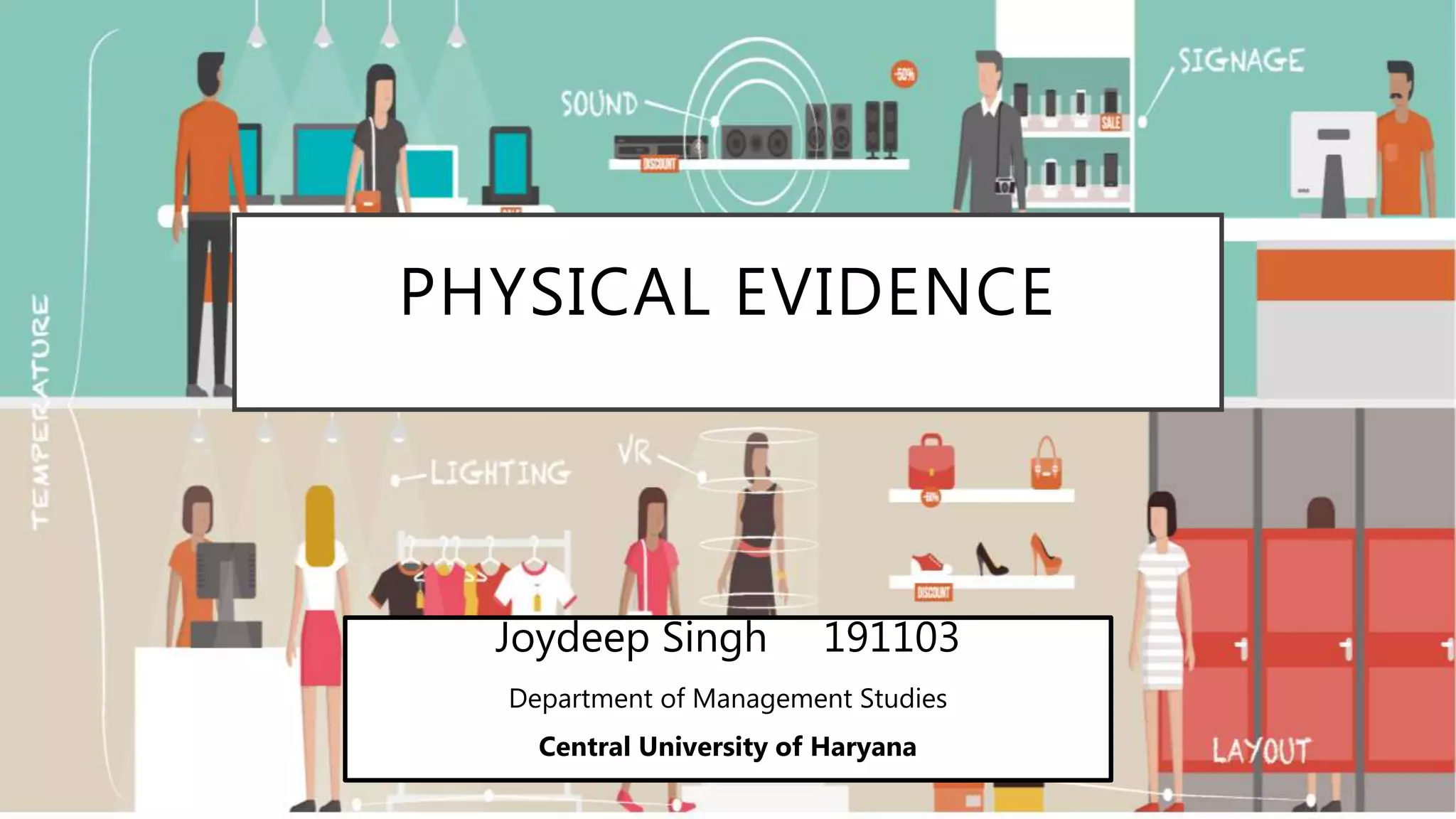
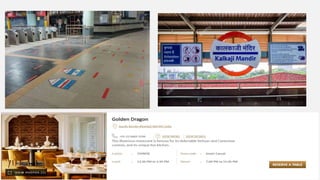
PHYSICAL EVIDENCE
Joydeep Singh 191103
Department of Management Studies
Central University of Haryana
INTRODUCTION
• 4P’s - set of marketing tools that the firm uses to pursue its marketing
objectives in the target market
• Need of 7P’s – Characteristics of Services – Intangibility, inseparability,
Perishability, Variability
• The elements of 'marketing mix' which customers can actually see or
experience when they use a service, and which contribute to the
perceived quality of the service.
DEFINITION
the environment in which the service is delivered and in
which the firm and the customer interact, and any
tangible commodities that facilitate performance or
communication of the service
Zeithaml and Bitner – Service Marketing
TYPES OF PHYSICAL EVIDENCE
• Essential evidence
• Peripheral evidence
ESSENTIAL EVIDENCE
• Facilities without which service delivery is impossible. Not
necessarily possessed by the client. It contributes to
ambience or image
• e.g. building and furnishings, layout, equipment, people
etc.
PERIPHERAL EVIDENCE
• Possessed as part of the purchase of a service but has no
independent value unless backed by the service.
• e.g. a cheque book, credit card, admission ticket, hotel
stationery.
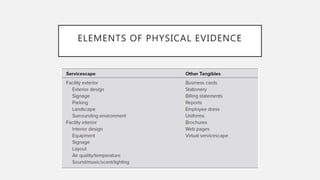
ELEMENTS OF PHYSICAL EVIDENCE
SERVICESCAPE
• the servicescape refers to the non-human elements of the environment
in which service encounters occur.
• the environment in which the service is assembled and in which the
seller and customer interact, combined with tangible commodities that
facilitate performance or communication of the service.
• Booms, BH; Bitner, MJ (1981). "Marketing strategies and organization
structures for service firms". In Donnelly, J; George, WR(eds.). Marketing of
Services. Chicago, IL: American Marketing Association.
PURPOSE OF SERVICESCAPE
there are four main purposes of Servicescapes:
(1) shape customers’ experiences and behaviors
(2) signal quality and position, differentiate and strengthen the brand
(3) be a core component of the value proposition
(4) facilitate the service encounter and enhance both service quality and
productivity
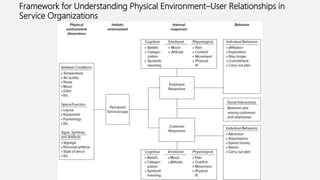
SERVICESCAPE MODEL
• Mary Jo Bitner, Servicescapes - The Impact of Physical
Surroundings on Customers and Employees, Journal of
Marketing (1992),Volume 56, Issue 2.
• The servicescape model seeks to describe all the customer
interactions that occur during a service encounter and to
understand how environmental elements impact on the
customer's service experience
Framework for Understanding Physical Environment–User Relationships in
Service Organizations
RESEARCH EVIDENCE
• Numerous research studies have found that fast tempo and high volume
music increases arousal levels, which can then lead to customers
increasing the pace of various behaviors.
• Morris B. Holbrook and Punam Anand (1990), “Effects of Tempo and
Situational Arousal on the Listener’s Perceptual and Affective Responses to
Music,” Psychology of Music, Vol. 18, pp. 150–162
• Color is “stimulating, calming, expressive, disturbing, impressionable,
cultural, exuberant, symbolic”.
• Linda Holtzschuhe, Understanding Color — An Introduction for Designers, 3rd
ed. (New Jersey: John Wiley, 2006), p. 51.
RESEARCH EVIDENCE
• first-time customers will automatically try to draw meaning from the
environment to guide them through the service processes.
• Angelo Bonfani (2013), “Towards an Approach to Signage Management Quality
(SMQ),” Journal of Services Marketing, Vol. 27, No. 4, pp. 312–321.
• Clue management (functional, mechanic, humanic) – Lewis P Carbone
• Clued In: How to Keep Customers Coming Back Again and Again
• Leonard L. Berry, Eileen A. Wall, and Lewis P. Carbone, Service Clues and
Customer Assessment of the Service Experience, Academy of Management
Perspectives
TYPES OF SERVICESCAPE
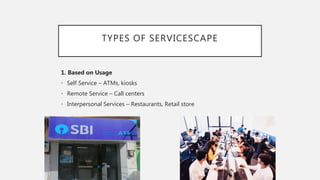
1. Based on Usage
• Self Service – ATMs, kiosks
• Remote Service – Call centers
• Interpersonal Services – Restaurants, Retail store
TYPES OF SERVICESCAPE
2. Based on Complexity
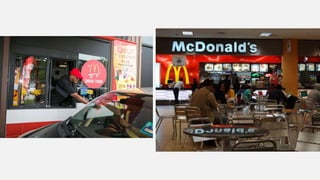
• Lean - kiosks, vending machines, fast food outlets
• environments that comprise relatively few spaces, contain few elements and
involve few interactions between customers and employees.
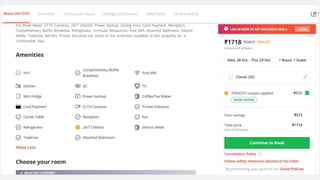
• Elaborate – Restaurants, Hotels
• environments that comprise multiple spaces, are rich in physical elements and
symbolism, involve high contact services with many interactions between
customers and employees
ROLE OF PHYSICAL EVIDENCE
PACKAGE
• Conveys expectations
• Physical evidence  quality cues  image development
• Influences perceptions
• Image development  reduces perceived risk  reduces
cognitive dissonance after the purchase
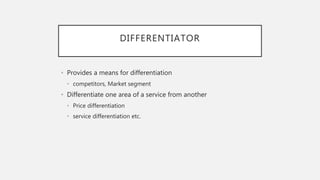
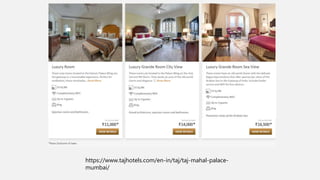
DIFFERENTIATOR
• Provides a means for differentiation
• competitors, Market segment
• Differentiate one area of a service from another
• Price differentiation
• service differentiation etc.
https://www.tajhotels.com/en-in/taj/taj-mahal-palace-
mumbai/
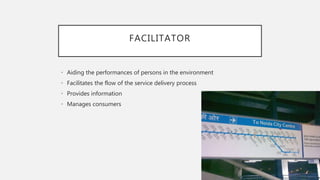
FACILITATOR
• Aiding the performances of persons in the environment
• Facilitates the flow of the service delivery process
• Provides information
• Manages consumers
SOCIALIZER
• Socializes employees and customers
• convey expected roles, behaviors, and relationships
• Uniforms - Identify the firm’s personnel
• Physical symbol that embodies the group’s ideals and attributes
• Facilitates perceptions of consistent performance
• Assists in controlling deviant members
REFERENCES
• Valarie A. Zeithaml, Mary Jo Bitner & Dwayne D. Gremler, “Services
Marketing: Integrating Customer Focus Across The Firm”, Seventh Edition,
McGraw-Hill Education
• Jochen Wirtz & Christopher Lovelock, “Services Marketing: People,
Technology, Strategy”, World Scientific
• Shostack, G.L., "How to Design a Service," in Donnelly an, J.H. and George,
W.R. (eds), Marketing of Services [AMA Special Conference on Services
Marketing], American Marketing Association, Chicago. Ill, 1981, pp 221-29
• Mary Jo Bitner, Servicescapes: The Impact of Physical Surroundings on
Customers and Employees, Journal of Marketing (1992),Volume 56, Issue 2.
• Booms, BH; Bitner, MJ (1981). "Marketing strategies and organization
structures for service firms". In Donnelly, J; George, WR(eds.). Marketing of
Services. Chicago, IL: American Marketing Association.
THANK YOU

Physical Evidence in Marketing

  • 1.
    PHYSICAL EVIDENCE Joydeep Singh191103 Department of Management Studies Central University of Haryana
  • 2.
    INTRODUCTION • 4P’s -set of marketing tools that the firm uses to pursue its marketing objectives in the target market • Need of 7P’s – Characteristics of Services – Intangibility, inseparability, Perishability, Variability • The elements of 'marketing mix' which customers can actually see or experience when they use a service, and which contribute to the perceived quality of the service.
  • 3.
    DEFINITION the environment inwhich the service is delivered and in which the firm and the customer interact, and any tangible commodities that facilitate performance or communication of the service Zeithaml and Bitner – Service Marketing
  • 4.
    TYPES OF PHYSICALEVIDENCE • Essential evidence • Peripheral evidence
  • 5.
    ESSENTIAL EVIDENCE • Facilitieswithout which service delivery is impossible. Not necessarily possessed by the client. It contributes to ambience or image • e.g. building and furnishings, layout, equipment, people etc.
  • 6.
    PERIPHERAL EVIDENCE • Possessedas part of the purchase of a service but has no independent value unless backed by the service. • e.g. a cheque book, credit card, admission ticket, hotel stationery.
  • 7.
  • 8.
    SERVICESCAPE • the servicescaperefers to the non-human elements of the environment in which service encounters occur. • the environment in which the service is assembled and in which the seller and customer interact, combined with tangible commodities that facilitate performance or communication of the service. • Booms, BH; Bitner, MJ (1981). "Marketing strategies and organization structures for service firms". In Donnelly, J; George, WR(eds.). Marketing of Services. Chicago, IL: American Marketing Association.
  • 9.
    PURPOSE OF SERVICESCAPE thereare four main purposes of Servicescapes: (1) shape customers’ experiences and behaviors (2) signal quality and position, differentiate and strengthen the brand (3) be a core component of the value proposition (4) facilitate the service encounter and enhance both service quality and productivity
  • 10.
    SERVICESCAPE MODEL • MaryJo Bitner, Servicescapes - The Impact of Physical Surroundings on Customers and Employees, Journal of Marketing (1992),Volume 56, Issue 2. • The servicescape model seeks to describe all the customer interactions that occur during a service encounter and to understand how environmental elements impact on the customer's service experience
  • 11.
    Framework for UnderstandingPhysical Environment–User Relationships in Service Organizations
  • 12.
    RESEARCH EVIDENCE • Numerousresearch studies have found that fast tempo and high volume music increases arousal levels, which can then lead to customers increasing the pace of various behaviors. • Morris B. Holbrook and Punam Anand (1990), “Effects of Tempo and Situational Arousal on the Listener’s Perceptual and Affective Responses to Music,” Psychology of Music, Vol. 18, pp. 150–162 • Color is “stimulating, calming, expressive, disturbing, impressionable, cultural, exuberant, symbolic”. • Linda Holtzschuhe, Understanding Color — An Introduction for Designers, 3rd ed. (New Jersey: John Wiley, 2006), p. 51.
  • 13.
    RESEARCH EVIDENCE • first-timecustomers will automatically try to draw meaning from the environment to guide them through the service processes. • Angelo Bonfani (2013), “Towards an Approach to Signage Management Quality (SMQ),” Journal of Services Marketing, Vol. 27, No. 4, pp. 312–321. • Clue management (functional, mechanic, humanic) – Lewis P Carbone • Clued In: How to Keep Customers Coming Back Again and Again • Leonard L. Berry, Eileen A. Wall, and Lewis P. Carbone, Service Clues and Customer Assessment of the Service Experience, Academy of Management Perspectives
  • 14.
    TYPES OF SERVICESCAPE 1.Based on Usage • Self Service – ATMs, kiosks • Remote Service – Call centers • Interpersonal Services – Restaurants, Retail store
  • 15.
    TYPES OF SERVICESCAPE 2.Based on Complexity • Lean - kiosks, vending machines, fast food outlets • environments that comprise relatively few spaces, contain few elements and involve few interactions between customers and employees. • Elaborate – Restaurants, Hotels • environments that comprise multiple spaces, are rich in physical elements and symbolism, involve high contact services with many interactions between customers and employees
  • 17.
  • 18.
    PACKAGE • Conveys expectations •Physical evidence  quality cues  image development • Influences perceptions • Image development  reduces perceived risk  reduces cognitive dissonance after the purchase
  • 20.
    DIFFERENTIATOR • Provides ameans for differentiation • competitors, Market segment • Differentiate one area of a service from another • Price differentiation • service differentiation etc.
  • 21.
  • 22.
    FACILITATOR • Aiding theperformances of persons in the environment • Facilitates the flow of the service delivery process • Provides information • Manages consumers
  • 23.
    SOCIALIZER • Socializes employeesand customers • convey expected roles, behaviors, and relationships • Uniforms - Identify the firm’s personnel • Physical symbol that embodies the group’s ideals and attributes • Facilitates perceptions of consistent performance • Assists in controlling deviant members
  • 25.
    REFERENCES • Valarie A.Zeithaml, Mary Jo Bitner & Dwayne D. Gremler, “Services Marketing: Integrating Customer Focus Across The Firm”, Seventh Edition, McGraw-Hill Education • Jochen Wirtz & Christopher Lovelock, “Services Marketing: People, Technology, Strategy”, World Scientific • Shostack, G.L., "How to Design a Service," in Donnelly an, J.H. and George, W.R. (eds), Marketing of Services [AMA Special Conference on Services Marketing], American Marketing Association, Chicago. Ill, 1981, pp 221-29 • Mary Jo Bitner, Servicescapes: The Impact of Physical Surroundings on Customers and Employees, Journal of Marketing (1992),Volume 56, Issue 2. • Booms, BH; Bitner, MJ (1981). "Marketing strategies and organization structures for service firms". In Donnelly, J; George, WR(eds.). Marketing of Services. Chicago, IL: American Marketing Association.
  • 26.