
CUSTOMER RELATIONSHIP
MANAGEMENT
SASIKUMAR NATARAJAN - EDUCATIONALIST &
HOSPITALITY TRAINER 1
Definition of Customer
Relationship
Customer Relationship Management (or
CRM) is a phrase that describes how your
business interacts with your customers. CRM
is a system to capture information about your
customers. CRM involves using technology
to gather the intelligence to provide
improved support and services to the
customers. In other words, CRM is also
about what you do with that information to
better meet the needs of your existing
customers and identify new customers,
resulting in higher profits for business.
SASIKUMAR NATARAJAN - EDUCATIONALIST &
HOSPITALITY TRAINER 2
Who Is the Customer
 ImportantVisitor of the Organization
 Customer is a Part of our business
 They are no disturbance to work, but
they are purpose of work
 A person whom we are dependent.
SASIKUMAR NATARAJAN - EDUCATIONALIST &
HOSPITALITY TRAINER 3
Types of Customer Relationship
Management
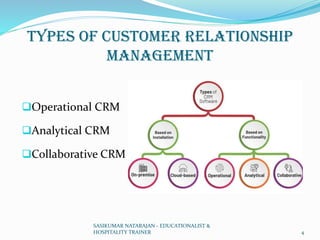
❑Operational CRM
❑Analytical CRM
❑Collaborative CRM
SASIKUMAR NATARAJAN - EDUCATIONALIST &
HOSPITALITY TRAINER 4
Operational CRM
 Means supporting the so-called "front office“ business
processes, which include customer contact (sales,
marketing and service). Tasks resulting from these
processes are forwarded to employees responsible,
information necessary for carrying out the tasks and
interfaces to back-end applications are being provided
and activities with customers are being documented
for further reference.
SASIKUMAR NATARAJAN - EDUCATIONALIST &
HOSPITALITY TRAINER 5
Analytical CRM
 Analytical CRM Data gathered within operational
CRM are analyzed to segment customers or to identify
cross- and up-selling potential.
 Data collection and analysis is viewed as a continuing
and iterative process.
 Ideally, business decisions are refined over time, based
on feedback from earlier analysis and decisions
SASIKUMAR NATARAJAN - EDUCATIONALIST &
HOSPITALITY TRAINER 6
Collaborative CRM
 Collaborative CRM Facilitates interactions with
customers through all channels (personal, letter, fax,
phone, web, email) and supports co-ordination of
employee teams and channels
 A solution that brings People, Processes and Data
together so companies can better serve and retain their
customers.
 The data/activities can be structured, unstructured,
conversational, and/or transactional in nature.
SASIKUMAR NATARAJAN - EDUCATIONALIST &
HOSPITALITY TRAINER 7
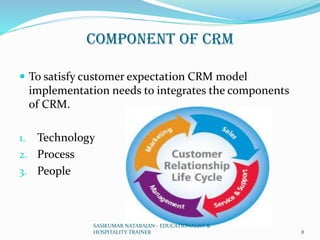
Component of CRM
 To satisfy customer expectation CRM model
implementation needs to integrates the components
of CRM.
1. Technology
2. Process
3. People
SASIKUMAR NATARAJAN - EDUCATIONALIST &
HOSPITALITY TRAINER 8
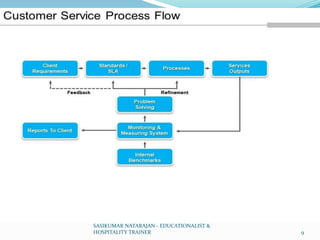
SASIKUMAR NATARAJAN - EDUCATIONALIST &
HOSPITALITY TRAINER 9
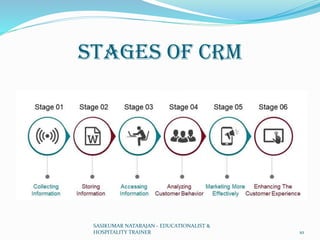
Stages of CRM
SASIKUMAR NATARAJAN - EDUCATIONALIST &
HOSPITALITY TRAINER 10
Improve Customer Relationship
Management
❖Communication
❖Positive Attitude
❖Make Contracts Clear
❖Compromise
❖Go Above and Beyond
❖Request Feedback
❖Share
❖Get to Know Them
❖Be timely
❖Thank your client
SASIKUMAR NATARAJAN - EDUCATIONALIST &
HOSPITALITY TRAINER 11
BASIC REQUIREMENT OF CRM
 Customer Services strategy across the business.
 To ensure that the Customer Services function operates effectively and that the
functions’ activities are aligned to departmental and Company objectives.
 To ensure the accurate processing of customer quotations, orders and order
confirmations within agreed timescales.
 To ensure that all customer enquiries are satisfactorily managed, resolved and closed
within agreed timescales.
 To ensure that the Customer Services function is adequately staffed and trained to
deliver an efficient service to internal and external customers.
 To represent the Customer Services function as an active member of the Senior
Management Team.
 To actively promote and manage the process of continuous improvement in Customer
Service standards within Call Enquiries and Order Processing.
 Create and sustain a positive team environment displaying high levels of motivation and
excellent team spirit.
 Contribute management meetings.
 Effective communication throughout all levels of the Customer Services function.
SASIKUMAR NATARAJAN - EDUCATIONALIST &
HOSPITALITY TRAINER 12
Do’s of CRM
 Be Honest - Nothing destroys trust faster than broken promises. So
always do what you promised. Be fair about prices, additional fees and
extra charges.
 Respect your customer - Any customer deserves your full attention and
polite, friendly attitude. That’s the easiest way to show that you really
care and generate a wholesome experience that lasts .
 Express Your Gratitude - Words of gratitude will make your customers
feel appreciated for their loyalty to your brand. Saying “Thank You” to
the people who support your business.
 Take Responsibility – Professionalism in customer service implies that
you are ready to take responsibility for the problems or negative
experiences that customers are having with your company, products or
services.
SASIKUMAR NATARAJAN - EDUCATIONALIST &
HOSPITALITY TRAINER 13
Don’ts of CRM
 Don’t Make Things Overly Complicated - Never underestimate the
inexperience of your customers.
 Don’t Be Indifferent - Indifference kills customer service. It means
you just don’t care anymore.
 Don’t Treat Customers as Transactions - Don’t treat people coming
to your website or office as one-time transaction, do all your best to
build strong and long-lasting relationship.
 Don’t Ignore Customer Feedback
 Don’t Be Afraid of Complaints - No matter how hard you try, you
can’t satisfy all your customers all the time.
SASIKUMAR NATARAJAN - EDUCATIONALIST &
HOSPITALITY TRAINER 14
Benefits of CRM
1. Improves Communication with Customers
2. loyalty and retention.
3. Better and more timely decision making
4. Brings Efficiency Through Automation
5. Helps Make Data-driven Decisions.
6. Boosts Revenue of Business
7. Develop superior services and products that meet your customers’
identified needs.
8. Enhance marketing towards the most profitable customers to improve your
bottom line.
9. Improve efficiency by providing support and services to customers online
(through frequently asked questions, for example).
10. Anticipate future business needs based on data on historic sale and service
trends.
11. Increase your customer base as you develop new ways to engage in
business online.
SASIKUMAR NATARAJAN - EDUCATIONALIST &
HOSPITALITY TRAINER 15
Thank You
SASIKUMAR NATARAJAN - EDUCATIONALIST &
HOSPITALITY TRAINER 16

Customer relationship management

  • 1.
    CUSTOMER RELATIONSHIP MANAGEMENT SASIKUMAR NATARAJAN- EDUCATIONALIST & HOSPITALITY TRAINER 1
  • 2.
    Definition of Customer Relationship CustomerRelationship Management (or CRM) is a phrase that describes how your business interacts with your customers. CRM is a system to capture information about your customers. CRM involves using technology to gather the intelligence to provide improved support and services to the customers. In other words, CRM is also about what you do with that information to better meet the needs of your existing customers and identify new customers, resulting in higher profits for business. SASIKUMAR NATARAJAN - EDUCATIONALIST & HOSPITALITY TRAINER 2
  • 3.
    Who Is theCustomer  ImportantVisitor of the Organization  Customer is a Part of our business  They are no disturbance to work, but they are purpose of work  A person whom we are dependent. SASIKUMAR NATARAJAN - EDUCATIONALIST & HOSPITALITY TRAINER 3
  • 4.
    Types of CustomerRelationship Management ❑Operational CRM ❑Analytical CRM ❑Collaborative CRM SASIKUMAR NATARAJAN - EDUCATIONALIST & HOSPITALITY TRAINER 4
  • 5.
    Operational CRM  Meanssupporting the so-called "front office“ business processes, which include customer contact (sales, marketing and service). Tasks resulting from these processes are forwarded to employees responsible, information necessary for carrying out the tasks and interfaces to back-end applications are being provided and activities with customers are being documented for further reference. SASIKUMAR NATARAJAN - EDUCATIONALIST & HOSPITALITY TRAINER 5
  • 6.
    Analytical CRM  AnalyticalCRM Data gathered within operational CRM are analyzed to segment customers or to identify cross- and up-selling potential.  Data collection and analysis is viewed as a continuing and iterative process.  Ideally, business decisions are refined over time, based on feedback from earlier analysis and decisions SASIKUMAR NATARAJAN - EDUCATIONALIST & HOSPITALITY TRAINER 6
  • 7.
    Collaborative CRM  CollaborativeCRM Facilitates interactions with customers through all channels (personal, letter, fax, phone, web, email) and supports co-ordination of employee teams and channels  A solution that brings People, Processes and Data together so companies can better serve and retain their customers.  The data/activities can be structured, unstructured, conversational, and/or transactional in nature. SASIKUMAR NATARAJAN - EDUCATIONALIST & HOSPITALITY TRAINER 7
  • 8.
    Component of CRM To satisfy customer expectation CRM model implementation needs to integrates the components of CRM. 1. Technology 2. Process 3. People SASIKUMAR NATARAJAN - EDUCATIONALIST & HOSPITALITY TRAINER 8
  • 9.
    SASIKUMAR NATARAJAN -EDUCATIONALIST & HOSPITALITY TRAINER 9
  • 10.
    Stages of CRM SASIKUMARNATARAJAN - EDUCATIONALIST & HOSPITALITY TRAINER 10
  • 11.
    Improve Customer Relationship Management ❖Communication ❖PositiveAttitude ❖Make Contracts Clear ❖Compromise ❖Go Above and Beyond ❖Request Feedback ❖Share ❖Get to Know Them ❖Be timely ❖Thank your client SASIKUMAR NATARAJAN - EDUCATIONALIST & HOSPITALITY TRAINER 11
  • 12.
    BASIC REQUIREMENT OFCRM  Customer Services strategy across the business.  To ensure that the Customer Services function operates effectively and that the functions’ activities are aligned to departmental and Company objectives.  To ensure the accurate processing of customer quotations, orders and order confirmations within agreed timescales.  To ensure that all customer enquiries are satisfactorily managed, resolved and closed within agreed timescales.  To ensure that the Customer Services function is adequately staffed and trained to deliver an efficient service to internal and external customers.  To represent the Customer Services function as an active member of the Senior Management Team.  To actively promote and manage the process of continuous improvement in Customer Service standards within Call Enquiries and Order Processing.  Create and sustain a positive team environment displaying high levels of motivation and excellent team spirit.  Contribute management meetings.  Effective communication throughout all levels of the Customer Services function. SASIKUMAR NATARAJAN - EDUCATIONALIST & HOSPITALITY TRAINER 12
  • 13.
    Do’s of CRM Be Honest - Nothing destroys trust faster than broken promises. So always do what you promised. Be fair about prices, additional fees and extra charges.  Respect your customer - Any customer deserves your full attention and polite, friendly attitude. That’s the easiest way to show that you really care and generate a wholesome experience that lasts .  Express Your Gratitude - Words of gratitude will make your customers feel appreciated for their loyalty to your brand. Saying “Thank You” to the people who support your business.  Take Responsibility – Professionalism in customer service implies that you are ready to take responsibility for the problems or negative experiences that customers are having with your company, products or services. SASIKUMAR NATARAJAN - EDUCATIONALIST & HOSPITALITY TRAINER 13
  • 14.
    Don’ts of CRM Don’t Make Things Overly Complicated - Never underestimate the inexperience of your customers.  Don’t Be Indifferent - Indifference kills customer service. It means you just don’t care anymore.  Don’t Treat Customers as Transactions - Don’t treat people coming to your website or office as one-time transaction, do all your best to build strong and long-lasting relationship.  Don’t Ignore Customer Feedback  Don’t Be Afraid of Complaints - No matter how hard you try, you can’t satisfy all your customers all the time. SASIKUMAR NATARAJAN - EDUCATIONALIST & HOSPITALITY TRAINER 14
  • 15.
    Benefits of CRM 1.Improves Communication with Customers 2. loyalty and retention. 3. Better and more timely decision making 4. Brings Efficiency Through Automation 5. Helps Make Data-driven Decisions. 6. Boosts Revenue of Business 7. Develop superior services and products that meet your customers’ identified needs. 8. Enhance marketing towards the most profitable customers to improve your bottom line. 9. Improve efficiency by providing support and services to customers online (through frequently asked questions, for example). 10. Anticipate future business needs based on data on historic sale and service trends. 11. Increase your customer base as you develop new ways to engage in business online. SASIKUMAR NATARAJAN - EDUCATIONALIST & HOSPITALITY TRAINER 15
  • 16.
    Thank You SASIKUMAR NATARAJAN- EDUCATIONALIST & HOSPITALITY TRAINER 16