Company and Marketing Strategy:
Partnering to Build Customer
Relationships
Companywide Strategic Planning
Strategic planning is the process of
developing and maintaining a strategic
fit between the organization’s goals
and capabilities and its changing
marketing opportunities
Strategic Planning
Companywide Strategic Planning
 The mission statement is the organization’s
purpose, what it wants to accomplish in the
larger environment
 Market-oriented mission statement defines the
business in terms of satisfying basic customer
needs
Defining a Market-Oriented Mission
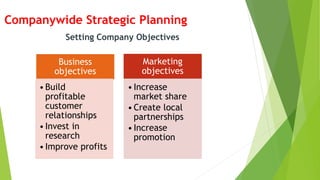
Companywide Strategic Planning
Business
objectives
•Build
profitable
customer
relationships
•Invest in
research
•Improve profits
Marketing
objectives
•Increase
market share
•Create local
partnerships
•Increase
promotion
Setting Company Objectives
Companywide Strategic Planning
The business portfolio is the collection of businesses
and products that make up the company
Portfolio analysis is a major activity in strategic
planning whereby management evaluates the
products and businesses that make up the company
Designing the Business Portfolio
Companywide Strategic Planning
Strategic business unit (SBU) is a unit of the company
that has a separate mission and objectives that can
be planned separately from other company businesses
 Company division
 Product line within a division
 Single product or brand
Analyzing the Current Business Portfolio
Companywide Strategic Planning
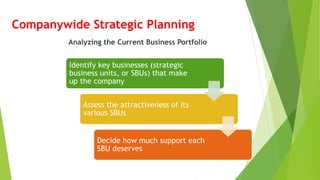
Identify key businesses (strategic
business units, or SBUs) that make
up the company
Assess the attractiveness of its
various SBUs
Decide how much support each
SBU deserves
Analyzing the Current Business Portfolio
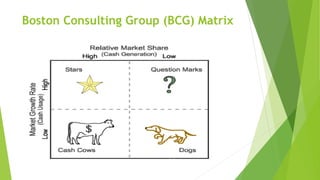
What Is BCG Matrix?
 BOSTON CONSULTING GROUP (BCG) MATRIX is developed by BRUCE
HENDERSON of the BOSTON CONSULTING GROUP IN THE
EARLY 1970’s.
 According to this technique, businesses or products are classified as low or
high performers depending upon their market growth rate and relative
market share.
 It is based on the combination of market growth and market share relative to
the next best competitor.
Boston Consulting Group (BCG) Matrix
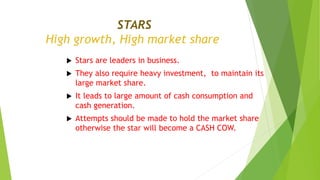
STARS
High growth, High market share
 Stars are leaders in business.
 They also require heavy investment, to maintain its
large market share.
 It leads to large amount of cash consumption and
cash generation.
 Attempts should be made to hold the market share
otherwise the star will become a CASH COW.
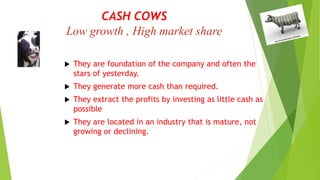
CASH COWS
Low growth , High market share
 They are foundation of the company and often the
stars of yesterday.
 They generate more cash than required.
 They extract the profits by investing as little cash as
possible
 They are located in an industry that is mature, not
growing or declining.
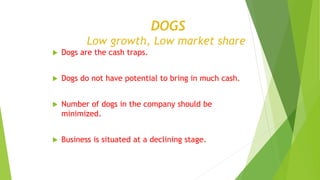
DOGS
Low growth, Low market share
 Dogs are the cash traps.
 Dogs do not have potential to bring in much cash.
 Number of dogs in the company should be
minimized.
 Business is situated at a declining stage.
QUESTION MARKS
High growth , Low market share
 Most businesses start of as question marks.
 They will absorb great amounts of cash if the
market share remains unchanged, (low).
 Why question marks?
 Question marks have potential to become
star and eventually cash cow but can also
become a dog.
 Investments should be high for question
marks.
Companywide Strategic Planning
 Difficulty in defining SBUs and measuring market
share and growth
 Time consuming
 Expensive
 Focus on current businesses, not future planning
Problems with Matrix Approaches
Companywide Strategic Planning
Product/market expansion grid is a tool
for identifying company growth
opportunities through market
penetration, market development,
product development, or diversification
Developing Strategies for Growth and Downsizing
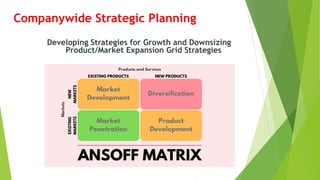
Companywide Strategic Planning
Developing Strategies for Growth and Downsizing
Product/Market Expansion Grid Strategies
Companywide Strategic Planning
Market penetration is a growth strategy increasing
sales to current market segments without changing
the product
Market development is a growth strategy that
identifies and develops new market segments for
current products
Developing Strategies
for Growth and Downsizing
Companywide Strategic Planning
Product development is a growth strategy that offers
new or modified products to existing market
segments
Diversification is a growth strategy for starting up or
acquiring businesses outside the company’s current
products and markets
Developing Strategies
for Growth and Downsizing
Companywide Strategic Planning
Downsizing is the reduction of the
business portfolio by eliminating
products or business units that are not
profitable or that no longer fit the
company’s overall strategy
Developing Strategies
for Growth and Downsizing
Managing the Marketing Effort
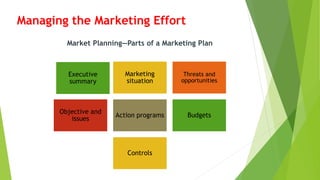
Executive
summary
Marketing
situation
Threats and
opportunities
Objective and
issues
Action programs Budgets
Controls
Market Planning—Parts of a Marketing Plan
Managing the Marketing Effort
Implementing is the process that turns
marketing plans into marketing actions to
accomplish strategic marketing objectives
 Successful implementation depends on how
well the company blends its people,
organizational structure, decision and reward
system, and company culture into a cohesive
action plan that supports its strategies
Marketing Implementation
Managing the Marketing Effort
Controlling is the measurement and
evaluation of results and the taking of
corrective action as needed
Operating control
Strategic control
Marketing Control
Measuring and Managing
Return on Marketing Investment
Return on marketing investment (marketing
ROI) is the net return from a marketing
investment divided by the costs of the
marketing investment. Marketing ROI
provides a measurement of the profits
generated by investments in marketing
activities.
Return on Marketing Investment (Marketing ROI)

marketing stratigies

  • 1.
    Company and MarketingStrategy: Partnering to Build Customer Relationships
  • 2.
    Companywide Strategic Planning Strategicplanning is the process of developing and maintaining a strategic fit between the organization’s goals and capabilities and its changing marketing opportunities Strategic Planning
  • 3.
    Companywide Strategic Planning The mission statement is the organization’s purpose, what it wants to accomplish in the larger environment  Market-oriented mission statement defines the business in terms of satisfying basic customer needs Defining a Market-Oriented Mission
  • 4.
    Companywide Strategic Planning Business objectives •Build profitable customer relationships •Investin research •Improve profits Marketing objectives •Increase market share •Create local partnerships •Increase promotion Setting Company Objectives
  • 5.
    Companywide Strategic Planning Thebusiness portfolio is the collection of businesses and products that make up the company Portfolio analysis is a major activity in strategic planning whereby management evaluates the products and businesses that make up the company Designing the Business Portfolio
  • 6.
    Companywide Strategic Planning Strategicbusiness unit (SBU) is a unit of the company that has a separate mission and objectives that can be planned separately from other company businesses  Company division  Product line within a division  Single product or brand Analyzing the Current Business Portfolio
  • 7.
    Companywide Strategic Planning Identifykey businesses (strategic business units, or SBUs) that make up the company Assess the attractiveness of its various SBUs Decide how much support each SBU deserves Analyzing the Current Business Portfolio
  • 8.
    What Is BCGMatrix?  BOSTON CONSULTING GROUP (BCG) MATRIX is developed by BRUCE HENDERSON of the BOSTON CONSULTING GROUP IN THE EARLY 1970’s.  According to this technique, businesses or products are classified as low or high performers depending upon their market growth rate and relative market share.  It is based on the combination of market growth and market share relative to the next best competitor.
  • 9.
  • 10.
    STARS High growth, Highmarket share  Stars are leaders in business.  They also require heavy investment, to maintain its large market share.  It leads to large amount of cash consumption and cash generation.  Attempts should be made to hold the market share otherwise the star will become a CASH COW.
  • 11.
    CASH COWS Low growth, High market share  They are foundation of the company and often the stars of yesterday.  They generate more cash than required.  They extract the profits by investing as little cash as possible  They are located in an industry that is mature, not growing or declining.
  • 12.
    DOGS Low growth, Lowmarket share  Dogs are the cash traps.  Dogs do not have potential to bring in much cash.  Number of dogs in the company should be minimized.  Business is situated at a declining stage.
  • 13.
    QUESTION MARKS High growth, Low market share  Most businesses start of as question marks.  They will absorb great amounts of cash if the market share remains unchanged, (low).  Why question marks?  Question marks have potential to become star and eventually cash cow but can also become a dog.  Investments should be high for question marks.
  • 14.
    Companywide Strategic Planning Difficulty in defining SBUs and measuring market share and growth  Time consuming  Expensive  Focus on current businesses, not future planning Problems with Matrix Approaches
  • 15.
    Companywide Strategic Planning Product/marketexpansion grid is a tool for identifying company growth opportunities through market penetration, market development, product development, or diversification Developing Strategies for Growth and Downsizing
  • 16.
    Companywide Strategic Planning DevelopingStrategies for Growth and Downsizing Product/Market Expansion Grid Strategies
  • 17.
    Companywide Strategic Planning Marketpenetration is a growth strategy increasing sales to current market segments without changing the product Market development is a growth strategy that identifies and develops new market segments for current products Developing Strategies for Growth and Downsizing
  • 18.
    Companywide Strategic Planning Productdevelopment is a growth strategy that offers new or modified products to existing market segments Diversification is a growth strategy for starting up or acquiring businesses outside the company’s current products and markets Developing Strategies for Growth and Downsizing
  • 19.
    Companywide Strategic Planning Downsizingis the reduction of the business portfolio by eliminating products or business units that are not profitable or that no longer fit the company’s overall strategy Developing Strategies for Growth and Downsizing
  • 20.
    Managing the MarketingEffort Executive summary Marketing situation Threats and opportunities Objective and issues Action programs Budgets Controls Market Planning—Parts of a Marketing Plan
  • 21.
    Managing the MarketingEffort Implementing is the process that turns marketing plans into marketing actions to accomplish strategic marketing objectives  Successful implementation depends on how well the company blends its people, organizational structure, decision and reward system, and company culture into a cohesive action plan that supports its strategies Marketing Implementation
  • 22.
    Managing the MarketingEffort Controlling is the measurement and evaluation of results and the taking of corrective action as needed Operating control Strategic control Marketing Control
  • 23.
    Measuring and Managing Returnon Marketing Investment Return on marketing investment (marketing ROI) is the net return from a marketing investment divided by the costs of the marketing investment. Marketing ROI provides a measurement of the profits generated by investments in marketing activities. Return on Marketing Investment (Marketing ROI)