SERVICES MARKETING
CHAPTER 7
MANAGING THE FIRM’S PHYSICAL EVIDENCE
OUTCOME
 Understand role of physical external
 The development of servicescape
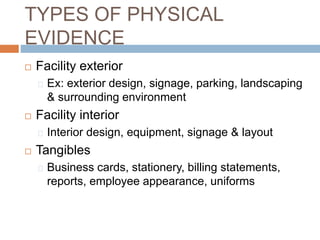
TYPES OF PHYSICAL
EVIDENCE
 Facility exterior
Ex: exterior design, signage, parking, landscaping
& surrounding environment
 Facility interior
Interior design, equipment, signage & layout
 Tangibles
Business cards, stationery, billing statements,
reports, employee appearance, uniforms
STRATEGIC ROLE OF PHYSICAL
EVIDENCE
1. Packaging
2. Facilitating the service process
3. Socializing employees & customers
4. A means for differentiation
THE STIMULUS-ORGANISM-
RESPONSE
1. A set of stimuli (physical evidence)
2. An organism (recipient of the stimuli:
customers)
3. A set of responses or outcomes
THE DEVELOPMENT OF
SERVICESCAPES
 The use of physical evidence to design the
service environment
Includes:
1. Ambient conditions
2. Space/function
3. Signs , symbols & artifacts
AMBIENT CONDITIONS
 Distinctive atmosphere of the service setting
Ex: lighting, air quality, noise & music
SPACE/FUNCTION
 The layout of the facility
Ex: equipment, furniture
SIGNS, SYMBOLS &
ARTIFACTS
 Environmental physical evidence including
signage, personalized artifacts style of decor
SERVICESCAPES PORTION
(REALIZATION)
 Holistic environment (perception)
 Internal response moderators (SAR
components)
 Internal response to environment
includes: cognitive, emotional response,
physiological
 Behavioral responses to environment
Individual and/or social interactions
SPECIFIC TACTICS FOR
CREATING SERVICE
ATMOSPHERE
 Sight appeals
 Sound appeals
 Scent appeals
 Touch appeals
 Taste appeals (free samples)
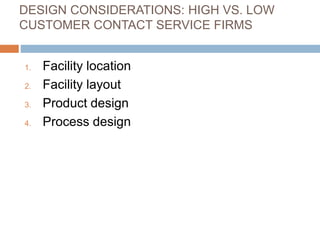
DESIGN CONSIDERATIONS: HIGH VS. LOW
CUSTOMER CONTACT SERVICE FIRMS
1. Facility location
2. Facility layout
3. Product design
4. Process design
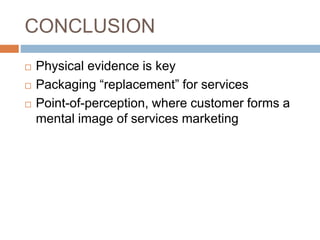
CONCLUSION
 Physical evidence is key
 Packaging “replacement” for services
 Point-of-perception, where customer forms a
mental image of services marketing
THANK YOU
Q&A

Servmarkchpter7