Dr. Binod Sinha
Professor BIMM Pune

 What is Physical Evidence of Service Quality?
 Roles played by Physical Environment
 Relationship between Physical Environment and the
Service Consumer
 Design and Maintenance of Physical Facilities
Contents

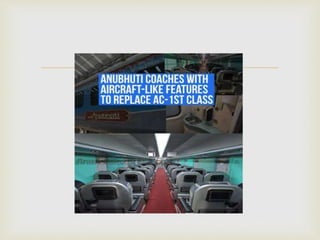
 The Indian Railways has embarked on to mesmerize
Indian Public Travelling with world class services by
Launching Swarna- gold standrad Rajdhani and
Shatabadi Express with Anubhuti Coaches matching
the experience, the comfort and ambience which has
been privilege of Airline customers.
Examples

 The interiors and exteriors of these ultra modern
coaches have been decorated with Vinyl
Wrappings,LED Lights and anti graffiti coating that
present a unique and enhanced look and feel.


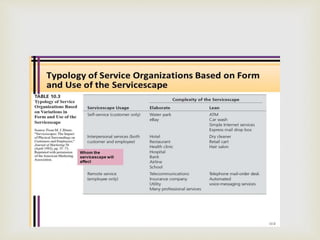
 Servicescape: It includes (i) facility exteriors like
exterior design, signage, parking, landscape and the
surrounding environment, and (ii) facility interiors
like interior design, equipment, signage, layout and
air quality and temperature.
 Other tangibles: It includes business cards,
stationery, billing statements, reports, employee
dress, uniforms, brochures, web pages and the
virtual servicescape.
What is Physical Evidence?....
the environment in which the service is delivered and where the firm
and the customer interact, and any tangible commodities that facilitate
performance or communication of the service.

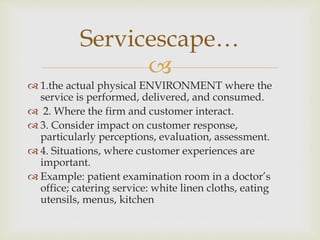
 1.the actual physical ENVIRONMENT where the
service is performed, delivered, and consumed.
 2. Where the firm and customer interact.
 3. Consider impact on customer response,
particularly perceptions, evaluation, assessment.
 4. Situations, where customer experiences are
important.
 Example: patient examination room in a doctor’s
office; catering service: white linen cloths, eating
utensils, menus, kitchen
Servicescape…


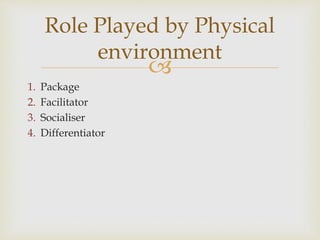
1. Package
2. Facilitator
3. Socialiser
4. Differentiator
Role Played by Physical
environment

 Package: The physical evidence of a service plays a role
similar to that of product packaging, it wraps the service
and communicates its characteristics to the customer.
 FedEx – providing customer with strong metaphors &
service packaging that convey the brand positioning.
The physical environment affects customers and
employees, i.e. anybody who uses it. It can play various
roles as discussed in the following sections:

A clean, safe servicescape conveys the
image of a superior quality service to the
customers and makes them feel proud of
being associated with the service, i.e., it
enhances the image benefits received by
the customer.
Package…contd.

 A hindrance-free layout of the servicescape can
enhance employee performance and customer
satisfaction. Physical evidence like comfortable
chairs in the seating area matches the requirements
of customers thereby enhancing the perception of the
quality of service in their minds.
E.g. airport – International Traveller
E.g. banking services
Facilitator

 The servicescape helps customers and employees
socialize and interact with each other and among
themselves as services are mainly delivered through
interactions during the moments of truth.
 The physical evidence also sets the mood for the
service, a cheerful mood at entertainment services, a
professional mood around offices and calm, relaxing
ambience in healthcare establishments.
 Ex: A new employee in an organization / Private
bank Vs. Public bank
Socialiser

 The physical evidence can help to differentiate and
position a service for a particular segment of
customers when designed according to their tastes
and preferences including what they are willing to
pay for.
 For instance, the physical evidence for a high-priced
upper class area would be enhanced and
differentiated from a low-priced lower class area in
any service setting or among similar services.
 Ex: Shopping mall – signage, color, music.
Differentiator

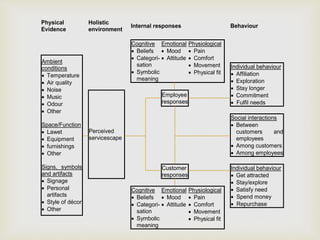
Professor Mary J. Bitner introduced a framework for
understanding environment-user relationships in service
organisations in 1992. The framework is depicted in the next slide
a framework for understanding environment-
user relationships
Physical
Evidence
Holistic
environment
Internal responses Behaviour
Cognitive
 Beliefs
 Categori-
sation
 Symbolic
meaning
Emotional
 Mood
 Attitude
Physiological
 Pain
 Comfort
 Movement
 Physical fit
Ambient
conditions
 Temperature
 Air quality
 Noise
 Music
 Odour
 Other
Space/Function
 Lawet
 Equipment
 furnishings
 Other
Signs, symbols
and artifacts
 Signage
 Personal
artifacts
 Style of décor
 Other
Individual behaviour
 Affiliation
 Exploration
 Stay longer
 Commitment
 Fulfil needs
Perceived
servicescape
Employee
responses
Social interactions
 Between
customers and
employees
 Among customers
 Among employees
Customer
responses
Individual behaviour
 Get attracted
 Stay/explore
 Satisfy need
 Spend money
 Repurchase
Cognitive
 Beliefs
 Categori-
sation
 Symbolic
meaning
Emotional
 Mood
 Attitude
Physiological
 Pain
 Comfort
 Movement
 Physical fit

 The objective of our service business is to attract
customers and ensure that they are able to satisfy
their needs while enjoying the service experience.
 They would like to spend their money if they
perceive that they have received net benefit from our
company.
 If they are satisfied with the service, they would
repurchase our services and refer our services to
others.

 Our employees would mainly serve the customer. It
is important that they feel comfortable at our
servicescape. This would help them feel like staying
till they complete their duty and do additional
innovation for the benefit of the customers and our
organisation in the long term.
 As we know very well by now, services are primarily
delivered through interactions between and among
employees and customers

 Ambient conditions (Explicit / implicit signals to
communicate firm’s image) • Temperature •
Lighting • Noise • Music • Smell • Colour – E.g.
music affects perceptions of time – Scent (strong
impact on mood, affect & evaluate responses)

 In order that the above desirable behaviour can take
place effectively and efficiently, it is important that
they receive the right cues from the environment that
can elicit the right internal responses within
customers and employees.

 The responses would be of three types, cognitive,
emotional and physiological. The right environment
would give them desirable cues.
 For instance, a clean and organized office would
convey a sense of efficiency to customers and
employees alike. High quality, working equipment
would give assurance to customers that their
problems would be flawlessly satisfied at the service
outlet.

 Similarly, the availability of efficient working
equipment gives service providers the opportunity
for doing a good job of their service.
 The physical evidence, like presence and placement
of chairs gives meaning to the space and indicates
the category or segment of customers who are likely
to receive the service in those surroundings. These
are the cognitive responses of the physical evidence
of service.

 Lighting, music, décor, air temperature and
freshness make up the ambience of the servicescape
which is aided by sparkling surroundings and
equipment. This gives a positive mood and attitude
to customers and service providers.
 On the other hand, a poorly-lit, damp servicescape
quickly conveys a negative attitude of the service
provider and elicits negative emotional response
from the customers.

 Above cognitions and emotions give rise to
physiological responses like pain or comfort. The
placement of physical facilities gives them direction
for movement and rest.
 On the whole, customers and employees feel fit and
comfortable at the service facility. These responses
give employees an opportunity to provide flawless
service to customers that they can be proud of.
Similarly, customers are able to negotiate their way
in the service facility and have their needs satisfied
in the enabling atmosphere.

 Hence, it is clear that the appropriate physical
evidence, consistent with the service concept and the
brand image, elicits positive cognitions, emotions
and physiological responses from customers and
service providers. This enables the production and
consumption of services thereby leading to
fulfilment of customers’ and organisations’ goals.

 We have understood by now that physical evidence
is an important aspect of our service, which cannot
be ignored. Accordingly, we have to employ
architects, interior designers and merchandise
designers to design physical features that are
consistent with our service concept and conveys the
value, form and function, outcome and the nature of
experience that customers are to receive from the
servicescape.
Design and Maintenance of
Physical Facilities

 More importantly, they must match the preferences
of our customers, yet provide slightly more than
what our customer segment would have ordinarily
expected from the facility. You may have noted how
various elements of the physical evidence of Jet
Airways are blue in colour while those are red in
colour for Kingfisher Airlines.


 These elements are consistent with the logo and
masthead and reflect the value and nature of
experience that each airline has promised to deliver.
The physical evidence should have elements of
surprise, joy, interest and captivation inbuilt in them,
in order to be perceived to be slightly beyond the
expectations of the customers and delight them.

 Once the service is in operation, much attention must
be given to the maintenance of the facility in order to
keep it spick and span and in working order.
 All unused, non-working and damaged objects
should be removed without delay and replaced with
new components.

 We must remember that visitors to our facility will
quickly get used to the physical evidence in our
service facility. In order to maintain their interest in
the company and to give them a feel of a renewing
firm, the servicescape should be modernised and
updated beyond the expectations of customers.

 It is a challenge to implement what customers could
be suggesting later on, before they can expect it. This
can keep our customers interested in our
organisation and patronise the same. Interesting
elements of the servicescape can become a matter of
special attraction and customers would speak about
it to others while intentionally or unintentionally
promoting the firm and its services to them.

 Elements of the physical evidence, particularly the
servicescape, are costly and cannot be redone again and again
without making large outlays. Hence it has to be executed
correctly the first time itself.
 Every bit of the physical environment that is likely to affect
employees, customers and visitors must be identified in the
service blueprint. Alternative designs for these facilities must
be evaluated and the right one must be executed with care. The
opinion of customer representative, service personnel, service
managers, stockholders, collaborators and visitors must be
taken and a consensus arrived at while selecting an appropriate
design.

 This procedure will also help the service providers
and their collaborators to get involved and invest
interest and time in the development of the facility
while feeling a sense of ownership for the same. Care
must be taken to involve as many of the above
people as possible in decisions related to the smallest
details of the servicescape, so that the very best is
obtained without requirements for later replacement
and rework.

Physical evidence

  • 1.
  • 2.
      What isPhysical Evidence of Service Quality?  Roles played by Physical Environment  Relationship between Physical Environment and the Service Consumer  Design and Maintenance of Physical Facilities Contents
  • 3.
      The IndianRailways has embarked on to mesmerize Indian Public Travelling with world class services by Launching Swarna- gold standrad Rajdhani and Shatabadi Express with Anubhuti Coaches matching the experience, the comfort and ambience which has been privilege of Airline customers. Examples
  • 4.
      The interiorsand exteriors of these ultra modern coaches have been decorated with Vinyl Wrappings,LED Lights and anti graffiti coating that present a unique and enhanced look and feel.
  • 5.
  • 6.
      Servicescape: Itincludes (i) facility exteriors like exterior design, signage, parking, landscape and the surrounding environment, and (ii) facility interiors like interior design, equipment, signage, layout and air quality and temperature.  Other tangibles: It includes business cards, stationery, billing statements, reports, employee dress, uniforms, brochures, web pages and the virtual servicescape. What is Physical Evidence?.... the environment in which the service is delivered and where the firm and the customer interact, and any tangible commodities that facilitate performance or communication of the service.
  • 7.
      1.the actualphysical ENVIRONMENT where the service is performed, delivered, and consumed.  2. Where the firm and customer interact.  3. Consider impact on customer response, particularly perceptions, evaluation, assessment.  4. Situations, where customer experiences are important.  Example: patient examination room in a doctor’s office; catering service: white linen cloths, eating utensils, menus, kitchen Servicescape…
  • 8.
  • 9.
     1. Package 2. Facilitator 3.Socialiser 4. Differentiator Role Played by Physical environment
  • 10.
      Package: Thephysical evidence of a service plays a role similar to that of product packaging, it wraps the service and communicates its characteristics to the customer.  FedEx – providing customer with strong metaphors & service packaging that convey the brand positioning. The physical environment affects customers and employees, i.e. anybody who uses it. It can play various roles as discussed in the following sections:
  • 11.
     A clean, safeservicescape conveys the image of a superior quality service to the customers and makes them feel proud of being associated with the service, i.e., it enhances the image benefits received by the customer. Package…contd.
  • 12.
      A hindrance-freelayout of the servicescape can enhance employee performance and customer satisfaction. Physical evidence like comfortable chairs in the seating area matches the requirements of customers thereby enhancing the perception of the quality of service in their minds. E.g. airport – International Traveller E.g. banking services Facilitator
  • 13.
      The servicescapehelps customers and employees socialize and interact with each other and among themselves as services are mainly delivered through interactions during the moments of truth.  The physical evidence also sets the mood for the service, a cheerful mood at entertainment services, a professional mood around offices and calm, relaxing ambience in healthcare establishments.  Ex: A new employee in an organization / Private bank Vs. Public bank Socialiser
  • 14.
      The physicalevidence can help to differentiate and position a service for a particular segment of customers when designed according to their tastes and preferences including what they are willing to pay for.  For instance, the physical evidence for a high-priced upper class area would be enhanced and differentiated from a low-priced lower class area in any service setting or among similar services.  Ex: Shopping mall – signage, color, music. Differentiator
  • 15.
     Professor Mary J.Bitner introduced a framework for understanding environment-user relationships in service organisations in 1992. The framework is depicted in the next slide a framework for understanding environment- user relationships
  • 16.
    Physical Evidence Holistic environment Internal responses Behaviour Cognitive Beliefs  Categori- sation  Symbolic meaning Emotional  Mood  Attitude Physiological  Pain  Comfort  Movement  Physical fit Ambient conditions  Temperature  Air quality  Noise  Music  Odour  Other Space/Function  Lawet  Equipment  furnishings  Other Signs, symbols and artifacts  Signage  Personal artifacts  Style of décor  Other Individual behaviour  Affiliation  Exploration  Stay longer  Commitment  Fulfil needs Perceived servicescape Employee responses Social interactions  Between customers and employees  Among customers  Among employees Customer responses Individual behaviour  Get attracted  Stay/explore  Satisfy need  Spend money  Repurchase Cognitive  Beliefs  Categori- sation  Symbolic meaning Emotional  Mood  Attitude Physiological  Pain  Comfort  Movement  Physical fit
  • 17.
      The objectiveof our service business is to attract customers and ensure that they are able to satisfy their needs while enjoying the service experience.  They would like to spend their money if they perceive that they have received net benefit from our company.  If they are satisfied with the service, they would repurchase our services and refer our services to others.
  • 18.
      Our employeeswould mainly serve the customer. It is important that they feel comfortable at our servicescape. This would help them feel like staying till they complete their duty and do additional innovation for the benefit of the customers and our organisation in the long term.  As we know very well by now, services are primarily delivered through interactions between and among employees and customers
  • 19.
      Ambient conditions(Explicit / implicit signals to communicate firm’s image) • Temperature • Lighting • Noise • Music • Smell • Colour – E.g. music affects perceptions of time – Scent (strong impact on mood, affect & evaluate responses)
  • 20.
      In orderthat the above desirable behaviour can take place effectively and efficiently, it is important that they receive the right cues from the environment that can elicit the right internal responses within customers and employees.
  • 21.
      The responseswould be of three types, cognitive, emotional and physiological. The right environment would give them desirable cues.  For instance, a clean and organized office would convey a sense of efficiency to customers and employees alike. High quality, working equipment would give assurance to customers that their problems would be flawlessly satisfied at the service outlet.
  • 22.
      Similarly, theavailability of efficient working equipment gives service providers the opportunity for doing a good job of their service.  The physical evidence, like presence and placement of chairs gives meaning to the space and indicates the category or segment of customers who are likely to receive the service in those surroundings. These are the cognitive responses of the physical evidence of service.
  • 23.
      Lighting, music,décor, air temperature and freshness make up the ambience of the servicescape which is aided by sparkling surroundings and equipment. This gives a positive mood and attitude to customers and service providers.  On the other hand, a poorly-lit, damp servicescape quickly conveys a negative attitude of the service provider and elicits negative emotional response from the customers.
  • 24.
      Above cognitionsand emotions give rise to physiological responses like pain or comfort. The placement of physical facilities gives them direction for movement and rest.  On the whole, customers and employees feel fit and comfortable at the service facility. These responses give employees an opportunity to provide flawless service to customers that they can be proud of. Similarly, customers are able to negotiate their way in the service facility and have their needs satisfied in the enabling atmosphere.
  • 25.
      Hence, itis clear that the appropriate physical evidence, consistent with the service concept and the brand image, elicits positive cognitions, emotions and physiological responses from customers and service providers. This enables the production and consumption of services thereby leading to fulfilment of customers’ and organisations’ goals.
  • 26.
      We haveunderstood by now that physical evidence is an important aspect of our service, which cannot be ignored. Accordingly, we have to employ architects, interior designers and merchandise designers to design physical features that are consistent with our service concept and conveys the value, form and function, outcome and the nature of experience that customers are to receive from the servicescape. Design and Maintenance of Physical Facilities
  • 27.
      More importantly,they must match the preferences of our customers, yet provide slightly more than what our customer segment would have ordinarily expected from the facility. You may have noted how various elements of the physical evidence of Jet Airways are blue in colour while those are red in colour for Kingfisher Airlines. 
  • 28.
      These elementsare consistent with the logo and masthead and reflect the value and nature of experience that each airline has promised to deliver. The physical evidence should have elements of surprise, joy, interest and captivation inbuilt in them, in order to be perceived to be slightly beyond the expectations of the customers and delight them.
  • 29.
      Once theservice is in operation, much attention must be given to the maintenance of the facility in order to keep it spick and span and in working order.  All unused, non-working and damaged objects should be removed without delay and replaced with new components.
  • 30.
      We mustremember that visitors to our facility will quickly get used to the physical evidence in our service facility. In order to maintain their interest in the company and to give them a feel of a renewing firm, the servicescape should be modernised and updated beyond the expectations of customers.
  • 31.
      It isa challenge to implement what customers could be suggesting later on, before they can expect it. This can keep our customers interested in our organisation and patronise the same. Interesting elements of the servicescape can become a matter of special attraction and customers would speak about it to others while intentionally or unintentionally promoting the firm and its services to them.
  • 32.
      Elements ofthe physical evidence, particularly the servicescape, are costly and cannot be redone again and again without making large outlays. Hence it has to be executed correctly the first time itself.  Every bit of the physical environment that is likely to affect employees, customers and visitors must be identified in the service blueprint. Alternative designs for these facilities must be evaluated and the right one must be executed with care. The opinion of customer representative, service personnel, service managers, stockholders, collaborators and visitors must be taken and a consensus arrived at while selecting an appropriate design.
  • 33.
      This procedurewill also help the service providers and their collaborators to get involved and invest interest and time in the development of the facility while feeling a sense of ownership for the same. Care must be taken to involve as many of the above people as possible in decisions related to the smallest details of the servicescape, so that the very best is obtained without requirements for later replacement and rework.