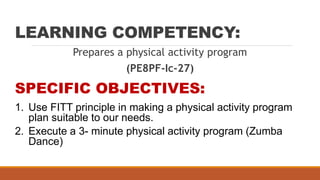
LEARNING COMPETENCY:
Prepares a physical activity program
(PE8PF-Ic-27)
SPECIFIC OBJECTIVES:
1. Use FITT principle in making a physical activity program
plan suitable to our needs.
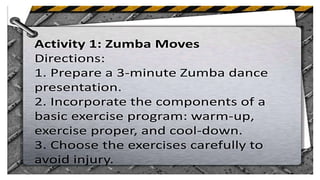
2. Execute a 3- minute physical activity program (Zumba
Dance)
Activity 1: FILL ME!
Directions: Supply the missing letters to
form a word or a phrase out from the
given definition.
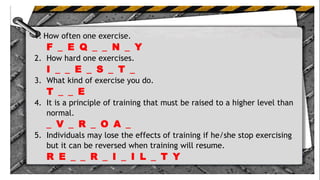
1. How often one exercise.
F _ E Q _ _ N _ Y
2. How hard one exercises.
I _ _ E _ S _ T _
3. What kind of exercise you do.
T _ _ E
4. It is a principle of training that must be raised to a higher level than
normal.
_ V _ R _ O A _
5. Individuals may lose the effects of training if he/she stop exercising
but it can be reversed when training will resume.
R E _ _ R _ I _ I L _ T Y
What is FITT Principle?
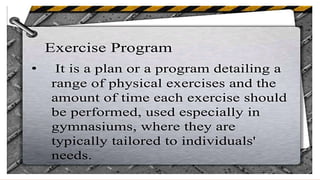
This principle helps you to create and develop
your workout plan or program that will be more
effective in achieving your fitness goals.
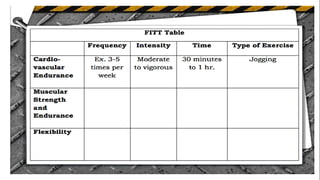
F- FREQUENCY
How often one exercises
Beginners should try to exercise
3 to 4 times a week while
experienced or healthy
individuals should aim for 5 to 6
days a week.
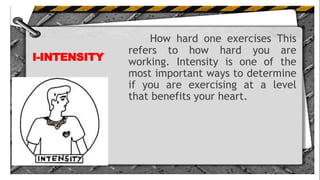
I-INTENSITY
How hard one exercises This
refers to how hard you are
working. Intensity is one of the
most important ways to determine
if you are exercising at a level
that benefits your heart.
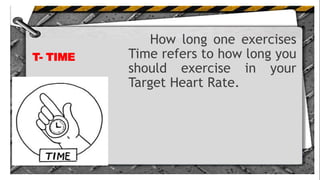
T- TIME
How long one exercises
Time refers to how long you
should exercise in your
Target Heart Rate.
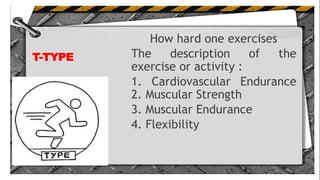
T-TYPE
How hard one exercises
The description of the
exercise or activity :
1. Cardiovascular Endurance
2. Muscular Strength
3. Muscular Endurance
4. Flexibility
1.Overload - This refers to which training must be
raised to a higher level than normal to create the
demands to which your body will adapt.
2.Specificity - This training must be specific to the
sport or activity, the type of fitness required and the
particular muscle groups.
3.Progression - As your body adapts to training, you
progress to a new level of fitness. To then take this to
the “new level’, a gradual increase in intensity is
needed to create an overload
.
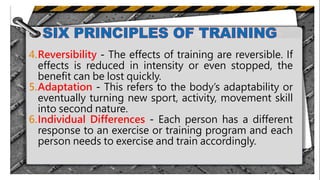
4.Reversibility - The effects of training are reversible. If
effects is reduced in intensity or even stopped, the
benefit can be lost quickly.
5.Adaptation - This refers to the body’s adaptability or
eventually turning new sport, activity, movement skill
into second nature.
6.Individual Differences - Each person has a different
response to an exercise or training program and each
person needs to exercise and train accordingly.
.
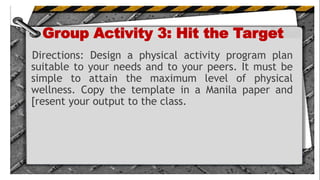
Group Activity 3: Hit the Target
Directions: Design a physical activity program plan
suitable to your needs and to your peers. It must be
simple to attain the maximum level of physical
wellness. Copy the template in a Manila paper and
[resent your output to the class.
.
.
.
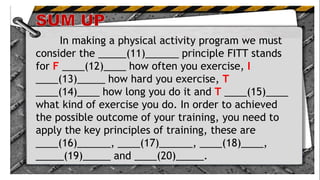
In making a physical activity program we must
consider the _____(11)______ principle FITT stands
for F ____(12)____ how often you exercise, I
____(13)_____ how hard you exercise, T
____(14)____ how long you do it and T ____(15)____
what kind of exercise you do. In order to achieved
the possible outcome of your training, you need to
apply the key principles of training, these are
____(16)______, ____(17)______, ____(18)____,
_____(19)_____ and ____(20)_____.

Physical Education 8- Basic Exercise Program CO1.pptx

  • 2.
    LEARNING COMPETENCY: Prepares aphysical activity program (PE8PF-Ic-27) SPECIFIC OBJECTIVES: 1. Use FITT principle in making a physical activity program plan suitable to our needs. 2. Execute a 3- minute physical activity program (Zumba Dance)
  • 5.
    Activity 1: FILLME! Directions: Supply the missing letters to form a word or a phrase out from the given definition.
  • 6.
    1. How oftenone exercise. F _ E Q _ _ N _ Y 2. How hard one exercises. I _ _ E _ S _ T _ 3. What kind of exercise you do. T _ _ E 4. It is a principle of training that must be raised to a higher level than normal. _ V _ R _ O A _ 5. Individuals may lose the effects of training if he/she stop exercising but it can be reversed when training will resume. R E _ _ R _ I _ I L _ T Y
  • 27.
    What is FITTPrinciple? This principle helps you to create and develop your workout plan or program that will be more effective in achieving your fitness goals.
  • 28.
    F- FREQUENCY How oftenone exercises Beginners should try to exercise 3 to 4 times a week while experienced or healthy individuals should aim for 5 to 6 days a week.
  • 29.
    I-INTENSITY How hard oneexercises This refers to how hard you are working. Intensity is one of the most important ways to determine if you are exercising at a level that benefits your heart.
  • 30.
    T- TIME How longone exercises Time refers to how long you should exercise in your Target Heart Rate.
  • 31.
    T-TYPE How hard oneexercises The description of the exercise or activity : 1. Cardiovascular Endurance 2. Muscular Strength 3. Muscular Endurance 4. Flexibility
  • 32.
    1.Overload - Thisrefers to which training must be raised to a higher level than normal to create the demands to which your body will adapt. 2.Specificity - This training must be specific to the sport or activity, the type of fitness required and the particular muscle groups. 3.Progression - As your body adapts to training, you progress to a new level of fitness. To then take this to the “new level’, a gradual increase in intensity is needed to create an overload .
  • 33.
    4.Reversibility - Theeffects of training are reversible. If effects is reduced in intensity or even stopped, the benefit can be lost quickly. 5.Adaptation - This refers to the body’s adaptability or eventually turning new sport, activity, movement skill into second nature. 6.Individual Differences - Each person has a different response to an exercise or training program and each person needs to exercise and train accordingly. .
  • 34.
    Group Activity 3:Hit the Target Directions: Design a physical activity program plan suitable to your needs and to your peers. It must be simple to attain the maximum level of physical wellness. Copy the template in a Manila paper and [resent your output to the class. .
  • 35.
  • 38.
    . In making aphysical activity program we must consider the _____(11)______ principle FITT stands for F ____(12)____ how often you exercise, I ____(13)_____ how hard you exercise, T ____(14)____ how long you do it and T ____(15)____ what kind of exercise you do. In order to achieved the possible outcome of your training, you need to apply the key principles of training, these are ____(16)______, ____(17)______, ____(18)____, _____(19)_____ and ____(20)_____.