Contemporary Dance and
Modern Dance
GROUP 3:
DUMAGUING, FRAYNE
LLERIN, JADEY JOY
GEOLAGON, REAL JOY
MODERN
DANCE
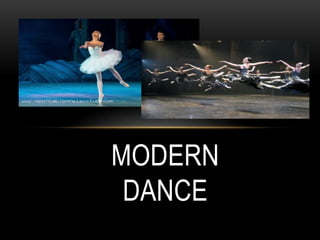
MODERN DANCE
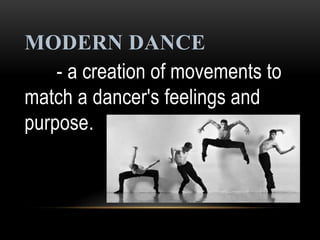
- a creation of movements to
match a dancer's feelings and
purpose.
MODERN DANCE
-is a broad genre
of western concert or
theatrical dance,
primarily arising out of
Germany and the
United States in the
late 19th and early
20th centuries.
History: in the early 20th century, Modern
dance is a dance style that focuses on a
dancer's own interpretations instead of
structured steps, as in traditional
ballet dancing. Modern dancers reject the
limitations of classical ballet and favor
movements derived from the expression of
their inner feelings. Modern Dance style
that began to develop during the late 19th
century as a protest against classical
ballet.
MODERN DANCE
PURPOSE: Modern dance flourished in
areas that lacked strong ballet traditions,
such as in the United States where ballet
companies were imported from Europe.
Although modern dance originated in
Europe, by 1930 the United States had
become the center for dance
experimentation.
MODERN DANCE
MIND EXERCISE
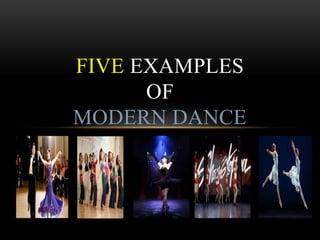
FIVE EXAMPLES
OF
MODERN DANCE
Ballet
Balleturlesque
Ballroom
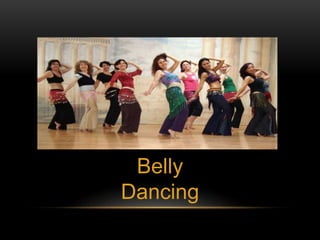
Belly
Dancing
Jazz
BENEFITS ON
DOING MODERN
DANCE
(PHYSICAL AND
HEALTH)
Stronger bones and reduced
risk of osteoporosis.
Better coordination, agility
and flexibility
• Improved balance and spatial
awareness.
• Increased physical confidence.
CONTEMPORARY
DANCE
CONTEMPORARY DANCE
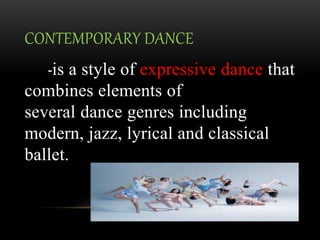
-is a style of expressive dance that
combines elements of
several dance genres including
modern, jazz, lyrical and classical
ballet.
CONTEMPORARY DANCE
-Stresses versatility and
improvisation, unlike the strict,
structured nature of ballet.
Contemporary dancers focus on floor
work, using gravity to pull them
down to the floor. This dance genre is
often done in bare feet. Contemporary
dance can be performed to many
different styles of music.
CONTEMPORARY DANCE
History: It began at the start of
the 20th century when
US dancer Isadora Duncan
(1878–1927) broke away from
ballet and developed her own,
more natural style.
CONTEMPORARY DANCE
Purpose: is to let
the dancer express his or
her inner emotions to the
audience. The dancer tells a
story to the audience that is
generally sad or depressing
in hopes of making them an
emotion.
CONTEMPORARY DANCE
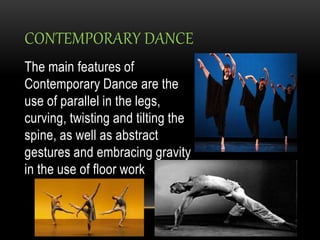
The main features of
Contemporary Dance are the
use of parallel in the legs,
curving, twisting and tilting the
spine, as well as abstract
gestures and embracing gravity
in the use of floor work
1. Graham 2. Cunningham
3. Limon
BENEFITS ON DOING
CONTEMPORARY DANCE:
(PHYSICAL & HEALTH)
Stronger bones and reduced risk of
osteoporosis.
Better coordination, agility and
flexibility.
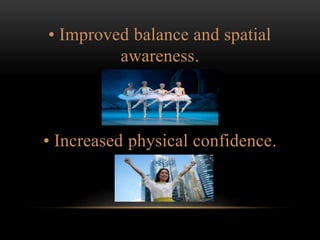
Improved balance and spatial awareness.
Increased physical confidence.
Improved mental functioning.
Improved general and psychological well
being.
Greater self-confidence and self-esteem.
Better social skills.
Modern and Contemporary dance

Modern and Contemporary dance