Activity 1. FITNESSQUEST
•Direction: Identify what HRF components do
the following physical activities in column A
belong to. Then, determine whether they are
Cardiovascular Activity, Flexibility Muscular or
Strength Activity and Endurance Activity.
Write your answer on a separate sheet.
Activity 2: WORDHUNT
•Directions: Find ten (10) words related
to health on the grid. Words appear
straight across, up and down, down
and up, and diagonally. Write your
answer on a separate sheet.
5.
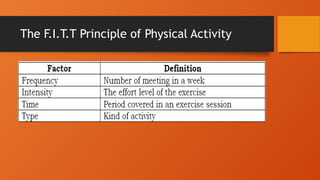
The FITT Principleof Physical Activity
(Dance)
F – Frequency
I – Intensity
T – Type
T - Time
6.
Principles of PhysicalActivity
•Overload Principle
•Principle of Progression
•Principle of Specificity
•Principle of Reversibility
7.
Overload Principle
This principlepertains to doing “more than
normal” for improvement to happen. It means to
boost our fitness, strength, or endurance. The
workload is extended accordingly. Applying these
training principles will cause long-term
adaptations, enabling the body to figure more
efficiently to deal with higher levels of
performance.
8.
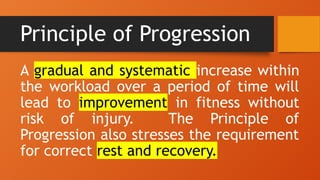
Principle of Progression
Agradual and systematic increase within
the workload over a period of time will
lead to improvement in fitness without
risk of injury. The Principle of
Progression also stresses the requirement
for correct rest and recovery.
9.
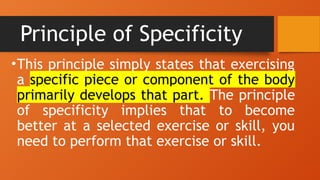
Principle of Specificity
•Thisprinciple simply states that exercising
a specific piece or component of the body
primarily develops that part. The principle
of specificity implies that to become
better at a selected exercise or skill, you
need to perform that exercise or skill.
10.
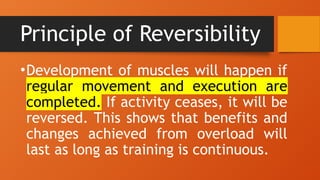
Principle of Reversibility
•Developmentof muscles will happen if
regular movement and execution are
completed. If activity ceases, it will be
reversed. This shows that benefits and
changes achieved from overload will
last as long as training is continuous.
FREQUENCY
The first thingto identify in the workout
plan is frequency—how often you exercise.
Your frequency often depends on a spread
of things including the sort of workout
you're doing, how hard you're working,
your fitness level, and your exercise goals.
Three to five times
13.
Intensity
•Intensity refers tohow hard you work during
the physical activity period. Intensity is often
measured in several ways, counting on the
health-related component. For instance,
monitoring pulse rate is a technique to
measure intensity during aerobic endurance
activities but gives no indication of intensity
during flexibility activities.
14.
TIME
•Time is thelength of the physical
activity. Considering the other
aspects of the F.I.T.T principle, the
time differs depending on the
health-related fitness component
targeted.
15.
TYPE
Type refers tothe definite physical activity
selected to improve a component of health-
related fitness. For example, a person who wants
to improve the arm strength should exercise the
triceps and biceps, while an individual who wants
to improve aerobic endurance needs to execute
some other aerobically challenging activities such
as jogging, running, swimming.
16.
Part of anExercise Program
•warm-up
•exercise load
•cool-down
17.
WARM-UP
• is essentialprior to the actual workload as it prepares the
body for more strenuous activity. It increases the blood
flow to the working muscles without an abrupt increase in
lactic acid accumulation. According to research, the
warmer the body and muscle, the higher the muscular
output. A good warm-up also prepares the heart, muscles,
and joints for the next activity by decreasing joint
stiffness and increasing nerve impulses.
18.
EXERCISE LOAD ORWORKOUT LOAD
is the program activity
that would stimulate
beneficial adaptation
when performed regularly.
19.
COOL-DOWN
•is essential aftera workout as it permits
the pre-exercise heart rate and blood
pressure for a gradual recovery. Cooling
down may be most vital for competitive
endurance athletes, like marathoners,
because it helps regulate blood flow.
20.
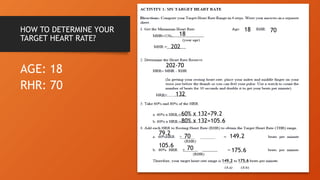
HOW TO DETERMINEYOUR
TARGET HEART RATE?
AGE: 18
RHR: 70
18 70
202
202-70
132
60% x 132=79.2
80% x 132=105.6
79.2
70 149.2
105.6 70 175.6
149.2 175.6
Activity 4: SUMIT UP!!
Direction: In this activity you will
summarize all your learnings.
Review all the readings you had
about the lesson.
23.
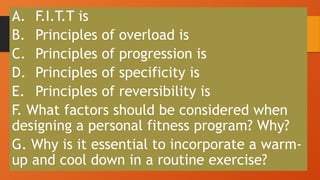
A. F.I.T.T is
B.Principles of overload is
C. Principles of progression is
D. Principles of specificity is
E. Principles of reversibility is
F. What factors should be considered when
designing a personal fitness program? Why?
G. Why is it essential to incorporate a warm-
up and cool down in a routine exercise?
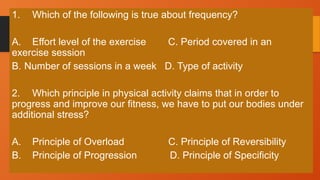
1. Which ofthe following is true about frequency?
A. Effort level of the exercise C. Period covered in an
exercise session
B. Number of sessions in a week D. Type of activity
2. Which principle in physical activity claims that in order to
progress and improve our fitness, we have to put our bodies under
additional stress?
A. Principle of Overload C. Principle of Reversibility
B. Principle of Progression D. Principle of Specificity
26.
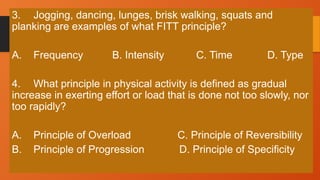
3. Jogging, dancing,lunges, brisk walking, squats and
planking are examples of what FITT principle?
A. Frequency B. Intensity C. Time D. Type
4. What principle in physical activity is defined as gradual
increase in exerting effort or load that is done not too slowly, nor
too rapidly?
A. Principle of Overload C. Principle of Reversibility
B. Principle of Progression D. Principle of Specificity
27.
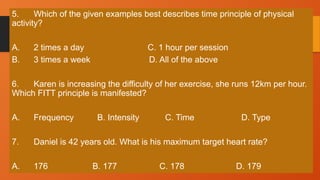
5. Which ofthe given examples best describes time principle of physical
activity?
A. 2 times a day C. 1 hour per session
B. 3 times a week D. All of the above
6. Karen is increasing the difficulty of her exercise, she runs 12km per hour.
Which FITT principle is manifested?
A. Frequency B. Intensity C. Time D. Type
7. Daniel is 42 years old. What is his maximum target heart rate?
A. 176 B. 177 C. 178 D. 179
28.
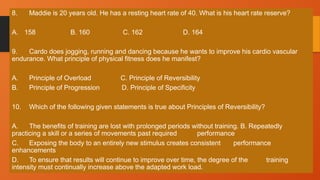
8. Maddie is20 years old. He has a resting heart rate of 40. What is his heart rate reserve?
A. 158 B. 160 C. 162 D. 164
9. Cardo does jogging, running and dancing because he wants to improve his cardio vascular
endurance. What principle of physical fitness does he manifest?
A. Principle of Overload C. Principle of Reversibility
B. Principle of Progression D. Principle of Specificity
10. Which of the following given statements is true about Principles of Reversibility?
A. The benefits of training are lost with prolonged periods without training. B. Repeatedly
practicing a skill or a series of movements past required performance
C. Exposing the body to an entirely new stimulus creates consistent performance
enhancements
D. To ensure that results will continue to improve over time, the degree of the training
intensity must continually increase above the adapted work load.