P.E AND HEALTH 11
Training/Exercise Principles
and FITT Principles
LEARNING COMPETENCY
•Sets Frequency Intensity Time Type
(FITT) goals based on training
principles to achieve and/or maintain
health-related fitness (HRF).
PEH11FH-Ii-j-7
LEARNING OBJECTIVES
Identify and discuss FITT principles and principles
of training,
Illustrate the use of FITT and training principles by
crafting a fitness program,
Analyze the relation of FITT principles and
Training Principles in light of crafting a
training/fitness program, and
•Value the importance of applying the FITT and
training principles in optimizing HRF.
ACTIVITY #1: PRE-TEST/DIAGNOSTIC TEST
Directions: In a ¼ sheet of paper, answer the following
questions. Choose the letter of a correct answer.
1. What is the first element you should set up when
planning a workout plan? It refers to how often you
exercise.
A. Frequency B. Intensity C. Time D. Type
2. What is the most basic principle in physical
activity that indicates doing more than normal for
improvement to happen?
A. Overload Principle C. Reversibility Principle
B. Progression Principle D. Specificity Principle
3. What do you call the duration or the length of a
session of physical activity?
A. Frequency B. Intensity C. Time D. Type
4. What principle in physical activity is defined as a
gradual increase in exerting effort or load that is
done not too slowly, nor too rapidly?
A. Overload Principle C. Reversibility Principle
B. Progression Principle D. Specificity Principle
5. Jogging, dancing, lunges, brisk walking, squats,
and planking are examples of what FITT principle?
A. Time B. Type C. Intensity D. Frequency
6. The effect of training will be lost if the training is
discontinued. Which
principle of physical activity does it refer to?
A. Overload Principle C. Reversibility Principle
B. Progression Principle D. Specificity Principle
7. Cardo does jogging, running, and dancing to
improve his cardiovascular endurance. What principle
of physical fitness does it manifest?
A. Overload Principle C. Reversibility Principle
B. Progression Principle D. Specificity Principle
8. Which of the FITT principles discuss the effort
level of the exercise?
A. Time B. Type C. Intensity D. Frequency
9. Which is essential before the actual workload so
that the body can prepare for more strenuous
activity?
A. Cool-down C. Stretching
B. Exercise load D. Warm-up
10.Which part of the exercise program is
essential after a workout as it permits the pre-
exercise heart rate and blood pressure for a
gradual recovery?
A. Cool-down C. Stretching
B. Exercise load D. Warm-up
ACTIVITY # 2: (WORD HUNT)
• Find 10 words related to health and fitness on the grid.
• Words appear straight across, up and down, down and
up, and diagonally. Write your answer on the board,
• Anyone from the class can voluntarily participate in the
activity.
• Each student is allowed to answer once,
• If the student able to find a word he/she will be going to
use it in a sentence related to health & fitness.
T F O T I R S Y N A E T F O G
S I M Y R E E U P M O I R E F
R F M P P R I N C I P L E D D
E O R E N E N P A G P E Q L A
V R E M E K Q R Z J E S U A O
E V E R W E T O X C P T E V L
R F S O A V B G A F S C N E R
S S O W W Y C R Q O C E C T E
I T F V I N T E N S I T Y H V
B M E E A L P S C F O T S H O
I A N D S D E S A B Q X V S M
L I J S P E C I F I C I T Y K
I I O A R P I O O E A C E P Y
T O S E H W V N E E T N L D P
Y A T R A I N I N G G N B T U
PROCESSING QUESTIONS!
•Can you define or describe the terms we
have in the activity #2?
•How will you describe Principles of training
or exercise based on this terms?
What is the first thing you considered when
you wanted to put a firm/business?
* Planning (General principle)
Do you think planning is crucial in
developing a business?
What do you think will happen if you dive-
in directly to a business without considering
the things you should do first before putting-
up?
PRINCIPLES OF TRAINING
AND EXERCISE
•Outlines the criteria that guide all training.
Each principle allows us to critique some
element of a person’s training. When a
person’s training follows the principles well it is
most likely to be successful.
PRINCIPLE OF OVERLOAD
•The body must work harder than what it is used to
in order for it to adapt.
•It implies that exercise is a controlled form of
stress that will stimulate the body to become more
stronger.
•In order for a muscle (including the heart muscle)
to get stronger, it must be overload or worked
beyond the usual load.
PRINCIPLE OF PROGRESSION
•The body should experience a gradual increase in
workload. If the principle of overload asks “ How hard?”
then the principle of progression asks “How soon?”.
•The body will get injured if it experiences a workload
that is too hard and too soon.
•A reasonable time frame is to increase the load after
two weeks. But do not increase the workload by more
than 10% from the previous week.
PRINCIPLE OF SPECIFICITY
•Improvements in fitness level will be limited to the
activities that one is performing.
•The application of this principle is not only on the
movement or activity performed but to the
intensity at which it is performed.
•This principle highlights the importance of
performing a variety of activities to improve
overall fitness.
PRINCIPLE OF INDIVIDUALITY
•States that no two persons are the same and
their rate of adaptation to the same workload
differs.
•Emphasizes the need to create an exercise
program that is individual-specific.
•It is therefore essential that the exercise program
cater to these individual needs and preferences.
PRINCIPLE OF REVERSIBILITY
•The adaptation that takes place as a result of
training are all reversible.
•An exercise program requires rest for the body to
recover, too much rest may be
counterproductive.
•If an individual stops to exercise, the body
gradually returns to its initial level of fitness.
FITT PRINCIPLES
•Is an acronym for Frequency, Intensity,
Time, and Type.
•The key factors in designing an exercise
program that will address the current
fitness level.
FREQUENCY
•Refers to as the number of sessions in a week.
•Depends on the current fitness level and the type
of activity performed.
•Consequently, beginners should exercise less
frequently as compared to athletes.
•As fitness level increases, the individual can
increase the number of session gradually.
INTENSITY
•Difficulty level of the exercise or work
demand/workout.
•It is important to set a workload that is more
challenging than what one is used to.
•This factor is affected by the current fitness
level and the time allotted to an exercise
session.
TIME
•Refers to the duration or distance covered
in an exercise session.
•This factor is influenced by the intensity
and the type of activity performed.
TYPE
•Mode of exercise or activity.
•The type of activity is influenced by the
fitness goal and the current fitness level.
•The exercise program should be designed
so that the exercise is the best activity to
specially address the fitness goal.
WHAT I HAVE LEARNED?
•What are the principles of exercise and
training?
•What is FITT principles?
•What is the importance of the above
mentioned principles in crafting and engaging
fitness program?
ACTIVITY #3: LET’S CRAFT IT TOGETHER!
•Directions: In a group of 4, the students will be
going to craft a 2-days fitness program using
and applying FITT principles and reflecting
some of the training principles in crafting the
program.
Day Exercise Set & Repetition Time
Monday
Warm-up/stretching
Push-up
Curl-up
Wall Squats
Cooling down
3 sets (1st
- 5 reps) 1min. rest
(2nd
- 8 reps) 2min. rest
(3rd
- 12 reps) 3min. rest
3 sets (1st
- 10 reps) 1min. rest
(2nd
– 15 reps) 2min. rest
(3rd
– 20 reps) 3 min. rest
3 sets (1st
– 10 reps) 1min. rest
(2nd
– 15 reps) 2min. rest
(3rd
– 20 reps)
2-3 min.
15 min.
15 min.
15 min.
1-2 min.
Tuesday
Warm-up/stretching
Jogging
Cooling down
4 sets
(1st
– 30sec.jog) 30sec. walking
(2nd
– 2-4 min. jog) 1min. walking
(3rd
– 6-8min. jog) 2min. Walking
(4th
– 10-12min. Jog) 1min.walking
2-3 min.
30-40 min.
1-2 min.
QUIZ: LET’S MEASURE YOUR LEARNING!
MULTIPLE CHOICE:
Directions: Choose the letter of a
correct answer. Write the chosen letter
on a separate ¼ sheet of paper.
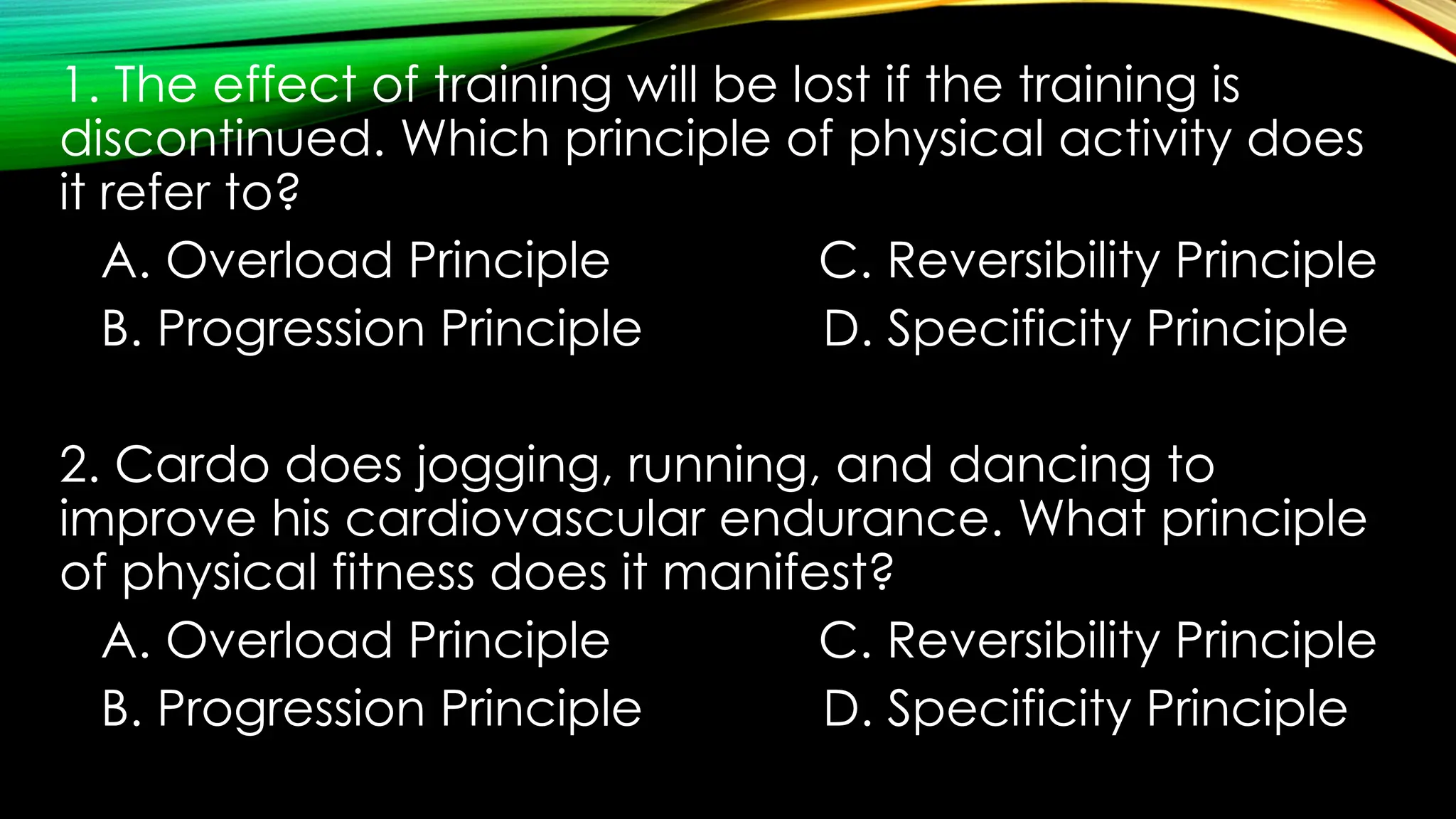
1. The effect of training will be lost if the training is
discontinued. Which principle of physical activity does
it refer to?
A. Overload Principle C. Reversibility Principle
B. Progression Principle D. Specificity Principle
2. Cardo does jogging, running, and dancing to
improve his cardiovascular endurance. What principle
of physical fitness does it manifest?
A. Overload Principle C. Reversibility Principle
B. Progression Principle D. Specificity Principle
3. What principle in physical activity is defined as a
gradual increase in exerting effort or load that is
done not too slowly, nor too rapidly?
A. Overload Principle C. Reversibility Principle
B. Progression Principle D. Specificity Principle
4. Jogging, dancing, lunges, brisk walking, squats,
and planking are examples of what FITT principle?
A. Time B. Type C. Intensity D. Frequency
5. What is the most basic principle in physical
activity that indicates doing more than normal for
improvement to happen?
A. Overload Principle C. Reversibility Principle
B. Progression Principle D. Specificity Principle
6. What do you call the duration or the length of a
session of physical activity?
A. Frequency B. Intensity C. Time D. Type
7. Which of the FITT principles discuss the effort
level of the exercise?
A. Time B. Type C. Intensity D. Frequency
8. Which is essential before the actual workload so
that the body can prepare for more strenuous
activity?
A. Cool-down C. Stretching
B. Exercise load D. Warm-up
9. What is the first element you should set up when
planning a workout plan? It refers to how often
you exercise.
A. Frequency B. Intensity C. Time D. Type
10.Which part of the exercise program is essential
after a workout as it permits the pre-exercise heart
rate and blood pressure for a gradual recovery?
A. Cool-down C. Stretching
B. Exercise load D. Warm-up
ADDITIONAL ACTIVITY!
•Using a 1whole sheet of paper create a
Personal 1-Week fitness program applying
the FITT principles and Principles of
training/exercise.
THANK YOU!!!

H.O.P.E 1 physical education grade 11.pptx

  • 1.
    P.E AND HEALTH11 Training/Exercise Principles and FITT Principles
  • 2.
    LEARNING COMPETENCY •Sets FrequencyIntensity Time Type (FITT) goals based on training principles to achieve and/or maintain health-related fitness (HRF). PEH11FH-Ii-j-7
  • 3.
    LEARNING OBJECTIVES Identify anddiscuss FITT principles and principles of training, Illustrate the use of FITT and training principles by crafting a fitness program, Analyze the relation of FITT principles and Training Principles in light of crafting a training/fitness program, and •Value the importance of applying the FITT and training principles in optimizing HRF.
  • 4.
    ACTIVITY #1: PRE-TEST/DIAGNOSTICTEST Directions: In a ¼ sheet of paper, answer the following questions. Choose the letter of a correct answer. 1. What is the first element you should set up when planning a workout plan? It refers to how often you exercise. A. Frequency B. Intensity C. Time D. Type
  • 5.
    2. What isthe most basic principle in physical activity that indicates doing more than normal for improvement to happen? A. Overload Principle C. Reversibility Principle B. Progression Principle D. Specificity Principle 3. What do you call the duration or the length of a session of physical activity? A. Frequency B. Intensity C. Time D. Type
  • 6.
    4. What principlein physical activity is defined as a gradual increase in exerting effort or load that is done not too slowly, nor too rapidly? A. Overload Principle C. Reversibility Principle B. Progression Principle D. Specificity Principle 5. Jogging, dancing, lunges, brisk walking, squats, and planking are examples of what FITT principle? A. Time B. Type C. Intensity D. Frequency
  • 7.
    6. The effectof training will be lost if the training is discontinued. Which principle of physical activity does it refer to? A. Overload Principle C. Reversibility Principle B. Progression Principle D. Specificity Principle 7. Cardo does jogging, running, and dancing to improve his cardiovascular endurance. What principle of physical fitness does it manifest? A. Overload Principle C. Reversibility Principle B. Progression Principle D. Specificity Principle
  • 8.
    8. Which ofthe FITT principles discuss the effort level of the exercise? A. Time B. Type C. Intensity D. Frequency 9. Which is essential before the actual workload so that the body can prepare for more strenuous activity? A. Cool-down C. Stretching B. Exercise load D. Warm-up
  • 9.
    10.Which part ofthe exercise program is essential after a workout as it permits the pre- exercise heart rate and blood pressure for a gradual recovery? A. Cool-down C. Stretching B. Exercise load D. Warm-up
  • 10.
    ACTIVITY # 2:(WORD HUNT) • Find 10 words related to health and fitness on the grid. • Words appear straight across, up and down, down and up, and diagonally. Write your answer on the board, • Anyone from the class can voluntarily participate in the activity. • Each student is allowed to answer once, • If the student able to find a word he/she will be going to use it in a sentence related to health & fitness.
  • 11.
    T F OT I R S Y N A E T F O G S I M Y R E E U P M O I R E F R F M P P R I N C I P L E D D E O R E N E N P A G P E Q L A V R E M E K Q R Z J E S U A O E V E R W E T O X C P T E V L R F S O A V B G A F S C N E R S S O W W Y C R Q O C E C T E I T F V I N T E N S I T Y H V B M E E A L P S C F O T S H O I A N D S D E S A B Q X V S M L I J S P E C I F I C I T Y K I I O A R P I O O E A C E P Y T O S E H W V N E E T N L D P Y A T R A I N I N G G N B T U
  • 12.
    PROCESSING QUESTIONS! •Can youdefine or describe the terms we have in the activity #2? •How will you describe Principles of training or exercise based on this terms?
  • 13.
    What is thefirst thing you considered when you wanted to put a firm/business? * Planning (General principle) Do you think planning is crucial in developing a business? What do you think will happen if you dive- in directly to a business without considering the things you should do first before putting- up?
  • 14.
    PRINCIPLES OF TRAINING ANDEXERCISE •Outlines the criteria that guide all training. Each principle allows us to critique some element of a person’s training. When a person’s training follows the principles well it is most likely to be successful.
  • 15.
    PRINCIPLE OF OVERLOAD •Thebody must work harder than what it is used to in order for it to adapt. •It implies that exercise is a controlled form of stress that will stimulate the body to become more stronger. •In order for a muscle (including the heart muscle) to get stronger, it must be overload or worked beyond the usual load.
  • 16.
    PRINCIPLE OF PROGRESSION •Thebody should experience a gradual increase in workload. If the principle of overload asks “ How hard?” then the principle of progression asks “How soon?”. •The body will get injured if it experiences a workload that is too hard and too soon. •A reasonable time frame is to increase the load after two weeks. But do not increase the workload by more than 10% from the previous week.
  • 17.
    PRINCIPLE OF SPECIFICITY •Improvementsin fitness level will be limited to the activities that one is performing. •The application of this principle is not only on the movement or activity performed but to the intensity at which it is performed. •This principle highlights the importance of performing a variety of activities to improve overall fitness.
  • 18.
    PRINCIPLE OF INDIVIDUALITY •Statesthat no two persons are the same and their rate of adaptation to the same workload differs. •Emphasizes the need to create an exercise program that is individual-specific. •It is therefore essential that the exercise program cater to these individual needs and preferences.
  • 19.
    PRINCIPLE OF REVERSIBILITY •Theadaptation that takes place as a result of training are all reversible. •An exercise program requires rest for the body to recover, too much rest may be counterproductive. •If an individual stops to exercise, the body gradually returns to its initial level of fitness.
  • 20.
    FITT PRINCIPLES •Is anacronym for Frequency, Intensity, Time, and Type. •The key factors in designing an exercise program that will address the current fitness level.
  • 21.
    FREQUENCY •Refers to asthe number of sessions in a week. •Depends on the current fitness level and the type of activity performed. •Consequently, beginners should exercise less frequently as compared to athletes. •As fitness level increases, the individual can increase the number of session gradually.
  • 22.
    INTENSITY •Difficulty level ofthe exercise or work demand/workout. •It is important to set a workload that is more challenging than what one is used to. •This factor is affected by the current fitness level and the time allotted to an exercise session.
  • 23.
    TIME •Refers to theduration or distance covered in an exercise session. •This factor is influenced by the intensity and the type of activity performed.
  • 24.
    TYPE •Mode of exerciseor activity. •The type of activity is influenced by the fitness goal and the current fitness level. •The exercise program should be designed so that the exercise is the best activity to specially address the fitness goal.
  • 25.
    WHAT I HAVELEARNED? •What are the principles of exercise and training? •What is FITT principles? •What is the importance of the above mentioned principles in crafting and engaging fitness program?
  • 26.
    ACTIVITY #3: LET’SCRAFT IT TOGETHER! •Directions: In a group of 4, the students will be going to craft a 2-days fitness program using and applying FITT principles and reflecting some of the training principles in crafting the program.
  • 27.
    Day Exercise Set& Repetition Time Monday Warm-up/stretching Push-up Curl-up Wall Squats Cooling down 3 sets (1st - 5 reps) 1min. rest (2nd - 8 reps) 2min. rest (3rd - 12 reps) 3min. rest 3 sets (1st - 10 reps) 1min. rest (2nd – 15 reps) 2min. rest (3rd – 20 reps) 3 min. rest 3 sets (1st – 10 reps) 1min. rest (2nd – 15 reps) 2min. rest (3rd – 20 reps) 2-3 min. 15 min. 15 min. 15 min. 1-2 min. Tuesday Warm-up/stretching Jogging Cooling down 4 sets (1st – 30sec.jog) 30sec. walking (2nd – 2-4 min. jog) 1min. walking (3rd – 6-8min. jog) 2min. Walking (4th – 10-12min. Jog) 1min.walking 2-3 min. 30-40 min. 1-2 min.
  • 28.
    QUIZ: LET’S MEASUREYOUR LEARNING! MULTIPLE CHOICE: Directions: Choose the letter of a correct answer. Write the chosen letter on a separate ¼ sheet of paper.
  • 29.
    1. The effectof training will be lost if the training is discontinued. Which principle of physical activity does it refer to? A. Overload Principle C. Reversibility Principle B. Progression Principle D. Specificity Principle 2. Cardo does jogging, running, and dancing to improve his cardiovascular endurance. What principle of physical fitness does it manifest? A. Overload Principle C. Reversibility Principle B. Progression Principle D. Specificity Principle
  • 30.
    3. What principlein physical activity is defined as a gradual increase in exerting effort or load that is done not too slowly, nor too rapidly? A. Overload Principle C. Reversibility Principle B. Progression Principle D. Specificity Principle 4. Jogging, dancing, lunges, brisk walking, squats, and planking are examples of what FITT principle? A. Time B. Type C. Intensity D. Frequency
  • 31.
    5. What isthe most basic principle in physical activity that indicates doing more than normal for improvement to happen? A. Overload Principle C. Reversibility Principle B. Progression Principle D. Specificity Principle 6. What do you call the duration or the length of a session of physical activity? A. Frequency B. Intensity C. Time D. Type
  • 32.
    7. Which ofthe FITT principles discuss the effort level of the exercise? A. Time B. Type C. Intensity D. Frequency 8. Which is essential before the actual workload so that the body can prepare for more strenuous activity? A. Cool-down C. Stretching B. Exercise load D. Warm-up
  • 33.
    9. What isthe first element you should set up when planning a workout plan? It refers to how often you exercise. A. Frequency B. Intensity C. Time D. Type 10.Which part of the exercise program is essential after a workout as it permits the pre-exercise heart rate and blood pressure for a gradual recovery? A. Cool-down C. Stretching B. Exercise load D. Warm-up
  • 34.
    ADDITIONAL ACTIVITY! •Using a1whole sheet of paper create a Personal 1-Week fitness program applying the FITT principles and Principles of training/exercise.
  • 36.