Objectives:
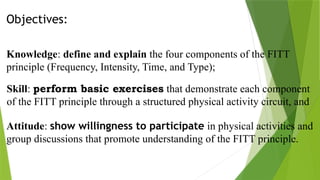
Knowledge: define andexplain the four components of the FITT
principle (Frequency, Intensity, Time, and Type);
Skill: perform basic exercises that demonstrate each component
of the FITT principle through a structured physical activity circuit, and
Attitude: show willingness to participate in physical activities and
group discussions that promote understanding of the FITT principle.
3.
IDENTIFY ME!
Directions: Identifywhat HRF component the
following physical activities belong to. Choose
your answer from the given choices. Write the
letter of your answer in your notebook.
4.
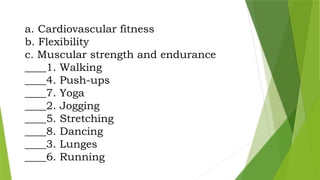
a. Cardiovascular fitness
b.Flexibility
c. Muscular strength and endurance
____1. Walking
____4. Push-ups
____7. Yoga
____2. Jogging
____5. Stretching
____8. Dancing
____3. Lunges
____6. Running
Activity 1: WORDSTORM
Directions:Rearrange each set of jumbled letters to form
important word/words that you will encounter in this
module.
1. PTYE
2. IMET
3. QUENCYFRE
4. TENINCIYT
8.
Anecdote 1 -"In our barangay, we often have community basketball games every
weekend. My uncle always says that playing regularly (Frequency) is key to
improving our skills. He also emphasizes that we should push ourselves
(Intensity) to do better each game!"
Anecdote 2 - "I remember when we would have family hikes up the mountains.
My aunt would always say that the time we spend hiking (Time) and choosing
different trails (Type) helps us stay fit and healthy together as a family."
9.
FITT PRINCIPLE
Exercise isan activity that will stimulate the body to adapt and
become stronger. The stimulus has to be appropriate to derive the
health benefits. If the stimulus is too light, the body will not
adapt, and if it is too hard, it may cause some injuries. The
exercise program should be designed to fit the current health
condition of the individual and it should be interesting. The FITT
Principle is a helpful guide in designing a personalized fitness
program
11.
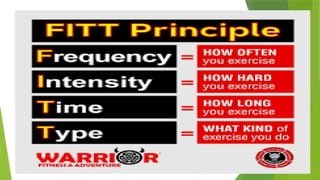
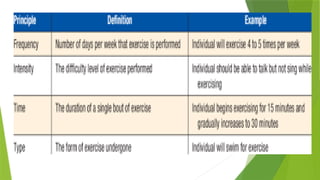
The FITT Principleis an acronym for Frequency, Intensity, Time, and
Type.
These are the key factors in designing an exercise program that will
address the current fitness level, provide means to overload the body,
and trigger positive adaptations. These variables can be modified
occasionally to consistently challenge the body to become stronger. It is
important to remember that increasing the workload should be done
one variable at a time to prevent chronic injuries or overtraining. The
proposed recommendations are conservative to reduce the
likelihood of injury and encourage adoption of an active lifestyle
14.
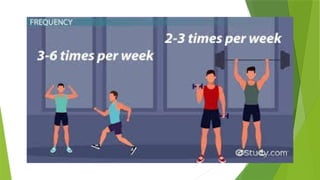
The frequency ofan exercise program depends on the current
fitness level and the type of activity performed. It is important
to provide rest days to allow the body to recover.Consequently,
beginners should exercise less frequently as compared to
athletes. As the fitness level increases, the individual can
increase the number of sessions gradually. Some individuals
train twice or thrice every day. However, one should refrain
from designing his/her program (especially for
beginners) this way because it leads to burnout and possible
injuries.
16.
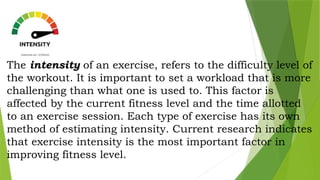
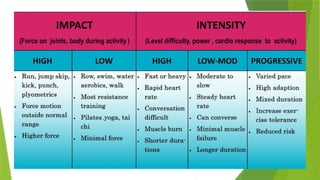
The intensity ofan exercise, refers to the difficulty level of
the workout. It is important to set a workload that is more
challenging than what one is used to. This factor is
affected by the current fitness level and the time allotted
to an exercise session. Each type of exercise has its own
method of estimating intensity. Current research indicates
that exercise intensity is the most important factor in
improving fitness level.
18.
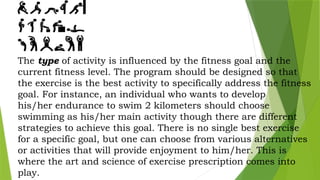
The type ofactivity is influenced by the fitness goal and the
current fitness level. The program should be designed so that
the exercise is the best activity to specifically address the fitness
goal. For instance, an individual who wants to develop
his/her endurance to swim 2 kilometers should choose
swimming as his/her main activity though there are different
strategies to achieve this goal. There is no single best exercise
for a specific goal, but one can choose from various alternatives
or activities that will provide enjoyment to him/her. This is
where the art and science of exercise prescription comes into
play.
20.
The time orduration of an exercise session is influenced
by the intensity and the type of activity performed. An
exercise that is performed at a high intensity cannot be
sustained for a long period. Furthermore, a stretching
program usually takes a shorter period to complete as
compared to a resistance training program.
22.
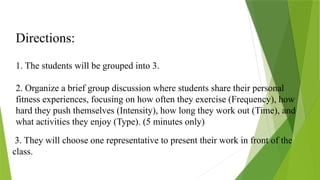
Directions:
1. The studentswill be grouped into 3.
2. Organize a brief group discussion where students share their personal
fitness experiences, focusing on how often they exercise (Frequency), how
hard they push themselves (Intensity), how long they work out (Time), and
what activities they enjoy (Type). (5 minutes only)
3. They will choose one representative to present their work in front of the
class.
23.
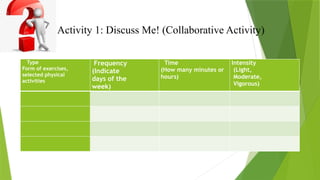
Activity 1: DiscussMe! (Collaborative Activity)
Type
Form of exercises,
selected physical
activities
Frequency
(Indicate
days of the
week)
Time
(How many minutes or
hours)
Intensity
(Light,
Moderate,
Vigorous)
24.
Activity 2: "FITTCircuit Training"[Teaching Strategy: Experiential Learning]
Materials - Exercise mats, cones, stopwatches
Significance - Students will experience firsthand how to apply the FITT principle in a
practical setting.
Instructions :
1) Set up four stations: one for each FITT component (e.g., jumping jacks for Frequency,
squatting for Intensity, planking for Time, and yoga for Type).
2) Divide students into groups, and assign each group to a station for 5 minutes.
3) Rotate groups through each station, ensuring they understand and perform the exercises
related to each FITT component.
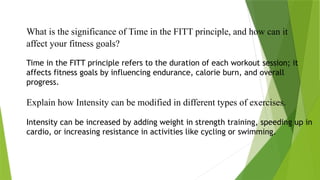
What is thesignificance of Time in the FITT principle, and how can it
affect your fitness goals?
Time in the FITT principle refers to the duration of each workout session; it
affects fitness goals by influencing endurance, calorie burn, and overall
progress.
Explain how Intensity can be modified in different types of exercises.
Intensity can be increased by adding weight in strength training, speeding up in
cardio, or increasing resistance in activities like cycling or swimming.
27.
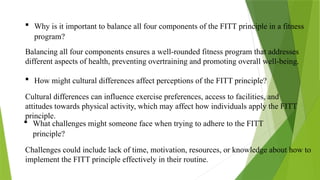
Why isit important to balance all four components of the FITT principle in a fitness
program?
Balancing all four components ensures a well-rounded fitness program that addresses
different aspects of health, preventing overtraining and promoting overall well-being.
How might cultural differences affect perceptions of the FITT principle?
Cultural differences can influence exercise preferences, access to facilities, and
attitudes towards physical activity, which may affect how individuals apply the FITT
principle.
What challenges might someone face when trying to adhere to the FITT
principle?
Challenges could include lack of time, motivation, resources, or knowledge about how to
implement the FITT principle effectively in their routine.
28.
Inclusive Activity 3:"FITT Walk"[Teaching Strategy: Cooperative
Learning]
Materials - None
Significance - This activity promotes inclusivity and allows students to apply
the FITT principle without needing special equipment.
Instructions :
1) Take students for a walk around the school.
2) As you walk, discuss each FITT component, asking students to identify
examples they see (e.g., frequency of walkers, intensity of their pace).
3) Encourage students to suggest different walking paths and activities that fit
the Type component.
29.
Questions:
1) What typesof walking activities did you notice during our
FITT walk?
2) How often do you think people should walk to maintain
fitness?
3) What intensity level do you think is ideal for walking?
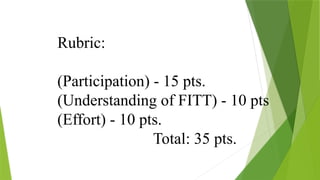
Rubric:
(Participation) - 15 pts.
(Engagement in Discussion) - 10 pts.
(Understanding of FITT) - 10 pts.
Total: 35pts.
30.
EVALUATION:
Directions: Choose theletter that corresponds to the best answer.
Write your answers in your notebook.
1. Jasmine wants to improve her cardiovascular endurance. She decides to jog every morning
for 30 minutes, five times a week. What part of the FITT principle does "five times a week"
refer to?
A. Frequency
B. Intensity
C. Time
D. Type
31.
2. Miguel increaseshis workout from lifting 10-pound weights to 15-pound weights to
challenge his muscles. Which component of the FITT principle is being adjusted?
A. Type
B. Frequency
C. Intensity
D. Time
3. Angela's fitness coach advised her to shift from walking to running to lose weight more
effectively. What FITT component does this change affect?
A. Time
B. Type
C. Frequency
D. Intensity
32.
4. Carlo wantsto tone his muscles. He works out three times a week for 45 minutes each
session, using moderate weights. What part of FITT does “moderate weights” describe?
A. Frequency
B. Intensity
C. Type
D. Time
5. Sofia has been exercising for 20 minutes, and her coach tells her to increase it to 40 minutes
to build endurance. Which part of the FITT principle is being changed?
A. Intensity
B. Frequency
C. Type
D. Time
33.
6. Luis wantsto maintain his current level of fitness. What is the minimum recommended
frequency of cardiovascular exercise per week?
A. Once
B. Twice
C. Three times
D. Seven times
7. Anna attends Zumba classes four times a week to improve her cardiovascular health.
What FITT component is represented by the word “Zumba”?
A. Time
B. Frequency
C. Intensity
D. Type
34.
8. After severalweeks of yoga, Jamal no longer feels challenged. To continue improving,
he adds resistance bands to his routine. What FITT component is this?
A. Frequency
B. Type
C. Intensity
D. Time
9. A PE teacher recommends starting with low-impact aerobics before progressing to more
intense exercises. Which principle supports this advice?
A. Time
B. Frequency
C. Intensity
D. Type
35.
10. Kelly alternatesbetween strength training, cycling, and swimming each week. What
benefit does this variety of exercises provide under FITT?
A. It maintains low intensity
B. It increases frequency
C. It modifies type
D. It reduces time
11. Dan wants to build strength and decides to lift weights for 60 minutes per session, four
times a week. What does “60 minutes” refer to?
A. Type
B. Intensity
C. Time
D. Frequency
36.
12. If abeginner wants to avoid injury, what should they adjust first in the FITT
principle?
A. Intensity
B. Time
C. Type
D. Frequency
13. Pauline runs at a faster pace than usual to improve her stamina. Which FITT
principle is being applied here?
A. Time
B. Intensity
C. Frequency
D. Type
37.
14. The schoolrequired students to perform aerobic activities three times per week. Which
FITT principle is applied in this directive?
A. Type
B. Frequency
C. Time
D. Intensity
15. What should be increased if a person wants longer training sessions for endurance
building?
A. Frequency
B. Intensity
C. Time
D. Type
38.
16. If Anawants to maintain her fitness level without getting bored, which FITT element
should she vary?
A. Intensity
B. Type
C. Time
D. Frequency
17. A 16-year-old student wants to increase muscle mass. He decides to include weight
training every other day. What part of FITT does “every other day” fall under?
A. Frequency
B. Intensity
C. Type
D. Time
39.
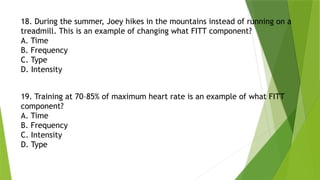
18. During thesummer, Joey hikes in the mountains instead of running on a
treadmill. This is an example of changing what FITT component?
A. Time
B. Frequency
C. Type
D. Intensity
19. Training at 70–85% of maximum heart rate is an example of what FITT
component?
A. Time
B. Frequency
C. Intensity
D. Type
40.
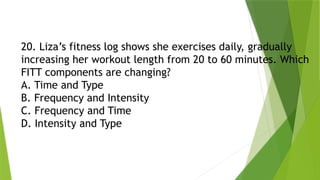
20. Liza’s fitnesslog shows she exercises daily, gradually
increasing her workout length from 20 to 60 minutes. Which
FITT components are changing?
A. Time and Type
B. Frequency and Intensity
C. Frequency and Time
D. Intensity and Type
41.
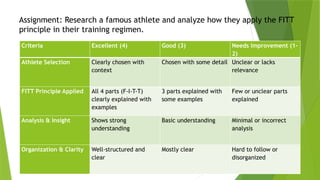
Assignment: Research afamous athlete and analyze how they apply the FITT
principle in their training regimen.
Criteria Excellent (4) Good (3) Needs Improvement (1-
2)
Athlete Selection Clearly chosen with
context
Chosen with some detail Unclear or lacks
relevance
FITT Principle Applied All 4 parts (F-I-T-T)
clearly explained with
examples
3 parts explained with
some examples
Few or unclear parts
explained
Analysis & Insight Shows strong
understanding
Basic understanding Minimal or incorrect
analysis
Organization & Clarity Well-structured and
clear
Mostly clear Hard to follow or
disorganized








![Activity 2: "FITT Circuit Training"[Teaching Strategy: Experiential Learning]
Materials - Exercise mats, cones, stopwatches
Significance - Students will experience firsthand how to apply the FITT principle in a
practical setting.
Instructions :
1) Set up four stations: one for each FITT component (e.g., jumping jacks for Frequency,
squatting for Intensity, planking for Time, and yoga for Type).
2) Divide students into groups, and assign each group to a station for 5 minutes.
3) Rotate groups through each station, ensuring they understand and perform the exercises
related to each FITT component.](https://image.slidesharecdn.com/demopptp-251110085300-63b9b672/85/demo-ppt-p-e-11-pptx-power-point-presentation-24-320.jpg)
![Inclusive Activity 3: "FITT Walk"[Teaching Strategy: Cooperative
Learning]
Materials - None
Significance - This activity promotes inclusivity and allows students to apply
the FITT principle without needing special equipment.
Instructions :
1) Take students for a walk around the school.
2) As you walk, discuss each FITT component, asking students to identify
examples they see (e.g., frequency of walkers, intensity of their pace).
3) Encourage students to suggest different walking paths and activities that fit
the Type component.](https://image.slidesharecdn.com/demopptp-251110085300-63b9b672/85/demo-ppt-p-e-11-pptx-power-point-presentation-28-320.jpg)