B2 EOI CARTAGENA
Isabel Bastida & Ana Mena
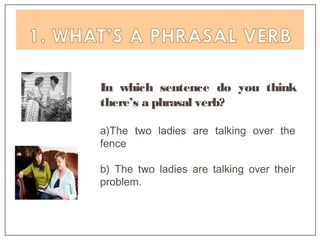
In which sentence do you think
there’s a phrasal verb?
a)The two ladies are talking over the
fence
b) The two ladies are talking over their
problem.
In which sentence do you think
there’s a phrasal verb?
a)The vet put out the dog before the
operation.
b) The vet put the dog out of the cage.
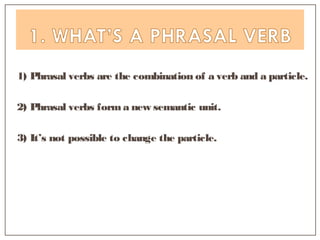
1) Phrasal verbs are the combination of a verb and a particle.
2) Phrasal verbs form a new semantic unit.
3) It’s not possible to change the particle.
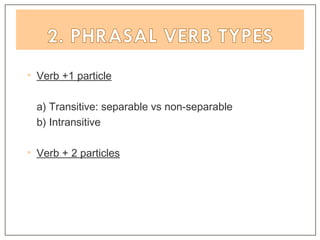
• Verb +1 particle
a) Transitive: separable vs non-separable
b) Intransitive
• Verb + 2 particles
TRANSIVITE SEPARABLE
TRANSITIVE NON-
SEPARABLE
That’s a pack of lies. He
made up the whole story.
He made the whole story
up.
He made it up.
I have never come across a
stolen wallet in the park.
I have never come across it
in the park.
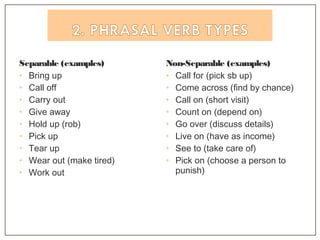
Separable (examples)
• Bring up
• Call off
• Carry out
• Give away
• Hold up (rob)
• Pick up
• Tear up
• Wear out (make tired)
• Work out
Non-Separable (examples)
• Call for (pick sb up)
• Come across (find by chance)
• Call on (short visit)
• Count on (depend on)
• Go over (discuss details)
• Live on (have as income)
• See to (take care of)
• Pick on (choose a person to
punish)
INTRANSTIVE
Oh dear, Mathew has just dozed off and
hasn’t finished his meal.
The Buggs Bunny cartoon is over.
Some phrasal verbs have a transitive use with one
meaning, and
an intransitive use with a different meaning.
Compare:
The plane tookoff (intransitive)
The man tookoff his coat (transitive)
Transitive – Intransitive with different meaning (examples)
• Clear up:
Could you clear up your room? (make tidy, trans.)
The weather is clearing up (improve, intrans.)
• Fill in:
Can you fill in this form, please? (complete, trans.)
Our teacher was ill, so Mrs Frost filled in. (Take someone’s place, intrans.)
• Look up:
I have to look it up in my dictionary. (find information, trans.)
Things are looking up. (appear better, intrans.)
• Make up:
Mary made it all up. (invent, trans.)
They made up, but in ten minutes they made up again. (become friends again)
• Take over:
A German company took us over last year. (buy a company, trans.)
If you feel ill, I’ll take over. (take someone’s place)
• Turn up:
Please, turn up the volume. I love this song! (increase, transitive)
Only ten people turned up at the meeting. (appear, arrive, intrans.)
• Draw up:
My lawyer is drawing up a new contract (write a legal document, trans.)
Suddenly an ambulance drew up in front of us (come to a stop, intrans.)
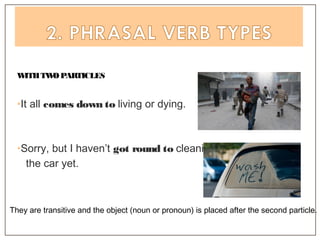
WITHTWOPARTICLES
•It all comes down to living or dying.
•Sorry, but I haven’t got round to cleaning
the car yet.
They are transitive and the object (noun or pronoun) is placed after the second particle.
• Come up with sth (invent)
• Get away with sth (not having a punishment)
• Keep away from sb or sth (avoid)
• Stand up for sth (defend)
• Put up with sb or sth (tolerate)
• Face up to sth (confront)
• Come across as sth (appear to be)
• Cut down on sth (reduce)
• Look up to sb (admire)
• Get back to sth (return)
• Go up to sb (approach)
• Phrasal Verbs are a creative part of the language.
• Formality: Where a phrasal verb has no exact synonym,
e.g. grow up, we can use it in both formal and informal
context. However, when there is a single verb with an
equivalent meaning, the phrasal verb tends to be used in
informal contexts.
• Some phrasal verbs have different meanings and uses.
Make a list up and write down what you need.
Perhaps a refund will make up for the incovenience.
You’ll have to make up your mind soon.
She made up herself and looked stunning, etc.
• It’s difficult forstudents to predict theirmeaning, but…
up (completely), on (continue, connect), down (collapse),
off (disconnect), back (return), out (removal)
DO THE ACTIVITIES IN PAIRS/ GROUPS.

Phrasal verbs b2 ana

  • 1.
    B2 EOI CARTAGENA IsabelBastida & Ana Mena
  • 3.
    In which sentencedo you think there’s a phrasal verb? a)The two ladies are talking over the fence b) The two ladies are talking over their problem.
  • 4.
    In which sentencedo you think there’s a phrasal verb? a)The vet put out the dog before the operation. b) The vet put the dog out of the cage.
  • 5.
    1) Phrasal verbsare the combination of a verb and a particle. 2) Phrasal verbs form a new semantic unit. 3) It’s not possible to change the particle.
  • 6.
    • Verb +1particle a) Transitive: separable vs non-separable b) Intransitive • Verb + 2 particles
  • 7.
    TRANSIVITE SEPARABLE TRANSITIVE NON- SEPARABLE That’sa pack of lies. He made up the whole story. He made the whole story up. He made it up. I have never come across a stolen wallet in the park. I have never come across it in the park.
  • 8.
    Separable (examples) • Bringup • Call off • Carry out • Give away • Hold up (rob) • Pick up • Tear up • Wear out (make tired) • Work out Non-Separable (examples) • Call for (pick sb up) • Come across (find by chance) • Call on (short visit) • Count on (depend on) • Go over (discuss details) • Live on (have as income) • See to (take care of) • Pick on (choose a person to punish)
  • 9.
    INTRANSTIVE Oh dear, Mathewhas just dozed off and hasn’t finished his meal. The Buggs Bunny cartoon is over.
  • 10.
    Some phrasal verbshave a transitive use with one meaning, and an intransitive use with a different meaning. Compare: The plane tookoff (intransitive) The man tookoff his coat (transitive)
  • 11.
    Transitive – Intransitivewith different meaning (examples) • Clear up: Could you clear up your room? (make tidy, trans.) The weather is clearing up (improve, intrans.) • Fill in: Can you fill in this form, please? (complete, trans.) Our teacher was ill, so Mrs Frost filled in. (Take someone’s place, intrans.) • Look up: I have to look it up in my dictionary. (find information, trans.) Things are looking up. (appear better, intrans.) • Make up: Mary made it all up. (invent, trans.) They made up, but in ten minutes they made up again. (become friends again) • Take over: A German company took us over last year. (buy a company, trans.) If you feel ill, I’ll take over. (take someone’s place) • Turn up: Please, turn up the volume. I love this song! (increase, transitive) Only ten people turned up at the meeting. (appear, arrive, intrans.) • Draw up: My lawyer is drawing up a new contract (write a legal document, trans.) Suddenly an ambulance drew up in front of us (come to a stop, intrans.)
  • 12.
    WITHTWOPARTICLES •It all comesdown to living or dying. •Sorry, but I haven’t got round to cleaning the car yet. They are transitive and the object (noun or pronoun) is placed after the second particle.
  • 13.
    • Come upwith sth (invent) • Get away with sth (not having a punishment) • Keep away from sb or sth (avoid) • Stand up for sth (defend) • Put up with sb or sth (tolerate) • Face up to sth (confront) • Come across as sth (appear to be) • Cut down on sth (reduce) • Look up to sb (admire) • Get back to sth (return) • Go up to sb (approach)
  • 14.
    • Phrasal Verbsare a creative part of the language. • Formality: Where a phrasal verb has no exact synonym, e.g. grow up, we can use it in both formal and informal context. However, when there is a single verb with an equivalent meaning, the phrasal verb tends to be used in informal contexts. • Some phrasal verbs have different meanings and uses. Make a list up and write down what you need. Perhaps a refund will make up for the incovenience. You’ll have to make up your mind soon. She made up herself and looked stunning, etc. • It’s difficult forstudents to predict theirmeaning, but… up (completely), on (continue, connect), down (collapse), off (disconnect), back (return), out (removal)
  • 15.
    DO THE ACTIVITIESIN PAIRS/ GROUPS.