

TDC 1
Pedagogical Grammar
Phrasal Verbs
Phrasal Verbs
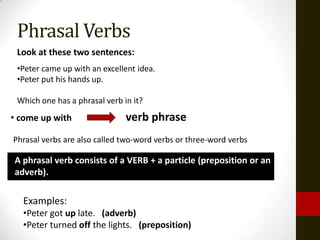
 Look at these two sentences:
 •Peter came up with an excellent idea.
 •Peter put his hands up.

 Which one has a phrasal verb in it?
• come up with                 verb phrase
Phrasal verbs are also called two-word verbs or three-word verbs

A phrasal verb consists of a VERB + a particle (preposition or an
adverb).

  Examples:
  •Peter got up late. (adverb)
  •Peter turned off the lights. (preposition)
ELLs avoidusing phrasalverbs firstbecause they do not know of their
existanceand thenbecause they seem to be more difficult.
Thereis a singleword equivalentto almostall phrasalverbs in the dictionary,
theseequivalentsare oftenof Latinorigin.
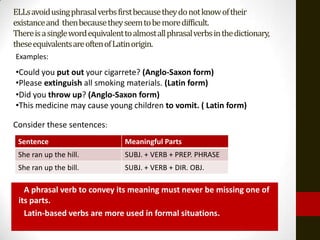
Examples:
•Could you put out your cigarrete? (Anglo-Saxon form)
•Please extinguish all smoking materials. (Latin form)
•Did you throw up? (Anglo-Saxon form)
•This medicine may cause young children to vomit. ( Latin form)

Consider these sentences:
 Sentence                       Meaningful Parts
 She ran up the hill.           SUBJ. + VERB + PREP. PHRASE
 She ran up the bill.           SUBJ. + VERB + DIR. OBJ.

 oA phrasal verb to convey its meaning must never be missing one of
 its parts.
 oLatin-based verbs are more used in formal situations.
Why are phrasal verbs so difficult?
Just like any other verb, phrasal verbs determine the meaning of an entire
sentence. Because very few languages have phrasal verbs, the idea of multiple
words to express one action is hard to assimilate.


a) If you change the particle of a phrasal verb, you change its meaning
completely.


Examples:
• We managed to get our message across. (make other people understand it)
• We found a way to get around our problems. ( to overcome or escape)
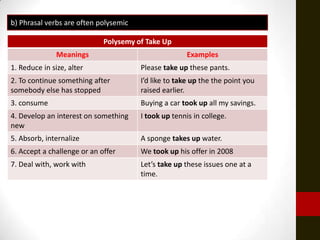
b) Phrasal verbs are often polysemic

                             Polysemy of Take Up
               Meanings                               Examples
1. Reduce in size, alter               Please take up these pants.
2. To continue something after         I’d like to take up the the point you
somebody else has stopped              raised earlier.
3. consume                             Buying a car took up all my savings.
4. Develop an interest on something    I took up tennis in college.
new
5. Absorb, internalize                 A sponge takes up water.
6. Accept a challenge or an offer      We took up his offer in 2008
7. Deal with, work with                Let’s take up these issues one at a
                                       time.
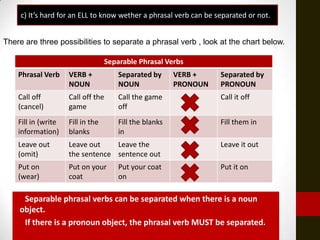
c) It’s hard for an ELL to know wether a phrasal verb can be separated or not.


There are three possibilities to separate a phrasal verb , look at the chart below.

                                   Separable Phrasal Verbs
    Phrasal Verb     VERB +            Separated by      VERB +    Separated by
                     NOUN              NOUN              PRONOUN   PRONOUN
    Call off         Call off the      Call the game               Call it off
    (cancel)         game              off
    Fill in (write   Fill in the       Fill the blanks             Fill them in
    information)     blanks            in
    Leave out        Leave out    Leave the                        Leave it out
    (omit)           the sentence sentence out
    Put on           Put on your       Put your coat               Put it on
    (wear)           coat              on

    oSeparable phrasal verbs can be separated when there is a noun
    object.
    oIf there is a pronoun object, the phrasal verb MUST be separated.
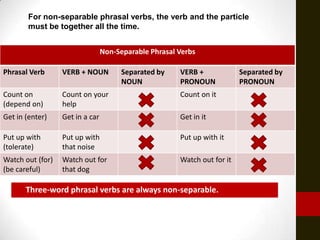
For non-separable phrasal verbs, the verb and the particle
        must be together all the time.


                                 Non-Separable Phrasal Verbs

Phrasal Verb      VERB + NOUN          Separated by    VERB +             Separated by
                                       NOUN            PRONOUN            PRONOUN
Count on          Count on your                        Count on it
(depend on)       help
Get in (enter)    Get in a car                         Get in it

Put up with       Put up with                          Put up with it
(tolerate)        that noise
Watch out (for)   Watch out for                        Watch out for it
(be careful)      that dog

    o Three-word phrasal verbs are always non-separable.
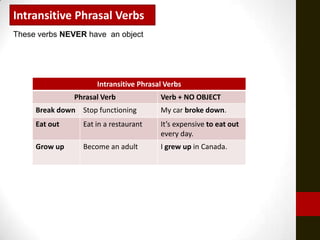
Intransitive Phrasal Verbs
These verbs NEVER have an object


                     Intransitive Phrasal Verbs
               Phrasal Verb             Verb + NO OBJECT
     Break down Stop functioning        My car broke down.
     Eat out     Eat in a restaurant    It’s expensive to eat out
                                        every day.
     Grow up     Become an adult        I grew up in Canada.
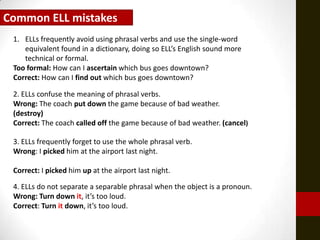
Common ELL mistakes
 1. ELLs frequently avoid using phrasal verbs and use the single-word
    equivalent found in a dictionary, doing so ELL’s English sound more
    technical or formal.
 Too formal: How can I ascertain which bus goes downtown?
 Correct: How can I find out which bus goes downtown?

 2. ELLs confuse the meaning of phrasal verbs.
 Wrong: The coach put down the game because of bad weather.
 (destroy)
 Correct: The coach called off the game because of bad weather. (cancel)

 3. ELLs frequently forget to use the whole phrasal verb.
 Wrong: I picked him at the airport last night.

 Correct: I picked him up at the airport last night.

 4. ELLs do not separate a separable phrasal when the object is a pronoun.
 Wrong: Turn down it, it’s too loud.
 Correct: Turn it down, it’s too loud.
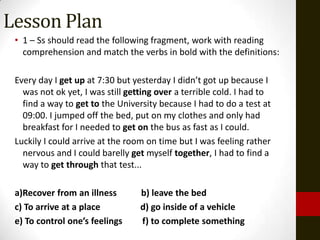
Lesson Plan
 • 1 – Ss should read the following fragment, work with reading
   comprehension and match the verbs in bold with the definitions:

 Every day I get up at 7:30 but yesterday I didn’t got up because I
   was not ok yet, I was still getting over a terrible cold. I had to
   find a way to get to the University because I had to do a test at
   09:00. I jumped off the bed, put on my clothes and only had
   breakfast for I needed to get on the bus as fast as I could.
 Luckily I could arrive at the room on time but I was feeling rather
   nervous and I could barelly get myself together, I had to find a
   way to get through that test...

 a)Recover from an illness        b) leave the bed
 c) To arrive at a place          d) go inside of a vehicle
 e) To control one’s feelings     f) to complete something
• After working with two or three fragments like these, the ss
  will be able to create their own sentences using phrasal verbs.


              The End

Cláudio's PPT - Phrasal Verbs

  • 1.
  • 2.
    Phrasal Verbs Lookat these two sentences: •Peter came up with an excellent idea. •Peter put his hands up. Which one has a phrasal verb in it? • come up with verb phrase Phrasal verbs are also called two-word verbs or three-word verbs A phrasal verb consists of a VERB + a particle (preposition or an adverb). Examples: •Peter got up late. (adverb) •Peter turned off the lights. (preposition)
  • 3.
    ELLs avoidusing phrasalverbsfirstbecause they do not know of their existanceand thenbecause they seem to be more difficult. Thereis a singleword equivalentto almostall phrasalverbs in the dictionary, theseequivalentsare oftenof Latinorigin. Examples: •Could you put out your cigarrete? (Anglo-Saxon form) •Please extinguish all smoking materials. (Latin form) •Did you throw up? (Anglo-Saxon form) •This medicine may cause young children to vomit. ( Latin form) Consider these sentences: Sentence Meaningful Parts She ran up the hill. SUBJ. + VERB + PREP. PHRASE She ran up the bill. SUBJ. + VERB + DIR. OBJ. oA phrasal verb to convey its meaning must never be missing one of its parts. oLatin-based verbs are more used in formal situations.
  • 4.
    Why are phrasalverbs so difficult? Just like any other verb, phrasal verbs determine the meaning of an entire sentence. Because very few languages have phrasal verbs, the idea of multiple words to express one action is hard to assimilate. a) If you change the particle of a phrasal verb, you change its meaning completely. Examples: • We managed to get our message across. (make other people understand it) • We found a way to get around our problems. ( to overcome or escape)
  • 5.
    b) Phrasal verbsare often polysemic Polysemy of Take Up Meanings Examples 1. Reduce in size, alter Please take up these pants. 2. To continue something after I’d like to take up the the point you somebody else has stopped raised earlier. 3. consume Buying a car took up all my savings. 4. Develop an interest on something I took up tennis in college. new 5. Absorb, internalize A sponge takes up water. 6. Accept a challenge or an offer We took up his offer in 2008 7. Deal with, work with Let’s take up these issues one at a time.
  • 6.
    c) It’s hardfor an ELL to know wether a phrasal verb can be separated or not. There are three possibilities to separate a phrasal verb , look at the chart below. Separable Phrasal Verbs Phrasal Verb VERB + Separated by VERB + Separated by NOUN NOUN PRONOUN PRONOUN Call off Call off the Call the game Call it off (cancel) game off Fill in (write Fill in the Fill the blanks Fill them in information) blanks in Leave out Leave out Leave the Leave it out (omit) the sentence sentence out Put on Put on your Put your coat Put it on (wear) coat on oSeparable phrasal verbs can be separated when there is a noun object. oIf there is a pronoun object, the phrasal verb MUST be separated.
  • 7.
    For non-separable phrasalverbs, the verb and the particle must be together all the time. Non-Separable Phrasal Verbs Phrasal Verb VERB + NOUN Separated by VERB + Separated by NOUN PRONOUN PRONOUN Count on Count on your Count on it (depend on) help Get in (enter) Get in a car Get in it Put up with Put up with Put up with it (tolerate) that noise Watch out (for) Watch out for Watch out for it (be careful) that dog o Three-word phrasal verbs are always non-separable.
  • 8.
    Intransitive Phrasal Verbs Theseverbs NEVER have an object Intransitive Phrasal Verbs Phrasal Verb Verb + NO OBJECT Break down Stop functioning My car broke down. Eat out Eat in a restaurant It’s expensive to eat out every day. Grow up Become an adult I grew up in Canada.
  • 9.
    Common ELL mistakes 1. ELLs frequently avoid using phrasal verbs and use the single-word equivalent found in a dictionary, doing so ELL’s English sound more technical or formal. Too formal: How can I ascertain which bus goes downtown? Correct: How can I find out which bus goes downtown? 2. ELLs confuse the meaning of phrasal verbs. Wrong: The coach put down the game because of bad weather. (destroy) Correct: The coach called off the game because of bad weather. (cancel) 3. ELLs frequently forget to use the whole phrasal verb. Wrong: I picked him at the airport last night. Correct: I picked him up at the airport last night. 4. ELLs do not separate a separable phrasal when the object is a pronoun. Wrong: Turn down it, it’s too loud. Correct: Turn it down, it’s too loud.
  • 10.
    Lesson Plan •1 – Ss should read the following fragment, work with reading comprehension and match the verbs in bold with the definitions: Every day I get up at 7:30 but yesterday I didn’t got up because I was not ok yet, I was still getting over a terrible cold. I had to find a way to get to the University because I had to do a test at 09:00. I jumped off the bed, put on my clothes and only had breakfast for I needed to get on the bus as fast as I could. Luckily I could arrive at the room on time but I was feeling rather nervous and I could barelly get myself together, I had to find a way to get through that test... a)Recover from an illness b) leave the bed c) To arrive at a place d) go inside of a vehicle e) To control one’s feelings f) to complete something
  • 11.
    • After workingwith two or three fragments like these, the ss will be able to create their own sentences using phrasal verbs. The End