HOW TO WRITE A PERSONAL
NARRATIVE
Isabel Bastida & Ana Mena
PERSONAL NARRATIVES
• Personal narratives share a personal
experience in order to get an emotional
reaction
• A personal narrative is a story about
yourself
Common characteristics
• It’s usually told in 1st person (I, me, we, us,…)
• You are telling a story that happened to YOU (main
character)
• It focuses on only ONE event / memory/ incident in your
life. Do NOT tell your whole life story!
• The writer must express his/her feelings and emotions so
the reader can feel the same.
• It develops in chronological order.
• The use of transition words of time and place are frequent
to help the reader understand your story at every single
point.
LAYOUT
• Stick to the before the event, event, after the event formula.
- INTRO : Background info, context and characters.
What? Who? When? Where?
Grab the reader’s attention.
- BODY : Event and after the event.
- CONCLUSION : Connection to present
Final resolution, feeling
• Make sure your story has a point and connect it to the present.
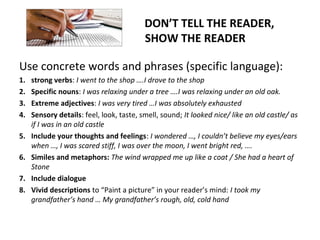
DON’T TELL THE READER,
SHOW THE READER
Use concrete words and phrases (specific language):
1. strong verbs: I went to the shop ….I drove to the shop
2. Specific nouns: I was relaxing under a tree ….I was relaxing under an old oak.
3. Extreme adjectives: I was very tired …I was absolutely exhausted
4. Sensory details: feel, look, taste, smell, sound; It looked nice/ like an old castle/ as
if I was in an old castle
5. Include your thoughts and feelings: I wondered …, I couldn’t believe my eyes/ears
when …, I was scared stiff, I was over the moon, I went bright red, ….
6. Similes and metaphors: The wind wrapped me up like a coat / She had a heart of
Stone
7. Include dialogue
8. Vivid descriptions to “Paint a picture” in your reader’s mind: I took my
grandfather’s hand … My grandfather’s rough, old, cold hand
FINAL TIPS
• BE CONSISTENT: be careful with tenses. You
are telling a story from the past so don’t mix
past and present tenses.
• Use TRANSITION words: before, after, as soon
as, while, just after lunch, suddenly, …
• Stick to your story
• Make the reader feel, see, hear, touch, smell
…what you felt, saw, heard, touched, smelt…
• Use specific language.
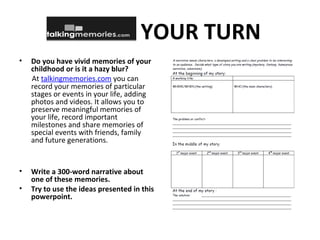
YOUR TURN
• Do you have vivid memories of your
childhood or is it a hazy blur?
At talkingmemories.com you can
record your memories of particular
stages or events in your life, adding
photos and videos. It allows you to
preserve meaningful memories of
your life, record important
milestones and share memories of
special events with friends, family
and future generations.
• Write a 300-word narrative about
one of these memories.
• Try to use the ideas presented in this
powerpoint.

Writing a narrative ana

  • 1.
    HOW TO WRITEA PERSONAL NARRATIVE Isabel Bastida & Ana Mena
  • 2.
    PERSONAL NARRATIVES • Personalnarratives share a personal experience in order to get an emotional reaction • A personal narrative is a story about yourself
  • 3.
    Common characteristics • It’susually told in 1st person (I, me, we, us,…) • You are telling a story that happened to YOU (main character) • It focuses on only ONE event / memory/ incident in your life. Do NOT tell your whole life story! • The writer must express his/her feelings and emotions so the reader can feel the same. • It develops in chronological order. • The use of transition words of time and place are frequent to help the reader understand your story at every single point.
  • 4.
    LAYOUT • Stick tothe before the event, event, after the event formula. - INTRO : Background info, context and characters. What? Who? When? Where? Grab the reader’s attention. - BODY : Event and after the event. - CONCLUSION : Connection to present Final resolution, feeling • Make sure your story has a point and connect it to the present.
  • 5.
    DON’T TELL THEREADER, SHOW THE READER Use concrete words and phrases (specific language): 1. strong verbs: I went to the shop ….I drove to the shop 2. Specific nouns: I was relaxing under a tree ….I was relaxing under an old oak. 3. Extreme adjectives: I was very tired …I was absolutely exhausted 4. Sensory details: feel, look, taste, smell, sound; It looked nice/ like an old castle/ as if I was in an old castle 5. Include your thoughts and feelings: I wondered …, I couldn’t believe my eyes/ears when …, I was scared stiff, I was over the moon, I went bright red, …. 6. Similes and metaphors: The wind wrapped me up like a coat / She had a heart of Stone 7. Include dialogue 8. Vivid descriptions to “Paint a picture” in your reader’s mind: I took my grandfather’s hand … My grandfather’s rough, old, cold hand
  • 6.
    FINAL TIPS • BECONSISTENT: be careful with tenses. You are telling a story from the past so don’t mix past and present tenses. • Use TRANSITION words: before, after, as soon as, while, just after lunch, suddenly, … • Stick to your story • Make the reader feel, see, hear, touch, smell …what you felt, saw, heard, touched, smelt… • Use specific language.
  • 7.
    YOUR TURN • Doyou have vivid memories of your childhood or is it a hazy blur? At talkingmemories.com you can record your memories of particular stages or events in your life, adding photos and videos. It allows you to preserve meaningful memories of your life, record important milestones and share memories of special events with friends, family and future generations. • Write a 300-word narrative about one of these memories. • Try to use the ideas presented in this powerpoint.