Isabel Bastida & Ana Mena
Nivel Avanzado C1
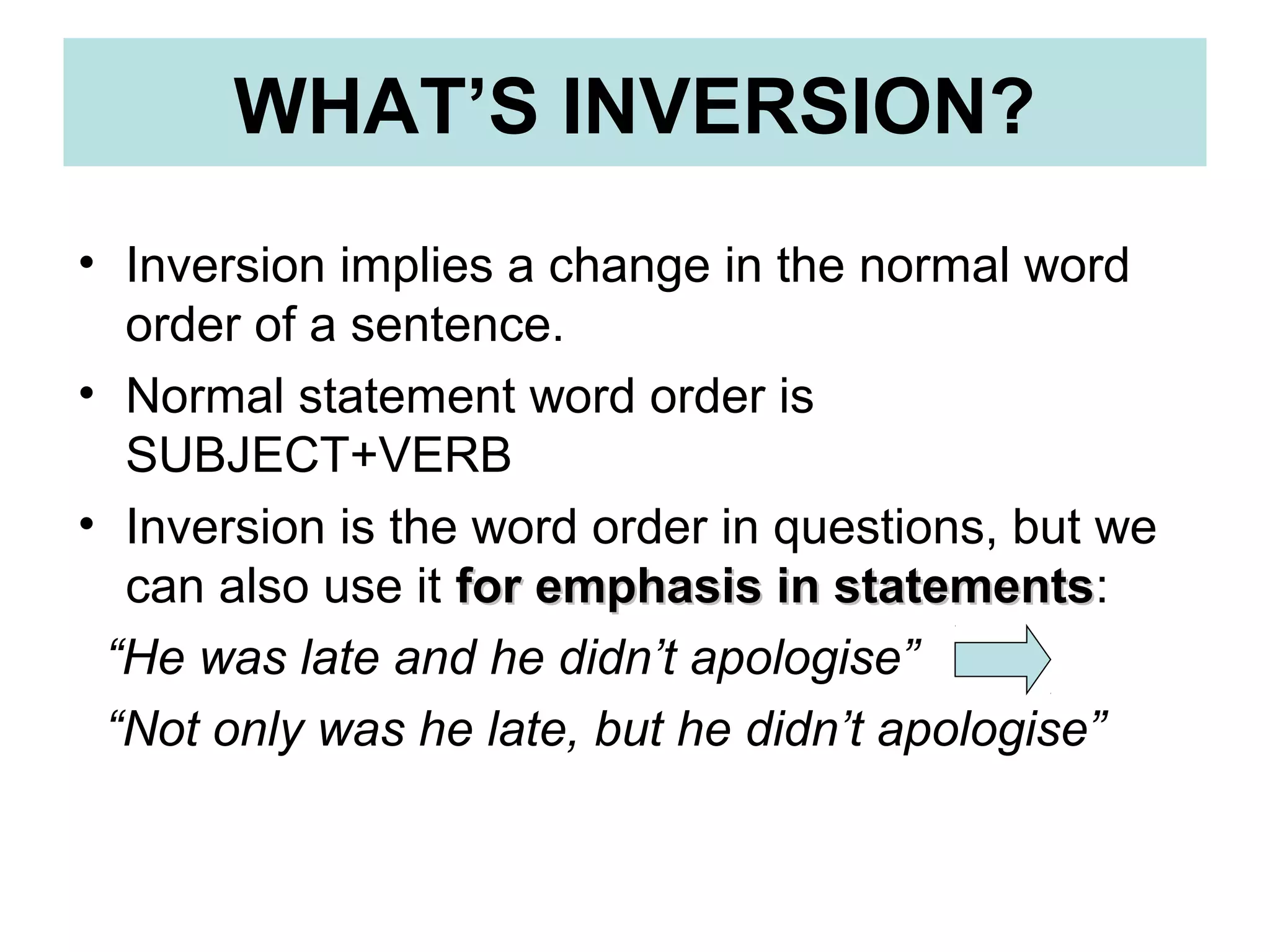
WHAT’S INVERSION?
• Inversion implies a change in the normal word
order of a sentence.
• Normal statement word order is
SUBJECT+VERB
• Inversion is the word order in questions, but we
can also use it for emphasis in statementsfor emphasis in statements:
“He was late and he didn’t apologise”
“Not only was he late, but he didn’t apologise”
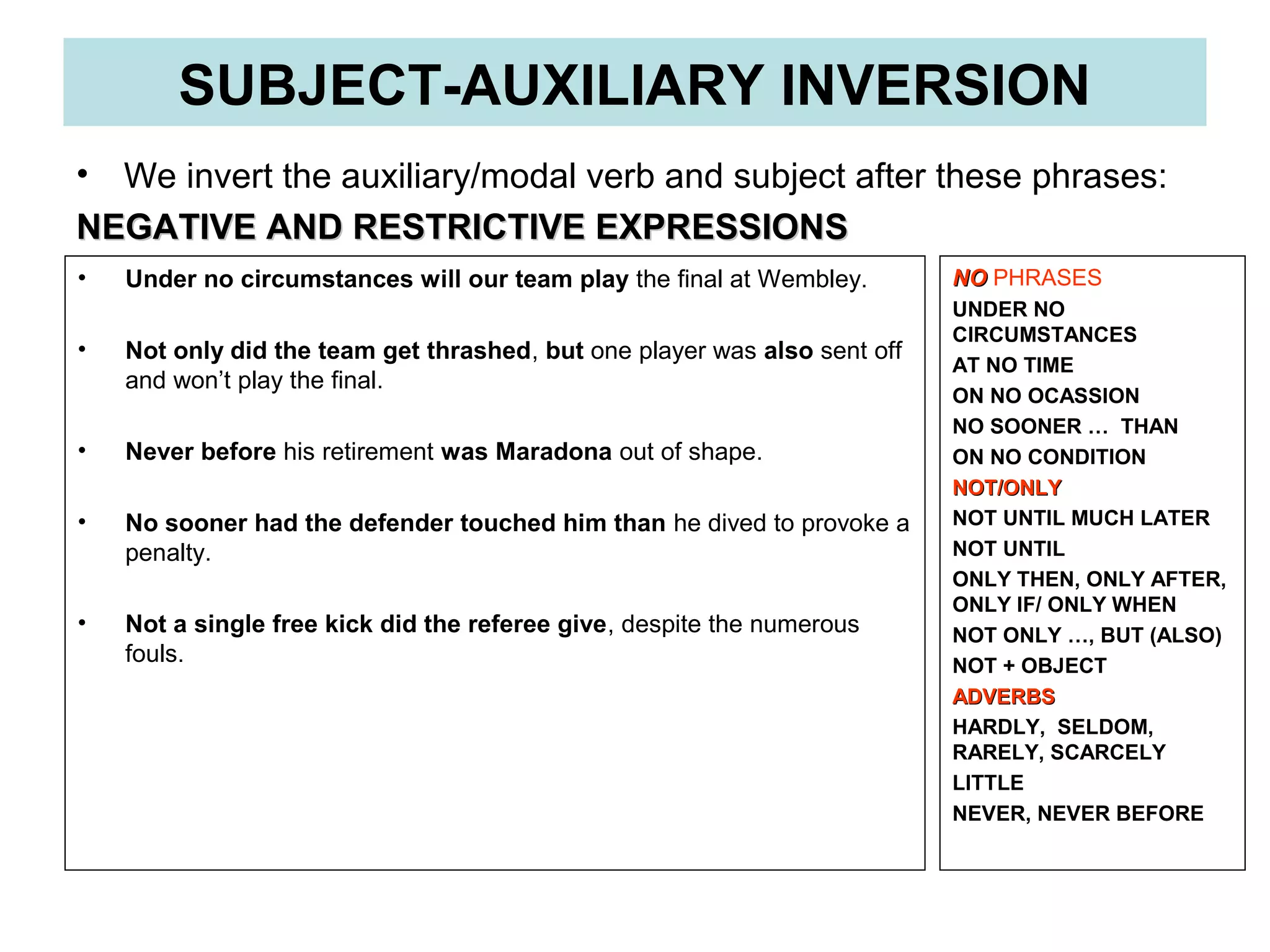
SUBJECT-AUXILIARY INVERSION
• We invert the auxiliary/modal verb and subject after these phrases:
NEGATIVE AND RESTRICTIVE EXPRESSIONSNEGATIVE AND RESTRICTIVE EXPRESSIONS
• Under no circumstances will our team play the final at Wembley.
• Not only did the team get thrashed, but one player was also sent off
and won’t play the final.
• Never before his retirement was Maradona out of shape.
• No sooner had the defender touched him than he dived to provoke a
penalty.
• Not a single free kick did the referee give, despite the numerous
fouls.
NONO PHRASES
UNDER NO
CIRCUMSTANCES
AT NO TIME
ON NO OCASSION
NO SOONER … THAN
ON NO CONDITION
NOT/ONLYNOT/ONLY
NOT UNTIL MUCH LATER
NOT UNTIL
ONLY THEN, ONLY AFTER,
ONLY IF/ ONLY WHEN
NOT ONLY …, BUT (ALSO)
NOT + OBJECT
ADVERBSADVERBS
HARDLY, SELDOM,
RARELY, SCARCELY
LITTLE
NEVER, NEVER BEFORE
CLAUSES BEGINNING WITHCLAUSES BEGINNING WITH
“NEITHER / NOR/ SO”“NEITHER / NOR/ SO”
• My husband is totally uncoordinated and so am I.
• She would never give up trekking, and neither would
her boyfriend.
• I couldn’t finish the race nor could my other team
mates.
• (express agreement)
A: I have never been to New York.
B: Neither have I.
A: That’s why I’m really looking forward to it!
B: So am I!
CLAUSES BEGINNING WITHCLAUSES BEGINNING WITH MAYMAY
(STRONG WISH)(STRONG WISH)
May he live to regret that decision!
May your dreams come true.
SUBJECT-VERB INVERSION
• We occasionally invert a main verb and subject
after prepositional phrases, adverbs of place
and adverbs of time. We can use a form of the
verb to be or verbs of place and movement
before the subject:
 Here lies the body of our beloved Frank.
 All along the wall climbed a beautiful white cat.
 For the first hour the teams seemed evenly matched.
Then came the turning point as Ed scored.
(we don’t use inversion when the subject is a pronoun)
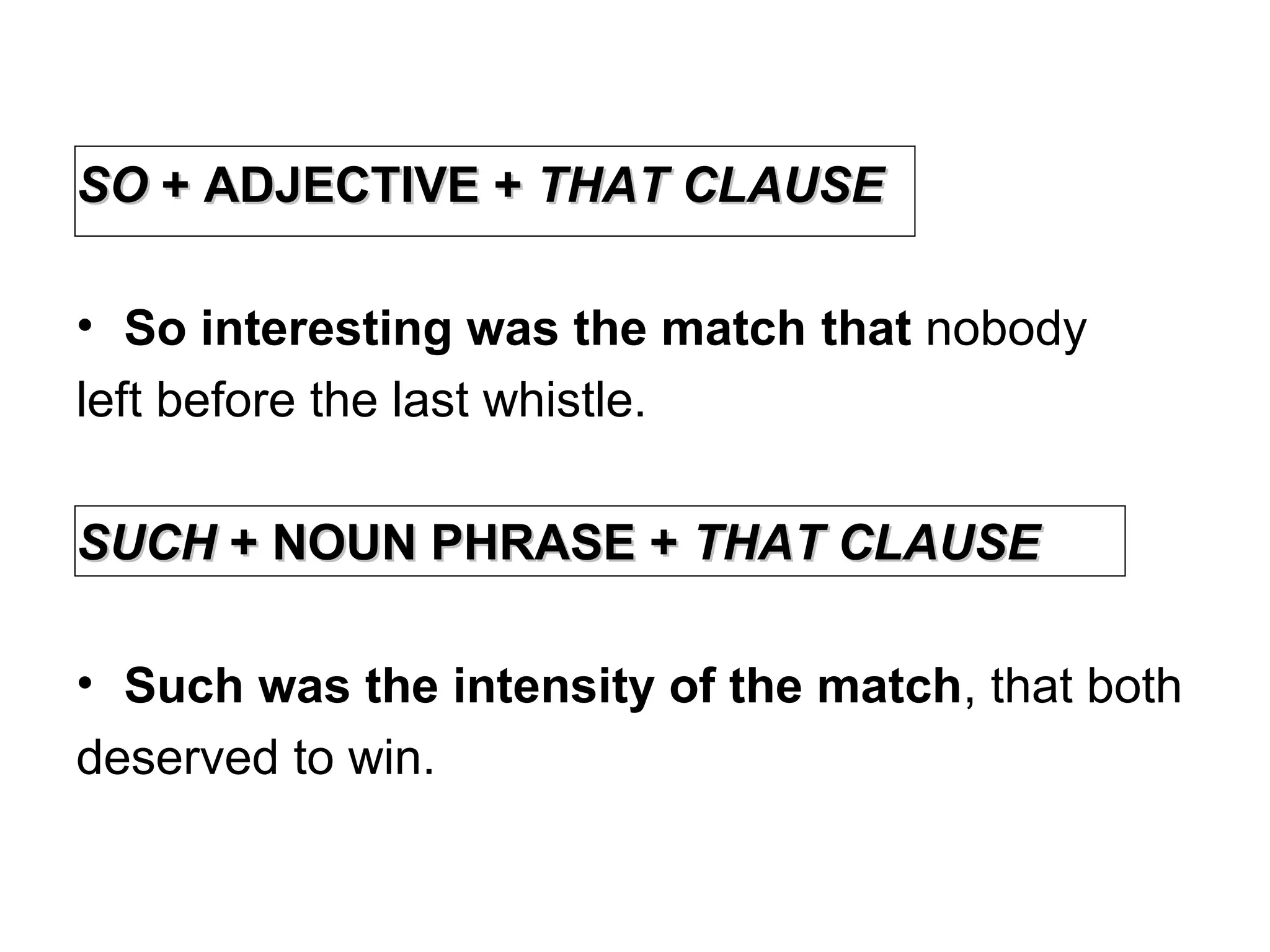
SOSO + ADJECTIVE ++ ADJECTIVE + THAT CLAUSETHAT CLAUSE
• So interesting was the match that nobody
left before the last whistle.
SUCHSUCH + NOUN PHRASE ++ NOUN PHRASE + THAT CLAUSETHAT CLAUSE
• Such was the intensity of the match, that both
deserved to win.
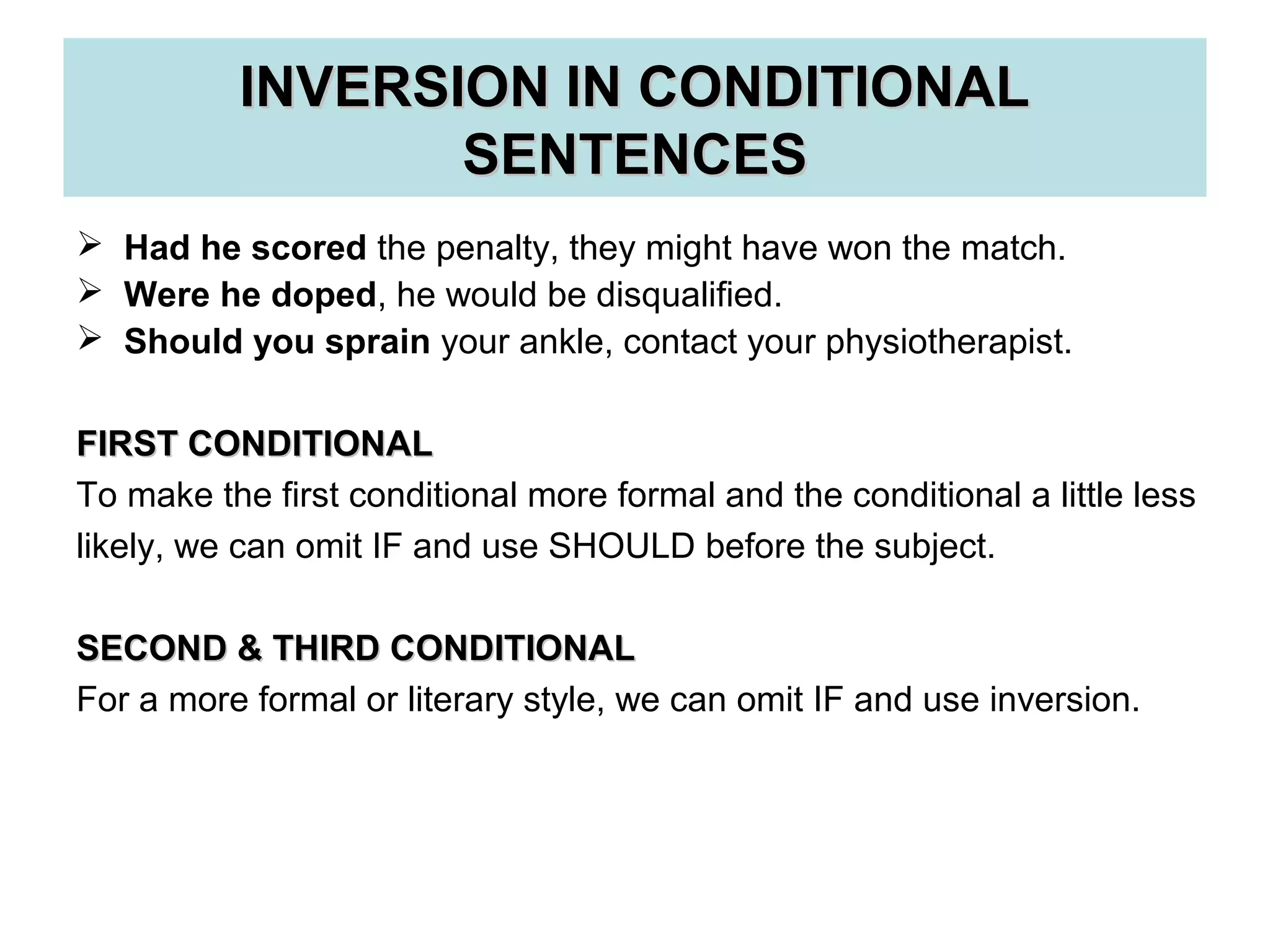
INVERSION IN CONDITIONALINVERSION IN CONDITIONAL
SENTENCESSENTENCES
 Had he scored the penalty, they might have won the match.
 Were he doped, he would be disqualified.
 Should you sprain your ankle, contact your physiotherapist.
FIRST CONDITIONALFIRST CONDITIONAL
To make the first conditional more formal and the conditional a little less
likely, we can omit IF and use SHOULD before the subject.
SECOND & THIRD CONDITIONALSECOND & THIRD CONDITIONAL
For a more formal or literary style, we can omit IF and use inversion.

Inversions c1

  • 1.
    Isabel Bastida &Ana Mena Nivel Avanzado C1
  • 2.
    WHAT’S INVERSION? • Inversionimplies a change in the normal word order of a sentence. • Normal statement word order is SUBJECT+VERB • Inversion is the word order in questions, but we can also use it for emphasis in statementsfor emphasis in statements: “He was late and he didn’t apologise” “Not only was he late, but he didn’t apologise”
  • 3.
    SUBJECT-AUXILIARY INVERSION • Weinvert the auxiliary/modal verb and subject after these phrases: NEGATIVE AND RESTRICTIVE EXPRESSIONSNEGATIVE AND RESTRICTIVE EXPRESSIONS • Under no circumstances will our team play the final at Wembley. • Not only did the team get thrashed, but one player was also sent off and won’t play the final. • Never before his retirement was Maradona out of shape. • No sooner had the defender touched him than he dived to provoke a penalty. • Not a single free kick did the referee give, despite the numerous fouls. NONO PHRASES UNDER NO CIRCUMSTANCES AT NO TIME ON NO OCASSION NO SOONER … THAN ON NO CONDITION NOT/ONLYNOT/ONLY NOT UNTIL MUCH LATER NOT UNTIL ONLY THEN, ONLY AFTER, ONLY IF/ ONLY WHEN NOT ONLY …, BUT (ALSO) NOT + OBJECT ADVERBSADVERBS HARDLY, SELDOM, RARELY, SCARCELY LITTLE NEVER, NEVER BEFORE
  • 4.
    CLAUSES BEGINNING WITHCLAUSESBEGINNING WITH “NEITHER / NOR/ SO”“NEITHER / NOR/ SO” • My husband is totally uncoordinated and so am I. • She would never give up trekking, and neither would her boyfriend. • I couldn’t finish the race nor could my other team mates. • (express agreement) A: I have never been to New York. B: Neither have I. A: That’s why I’m really looking forward to it! B: So am I!
  • 5.
    CLAUSES BEGINNING WITHCLAUSESBEGINNING WITH MAYMAY (STRONG WISH)(STRONG WISH) May he live to regret that decision! May your dreams come true.
  • 6.
    SUBJECT-VERB INVERSION • Weoccasionally invert a main verb and subject after prepositional phrases, adverbs of place and adverbs of time. We can use a form of the verb to be or verbs of place and movement before the subject:  Here lies the body of our beloved Frank.  All along the wall climbed a beautiful white cat.  For the first hour the teams seemed evenly matched. Then came the turning point as Ed scored. (we don’t use inversion when the subject is a pronoun)
  • 7.
    SOSO + ADJECTIVE++ ADJECTIVE + THAT CLAUSETHAT CLAUSE • So interesting was the match that nobody left before the last whistle. SUCHSUCH + NOUN PHRASE ++ NOUN PHRASE + THAT CLAUSETHAT CLAUSE • Such was the intensity of the match, that both deserved to win.
  • 8.
    INVERSION IN CONDITIONALINVERSIONIN CONDITIONAL SENTENCESSENTENCES  Had he scored the penalty, they might have won the match.  Were he doped, he would be disqualified.  Should you sprain your ankle, contact your physiotherapist. FIRST CONDITIONALFIRST CONDITIONAL To make the first conditional more formal and the conditional a little less likely, we can omit IF and use SHOULD before the subject. SECOND & THIRD CONDITIONALSECOND & THIRD CONDITIONAL For a more formal or literary style, we can omit IF and use inversion.