TRANSPORT &
ACCOMMODATION
C1
Ana Mena
WHERE WOULD YOU LIKE TO STAY?
HOW CAN YOU GET THERE?
How many ways of getting
around can you think of?
Make a list.
Look at your list. Which form of
transport...:
 is the cheapest?
 is the most stressful?
 is the most relaxing?
 is the fastest?
 lets you see the most?
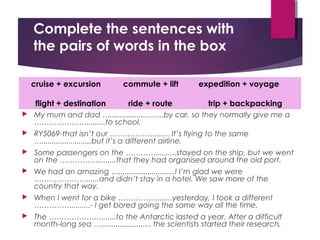
Complete the sentences with
the pairs of words in the box
 My mum and dad …..........................by car, so they normally give me a
………………….........to school.
 RY5069-that isn’t our ………………....... It’s flying to the same
…........................but it’s a different airline.
 Some passengers on the …………..........stayed on the ship, but we went
on the …………….........that they had organised around the old port.
 We had an amazing …...........................! I’m glad we were
…………………......and didn’t stay in a hotel. We saw more of the
country that way.
 When I went for a bike ……………........yesterday, I took a different
…………….........- I get bored going the same way all the time.
 The ………………….......to the Antarctic lasted a year. After a difficult
month-long sea …........................ the scientists started their research.
cruise + excursion commute + lift expedition + voyage
flight + destination ride + route trip + backpacking
Cross out the item in the list that does NOT
collocate with the verb(s)
 Catch / Miss the bus, the train, my car
 Get home, lost, school, from A to B
 Get on/ off the bus, the car, the train, the plane
 Get to know the city, your way around, a trip
 Get to work, home, school
 Go for a trip, a bike ride, a drive
 Go on a flight, a journey, a travel, a trip, an expedition, a cruise
 Take a taxi, an hour, ten kilometres, public transport
What are the main problems with modern transport
systems- cars, buses, underground trains, air travel,
bikes, trains? Discuss the following:
 Traffic congestion
 Delays
 High cost
 Lack of comfort
 Poor connections
 Safety
 Others
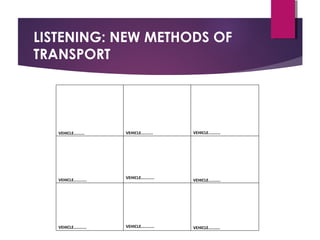
LISTENING: NEW METHODS OF
TRANSPORT
VEHICLE......... VEHICLE.......... VEHICLE..........
VEHICLE...........
VEHICLE...........
VEHICLE..........
VEHICLE…........ VEHICLE........... VEHICLE….......
Match one sentence to one vehicle.
There are two extra sentences you don’t
have to use.
VEHICLE
A. 1
.
This is a vehicle for those who enjoy reaching place in a fast and weird way.
B. 2
.
This vehicle is only available for pre-order.
C. 3
.
It’s a very light vehicle.
D. 4
.
This vehicle includes some sounds.
E. 5
.
You can see this vehicle in a sci-fi movie.
F. 6
.
This vehicle can lift into the air with the help of magnets.
G. 7
.
This vehicle was designed and developed by a young Chinese man.
H. 8
.
You can use this vehicle on different surfaces, including stones.
I. 9
.
It may take time to master this vehicle.
J. 1
0
.
This vehicle couldn’t be purchased till 2017.
K. 1
1
.
It’s a very quiet vehicle.
Discuss these questions
 What do you think of these new methods of
transportation? Which one would you like/ would
never dare to try?
 Do you think these new ways of getting around can
solve the problems discussed in act.5 (traffic
congestion, delays, high cost …)?
USEFUL LANGUAGE: ADVANTAGES
AND DISADVANTAGES
ADVANTAGES DISADVANTAGES
The main benefit/ upside/ argument for /
positive aspect …..
A great/ major/ big disadvantage …..
A significant plus …. The main argument against ….
An overwhelming merit …. A potential minus ….
What I do like about …. A comparatively minor drawback …
The best think about … One of the cons ….
Looking on the bright side …. Worst of all …..
By far the greatest selling point … The only disadvantage …
I wouldn’t mind staying …. I won’t be bothered to …
Adding:
“Moreover, Furthermore, In addition Additionally, …”
Switching to the other side of the argument:
“On the other hand, On the other side of the coin, As for, Moving
onto, …”
 
 There are many different types of accommodation.
 Think of the advantages and disadvantages of
each type.
 Which would you choose? Why?
 Hotels provide private serviced rooms for guests. They
range from very basic budget-style to extremely
luxurious accommodation.
 Hostels (often referred to as "youth hostels" or
"backpackers") are a form of guesthouse, generally low-
budget compared to other places to sleep. Although
often used by youth there is usually no upper age limit
 Capsule hotels are a cheap form of accommodation
in Japan, usually more or less on par with a dorm bed in
a hostel, in terms of pricing. The "rooms" are little more
than small one-person capsules with only a mattress,
radio, and TV.
 Note that most capsule hotels are segregated by
gender, while many, if not most, don't accept female
guests at all.
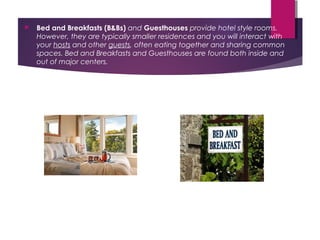
 Bed and Breakfasts (B&Bs) and Guesthouses provide hotel style rooms.
However, they are typically smaller residences and you will interact with
your hosts and other guests, often eating together and sharing common
spaces. Bed and Breakfasts and Guesthouses are found both inside and
out of major centers.
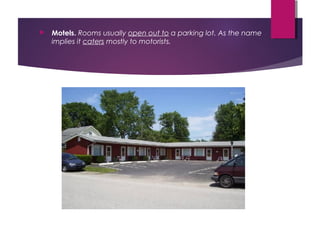
 Motels. Rooms usually open out to a parking lot. As the name
implies it caters mostly to motorists.
 A hospitality exchange or home stay network is an organization that
connects travellers with local residents in the cities they're visiting. If
travellers can connect with the right people at the right time, they can get
room and sometimes board in the place they're visiting for free or at a
deep discount. Network size goes from a few thousands to a hundred
thousands, and most networks are growing steadily.
 Serviced apartments offer the comfort, privacy and flexibility of
a self-catering property, combined with a city centre location
and often with the added benefits of many hotel-type services
– such as maid service, room service and reception.
 Holiday villages/ resorts. With pools, sports centres, evening
entertainment, and many other activities you can’t help but have fun.
Many also have a ‘Kids Club’, so Mum and Dad can relax a little more
during their stay. From the more traditional holiday camps, to the
modern climate-controlled sites, they are a great way of combining
accommodation with on-site leisure facilities and entertainment.
 Car camping, Caravanning, RV camping... it goes by many names, and the
experience varies widely, but this form of camping involves carrying your
equipment in your motor vehicle, which you drive right to your campsite. Unlike
more traditional camping, car camping allows you to carry quite a bit more
equipment, and the focus is usually to enjoy the site, cook-outs, day hikes, and
other outdoor activities
 Camping is do-it-yourself accommodation: you carry your roof
and your bedding in your backpack or your car. It's often the
only choice of accommodation you have when you're
travelling off the beaten track, but there are also very popular
sites for camping holidays.
 Vacation rentals. Many residents of popular tourist destinations
lease their houses and apartments to vacationers. The
residence may have been bought specifically for this purpose
or the normal occupants may vacate it during some parts of
the year.
Discuss these questions
 Can you think of any other types of accommodation?
 Which ones have you stayed in?
 Which is the weirdest place you’ve ever stayed in?
Have you ever had any problems with …
 hotels?
 renting accommodation?
 sharing a room/ flat?
 any other kinds of accommodation?
What happened?
Did you manage to solve the problem? How?
USEFUL LANGUAGE:
RECOMMENDING
Recommending things Not recommending things
It’s probably better to…
I’d recommend…
You should definitely see…
That’s worth seeing.
You really must go to…
… is a must.
It’s the best place to…
You can’t miss…
You should .../could ....
You’re best / better off staying...
Don’t go to…
It isn’t worth visiting.
Don’t …
I wouldn’t…
I don’t think it’s a good idea…
It’s not the best way to…
I can’t be bothered to…
…. is too expensive for my liking.
It’s definitely a tourist trap.
In terms of……… / If you want to ………/ As far as ….. is concerned/
When it comes to getting around ….
ACCOMMODATION WANTED
 Chiara and Philippo: They are university students from Italy. They are planning to
spend some days in London. They would like to find low-budget accommodation for
their stay. They are planning to leave their accommodation early in the morning and
go back in the evening hours after exploring the most famous sites.
 Jim and Julia: They are getting married next summer. They would love to spend their
honeymoon on a tropical island. Money doesn’t count since her parents are paying
for the trip.
 Allison: A sales rep. She travels around the country by car selling beauty products.
Next week she is going on a longer business trip and wants to find some cheap
accommodation where she can stay for a night. Parking services is very important
for her.
 Peter and Susan: they have two children, aged 8 and 10, and are planning to go on
a low-budget weekend. They would like to stay close to nature and spend the
weekend hiking and fishing
 Adam and Emma: They are university students, and in the summer they want to go
on a backpacking tour around Europe. As they have a limited budget, they would
like to find a cheap type of accommodation in each city they stop over. They want
to meet young people from all over the world.
 Kyle and Samantha: They are a young couple of top managers. They would like to
spend a weekend somewhere either in the countryside or near the sea. They want
to have their privacy and relax after long months of work at the office.
USEFUL LANGUAGE:
PREFERENCE AND CHOICE
GENERAL PREFERENCES
 On the whole, I prefer sightseeing …...sunbathing.
 
 Personally, I like secluded coves rather ….... crowded beaches.
MAKING A CHOICE
 I think I’d rather go out …...stay in tonight.
 
 On balance, I’d prefer to travel alone …...than go on a coach tour.
LIKE
 
DISLIKE
 It’s right up my street.
 
 It’s my dream destination.
 
 It’s on my list.
 
 It really floats my boat.
 
 It sounds exciting. I’ll give it a go!
 It’s not my cup of tea.
 
 I don’t see the appeal of …
 
 It just doesn’t do it for me.
 
 It isn’t really my thing.
 
 It’s a big no-no for me.
 
 
Other expressions:
Which one do you prefer? Why?

Transport and accommodation

  • 1.
    TRANSPORT & ACCOMMODATION C1 Ana Mena WHEREWOULD YOU LIKE TO STAY? HOW CAN YOU GET THERE?
  • 2.
    How many waysof getting around can you think of? Make a list.
  • 3.
    Look at yourlist. Which form of transport...:  is the cheapest?  is the most stressful?  is the most relaxing?  is the fastest?  lets you see the most?
  • 4.
    Complete the sentenceswith the pairs of words in the box  My mum and dad …..........................by car, so they normally give me a ………………….........to school.  RY5069-that isn’t our ………………....... It’s flying to the same …........................but it’s a different airline.  Some passengers on the …………..........stayed on the ship, but we went on the …………….........that they had organised around the old port.  We had an amazing …...........................! I’m glad we were …………………......and didn’t stay in a hotel. We saw more of the country that way.  When I went for a bike ……………........yesterday, I took a different …………….........- I get bored going the same way all the time.  The ………………….......to the Antarctic lasted a year. After a difficult month-long sea …........................ the scientists started their research. cruise + excursion commute + lift expedition + voyage flight + destination ride + route trip + backpacking
  • 5.
    Cross out theitem in the list that does NOT collocate with the verb(s)  Catch / Miss the bus, the train, my car  Get home, lost, school, from A to B  Get on/ off the bus, the car, the train, the plane  Get to know the city, your way around, a trip  Get to work, home, school  Go for a trip, a bike ride, a drive  Go on a flight, a journey, a travel, a trip, an expedition, a cruise  Take a taxi, an hour, ten kilometres, public transport
  • 6.
    What are themain problems with modern transport systems- cars, buses, underground trains, air travel, bikes, trains? Discuss the following:  Traffic congestion  Delays  High cost  Lack of comfort  Poor connections  Safety  Others
  • 7.
    LISTENING: NEW METHODSOF TRANSPORT VEHICLE......... VEHICLE.......... VEHICLE.......... VEHICLE........... VEHICLE........... VEHICLE.......... VEHICLE…........ VEHICLE........... VEHICLE….......
  • 8.
    Match one sentenceto one vehicle. There are two extra sentences you don’t have to use. VEHICLE A. 1 . This is a vehicle for those who enjoy reaching place in a fast and weird way. B. 2 . This vehicle is only available for pre-order. C. 3 . It’s a very light vehicle. D. 4 . This vehicle includes some sounds. E. 5 . You can see this vehicle in a sci-fi movie. F. 6 . This vehicle can lift into the air with the help of magnets. G. 7 . This vehicle was designed and developed by a young Chinese man. H. 8 . You can use this vehicle on different surfaces, including stones. I. 9 . It may take time to master this vehicle. J. 1 0 . This vehicle couldn’t be purchased till 2017. K. 1 1 . It’s a very quiet vehicle.
  • 9.
    Discuss these questions What do you think of these new methods of transportation? Which one would you like/ would never dare to try?  Do you think these new ways of getting around can solve the problems discussed in act.5 (traffic congestion, delays, high cost …)?
  • 10.
    USEFUL LANGUAGE: ADVANTAGES ANDDISADVANTAGES ADVANTAGES DISADVANTAGES The main benefit/ upside/ argument for / positive aspect ….. A great/ major/ big disadvantage ….. A significant plus …. The main argument against …. An overwhelming merit …. A potential minus …. What I do like about …. A comparatively minor drawback … The best think about … One of the cons …. Looking on the bright side …. Worst of all ….. By far the greatest selling point … The only disadvantage … I wouldn’t mind staying …. I won’t be bothered to … Adding: “Moreover, Furthermore, In addition Additionally, …” Switching to the other side of the argument: “On the other hand, On the other side of the coin, As for, Moving onto, …”  
  • 11.
     There aremany different types of accommodation.  Think of the advantages and disadvantages of each type.  Which would you choose? Why?
  • 12.
     Hotels provide privateserviced rooms for guests. They range from very basic budget-style to extremely luxurious accommodation.
  • 13.
     Hostels (often referredto as "youth hostels" or "backpackers") are a form of guesthouse, generally low- budget compared to other places to sleep. Although often used by youth there is usually no upper age limit
  • 14.
     Capsule hotels area cheap form of accommodation in Japan, usually more or less on par with a dorm bed in a hostel, in terms of pricing. The "rooms" are little more than small one-person capsules with only a mattress, radio, and TV.  Note that most capsule hotels are segregated by gender, while many, if not most, don't accept female guests at all.
  • 15.
     Bed andBreakfasts (B&Bs) and Guesthouses provide hotel style rooms. However, they are typically smaller residences and you will interact with your hosts and other guests, often eating together and sharing common spaces. Bed and Breakfasts and Guesthouses are found both inside and out of major centers.
  • 16.
     Motels. Roomsusually open out to a parking lot. As the name implies it caters mostly to motorists.
  • 17.
     A hospitality exchange or homestay network is an organization that connects travellers with local residents in the cities they're visiting. If travellers can connect with the right people at the right time, they can get room and sometimes board in the place they're visiting for free or at a deep discount. Network size goes from a few thousands to a hundred thousands, and most networks are growing steadily.
  • 18.
     Serviced apartmentsoffer the comfort, privacy and flexibility of a self-catering property, combined with a city centre location and often with the added benefits of many hotel-type services – such as maid service, room service and reception.
  • 19.
     Holiday villages/resorts. With pools, sports centres, evening entertainment, and many other activities you can’t help but have fun. Many also have a ‘Kids Club’, so Mum and Dad can relax a little more during their stay. From the more traditional holiday camps, to the modern climate-controlled sites, they are a great way of combining accommodation with on-site leisure facilities and entertainment.
  • 20.
     Car camping, Caravanning, RVcamping... it goes by many names, and the experience varies widely, but this form of camping involves carrying your equipment in your motor vehicle, which you drive right to your campsite. Unlike more traditional camping, car camping allows you to carry quite a bit more equipment, and the focus is usually to enjoy the site, cook-outs, day hikes, and other outdoor activities
  • 21.
     Camping is do-it-yourselfaccommodation: you carry your roof and your bedding in your backpack or your car. It's often the only choice of accommodation you have when you're travelling off the beaten track, but there are also very popular sites for camping holidays.
  • 22.
     Vacation rentals.Many residents of popular tourist destinations lease their houses and apartments to vacationers. The residence may have been bought specifically for this purpose or the normal occupants may vacate it during some parts of the year.
  • 23.
    Discuss these questions Can you think of any other types of accommodation?  Which ones have you stayed in?  Which is the weirdest place you’ve ever stayed in? Have you ever had any problems with …  hotels?  renting accommodation?  sharing a room/ flat?  any other kinds of accommodation? What happened? Did you manage to solve the problem? How?
  • 24.
    USEFUL LANGUAGE: RECOMMENDING Recommending thingsNot recommending things It’s probably better to… I’d recommend… You should definitely see… That’s worth seeing. You really must go to… … is a must. It’s the best place to… You can’t miss… You should .../could .... You’re best / better off staying... Don’t go to… It isn’t worth visiting. Don’t … I wouldn’t… I don’t think it’s a good idea… It’s not the best way to… I can’t be bothered to… …. is too expensive for my liking. It’s definitely a tourist trap. In terms of……… / If you want to ………/ As far as ….. is concerned/ When it comes to getting around ….
  • 25.
    ACCOMMODATION WANTED  Chiaraand Philippo: They are university students from Italy. They are planning to spend some days in London. They would like to find low-budget accommodation for their stay. They are planning to leave their accommodation early in the morning and go back in the evening hours after exploring the most famous sites.  Jim and Julia: They are getting married next summer. They would love to spend their honeymoon on a tropical island. Money doesn’t count since her parents are paying for the trip.  Allison: A sales rep. She travels around the country by car selling beauty products. Next week she is going on a longer business trip and wants to find some cheap accommodation where she can stay for a night. Parking services is very important for her.  Peter and Susan: they have two children, aged 8 and 10, and are planning to go on a low-budget weekend. They would like to stay close to nature and spend the weekend hiking and fishing  Adam and Emma: They are university students, and in the summer they want to go on a backpacking tour around Europe. As they have a limited budget, they would like to find a cheap type of accommodation in each city they stop over. They want to meet young people from all over the world.  Kyle and Samantha: They are a young couple of top managers. They would like to spend a weekend somewhere either in the countryside or near the sea. They want to have their privacy and relax after long months of work at the office.
  • 26.
    USEFUL LANGUAGE: PREFERENCE ANDCHOICE GENERAL PREFERENCES  On the whole, I prefer sightseeing …...sunbathing.    Personally, I like secluded coves rather ….... crowded beaches. MAKING A CHOICE  I think I’d rather go out …...stay in tonight.    On balance, I’d prefer to travel alone …...than go on a coach tour. LIKE   DISLIKE  It’s right up my street.    It’s my dream destination.    It’s on my list.    It really floats my boat.    It sounds exciting. I’ll give it a go!  It’s not my cup of tea.    I don’t see the appeal of …    It just doesn’t do it for me.    It isn’t really my thing.    It’s a big no-no for me.     Other expressions:
  • 27.
    Which one doyou prefer? Why?