PHP Identity and
Data Security!
Jonathan LeBlanc !
Twitter: @jcleblanc !
Book: http://bit.ly/iddatasecurity!
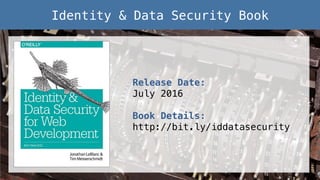
Release Date:!
July 2016!
!
Book Details:!
http://bit.ly/iddatasecurity!
Identity & Data Security Book!
Security is Hard!
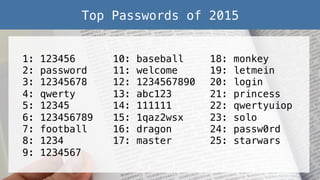
1: 123456 !
2: password !
3: 12345678 !
4: qwerty !
5: 12345 !
6: 123456789!
7: football!
8: 1234!
9: 1234567!
Top Passwords of 2015!
10: baseball!
11: welcome!
12: 1234567890!
13: abc123!
14: 111111!
15: 1qaz2wsx!
16: dragon!
17: master!
18: monkey!
19: letmein!
20: login!
21: princess!
22: qwertyuiop!
23: solo!
24: passw0rd!
25: starwars!
Protecting Identity!
Password Attack Vectors!
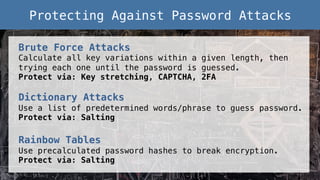
Brute Force Attacks!
Calculate all key variations within a given length, then
trying each one until the password is guessed. !
Protect via: Key stretching, CAPTCHA, 2FA!
!
Dictionary Attacks!
Use a list of predetermined words/phrase to guess password.!
Protect via: Salting!
!
Rainbow Tables!
Use precalculated password hashes to break encryption.!
Protect via: Salting !
Protecting Against Password Attacks!
Salting and Peppering!
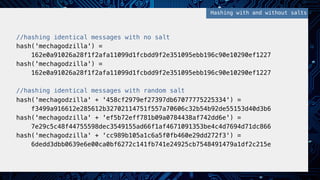
//hashing identical messages with no salt!
hash('mechagodzilla') = !
162e0a91026a28f1f2afa11099d1fcbdd9f2e351095ebb196c90e10290ef1227!
hash('mechagodzilla') = !
162e0a91026a28f1f2afa11099d1fcbdd9f2e351095ebb196c90e10290ef1227!
!
//hashing identical messages with random salt!
hash('mechagodzilla' + '458cf2979ef27397db67077775225334') = !
f3499a916612e285612b32702114751f557a70606c32b54b92de55153d40d3b6!
hash('mechagodzilla' + 'ef5b72eff781b09a0784438af742dd6e') = !
7e29c5c48f44755598dec3549155ad66f1af4671091353be4c4d7694d71dc866!
hash('mechagodzilla' + 'cc989b105a1c6a5f0fb460e29dd272f3') = !
6dedd3dbb0639e6e00ca0bf6272c141fb741e24925cb7548491479a1df2c215e!
Hashing with and without salts!
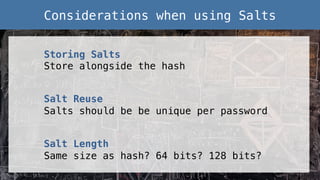
Storing Salts!
Store alongside the hash!
!
Salt Reuse!
Salts should be be unique per password!
!
Salt Length!
Same size as hash? 64 bits? 128 bits?!
Considerations when using Salts!
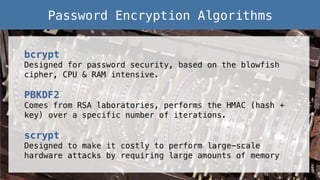
bcrypt!
Designed for password security, based on the blowfish
cipher, CPU & RAM intensive.!
!
PBKDF2!
Comes from RSA laboratories, performs the HMAC (hash +
key) over a specific number of iterations.!
!
scrypt!
Designed to make it costly to perform large-scale
hardware attacks by requiring large amounts of memory!
Password Encryption Algorithms!
!
//fetch password from user creation request!
$password = $_POST['password'];!
!
//salt option deprecated in PHP 7.0.0+!
$options = [!
'cost' => 12!
];!
!
//create 60 character hash, with default unique salt, and options !
$hash = password_hash($password, PASSWORD_BCRYPT, $options);!
!
//STORE HASH IN USER DATABASE RECORD!
//SALT IS BUILT INTO HASH!
Hashing with bcrypt!
//fetch login request information!
$username = $_POST['username'];!
$password = $_POST['password'];!
!
//fetch user record from database!
$user = fetchDBRecord($username);!
!
//verify if login attempt password matches stored user hash!
if (password_verify($password, $user->hash)){!
echo "password matches";!
} else {!
echo "password doesn't match";!
}!
Login Hash Comparison with bcrypt!
!
!
//fetch password from user creation request!
$password = $_POST['password'];!
!
//set iterations and random initialization vector!
$iterations = 1000;!
$salt = mcrypt_create_iv(16, MCRYPT_DEV_URANDOM);!
!
//hash password using sha256!
$hash = hash_pbkdf2("sha256", $password, $salt, $iterations, 20);!
!
//STORE HASH AND SALT IN USER DATABASE RECORD!
Hashing with PBKDF2!
!
//fetch login request info and set iterations!
$username = $_POST['username'];!
$password = $_POST['password'];!
$iterations = 1000;!
!
//fetch user record from database!
$user = fetchDBRecord($username);!
!
//manually hash the login attempt password!
$loginhash = hash_pbkdf2("sha256", $password, $user->salt, $iterations, 20);!
!
//validate if hashes match!
if (hash_equals ($loginhash, $user->hash)){ !
echo 'password match';!
} else {!
echo 'password mismatch';!
}!
!
Login Hash Comparison with PBKDF2!
Protecting Data!
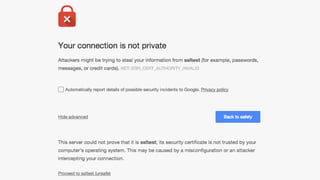
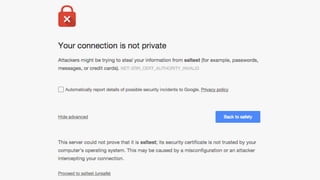
Ideal Scenario: SSL/TLS!
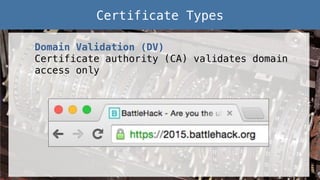
Domain Validation (DV)!
Certificate authority (CA) validates domain
access only!
Certificate Types!
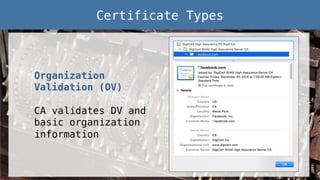
Organization
Validation (OV)!
!
CA validates DV and
basic organization
information!
Certificate Types!
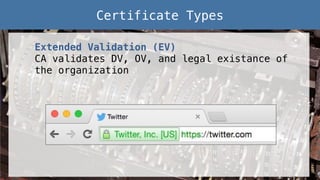
Extended Validation (EV)!
CA validates DV, OV, and legal existance of
the organization!
Certificate Types!
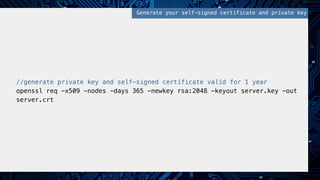
//generate private key and self-signed certificate valid for 1 year!
openssl req -x509 -nodes -days 365 -newkey rsa:2048 -keyout server.key -out
server.crt!
Generate your self-signed certificate and private key!
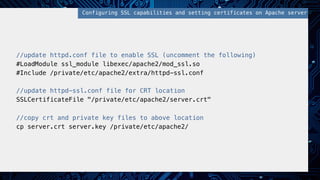
//update httpd.conf file to enable SSL (uncomment the following)!
#LoadModule ssl_module libexec/apache2/mod_ssl.so!
#Include /private/etc/apache2/extra/httpd-ssl.conf!
!
//update httpd-ssl.conf file for CRT location!
SSLCertificateFile "/private/etc/apache2/server.crt"!
!
//copy crt and private key files to above location!
cp server.crt server.key /private/etc/apache2/!
Configuring SSL capabilities and setting certificates on Apache server!
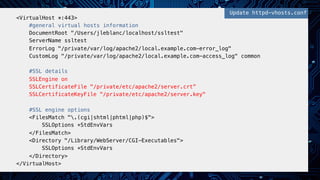
<VirtualHost *:443>!
#general virtual hosts information!
DocumentRoot "/Users/jleblanc/localhost/ssltest"!
ServerName ssltest!
ErrorLog "/private/var/log/apache2/local.example.com-error_log"!
CustomLog "/private/var/log/apache2/local.example.com-access_log" common!
!
#SSL details!
SSLEngine on!
SSLCertificateFile "/private/etc/apache2/server.crt”!
SSLCertificateKeyFile "/private/etc/apache2/server.key"!
!
#SSL engine options!
<FilesMatch ".(cgi|shtml|phtml|php)$">!
SSLOptions +StdEnvVars!
</FilesMatch>!
<Directory "/Library/WebServer/CGI-Executables">!
SSLOptions +StdEnvVars!
</Directory>!
</VirtualHost>!
Update httpd-vhosts.conf!
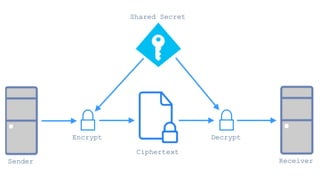
Synchronous Cryptography!
Single User Environment!
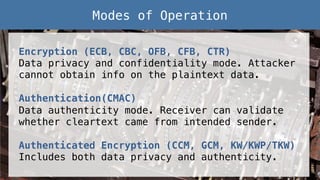
Encryption (ECB, CBC, OFB, CFB, CTR)!
Data privacy and confidentiality mode. Attacker
cannot obtain info on the plaintext data.!
!
Authentication(CMAC)!
Data authenticity mode. Receiver can validate
whether cleartext came from intended sender.!
!
Authenticated Encryption (CCM, GCM, KW/KWP/TKW)!
Includes both data privacy and authenticity.!
Modes of Operation!
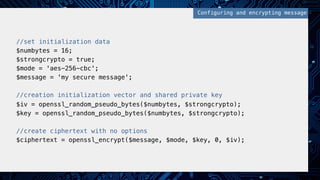
//set initialization data!
$numbytes = 16;!
$strongcrypto = true;!
$mode = 'aes-256-cbc';!
$message = 'my secure message';!
!
//creation initialization vector and shared private key!
$iv = openssl_random_pseudo_bytes($numbytes, $strongcrypto);!
$key = openssl_random_pseudo_bytes($numbytes, $strongcrypto);!
!
//create ciphertext with no options!
$ciphertext = openssl_encrypt($message, $mode, $key, 0, $iv);!
Configuring and encrypting message!
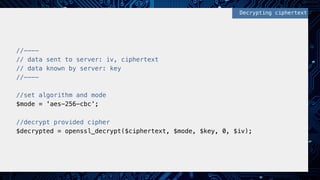
//----!
// data sent to server: iv, ciphertext!
// data known by server: key!
//----!
!
//set algorithm and mode!
$mode = 'aes-256-cbc’;!
!
//decrypt provided cipher!
$decrypted = openssl_decrypt($ciphertext, $mode, $key, 0, $iv);!
Decrypting ciphertext!
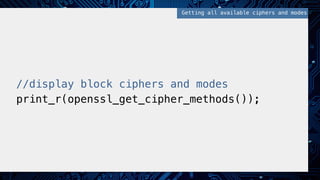
//display block ciphers and modes!
print_r(openssl_get_cipher_methods());!
Getting all available ciphers and modes !
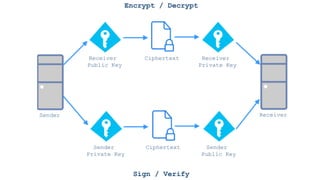
Asynchronous Cryptography!
Multi-User Environment!
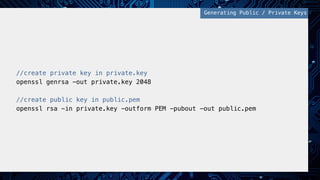
//create private key in private.key!
openssl genrsa -out private.key 2048!
!
//create public key in public.pem!
openssl rsa -in private.key -outform PEM -pubout -out public.pem!
Generating Public / Private Keys!
//set public key data from files and object to send!
$public_key = openssl_get_publickey(file_get_contents('public.pem'));!
$data = '{"message": "my super secure message"}';!
!
//encrypt object and public keys!
openssl_seal($data, $encrypted, $encpub, array($public_key));!
!
//encrypted data and encrypted public key!
$sealed_data = base64_encode($encrypted);!
$envelope = base64_encode($encpub[0]);!
!
//SEND SEALED DATA AND ENVELOPE TO RECIPIENT!
Preparing Message, Encrypting, and Signing!
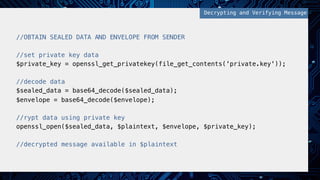
//OBTAIN SEALED DATA AND ENVELOPE FROM SENDER!
!
//set private key data!
$private_key = openssl_get_privatekey(file_get_contents('private.key'));!
!
//decode data!
$sealed_data = base64_decode($sealed_data);!
$envelope = base64_decode($envelope);!
!
//rypt data using private key!
openssl_open($sealed_data, $plaintext, $envelope, $private_key);!
!
//decrypted message available in $plaintext!
Decrypting and Verifying Message!
Security Fundamentals Wrapup!
Thank You!!
Jonathan LeBlanc !
Twitter: @jcleblanc !
Book: http://bit.ly/iddatasecurity!

PHP Identity and Data Security

  • 1.
    PHP Identity and DataSecurity! Jonathan LeBlanc ! Twitter: @jcleblanc ! Book: http://bit.ly/iddatasecurity!
  • 2.
    Release Date:! July 2016! ! BookDetails:! http://bit.ly/iddatasecurity! Identity & Data Security Book!
  • 3.
  • 4.
    1: 123456 ! 2:password ! 3: 12345678 ! 4: qwerty ! 5: 12345 ! 6: 123456789! 7: football! 8: 1234! 9: 1234567! Top Passwords of 2015! 10: baseball! 11: welcome! 12: 1234567890! 13: abc123! 14: 111111! 15: 1qaz2wsx! 16: dragon! 17: master! 18: monkey! 19: letmein! 20: login! 21: princess! 22: qwertyuiop! 23: solo! 24: passw0rd! 25: starwars!
  • 6.
  • 7.
  • 8.
    Brute Force Attacks! Calculateall key variations within a given length, then trying each one until the password is guessed. ! Protect via: Key stretching, CAPTCHA, 2FA! ! Dictionary Attacks! Use a list of predetermined words/phrase to guess password.! Protect via: Salting! ! Rainbow Tables! Use precalculated password hashes to break encryption.! Protect via: Salting ! Protecting Against Password Attacks!
  • 9.
  • 10.
    //hashing identical messageswith no salt! hash('mechagodzilla') = ! 162e0a91026a28f1f2afa11099d1fcbdd9f2e351095ebb196c90e10290ef1227! hash('mechagodzilla') = ! 162e0a91026a28f1f2afa11099d1fcbdd9f2e351095ebb196c90e10290ef1227! ! //hashing identical messages with random salt! hash('mechagodzilla' + '458cf2979ef27397db67077775225334') = ! f3499a916612e285612b32702114751f557a70606c32b54b92de55153d40d3b6! hash('mechagodzilla' + 'ef5b72eff781b09a0784438af742dd6e') = ! 7e29c5c48f44755598dec3549155ad66f1af4671091353be4c4d7694d71dc866! hash('mechagodzilla' + 'cc989b105a1c6a5f0fb460e29dd272f3') = ! 6dedd3dbb0639e6e00ca0bf6272c141fb741e24925cb7548491479a1df2c215e! Hashing with and without salts!
  • 11.
    Storing Salts! Store alongsidethe hash! ! Salt Reuse! Salts should be be unique per password! ! Salt Length! Same size as hash? 64 bits? 128 bits?! Considerations when using Salts!
  • 12.
    bcrypt! Designed for passwordsecurity, based on the blowfish cipher, CPU & RAM intensive.! ! PBKDF2! Comes from RSA laboratories, performs the HMAC (hash + key) over a specific number of iterations.! ! scrypt! Designed to make it costly to perform large-scale hardware attacks by requiring large amounts of memory! Password Encryption Algorithms!
  • 13.
    ! //fetch password fromuser creation request! $password = $_POST['password'];! ! //salt option deprecated in PHP 7.0.0+! $options = [! 'cost' => 12! ];! ! //create 60 character hash, with default unique salt, and options ! $hash = password_hash($password, PASSWORD_BCRYPT, $options);! ! //STORE HASH IN USER DATABASE RECORD! //SALT IS BUILT INTO HASH! Hashing with bcrypt!
  • 14.
    //fetch login requestinformation! $username = $_POST['username'];! $password = $_POST['password'];! ! //fetch user record from database! $user = fetchDBRecord($username);! ! //verify if login attempt password matches stored user hash! if (password_verify($password, $user->hash)){! echo "password matches";! } else {! echo "password doesn't match";! }! Login Hash Comparison with bcrypt!
  • 15.
    ! ! //fetch password fromuser creation request! $password = $_POST['password'];! ! //set iterations and random initialization vector! $iterations = 1000;! $salt = mcrypt_create_iv(16, MCRYPT_DEV_URANDOM);! ! //hash password using sha256! $hash = hash_pbkdf2("sha256", $password, $salt, $iterations, 20);! ! //STORE HASH AND SALT IN USER DATABASE RECORD! Hashing with PBKDF2!
  • 16.
    ! //fetch login requestinfo and set iterations! $username = $_POST['username'];! $password = $_POST['password'];! $iterations = 1000;! ! //fetch user record from database! $user = fetchDBRecord($username);! ! //manually hash the login attempt password! $loginhash = hash_pbkdf2("sha256", $password, $user->salt, $iterations, 20);! ! //validate if hashes match! if (hash_equals ($loginhash, $user->hash)){ ! echo 'password match';! } else {! echo 'password mismatch';! }! ! Login Hash Comparison with PBKDF2!
  • 17.
  • 18.
  • 19.
    Domain Validation (DV)! Certificateauthority (CA) validates domain access only! Certificate Types!
  • 20.
    Organization Validation (OV)! ! CA validatesDV and basic organization information! Certificate Types!
  • 21.
    Extended Validation (EV)! CAvalidates DV, OV, and legal existance of the organization! Certificate Types!
  • 23.
    //generate private keyand self-signed certificate valid for 1 year! openssl req -x509 -nodes -days 365 -newkey rsa:2048 -keyout server.key -out server.crt! Generate your self-signed certificate and private key!
  • 24.
    //update httpd.conf fileto enable SSL (uncomment the following)! #LoadModule ssl_module libexec/apache2/mod_ssl.so! #Include /private/etc/apache2/extra/httpd-ssl.conf! ! //update httpd-ssl.conf file for CRT location! SSLCertificateFile "/private/etc/apache2/server.crt"! ! //copy crt and private key files to above location! cp server.crt server.key /private/etc/apache2/! Configuring SSL capabilities and setting certificates on Apache server!
  • 25.
    <VirtualHost *:443>! #general virtualhosts information! DocumentRoot "/Users/jleblanc/localhost/ssltest"! ServerName ssltest! ErrorLog "/private/var/log/apache2/local.example.com-error_log"! CustomLog "/private/var/log/apache2/local.example.com-access_log" common! ! #SSL details! SSLEngine on! SSLCertificateFile "/private/etc/apache2/server.crt”! SSLCertificateKeyFile "/private/etc/apache2/server.key"! ! #SSL engine options! <FilesMatch ".(cgi|shtml|phtml|php)$">! SSLOptions +StdEnvVars! </FilesMatch>! <Directory "/Library/WebServer/CGI-Executables">! SSLOptions +StdEnvVars! </Directory>! </VirtualHost>! Update httpd-vhosts.conf!
  • 27.
  • 29.
  • 30.
    Encryption (ECB, CBC,OFB, CFB, CTR)! Data privacy and confidentiality mode. Attacker cannot obtain info on the plaintext data.! ! Authentication(CMAC)! Data authenticity mode. Receiver can validate whether cleartext came from intended sender.! ! Authenticated Encryption (CCM, GCM, KW/KWP/TKW)! Includes both data privacy and authenticity.! Modes of Operation!
  • 31.
    //set initialization data! $numbytes= 16;! $strongcrypto = true;! $mode = 'aes-256-cbc';! $message = 'my secure message';! ! //creation initialization vector and shared private key! $iv = openssl_random_pseudo_bytes($numbytes, $strongcrypto);! $key = openssl_random_pseudo_bytes($numbytes, $strongcrypto);! ! //create ciphertext with no options! $ciphertext = openssl_encrypt($message, $mode, $key, 0, $iv);! Configuring and encrypting message!
  • 32.
    //----! // data sentto server: iv, ciphertext! // data known by server: key! //----! ! //set algorithm and mode! $mode = 'aes-256-cbc’;! ! //decrypt provided cipher! $decrypted = openssl_decrypt($ciphertext, $mode, $key, 0, $iv);! Decrypting ciphertext!
  • 33.
    //display block ciphersand modes! print_r(openssl_get_cipher_methods());! Getting all available ciphers and modes !
  • 34.
  • 36.
  • 37.
    //create private keyin private.key! openssl genrsa -out private.key 2048! ! //create public key in public.pem! openssl rsa -in private.key -outform PEM -pubout -out public.pem! Generating Public / Private Keys!
  • 38.
    //set public keydata from files and object to send! $public_key = openssl_get_publickey(file_get_contents('public.pem'));! $data = '{"message": "my super secure message"}';! ! //encrypt object and public keys! openssl_seal($data, $encrypted, $encpub, array($public_key));! ! //encrypted data and encrypted public key! $sealed_data = base64_encode($encrypted);! $envelope = base64_encode($encpub[0]);! ! //SEND SEALED DATA AND ENVELOPE TO RECIPIENT! Preparing Message, Encrypting, and Signing!
  • 39.
    //OBTAIN SEALED DATAAND ENVELOPE FROM SENDER! ! //set private key data! $private_key = openssl_get_privatekey(file_get_contents('private.key'));! ! //decode data! $sealed_data = base64_decode($sealed_data);! $envelope = base64_decode($envelope);! ! //rypt data using private key! openssl_open($sealed_data, $plaintext, $envelope, $private_key);! ! //decrypted message available in $plaintext! Decrypting and Verifying Message!
  • 40.
  • 41.
    Thank You!! Jonathan LeBlanc! Twitter: @jcleblanc ! Book: http://bit.ly/iddatasecurity!

Editor's Notes

  • #4 Where to store the salt Salt Reuse Salt Length
  • #7 Password attack vectors
  • #8 Where to store the salt Salt Reuse Salt Length
  • #10 Examples of not using a salt vs using a salt
  • #11 Moore’s law – computing power doubles every 2 years
  • #13 Examples of not using a salt vs using a salt
  • #14 Examples of not using a salt vs using a salt
  • #15 Examples of not using a salt vs using a salt
  • #16 Examples of not using a salt vs using a salt