Breaking Vaults
Stealing LastPass protected
secrets
Martin Vigo
@martin_vigo
martinvigo.com
Who am I
• Product Security Engineer
• Spaniard / Galician
• Diver
• Gin tonic consumer
• @martin_vigo / martinvigo.com
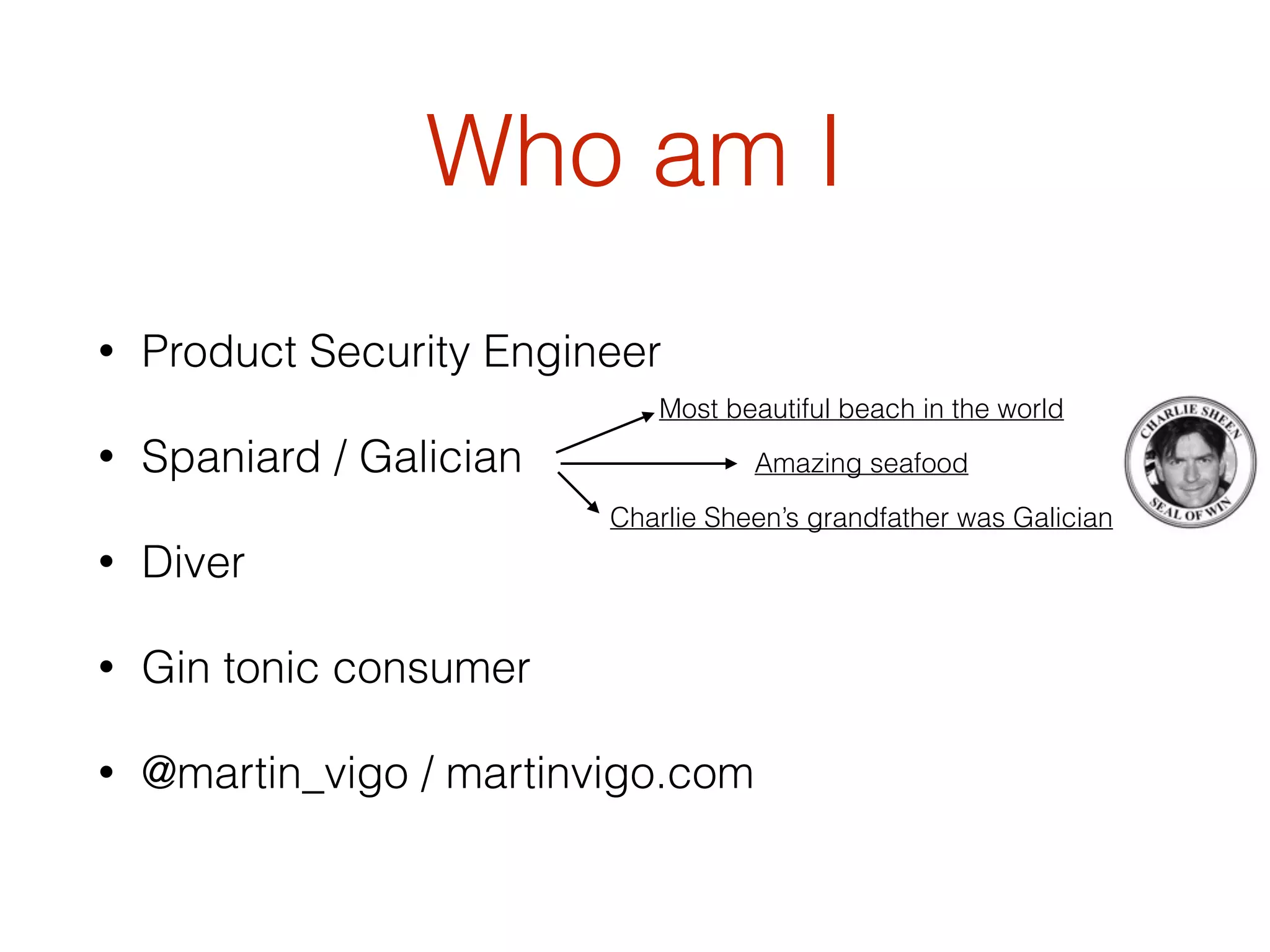
Most beautiful beach in the world
Amazing seafood
Charlie Sheen’s grandfather was Galician
Wikipedia
“LastPass is a password management service
which seeks to resolve the password fatigue
problem by centralizing user password
management in the cloud”
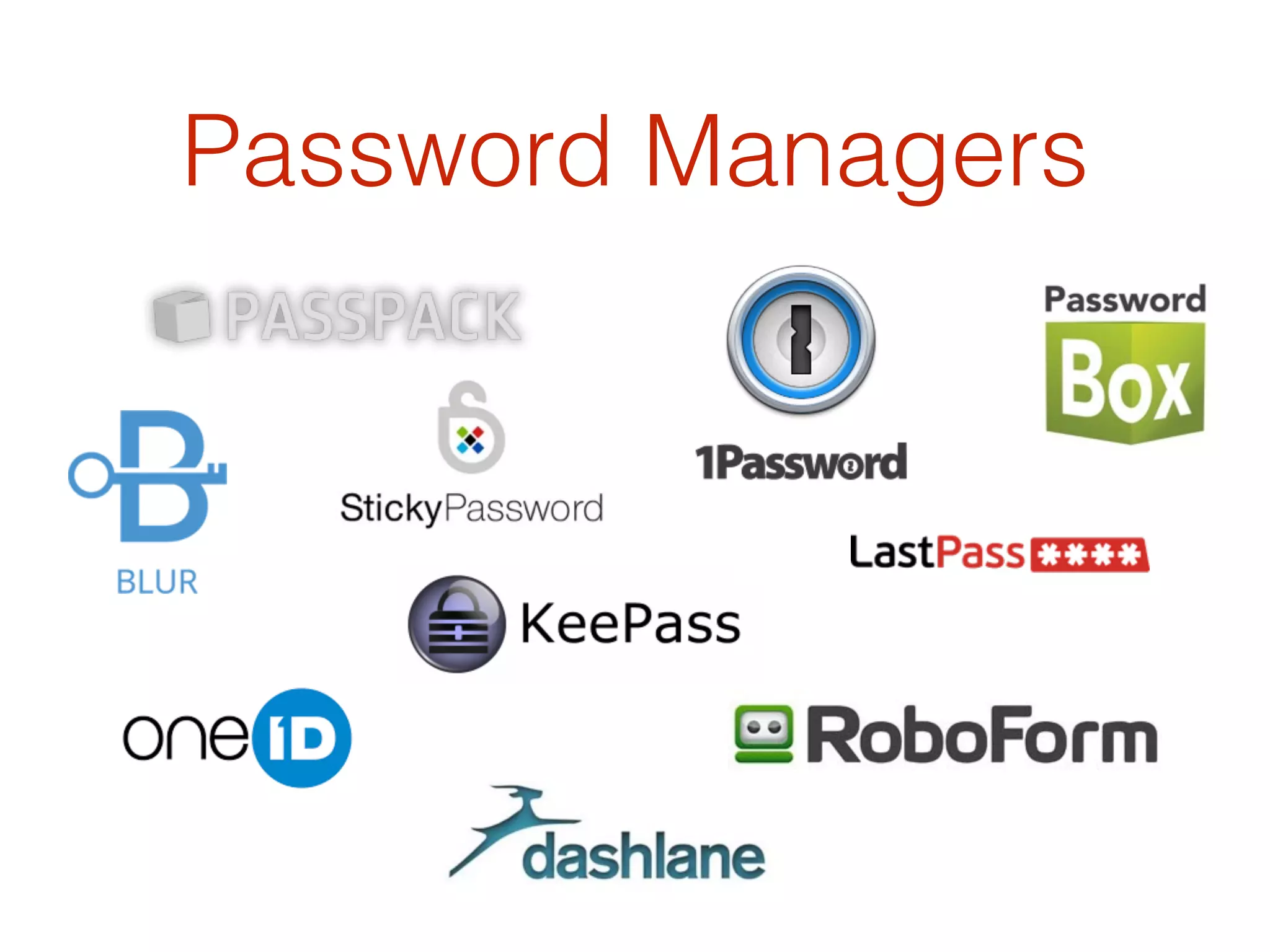
Password Managers
Why targeting Password
Managers?
• All you want to hack is in one
place
• Social Networks
• Banks
• Email accounts
• Corporate credentials
Why LastPass?
• Enterprise edition
• Large companies use it
• “More than 10,000 corporate customers
ranging in size all the way up to the
Fortune 500”
• Not only credentials
• Credit Cards, Personal documentation,
Private notes, etc.
• Arguably the most popular password
manager
State of the art
• Vulnerabilities
• DNS poisoning
• XSS form injection
All focus on leaking specific secrets
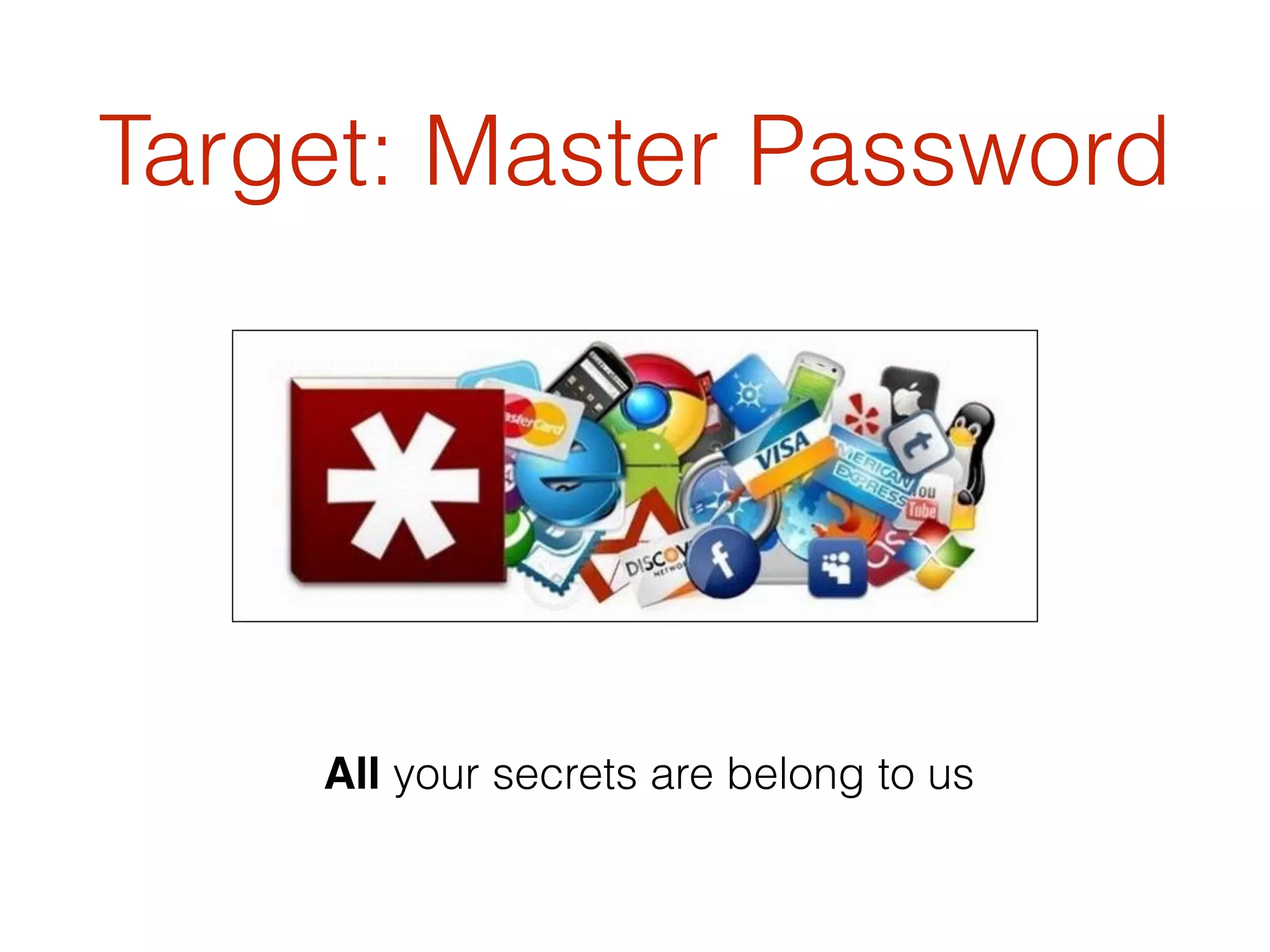
Target: Master Password
All your secrets are belong to us
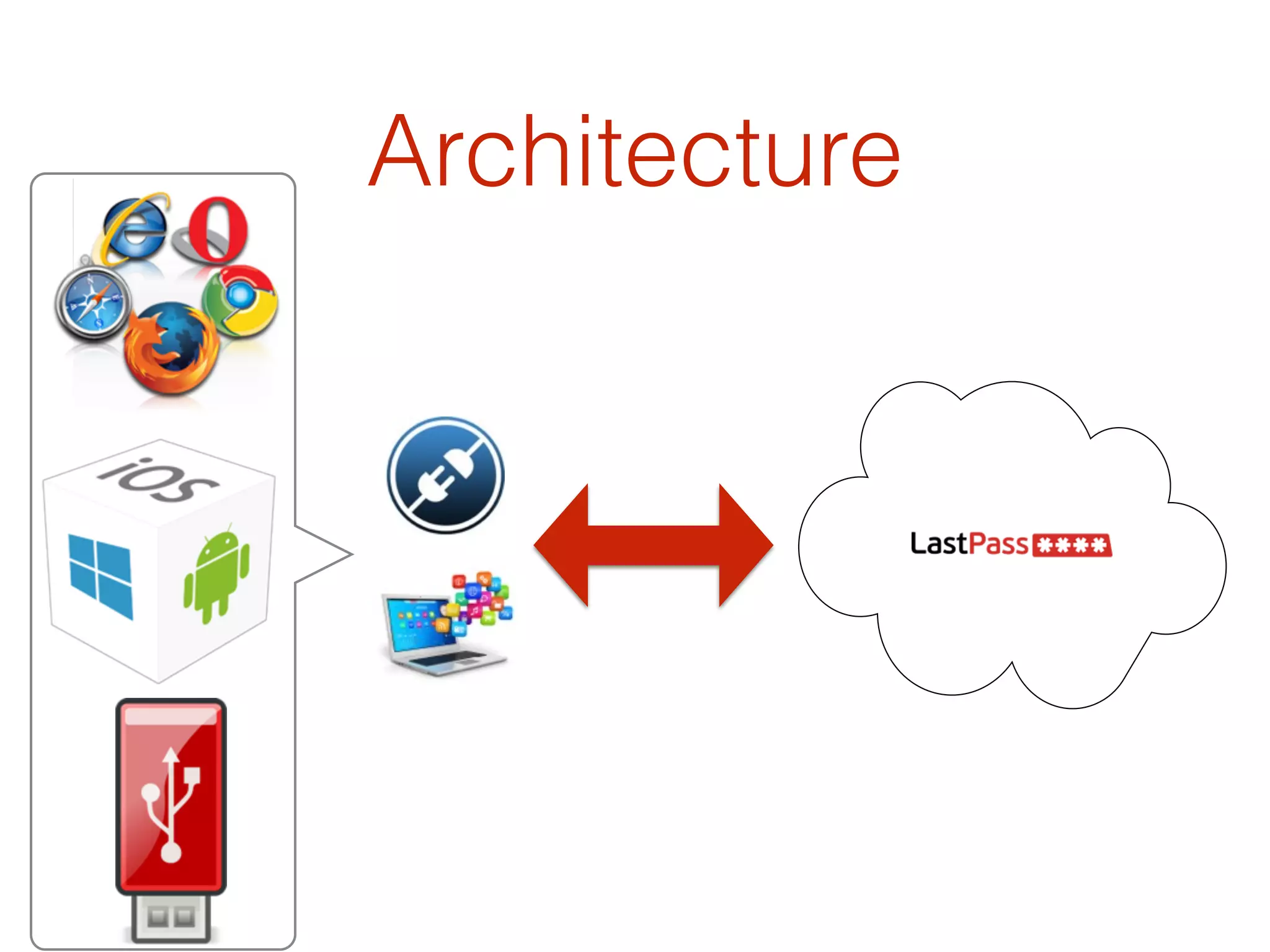
Architecture
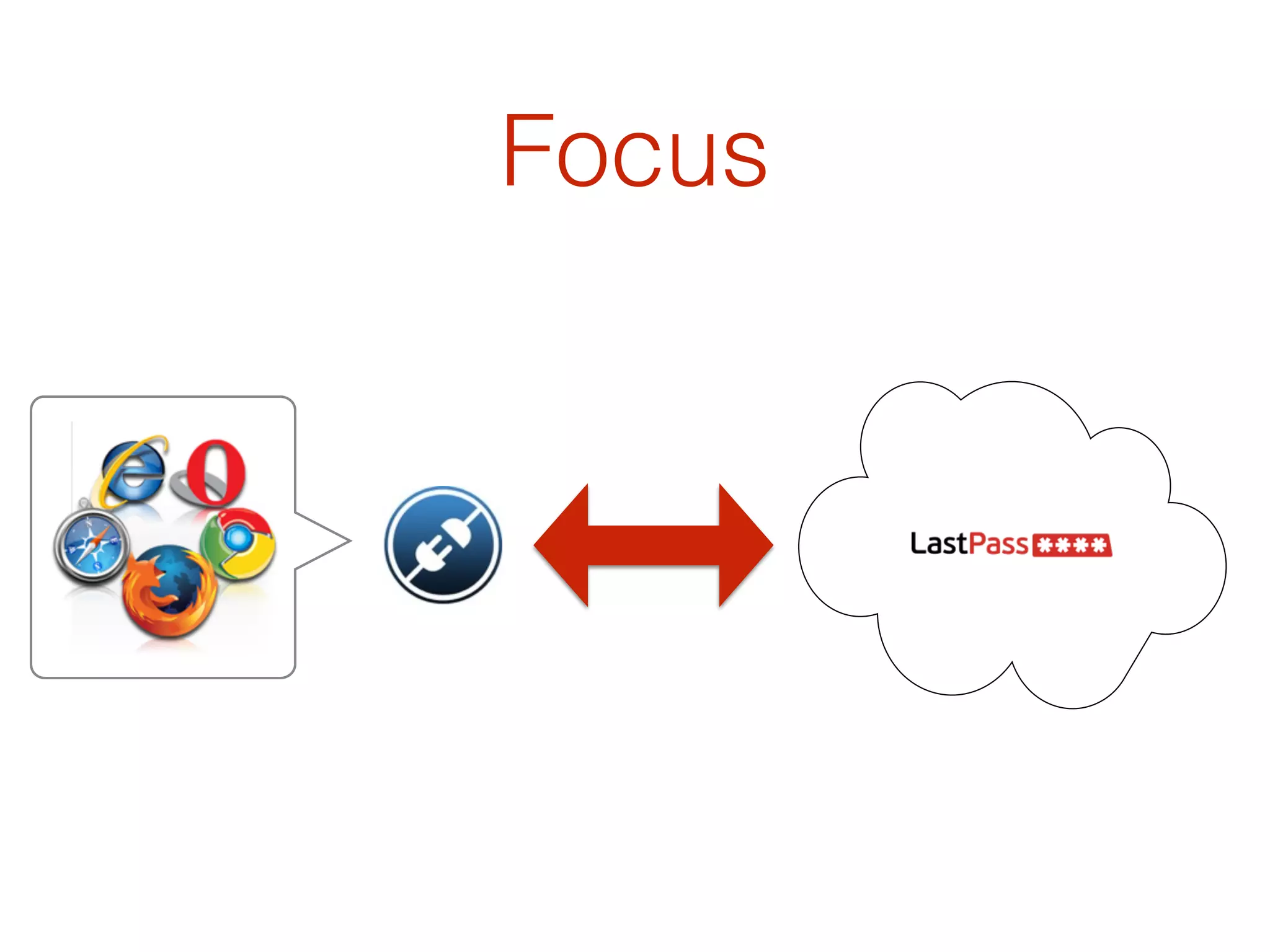
Focus
Browser Plugin
• Javascript
• Sandboxed (SOP)
• Injects code into DOM
• Access to filesystem
Security claims
• LastPass has no access to your data
• Local encryption
• Secure storage
Reversing
Meaning making sense of 3MB of obfuscated JS
siesta.py
• Beautifies every JS file
• Injects a payload to every function
• console.log([file] [function] [params])
• Credits to Alberto Garcia (@algillera)
• Identified all accessed files
• Minimized JS
• Storage on Sqlite DBs
• Browser specific implementation
• Business logic
• File location
• Storage
• AES own implementation
• RSA is based on jsbn library
Logic and storage
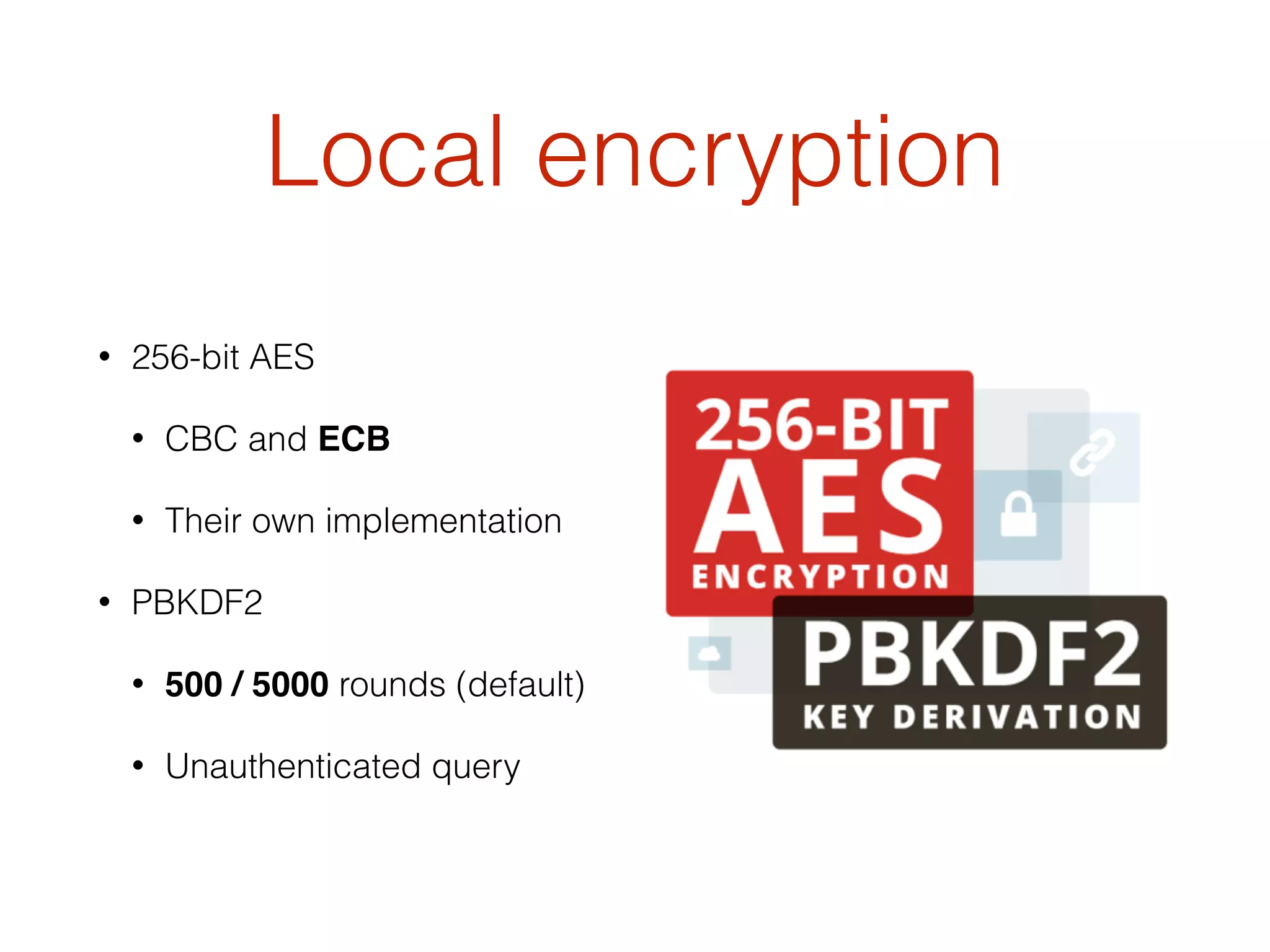
Local encryption
• 256-bit AES
• CBC and ECB
• Their own implementation
• PBKDF2
• 500 / 5000 rounds (default)
• Unauthenticated query
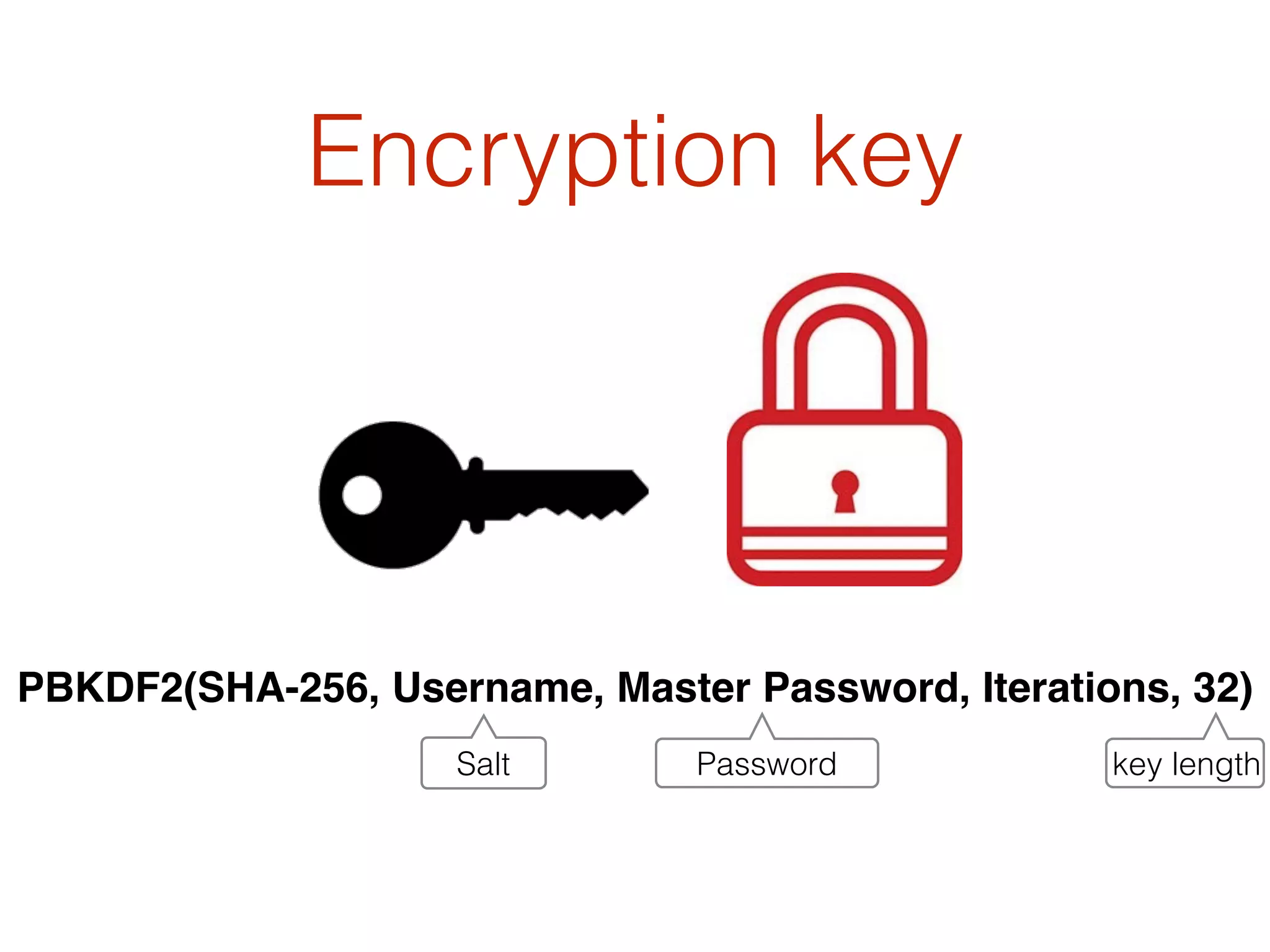
Encryption key
PBKDF2(SHA-256, Username, Master Password, Iterations, 32)
Salt Password key length
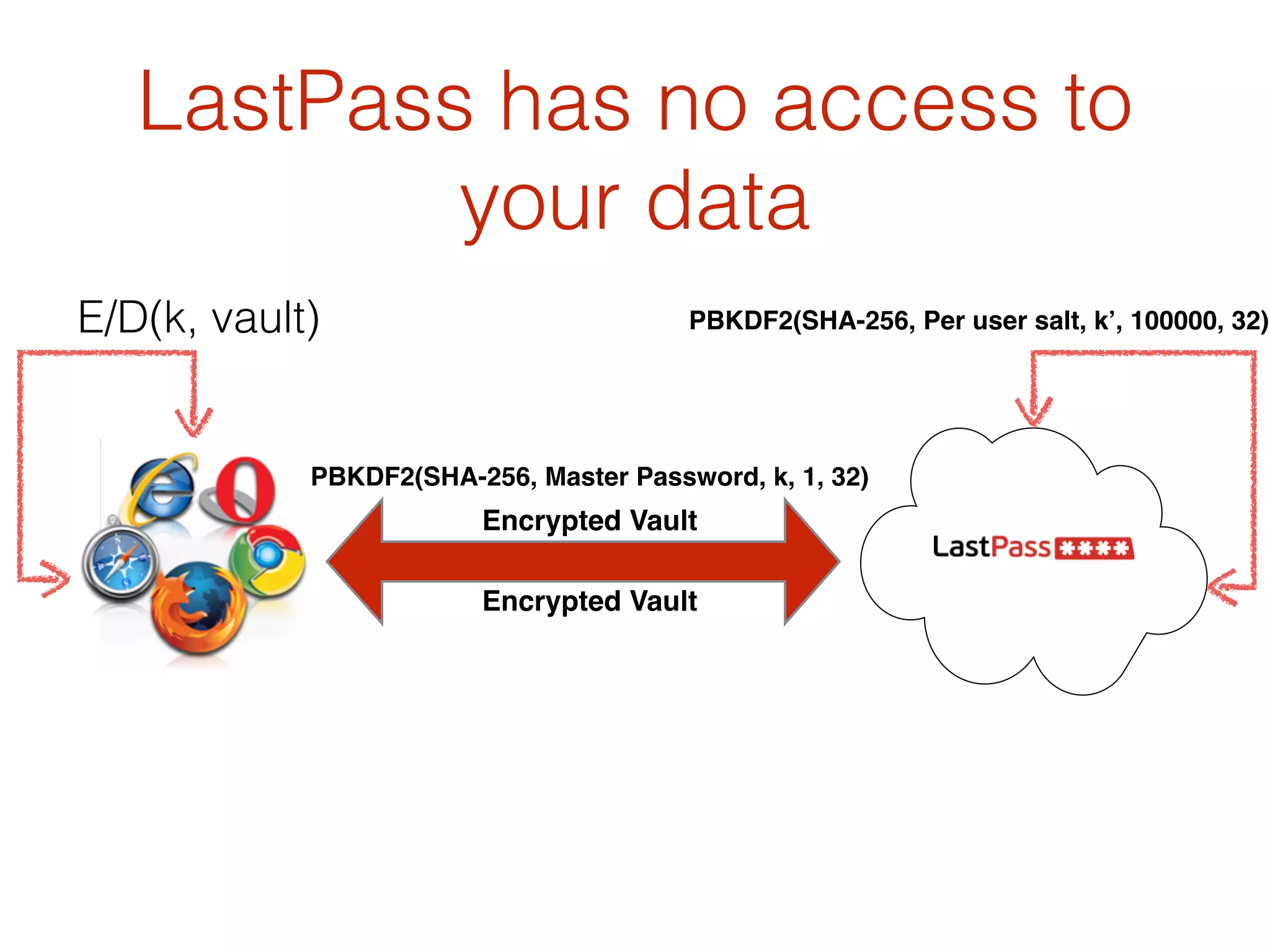
LastPass has no access to
your data
PBKDF2(SHA-256, Master Password, k, 1, 32)
E/D(k, vault)
Encrypted Vault
Encrypted Vault
PBKDF2(SHA-256, Per user salt, k’, 100000, 32)
What does LastPass see?
The encrypted vault
A 1-round PBKDF2-SHA256 of
the encryption key
Stealing the Master Password
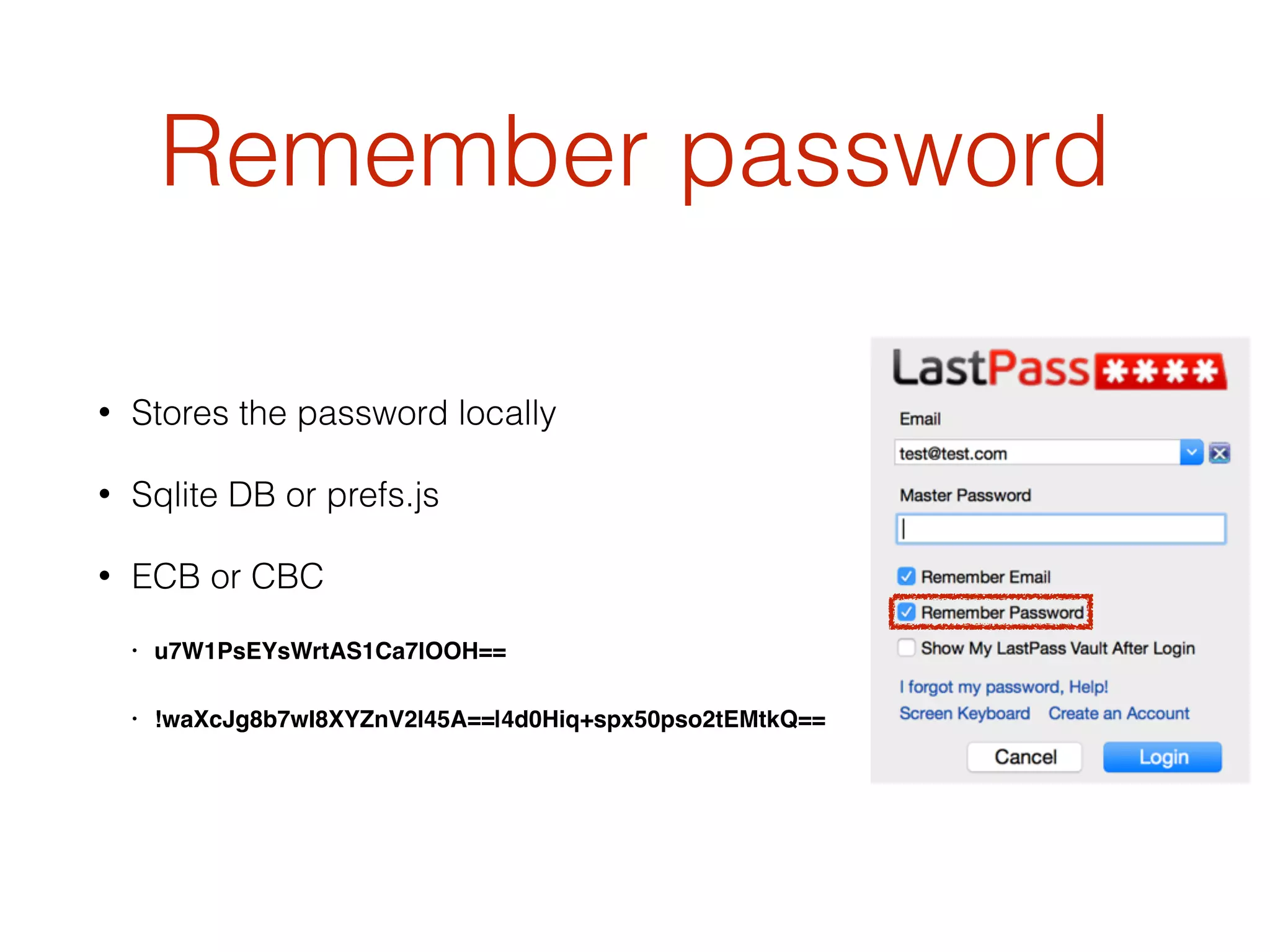
Remember password
• Stores the password locally
• Sqlite DB or prefs.js
• ECB or CBC
• u7W1PsEYsWrtAS1Ca7lOOH==
• !waXcJg8b7wI8XYZnV2l45A==|4d0Hiq+spx50pso2tEMtkQ==
Storage
Chrome Firefox Safari Opera
Windows
#{user_profile['LocalApp
Data']}/Google/Chrome/
User Data/Default/
databases/chrome-
extension_hdokiejnpimak
edhajhdlcegeplioahd_0
#{user_profile[
'AppData']}/
Mozilla/
Firefox/Profiles
#{user_profile['LocalAppData
']}/Apple Computer/Safari/
Databases/safari-
extension_com.lastpass.lpsaf
ariextension-n24rep3bmn_0
#{user_profile['AppData']}/
Opera Software/Opera
Stable/databases/chrome-
extension_hnjalnkldgigidg
gphhmacmimbdlafdo_0
Mac
#{user_profile['LocalApp
Data']}/Google/Chrome/
Default/databases/
chrome-
extension_hdokiejnpimak
edhajhdlcegeplioahd_0
#{user_profile['
LocalAppData']
}/Firefox/
Profiles
#{user_profile['AppData']}/
Safari/Databases/safari-
extension_com.lastpass.lpsaf
ariextension-n24rep3bmn_0
#{user_profile['LocalAppData']
}/com.operasoftware.Opera/
databases/chrome-
extension_hnjalnkldgigidggph
hmacmimbdlafdo_0
Unix
#{user_profile['LocalApp
Data']}/.config/google-
chrome/Default/
databases/chrome-
extension_hdokiejnpimak
edhajhdlcegeplioahd_0
#{user_profile['
LocalAppData']
}/.mozilla/firefox
#{user_profile[‘LocalApp
Data’]}/.opera/widgets/
wuid-*/pstorage
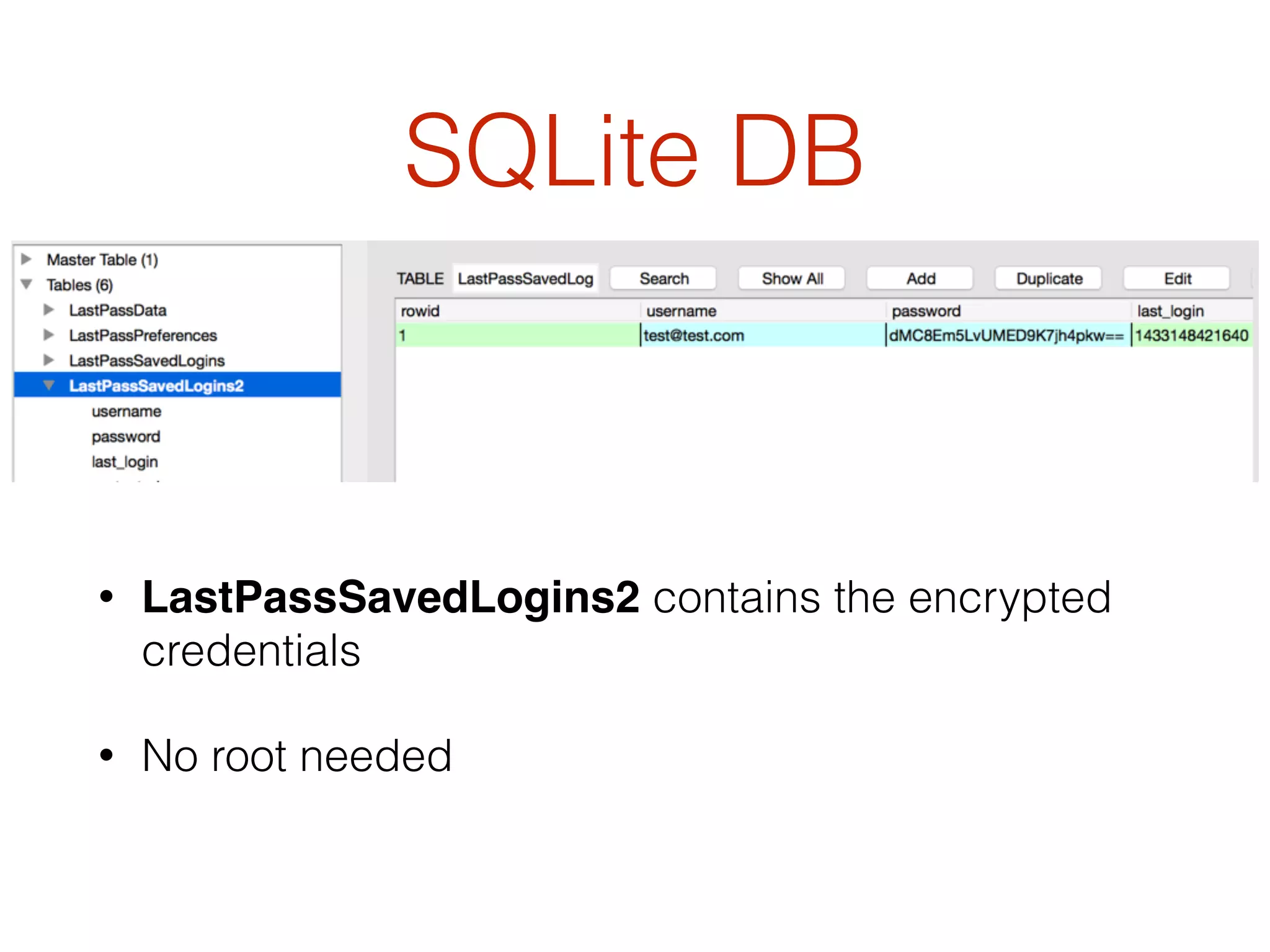
SQLite DB
• LastPassSavedLogins2 contains the encrypted
credentials
• No root needed
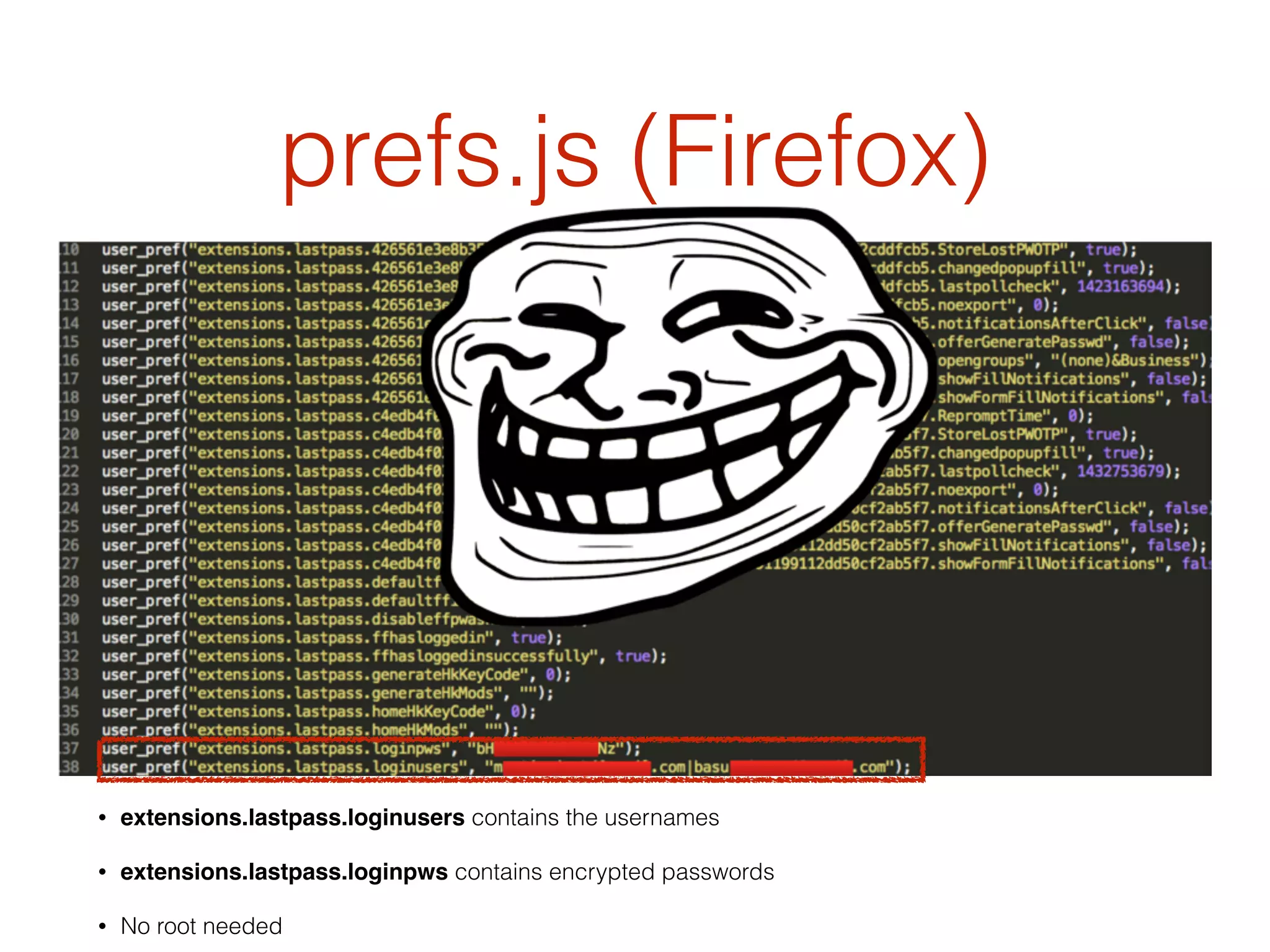
prefs.js (Firefox)
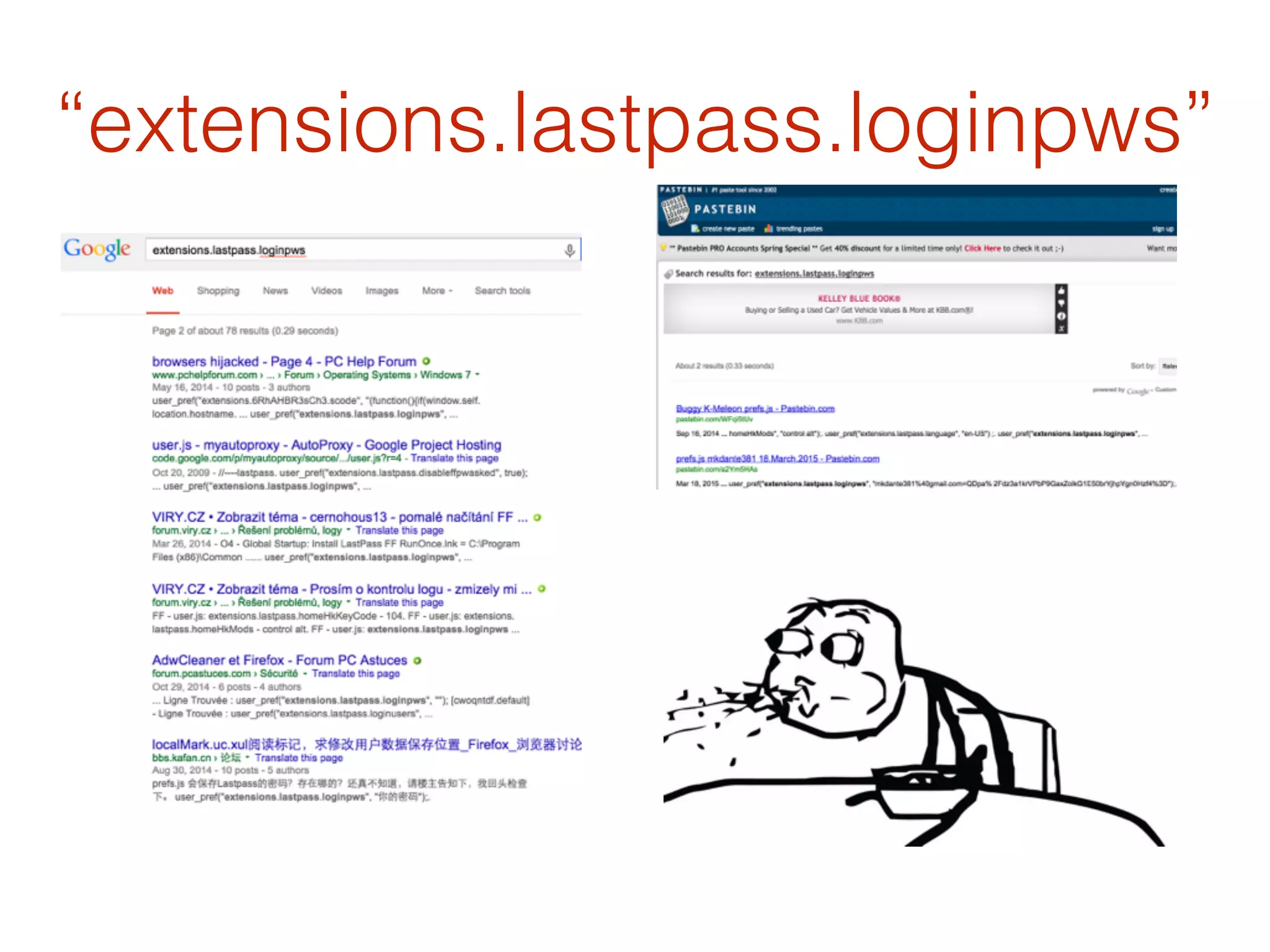
• extensions.lastpass.loginusers contains the usernames
• extensions.lastpass.loginpws contains encrypted passwords
• No root needed
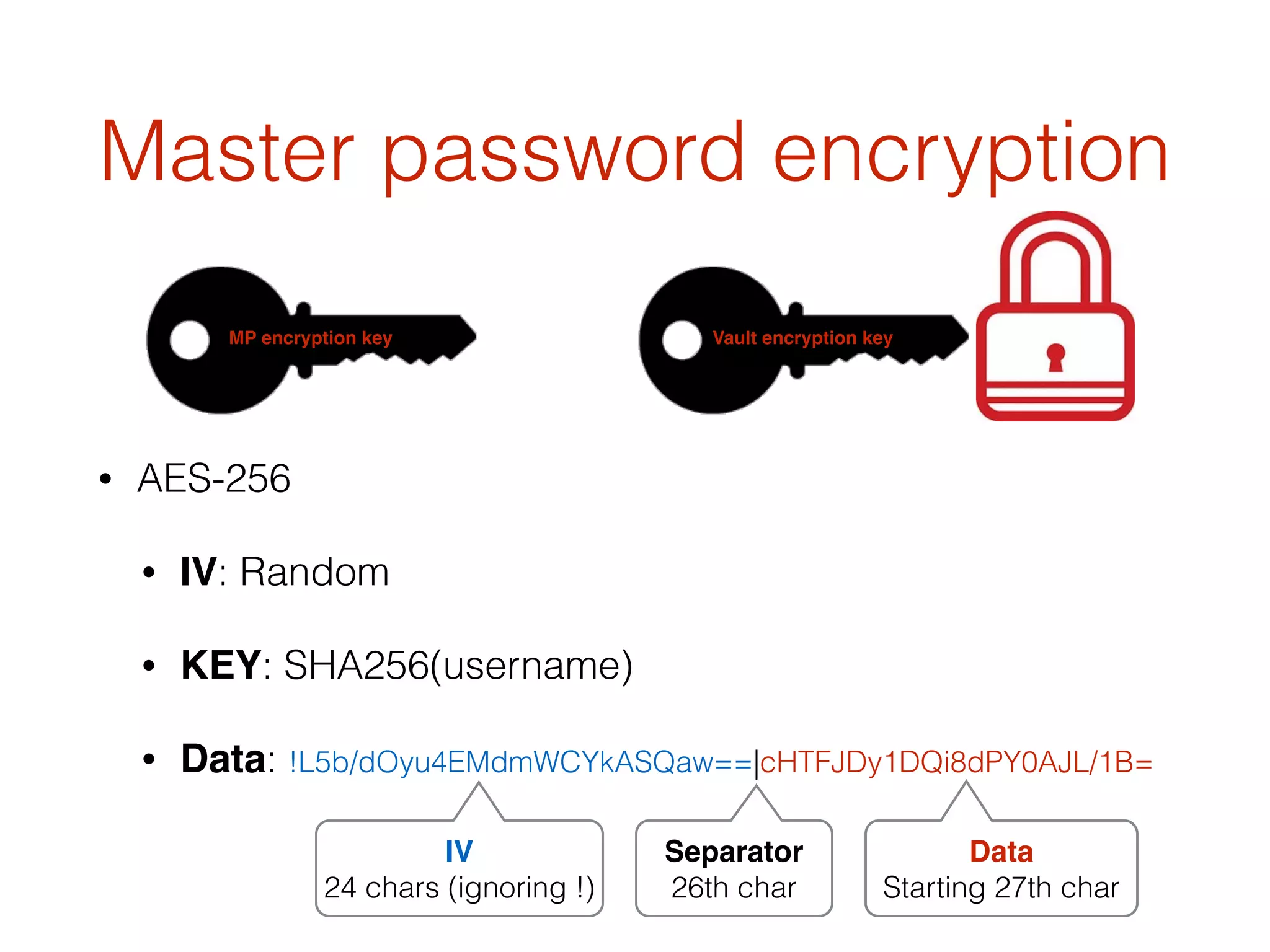
Master password encryption
• AES-256
• IV: Random
• KEY: SHA256(username)
• Data: !L5b/dOyu4EMdmWCYkASQaw==|cHTFJDy1DQi8dPY0AJL/1B=
IV
24 chars (ignoring !)
Separator
26th char
Data
Starting 27th char
MP encryption key Vault encryption key
Profit!
• We located the files
• We know the encryption system
• We have the IV
• We have the key
• We have the data
What about 2 factor auth?
Bypassing 2-factor Auth
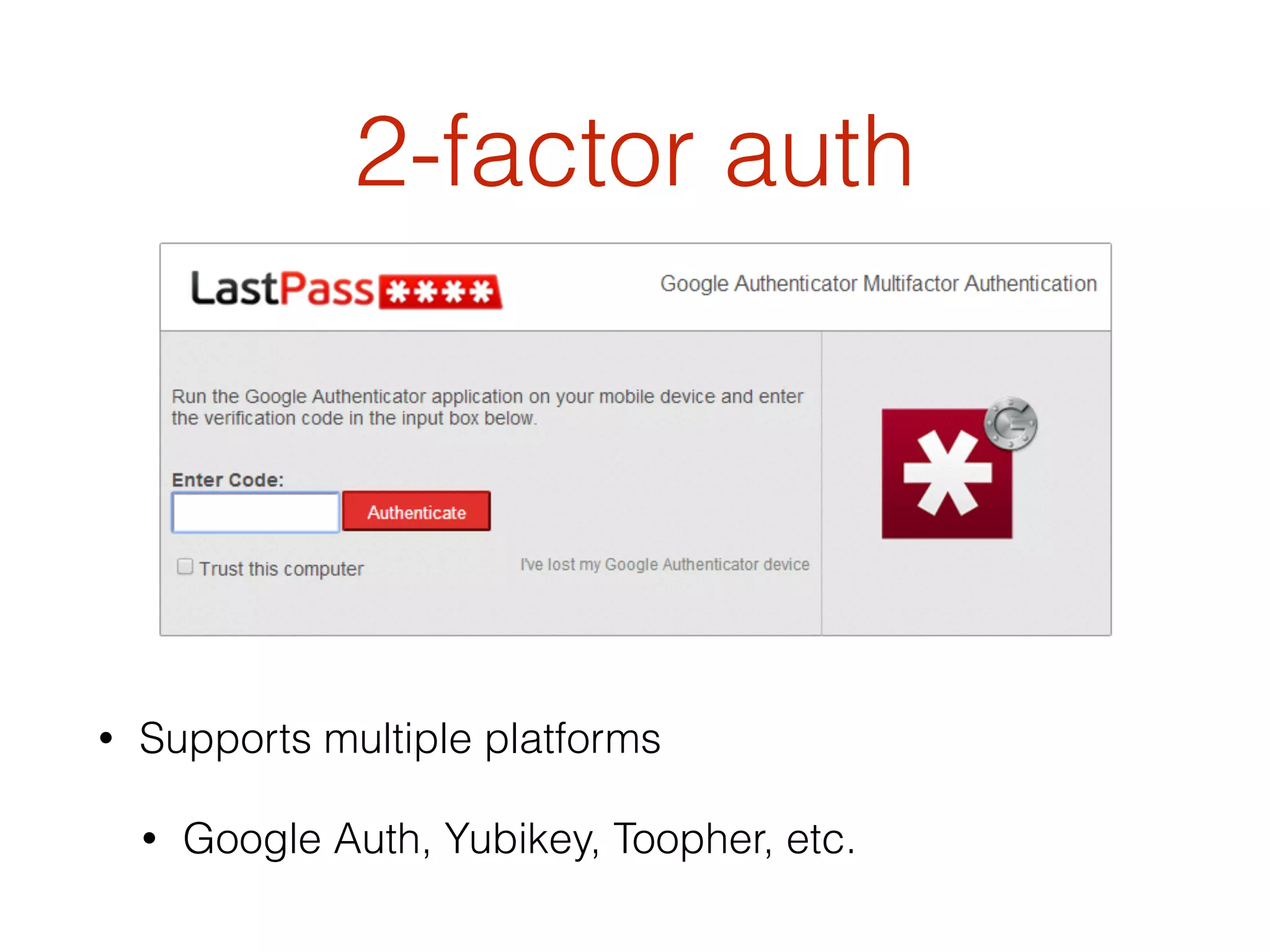
2-factor auth
• Supports multiple platforms
• Google Auth, Yubikey, Toopher, etc.
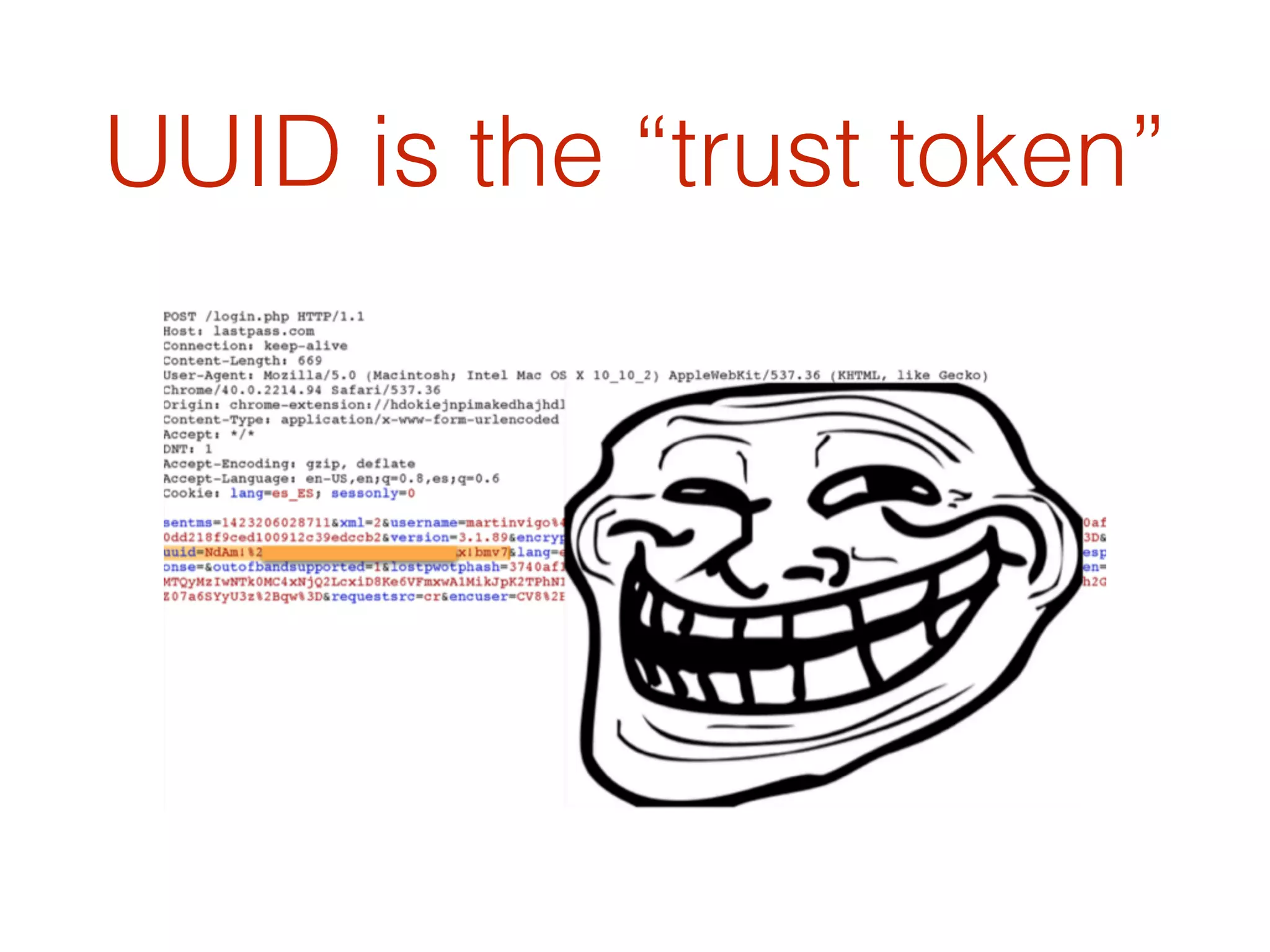
UUID is the “trust token”
What’s going on?
• How is the request forged?
• How is the token generated?
• How is it stored?
• Where is it stored?
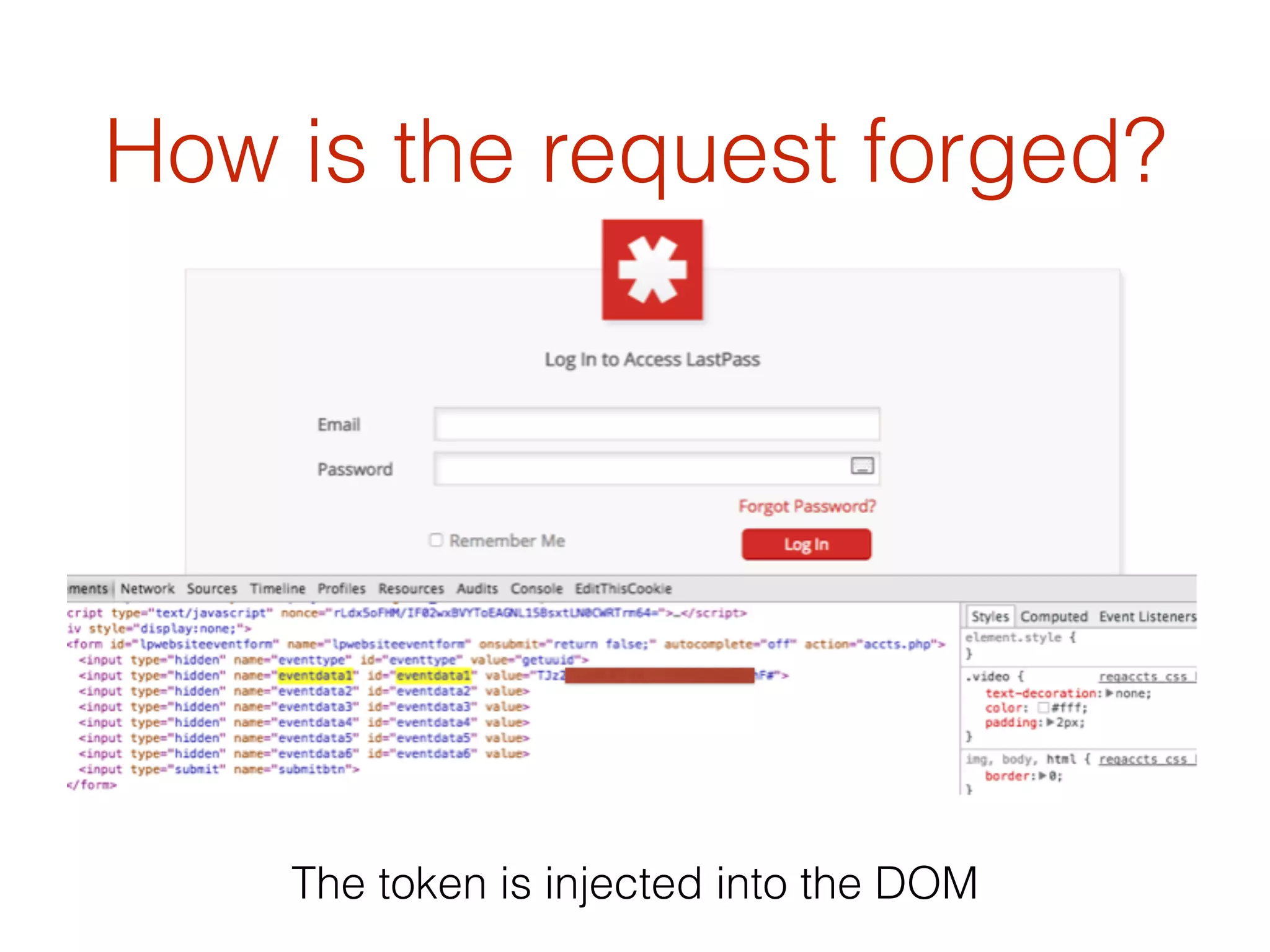
How is the request forged?
The token is injected into the DOM
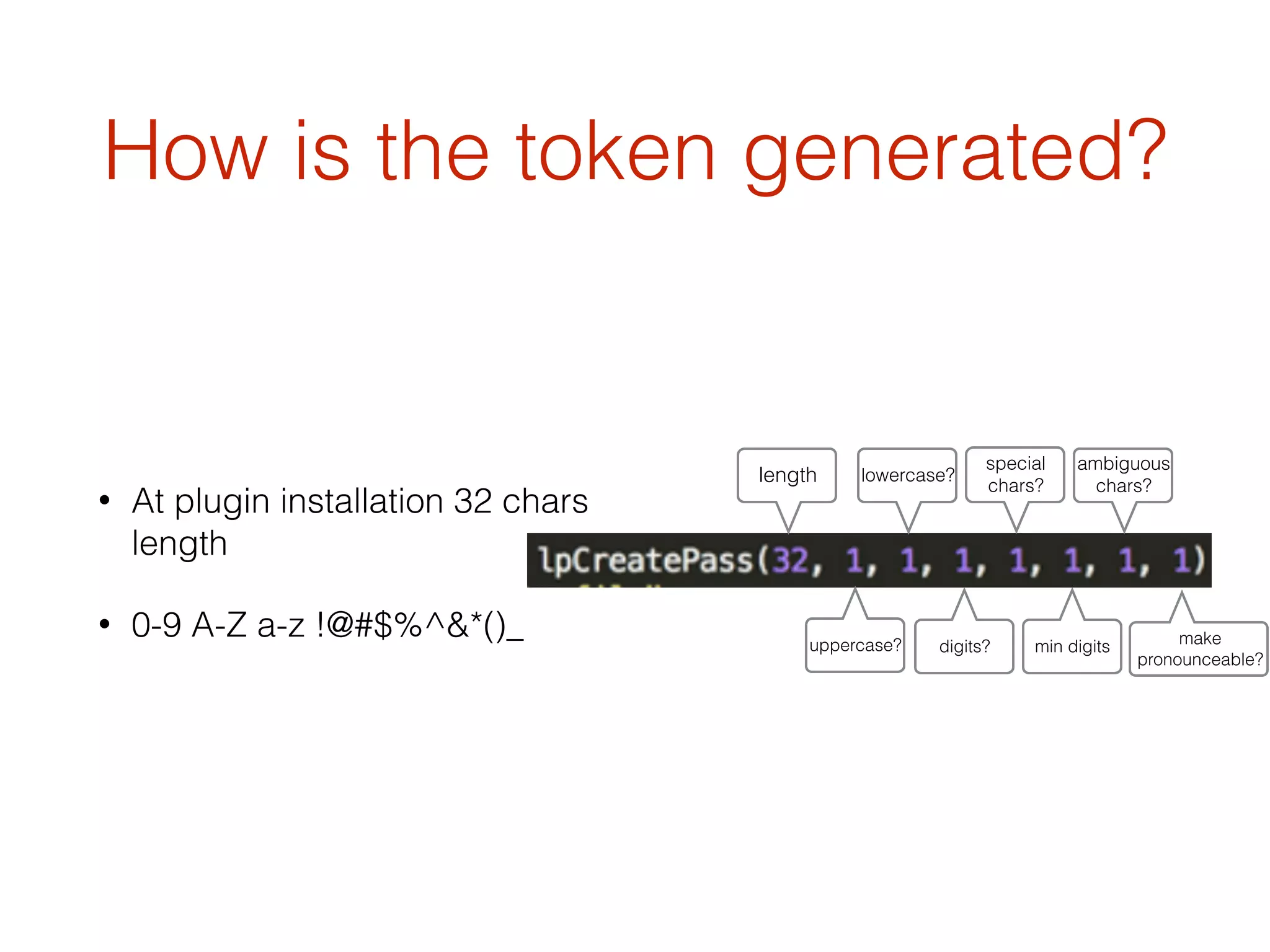
How is the token generated?
• At plugin installation 32 chars
length
• 0-9 A-Z a-z !@#$%^&*()_
length lowercase?
uppercase? digits?
special
chars?
min digits
ambiguous
chars?
make
pronounceable?
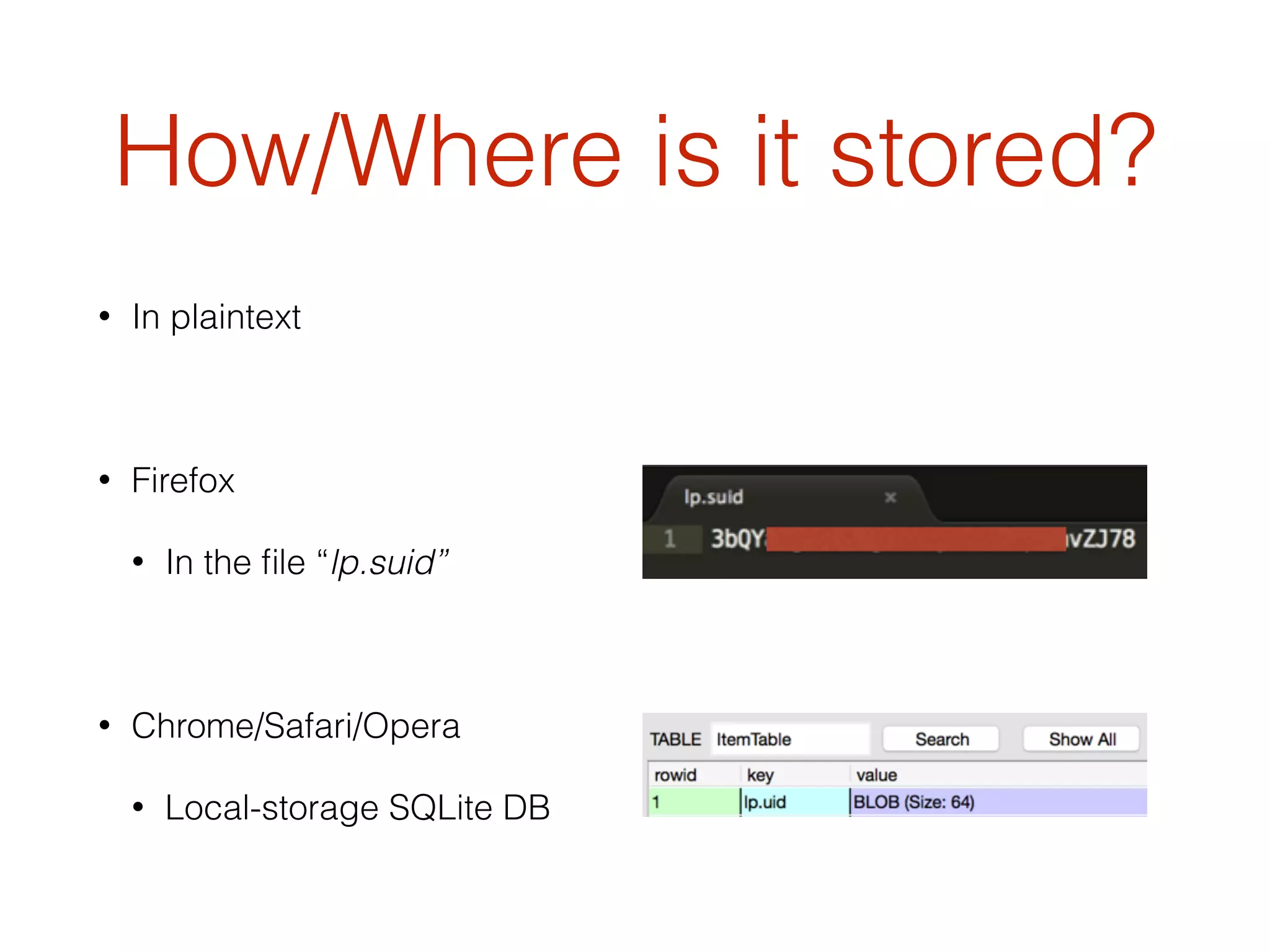
How/Where is it stored?
• In plaintext
• Firefox
• In the file “lp.suid”
• Chrome/Safari/Opera
• Local-storage SQLite DB
Design Problems?
• Browsers don’t encrypt local storage
• LocalStorage DB and lp.suid are
accessible and unencrypted
• The token is stored in plaintext
• Token is injected in DOM
• XSS means game over
More problems
• Same token for all browser users
• Fixed token till plugin is reinstalled
• Untrusting the browser has no real effect
• Same token when changing QR Code
• Token fixation
• Attacker can set a token on the client
• Proactive token stealing
• Steal token today, use it tomorrow
Profit!
• We have the file
• We know the encryption
• We have the data
• We have the IV
• We have the key
• We have the 2-factor token
What about if:
“Remember password” was not clicked
There was no way to obtain 2-factor auth token
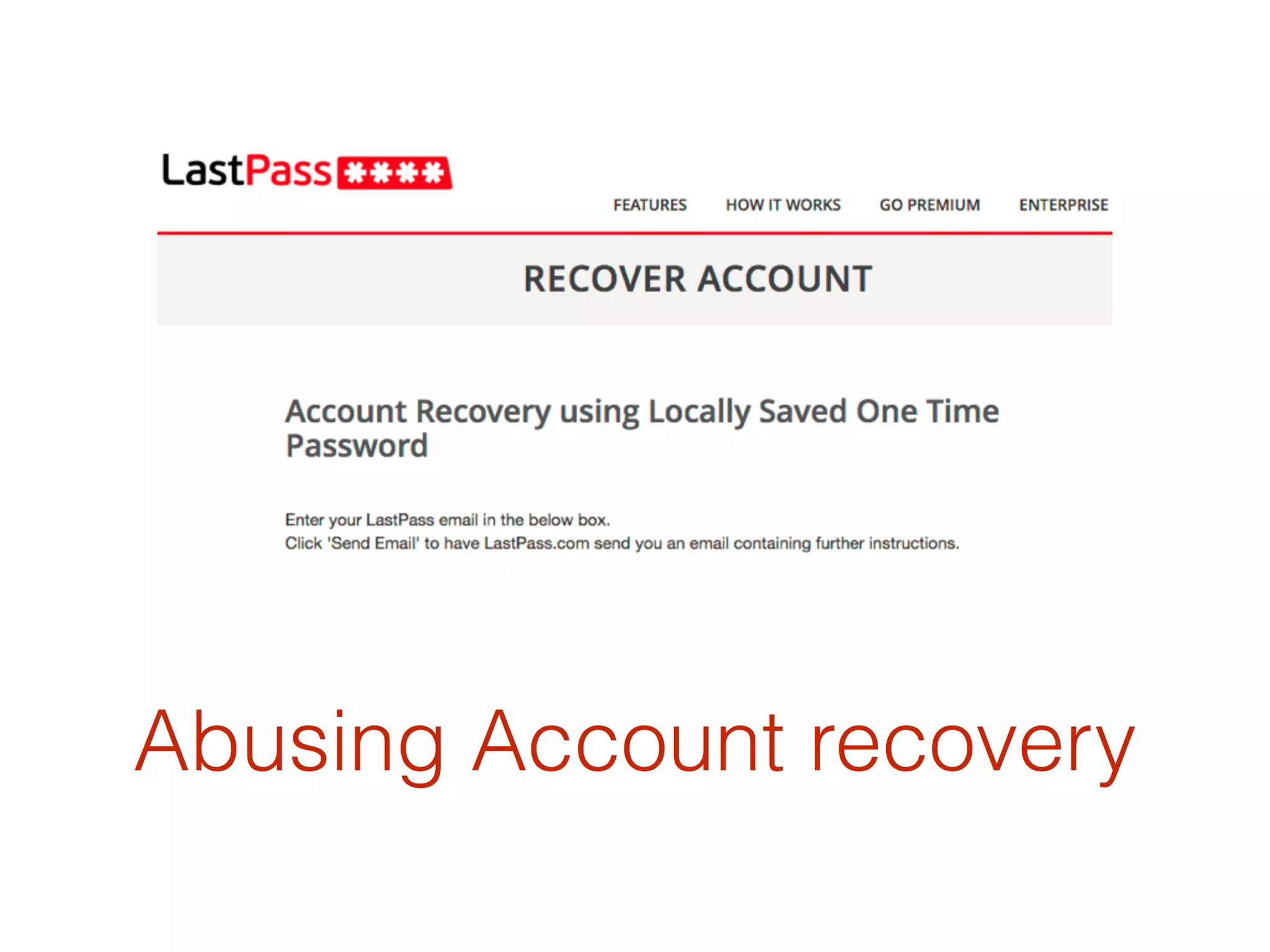
Abusing Account recovery
Wait… What?
How is account recovery possible if LastPass
does not know my password?
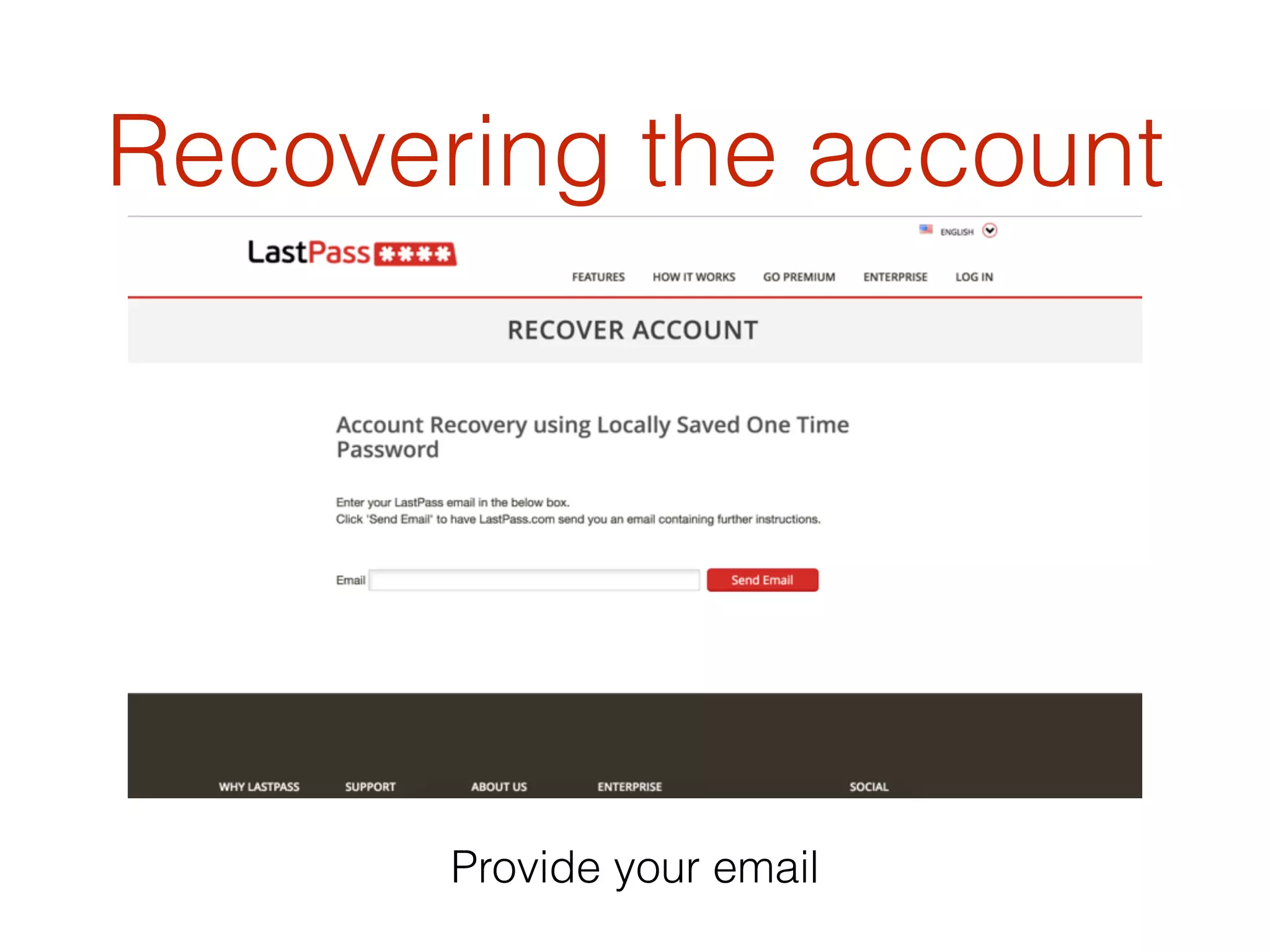
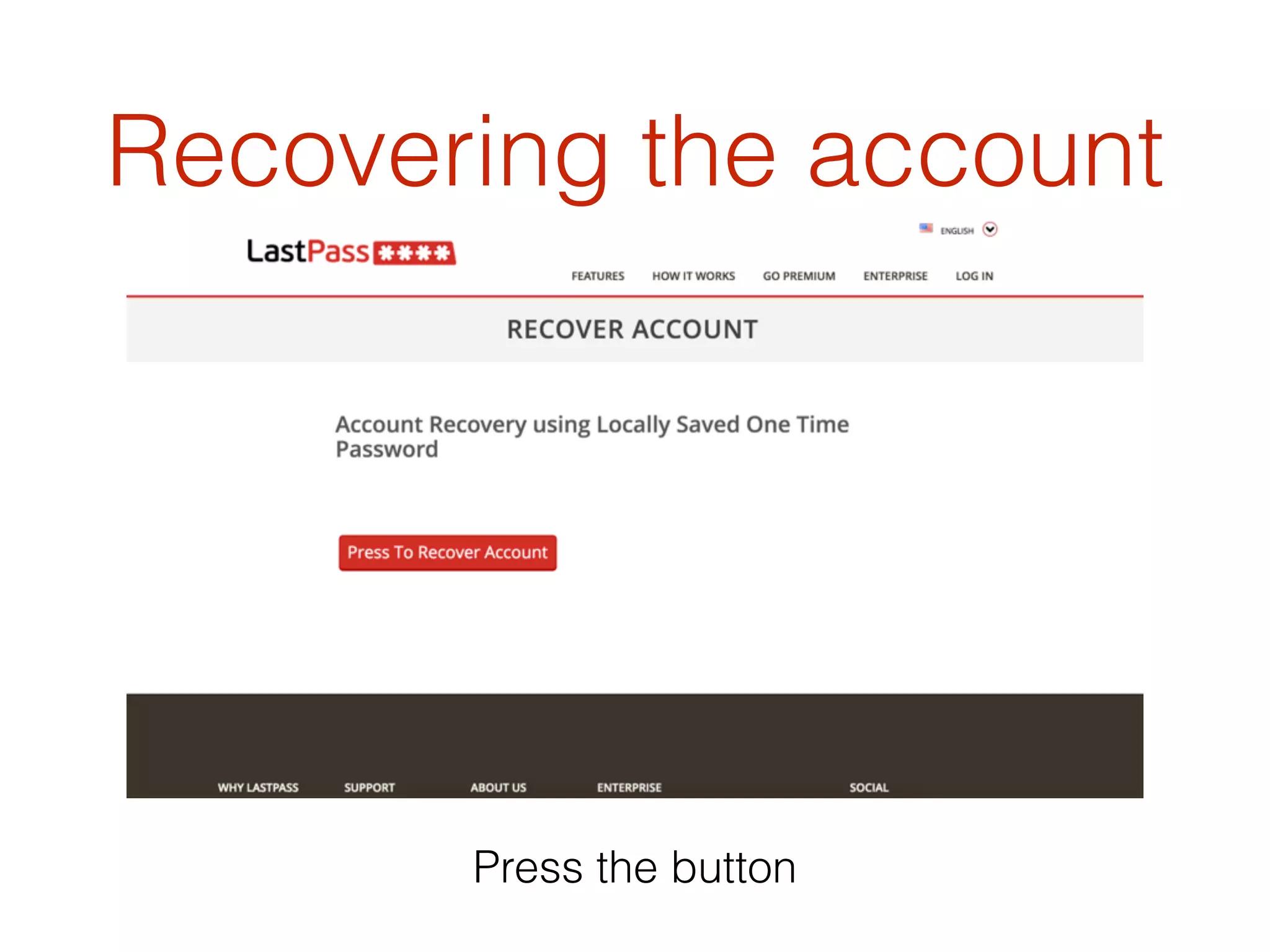
Recovering the account
Provide your email
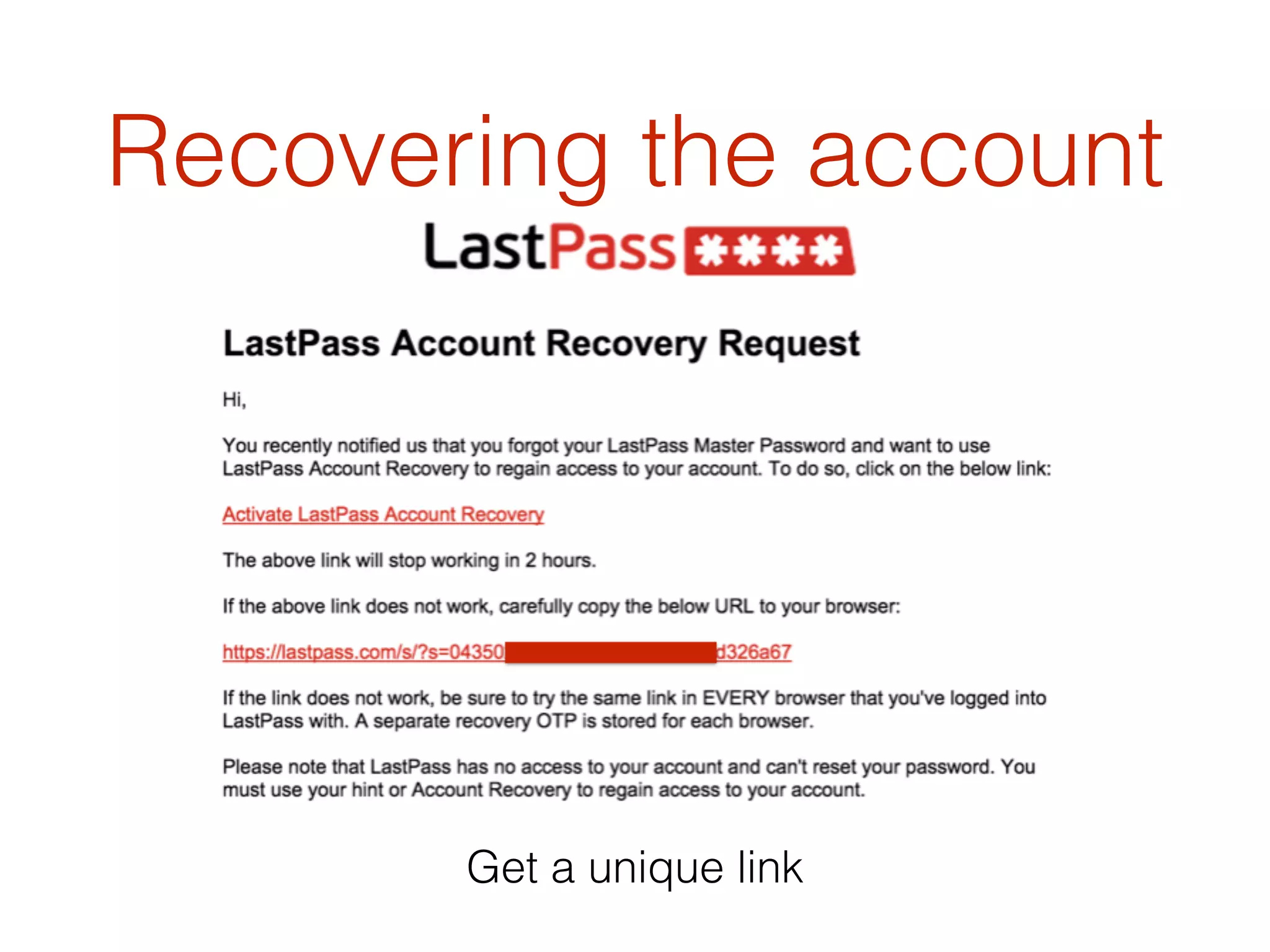
Recovering the account
Get a unique link
Recovering the account
Press the button
Boom!
• Full, unrestricted access to the vault
• Attacker can set a new password
• But does not have to!
• Bypasses 2 factor-auth
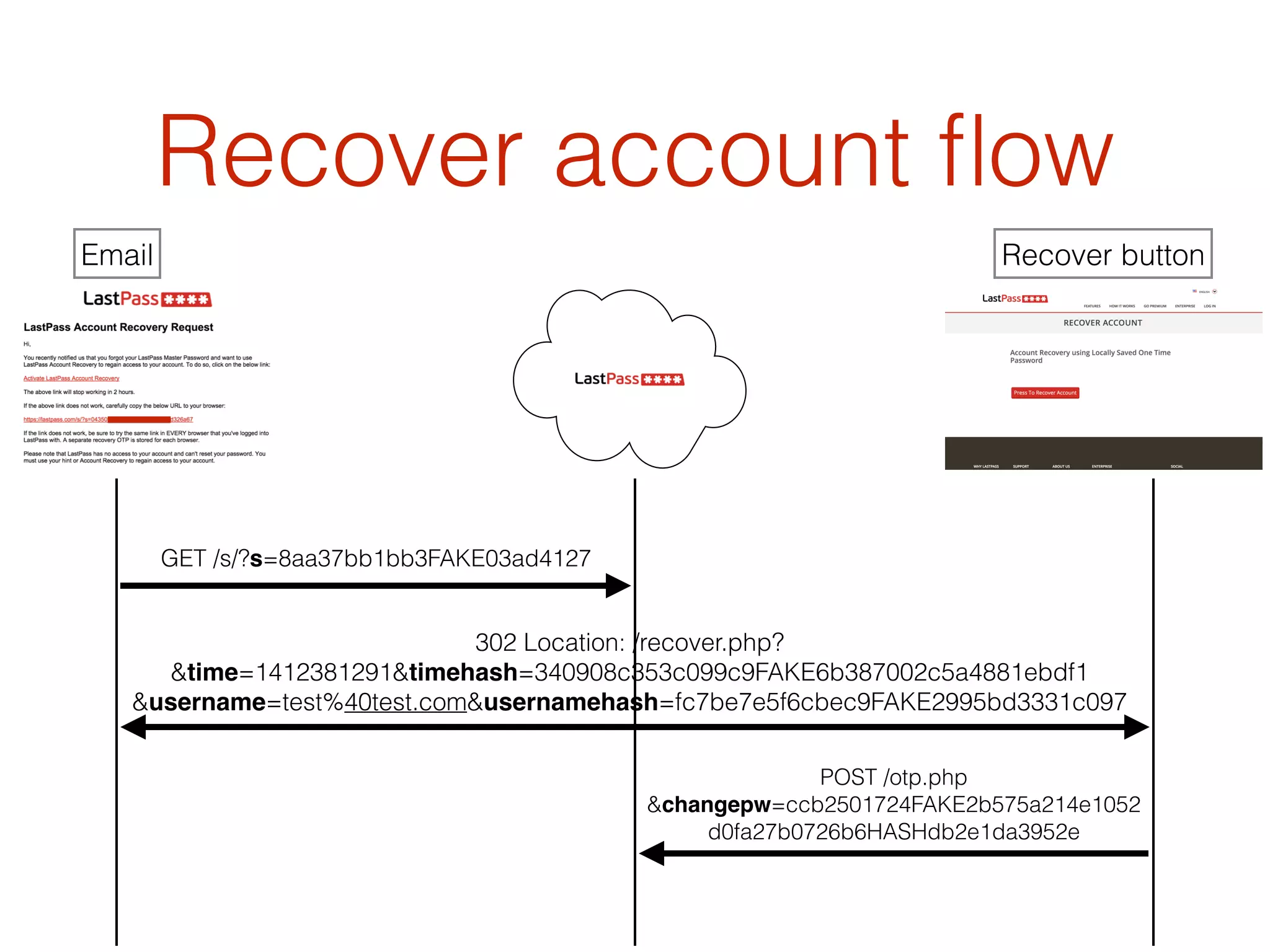
Recover account flow
Email
GET /s/?s=8aa37bb1bb3FAKE03ad4127
302 Location: /recover.php?
&time=1412381291&timehash=340908c353c099c9FAKE6b387002c5a4881ebdf1
&username=test%40test.com&usernamehash=fc7be7e5f6cbec9FAKE2995bd3331c097
POST /otp.php
&changepw=ccb2501724FAKE2b575a214e1052
d0fa27b0726b6HASHdb2e1da3952e
Recover button
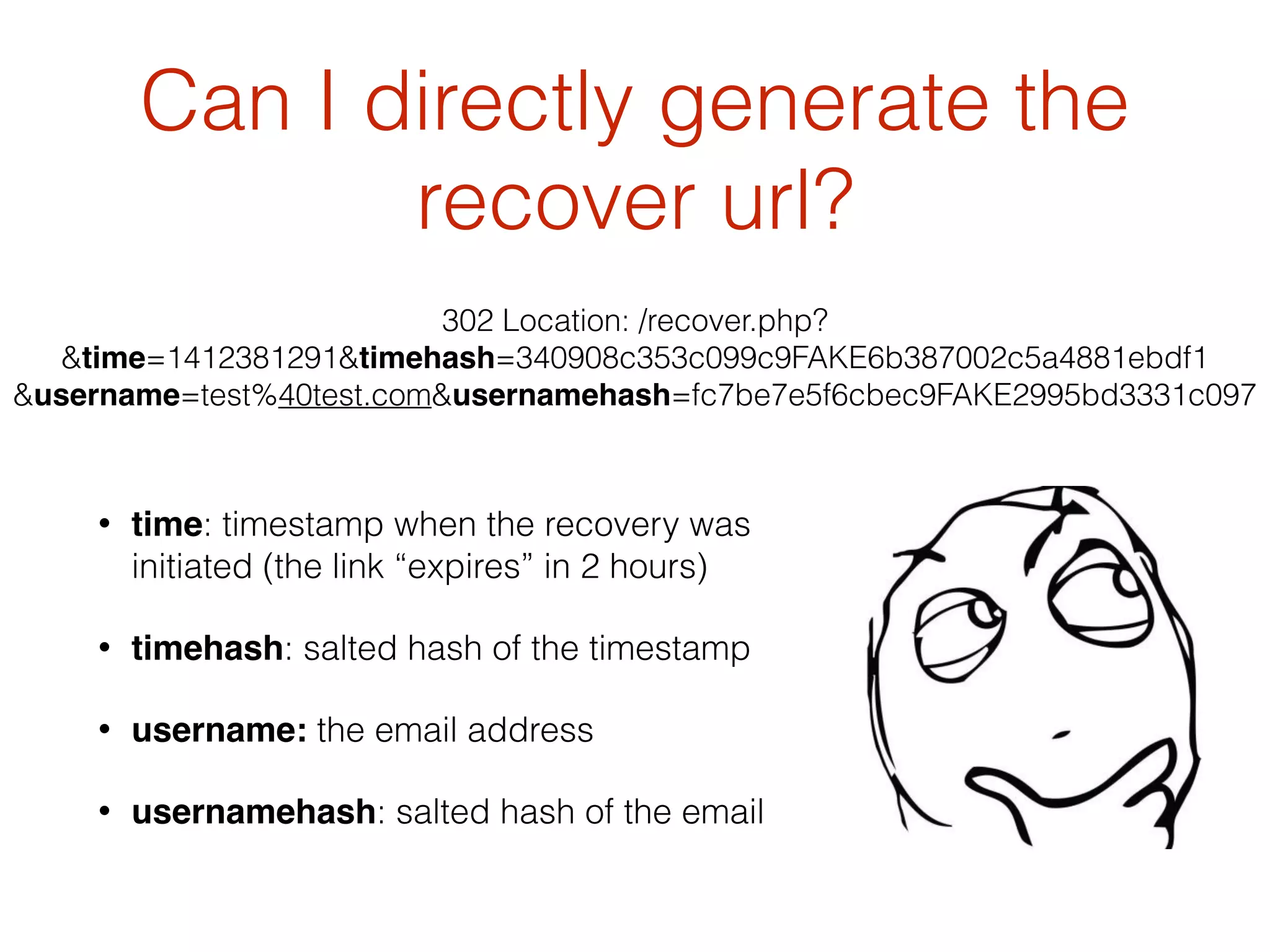
Can I directly generate the
recover url?
• time: timestamp when the recovery was
initiated (the link “expires” in 2 hours)
• timehash: salted hash of the timestamp
• username: the email address
• usernamehash: salted hash of the email
302 Location: /recover.php?
&time=1412381291&timehash=340908c353c099c9FAKE6b387002c5a4881ebdf1
&username=test%40test.com&usernamehash=fc7be7e5f6cbec9FAKE2995bd3331c097
Challenges
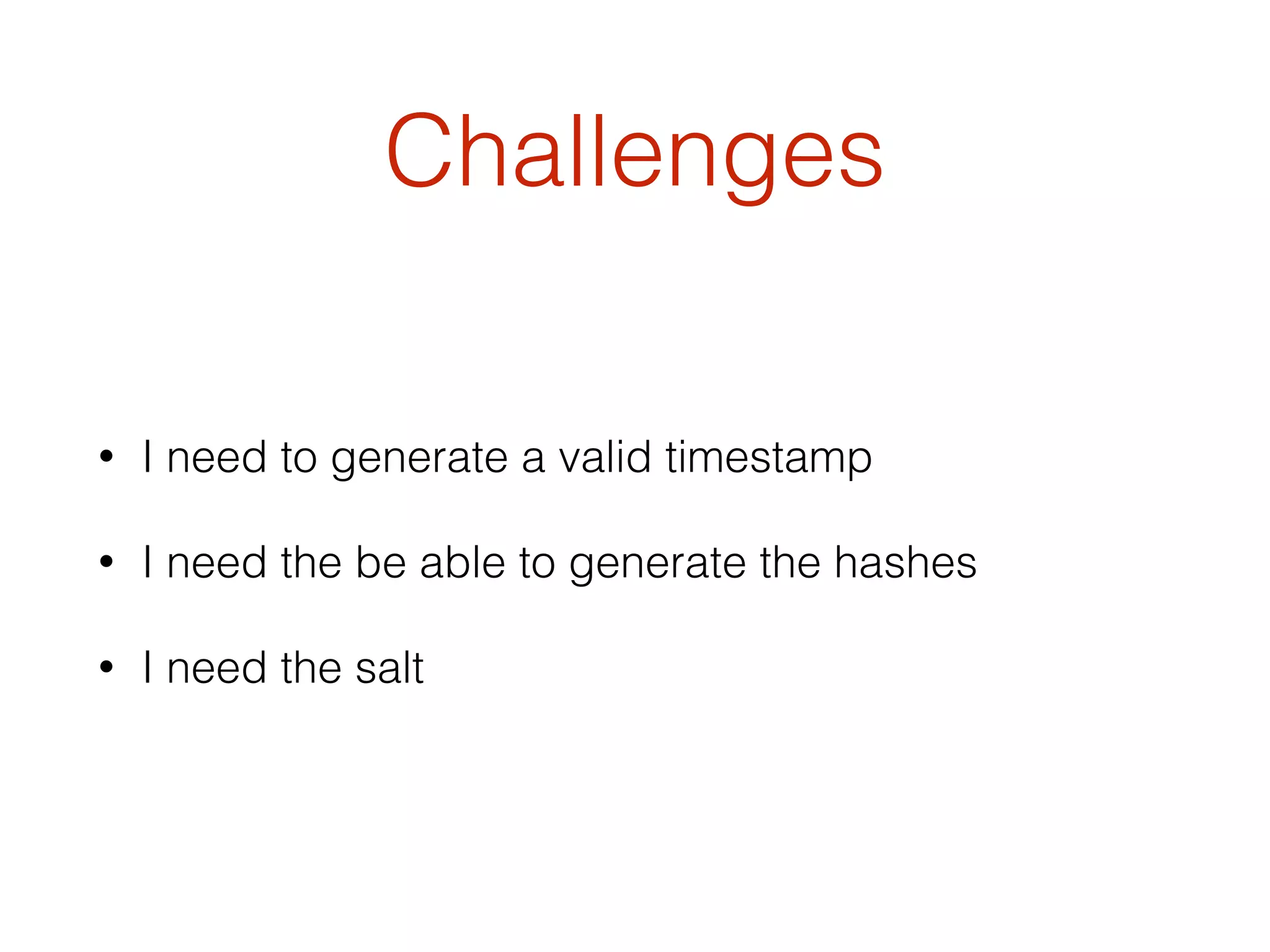
• I need to generate a valid timestamp
• I need the be able to generate the hashes
• I need the salt
Let’s try…
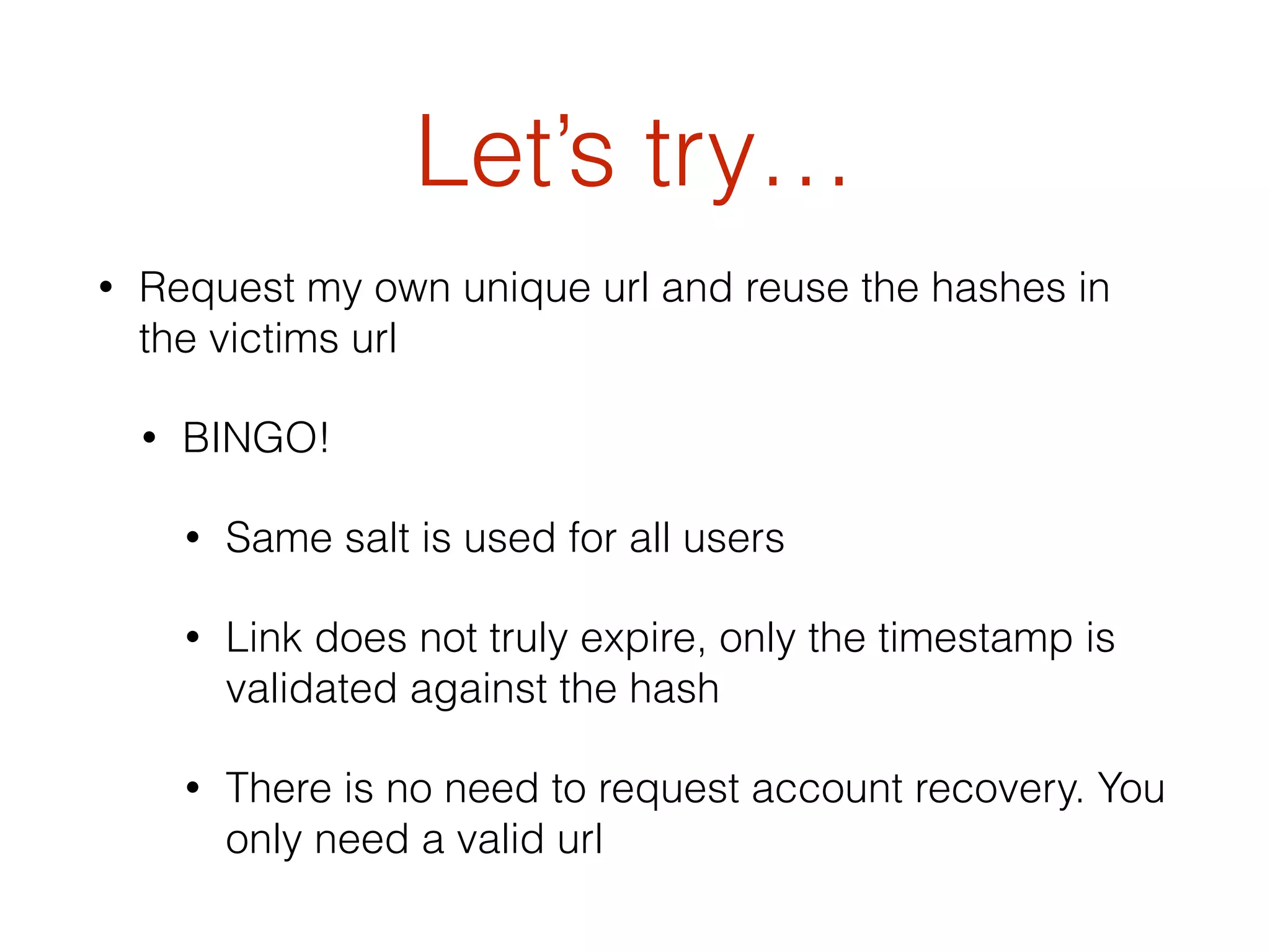
• Request my own unique url and reuse the hashes in
the victims url
• BINGO!
• Same salt is used for all users
• Link does not truly expire, only the timestamp is
validated against the hash
• There is no need to request account recovery. You
only need a valid url
The salt is the secret
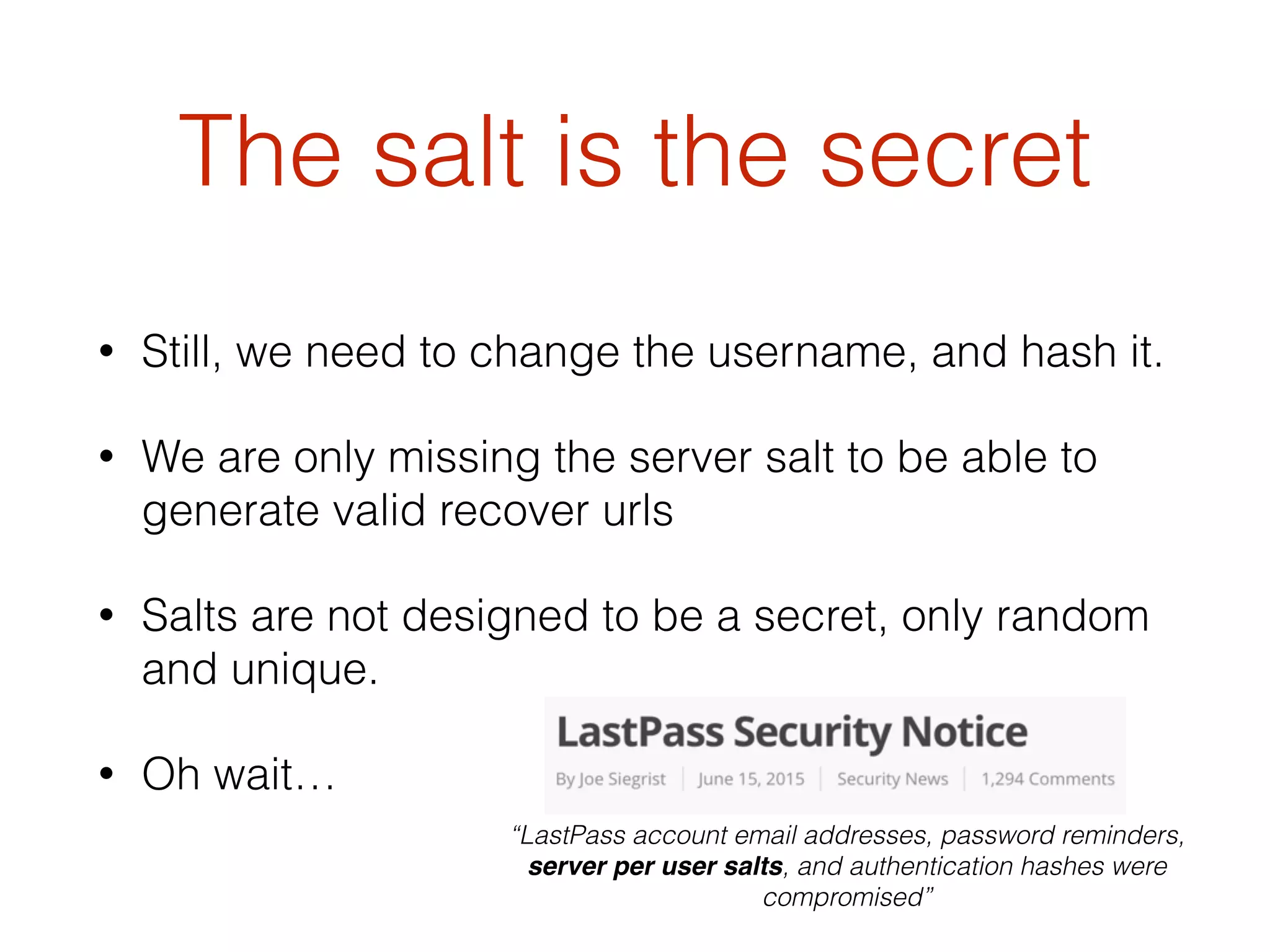
• Still, we need to change the username, and hash it.
• We are only missing the server salt to be able to
generate valid recover urls
• Salts are not designed to be a secret, only random
and unique.
• Oh wait…
“LastPass account email addresses, password reminders,
server per user salts, and authentication hashes were
compromised”
Can I forge the post
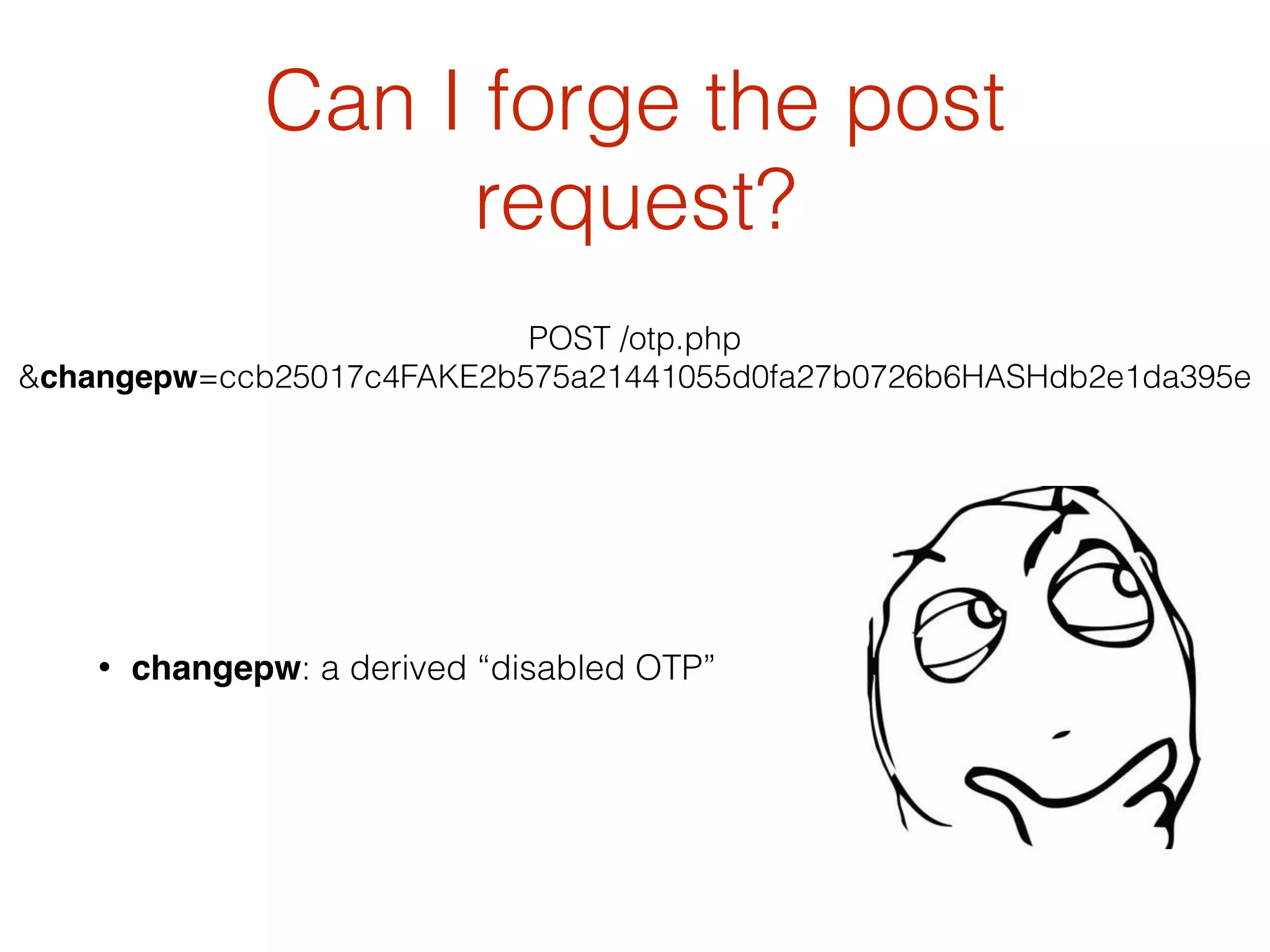
request?
• changepw: a derived “disabled OTP”
POST /otp.php
&changepw=ccb25017c4FAKE2b575a21441055d0fa27b0726b6HASHdb2e1da395e
OTPs in LastPass
• 2 types of OTPs
• “True” OTPs for authentication
• “Disabled” OTP
• Let’s call it dOTP
Disabled OTP
• Used to recover the vault
• Which ultimately means for authentication
• It’s set by default
• It’s not the encryption key
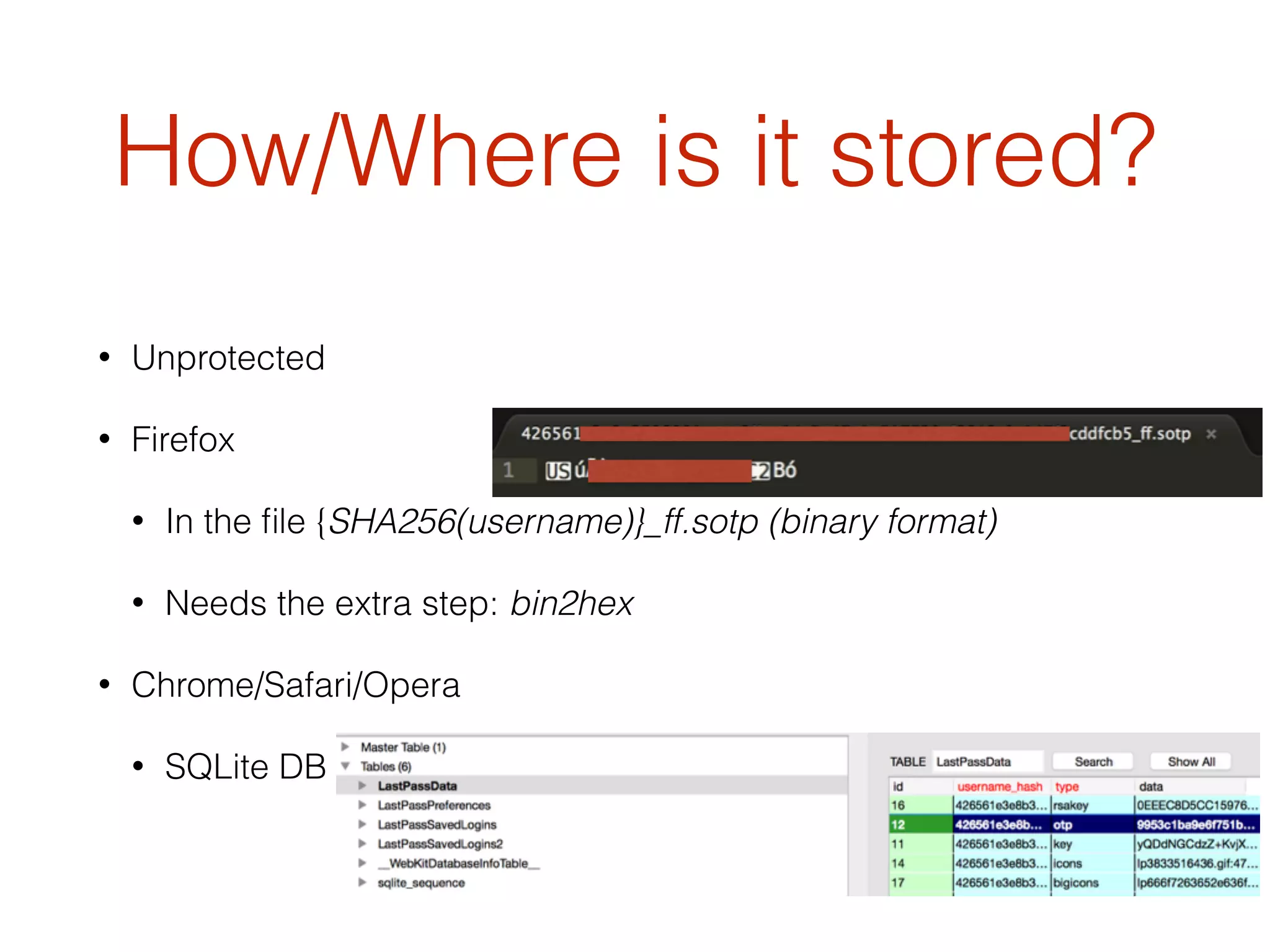
How/Where is it stored?
• Unprotected
• Firefox
• In the file {SHA256(username)}_ff.sotp (binary format)
• Needs the extra step: bin2hex
• Chrome/Safari/Opera
• SQLite DB
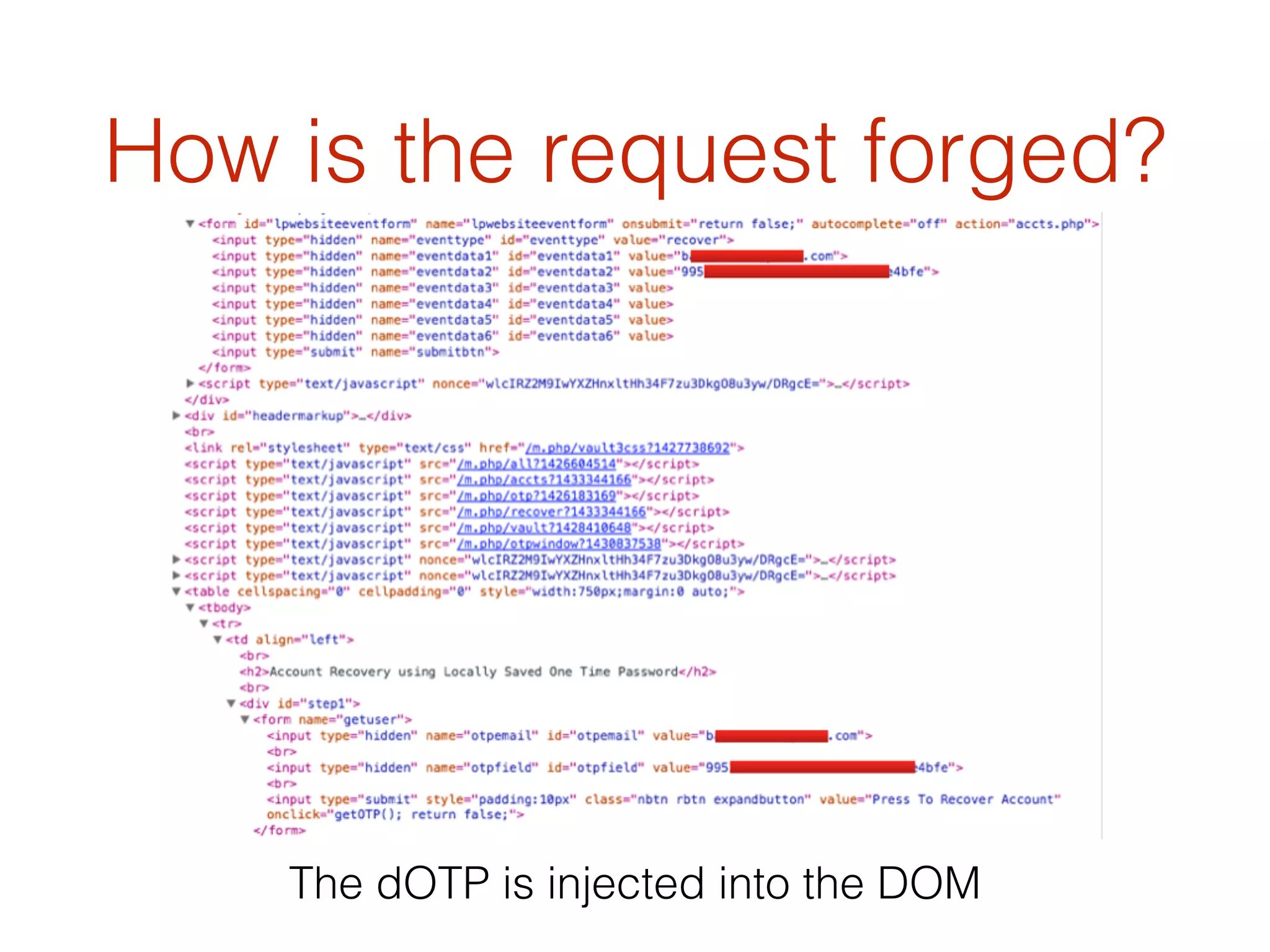
How is the request forged?
The dOTP is injected into the DOM
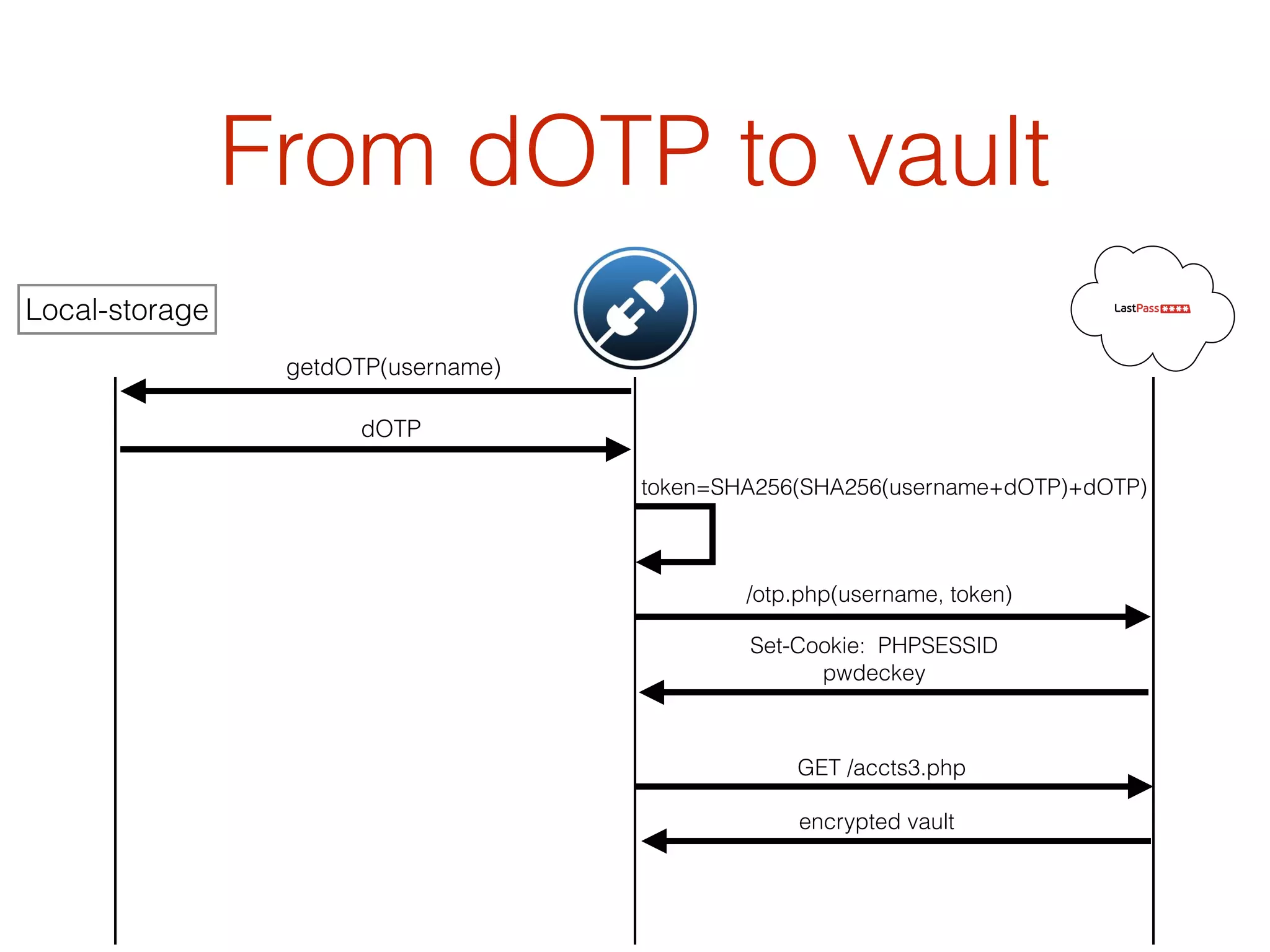
From dOTP to vault
Local-storage
getdOTP(username)
dOTP
token=SHA256(SHA256(username+dOTP)+dOTP)
/otp.php(username, token)
Set-Cookie: PHPSESSID
pwdeckey
GET /accts3.php
encrypted vault
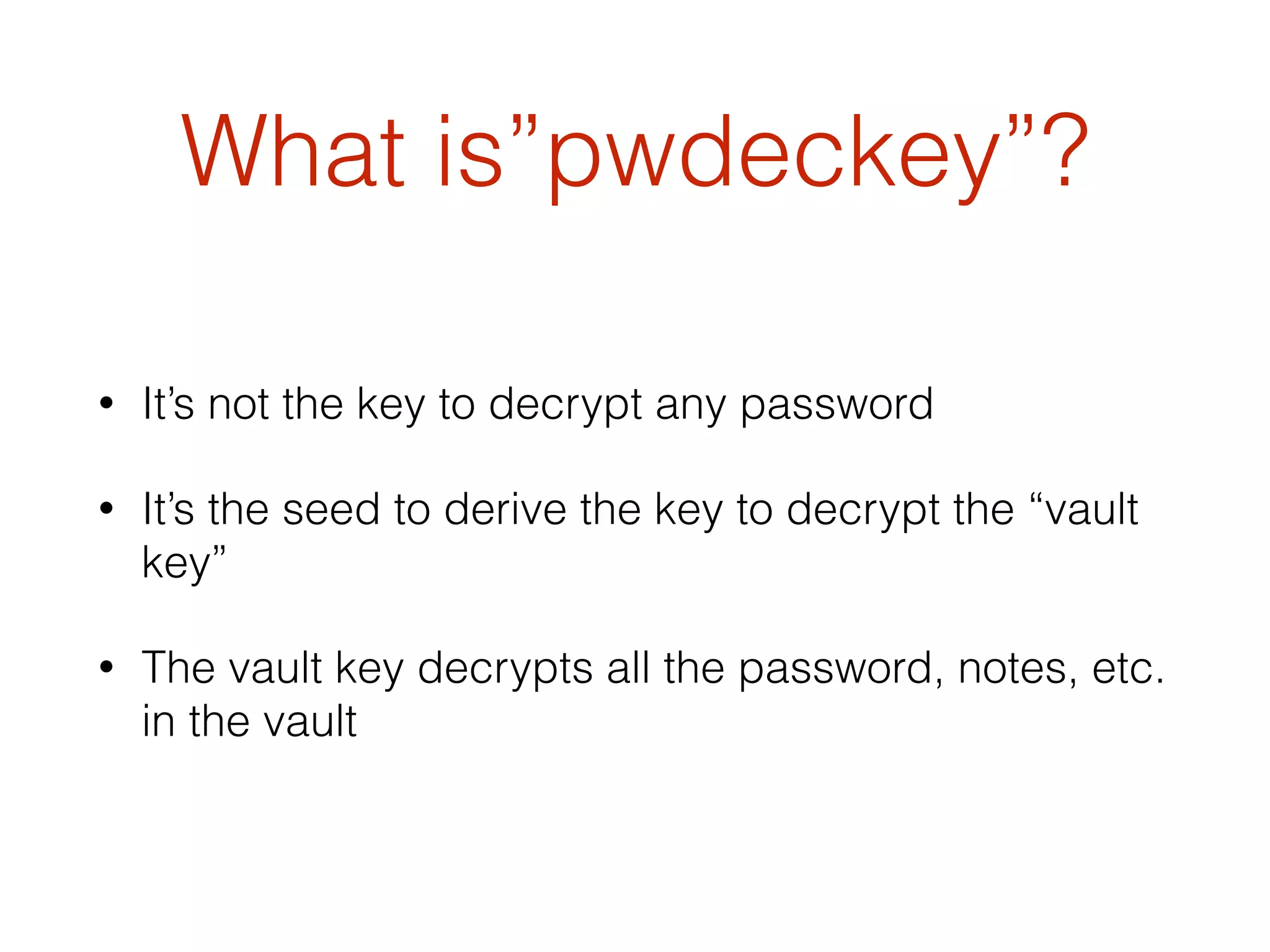
What is”pwdeckey”?
• It’s not the key to decrypt any password
• It’s the seed to derive the key to decrypt the “vault
key”
• The vault key decrypts all the password, notes, etc.
in the vault
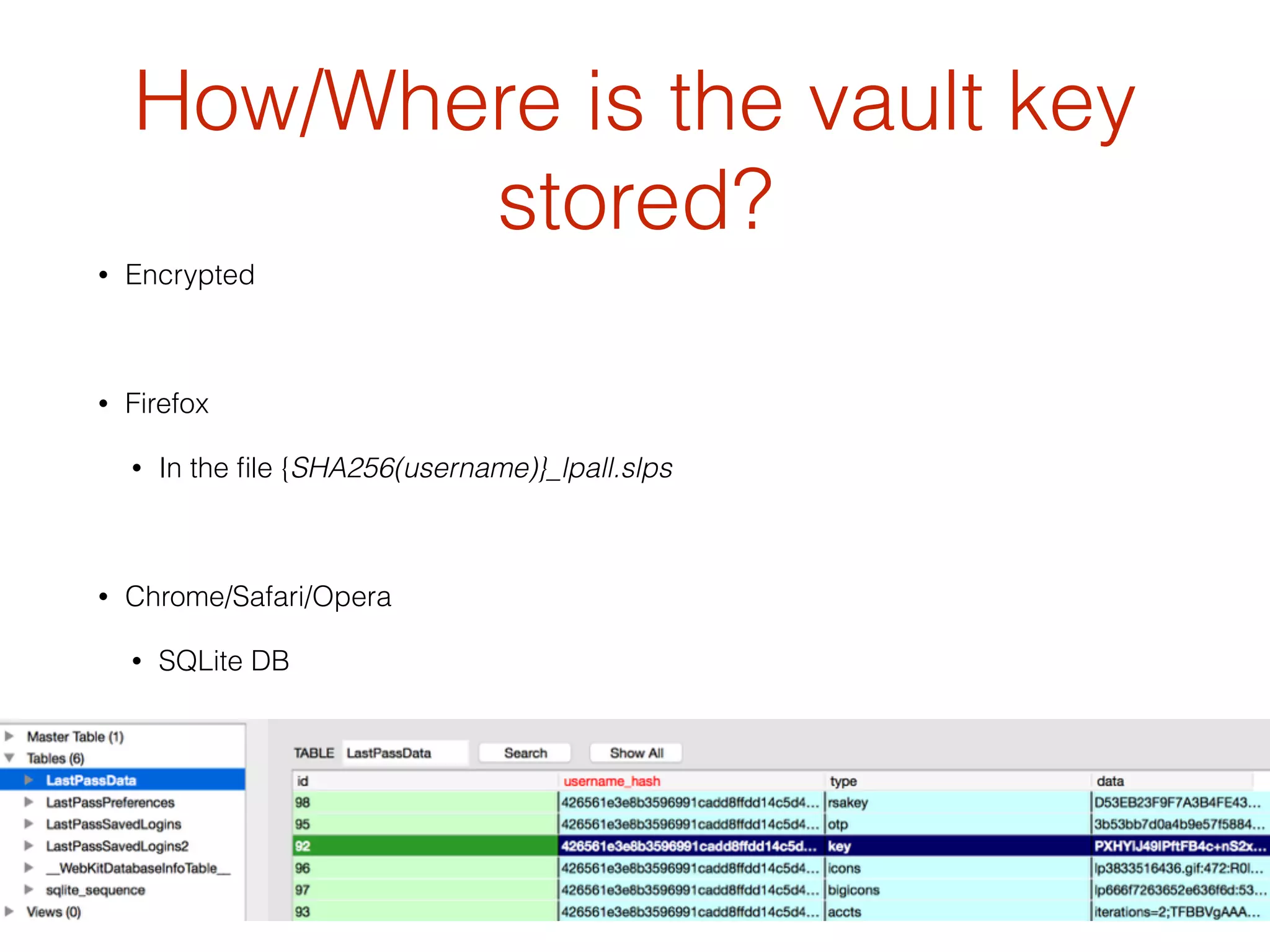
How/Where is the vault key
stored?
• Encrypted
• Firefox
• In the file {SHA256(username)}_lpall.slps
• Chrome/Safari/Opera
• SQLite DB
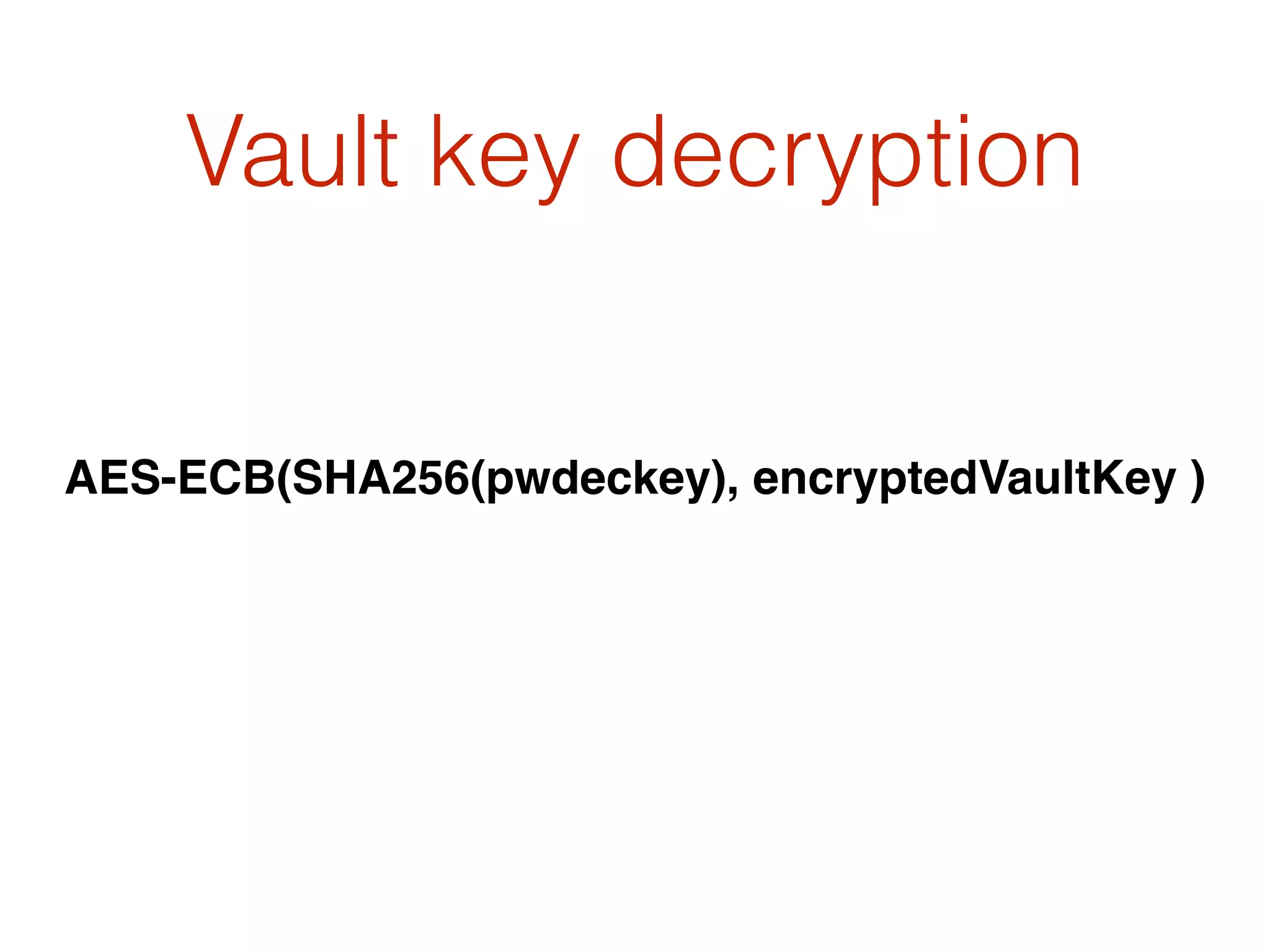
AES-ECB(SHA256(pwdeckey), encryptedVaultKey )
Vault key decryption
Profit!
• We located the token
• We know how to hash it
• We get the vault key
decryption key
• We get the vault
• We decrypt the vault key
• We decrypt the vault
Automating all the stuff
Metasploit module
• Steals and decrypts the master
password
• Steals the 2-factor auth token
• Steals the encryption key
• Decrypts the entire vault
• Supports:
• Win, Mac and Unix
• Chrome, Firefox, Safari and Opera
• Meterpreter and shell
• Multiuser
Demo
What about if there is:
No disabled OTP
No access to the machine
No Exploit
No nothing!
Google dorks
“extensions.lastpass.loginpws”
Stop sharing your LastPass
credentials with the entire world!!!!
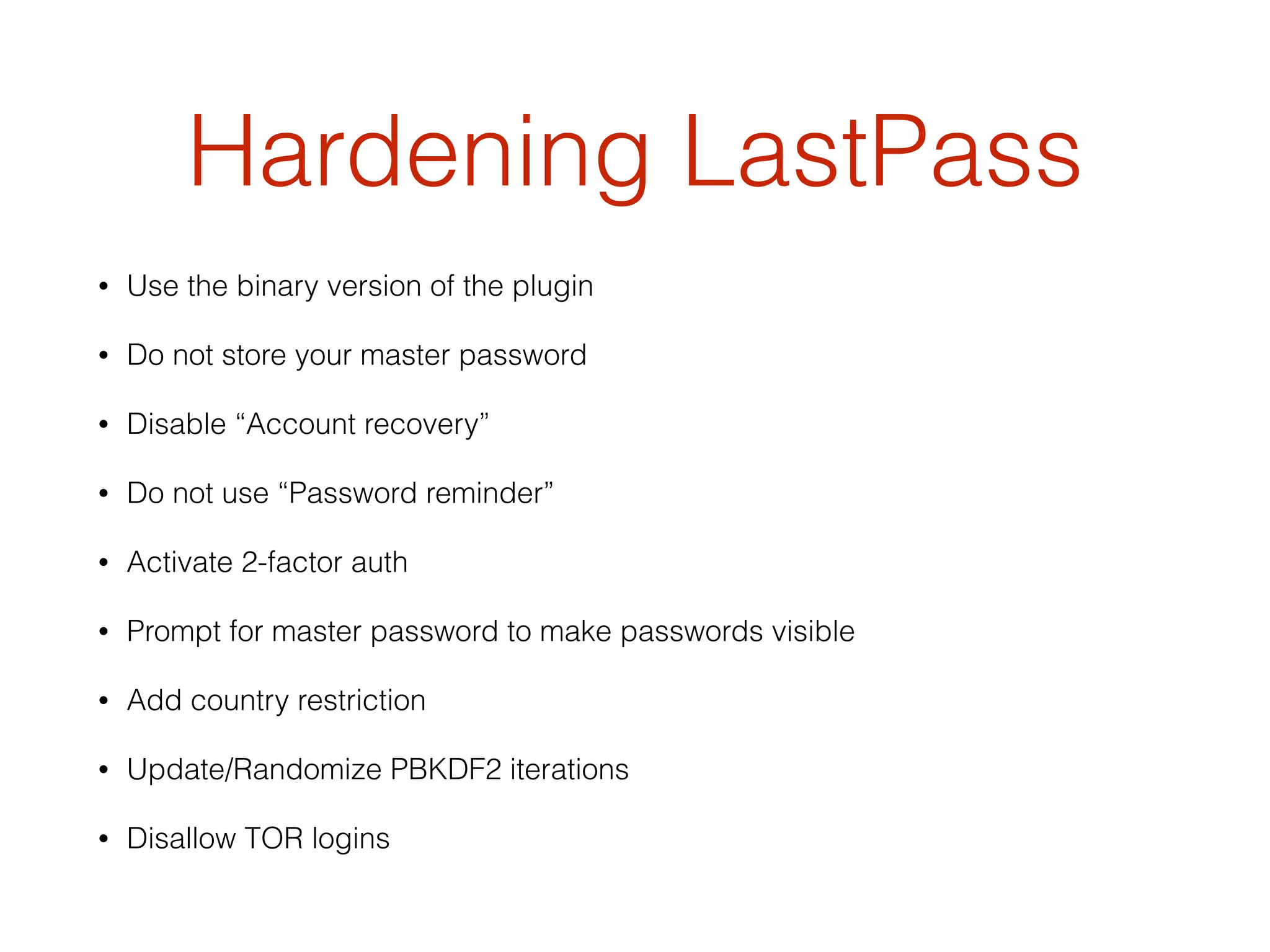
Hardening LastPass
Hardening LastPass
• Use the binary version of the plugin
• Do not store your master password
• Disable “Account recovery”
• Do not use “Password reminder”
• Activate 2-factor auth
• Prompt for master password to make passwords visible
• Add country restriction
• Update/Randomize PBKDF2 iterations
• Disallow TOR logins
Thank you!
Questions?
@martin_vigo
martinvigo.com
martinvigo@gmail.com

Breaking Vaults - Stealing Lastpass Protected Secrets by Martin Vigo

  • 1.
    Breaking Vaults Stealing LastPassprotected secrets Martin Vigo @martin_vigo martinvigo.com
  • 2.
    Who am I •Product Security Engineer • Spaniard / Galician • Diver • Gin tonic consumer • @martin_vigo / martinvigo.com Most beautiful beach in the world Amazing seafood Charlie Sheen’s grandfather was Galician
  • 3.
    Wikipedia “LastPass is apassword management service which seeks to resolve the password fatigue problem by centralizing user password management in the cloud”
  • 4.
  • 5.
    Why targeting Password Managers? •All you want to hack is in one place • Social Networks • Banks • Email accounts • Corporate credentials
  • 6.
    Why LastPass? • Enterpriseedition • Large companies use it • “More than 10,000 corporate customers ranging in size all the way up to the Fortune 500” • Not only credentials • Credit Cards, Personal documentation, Private notes, etc. • Arguably the most popular password manager
  • 7.
    State of theart • Vulnerabilities • DNS poisoning • XSS form injection All focus on leaking specific secrets
  • 8.
    Target: Master Password Allyour secrets are belong to us
  • 9.
  • 10.
  • 11.
    Browser Plugin • Javascript •Sandboxed (SOP) • Injects code into DOM • Access to filesystem
  • 12.
    Security claims • LastPasshas no access to your data • Local encryption • Secure storage
  • 13.
    Reversing Meaning making senseof 3MB of obfuscated JS
  • 14.
    siesta.py • Beautifies everyJS file • Injects a payload to every function • console.log([file] [function] [params]) • Credits to Alberto Garcia (@algillera)
  • 15.
    • Identified allaccessed files • Minimized JS • Storage on Sqlite DBs • Browser specific implementation • Business logic • File location • Storage • AES own implementation • RSA is based on jsbn library Logic and storage
  • 16.
    Local encryption • 256-bitAES • CBC and ECB • Their own implementation • PBKDF2 • 500 / 5000 rounds (default) • Unauthenticated query
  • 17.
    Encryption key PBKDF2(SHA-256, Username,Master Password, Iterations, 32) Salt Password key length
  • 18.
    LastPass has noaccess to your data PBKDF2(SHA-256, Master Password, k, 1, 32) E/D(k, vault) Encrypted Vault Encrypted Vault PBKDF2(SHA-256, Per user salt, k’, 100000, 32)
  • 19.
    What does LastPasssee? The encrypted vault A 1-round PBKDF2-SHA256 of the encryption key
  • 20.
  • 21.
    Remember password • Storesthe password locally • Sqlite DB or prefs.js • ECB or CBC • u7W1PsEYsWrtAS1Ca7lOOH== • !waXcJg8b7wI8XYZnV2l45A==|4d0Hiq+spx50pso2tEMtkQ==
  • 22.
    Storage Chrome Firefox SafariOpera Windows #{user_profile['LocalApp Data']}/Google/Chrome/ User Data/Default/ databases/chrome- extension_hdokiejnpimak edhajhdlcegeplioahd_0 #{user_profile[ 'AppData']}/ Mozilla/ Firefox/Profiles #{user_profile['LocalAppData ']}/Apple Computer/Safari/ Databases/safari- extension_com.lastpass.lpsaf ariextension-n24rep3bmn_0 #{user_profile['AppData']}/ Opera Software/Opera Stable/databases/chrome- extension_hnjalnkldgigidg gphhmacmimbdlafdo_0 Mac #{user_profile['LocalApp Data']}/Google/Chrome/ Default/databases/ chrome- extension_hdokiejnpimak edhajhdlcegeplioahd_0 #{user_profile[' LocalAppData'] }/Firefox/ Profiles #{user_profile['AppData']}/ Safari/Databases/safari- extension_com.lastpass.lpsaf ariextension-n24rep3bmn_0 #{user_profile['LocalAppData'] }/com.operasoftware.Opera/ databases/chrome- extension_hnjalnkldgigidggph hmacmimbdlafdo_0 Unix #{user_profile['LocalApp Data']}/.config/google- chrome/Default/ databases/chrome- extension_hdokiejnpimak edhajhdlcegeplioahd_0 #{user_profile[' LocalAppData'] }/.mozilla/firefox #{user_profile[‘LocalApp Data’]}/.opera/widgets/ wuid-*/pstorage
  • 23.
    SQLite DB • LastPassSavedLogins2contains the encrypted credentials • No root needed
  • 24.
    prefs.js (Firefox) • extensions.lastpass.loginuserscontains the usernames • extensions.lastpass.loginpws contains encrypted passwords • No root needed
  • 25.
    Master password encryption •AES-256 • IV: Random • KEY: SHA256(username) • Data: !L5b/dOyu4EMdmWCYkASQaw==|cHTFJDy1DQi8dPY0AJL/1B= IV 24 chars (ignoring !) Separator 26th char Data Starting 27th char MP encryption key Vault encryption key
  • 26.
    Profit! • We locatedthe files • We know the encryption system • We have the IV • We have the key • We have the data
  • 27.
    What about 2factor auth?
  • 28.
  • 29.
    2-factor auth • Supportsmultiple platforms • Google Auth, Yubikey, Toopher, etc.
  • 30.
    UUID is the“trust token”
  • 32.
    What’s going on? •How is the request forged? • How is the token generated? • How is it stored? • Where is it stored?
  • 33.
    How is therequest forged? The token is injected into the DOM
  • 34.
    How is thetoken generated? • At plugin installation 32 chars length • 0-9 A-Z a-z !@#$%^&*()_ length lowercase? uppercase? digits? special chars? min digits ambiguous chars? make pronounceable?
  • 35.
    How/Where is itstored? • In plaintext • Firefox • In the file “lp.suid” • Chrome/Safari/Opera • Local-storage SQLite DB
  • 36.
    Design Problems? • Browsersdon’t encrypt local storage • LocalStorage DB and lp.suid are accessible and unencrypted • The token is stored in plaintext • Token is injected in DOM • XSS means game over
  • 37.
    More problems • Sametoken for all browser users • Fixed token till plugin is reinstalled • Untrusting the browser has no real effect • Same token when changing QR Code • Token fixation • Attacker can set a token on the client • Proactive token stealing • Steal token today, use it tomorrow
  • 38.
    Profit! • We havethe file • We know the encryption • We have the data • We have the IV • We have the key • We have the 2-factor token
  • 39.
    What about if: “Rememberpassword” was not clicked There was no way to obtain 2-factor auth token
  • 40.
  • 41.
    Wait… What? How isaccount recovery possible if LastPass does not know my password?
  • 42.
  • 43.
  • 44.
  • 45.
    Boom! • Full, unrestrictedaccess to the vault • Attacker can set a new password • But does not have to! • Bypasses 2 factor-auth
  • 46.
    Recover account flow Email GET/s/?s=8aa37bb1bb3FAKE03ad4127 302 Location: /recover.php? &time=1412381291&timehash=340908c353c099c9FAKE6b387002c5a4881ebdf1 &username=test%40test.com&usernamehash=fc7be7e5f6cbec9FAKE2995bd3331c097 POST /otp.php &changepw=ccb2501724FAKE2b575a214e1052 d0fa27b0726b6HASHdb2e1da3952e Recover button
  • 47.
    Can I directlygenerate the recover url? • time: timestamp when the recovery was initiated (the link “expires” in 2 hours) • timehash: salted hash of the timestamp • username: the email address • usernamehash: salted hash of the email 302 Location: /recover.php? &time=1412381291&timehash=340908c353c099c9FAKE6b387002c5a4881ebdf1 &username=test%40test.com&usernamehash=fc7be7e5f6cbec9FAKE2995bd3331c097
  • 48.
    Challenges • I needto generate a valid timestamp • I need the be able to generate the hashes • I need the salt
  • 49.
    Let’s try… • Requestmy own unique url and reuse the hashes in the victims url • BINGO! • Same salt is used for all users • Link does not truly expire, only the timestamp is validated against the hash • There is no need to request account recovery. You only need a valid url
  • 50.
    The salt isthe secret • Still, we need to change the username, and hash it. • We are only missing the server salt to be able to generate valid recover urls • Salts are not designed to be a secret, only random and unique. • Oh wait… “LastPass account email addresses, password reminders, server per user salts, and authentication hashes were compromised”
  • 51.
    Can I forgethe post request? • changepw: a derived “disabled OTP” POST /otp.php &changepw=ccb25017c4FAKE2b575a21441055d0fa27b0726b6HASHdb2e1da395e
  • 52.
    OTPs in LastPass •2 types of OTPs • “True” OTPs for authentication • “Disabled” OTP • Let’s call it dOTP
  • 53.
    Disabled OTP • Usedto recover the vault • Which ultimately means for authentication • It’s set by default • It’s not the encryption key
  • 54.
    How/Where is itstored? • Unprotected • Firefox • In the file {SHA256(username)}_ff.sotp (binary format) • Needs the extra step: bin2hex • Chrome/Safari/Opera • SQLite DB
  • 55.
    How is therequest forged? The dOTP is injected into the DOM
  • 56.
    From dOTP tovault Local-storage getdOTP(username) dOTP token=SHA256(SHA256(username+dOTP)+dOTP) /otp.php(username, token) Set-Cookie: PHPSESSID pwdeckey GET /accts3.php encrypted vault
  • 57.
    What is”pwdeckey”? • It’snot the key to decrypt any password • It’s the seed to derive the key to decrypt the “vault key” • The vault key decrypts all the password, notes, etc. in the vault
  • 58.
    How/Where is thevault key stored? • Encrypted • Firefox • In the file {SHA256(username)}_lpall.slps • Chrome/Safari/Opera • SQLite DB
  • 59.
  • 60.
    Profit! • We locatedthe token • We know how to hash it • We get the vault key decryption key • We get the vault • We decrypt the vault key • We decrypt the vault
  • 61.
  • 62.
    Metasploit module • Stealsand decrypts the master password • Steals the 2-factor auth token • Steals the encryption key • Decrypts the entire vault • Supports: • Win, Mac and Unix • Chrome, Firefox, Safari and Opera • Meterpreter and shell • Multiuser
  • 63.
  • 64.
    What about ifthere is: No disabled OTP No access to the machine No Exploit No nothing!
  • 65.
  • 66.
  • 67.
    Stop sharing yourLastPass credentials with the entire world!!!!
  • 68.
  • 69.
    Hardening LastPass • Usethe binary version of the plugin • Do not store your master password • Disable “Account recovery” • Do not use “Password reminder” • Activate 2-factor auth • Prompt for master password to make passwords visible • Add country restriction • Update/Randomize PBKDF2 iterations • Disallow TOR logins
  • 70.