Third Party Auth in WO
Joe Little and Daniel Beatty
Authentication Methods
•   Storing passwords in your DB (Model)
•   Authenticating against LDAP services
•   LDAP via your Model and hybrid solutions
•   Kerberos/SSO and hybrid redux
•   WebAuth and gateway solutions
•   Shibboleth and the future
Auth in DB

•   The default approach
•   With little database security, the hash must be secure
•   SHA-1 (160) or SHA-2 (256) and friends
•   Sample code...
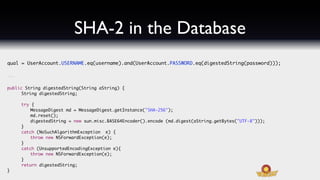
SHA-2 in the Database
qual = UserAccount.USERNAME.eq(username).and(UserAccount.PASSWORD.eq(digestedString(password)));

....


public String digestedString(String aString) {
	     String digestedString;
	
	     try {
	   	     MessageDigest md = MessageDigest.getInstance("SHA-256");
	   	     md.reset();
	   	     digestedString = new sun.misc.BASE64Encoder().encode (md.digest(aString.getBytes("UTF-8")));
	     }
	     catch (NoSuchAlgorithmException e) {
	   	     throw new NSForwardException(e);
	     }
	     catch (UnsupportedEncodingException e){
	   	     throw new NSForwardException(e);
	     }
	     return digestedString;
}
LDAP
•   JNDI can be used for EOs, but NOT for passwords!
•   Generally restricted by sites LDAP configuration
•   Standard method is to try a “simple bind” against LDAP
    •   LDAPS:// - Port 636 if possible (SSL), DIGEST otherwise
    •   StartTLS is not an option
    •   http://java.sun.com/products/jndi/tutorial/ldap/security/ssl.html
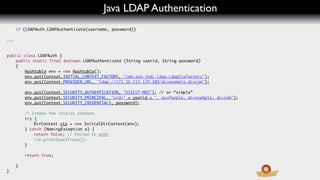
Java LDAP Authentication
      if (LDAPAuth.LDAPAuthenticate(username, password))

...


public class LDAPAuth {
	   public static final boolean LDAPAuthenticate (String userid, String password)
	   {
	   	   Hashtable env = new Hashtable();
	   	   env.put(Context.INITIAL_CONTEXT_FACTORY, "com.sun.jndi.ldap.LdapCtxFactory");
	   	   env.put(Context.PROVIDER_URL, "ldap://172.16.113.129:389/dc=example,dc=com");

	     	   env.put(Context.SECURITY_AUTHENTICATION, "DIGEST-MD5"); // or “simple”
	     	   env.put(Context.SECURITY_PRINCIPAL, "uid=" + userid + ", ou=People, dc=example, dc=com");
	     	   env.put(Context.SECURITY_CREDENTIALS, password);

	     	   // Create the initial context
	     	   try {
	     	   	   DirContext ctx = new InitialDirContext(env);
	     	   } catch (NamingException e) {
	     	   	   return false; // Failed to auth
	     	   	   //e.printStackTrace();
	     	   }
	     	
	     	   return true;

	     }
}
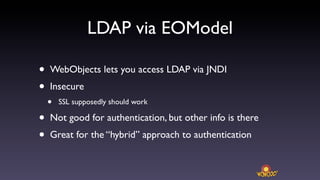
LDAP via EOModel

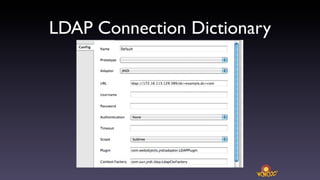
•   WebObjects lets you access LDAP via JNDI
•   Insecure
    •   SSL supposedly should work

•   Not good for authentication, but other info is there
•   Great for the “hybrid” approach to authentication
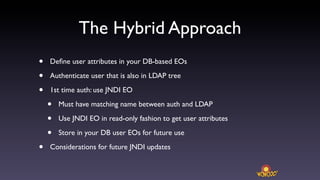
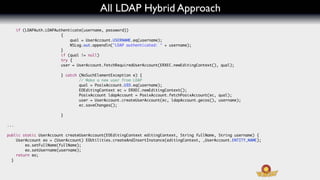
The Hybrid Approach
•   Define user attributes in your DB-based EOs

•   Authenticate user that is also in LDAP tree

•   1st time auth: use JNDI EO

    •   Must have matching name between auth and LDAP

    •   Use JNDI EO in read-only fashion to get user attributes

    •   Store in your DB user EOs for future use

•   Considerations for future JNDI updates
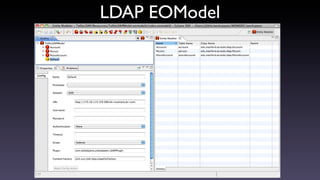
LDAP EOModel
LDAP Connection Dictionary
All LDAP Hybrid Approach
      if (LDAPAuth.LDAPAuthenticate(username, password))
                  	   	   {
                  	   	   	   qual = UserAccount.USERNAME.eq(username);
                  	   	   	   NSLog.out.appendln("LDAP authenticated: " + username);
                  	   	   }
                  	   	   if (qual != null)
                  	   	   try {
                  	   	   user = UserAccount.fetchRequiredUserAccount(ERXEC.newEditingContext(), qual);

                         } catch (NoSuchElementException e) {
                                 // Make a new user from LDAP
                         	   	   qual = PosixAccount.UID.eq(username);
                         	   	   EOEditingContext ec = ERXEC.newEditingContext();
                         	   	   PosixAccount ldapAccount = PosixAccount.fetchPosixAccount(ec, qual);
                         	   	   user = UserAccount.createUserAccount(ec, ldapAccount.gecos(), username);
                         	   	   ec.saveChanges();
                         	   	
                         }

...

public static UserAccount createUserAccount(EOEditingContext editingContext, String fullName, String username) {
    UserAccount eo = (UserAccount) EOUtilities.createAndInsertInstance(editingContext, _UserAccount.ENTITY_NAME);
	   	   eo.setFullName(fullName);
	   	   eo.setUsername(username);
    return eo;
  }
SSO: Kerberos

•   Many Single-Sign On (SSO) solutions

•   Kerberos / Active Directory are most common today

•   AD and OpenDirectory marry LDAP w/ Kerberos: hybrid!

•   Heavily tied into Java Crypto APIs, so Frustration-By-Design

•   Remember to set classes.include.patternset in woproject to have “**/*.conf”

•   Best seen by example... (Thanks Mike!)
Kerberos Methods

    public class KerberosAuth {

	   static final String krbPath = "/Library/Preferences/edu.mit.Kerberos";
	   public static final boolean KerberosAuthenticate (String userid, char[] password)
	   {
	   	   System.setProperty("java.security.krb5.conf", krbPath);
	   	   System.setProperty("java.security.auth.login.config", KerberosAuth.class.getResource("/kerberos.conf").toExternalForm());
	   	   try {
	   	   	   LoginContext lc = new LoginContext("primaryLoginContext", new UserNamePasswordCallbackHandler(userid, password));
	   	   	   lc.login();
	   	   	   }
	   	   	   catch (LoginException e) {
	   	   	   	   // e.printStackTrace();
	   	   	   	   return false; // Consider all failures as equal
	   	       }
	   	   return true;
	   }
Kerberos Method Part 2

public static class UserNamePasswordCallbackHandler implements CallbackHandler {
	
	   	   private String _userName;
	   	   private char[] _password;
	
	   	   public UserNamePasswordCallbackHandler(String userName, char[] password) {
	   	   	   _userName = userName;
	   	   	   _password = password;
	   	   }
	
	       public void handle(Callback[] callbacks) throws IOException, UnsupportedCallbackException {
	       	     for (Callback callback : callbacks) {
	       	   	   if (callback instanceof NameCallback && _userName != null) {
	       	   	   	   ((NameCallback) callback).setName(_userName);
	       	   	   }
	       	   	   else if (callback instanceof PasswordCallback && _password != null) {
	       	   	   	   ((PasswordCallback) callback).setPassword(_password);
	       	   	   }
	       	     }
	       }
	   }
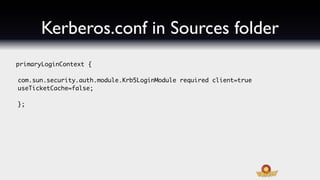
Kerberos.conf in Sources folder
primaryLoginContext {

com.sun.security.auth.module.Krb5LoginModule required client=true
useTicketCache=false;

};
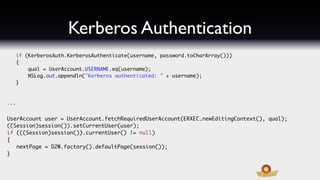
Kerberos Authentication
  if (KerberosAuth.KerberosAuthenticate(username, password.toCharArray()))
  {
      qual = UserAccount.USERNAME.eq(username);
      NSLog.out.appendln("Kerberos authenticated: " + username);
  }


...


UserAccount user = UserAccount.fetchRequiredUserAccount(ERXEC.newEditingContext(), qual);
((Session)session()).setCurrentUser(user);
if (((Session)session()).currentUser() != null)
{
   nextPage = D2W.factory().defaultPage(session());
}
Demo and Review
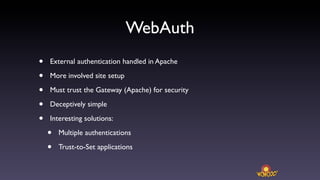
WebAuth
•   External authentication handled in Apache

•   More involved site setup

•   Must trust the Gateway (Apache) for security

•   Deceptively simple

•   Interesting solutions:

    •   Multiple authentications

    •   Trust-to-Set applications
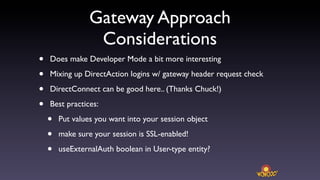
Gateway Approach
                  Considerations
•   Does make Developer Mode a bit more interesting

•   Mixing up DirectAction logins w/ gateway header request check

•   DirectConnect can be good here.. (Thanks Chuck!)

•   Best practices:

    •   Put values you want into your session object

    •   make sure your session is SSL-enabled!

    •   useExternalAuth boolean in User-type entity?
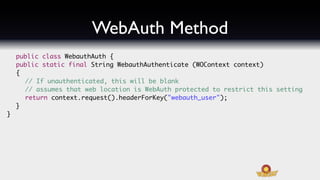
WebAuth Method
    public class WebauthAuth {
	   public static final String WebauthAuthenticate (WOContext context)
	   {	
	   	 // If unauthenticated, this will be blank
	   	 // assumes that web location is WebAuth protected to restrict this setting
	   	 return context.request().headerForKey("webauth_user");
	   }
}
Which brings us too...

“Gilead then cut Ephraim off from the fords of the Jordan, and whenever
Ephraimite fugitives said, 'Let me cross,' the men of Gilead would ask, 'Are you
an Ephraimite?' If he said, 'No,' they then said, 'Very well, say
"Shibboleth" (‫ '.)שיבולת‬If anyone said, "Sibboleth" (‫ ,)סיבולת‬because he could
not pronounce it, then they would seize him and kill him by the fords of the
Jordan. Forty-two thousand Ephraimites fell on this occasion.”
Shibboleth Topics

•   Shibboleth Authentication Point of View

•   Federated Frameworks

•   How is IdP put together

•   General Shibboleth Service Provision Scenario

•   Classic Computer Security
The Shibboleth Point of View

•   Stone Age: Application maintains unique credential and identity
    information for each user.

•   Bronze Age: Credentials are centralized but applications maintain
    all user identity information

•   Iron Age: Credentials and core identity information are
    centralized and application maintains only app-specific user data.
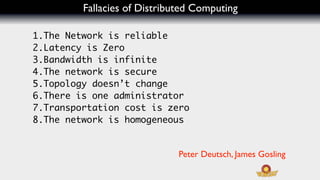
Fallacies of Distributed Computing

1.The Network is reliable
2.Latency is Zero
3.Bandwidth is infinite
4.The network is secure
5.Topology doesn’t change
6.There is one administrator
7.Transportation cost is zero
8.The network is homogeneous


                              Peter Deutsch, James Gosling
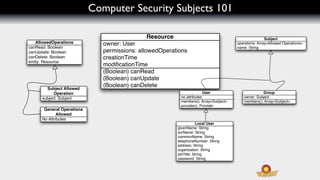
Computer Security Subjects 101

                                              Resource                                                Subject
    AllowedOperations          owner: User                                            operations: Array<Allowed Operations>
canRead: Boolean                                                                      name: String
canUpdate: Boolean             permissions: allowedOperations
canDelete: Boolean             creationTime
entity: Resource
                               modificationTime
                               (Boolean) canRead
                               (Boolean) canUpdate
        Subject Allowed
                               (Boolean) canDelete
            Operation                                                 User                         Group
      subject: Subject                                    no attributes                  owner: Subject
                                                          members(): Array<Subject>      members(): Array<Subject>
                                                          provider(): Provider
       General Operations
              Allowed
      No Attributes
                                                                     Local User
                                                         givenName: String
                                                         surName: String
                                                         commonName: String
                                                         telephoneNumber: String
                                                         address: String
                                                         organization: String
                                                         jobTitle: String
                                                         password: String
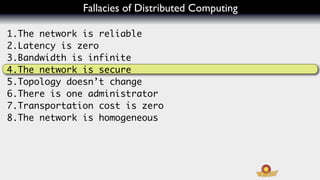
Fallacies of Distributed Computing

1.The network is reliable
2.Latency is zero
3.Bandwidth is infinite
4.The network is secure
5.Topology doesn’t change
6.There is one administrator
7.Transportation cost is zero
8.The network is homogeneous
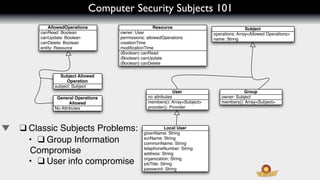
Computer Security Subjects 101
           AllowedOperations                        Resource                                  Subject
       canRead: Boolean              owner: User                              operations: Array<Allowed Operations>
       canUpdate: Boolean            permissions: allowedOperations           name: String
       canDelete: Boolean            creationTime
       entity: Resource              modificationTime
                                     (Boolean) canRead
                                     (Boolean) canUpdate
                                     (Boolean) canDelete

               Subject Allowed
                   Operation
             subject: Subject
                                                             User                          Group
              General Operations                  no attributes                  owner: Subject
                     Allowed                      members(): Array<Subject>      members(): Array<Subject>
             No Attributes                        provider(): Provider


! ❑!Classic Subjects Problems:                              Local User
                                                givenName: String
  ! •! ❑!Group Information                      surName: String
                                                commonName: String
    Compromise                                  telephoneNumber: String
                                                address: String

  ! •! ❑!User info compromise                   organization: String
                                                jobTitle: String
                                                password: String
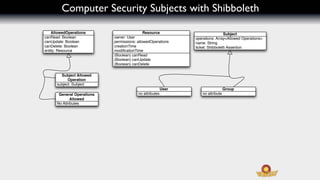
Computer Security Subjects with Shibboleth

    AllowedOperations                      Resource                              Subject
canRead: Boolean            owner: User                         operations: Array<Allowed Operations>
canUpdate: Boolean          permissions: allowedOperations      name: String
canDelete: Boolean          creationTime                        ticket: Shibboleth Assertion
entity: Resource            modificationTime
                            (Boolean) canRead
                            (Boolean) canUpdate
                            (Boolean) canDelete

        Subject Allowed
            Operation
      subject: Subject
                                                         User                     Group
       General Operations                no attributes             no attribute
              Allowed
      No Attributes
Federated Identity Frameworks


•   Shibboleth (http://shibboleth.internet2.edu/)

•   OpenID (http://openid.net)
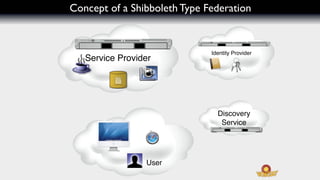
Concept of a Shibboleth Type Federation


                              Identity Provider
   Service Provider


                                Discovery
                                 Service


                 User
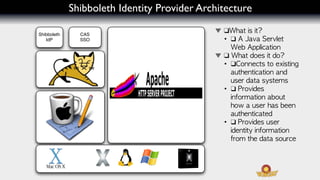
Shibboleth Identity Provider Architecture

Shibboleth     CAS
                                               !
   IdP         SSO                                 !

                                               !
                                                   !


                                                   !


                                                   !
Commercial Providers

•   Test Shibboleth Two (https://www.testshib.org)

•   Protect Network (http://www.protectnetwork.org/)

•   NJ Trust (http://njtrust.net/)

•   SWITCH (http://www.switch.ch/uni/security/) (Switzerland)

•   UK Federation (http://www.ukfederation.org.uk/content/
    Documents/Setup2IdP)
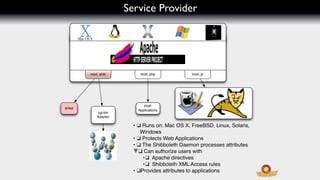
Service Provider


        mod_shib          mod_php             mod_jk


                            PHP
shibd
                         Applications
           cgi-bin
           Adaptor

                       • ! Runs on: Mac OS X, FreeBSD, Linux, Solaris,
                          Windows
                       • ! Protects Web Applications
                       • ! The Shibboleth Daemon processes attributes
                       ▼! Can authorize users with
                           •! Apache directives
                           •! Shibboleth XML Access rules
                       • !Provides attributes to applications
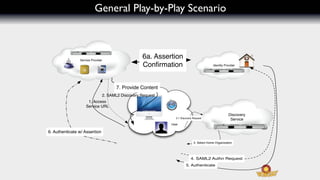
General Play-by-Play Scenario


                Service Provider
                                                  6a. Assertion
                                                  Confirmation                            Identity Provider


                                      7. Provide Content
                               2. SAML2 Discovery Request
                     1. Access
                    Service URL

                                                                                                    Discovery
                                                              2.1 Discovery Request
                                                                                                     Service
                                                            User

6. Authenticate w/ Assertion

                                                                            3. Select Home Organization


                                                                          4. SAML2 Authn Request
                                                                      5. Authenticate
Installation on Mac OS X

•   IdP: Note do not have IdP compete with Teams/ Podcast
    Producer

•   MacPorts SP Install: Note, install curl +ssl first. (https://
    spaces.internet2.edu/display/SHIB2/NativeSPMacPortInstallation)

•   Do the registry steps with IdP/SP and federation.

•   Demo:
Q&A
Shibboleth in Production


    Stanford Shibboleth Example
Mobility Trends

•   “Cached Credentials” approach for mobile devices: Browser local storage

•   Using your User EO for credential storage and remote wiping

•   RESTful interfaces and authentication approaches

•   Issues with “gateway” authentication with unknown site authenticators: Split
    Authentication

Third Party Auth in WebObjects

  • 1.
    Third Party Authin WO Joe Little and Daniel Beatty
  • 2.
    Authentication Methods • Storing passwords in your DB (Model) • Authenticating against LDAP services • LDAP via your Model and hybrid solutions • Kerberos/SSO and hybrid redux • WebAuth and gateway solutions • Shibboleth and the future
  • 3.
    Auth in DB • The default approach • With little database security, the hash must be secure • SHA-1 (160) or SHA-2 (256) and friends • Sample code...
  • 4.
    SHA-2 in theDatabase qual = UserAccount.USERNAME.eq(username).and(UserAccount.PASSWORD.eq(digestedString(password))); .... public String digestedString(String aString) { String digestedString; try { MessageDigest md = MessageDigest.getInstance("SHA-256"); md.reset(); digestedString = new sun.misc.BASE64Encoder().encode (md.digest(aString.getBytes("UTF-8"))); } catch (NoSuchAlgorithmException e) { throw new NSForwardException(e); } catch (UnsupportedEncodingException e){ throw new NSForwardException(e); } return digestedString; }
  • 5.
    LDAP • JNDI can be used for EOs, but NOT for passwords! • Generally restricted by sites LDAP configuration • Standard method is to try a “simple bind” against LDAP • LDAPS:// - Port 636 if possible (SSL), DIGEST otherwise • StartTLS is not an option • http://java.sun.com/products/jndi/tutorial/ldap/security/ssl.html
  • 6.
    Java LDAP Authentication if (LDAPAuth.LDAPAuthenticate(username, password)) ... public class LDAPAuth { public static final boolean LDAPAuthenticate (String userid, String password) { Hashtable env = new Hashtable(); env.put(Context.INITIAL_CONTEXT_FACTORY, "com.sun.jndi.ldap.LdapCtxFactory"); env.put(Context.PROVIDER_URL, "ldap://172.16.113.129:389/dc=example,dc=com"); env.put(Context.SECURITY_AUTHENTICATION, "DIGEST-MD5"); // or “simple” env.put(Context.SECURITY_PRINCIPAL, "uid=" + userid + ", ou=People, dc=example, dc=com"); env.put(Context.SECURITY_CREDENTIALS, password); // Create the initial context try { DirContext ctx = new InitialDirContext(env); } catch (NamingException e) { return false; // Failed to auth //e.printStackTrace(); } return true; } }
  • 7.
    LDAP via EOModel • WebObjects lets you access LDAP via JNDI • Insecure • SSL supposedly should work • Not good for authentication, but other info is there • Great for the “hybrid” approach to authentication
  • 8.
    The Hybrid Approach • Define user attributes in your DB-based EOs • Authenticate user that is also in LDAP tree • 1st time auth: use JNDI EO • Must have matching name between auth and LDAP • Use JNDI EO in read-only fashion to get user attributes • Store in your DB user EOs for future use • Considerations for future JNDI updates
  • 9.
  • 10.
  • 11.
    All LDAP HybridApproach if (LDAPAuth.LDAPAuthenticate(username, password)) { qual = UserAccount.USERNAME.eq(username); NSLog.out.appendln("LDAP authenticated: " + username); } if (qual != null) try { user = UserAccount.fetchRequiredUserAccount(ERXEC.newEditingContext(), qual); } catch (NoSuchElementException e) { // Make a new user from LDAP qual = PosixAccount.UID.eq(username); EOEditingContext ec = ERXEC.newEditingContext(); PosixAccount ldapAccount = PosixAccount.fetchPosixAccount(ec, qual); user = UserAccount.createUserAccount(ec, ldapAccount.gecos(), username); ec.saveChanges(); } ... public static UserAccount createUserAccount(EOEditingContext editingContext, String fullName, String username) { UserAccount eo = (UserAccount) EOUtilities.createAndInsertInstance(editingContext, _UserAccount.ENTITY_NAME); eo.setFullName(fullName); eo.setUsername(username); return eo; }
  • 12.
    SSO: Kerberos • Many Single-Sign On (SSO) solutions • Kerberos / Active Directory are most common today • AD and OpenDirectory marry LDAP w/ Kerberos: hybrid! • Heavily tied into Java Crypto APIs, so Frustration-By-Design • Remember to set classes.include.patternset in woproject to have “**/*.conf” • Best seen by example... (Thanks Mike!)
  • 13.
    Kerberos Methods public class KerberosAuth { static final String krbPath = "/Library/Preferences/edu.mit.Kerberos"; public static final boolean KerberosAuthenticate (String userid, char[] password) { System.setProperty("java.security.krb5.conf", krbPath); System.setProperty("java.security.auth.login.config", KerberosAuth.class.getResource("/kerberos.conf").toExternalForm()); try { LoginContext lc = new LoginContext("primaryLoginContext", new UserNamePasswordCallbackHandler(userid, password)); lc.login(); } catch (LoginException e) { // e.printStackTrace(); return false; // Consider all failures as equal } return true; }
  • 14.
    Kerberos Method Part2 public static class UserNamePasswordCallbackHandler implements CallbackHandler { private String _userName; private char[] _password; public UserNamePasswordCallbackHandler(String userName, char[] password) { _userName = userName; _password = password; } public void handle(Callback[] callbacks) throws IOException, UnsupportedCallbackException { for (Callback callback : callbacks) { if (callback instanceof NameCallback && _userName != null) { ((NameCallback) callback).setName(_userName); } else if (callback instanceof PasswordCallback && _password != null) { ((PasswordCallback) callback).setPassword(_password); } } } }
  • 15.
    Kerberos.conf in Sourcesfolder primaryLoginContext { com.sun.security.auth.module.Krb5LoginModule required client=true useTicketCache=false; };
  • 16.
    Kerberos Authentication if (KerberosAuth.KerberosAuthenticate(username, password.toCharArray())) { qual = UserAccount.USERNAME.eq(username); NSLog.out.appendln("Kerberos authenticated: " + username); } ... UserAccount user = UserAccount.fetchRequiredUserAccount(ERXEC.newEditingContext(), qual); ((Session)session()).setCurrentUser(user); if (((Session)session()).currentUser() != null) { nextPage = D2W.factory().defaultPage(session()); }
  • 17.
  • 18.
    WebAuth • External authentication handled in Apache • More involved site setup • Must trust the Gateway (Apache) for security • Deceptively simple • Interesting solutions: • Multiple authentications • Trust-to-Set applications
  • 19.
    Gateway Approach Considerations • Does make Developer Mode a bit more interesting • Mixing up DirectAction logins w/ gateway header request check • DirectConnect can be good here.. (Thanks Chuck!) • Best practices: • Put values you want into your session object • make sure your session is SSL-enabled! • useExternalAuth boolean in User-type entity?
  • 20.
    WebAuth Method public class WebauthAuth { public static final String WebauthAuthenticate (WOContext context) { // If unauthenticated, this will be blank // assumes that web location is WebAuth protected to restrict this setting return context.request().headerForKey("webauth_user"); } }
  • 21.
    Which brings ustoo... “Gilead then cut Ephraim off from the fords of the Jordan, and whenever Ephraimite fugitives said, 'Let me cross,' the men of Gilead would ask, 'Are you an Ephraimite?' If he said, 'No,' they then said, 'Very well, say "Shibboleth" (‫ '.)שיבולת‬If anyone said, "Sibboleth" (‫ ,)סיבולת‬because he could not pronounce it, then they would seize him and kill him by the fords of the Jordan. Forty-two thousand Ephraimites fell on this occasion.”
  • 22.
    Shibboleth Topics • Shibboleth Authentication Point of View • Federated Frameworks • How is IdP put together • General Shibboleth Service Provision Scenario • Classic Computer Security
  • 23.
    The Shibboleth Pointof View • Stone Age: Application maintains unique credential and identity information for each user. • Bronze Age: Credentials are centralized but applications maintain all user identity information • Iron Age: Credentials and core identity information are centralized and application maintains only app-specific user data.
  • 24.
    Fallacies of DistributedComputing 1.The Network is reliable 2.Latency is Zero 3.Bandwidth is infinite 4.The network is secure 5.Topology doesn’t change 6.There is one administrator 7.Transportation cost is zero 8.The network is homogeneous Peter Deutsch, James Gosling
  • 25.
    Computer Security Subjects101 Resource Subject AllowedOperations owner: User operations: Array<Allowed Operations> canRead: Boolean name: String canUpdate: Boolean permissions: allowedOperations canDelete: Boolean creationTime entity: Resource modificationTime (Boolean) canRead (Boolean) canUpdate Subject Allowed (Boolean) canDelete Operation User Group subject: Subject no attributes owner: Subject members(): Array<Subject> members(): Array<Subject> provider(): Provider General Operations Allowed No Attributes Local User givenName: String surName: String commonName: String telephoneNumber: String address: String organization: String jobTitle: String password: String
  • 26.
    Fallacies of DistributedComputing 1.The network is reliable 2.Latency is zero 3.Bandwidth is infinite 4.The network is secure 5.Topology doesn’t change 6.There is one administrator 7.Transportation cost is zero 8.The network is homogeneous
  • 27.
    Computer Security Subjects101 AllowedOperations Resource Subject canRead: Boolean owner: User operations: Array<Allowed Operations> canUpdate: Boolean permissions: allowedOperations name: String canDelete: Boolean creationTime entity: Resource modificationTime (Boolean) canRead (Boolean) canUpdate (Boolean) canDelete Subject Allowed Operation subject: Subject User Group General Operations no attributes owner: Subject Allowed members(): Array<Subject> members(): Array<Subject> No Attributes provider(): Provider ! ❑!Classic Subjects Problems: Local User givenName: String ! •! ❑!Group Information surName: String commonName: String Compromise telephoneNumber: String address: String ! •! ❑!User info compromise organization: String jobTitle: String password: String
  • 28.
    Computer Security Subjectswith Shibboleth AllowedOperations Resource Subject canRead: Boolean owner: User operations: Array<Allowed Operations> canUpdate: Boolean permissions: allowedOperations name: String canDelete: Boolean creationTime ticket: Shibboleth Assertion entity: Resource modificationTime (Boolean) canRead (Boolean) canUpdate (Boolean) canDelete Subject Allowed Operation subject: Subject User Group General Operations no attributes no attribute Allowed No Attributes
  • 29.
    Federated Identity Frameworks • Shibboleth (http://shibboleth.internet2.edu/) • OpenID (http://openid.net)
  • 30.
    Concept of aShibboleth Type Federation Identity Provider Service Provider Discovery Service User
  • 31.
    Shibboleth Identity ProviderArchitecture Shibboleth CAS ! IdP SSO ! ! ! ! !
  • 32.
    Commercial Providers • Test Shibboleth Two (https://www.testshib.org) • Protect Network (http://www.protectnetwork.org/) • NJ Trust (http://njtrust.net/) • SWITCH (http://www.switch.ch/uni/security/) (Switzerland) • UK Federation (http://www.ukfederation.org.uk/content/ Documents/Setup2IdP)
  • 33.
    Service Provider mod_shib mod_php mod_jk PHP shibd Applications cgi-bin Adaptor • ! Runs on: Mac OS X, FreeBSD, Linux, Solaris, Windows • ! Protects Web Applications • ! The Shibboleth Daemon processes attributes ▼! Can authorize users with •! Apache directives •! Shibboleth XML Access rules • !Provides attributes to applications
  • 34.
    General Play-by-Play Scenario Service Provider 6a. Assertion Confirmation Identity Provider 7. Provide Content 2. SAML2 Discovery Request 1. Access Service URL Discovery 2.1 Discovery Request Service User 6. Authenticate w/ Assertion 3. Select Home Organization 4. SAML2 Authn Request 5. Authenticate
  • 35.
    Installation on MacOS X • IdP: Note do not have IdP compete with Teams/ Podcast Producer • MacPorts SP Install: Note, install curl +ssl first. (https:// spaces.internet2.edu/display/SHIB2/NativeSPMacPortInstallation) • Do the registry steps with IdP/SP and federation. • Demo:
  • 36.
  • 37.
    Shibboleth in Production Stanford Shibboleth Example
  • 38.
    Mobility Trends • “Cached Credentials” approach for mobile devices: Browser local storage • Using your User EO for credential storage and remote wiping • RESTful interfaces and authentication approaches • Issues with “gateway” authentication with unknown site authenticators: Split Authentication