PHOTOSYNTHESIS
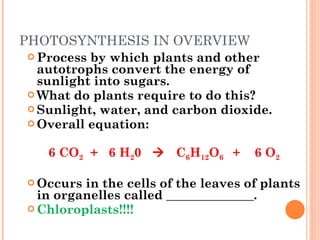
Process by which plants and other autotrophs convert the energy of sunlight into sugars. What do plants require to do this? Sunlight, water, and carbon dioxide. Overall equation: 6 CO 2   +  6 H 2 0     C 6 H 12 O 6  +  6 O 2 Occurs in the cells of the leaves of plants in organelles called ______________. Chloroplasts!!!! PHOTOSYNTHESIS IN OVERVIEW
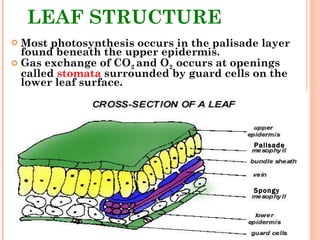
LEAF STRUCTURE Most photosynthesis occurs in the palisade layer found beneath the upper epidermis. Gas exchange of CO 2  and O 2  occurs at openings called  stomata  surrounded by guard cells on the lower leaf surface.   Palisade Spongy
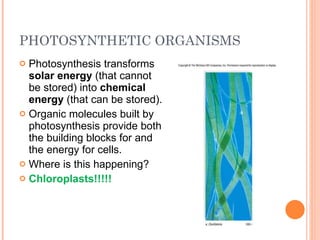
PHOTOSYNTHETIC ORGANISMS Photosynthesis transforms  solar energy  (that cannot be stored) into  chemical energy  (that can be stored). Organic molecules built by photosynthesis provide both the building blocks for and  the energy for cells. Where is this happening? Chloroplasts!!!!!
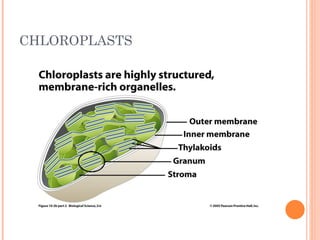
CHLOROPLASTS
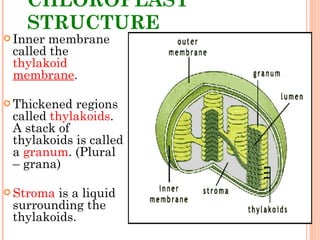
CHLOROPLAST STRUCTURE Inner membrane called the  thylakoid   membrane . Thickened regions called  thylakoids .  A stack of thylakoids is called a  granum . (Plural – grana) Stroma  is a liquid surrounding the thylakoids.
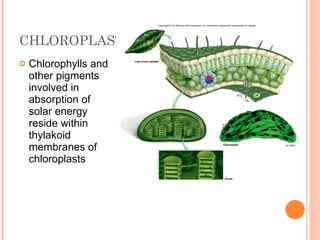
CHLOROPLASTS Chlorophylls and other pigments involved in absorption of solar energy reside within thylakoid membranes of chloroplasts
PIGMENTS Chlorophyll A is the most important photosynthetic pigment.  Other pigments called antenna or accessory pigments are also present in the leaf. Chlorophyll B Carotenoids (orange / red) Xanthophylls (yellow / brown) These pigments are embedded in the membranes of the chloroplast in groups called  photosystems .
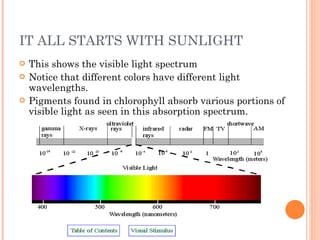
IT ALL STARTS WITH SUNLIGHT This shows the visible light spectrum Notice that different colors have different light wavelengths. Pigments found in chlorophyll absorb various portions of visible light as seen in this absorption spectrum.
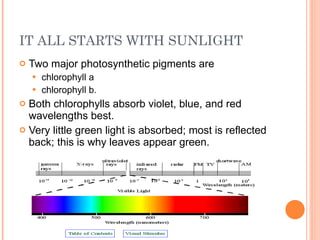
IT ALL STARTS WITH SUNLIGHT Two major photosynthetic pigments are  chlorophyll a  chlorophyll b. Both chlorophylls absorb violet, blue, and red wavelengths best. Very little green light is absorbed; most is reflected back; this is why leaves appear green.
AUTUMN COLORS Carotenoids are yellow-orange pigments which absorb light in violet, blue, and green regions. When chlorophyll breaks down in fall, the yellow-orange pigments in leaves show through.
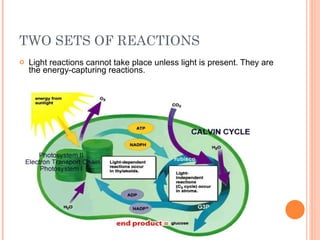
TWO SETS OF REACTIONS Occurs in two main phases. Light reactions Dark reactions (aka – the Calvin Cycle) Light reactions are the “photo” part of photosynthesis.  Light is absorbed by pigments. Dark reactions are the “synthesis” part of photosynthesis.  Trapped energy from the sun is converted to the chemical energy of sugars.
TWO SETS OF REACTIONS Light reactions cannot take place unless light is present. They are the energy-capturing reactions.
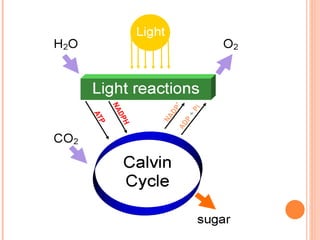
LIGHT REACTIONS Light-dependent reactions occur on the thylakoid membranes. Light and water are required for this process. Energy storage molecules are formed. (ATP and NADPH) Oxygen gas is made as a waste product.
DARK REACTIONS Dark reactions (light-independent; Calvin cycle) occur in the stroma. Carbon dioxide is “fixed” into the sugar glucose. the ATP and NADPH molecules created during the light reactions power the production of this glucose.
 
First video is the simple version. Second video is the detailed version. You need to know somewhere between the two. YouTube: The process of photosynthesis. http://www.youtube.com/watch?v=Z03i3mscbwc&NR=1

Photosynthesis

  • 1.
  • 2.
    Process by whichplants and other autotrophs convert the energy of sunlight into sugars. What do plants require to do this? Sunlight, water, and carbon dioxide. Overall equation: 6 CO 2 + 6 H 2 0  C 6 H 12 O 6 + 6 O 2 Occurs in the cells of the leaves of plants in organelles called ______________. Chloroplasts!!!! PHOTOSYNTHESIS IN OVERVIEW
  • 3.
    LEAF STRUCTURE Mostphotosynthesis occurs in the palisade layer found beneath the upper epidermis. Gas exchange of CO 2 and O 2 occurs at openings called stomata surrounded by guard cells on the lower leaf surface. Palisade Spongy
  • 4.
    PHOTOSYNTHETIC ORGANISMS Photosynthesistransforms solar energy (that cannot be stored) into chemical energy (that can be stored). Organic molecules built by photosynthesis provide both the building blocks for and the energy for cells. Where is this happening? Chloroplasts!!!!!
  • 5.
  • 6.
    CHLOROPLAST STRUCTURE Innermembrane called the thylakoid membrane . Thickened regions called thylakoids . A stack of thylakoids is called a granum . (Plural – grana) Stroma is a liquid surrounding the thylakoids.
  • 7.
    CHLOROPLASTS Chlorophylls andother pigments involved in absorption of solar energy reside within thylakoid membranes of chloroplasts
  • 8.
    PIGMENTS Chlorophyll Ais the most important photosynthetic pigment. Other pigments called antenna or accessory pigments are also present in the leaf. Chlorophyll B Carotenoids (orange / red) Xanthophylls (yellow / brown) These pigments are embedded in the membranes of the chloroplast in groups called photosystems .
  • 9.
    IT ALL STARTSWITH SUNLIGHT This shows the visible light spectrum Notice that different colors have different light wavelengths. Pigments found in chlorophyll absorb various portions of visible light as seen in this absorption spectrum.
  • 10.
    IT ALL STARTSWITH SUNLIGHT Two major photosynthetic pigments are chlorophyll a chlorophyll b. Both chlorophylls absorb violet, blue, and red wavelengths best. Very little green light is absorbed; most is reflected back; this is why leaves appear green.
  • 11.
    AUTUMN COLORS Carotenoidsare yellow-orange pigments which absorb light in violet, blue, and green regions. When chlorophyll breaks down in fall, the yellow-orange pigments in leaves show through.
  • 12.
    TWO SETS OFREACTIONS Occurs in two main phases. Light reactions Dark reactions (aka – the Calvin Cycle) Light reactions are the “photo” part of photosynthesis. Light is absorbed by pigments. Dark reactions are the “synthesis” part of photosynthesis. Trapped energy from the sun is converted to the chemical energy of sugars.
  • 13.
    TWO SETS OFREACTIONS Light reactions cannot take place unless light is present. They are the energy-capturing reactions.
  • 14.
    LIGHT REACTIONS Light-dependentreactions occur on the thylakoid membranes. Light and water are required for this process. Energy storage molecules are formed. (ATP and NADPH) Oxygen gas is made as a waste product.
  • 15.
    DARK REACTIONS Darkreactions (light-independent; Calvin cycle) occur in the stroma. Carbon dioxide is “fixed” into the sugar glucose. the ATP and NADPH molecules created during the light reactions power the production of this glucose.
  • 16.
  • 17.
    First video isthe simple version. Second video is the detailed version. You need to know somewhere between the two. YouTube: The process of photosynthesis. http://www.youtube.com/watch?v=Z03i3mscbwc&NR=1