ECOLOGY
L E V E L S   O F   O R G AN I Z A T I O N
                   AN D
                B I O M E S
5 LEVELS OF ORGANIZATION

•   Biosphere
•   Ecosystems
•   Communities
•   Populations
•   Organisms
•   EXTRA Specific:
•   Cells grouped into tissues
•   Cells
•   Molecules.
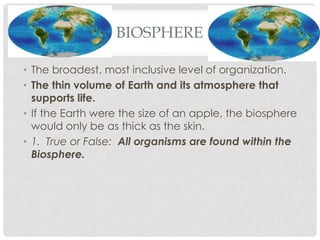
BIOSPHERE

• The broadest, most inclusive level of organization.
• The thin volume of Earth and its atmosphere that
  supports life.
• If the Earth were the size of an apple, the biosphere
  would only be as thick as the skin.
• 1. True or False: All organisms are found within the
  Biosphere.
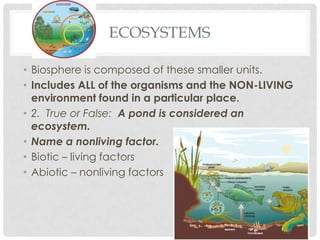
ECOSYSTEMS

• Biosphere is composed of these smaller units.
• Includes ALL of the organisms and the NON-LIVING
  environment found in a particular place.
• 2. True or False: A pond is considered an
  ecosystem.
• Name a nonliving factor.
• Biotic – living factors
• Abiotic – nonliving factors
COMMUNITIES

• A community is all the interacting organisms living in
  an area.
• Ecologist studying a community often focus on how
  species interact and how these interactions
  influence the nature of the community.
• 3. True or False: The word community means the
  same thing in biology as is means in everyday life.
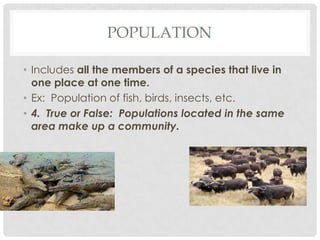
POPULATION

• Includes all the members of a species that live in
  one place at one time.
• Ex: Population of fish, birds, insects, etc.
• 4. True or False: Populations located in the same
  area make up a community.
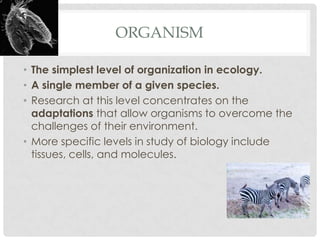
ORGANISM

• The simplest level of organization in ecology.
• A single member of a given species.
• Research at this level concentrates on the
  adaptations that allow organisms to overcome the
  challenges of their environment.
• More specific levels in study of biology include
  tissues, cells, and molecules.
TUNDRA

• Cold, largest, northernmost biome, covers 1/5 of
  world’s land surface.
• Few trees, permafrost – permanently frozen layer of
  soil under surface.
• -26 to 12 degrees C (-14.8 to 53.6 degrees F)
• Less 25 cm precipitation yearly.
• 5. True or False: Tundra supports the GREATEST
  amount of Biodiversity.
• http://videos.howstuffworks.com/discovery/28112-
  assignment-discovery-the-tundra-biomes-
  video.htm
TAIGA

• Located just south of the Tundra.
• AKA: Borreal Forest, Coniferous Forest
• Forest dominated by evergreen trees, plants
  adapted to long cold winters, moose, bears,
  wolves.
• -10 to 14 degrees C (14 to 57.2 degrees F)
• 35-75 cm average precipitation.
• 6. Why do evergreens have needle-leaves?
• http://videos.howstuffworks.com/discovery/28108-
  assignment-discovery-taiga-biomes-video.htm
TEMPERATE DECIDUOUS FOREST

• Trees lose all leaves in fall= deciduous.
• Leaves are thin with large surface area.
• Pronounced seasons.
• Deer, foxes, raccoons, squirrels.
• 6 to 28 degrees C (42.8 to 82.4 F)
• 75-125 cm ave. precip.
• 7. True or False: We live in a temperate deciduous
  forest.
• http://videos.howstuffworks.com/discovery/28109-
  assignment-discovery-temperate-forest-video.htm
TEMPERATE GRASSLAND

• Prairie, interior of continents, about same latitude as
  TDF, less rainfall=no trees.
• 8. Why less rainfall?
• 0 to 25 degrees C (32 to 77 degrees F)
• 25-75 cm ave precip.
• Grasses and grazing animals.
• Rich soil – farmland.
• http://videos.howstuffworks.com/discovery/28110-
  assignment-discovery-temperate-grassland-biomes-
  video.htm
DESERT

•   NOT hot all the time, cold at night!
•   Vegetation is sparse.
•   Animals, active at night.
•   Lizards, snakes, kit foxes.
•    7 to 38 degrees C (44.6 to100.4 degrees F)
•   Less than 25 cm ave. precip.
•   9. True or False: The Tundra is like a frozen Desert.
•   http://videos.howstuffworks.com/discovery/28106-
    assignment-discovery-desert-biomes-video.htm
SAVANNAS

• Tropical or subtropical grasslands
• Alternating wet and dry seasons
• Zebras, wildebeest, giraffes, gazelles.
• Lions, leopards and cheetahs.
• 16 to 34 degrees C (60.8 to 93.2 degrees F)
• 75-150 cm ave. precip.
• 10. True or False: There are more carnivores than
  herbivores living in the savanna.
• http://videos.howstuffworks.com/discovery/28107-
  assignment-discovery-savanna-biomes-video.htm
TROPICAL RAIN FOREST

• Stable, year-round growing season
• Abundant Rainfall
• Most Productive Biome – 1/5 of known species.
• 20 to 34 degrees C (68 to 93.2 degrees F)
• 200 to 400 cm ave. precip.
• Responsible for 28% of world’s oxygen turnover.
• 11. True or False: The tropical rain forest produces 28%
  of the world’s oxygen.
http://videos.howstuffworks.com/discovery/30139-
  assignment-discovery-tropical-ecosystem-video.htm
http://videos.howstuffworks.com/discovery/28111-
  assignment-discovery-the-tropic-biomes-video.htm

Biosphere and biomes

  • 1.
    ECOLOGY L E VE L S O F O R G AN I Z A T I O N AN D B I O M E S
  • 2.
    5 LEVELS OFORGANIZATION • Biosphere • Ecosystems • Communities • Populations • Organisms • EXTRA Specific: • Cells grouped into tissues • Cells • Molecules.
  • 3.
    BIOSPHERE • The broadest,most inclusive level of organization. • The thin volume of Earth and its atmosphere that supports life. • If the Earth were the size of an apple, the biosphere would only be as thick as the skin. • 1. True or False: All organisms are found within the Biosphere.
  • 4.
    ECOSYSTEMS • Biosphere iscomposed of these smaller units. • Includes ALL of the organisms and the NON-LIVING environment found in a particular place. • 2. True or False: A pond is considered an ecosystem. • Name a nonliving factor. • Biotic – living factors • Abiotic – nonliving factors
  • 5.
    COMMUNITIES • A communityis all the interacting organisms living in an area. • Ecologist studying a community often focus on how species interact and how these interactions influence the nature of the community. • 3. True or False: The word community means the same thing in biology as is means in everyday life.
  • 6.
    POPULATION • Includes allthe members of a species that live in one place at one time. • Ex: Population of fish, birds, insects, etc. • 4. True or False: Populations located in the same area make up a community.
  • 7.
    ORGANISM • The simplestlevel of organization in ecology. • A single member of a given species. • Research at this level concentrates on the adaptations that allow organisms to overcome the challenges of their environment. • More specific levels in study of biology include tissues, cells, and molecules.
  • 8.
    TUNDRA • Cold, largest,northernmost biome, covers 1/5 of world’s land surface. • Few trees, permafrost – permanently frozen layer of soil under surface. • -26 to 12 degrees C (-14.8 to 53.6 degrees F) • Less 25 cm precipitation yearly. • 5. True or False: Tundra supports the GREATEST amount of Biodiversity. • http://videos.howstuffworks.com/discovery/28112- assignment-discovery-the-tundra-biomes- video.htm
  • 9.
    TAIGA • Located justsouth of the Tundra. • AKA: Borreal Forest, Coniferous Forest • Forest dominated by evergreen trees, plants adapted to long cold winters, moose, bears, wolves. • -10 to 14 degrees C (14 to 57.2 degrees F) • 35-75 cm average precipitation. • 6. Why do evergreens have needle-leaves? • http://videos.howstuffworks.com/discovery/28108- assignment-discovery-taiga-biomes-video.htm
  • 10.
    TEMPERATE DECIDUOUS FOREST •Trees lose all leaves in fall= deciduous. • Leaves are thin with large surface area. • Pronounced seasons. • Deer, foxes, raccoons, squirrels. • 6 to 28 degrees C (42.8 to 82.4 F) • 75-125 cm ave. precip. • 7. True or False: We live in a temperate deciduous forest. • http://videos.howstuffworks.com/discovery/28109- assignment-discovery-temperate-forest-video.htm
  • 11.
    TEMPERATE GRASSLAND • Prairie,interior of continents, about same latitude as TDF, less rainfall=no trees. • 8. Why less rainfall? • 0 to 25 degrees C (32 to 77 degrees F) • 25-75 cm ave precip. • Grasses and grazing animals. • Rich soil – farmland. • http://videos.howstuffworks.com/discovery/28110- assignment-discovery-temperate-grassland-biomes- video.htm
  • 12.
    DESERT • NOT hot all the time, cold at night! • Vegetation is sparse. • Animals, active at night. • Lizards, snakes, kit foxes. • 7 to 38 degrees C (44.6 to100.4 degrees F) • Less than 25 cm ave. precip. • 9. True or False: The Tundra is like a frozen Desert. • http://videos.howstuffworks.com/discovery/28106- assignment-discovery-desert-biomes-video.htm
  • 13.
    SAVANNAS • Tropical orsubtropical grasslands • Alternating wet and dry seasons • Zebras, wildebeest, giraffes, gazelles. • Lions, leopards and cheetahs. • 16 to 34 degrees C (60.8 to 93.2 degrees F) • 75-150 cm ave. precip. • 10. True or False: There are more carnivores than herbivores living in the savanna. • http://videos.howstuffworks.com/discovery/28107- assignment-discovery-savanna-biomes-video.htm
  • 14.
    TROPICAL RAIN FOREST •Stable, year-round growing season • Abundant Rainfall • Most Productive Biome – 1/5 of known species. • 20 to 34 degrees C (68 to 93.2 degrees F) • 200 to 400 cm ave. precip. • Responsible for 28% of world’s oxygen turnover. • 11. True or False: The tropical rain forest produces 28% of the world’s oxygen. http://videos.howstuffworks.com/discovery/30139- assignment-discovery-tropical-ecosystem-video.htm http://videos.howstuffworks.com/discovery/28111- assignment-discovery-the-tropic-biomes-video.htm