CMD631 (Semester I, 2020-2021)
Project Submitted by
Sameer Hussain
2019CYS7042
Thesis supervisor
Prof. Ravi P. Singh
Department of Chemistry
Indian Institute of Technology, Delhi
New Delhi 110016
Construction of Carbon-Carbon(Ar-C) Bond via
Photogenerated Intermediates
INTRODUCTION
1. Carbon-Carbon bond formation via various photochemical and
photocatalytic methods.
2. Photochemical generated intermediates; aryl radicals, benzyl radicals,
simple radicals and carbenes
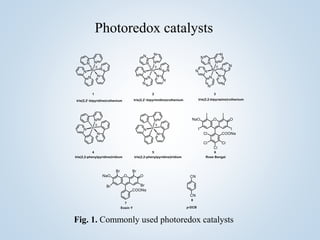
3. Photoredox catalysts like Eosin Y, Ru(bpy)2+, Cu(dpp)2
+ by activating in
the presence of visible light.
4. Ar-C bond formation by ipso substitution of various functional groups.
Photoredox catalysts
Fig. 1. Commonly used photoredox catalysts
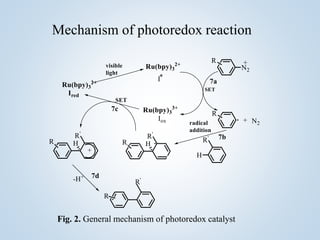
Mechanism of photoredox reaction
Fig. 2. General mechanism of photoredox catalyst
1. Visible-Light-Mediated Direct C−H Arylation of
Heteroarenes with Aryl Diazonium Salts.
21-80%
2. Homolytic aromatic substitutions via photoredox
catalysis to assemble biaryls
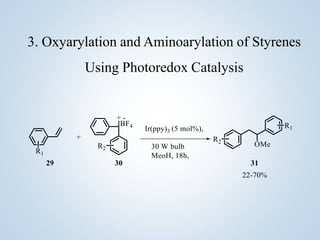
3. Oxyarylation and Aminoarylation of Styrenes
Using Photoredox Catalysis
4. Intermolecular Formyloxyarylation of Alkenes
by Photoredox Meerwein Reaction
5. Visible-light-mediated oxidative arylation of
vinylarenes under aerobic conditions
6. Aryl Radical formation by Cu(I) for
photocatalyzed reduction of diaryliodonium salts.
75-80%
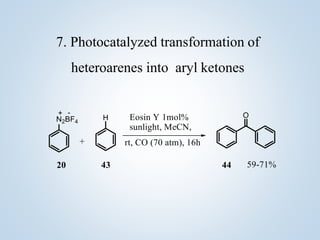
7. Photocatalyzed transformation of
heteroarenes into aryl ketones
8. Radical Alkoxycarbonylation of Aryldiazonium
Salts through Visible-Light Photoredox Catalysis.
9. Photoredox Cross-Coupling Ir/Ni Dual
Catalysis for the Synthesis of Benzylic Ethers.
70-92%
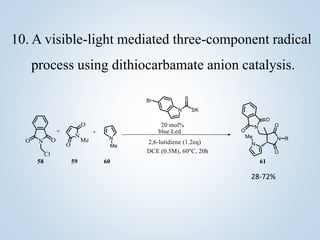
10. A visible-light mediated three-component radical
process using dithiocarbamate anion catalysis.
28-72%
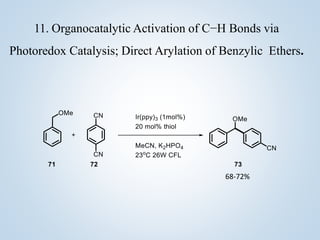
11. Organocatalytic Activation of C−H Bonds via
Photoredox Catalysis; Direct Arylation of Benzylic Ethers.
68-72%
12. Decarboxylative Arylation of α-Amino Acids
via Photo Redox Catalysis.
80-82%
Summary
Starting with the importance and application of photochemical reactions we
introduced the generation of reactive intermediates like radicals, biradicals,
radical ions, cations & anions and carbenes in the presence of photoredox
catalysts like eosin Y, rose Bengal and other Ir & Ru based catalysts,
irradiating via visible light of different intensities and also sometimes UV
light. We proceeded with Ar-C bond formation via ipso substitution of
various functional groups.
From discussion we anticipate these photoredox or photochemical reactions
will find broad applications among practitioners of organic synthesis.
Future perspectives
79 20
80
Acknowledgement
Dr. Ravi P. Singh ( Principal Investigator)
Sanjay Singh(Phd)
Department of Chemistry
IIT Delhi, New Delhi
References
1 Hari, D. P.; Schroll, P.; König,B. Metal-free, visible-light-mediated direct C–H arylation of heteroarenes with aryl diazonium salts. J. Am. Chem. Soc.,
2012, 134(6), 2958-2961.
2Gomes, F.; Narbonne, V.; Blanchard, F.; Maestri, G.; Malacria, M. Formal base-free homolytic aromatic substitutions via photoredox catalysis. Org.
Chem. Front., 2015, 2(5), 464- 469.
3 Fumagalli, G.; Boyd, S.; Greaney, M. F. Oxyarylation and aminoarylation of styrenes using photoredox catalysis. Org. Lett., 2013, 15(17), 4398-4401.
4 Yao, C. J.; Sun, Q.; Rastogi, N.; König,B. Intermolecular formyloxyarylation of alkenes by photoredox Meerwein reaction. ACS Catal., 2015, 5(5),
2935-2938.
5 Bu, M.; Niu, T. F.; Cai, C. Visible-light-mediated oxidative arylation of vinylarenes under aerobic conditions. Catal. Sci. Technol., 2015, 5(2), 830-
834.
6 Baralle, A.; Fensterbank, L.; Goddard, J. P.; Ollivier, C. Aryl radical formation by copper (I) photocatalyzed reduction of diaryliodonium salts:
NMR evidence for a CuII/CuI
mechanism. Chem. Eur. J., 2013, 19(33), 10809-10813.
7Gu, L.; Jin, C.; Liu, J. Metal-free, visible-light-mediated transformation of aryl diazonium salts and (hetero) arenes: an efficient route to aryl ketones.
Green Chem., 2015, 17(7), 3733-3736.
8Guo, W.; Lu, L. Q.; Wang, Y.; Wang, Y.N.; Chen, J. R.; Xiao, W. J. Metal‐Free,Room‐Temperature, Radical Alkoxycarbonylation of Aryldiazonium Salts
through Visible‐Light Photoredox Catalysis. Angew. Chem., 2015, 127(7), 2293-2297.
9 Karakaya, I.; Primer, D. N.; Molander, G. A. Photoredox cross-coupling: Ir/Ni dual catalysis for the synthesis of benzylic ethers. Org. Lett., 2015,
17(13), 3294-3297.
10Tang, J.; Yue, J. J.; Tao, F. F.; Grampp, G.; Wang, B. X.; Li, F., Xu, J. H. A Three-Component Reaction by Photoinduced Electron Transfer Mechanism
with N-Protected Pyrroles as Neutral Carbon Nucleophiles. J. Org. Chem., 2014, 79(16), 7572-7582.
11Qvortrup, K.; Rankic, D. A.; MacMillan, D. W. A general strategy for organocatalytic activation of C–H bonds via photoredox catalysis: Direct
arylation of benzylic ethers. J. Am. Chem. Soc., 2014. 136(2), 626-629.
12 Zuo, Z.; MacMillan, D. W. Decarboxylative arylation of α-amino acids via photoredox catalysis: a one-step conversion of biomass to drug
pharmacophore. J. Am. Chem. Soc.,
2014, 136(14), 5257-5260.
13Kumar, G.; Verma, S.; Ansari, A.; Noor-ul, H. K.; Kureshy, R. I.Enantioselective cross dehydrogenative coupling reaction catalyzed by Rose Bengal
Incorporated-Cu (I)-dimeric chiral complexes. Catal. Commun., 2017, 99, 94-99.

MSc Project presentation

  • 1.
    CMD631 (Semester I,2020-2021) Project Submitted by Sameer Hussain 2019CYS7042 Thesis supervisor Prof. Ravi P. Singh Department of Chemistry Indian Institute of Technology, Delhi New Delhi 110016 Construction of Carbon-Carbon(Ar-C) Bond via Photogenerated Intermediates
  • 2.
    INTRODUCTION 1. Carbon-Carbon bondformation via various photochemical and photocatalytic methods. 2. Photochemical generated intermediates; aryl radicals, benzyl radicals, simple radicals and carbenes 3. Photoredox catalysts like Eosin Y, Ru(bpy)2+, Cu(dpp)2 + by activating in the presence of visible light. 4. Ar-C bond formation by ipso substitution of various functional groups.
  • 3.
    Photoredox catalysts Fig. 1.Commonly used photoredox catalysts
  • 4.
    Mechanism of photoredoxreaction Fig. 2. General mechanism of photoredox catalyst
  • 5.
    1. Visible-Light-Mediated DirectC−H Arylation of Heteroarenes with Aryl Diazonium Salts. 21-80%
  • 6.
    2. Homolytic aromaticsubstitutions via photoredox catalysis to assemble biaryls
  • 7.
    3. Oxyarylation andAminoarylation of Styrenes Using Photoredox Catalysis
  • 8.
    4. Intermolecular Formyloxyarylationof Alkenes by Photoredox Meerwein Reaction
  • 9.
    5. Visible-light-mediated oxidativearylation of vinylarenes under aerobic conditions
  • 10.
    6. Aryl Radicalformation by Cu(I) for photocatalyzed reduction of diaryliodonium salts. 75-80%
  • 11.
    7. Photocatalyzed transformationof heteroarenes into aryl ketones
  • 12.
    8. Radical Alkoxycarbonylationof Aryldiazonium Salts through Visible-Light Photoredox Catalysis.
  • 13.
    9. Photoredox Cross-CouplingIr/Ni Dual Catalysis for the Synthesis of Benzylic Ethers. 70-92%
  • 14.
    10. A visible-lightmediated three-component radical process using dithiocarbamate anion catalysis. 28-72%
  • 15.
    11. Organocatalytic Activationof C−H Bonds via Photoredox Catalysis; Direct Arylation of Benzylic Ethers. 68-72%
  • 16.
    12. Decarboxylative Arylationof α-Amino Acids via Photo Redox Catalysis. 80-82%
  • 17.
    Summary Starting with theimportance and application of photochemical reactions we introduced the generation of reactive intermediates like radicals, biradicals, radical ions, cations & anions and carbenes in the presence of photoredox catalysts like eosin Y, rose Bengal and other Ir & Ru based catalysts, irradiating via visible light of different intensities and also sometimes UV light. We proceeded with Ar-C bond formation via ipso substitution of various functional groups. From discussion we anticipate these photoredox or photochemical reactions will find broad applications among practitioners of organic synthesis.
  • 18.
  • 19.
    Acknowledgement Dr. Ravi P.Singh ( Principal Investigator) Sanjay Singh(Phd) Department of Chemistry IIT Delhi, New Delhi
  • 20.
    References 1 Hari, D.P.; Schroll, P.; König,B. Metal-free, visible-light-mediated direct C–H arylation of heteroarenes with aryl diazonium salts. J. Am. Chem. Soc., 2012, 134(6), 2958-2961. 2Gomes, F.; Narbonne, V.; Blanchard, F.; Maestri, G.; Malacria, M. Formal base-free homolytic aromatic substitutions via photoredox catalysis. Org. Chem. Front., 2015, 2(5), 464- 469. 3 Fumagalli, G.; Boyd, S.; Greaney, M. F. Oxyarylation and aminoarylation of styrenes using photoredox catalysis. Org. Lett., 2013, 15(17), 4398-4401. 4 Yao, C. J.; Sun, Q.; Rastogi, N.; König,B. Intermolecular formyloxyarylation of alkenes by photoredox Meerwein reaction. ACS Catal., 2015, 5(5), 2935-2938. 5 Bu, M.; Niu, T. F.; Cai, C. Visible-light-mediated oxidative arylation of vinylarenes under aerobic conditions. Catal. Sci. Technol., 2015, 5(2), 830- 834. 6 Baralle, A.; Fensterbank, L.; Goddard, J. P.; Ollivier, C. Aryl radical formation by copper (I) photocatalyzed reduction of diaryliodonium salts: NMR evidence for a CuII/CuI mechanism. Chem. Eur. J., 2013, 19(33), 10809-10813. 7Gu, L.; Jin, C.; Liu, J. Metal-free, visible-light-mediated transformation of aryl diazonium salts and (hetero) arenes: an efficient route to aryl ketones. Green Chem., 2015, 17(7), 3733-3736. 8Guo, W.; Lu, L. Q.; Wang, Y.; Wang, Y.N.; Chen, J. R.; Xiao, W. J. Metal‐Free,Room‐Temperature, Radical Alkoxycarbonylation of Aryldiazonium Salts through Visible‐Light Photoredox Catalysis. Angew. Chem., 2015, 127(7), 2293-2297. 9 Karakaya, I.; Primer, D. N.; Molander, G. A. Photoredox cross-coupling: Ir/Ni dual catalysis for the synthesis of benzylic ethers. Org. Lett., 2015, 17(13), 3294-3297. 10Tang, J.; Yue, J. J.; Tao, F. F.; Grampp, G.; Wang, B. X.; Li, F., Xu, J. H. A Three-Component Reaction by Photoinduced Electron Transfer Mechanism with N-Protected Pyrroles as Neutral Carbon Nucleophiles. J. Org. Chem., 2014, 79(16), 7572-7582. 11Qvortrup, K.; Rankic, D. A.; MacMillan, D. W. A general strategy for organocatalytic activation of C–H bonds via photoredox catalysis: Direct arylation of benzylic ethers. J. Am. Chem. Soc., 2014. 136(2), 626-629. 12 Zuo, Z.; MacMillan, D. W. Decarboxylative arylation of α-amino acids via photoredox catalysis: a one-step conversion of biomass to drug pharmacophore. J. Am. Chem. Soc., 2014, 136(14), 5257-5260. 13Kumar, G.; Verma, S.; Ansari, A.; Noor-ul, H. K.; Kureshy, R. I.Enantioselective cross dehydrogenative coupling reaction catalyzed by Rose Bengal Incorporated-Cu (I)-dimeric chiral complexes. Catal. Commun., 2017, 99, 94-99.