Task 1
Cameras
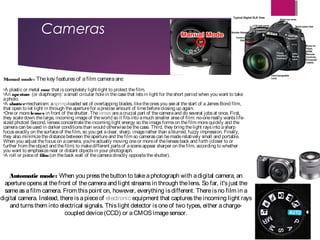
Manual mode: Thekey featuresof afilm cameraare:
•A plastic or metal case that iscompletely light-tight to protect thefilm.
•An aperture (or diaphragm): asmall circular holein thecasethat letsin light for theshort period when you want to take
aphoto.
•A shutter mechanism: a spring-loaded set of overlapping blades, liketheonesyou seeat thestart of aJamesBond film,
that open to let light in through theaperturefor apreciseamount of timebeforeclosing up again.
•Oneor more lenses in front of theshutter. The lenses areacrucial part of thecameraand do several jobsat once. First,
they scaledown thelarge, incoming imageof theworld so it fitsinto amuch smaller areaof film: no-onereally wantslife-
sized photos! Second, lensesconcentratetheincoming light energy so theimageformson thefilm morequickly and the
cameracan beused in darker conditionsthan would otherwisebethecase. Third, they bring thelight raysinto asharp
focusexactly on thesurfaceof thefilm, so you get aclear, sharp, imagerather than ablurred, fuzzy impression. Finally,
they also minimizethedistancebetween theapertureand thefilm so camerascan bemaderelatively small and portable.
When you adjust thefocuson acamera, you'reactually moving oneor moreof thelensesback and forth (closer to or
further from theobject and thefilm) to makedifferent partsof asceneappear sharper on thefilm, according to whether
you want to emphasizenear or distant objectsin your photograph.
•A roll or pieceof film (on theback wall of thecameradirectly oppositetheshutter).
Automatic mode: When you pressthebutton to takeaphotograph with adigital camera, an
apertureopensat thefront of thecameraand light streamsin through thelens. So far, it'sjust the
sameasafilm camera. From thispoint on, however, everything isdifferent. Thereisno film in a
digital camera. Instead, thereisapieceof electronic equipment that capturestheincoming light rays
and turnsthem into electrical signals. Thislight detector isoneof two types, either a charge-
coupled device(CCD) or a CMOSimagesensor.
Capturing Images
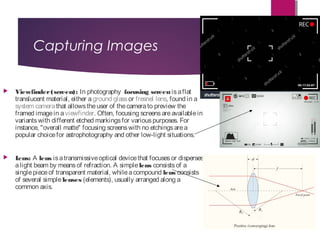
 Viewfinder(screen): In photography  focusing screen isaflat
translucent material, either a ground glass or fresnel lens, found in a 
system camera that allowstheuser of thecamerato preview the
framed imagein a viewfinder. Often, focusing screensareavailablein
variantswith different etched markingsfor variouspurposes. For
instance, "overall matte" focusing screenswith no etchingsarea
popular choicefor astrophotography and other low-light situations.
 Lens: A lens isatransmissiveoptical devicethat focusesor disperses
alight beam by meansof refraction. A simple lens consistsof a
singlepieceof transparent material, whileacompound lens consists
of several simple lenses (elements), usually arranged along a
common axis.
 Image sensor: An image sensor or imaging sensor isa sensor that detects
and conveysthe information that constitutesan image. It doesso by converting
thevariable attenuation of light waves (asthey passthrough or reflect off
 objects) into signals, small burstsof current that convey theinformation. The
wavescan be light or other electromagnetic radiation. Imagesensorsareused in 
electronic imaging devicesof both analog and digital types, which include 
digital cameras, cameramodules, medical imaging equipment, night vision
 equipment such as thermal imaging devices, radar, sonar, and others. As 
technology changes, digital imaging tendsto replaceanalog imaging.
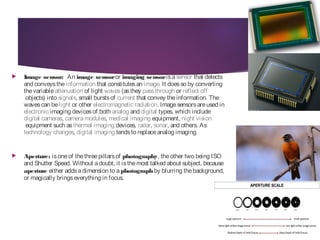
 Aperture: isoneof thethreepillarsof photography, theother two being ISO
and Shutter Speed. Without adoubt, it isthemost talked about subject, because
aperture either addsadimension to a photograph by blurring thebackground,
or magically bringseverything in focus.
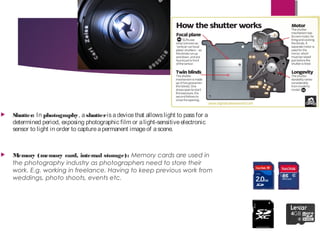
 Shutter: In photography, a shutter isadevicethat allowslight to passfor a
determined period, exposing photographic film or alight-sensitiveelectronic
sensor to light in order to captureapermanent imageof ascene.
 Memory (memory card, internal storage): Memory cards are used in
the photography industry as photographers need to store their
work. E.g. working in freelance. Having to keep previous work from
weddings, photo shoots, events etc.
Lighting
 Flash: A  flash is a device used in photography producing a flash of artificial light
 (typically 1/1000 to 1/200 of a second) at a color temperature of about 5500 K (
Kelvin)[citation needed]
 to help illuminate a scene. A major purpose of a flash is to illuminate a
dark scene. Other uses are capturing quickly moving objects or changing the quality
of light. Flash refers either to the flash of light itself or to the electronic flash
unit discharging the light. Most current 
 Exposure: In photography, exposure is the amount of light per unit area (the image
plane illuminance times the exposure time) reaching a photographic film or
electronic image sensor, as determined by shutter speed, lens aperture and
scene luminance. Exposure is measured in lux seconds, and can be computed
from exposure value (EV) and scene luminance in a specified region.
 Colour: Lighting jellsareoften used in thephotography industry. Thelighting jellscan giveout
multiplecoloursout.
 White balance: TheWhiteBalancesetting you choosewill changethecolour balancein your
pictures, making it warmer or cooler depending on how thesort of light you'reshooting in affects
things. Using Auto WhiteBalanceisthesimpleoption, but your camera'sWhiteBalancepresentsgive
you morecontrol over colour.
 Lights: A ways of using lights in photography: Studio flash isall about positioning thelight
sourceaway from thecamera, so standsarecrucial. They support theflash heads, which meansthey
can bepositioned at theright distanceand angleto thesubject.
Support
 Handheld: Usesof your camerabeing handheld: Shoot aminimum shutter speed of 1/60sec. I usually shoot 1/100sec to
play it safe.
 Usefaster lensesto keep your ISO low, whilestill keeping aminimum shutter of 1/60sec.
 Experiment with angles. ...
 Stabilizeyour body. ...
 Ditch your lenscap
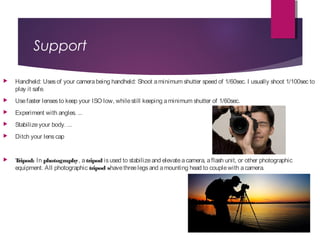
 Tripod: In photography, a tripod isused to stabilizeand elevateacamera, aflash unit, or other photographic
equipment. All photographic tripod shavethreelegsand amounting head to couplewith acamera.
File Storage
Advantages Disadvantages
• When shooting in aformat like JPEG imageinformation is
compressed and lost. Becauseno information is
compressed with RAW you’reableto producehigher
quality images, aswell ascorrect problem imagesthat
would beunrecoverableif shot in the JPEG format.
• Levelsof brightnessarethenumber of stepsfrom black to
whitein an image. Themoreyou have, thesmoother the
transitionsof tones. Smooth is good.
• Themost attractivebit about filming in RAW isthesheer
amount of information that isretained in your video. The
detailsthat normally disappear in theshadowsand
highlightsof DSLR footageiscompletely retained. No
longer do you haveto sacrificequality in oneareafor
another. 
• Almost every DSLR shootsin an 8 bit colour spacewith 4-
2-0 sampling. Thismeansthat thereareonly acertain
number of coloursto choosefrom, with only aspecific
portion of thosesaid coloursbeing sampled. Thisiswhere
RAW comesin. RAW video typically hasacolour space
between 10bitsand 16bitsand asampling of 4-2-2 or 4-4-4-
4; which isuseful information, but that’snot what RAW
fileformat really means. I’m not going to go into details,
but it effectively meansthat you can captureahugerange
of coloursand information, and exposeyour footagein
post. You technically havetheflexibility to changetheway
your footagebehavesafter you film it. It’smuch like
shooting photographsin RAW. You retain awiderangeof
information and usethat to achievethebest results
possible. It’struly amazing what you can do when you get
• Themost attractivebit about filming in RAW isthe
sheer amount of information that isretained in your
video. Thedetailsthat normally disappear in the
shadowsand highlightsof DSLR footageiscompletely
retained. No longer do you haveto sacrificequality in
oneareafor another. 
• Almost every DSLR shootsin an 8 bit color spacewith
4-2-0 sampling. Thismeansthat thereareonly a
certain number of colorsto choosefrom, with only a
specific portion of thosesaid colorsbeing sampled.
ThisiswhereRAW comesin. RAW video typically
hasacolor spacebetween 10bitsand 16bitsand a
sampling of 4-2-2 or 4-4-4-4; which isuseful
information, but that’snot what RAW fileformat
really means. I’m not going to go into details, but it
effectively meansthat you can captureahugerangeof
coloursand information, and exposeyour footagein
post. You technically havetheflexibility to changethe
way your footagebehavesafter you film it. It’smuch
likeshooting photographsin RAW. You retain awide
rangeof information and usethat to achievethebest
resultspossible. It’struly amazing what you can do
when you get to colour grading.
Raw
Size
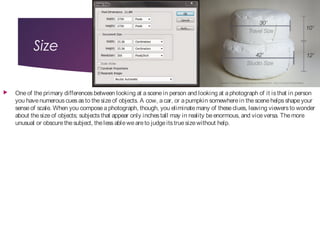
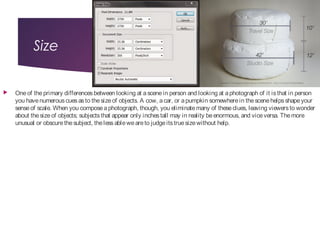
 Oneof theprimary differencesbetween looking at ascenein person and looking at aphotograph of it isthat in person
you havenumerouscuesasto thesizeof objects. A cow, acar, or apumpkin somewherein thescenehelpsshapeyour
senseof scale. When you composeaphotograph, though, you eliminatemany of theseclues, leaving viewersto wonder
about thesizeof objects; subjectsthat appear only inchestall may in reality beenormous, and viceversa. Themore
unusual or obscurethesubject, thelessableweareto judgeitstruesizewithout help.
Size
 Oneof theprimary differencesbetween looking at ascenein person and looking at aphotograph of it isthat in person
you havenumerouscuesasto thesizeof objects. A cow, acar, or apumpkin somewherein thescenehelpsshapeyour
senseof scale. When you composeaphotograph, though, you eliminatemany of theseclues, leaving viewersto wonder
about thesizeof objects; subjectsthat appear only inchestall may in reality beenormous, and viceversa. Themore
unusual or obscurethesubject, thelessableweareto judgeitstruesizewithout help.

Photography

  • 1.
  • 2.
    Cameras Manual mode: Thekeyfeaturesof afilm cameraare: •A plastic or metal case that iscompletely light-tight to protect thefilm. •An aperture (or diaphragm): asmall circular holein thecasethat letsin light for theshort period when you want to take aphoto. •A shutter mechanism: a spring-loaded set of overlapping blades, liketheonesyou seeat thestart of aJamesBond film, that open to let light in through theaperturefor apreciseamount of timebeforeclosing up again. •Oneor more lenses in front of theshutter. The lenses areacrucial part of thecameraand do several jobsat once. First, they scaledown thelarge, incoming imageof theworld so it fitsinto amuch smaller areaof film: no-onereally wantslife- sized photos! Second, lensesconcentratetheincoming light energy so theimageformson thefilm morequickly and the cameracan beused in darker conditionsthan would otherwisebethecase. Third, they bring thelight raysinto asharp focusexactly on thesurfaceof thefilm, so you get aclear, sharp, imagerather than ablurred, fuzzy impression. Finally, they also minimizethedistancebetween theapertureand thefilm so camerascan bemaderelatively small and portable. When you adjust thefocuson acamera, you'reactually moving oneor moreof thelensesback and forth (closer to or further from theobject and thefilm) to makedifferent partsof asceneappear sharper on thefilm, according to whether you want to emphasizenear or distant objectsin your photograph. •A roll or pieceof film (on theback wall of thecameradirectly oppositetheshutter). Automatic mode: When you pressthebutton to takeaphotograph with adigital camera, an apertureopensat thefront of thecameraand light streamsin through thelens. So far, it'sjust the sameasafilm camera. From thispoint on, however, everything isdifferent. Thereisno film in a digital camera. Instead, thereisapieceof electronic equipment that capturestheincoming light rays and turnsthem into electrical signals. Thislight detector isoneof two types, either a charge- coupled device(CCD) or a CMOSimagesensor.
  • 3.
    Capturing Images  Viewfinder(screen):In photography  focusing screen isaflat translucent material, either a ground glass or fresnel lens, found in a  system camera that allowstheuser of thecamerato preview the framed imagein a viewfinder. Often, focusing screensareavailablein variantswith different etched markingsfor variouspurposes. For instance, "overall matte" focusing screenswith no etchingsarea popular choicefor astrophotography and other low-light situations.  Lens: A lens isatransmissiveoptical devicethat focusesor disperses alight beam by meansof refraction. A simple lens consistsof a singlepieceof transparent material, whileacompound lens consists of several simple lenses (elements), usually arranged along a common axis.
  • 4.
     Image sensor:An image sensor or imaging sensor isa sensor that detects and conveysthe information that constitutesan image. It doesso by converting thevariable attenuation of light waves (asthey passthrough or reflect off  objects) into signals, small burstsof current that convey theinformation. The wavescan be light or other electromagnetic radiation. Imagesensorsareused in  electronic imaging devicesof both analog and digital types, which include  digital cameras, cameramodules, medical imaging equipment, night vision  equipment such as thermal imaging devices, radar, sonar, and others. As  technology changes, digital imaging tendsto replaceanalog imaging.  Aperture: isoneof thethreepillarsof photography, theother two being ISO and Shutter Speed. Without adoubt, it isthemost talked about subject, because aperture either addsadimension to a photograph by blurring thebackground, or magically bringseverything in focus.
  • 5.
     Shutter: In photography,a shutter isadevicethat allowslight to passfor a determined period, exposing photographic film or alight-sensitiveelectronic sensor to light in order to captureapermanent imageof ascene.  Memory (memory card, internal storage): Memory cards are used in the photography industry as photographers need to store their work. E.g. working in freelance. Having to keep previous work from weddings, photo shoots, events etc.
  • 6.
    Lighting  Flash: A flash is a device used in photography producing a flash of artificial light  (typically 1/1000 to 1/200 of a second) at a color temperature of about 5500 K ( Kelvin)[citation needed]  to help illuminate a scene. A major purpose of a flash is to illuminate a dark scene. Other uses are capturing quickly moving objects or changing the quality of light. Flash refers either to the flash of light itself or to the electronic flash unit discharging the light. Most current   Exposure: In photography, exposure is the amount of light per unit area (the image plane illuminance times the exposure time) reaching a photographic film or electronic image sensor, as determined by shutter speed, lens aperture and scene luminance. Exposure is measured in lux seconds, and can be computed from exposure value (EV) and scene luminance in a specified region.  Colour: Lighting jellsareoften used in thephotography industry. Thelighting jellscan giveout multiplecoloursout.  White balance: TheWhiteBalancesetting you choosewill changethecolour balancein your pictures, making it warmer or cooler depending on how thesort of light you'reshooting in affects things. Using Auto WhiteBalanceisthesimpleoption, but your camera'sWhiteBalancepresentsgive you morecontrol over colour.  Lights: A ways of using lights in photography: Studio flash isall about positioning thelight sourceaway from thecamera, so standsarecrucial. They support theflash heads, which meansthey can bepositioned at theright distanceand angleto thesubject.
  • 7.
    Support  Handheld: Usesofyour camerabeing handheld: Shoot aminimum shutter speed of 1/60sec. I usually shoot 1/100sec to play it safe.  Usefaster lensesto keep your ISO low, whilestill keeping aminimum shutter of 1/60sec.  Experiment with angles. ...  Stabilizeyour body. ...  Ditch your lenscap  Tripod: In photography, a tripod isused to stabilizeand elevateacamera, aflash unit, or other photographic equipment. All photographic tripod shavethreelegsand amounting head to couplewith acamera.
  • 8.
    File Storage Advantages Disadvantages •When shooting in aformat like JPEG imageinformation is compressed and lost. Becauseno information is compressed with RAW you’reableto producehigher quality images, aswell ascorrect problem imagesthat would beunrecoverableif shot in the JPEG format. • Levelsof brightnessarethenumber of stepsfrom black to whitein an image. Themoreyou have, thesmoother the transitionsof tones. Smooth is good. • Themost attractivebit about filming in RAW isthesheer amount of information that isretained in your video. The detailsthat normally disappear in theshadowsand highlightsof DSLR footageiscompletely retained. No longer do you haveto sacrificequality in oneareafor another.  • Almost every DSLR shootsin an 8 bit colour spacewith 4- 2-0 sampling. Thismeansthat thereareonly acertain number of coloursto choosefrom, with only aspecific portion of thosesaid coloursbeing sampled. Thisiswhere RAW comesin. RAW video typically hasacolour space between 10bitsand 16bitsand asampling of 4-2-2 or 4-4-4- 4; which isuseful information, but that’snot what RAW fileformat really means. I’m not going to go into details, but it effectively meansthat you can captureahugerange of coloursand information, and exposeyour footagein post. You technically havetheflexibility to changetheway your footagebehavesafter you film it. It’smuch like shooting photographsin RAW. You retain awiderangeof information and usethat to achievethebest results possible. It’struly amazing what you can do when you get • Themost attractivebit about filming in RAW isthe sheer amount of information that isretained in your video. Thedetailsthat normally disappear in the shadowsand highlightsof DSLR footageiscompletely retained. No longer do you haveto sacrificequality in oneareafor another.  • Almost every DSLR shootsin an 8 bit color spacewith 4-2-0 sampling. Thismeansthat thereareonly a certain number of colorsto choosefrom, with only a specific portion of thosesaid colorsbeing sampled. ThisiswhereRAW comesin. RAW video typically hasacolor spacebetween 10bitsand 16bitsand a sampling of 4-2-2 or 4-4-4-4; which isuseful information, but that’snot what RAW fileformat really means. I’m not going to go into details, but it effectively meansthat you can captureahugerangeof coloursand information, and exposeyour footagein post. You technically havetheflexibility to changethe way your footagebehavesafter you film it. It’smuch likeshooting photographsin RAW. You retain awide rangeof information and usethat to achievethebest resultspossible. It’struly amazing what you can do when you get to colour grading. Raw
  • 9.
    Size  Oneof theprimarydifferencesbetween looking at ascenein person and looking at aphotograph of it isthat in person you havenumerouscuesasto thesizeof objects. A cow, acar, or apumpkin somewherein thescenehelpsshapeyour senseof scale. When you composeaphotograph, though, you eliminatemany of theseclues, leaving viewersto wonder about thesizeof objects; subjectsthat appear only inchestall may in reality beenormous, and viceversa. Themore unusual or obscurethesubject, thelessableweareto judgeitstruesizewithout help.
  • 10.
    Size  Oneof theprimarydifferencesbetween looking at ascenein person and looking at aphotograph of it isthat in person you havenumerouscuesasto thesizeof objects. A cow, acar, or apumpkin somewherein thescenehelpsshapeyour senseof scale. When you composeaphotograph, though, you eliminatemany of theseclues, leaving viewersto wonder about thesizeof objects; subjectsthat appear only inchestall may in reality beenormous, and viceversa. Themore unusual or obscurethesubject, thelessableweareto judgeitstruesizewithout help.