Conquer the Code: Sounds, Symbols, and Syllables
Reading . . . an extraordinary ability,   peculiarly human and yet   distinctly unnatural. Dr. Sally Shaywitz,  Overcoming Dyslexia , 2003
Literacy . . . Begins at birth,   and is a lifelong process!
Unfortunately, Children are not born with this insight, nor does it develop naturally without instruction. Reid Lyon, 1997, NICHD
In today’s world, learning to read well is a key to the future success of our children. Not only is reading fluently and with comprehension by third grade a legislated priority,  it is an ethical and professional imperative.   (Wolfe and Nevills, 2004)
In fact,  teaching reading is   Rocket Science! (See  Teaching Reading Is Rocket Science: What Expert Teachers of Reading Should Know and Be Able to Do  by Louisa C. Moats, AFT, June 1999)
Research  Practice National Research Council: Committee on National Research Council: Preventing Reading Difficulties in Young Children (1998) National Research Council - Starting Out Right: A Guide to Promoting Children’s Reading Success (1999) National Reading Panel: Teaching Children to Read (2000) Put Reading First: The Research Building Blocks for Teaching Children to Read (2001) Scientific Research in Education (2002)
Reading and the Brain “ If we provide intervention at an early age, then we can improve reading fluency and facilitate the development of the neural systems that underlie skilled reading.” ( Sally and Bennett Shaywitz,  Educational Leadership , March 2004, p. 10)
Language Components Receptive Expressive Oral Listening Speaking Written Reading Writing
“The Big Five” Phonemic Awareness Phonics Vocabulary Fluency Text Comprehension
Reading Components  and the “Big Five” Means DECODING Phonemic Awareness Phonics   End COMPREHENSION Vocabulary Text Comprehension Fluency
Lesson Plan Format Preread  Schema Read it Story grammar Reread it Fluency Discuss it Vocabulary React to it Comprehension Code it Alphabetic code Apply it Practice  Transfer it Generalization
Read with “ H u G s” u niting   H olistic  &  G raphophonic       s trategies
Reading is the  union  of  Comprehension  +  Decoding   (Holistic)   (Graphophonic) Pre-read it   Code it: Read it   Hear it Reread it   See it Discuss it   Associate it React to it   Expand it
Code it: Alphabetic Code  Hear it See it Associate it Expand it Phonological: sound Print: symbol Sound/symbol Structural analysis
Conquer the Code:  Sounds, Symbols, and Syllables Sounds   Phonological Awareness Phonemic Awareness Symbols  Print Awareness Alphabet knowledge Syllables  Vowel Patterns Syllabication
Oral Language Listening and Speaking Literacy Events “Grand Conversations” Phonological Awareness: sensitivity to the sounds of language
Phonology:  Sounds Phonological awareness Phonemic awareness 44 phonemes (speech sounds) Oral / auditory Related to reading and writing
How many sounds? in the word box in the word enough in the word precious
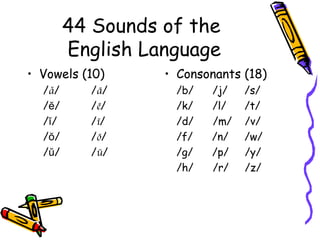
44 Sounds of the  English Language Vowels (10) / ă / / ā / / ĕ / / ē / / ĭ / / ī / / ŏ / / ō / / ŭ / / ū / Consonants (18) /b/   /j/   /s/ /k/   /l/   /t/ /d/  /m/  /v/ /f/  /n/  /w/ /g/  /p/  /y/ /h/  /r/  /z/
44 Sounds of the  English Language Vowel Diphthongs (2) /ou/ /oi/ Vowel Variants (3) /au/ /oo/ (moon) /oo/ (book) Schwa (1) / ə / Consonant Digraphs(7)   /sh/  /ch/  /wh/ /th/  / th /  /zh/   /ng/ r-controlled (3) /ar/  /or/  /er/
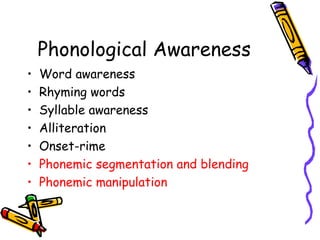
Phonological Awareness “ Funnel – ogical” awareness Sensitivity to the sounds of language words, syllables, and sounds  Includes phonemic awareness Necessary for understanding the alphabetic principle and how sounds match print
Phonological Awareness Word awareness Rhyming words Syllable awareness Alliteration Onset-rime Phonemic segmentation and blending Phonemic manipulation
Phonological Activities Clapping, standing, using body motions Manipulatives, e.g., linking blocks, puzzles, objects, chips or tokens Pictures, books, posters Music and rhyme “ Feel it in your mouth!” Elkonin (sound) boxes
Written Language Reading and writing Print awareness Reading: decoding + comprehension Sound – symbol connection [phonics] Writing: spelling, handwriting, written expression [writing process]
Orthography:  Symbols Alphabet (26 letters) Represent speech sounds Written / visual Spelling patterns
Print Awareness Concepts of Print Book concepts One-to-one correspondence Directionality Alphabet Knowledge Recognition Identification Formation
How do children develop print awareness? Read alouds Shared reading Print rich environment Big Books, little books, lots of books Hearing poems, nursery rhymes Seeing charts, signs, lists, “Morning Message” and “Sign in”
Alphabet Activities Sort plastic or magnetic letters Use letter cards with the ABC song Match environmental print labels to alphabet letter cards Locate target letter by using highlighter tape Write letters in the air, using large muscle movements Write letters in shaving cream, sand, or  rice trays
Pre-Phonics Phonological Awareness Oral Sounds  Print Awareness Visual Symbols
Phonics “ refers to instructional practices that emphasize how spellings are related to speech sounds in systematic ways.” (Snow, Burns, & Griffin, 1998)
What is the Alphabetic Principle? the  systematic  and  predictable  relationship between the letters of written language and the sounds of spoken language the way print matches speech the relationship between phonology  and orthography also known as the alphabetic code
Why learn the  Alphabetic Code? It provides the understanding for the  internal structure  of words. It helps children recognize familiar words and decode new words. It connects reading and writing. It enables children to read with fluency and comprehension.
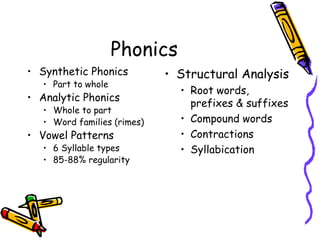
Phonics Synthetic Phonics Part to whole Analytic Phonics Whole to part Word families (rimes) Vowel Patterns 6 Syllable types 85-88% regularity Structural Analysis Root words, prefixes & suffixes Compound words Contractions Syllabication
Color-Code  Blends bl- cr- st- -nd -mp etc. Digraphs sh ch th wh ph Vowels a e i o u -y  -w
Orthography:  Syllables Six basic syllable types 85 – 88% of English language Vowel Patterns (syllable types) Structure of our language Alphabetic code
Vowel Patterns Regular Reliable Research-based Effective Efficient Easy to use
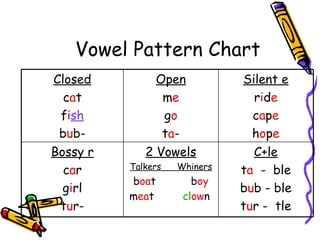
Vowel Pattern Chart C+le 2 Vowels Talkers  Whiners Bossy r Silent e Open Closed
Vowel Pattern Chart C+le t a   -  ble b u b - ble t u r -  tle 2 Vowels Talkers  Whiners b oa t  b oy m ea t   cl ow n   Bossy r c a r g i rl t u r- Silent e r i d e c a p e h o p e Open m e g o t a - Closed c a t f i sh b u b-
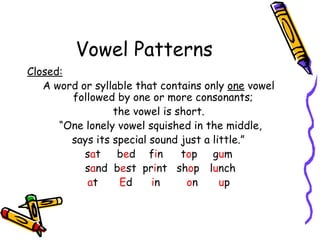
Vowel Patterns Closed: A word or syllable that contains only  one  vowel followed by one or more consonants;  the vowel is short. “ One lonely vowel squished in the middle,    says its special sound just a little.” s a t b e d f i n t o p g u m   s a nd  b e st pr i nt  sh o p  l u nch a t  E d  i n   o n   u p
Vowel Patterns Open: A word or syllable that ends with  one  vowel; the vowel is long. “If one vowel at the end is free, it pops way up and says its name to me.” m e sh e  h i g o fl u fl y
Vowel Patterns Silent e [Magic e]: A word or syllable that ends in e, containing one consonant before the final e and one vowel before that consonant; the vowel is long. “ The magic e is quiet, but it has a claim to fame;  it makes the vowel before it say its real name.” The magic e is so powerful, it gives all its strength to the other vowel so that it can say its real name. m a k e  St e v e   r i d e   h o p e  c u b e
Vowel Patterns Bossy r [r-controlled]: A word or syllable containing a vowel followed by r; the vowel sound is altered by the r. The letter r is so bossy, it tells the vowel that it can’t say its real name (long vowel) or its special sound (short vowel), but must say the r sound (as in car, for, her). c a r   h e r  g i rl  f o r   c u rl
Vowel Patterns Double Vowel Talkers:  [vowel digraphs] A word or syllable containing  two  adjacent vowels; the first one is long. “ When two vowels go walking, the first one does the talking and says its name.” r ai n  d ay   s ee   m ea t  p ie   b oa t  t oe   sl ow s ui t  bl ue
Vowel Patterns Double Vowel Whiners  :[diphthongs and variants] A word or syllable that contains  two  adjacent vowels; the vowels say neither a long or short vowel sound, but rather a very different sound. Sometimes when two vowels are next to each other, they make a funny whining sound, like when you fall down and say “ow,” “aw,” “oy,” and get a “boo-boo.” f au lt  s aw   f oi l  b oy  l ou d  c ow  m oo n  n ew   b oo k
Vowel Patterns C+le:  [ c onsonant + le] This syllable ends with “le” preceded by a consonant, and occurs in two-syllable words. When a word ends with a consonant and “le,” the “le” grabs the consonant before it, and the word breaks into two parts right before that consonant. b u b–ble c a –ble  ea –gle  p oo –dle  p u r-ple
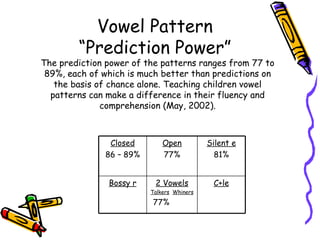
Vowel Pattern  “Prediction Power”  The prediction power of the patterns ranges from 77 to 89%, each of which is much better than predictions on the basis of chance alone. Teaching children vowel patterns can make a difference in their fluency and comprehension (May, 2002). C+le 2 Vowels Talkers   Whiners 77% Bossy r Silent e 81% Open 77% Closed 86 – 89%
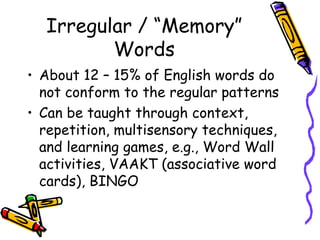
Irregular / “Memory” Words About 12 – 15% of English words do not conform to the regular patterns Can be taught through context, repetition, multisensory techniques, and learning games, e.g., Word Wall activities, VAAKT (associative word cards), BINGO
Structural Analysis Root words and affixes Compound words Contractions Syllabication
Root Words and Affixes Prefix Root Suffix un   friend   ly re   heat   ed in spect   or Color-highlight or draw a box around affixes (prefix = green; suffix = red) Make charts for similar affixes
Compound Words Begin with whole word, e.g., doghouse Segment and blend Use fists, puzzles, linking blocks Make lists of compound words Use color-coding ( dog house ) Practice deletion (say doghouse without dog)
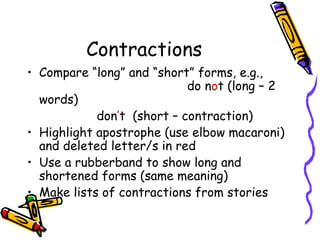
Contractions Compare “long” and “short” forms, e.g.,  do n o t (long – 2 words) don ’ t  (short – contraction) Highlight apostrophe (use elbow macaroni) and deleted letter/s in red Use a rubberband to show long and shortened forms (same meaning) Make lists of contractions from stories
Syllabication Patterns C+le turtle tur – tle VC/CV rabbit rab – bit V/CV tiger ti – ger VC/V camel cam – el V/V lion li - on
Strategy for Syllabication “ Spot and dot” the vowels Connect the dots Look at the number of consonants between the vowels If 2 – break between the consonants If 1 – break before the consonant; if it doesn’t sound right, move over one letter
Apply and Transfer Provide many opportunities to use these skills and strategies, both in isolation and in connected text Fiction and non-fiction Poetry and songs Decodable text Learning games and activities
Why? When students have the  MEANS  to  conquer the code, they will reach the  GOAL , and master the meaning!
The End Remember . . . Teach a child to read, Give a gift for life!! Thank you for your kind attention! Happy Teaching!
Websites of Interest www.aft.org  American Federation of Teachers www.ascd.org  Association for Supervision and Curriculum Development www. educationworld .com  Education World www. fcrr .org  Florida Center for Reading Research www.idafla.org  Florida Branch - IDA www. interdys .org   International Dyslexia Association www.nifl.gov  National Institute for Literacy www.nationalreadingpanel.org  National Reading Panel  www.reading.org   International Reading Association www.readingrockets.org  Reading Rockets

Phonics

  • 1.
    Conquer the Code:Sounds, Symbols, and Syllables
  • 2.
    Reading . .. an extraordinary ability, peculiarly human and yet distinctly unnatural. Dr. Sally Shaywitz, Overcoming Dyslexia , 2003
  • 3.
    Literacy . .. Begins at birth, and is a lifelong process!
  • 4.
    Unfortunately, Children arenot born with this insight, nor does it develop naturally without instruction. Reid Lyon, 1997, NICHD
  • 5.
    In today’s world,learning to read well is a key to the future success of our children. Not only is reading fluently and with comprehension by third grade a legislated priority, it is an ethical and professional imperative. (Wolfe and Nevills, 2004)
  • 6.
    In fact, teaching reading is Rocket Science! (See Teaching Reading Is Rocket Science: What Expert Teachers of Reading Should Know and Be Able to Do by Louisa C. Moats, AFT, June 1999)
  • 7.
    Research PracticeNational Research Council: Committee on National Research Council: Preventing Reading Difficulties in Young Children (1998) National Research Council - Starting Out Right: A Guide to Promoting Children’s Reading Success (1999) National Reading Panel: Teaching Children to Read (2000) Put Reading First: The Research Building Blocks for Teaching Children to Read (2001) Scientific Research in Education (2002)
  • 8.
    Reading and theBrain “ If we provide intervention at an early age, then we can improve reading fluency and facilitate the development of the neural systems that underlie skilled reading.” ( Sally and Bennett Shaywitz, Educational Leadership , March 2004, p. 10)
  • 9.
    Language Components ReceptiveExpressive Oral Listening Speaking Written Reading Writing
  • 10.
    “The Big Five”Phonemic Awareness Phonics Vocabulary Fluency Text Comprehension
  • 11.
    Reading Components and the “Big Five” Means DECODING Phonemic Awareness Phonics End COMPREHENSION Vocabulary Text Comprehension Fluency
  • 12.
    Lesson Plan FormatPreread Schema Read it Story grammar Reread it Fluency Discuss it Vocabulary React to it Comprehension Code it Alphabetic code Apply it Practice Transfer it Generalization
  • 13.
    Read with “H u G s” u niting H olistic & G raphophonic s trategies
  • 14.
    Reading is the union of Comprehension + Decoding (Holistic) (Graphophonic) Pre-read it Code it: Read it Hear it Reread it See it Discuss it Associate it React to it Expand it
  • 15.
    Code it: AlphabeticCode Hear it See it Associate it Expand it Phonological: sound Print: symbol Sound/symbol Structural analysis
  • 16.
    Conquer the Code: Sounds, Symbols, and Syllables Sounds Phonological Awareness Phonemic Awareness Symbols Print Awareness Alphabet knowledge Syllables Vowel Patterns Syllabication
  • 17.
    Oral Language Listeningand Speaking Literacy Events “Grand Conversations” Phonological Awareness: sensitivity to the sounds of language
  • 18.
    Phonology: SoundsPhonological awareness Phonemic awareness 44 phonemes (speech sounds) Oral / auditory Related to reading and writing
  • 19.
    How many sounds?in the word box in the word enough in the word precious
  • 20.
    44 Sounds ofthe English Language Vowels (10) / ă / / ā / / ĕ / / ē / / ĭ / / ī / / ŏ / / ō / / ŭ / / ū / Consonants (18) /b/ /j/ /s/ /k/ /l/ /t/ /d/ /m/ /v/ /f/ /n/ /w/ /g/ /p/ /y/ /h/ /r/ /z/
  • 21.
    44 Sounds ofthe English Language Vowel Diphthongs (2) /ou/ /oi/ Vowel Variants (3) /au/ /oo/ (moon) /oo/ (book) Schwa (1) / ə / Consonant Digraphs(7) /sh/ /ch/ /wh/ /th/ / th / /zh/ /ng/ r-controlled (3) /ar/ /or/ /er/
  • 22.
    Phonological Awareness “Funnel – ogical” awareness Sensitivity to the sounds of language words, syllables, and sounds Includes phonemic awareness Necessary for understanding the alphabetic principle and how sounds match print
  • 23.
    Phonological Awareness Wordawareness Rhyming words Syllable awareness Alliteration Onset-rime Phonemic segmentation and blending Phonemic manipulation
  • 24.
    Phonological Activities Clapping,standing, using body motions Manipulatives, e.g., linking blocks, puzzles, objects, chips or tokens Pictures, books, posters Music and rhyme “ Feel it in your mouth!” Elkonin (sound) boxes
  • 25.
    Written Language Readingand writing Print awareness Reading: decoding + comprehension Sound – symbol connection [phonics] Writing: spelling, handwriting, written expression [writing process]
  • 26.
    Orthography: SymbolsAlphabet (26 letters) Represent speech sounds Written / visual Spelling patterns
  • 27.
    Print Awareness Conceptsof Print Book concepts One-to-one correspondence Directionality Alphabet Knowledge Recognition Identification Formation
  • 28.
    How do childrendevelop print awareness? Read alouds Shared reading Print rich environment Big Books, little books, lots of books Hearing poems, nursery rhymes Seeing charts, signs, lists, “Morning Message” and “Sign in”
  • 29.
    Alphabet Activities Sortplastic or magnetic letters Use letter cards with the ABC song Match environmental print labels to alphabet letter cards Locate target letter by using highlighter tape Write letters in the air, using large muscle movements Write letters in shaving cream, sand, or rice trays
  • 30.
    Pre-Phonics Phonological AwarenessOral Sounds Print Awareness Visual Symbols
  • 31.
    Phonics “ refersto instructional practices that emphasize how spellings are related to speech sounds in systematic ways.” (Snow, Burns, & Griffin, 1998)
  • 32.
    What is theAlphabetic Principle? the systematic and predictable relationship between the letters of written language and the sounds of spoken language the way print matches speech the relationship between phonology and orthography also known as the alphabetic code
  • 33.
    Why learn the Alphabetic Code? It provides the understanding for the internal structure of words. It helps children recognize familiar words and decode new words. It connects reading and writing. It enables children to read with fluency and comprehension.
  • 34.
    Phonics Synthetic PhonicsPart to whole Analytic Phonics Whole to part Word families (rimes) Vowel Patterns 6 Syllable types 85-88% regularity Structural Analysis Root words, prefixes & suffixes Compound words Contractions Syllabication
  • 35.
    Color-Code Blendsbl- cr- st- -nd -mp etc. Digraphs sh ch th wh ph Vowels a e i o u -y -w
  • 36.
    Orthography: SyllablesSix basic syllable types 85 – 88% of English language Vowel Patterns (syllable types) Structure of our language Alphabetic code
  • 37.
    Vowel Patterns RegularReliable Research-based Effective Efficient Easy to use
  • 38.
    Vowel Pattern ChartC+le 2 Vowels Talkers Whiners Bossy r Silent e Open Closed
  • 39.
    Vowel Pattern ChartC+le t a - ble b u b - ble t u r - tle 2 Vowels Talkers Whiners b oa t b oy m ea t cl ow n Bossy r c a r g i rl t u r- Silent e r i d e c a p e h o p e Open m e g o t a - Closed c a t f i sh b u b-
  • 40.
    Vowel Patterns Closed:A word or syllable that contains only one vowel followed by one or more consonants; the vowel is short. “ One lonely vowel squished in the middle, says its special sound just a little.” s a t b e d f i n t o p g u m s a nd b e st pr i nt sh o p l u nch a t E d i n o n u p
  • 41.
    Vowel Patterns Open:A word or syllable that ends with one vowel; the vowel is long. “If one vowel at the end is free, it pops way up and says its name to me.” m e sh e h i g o fl u fl y
  • 42.
    Vowel Patterns Silente [Magic e]: A word or syllable that ends in e, containing one consonant before the final e and one vowel before that consonant; the vowel is long. “ The magic e is quiet, but it has a claim to fame; it makes the vowel before it say its real name.” The magic e is so powerful, it gives all its strength to the other vowel so that it can say its real name. m a k e St e v e r i d e h o p e c u b e
  • 43.
    Vowel Patterns Bossyr [r-controlled]: A word or syllable containing a vowel followed by r; the vowel sound is altered by the r. The letter r is so bossy, it tells the vowel that it can’t say its real name (long vowel) or its special sound (short vowel), but must say the r sound (as in car, for, her). c a r h e r g i rl f o r c u rl
  • 44.
    Vowel Patterns DoubleVowel Talkers: [vowel digraphs] A word or syllable containing two adjacent vowels; the first one is long. “ When two vowels go walking, the first one does the talking and says its name.” r ai n d ay s ee m ea t p ie b oa t t oe sl ow s ui t bl ue
  • 45.
    Vowel Patterns DoubleVowel Whiners :[diphthongs and variants] A word or syllable that contains two adjacent vowels; the vowels say neither a long or short vowel sound, but rather a very different sound. Sometimes when two vowels are next to each other, they make a funny whining sound, like when you fall down and say “ow,” “aw,” “oy,” and get a “boo-boo.” f au lt s aw f oi l b oy l ou d c ow m oo n n ew b oo k
  • 46.
    Vowel Patterns C+le: [ c onsonant + le] This syllable ends with “le” preceded by a consonant, and occurs in two-syllable words. When a word ends with a consonant and “le,” the “le” grabs the consonant before it, and the word breaks into two parts right before that consonant. b u b–ble c a –ble ea –gle p oo –dle p u r-ple
  • 47.
    Vowel Pattern “Prediction Power” The prediction power of the patterns ranges from 77 to 89%, each of which is much better than predictions on the basis of chance alone. Teaching children vowel patterns can make a difference in their fluency and comprehension (May, 2002). C+le 2 Vowels Talkers Whiners 77% Bossy r Silent e 81% Open 77% Closed 86 – 89%
  • 48.
    Irregular / “Memory”Words About 12 – 15% of English words do not conform to the regular patterns Can be taught through context, repetition, multisensory techniques, and learning games, e.g., Word Wall activities, VAAKT (associative word cards), BINGO
  • 49.
    Structural Analysis Rootwords and affixes Compound words Contractions Syllabication
  • 50.
    Root Words andAffixes Prefix Root Suffix un friend ly re heat ed in spect or Color-highlight or draw a box around affixes (prefix = green; suffix = red) Make charts for similar affixes
  • 51.
    Compound Words Beginwith whole word, e.g., doghouse Segment and blend Use fists, puzzles, linking blocks Make lists of compound words Use color-coding ( dog house ) Practice deletion (say doghouse without dog)
  • 52.
    Contractions Compare “long”and “short” forms, e.g., do n o t (long – 2 words) don ’ t (short – contraction) Highlight apostrophe (use elbow macaroni) and deleted letter/s in red Use a rubberband to show long and shortened forms (same meaning) Make lists of contractions from stories
  • 53.
    Syllabication Patterns C+leturtle tur – tle VC/CV rabbit rab – bit V/CV tiger ti – ger VC/V camel cam – el V/V lion li - on
  • 54.
    Strategy for Syllabication“ Spot and dot” the vowels Connect the dots Look at the number of consonants between the vowels If 2 – break between the consonants If 1 – break before the consonant; if it doesn’t sound right, move over one letter
  • 55.
    Apply and TransferProvide many opportunities to use these skills and strategies, both in isolation and in connected text Fiction and non-fiction Poetry and songs Decodable text Learning games and activities
  • 56.
    Why? When studentshave the MEANS to conquer the code, they will reach the GOAL , and master the meaning!
  • 57.
    The End Remember. . . Teach a child to read, Give a gift for life!! Thank you for your kind attention! Happy Teaching!
  • 58.
    Websites of Interestwww.aft.org American Federation of Teachers www.ascd.org Association for Supervision and Curriculum Development www. educationworld .com Education World www. fcrr .org Florida Center for Reading Research www.idafla.org Florida Branch - IDA www. interdys .org International Dyslexia Association www.nifl.gov National Institute for Literacy www.nationalreadingpanel.org National Reading Panel www.reading.org International Reading Association www.readingrockets.org Reading Rockets

Editor's Notes

  • #30 “ News of the Day” in kindergarten HighScope automaticity