The Big PictureThe Big Picture
Carrie DavenportCarrie Davenport
“It’s never just about the child. They bring with them
their cultural histories, their own assumptions about
what it means to engage in learning, and native
languages that must be understood and valued.”
- Professor Elizabeth Kozleski
Chapter’s IntentChapter’s Intent
Help educators understand that in ourHelp educators understand that in our
efforts to assist students in reachingefforts to assist students in reaching
benchmarks, attaining standards,benchmarks, attaining standards,
and passing standardized tests, weand passing standardized tests, we
may loose sight of the whole child.may loose sight of the whole child.
Realities of ESL EducationRealities of ESL Education
 Loss of status and difficultyLoss of status and difficulty
communicatingcommunicating
 Impact of PovertyImpact of Poverty
 Impact of family separationImpact of family separation
 Household responsibilitiesHousehold responsibilities
 Teacher attitudesTeacher attitudes
 Teenage angstTeenage angst
Issues Faced by EnglishIssues Faced by English
Learners in SchoolLearners in School
 Academic LanguageAcademic Language
 Background knowledge andBackground knowledge and
ExperienceExperience
 Cultural Values and NormsCultural Values and Norms
Factors Associated WithFactors Associated With
UnderachievementUnderachievement
 Lack of qualified teachersLack of qualified teachers
 Inappropriate teaching practicesInappropriate teaching practices
 At risk school environmentsAt risk school environments
Factors Associated withFactors Associated with
Educational SuccessEducational Success
 High Expectations for all studentsHigh Expectations for all students
 Effective teaching practicesEffective teaching practices
 Relationships of respectRelationships of respect
RTI and Cultural and LinguisticRTI and Cultural and Linguistic
DiversityDiversity
 Guided by questions and concernsGuided by questions and concerns
– Has adequate support in EnglishHas adequate support in English
language development been given?language development been given?
– How should we decide what additionalHow should we decide what additional
support to provide?support to provide?
The Important Role of ParentsThe Important Role of Parents
 Why don’t they come?Why don’t they come?
 What can we do?What can we do?
 Overall RoleOverall Role
Tier 1 InterventionsTier 1 Interventions
??????????????????????????????
“The success of the RTI process for
culturally and linguistically diverse
students depends on teachers having
access to appropriate evidence-based
instructional approaches that have been
validated with diverse populations”
-Klinger & Edwards
Tier 2 InterventionsTier 2 Interventions
Shannon UrbanekShannon Urbanek
“Focused classroom instruction is not sufficient to
meet the needs of some children. To accelerate their
progress and ensure that they do not slip further
behind, these students require more strategic
intervention.”
-Vaughn, Wanzek, Woodruff, & Linan-Thompson
What is Tier 2 Intervention?What is Tier 2 Intervention?
 Supplement InstructionSupplement Instruction
 Focus and target specific needs to meetFocus and target specific needs to meet
the broader academic successthe broader academic success
 Students who are not developing andStudents who are not developing and
acquiring their core skills to meet theiracquiring their core skills to meet their
overall academic skills.overall academic skills.
 Focuses on the instructional skills that ELLFocuses on the instructional skills that ELL
needneed
ex. Oral language, vocabulary , interactionex. Oral language, vocabulary , interaction
Should be 20-25% of students in a gradeShould be 20-25% of students in a grade
level/class, or schoollevel/class, or school
5 Key Elements5 Key Elements
 Using data to identify Tier 2 interventionUsing data to identify Tier 2 intervention
 Small groupsSmall groups
 Conducting interventionConducting intervention
 Monitoring progressMonitoring progress
 Reflect on data and make decisionsReflect on data and make decisions
Tier 2 In ActionTier 2 In Action Grade 5Grade 5
– Team meets 2x a monthTeam meets 2x a month
– 4 teachers, a bilingual specialist and resource4 teachers, a bilingual specialist and resource
specialist(special Education teacher.specialist(special Education teacher.
– Decisions for intervention are made in lateDecisions for intervention are made in late
OctoberOctober
– Data sheet is used by each teacher to monitorData sheet is used by each teacher to monitor
the progress of each individual students.the progress of each individual students.
 Analyzing the dataAnalyzing the data
– Discuss and decide who and when theDiscuss and decide who and when the
intervention will be provided.intervention will be provided.
– Consider others needs of the students such asConsider others needs of the students such as
staying on taskstaying on task
6 Principles of6 Principles of
Core Intervention Model (CIM)Core Intervention Model (CIM)
 Principle 1: Small groupPrinciple 1: Small group
 Principle 2: Setting ObjectivesPrinciple 2: Setting Objectives
 Principle 3: Content Materials and programsPrinciple 3: Content Materials and programs
are reflective of student abilitiesare reflective of student abilities
 Principle 4: Skills taught explicitly,Principle 4: Skills taught explicitly,
intensely, and quicklyintensely, and quickly
 Principle 5: Students must be provided manyPrinciple 5: Students must be provided many
opportunities to create correct responsesopportunities to create correct responses
 Principle 6: Corrective Feedback using thePrinciple 6: Corrective Feedback using the
staircase approachstaircase approach
Final ThoughtsFinal Thoughts
 5 key components of Tier 2 to assist in deciding5 key components of Tier 2 to assist in deciding
who is in need of Tier 2 interventionwho is in need of Tier 2 intervention
 Teacher who work together in teams and withTeacher who work together in teams and with
colleagues including those with second languagecolleagues including those with second language
acquisition and special education can makeacquisition and special education can make
appropriate informed decisions based on data forappropriate informed decisions based on data for
English learners.English learners.
 Decision made on an individual student base andDecision made on an individual student base and
take academic progress, language acquisition,take academic progress, language acquisition,
and proficient into consideration.and proficient into consideration.
Tier 3 InterventionsTier 3 Interventions
““A culturally responsive RTI model hasA culturally responsive RTI model has
tremendous potential to…moretremendous potential to…more
appropriately diffierentiate betweenappropriately diffierentiate between
culturally and linguistically diverseculturally and linguistically diverse
learners who do and do not havelearners who do and do not have
disabilities. Only by doing so can alldisabilities. Only by doing so can all
children achieve their full potential.”children achieve their full potential.”
-Klinger, Sorrells, & Barrera-Klinger, Sorrells, & Barrera
Barbara ShaughnessyBarbara Shaughnessy
It is difficult to distinguish struggling EnglishIt is difficult to distinguish struggling English
learners from those having disabilities because oflearners from those having disabilities because of
these several profiles;these several profiles;
 English learners who are literate and fluent inEnglish learners who are literate and fluent in
their home languagetheir home language
 English learners who speak their native languageEnglish learners who speak their native language
fluently but are not literate in itfluently but are not literate in it
 English learners born in the US but are notEnglish learners born in the US but are not
completely fluent in their home language nor yetcompletely fluent in their home language nor yet
proficient in Englishproficient in English
Tier Three is different because….Tier Three is different because….
 It is individualized, intensive, explicit ,small groupIt is individualized, intensive, explicit ,small group
instruction.instruction.
 The most intensive level in instruction provided toThe most intensive level in instruction provided to
students in general educationstudents in general education
 The goal is remediation of existing problems andThe goal is remediation of existing problems and
prevention of more severe problemsprevention of more severe problems
 In the best of all worlds, the person deliveringIn the best of all worlds, the person delivering
instruction should have an understanding ofinstruction should have an understanding of
second language acquisition and be familiar withsecond language acquisition and be familiar with
the students culturethe students culture
What is different about Tier Three?What is different about Tier Three?
 Tier Three is:Tier Three is:
 Teacher centered, systematic and explicitTeacher centered, systematic and explicit
 Intended for aIntended for a specificspecific duration of timeduration of time
 Part of a RTI process where studentsPart of a RTI process where students move in andmove in and
outout of tiersof tiers
 A way toA way to identifyidentify disabilitiesdisabilities
 Tier Three is not:Tier Three is not:
 More of the same instruction the student receivedMore of the same instruction the student received
in the core curriculumin the core curriculum
 A life sentenceA life sentence
 A way to remove challenging students from theA way to remove challenging students from the
classroomclassroom
 Not necessarily special educationNot necessarily special education
Learning Disability –Hard to DefineLearning Disability –Hard to Define
 Learning Disability is used to describe a disorder that affectsLearning Disability is used to describe a disorder that affects
listening, speaking, reading, writing, reasoning, math, and sociallistening, speaking, reading, writing, reasoning, math, and social
skills.skills.
 More complicated when a student is culturally and linguisticallyMore complicated when a student is culturally and linguistically
diversediverse
 Critical to assess students suspected of learning disabilities bothCritical to assess students suspected of learning disabilities both
in the home language and in Englishin the home language and in English
 English learners with learning disabilities will not make quickEnglish learners with learning disabilities will not make quick
progress with exposure to English.progress with exposure to English.
 Learning disabilities are life long and academic progress will beLearning disabilities are life long and academic progress will be
slower than for a student whose only challenge is developingslower than for a student whose only challenge is developing
English proficiency.English proficiency.
How do we distinguish a Disability from a Difference?How do we distinguish a Disability from a Difference?
 1. Use records – cumulative files will paint a picture of educational1. Use records – cumulative files will paint a picture of educational
historyhistory
 2. Interviews – families are our best information source2. Interviews – families are our best information source
 3. Observations – in-class observations are critical to see if the3. Observations – in-class observations are critical to see if the
student is receiving high quality instruction that meets his needsstudent is receiving high quality instruction that meets his needs
 4. Testing – assessments provides valuable information on4. Testing – assessments provides valuable information on
performance. However no single test should be used forperformance. However no single test should be used for
placementplacement
A successful IEP Meeting should:A successful IEP Meeting should:
 Reassure the parent that you are there to helpReassure the parent that you are there to help
 Have an interpreter available at the meetingHave an interpreter available at the meeting
 Make sure the parents understand everything being discussedMake sure the parents understand everything being discussed
 suggest what the parents can do at home to helpsuggest what the parents can do at home to help
 Offer an “open door” policy for frequent questions andOffer an “open door” policy for frequent questions and
communicationscommunications
 Offer an list of community resourcesOffer an list of community resources
Wrap UpWrap Up
 Tier OneTier One
 Classroom modification, accommodations, andClassroom modification, accommodations, and
documentationdocumentation
 Tier TwoTier Two
 Further modification, progress monitoring andFurther modification, progress monitoring and
documentationdocumentation
 Tier ThreeTier Three
 Intensive instruction focusing on specific needsIntensive instruction focusing on specific needs
for longer, provided by a highly trained teacher,for longer, provided by a highly trained teacher,
monitored weekly.monitored weekly.
Special Considerations forSpecial Considerations for
Secondary English LearnersSecondary English Learners
Cheri ZimmermanCheri Zimmerman
“What RTI does is put everybody on the same playing
field. It doesn’t matter what your language structure is,
whether or not you’re disabled, or whether or not you’re
poor. What matters is that you need to progress at a
satisfactory pace in the general curriculum.”
-Wayne Sailor
Why do Secondary English LearnersWhy do Secondary English Learners
Struggle with Reading and Writing?Struggle with Reading and Writing?
 There is a strong relationship between literacy
proficiency and academic achievement.
 Students need to use English to:
–  1. Read and understand content
– 2. Understand complex expository from textbooks
– 3. Read reference material
– 4. Write persuasively
– 5. Make predictions
– 6. Draw conclusions
Students must use their emergingStudents must use their emerging
English Knowledge to completeEnglish Knowledge to complete
assignmentsassignments
 Knowledge of EnglishKnowledge of English
 Knowledge of ContentKnowledge of Content
 Knowledge of how tasks are to beKnowledge of how tasks are to be
completedcompleted
Major Challenges to improve literacy ofMajor Challenges to improve literacy of
adolescent English Learners are theadolescent English Learners are the
following:following:
 Lack of common criteria for identifying English learners and tracking their
academic performance
 Lack of appropriate assessments for measuring native-language literacy,
content knowledge, and English literacy development
 Inadequate educator capacity for improving literacy in adolescent English
learners
 Lack of appropriate and flexible program options
 Inadequate use of research-based instructional practices
 Lack of a strong and coherent research agenda about adolescent English
learners literacy
*Short and Fitzsimmons (2006, p. 14)
RTI Effective Tier 1 SecondaryRTI Effective Tier 1 Secondary
Instruction: Eight PrinciplesInstruction: Eight Principles
 Assessment-based literacy program
 Explicit instruction to prepare them from college/work
 Rich text materials across genres and literacies
 A curriculum that is socioculturally aware
 Rich, engaging, motivating instruction
 Explicit Vocabulary Instruction
 Instruction in technologies
 Differentiated instruction
RTI Effective Tier 1 and 2RTI Effective Tier 1 and 2
Secondary InstructionSecondary Instruction
 Consider both in-school and out-of-school literacies
when designing interventions
– *out-of-school internet searches, social networking, hobbies,
games etc.
 Consider the household literacy skills students have
developed while helping family members, holding part-
time jobs
 Motivation, identity, choice and engagement are
important factors, including self-selection of reading
material, vocabulary
 The schedule
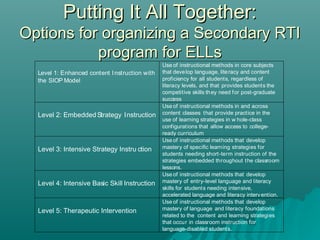
Putting It All Together:Putting It All Together:
Options for organizing a Secondary RTIOptions for organizing a Secondary RTI
program for ELLsprogram for ELLs
Level 1: Enhanced content Instruction with
the SIOP Model
Use of instructional methods in core subjects
that develop language, literacy and content
proficiency for all students, regardless of
literacy levels, and that provides students the
competitive skills they need for post-graduate
success
Level 2: EmbeddedStrategy Instruction
Use of instructional methods in and across
content classes that provide practice in the
use of learning strategies in w hole-class
configurations that allow access to college-
ready curriculum
Level 3: Intensive Strategy Instru ction
Use of instructional methods that develop
mastery of specific learning strategies for
students needing short-term instruction of the
strategies embedded throughout the classroom
lessons.
Level 4: Intensive Basic Skill Instruction
Use of instructional methods that develop
mastery of entry-level language and literacy
skills for students needing intensive,
accelerated language and literacy intervention.
Level 5: Therapeutic Intervention
Use of instructional methods that develop
mastery of language and literacy foundations
related to the content and learning strategies
that occur in classroom instruction for
language-disabled students.
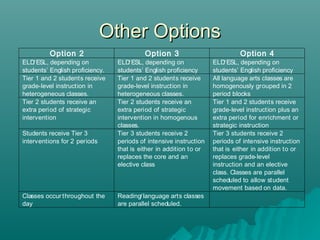
Other OptionsOther Options
Option 2 Option 3 Option 4
ELD/ESL, depending on
students’ English proficiency.
ELD/ESL, depending on
students’ English proficiency
ELD/ESL, depending on
students’ English proficiency
Tier 1 and 2 students receive
grade-level instruction in
heterogeneous classes.
Tier 1 and 2 students receive
grade-level instruction in
heterogeneous classes.
All language arts classes are
homogenously grouped in 2
period blocks
Tier 2 students receive an
extra period of strategic
intervention
Tier 2 students receive an
extra period of strategic
intervention in homogenous
classes.
Tier 1 and 2 students receive
grade-level instruction plus an
extra period for enrichment or
strategic instruction
Students receive Tier 3
interventions for 2 periods
Tier 3 students receive 2
periods of intensive instruction
that is either in addition to or
replaces the core and an
elective class
Tier 3 students receive 2
periods of intensive instruction
that is either in addition to or
replaces grade-level
instruction and an elective
class. Classes are parallel
scheduled to allow student
movement based on data.
Classes occur throughout the
day
Reading/language arts classes
are parallel scheduled.
Success and Barriers toSuccess and Barriers to
RTI ImplementationRTI Implementation
Christine DiakosChristine Diakos
“The great aim of education is not
knowledge, but action.”
-Herbert Spencer (1820–1903)
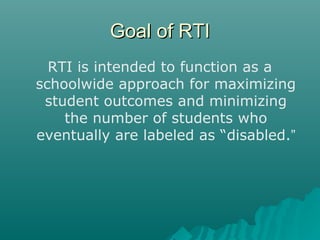
Goal of RTIGoal of RTI
RTI is intended to function as a
schoolwide approach for maximizing
student outcomes and minimizing
the number of students who
eventually are labeled as “disabled.”
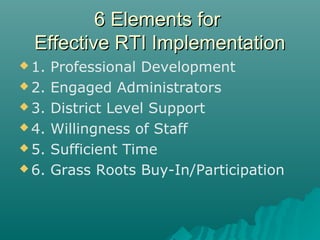
6 Elements for6 Elements for
Effective RTI ImplementationEffective RTI Implementation
 1. Professional Development
 2. Engaged Administrators
 3. District Level Support
 4. Willingness of Staff
 5. Sufficient Time
 6. Grass Roots Buy-In/Participation
How do these elements relate toHow do these elements relate to
English Language Learners?English Language Learners?
 Professional Development
 Best Practice
 New Hires
 Redefinition of Roles
 Time
 Changing Instructional Practice
 Voice
Six Principles ofSix Principles of
Successful RTI ProgramsSuccessful RTI Programs
 1. Instruction
 2. Responsive Teaching and Differentiation
 3. Assessment
 4. Collaboration
 5. Systemic and Comprehensive
Approaches
 6. Expertise

Rti ell

  • 1.
    The Big PictureTheBig Picture Carrie DavenportCarrie Davenport “It’s never just about the child. They bring with them their cultural histories, their own assumptions about what it means to engage in learning, and native languages that must be understood and valued.” - Professor Elizabeth Kozleski
  • 2.
    Chapter’s IntentChapter’s Intent Helpeducators understand that in ourHelp educators understand that in our efforts to assist students in reachingefforts to assist students in reaching benchmarks, attaining standards,benchmarks, attaining standards, and passing standardized tests, weand passing standardized tests, we may loose sight of the whole child.may loose sight of the whole child.
  • 3.
    Realities of ESLEducationRealities of ESL Education  Loss of status and difficultyLoss of status and difficulty communicatingcommunicating  Impact of PovertyImpact of Poverty  Impact of family separationImpact of family separation  Household responsibilitiesHousehold responsibilities  Teacher attitudesTeacher attitudes  Teenage angstTeenage angst
  • 4.
    Issues Faced byEnglishIssues Faced by English Learners in SchoolLearners in School  Academic LanguageAcademic Language  Background knowledge andBackground knowledge and ExperienceExperience  Cultural Values and NormsCultural Values and Norms
  • 5.
    Factors Associated WithFactorsAssociated With UnderachievementUnderachievement  Lack of qualified teachersLack of qualified teachers  Inappropriate teaching practicesInappropriate teaching practices  At risk school environmentsAt risk school environments
  • 6.
    Factors Associated withFactorsAssociated with Educational SuccessEducational Success  High Expectations for all studentsHigh Expectations for all students  Effective teaching practicesEffective teaching practices  Relationships of respectRelationships of respect
  • 7.
    RTI and Culturaland LinguisticRTI and Cultural and Linguistic DiversityDiversity  Guided by questions and concernsGuided by questions and concerns – Has adequate support in EnglishHas adequate support in English language development been given?language development been given? – How should we decide what additionalHow should we decide what additional support to provide?support to provide?
  • 8.
    The Important Roleof ParentsThe Important Role of Parents  Why don’t they come?Why don’t they come?  What can we do?What can we do?  Overall RoleOverall Role
  • 9.
    Tier 1 InterventionsTier1 Interventions ?????????????????????????????? “The success of the RTI process for culturally and linguistically diverse students depends on teachers having access to appropriate evidence-based instructional approaches that have been validated with diverse populations” -Klinger & Edwards
  • 10.
    Tier 2 InterventionsTier2 Interventions Shannon UrbanekShannon Urbanek “Focused classroom instruction is not sufficient to meet the needs of some children. To accelerate their progress and ensure that they do not slip further behind, these students require more strategic intervention.” -Vaughn, Wanzek, Woodruff, & Linan-Thompson
  • 11.
    What is Tier2 Intervention?What is Tier 2 Intervention?  Supplement InstructionSupplement Instruction  Focus and target specific needs to meetFocus and target specific needs to meet the broader academic successthe broader academic success  Students who are not developing andStudents who are not developing and acquiring their core skills to meet theiracquiring their core skills to meet their overall academic skills.overall academic skills.  Focuses on the instructional skills that ELLFocuses on the instructional skills that ELL needneed ex. Oral language, vocabulary , interactionex. Oral language, vocabulary , interaction Should be 20-25% of students in a gradeShould be 20-25% of students in a grade level/class, or schoollevel/class, or school
  • 12.
    5 Key Elements5Key Elements  Using data to identify Tier 2 interventionUsing data to identify Tier 2 intervention  Small groupsSmall groups  Conducting interventionConducting intervention  Monitoring progressMonitoring progress  Reflect on data and make decisionsReflect on data and make decisions
  • 13.
    Tier 2 InActionTier 2 In Action Grade 5Grade 5 – Team meets 2x a monthTeam meets 2x a month – 4 teachers, a bilingual specialist and resource4 teachers, a bilingual specialist and resource specialist(special Education teacher.specialist(special Education teacher. – Decisions for intervention are made in lateDecisions for intervention are made in late OctoberOctober – Data sheet is used by each teacher to monitorData sheet is used by each teacher to monitor the progress of each individual students.the progress of each individual students.  Analyzing the dataAnalyzing the data – Discuss and decide who and when theDiscuss and decide who and when the intervention will be provided.intervention will be provided. – Consider others needs of the students such asConsider others needs of the students such as staying on taskstaying on task
  • 14.
    6 Principles of6Principles of Core Intervention Model (CIM)Core Intervention Model (CIM)  Principle 1: Small groupPrinciple 1: Small group  Principle 2: Setting ObjectivesPrinciple 2: Setting Objectives  Principle 3: Content Materials and programsPrinciple 3: Content Materials and programs are reflective of student abilitiesare reflective of student abilities  Principle 4: Skills taught explicitly,Principle 4: Skills taught explicitly, intensely, and quicklyintensely, and quickly  Principle 5: Students must be provided manyPrinciple 5: Students must be provided many opportunities to create correct responsesopportunities to create correct responses  Principle 6: Corrective Feedback using thePrinciple 6: Corrective Feedback using the staircase approachstaircase approach
  • 15.
    Final ThoughtsFinal Thoughts 5 key components of Tier 2 to assist in deciding5 key components of Tier 2 to assist in deciding who is in need of Tier 2 interventionwho is in need of Tier 2 intervention  Teacher who work together in teams and withTeacher who work together in teams and with colleagues including those with second languagecolleagues including those with second language acquisition and special education can makeacquisition and special education can make appropriate informed decisions based on data forappropriate informed decisions based on data for English learners.English learners.  Decision made on an individual student base andDecision made on an individual student base and take academic progress, language acquisition,take academic progress, language acquisition, and proficient into consideration.and proficient into consideration.
  • 16.
    Tier 3 InterventionsTier3 Interventions ““A culturally responsive RTI model hasA culturally responsive RTI model has tremendous potential to…moretremendous potential to…more appropriately diffierentiate betweenappropriately diffierentiate between culturally and linguistically diverseculturally and linguistically diverse learners who do and do not havelearners who do and do not have disabilities. Only by doing so can alldisabilities. Only by doing so can all children achieve their full potential.”children achieve their full potential.” -Klinger, Sorrells, & Barrera-Klinger, Sorrells, & Barrera Barbara ShaughnessyBarbara Shaughnessy
  • 17.
    It is difficultto distinguish struggling EnglishIt is difficult to distinguish struggling English learners from those having disabilities because oflearners from those having disabilities because of these several profiles;these several profiles;  English learners who are literate and fluent inEnglish learners who are literate and fluent in their home languagetheir home language  English learners who speak their native languageEnglish learners who speak their native language fluently but are not literate in itfluently but are not literate in it  English learners born in the US but are notEnglish learners born in the US but are not completely fluent in their home language nor yetcompletely fluent in their home language nor yet proficient in Englishproficient in English
  • 18.
    Tier Three isdifferent because….Tier Three is different because….  It is individualized, intensive, explicit ,small groupIt is individualized, intensive, explicit ,small group instruction.instruction.  The most intensive level in instruction provided toThe most intensive level in instruction provided to students in general educationstudents in general education  The goal is remediation of existing problems andThe goal is remediation of existing problems and prevention of more severe problemsprevention of more severe problems  In the best of all worlds, the person deliveringIn the best of all worlds, the person delivering instruction should have an understanding ofinstruction should have an understanding of second language acquisition and be familiar withsecond language acquisition and be familiar with the students culturethe students culture
  • 19.
    What is differentabout Tier Three?What is different about Tier Three?  Tier Three is:Tier Three is:  Teacher centered, systematic and explicitTeacher centered, systematic and explicit  Intended for aIntended for a specificspecific duration of timeduration of time  Part of a RTI process where studentsPart of a RTI process where students move in andmove in and outout of tiersof tiers  A way toA way to identifyidentify disabilitiesdisabilities  Tier Three is not:Tier Three is not:  More of the same instruction the student receivedMore of the same instruction the student received in the core curriculumin the core curriculum  A life sentenceA life sentence  A way to remove challenging students from theA way to remove challenging students from the classroomclassroom  Not necessarily special educationNot necessarily special education
  • 20.
    Learning Disability –Hardto DefineLearning Disability –Hard to Define  Learning Disability is used to describe a disorder that affectsLearning Disability is used to describe a disorder that affects listening, speaking, reading, writing, reasoning, math, and sociallistening, speaking, reading, writing, reasoning, math, and social skills.skills.  More complicated when a student is culturally and linguisticallyMore complicated when a student is culturally and linguistically diversediverse  Critical to assess students suspected of learning disabilities bothCritical to assess students suspected of learning disabilities both in the home language and in Englishin the home language and in English  English learners with learning disabilities will not make quickEnglish learners with learning disabilities will not make quick progress with exposure to English.progress with exposure to English.  Learning disabilities are life long and academic progress will beLearning disabilities are life long and academic progress will be slower than for a student whose only challenge is developingslower than for a student whose only challenge is developing English proficiency.English proficiency.
  • 21.
    How do wedistinguish a Disability from a Difference?How do we distinguish a Disability from a Difference?  1. Use records – cumulative files will paint a picture of educational1. Use records – cumulative files will paint a picture of educational historyhistory  2. Interviews – families are our best information source2. Interviews – families are our best information source  3. Observations – in-class observations are critical to see if the3. Observations – in-class observations are critical to see if the student is receiving high quality instruction that meets his needsstudent is receiving high quality instruction that meets his needs  4. Testing – assessments provides valuable information on4. Testing – assessments provides valuable information on performance. However no single test should be used forperformance. However no single test should be used for placementplacement
  • 22.
    A successful IEPMeeting should:A successful IEP Meeting should:  Reassure the parent that you are there to helpReassure the parent that you are there to help  Have an interpreter available at the meetingHave an interpreter available at the meeting  Make sure the parents understand everything being discussedMake sure the parents understand everything being discussed  suggest what the parents can do at home to helpsuggest what the parents can do at home to help  Offer an “open door” policy for frequent questions andOffer an “open door” policy for frequent questions and communicationscommunications  Offer an list of community resourcesOffer an list of community resources
  • 23.
    Wrap UpWrap Up Tier OneTier One  Classroom modification, accommodations, andClassroom modification, accommodations, and documentationdocumentation  Tier TwoTier Two  Further modification, progress monitoring andFurther modification, progress monitoring and documentationdocumentation  Tier ThreeTier Three  Intensive instruction focusing on specific needsIntensive instruction focusing on specific needs for longer, provided by a highly trained teacher,for longer, provided by a highly trained teacher, monitored weekly.monitored weekly.
  • 24.
    Special Considerations forSpecialConsiderations for Secondary English LearnersSecondary English Learners Cheri ZimmermanCheri Zimmerman “What RTI does is put everybody on the same playing field. It doesn’t matter what your language structure is, whether or not you’re disabled, or whether or not you’re poor. What matters is that you need to progress at a satisfactory pace in the general curriculum.” -Wayne Sailor
  • 25.
    Why do SecondaryEnglish LearnersWhy do Secondary English Learners Struggle with Reading and Writing?Struggle with Reading and Writing?  There is a strong relationship between literacy proficiency and academic achievement.  Students need to use English to: –  1. Read and understand content – 2. Understand complex expository from textbooks – 3. Read reference material – 4. Write persuasively – 5. Make predictions – 6. Draw conclusions
  • 26.
    Students must usetheir emergingStudents must use their emerging English Knowledge to completeEnglish Knowledge to complete assignmentsassignments  Knowledge of EnglishKnowledge of English  Knowledge of ContentKnowledge of Content  Knowledge of how tasks are to beKnowledge of how tasks are to be completedcompleted
  • 27.
    Major Challenges toimprove literacy ofMajor Challenges to improve literacy of adolescent English Learners are theadolescent English Learners are the following:following:  Lack of common criteria for identifying English learners and tracking their academic performance  Lack of appropriate assessments for measuring native-language literacy, content knowledge, and English literacy development  Inadequate educator capacity for improving literacy in adolescent English learners  Lack of appropriate and flexible program options  Inadequate use of research-based instructional practices  Lack of a strong and coherent research agenda about adolescent English learners literacy *Short and Fitzsimmons (2006, p. 14)
  • 28.
    RTI Effective Tier1 SecondaryRTI Effective Tier 1 Secondary Instruction: Eight PrinciplesInstruction: Eight Principles  Assessment-based literacy program  Explicit instruction to prepare them from college/work  Rich text materials across genres and literacies  A curriculum that is socioculturally aware  Rich, engaging, motivating instruction  Explicit Vocabulary Instruction  Instruction in technologies  Differentiated instruction
  • 29.
    RTI Effective Tier1 and 2RTI Effective Tier 1 and 2 Secondary InstructionSecondary Instruction  Consider both in-school and out-of-school literacies when designing interventions – *out-of-school internet searches, social networking, hobbies, games etc.  Consider the household literacy skills students have developed while helping family members, holding part- time jobs  Motivation, identity, choice and engagement are important factors, including self-selection of reading material, vocabulary  The schedule
  • 30.
    Putting It AllTogether:Putting It All Together: Options for organizing a Secondary RTIOptions for organizing a Secondary RTI program for ELLsprogram for ELLs Level 1: Enhanced content Instruction with the SIOP Model Use of instructional methods in core subjects that develop language, literacy and content proficiency for all students, regardless of literacy levels, and that provides students the competitive skills they need for post-graduate success Level 2: EmbeddedStrategy Instruction Use of instructional methods in and across content classes that provide practice in the use of learning strategies in w hole-class configurations that allow access to college- ready curriculum Level 3: Intensive Strategy Instru ction Use of instructional methods that develop mastery of specific learning strategies for students needing short-term instruction of the strategies embedded throughout the classroom lessons. Level 4: Intensive Basic Skill Instruction Use of instructional methods that develop mastery of entry-level language and literacy skills for students needing intensive, accelerated language and literacy intervention. Level 5: Therapeutic Intervention Use of instructional methods that develop mastery of language and literacy foundations related to the content and learning strategies that occur in classroom instruction for language-disabled students.
  • 31.
    Other OptionsOther Options Option2 Option 3 Option 4 ELD/ESL, depending on students’ English proficiency. ELD/ESL, depending on students’ English proficiency ELD/ESL, depending on students’ English proficiency Tier 1 and 2 students receive grade-level instruction in heterogeneous classes. Tier 1 and 2 students receive grade-level instruction in heterogeneous classes. All language arts classes are homogenously grouped in 2 period blocks Tier 2 students receive an extra period of strategic intervention Tier 2 students receive an extra period of strategic intervention in homogenous classes. Tier 1 and 2 students receive grade-level instruction plus an extra period for enrichment or strategic instruction Students receive Tier 3 interventions for 2 periods Tier 3 students receive 2 periods of intensive instruction that is either in addition to or replaces the core and an elective class Tier 3 students receive 2 periods of intensive instruction that is either in addition to or replaces grade-level instruction and an elective class. Classes are parallel scheduled to allow student movement based on data. Classes occur throughout the day Reading/language arts classes are parallel scheduled.
  • 32.
    Success and BarrierstoSuccess and Barriers to RTI ImplementationRTI Implementation Christine DiakosChristine Diakos “The great aim of education is not knowledge, but action.” -Herbert Spencer (1820–1903)
  • 33.
    Goal of RTIGoalof RTI RTI is intended to function as a schoolwide approach for maximizing student outcomes and minimizing the number of students who eventually are labeled as “disabled.”
  • 34.
    6 Elements for6Elements for Effective RTI ImplementationEffective RTI Implementation  1. Professional Development  2. Engaged Administrators  3. District Level Support  4. Willingness of Staff  5. Sufficient Time  6. Grass Roots Buy-In/Participation
  • 35.
    How do theseelements relate toHow do these elements relate to English Language Learners?English Language Learners?  Professional Development  Best Practice  New Hires  Redefinition of Roles  Time  Changing Instructional Practice  Voice
  • 36.
    Six Principles ofSixPrinciples of Successful RTI ProgramsSuccessful RTI Programs  1. Instruction  2. Responsive Teaching and Differentiation  3. Assessment  4. Collaboration  5. Systemic and Comprehensive Approaches  6. Expertise