Important Rules to Teach
These rules can be taught in discrete lessons but must also be referred to regularly to reinforce knowledge to
prevent learning from falling away.
Pupils must also be aware that many of the rules do have exceptions. However, more often than not words do
adhere to the rules.
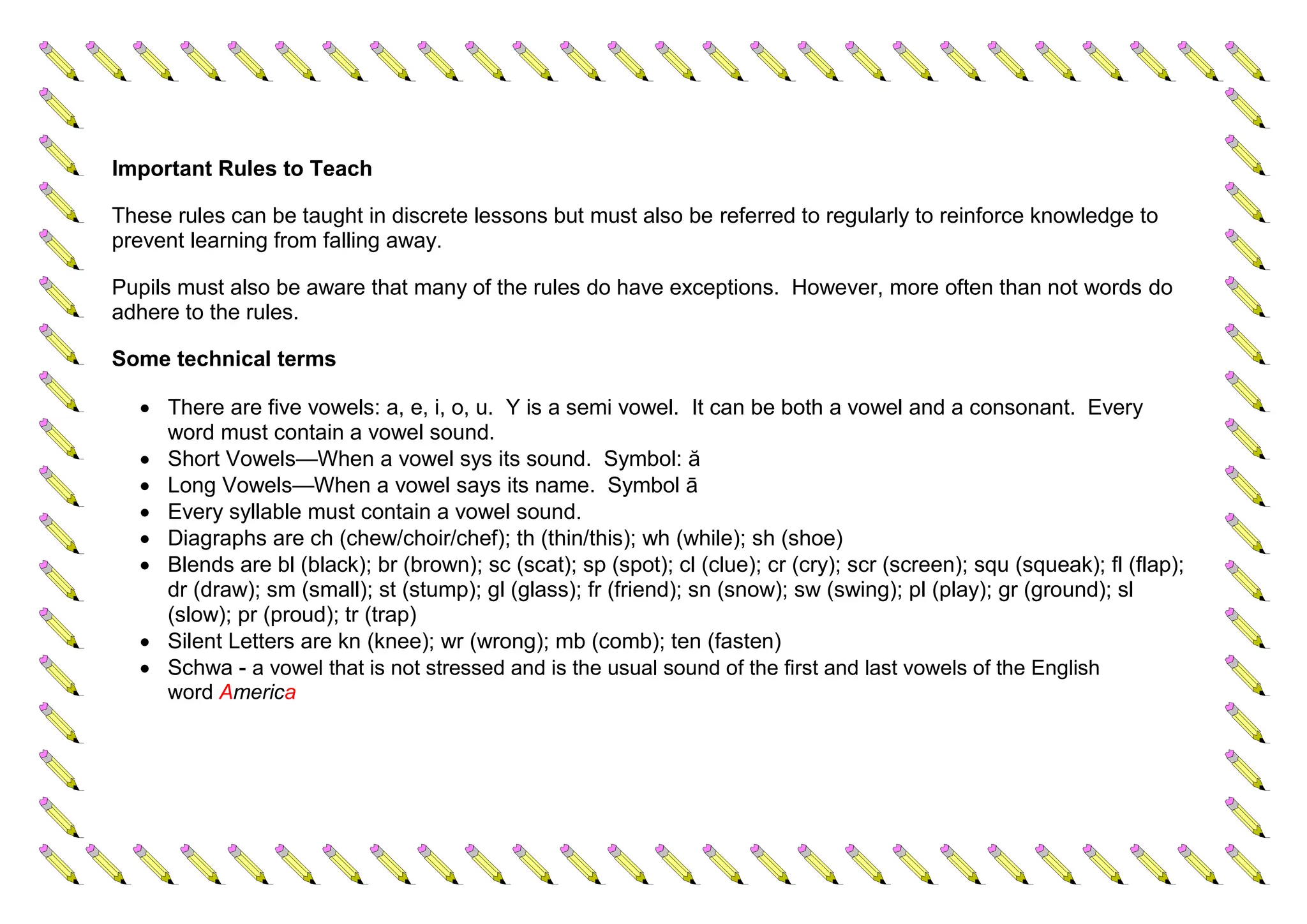
Some technical terms
 There are five vowels: a, e, i, o, u. Y is a semi vowel. It can be both a vowel and a consonant. Every
word must contain a vowel sound.
 Short Vowels—When a vowel sys its sound. Symbol: ă
 Long Vowels—When a vowel says its name. Symbol ā
 Every syllable must contain a vowel sound.
 Diagraphs are ch (chew/choir/chef); th (thin/this); wh (while); sh (shoe)
 Blends are bl (black); br (brown); sc (scat); sp (spot); cl (clue); cr (cry); scr (screen); squ (squeak); fl (flap);
dr (draw); sm (small); st (stump); gl (glass); fr (friend); sn (snow); sw (swing); pl (play); gr (ground); sl
(slow); pr (proud); tr (trap)
 Silent Letters are kn (knee); wr (wrong); mb (comb); ten (fasten)
 Schwa - a vowel that is not stressed and is the usual sound of the first and last vowels of the English
word America
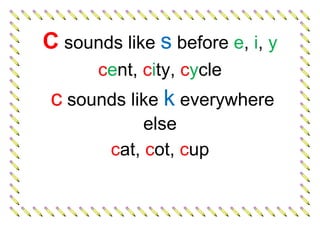
C sounds like s before e, i, y
cent, city, cycle
c sounds like k everywhere
else
cat, cot, cup
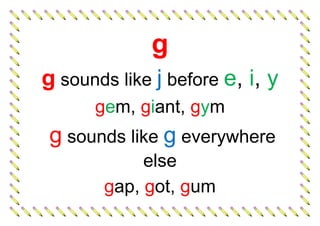
g
g sounds like j before e, i, y
gem, giant, gym
g sounds like g everywhere
else
gap, got, gum
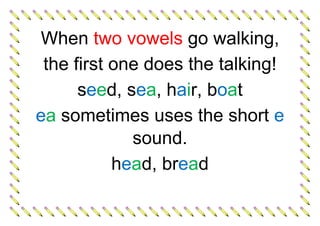
When two vowels go walking,
the first one does the talking!
seed, sea, hair, boat
ea sometimes uses the short e
sound.
head, bread
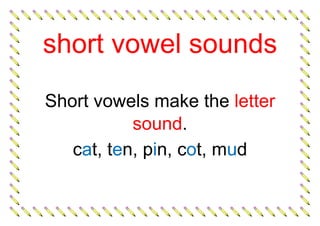
short vowel sounds
Short vowels make the letter
sound.
cat, ten, pin, cot, mud
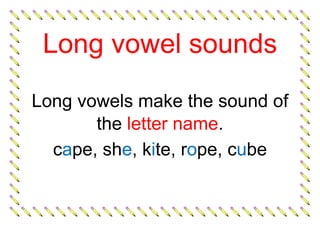
Long vowel sounds
Long vowels make the sound of
the letter name.
cape, she, kite, rope, cube
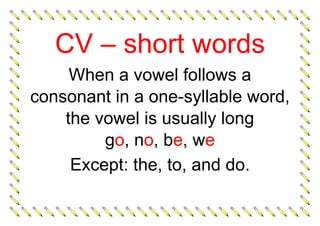
CV – short words
When a vowel follows a
consonant in a one-syllable word,
the vowel is usually long
go, no, be, we
Except: the, to, and do.
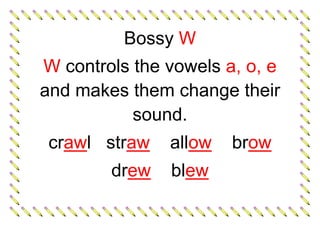
Bossy W
W controls the vowels a, o, e
and makes them change their
sound.
crawl straw allow brow
drew blew
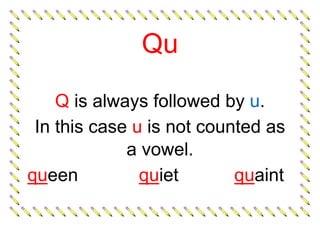
Qu
Q is always followed by u.
In this case u is not counted as
a vowel.
queen quiet quaint
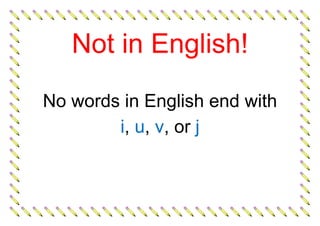
Not in English!
No words in English end with
i, u, v, or j
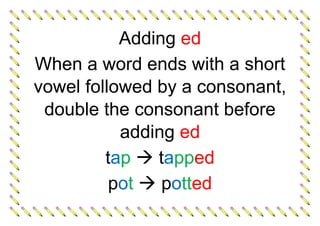
Adding ed
When a word ends with a short
vowel followed by a consonant,
double the consonant before
adding ed
tap  tapped
pot  potted
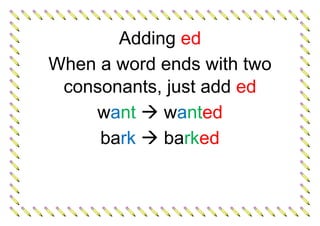
Adding ed
When a word ends with two
consonants, just add ed
want  wanted
bark  barked
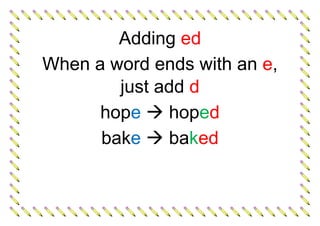
Adding ed
When a word ends with an e,
just add d
hope  hoped
bake  baked
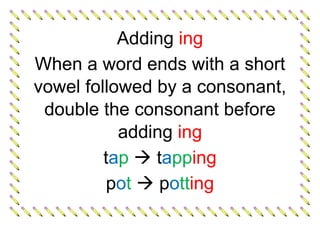
Adding ing
When a word ends with a short
vowel followed by a consonant,
double the consonant before
adding ing
tap  tapping
pot  potting
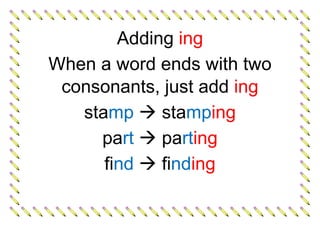
Adding ing
When a word ends with two
consonants, just add ing
stamp  stamping
part  parting
find  finding
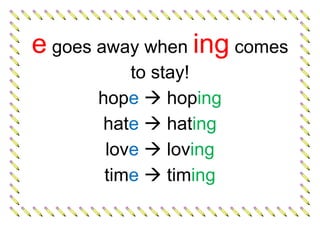
e goes away when ing comes
to stay!
hope  hoping
hate  hating
love  loving
time  timing
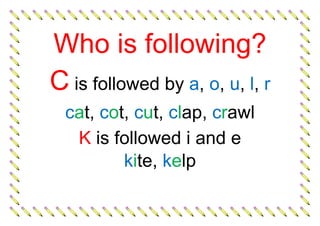
Who is following?
C is followed by a, o, u, l, r
cat, cot, cut, clap, crawl
K is followed i and e
kite, kelp
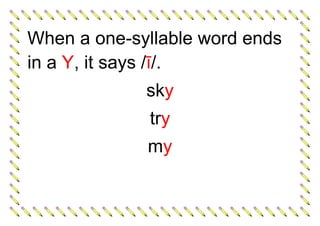
When a one-syllable word ends
in a Y, it says /ī/.
sky
try
my
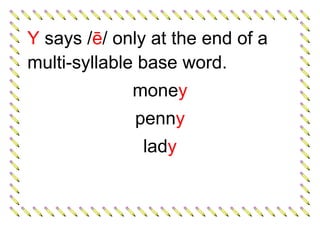
Y says /ē/ only at the end of a
multi-syllable base word.
money
penny
lady
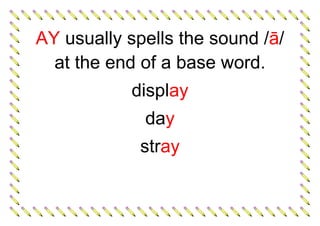
AY usually spells the sound /ā/
at the end of a base word.
display
day
stray
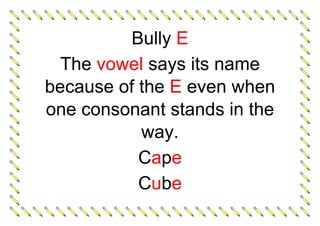
Bully E
The vowel says its name
because of the E even when
one consonant stands in the
way.
Cape
Cube
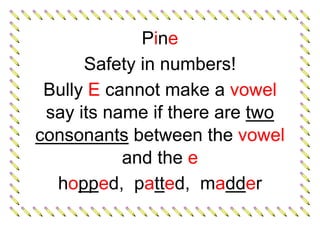
Pine
Safety in numbers!
Bully E cannot make a vowel
say its name if there are two
consonants between the vowel
and the e
hopped, patted, madder
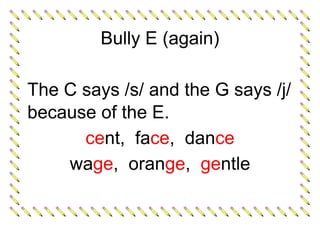
Bully E (again)
The C says /s/ and the G says /j/
because of the E.
cent, face, dance
wage, orange, gentle
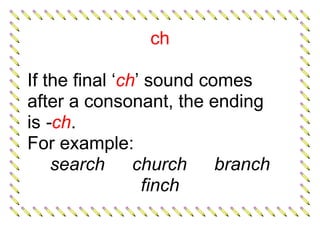
ch
If the final ‘ch’ sound comes
after a consonant, the ending
is -ch.
For example:
search church branch
finch
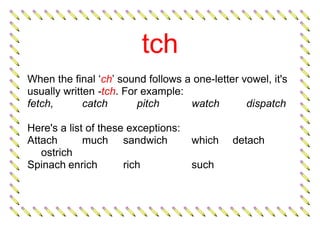
tch
When the final ‘ch’ sound follows a one-letter vowel, it's
usually written -tch. For example:
fetch, catch pitch watch dispatch
Here's a list of these exceptions:
Attach much sandwich which detach
ostrich
Spinach enrich rich such
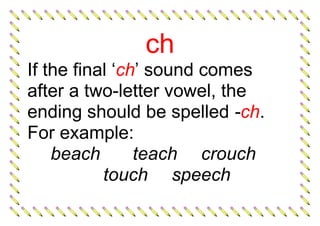
ch
If the final ‘ch’ sound comes
after a two-letter vowel, the
ending should be spelled -ch.
For example:
beach teach crouch
touch speech
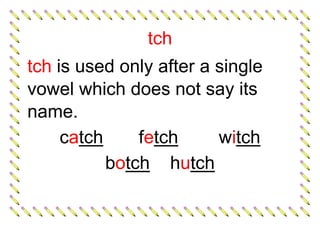
tch
tch is used only after a single
vowel which does not say its
name.
catch fetch witch
botch hutch
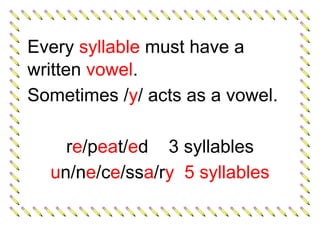
Every syllable must have a
written vowel.
Sometimes /y/ acts as a vowel.
re/peat/ed 3 syllables
un/ne/ce/ssa/ry 5 syllables
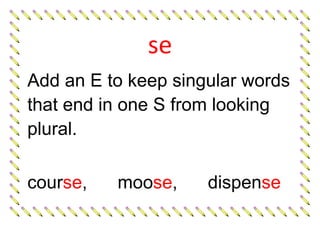
se
Add an E to keep singular words
that end in one S from looking
plural.
course, moose, dispense
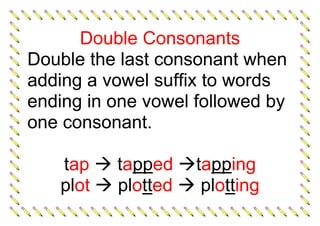
Double Consonants
Double the last consonant when
adding a vowel suffix to words
ending in one vowel followed by
one consonant.
tap  tapped tapping
plot  plotted  plotting
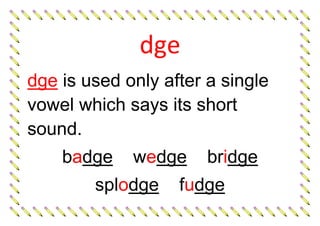
dge
dge is used only after a single
vowel which says its short
sound.
badge wedge bridge
splodge fudge
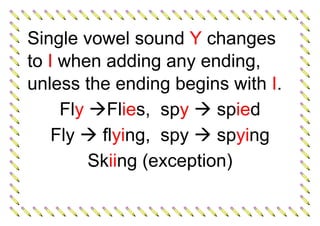
Single vowel sound Y changes
to I when adding any ending,
unless the ending begins with I.
Fly Flies, spy  spied
Fly  flying, spy  spying
Skiing (exception)
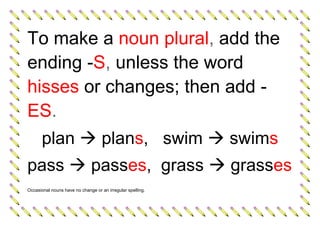
To make a noun plural, add the
ending -S, unless the word
hisses or changes; then add -
ES.
plan  plans, swim  swims
pass  passes, grass  grasses
Occasional nouns have no change or an irregular spelling.
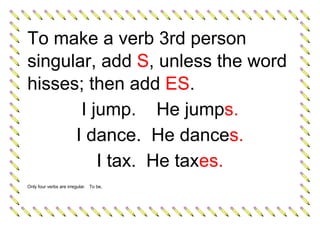
To make a verb 3rd person
singular, add S, unless the word
hisses; then add ES.
I jump. He jumps.
I dance. He dances.
I tax. He taxes.
Only four verbs are irregular. To be,
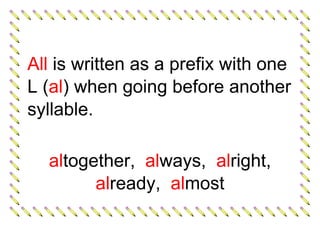
All is written as a prefix with one
L (al) when going before another
syllable.
altogether, always, alright,
already, almost
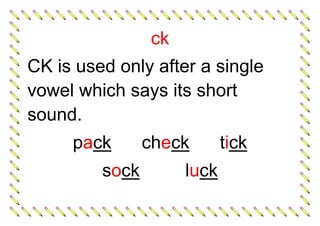
ck
CK is used only after a single
vowel which says its short
sound.
pack check tick
sock luck
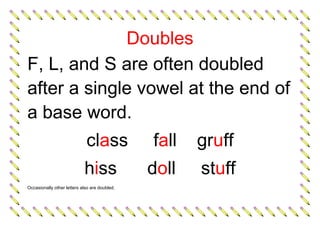
Doubles
F, L, and S are often doubled
after a single vowel at the end of
a base word.
class fall gruff
hiss doll stuff
Occasionally other letters also are doubled.
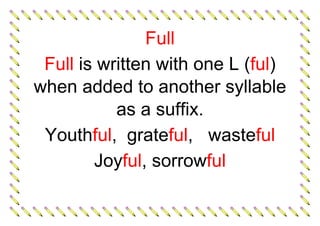
Full
Full is written with one L (ful)
when added to another syllable
as a suffix.
Youthful, grateful, wasteful
Joyful, sorrowful
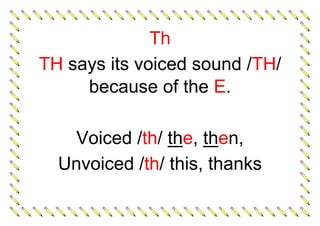
Th
TH says its voiced sound /TH/
because of the E.
Voiced /th/ the, then,
Unvoiced /th/ this, thanks
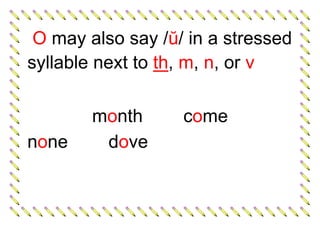
O may also say /ŭ/ in a stressed
syllable next to th, m, n, or v
month come
none dove
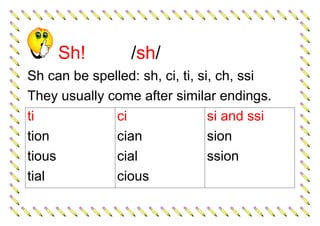
Sh! /sh/
Sh can be spelled: sh, ci, ti, si, ch, ssi
They usually come after similar endings.
ti
tion
tious
tial
ci
cian
cial
cious
si and ssi
sion
ssion
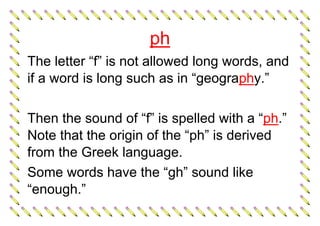
ph
The letter “f” is not allowed long words, and
if a word is long such as in “geography.”
Then the sound of “f” is spelled with a “ph.”
Note that the origin of the “ph” is derived
from the Greek language.
Some words have the “gh” sound like
“enough.”
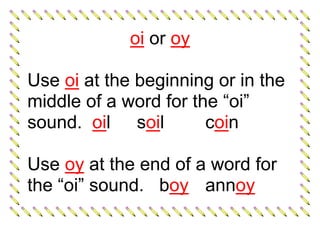
oi or oy
Use oi at the beginning or in the
middle of a word for the “oi”
sound. oil soil coin
Use oy at the end of a word for
the “oi” sound. boy annoy
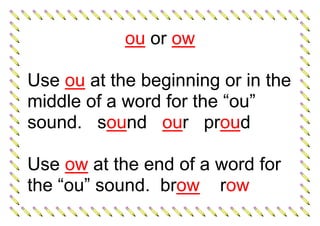
ou or ow
Use ou at the beginning or in the
middle of a word for the “ou”
sound. sound our proud
Use ow at the end of a word for
the “ou” sound. brow row
spelling-rules.pdf for all classes of English

spelling-rules.pdf for all classes of English

  • 1.
    Important Rules toTeach These rules can be taught in discrete lessons but must also be referred to regularly to reinforce knowledge to prevent learning from falling away. Pupils must also be aware that many of the rules do have exceptions. However, more often than not words do adhere to the rules. Some technical terms  There are five vowels: a, e, i, o, u. Y is a semi vowel. It can be both a vowel and a consonant. Every word must contain a vowel sound.  Short Vowels—When a vowel sys its sound. Symbol: ă  Long Vowels—When a vowel says its name. Symbol ā  Every syllable must contain a vowel sound.  Diagraphs are ch (chew/choir/chef); th (thin/this); wh (while); sh (shoe)  Blends are bl (black); br (brown); sc (scat); sp (spot); cl (clue); cr (cry); scr (screen); squ (squeak); fl (flap); dr (draw); sm (small); st (stump); gl (glass); fr (friend); sn (snow); sw (swing); pl (play); gr (ground); sl (slow); pr (proud); tr (trap)  Silent Letters are kn (knee); wr (wrong); mb (comb); ten (fasten)  Schwa - a vowel that is not stressed and is the usual sound of the first and last vowels of the English word America
  • 2.
    C sounds likes before e, i, y cent, city, cycle c sounds like k everywhere else cat, cot, cup
  • 3.
    g g sounds likej before e, i, y gem, giant, gym g sounds like g everywhere else gap, got, gum
  • 4.
    When two vowelsgo walking, the first one does the talking! seed, sea, hair, boat ea sometimes uses the short e sound. head, bread
  • 5.
    short vowel sounds Shortvowels make the letter sound. cat, ten, pin, cot, mud
  • 6.
    Long vowel sounds Longvowels make the sound of the letter name. cape, she, kite, rope, cube
  • 7.
    CV – shortwords When a vowel follows a consonant in a one-syllable word, the vowel is usually long go, no, be, we Except: the, to, and do.
  • 8.
    Bossy W W controlsthe vowels a, o, e and makes them change their sound. crawl straw allow brow drew blew
  • 9.
    Qu Q is alwaysfollowed by u. In this case u is not counted as a vowel. queen quiet quaint
  • 10.
    Not in English! Nowords in English end with i, u, v, or j
  • 11.
    Adding ed When aword ends with a short vowel followed by a consonant, double the consonant before adding ed tap  tapped pot  potted
  • 12.
    Adding ed When aword ends with two consonants, just add ed want  wanted bark  barked
  • 13.
    Adding ed When aword ends with an e, just add d hope  hoped bake  baked
  • 14.
    Adding ing When aword ends with a short vowel followed by a consonant, double the consonant before adding ing tap  tapping pot  potting
  • 15.
    Adding ing When aword ends with two consonants, just add ing stamp  stamping part  parting find  finding
  • 16.
    e goes awaywhen ing comes to stay! hope  hoping hate  hating love  loving time  timing
  • 17.
    Who is following? Cis followed by a, o, u, l, r cat, cot, cut, clap, crawl K is followed i and e kite, kelp
  • 18.
    When a one-syllableword ends in a Y, it says /ī/. sky try my
  • 19.
    Y says /ē/only at the end of a multi-syllable base word. money penny lady
  • 20.
    AY usually spellsthe sound /ā/ at the end of a base word. display day stray
  • 21.
    Bully E The vowelsays its name because of the E even when one consonant stands in the way. Cape Cube
  • 22.
    Pine Safety in numbers! BullyE cannot make a vowel say its name if there are two consonants between the vowel and the e hopped, patted, madder
  • 23.
    Bully E (again) TheC says /s/ and the G says /j/ because of the E. cent, face, dance wage, orange, gentle
  • 24.
    ch If the final‘ch’ sound comes after a consonant, the ending is -ch. For example: search church branch finch
  • 25.
    tch When the final‘ch’ sound follows a one-letter vowel, it's usually written -tch. For example: fetch, catch pitch watch dispatch Here's a list of these exceptions: Attach much sandwich which detach ostrich Spinach enrich rich such
  • 26.
    ch If the final‘ch’ sound comes after a two-letter vowel, the ending should be spelled -ch. For example: beach teach crouch touch speech
  • 27.
    tch tch is usedonly after a single vowel which does not say its name. catch fetch witch botch hutch
  • 28.
    Every syllable musthave a written vowel. Sometimes /y/ acts as a vowel. re/peat/ed 3 syllables un/ne/ce/ssa/ry 5 syllables
  • 29.
    se Add an Eto keep singular words that end in one S from looking plural. course, moose, dispense
  • 30.
    Double Consonants Double thelast consonant when adding a vowel suffix to words ending in one vowel followed by one consonant. tap  tapped tapping plot  plotted  plotting
  • 31.
    dge dge is usedonly after a single vowel which says its short sound. badge wedge bridge splodge fudge
  • 32.
    Single vowel soundY changes to I when adding any ending, unless the ending begins with I. Fly Flies, spy  spied Fly  flying, spy  spying Skiing (exception)
  • 33.
    To make anoun plural, add the ending -S, unless the word hisses or changes; then add - ES. plan  plans, swim  swims pass  passes, grass  grasses Occasional nouns have no change or an irregular spelling.
  • 34.
    To make averb 3rd person singular, add S, unless the word hisses; then add ES. I jump. He jumps. I dance. He dances. I tax. He taxes. Only four verbs are irregular. To be,
  • 35.
    All is writtenas a prefix with one L (al) when going before another syllable. altogether, always, alright, already, almost
  • 36.
    ck CK is usedonly after a single vowel which says its short sound. pack check tick sock luck
  • 37.
    Doubles F, L, andS are often doubled after a single vowel at the end of a base word. class fall gruff hiss doll stuff Occasionally other letters also are doubled.
  • 38.
    Full Full is writtenwith one L (ful) when added to another syllable as a suffix. Youthful, grateful, wasteful Joyful, sorrowful
  • 39.
    Th TH says itsvoiced sound /TH/ because of the E. Voiced /th/ the, then, Unvoiced /th/ this, thanks
  • 40.
    O may alsosay /ŭ/ in a stressed syllable next to th, m, n, or v month come none dove
  • 41.
    Sh! /sh/ Sh canbe spelled: sh, ci, ti, si, ch, ssi They usually come after similar endings. ti tion tious tial ci cian cial cious si and ssi sion ssion
  • 42.
    ph The letter “f”is not allowed long words, and if a word is long such as in “geography.” Then the sound of “f” is spelled with a “ph.” Note that the origin of the “ph” is derived from the Greek language. Some words have the “gh” sound like “enough.”
  • 43.
    oi or oy Useoi at the beginning or in the middle of a word for the “oi” sound. oil soil coin Use oy at the end of a word for the “oi” sound. boy annoy
  • 44.
    ou or ow Useou at the beginning or in the middle of a word for the “ou” sound. sound our proud Use ow at the end of a word for the “ou” sound. brow row