Essay Writing
 The word essay derives from the French
infinitive essayer, "to try" or "to attempt". In
English essay first meant "a trial" or "an attempt“.
 The word essay is defined in “ The Concise Oxford
Dictionary” as “a literary Composition (usually prose
and short) on any subject”.
 Properly speaking, it is a written composition giving
expression to one’s own personal ideas or opinions on
some topic; but the term usually covers also any
written composition, whether it expresses personal
opinions, or gives information on any given subject.
Characteristics of a Good Essay
 Unity: An essay must be a unity, developing one
theme with a definite purpose. The subject must be
clearly defined in the mind and kept in view
throughout. Nothing that is not relevant to it should
be admitted to the essay.
 Order: The essay should follow a certain ordered line
of thought and come to a definite conclusion. It should
not consist of haphazard reflections put down anyhow.
 Brevity: An essay should be a brief exercise, concisely,
comprehensively and compactly expressed.
Characteristics of a Good Essay
 Style: Construction of an essay should be simple,
direct and natural. The style should be
conversational- easy, natural and familiar. Style must
be more dignified and literary. Avoid ambiguous
words
 The Personal Touch: An essay should reveal the
personal feelings and opinions of the writer. It
should have his individuality in it.
Classification Of Essays
 Essays may be classified as Narrative Essays
Descriptive Essays, Expository Essays,
Reflective Essays, Discursive Essays and
Argumentative/Persuasive Essays
 Narrative Essays: A narrative essay consists
mainly in the narration of some events or a series
of events. Narrative essay may treat of- historical
stories or legends(e.g. the reign of Akbar);
biographies; incidents( e.g. a street quarrel, A
Road Accident etc.); a story ( imaginary or Real)
Classification Of Essays
 Descriptive Essay: A descriptive essay consists of
a description of some place or thing; e.g. animals,
plant, minerals; towns, countries, buildings etc.
 Expository Essays: An expository essay consists
of an exposition or explanation of some subject e.g.
scientific topics ( such as gravitation, evolution of
Earth etc.); Literary topics (such as the nature of
poetry, prose styles, Shakespearean Philosophy.
Classification Of Essays
 Reflective Essay: A reflection is a thought on
some subject-on an idea arising in the mind. So a
reflective essay consists of reflections or thought
on some topic e.g. Habits qualities, such as
patriotism; Social, political issues such as
democracy, terrorism etc. philosophical subjects
such as right and Wrong etc.
Purpose
Discursive Essay Argumentative Essay
 It presents a balanced
and objective
examination of a
subject.
 The topic may be
controversial, but the
discursive essay
attempts to present a
much more balanced
discussion of the issue.
 It presents the
advantages and
disadvantages of a
certain subject .
 Its purpose is to both
educate and persuade
the reader on a
particular point of view.
Style
Discursive Essay Argumentative Essay
 They are written in a
more formal and
impersonal style than
other essays.
 Each issue should be
discussed in a separate
paragraph and each
paragraph should begin
with a strong topic
sentence.
 They follow a general
format. The writer states
an initial thesis that
contains the point of
view for which the
author is arguing.
 The body generally
presents both sides of
the argument.
Parts of an Essay 1
 Introduction Paragraph
 What is an introduction paragraph?
The introduction paragraph is the first paragraph of your
essay.
What does it do?
It introduces the main idea of your essay. A good
opening paragraph captures the interest of your reader
and tells why your topic is important.
 How do I write one?
1. Write the thesis statement. The main idea of the essay is stated in a
single sentence called the thesis statement. You must limit your entire essay
to the topic you have introduced in your thesis statement.
2. Provide some background information about your topic. You can use
interesting facts, quotations, or definitions of important terms you will use
later in the essay.
Example:
Hockey has been a part of life in Canada for over 120 years. It has evolved
into an extremely popular sport watched and played by millions of
Canadians. The game has gone through several changes since hockey was
first played in Canada.
Parts of an Essay 2
 Supporting Paragraphs

What are supporting paragraphs?
Supporting paragraphs make up the main body of your
essay.
What do they do?
They develop the main idea of your essay.
 How do I write them?
1. List the points that develop the main idea of your
essay.
2. Place each supporting point in its own paragraph.
3. Develop each supporting point with facts, details, and
examples.
To connect your supporting paragraphs, you should use
special transition words. Transition words link your
paragraphs together and make your essay easier to read.
Use them at the beginning and end of your paragraphs.
 Examples of transition words that can help you to link
your paragraphs together:
For listing different points
 First
 Second
 Third
For counter examples
-However
-Even though
 On the other hand
 Nevertheless
For additional ideas
 Another
 In addition to
 Related to
 Furthermore
 Also
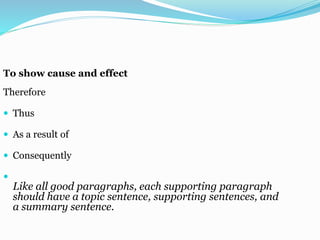
To show cause and effect
Therefore
 Thus
 As a result of
 Consequently

Like all good paragraphs, each supporting paragraph
should have a topic sentence, supporting sentences, and
a summary sentence.
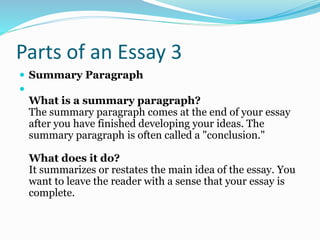
Parts of an Essay 3
 Summary Paragraph

What is a summary paragraph?
The summary paragraph comes at the end of your essay
after you have finished developing your ideas. The
summary paragraph is often called a "conclusion."
What does it do?
It summarizes or restates the main idea of the essay. You
want to leave the reader with a sense that your essay is
complete.
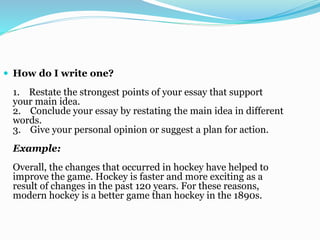
 How do I write one?
1. Restate the strongest points of your essay that support
your main idea.
2. Conclude your essay by restating the main idea in different
words.
3. Give your personal opinion or suggest a plan for action.
Example:
Overall, the changes that occurred in hockey have helped to
improve the game. Hockey is faster and more exciting as a
result of changes in the past 120 years. For these reasons,
modern hockey is a better game than hockey in the 1890s.

Essay Writing.pptx

  • 1.
    Essay Writing  Theword essay derives from the French infinitive essayer, "to try" or "to attempt". In English essay first meant "a trial" or "an attempt“.  The word essay is defined in “ The Concise Oxford Dictionary” as “a literary Composition (usually prose and short) on any subject”.  Properly speaking, it is a written composition giving expression to one’s own personal ideas or opinions on some topic; but the term usually covers also any written composition, whether it expresses personal opinions, or gives information on any given subject.
  • 2.
    Characteristics of aGood Essay  Unity: An essay must be a unity, developing one theme with a definite purpose. The subject must be clearly defined in the mind and kept in view throughout. Nothing that is not relevant to it should be admitted to the essay.  Order: The essay should follow a certain ordered line of thought and come to a definite conclusion. It should not consist of haphazard reflections put down anyhow.  Brevity: An essay should be a brief exercise, concisely, comprehensively and compactly expressed.
  • 3.
    Characteristics of aGood Essay  Style: Construction of an essay should be simple, direct and natural. The style should be conversational- easy, natural and familiar. Style must be more dignified and literary. Avoid ambiguous words  The Personal Touch: An essay should reveal the personal feelings and opinions of the writer. It should have his individuality in it.
  • 4.
    Classification Of Essays Essays may be classified as Narrative Essays Descriptive Essays, Expository Essays, Reflective Essays, Discursive Essays and Argumentative/Persuasive Essays  Narrative Essays: A narrative essay consists mainly in the narration of some events or a series of events. Narrative essay may treat of- historical stories or legends(e.g. the reign of Akbar); biographies; incidents( e.g. a street quarrel, A Road Accident etc.); a story ( imaginary or Real)
  • 5.
    Classification Of Essays Descriptive Essay: A descriptive essay consists of a description of some place or thing; e.g. animals, plant, minerals; towns, countries, buildings etc.  Expository Essays: An expository essay consists of an exposition or explanation of some subject e.g. scientific topics ( such as gravitation, evolution of Earth etc.); Literary topics (such as the nature of poetry, prose styles, Shakespearean Philosophy.
  • 6.
    Classification Of Essays Reflective Essay: A reflection is a thought on some subject-on an idea arising in the mind. So a reflective essay consists of reflections or thought on some topic e.g. Habits qualities, such as patriotism; Social, political issues such as democracy, terrorism etc. philosophical subjects such as right and Wrong etc.
  • 7.
    Purpose Discursive Essay ArgumentativeEssay  It presents a balanced and objective examination of a subject.  The topic may be controversial, but the discursive essay attempts to present a much more balanced discussion of the issue.  It presents the advantages and disadvantages of a certain subject .  Its purpose is to both educate and persuade the reader on a particular point of view.
  • 8.
    Style Discursive Essay ArgumentativeEssay  They are written in a more formal and impersonal style than other essays.  Each issue should be discussed in a separate paragraph and each paragraph should begin with a strong topic sentence.  They follow a general format. The writer states an initial thesis that contains the point of view for which the author is arguing.  The body generally presents both sides of the argument.
  • 9.
    Parts of anEssay 1  Introduction Paragraph  What is an introduction paragraph? The introduction paragraph is the first paragraph of your essay. What does it do? It introduces the main idea of your essay. A good opening paragraph captures the interest of your reader and tells why your topic is important.
  • 10.
     How doI write one? 1. Write the thesis statement. The main idea of the essay is stated in a single sentence called the thesis statement. You must limit your entire essay to the topic you have introduced in your thesis statement. 2. Provide some background information about your topic. You can use interesting facts, quotations, or definitions of important terms you will use later in the essay. Example: Hockey has been a part of life in Canada for over 120 years. It has evolved into an extremely popular sport watched and played by millions of Canadians. The game has gone through several changes since hockey was first played in Canada.
  • 11.
    Parts of anEssay 2  Supporting Paragraphs  What are supporting paragraphs? Supporting paragraphs make up the main body of your essay. What do they do? They develop the main idea of your essay.
  • 12.
     How doI write them? 1. List the points that develop the main idea of your essay. 2. Place each supporting point in its own paragraph. 3. Develop each supporting point with facts, details, and examples. To connect your supporting paragraphs, you should use special transition words. Transition words link your paragraphs together and make your essay easier to read. Use them at the beginning and end of your paragraphs.
  • 13.
     Examples oftransition words that can help you to link your paragraphs together: For listing different points  First  Second  Third For counter examples -However -Even though
  • 14.
     On theother hand  Nevertheless For additional ideas  Another  In addition to  Related to  Furthermore  Also
  • 15.
    To show causeand effect Therefore  Thus  As a result of  Consequently  Like all good paragraphs, each supporting paragraph should have a topic sentence, supporting sentences, and a summary sentence.
  • 16.
    Parts of anEssay 3  Summary Paragraph  What is a summary paragraph? The summary paragraph comes at the end of your essay after you have finished developing your ideas. The summary paragraph is often called a "conclusion." What does it do? It summarizes or restates the main idea of the essay. You want to leave the reader with a sense that your essay is complete.
  • 17.
     How doI write one? 1. Restate the strongest points of your essay that support your main idea. 2. Conclude your essay by restating the main idea in different words. 3. Give your personal opinion or suggest a plan for action. Example: Overall, the changes that occurred in hockey have helped to improve the game. Hockey is faster and more exciting as a result of changes in the past 120 years. For these reasons, modern hockey is a better game than hockey in the 1890s.