Speech &
Phonetics in
Prosthodontics
Presented by:
Dr Mujtaba Ashraf
MDS II
Definition
 Speech:
The faculty or act of expressing or describing
thoughts, feelings, or perceptions by the articulation of
words.
 Phonetics:
1. the science of speech sounds used in language.
2. a written code used by speech
language pathologists and linguists to represent
speech sounds.
Mosby's Medical Dictionary, 9th edition. © 2009, Elsevier.
HISTORY
 In 1949 ‘Sears’ recommended grooving the palate just
above the median sulcus of the patient.
 In 1951 ‘Pound’ was successful in improving phonetics by
contouring the entire palatal aspect of the maxillary
denture to simulate the normal palate
 ‘Landa’ suggested the use of ‘s’ sound to determine the
adequacy of ‘free way space’ & ‘M’ sound to establish a
desirable ‘rest position’.
 1953 & 1956, ‘Silverman’ used ‘speaking method’ to
measure patient’s vertical dimension in natural teeth
with dentures & without dentures.
 1959, ‘ML Morrison’ suggested the use of the word,
‘sixty six’ & ‘Mississippi’ to determine closest
speaking space
Speech
 Speech is the mechanical process of producing
audible sounds to represent language.
 The intrinsic muscles of the tongue enable the
shaping of the tongue which facilitates speech.
 Voice is mainly produced in larynx and modified by
tongue by constantly altering its shape, position by
contacting lips, teeth, alveolar processes, hard palate
and soft palate.
Mechanism Of Speech Production
 Normal speech depends on proper functioning of 5
essential mechanism:
Robert Rothman; Phonetic consideration in denture prosthesis, J Prosthet Dent;1961;11:214-223)
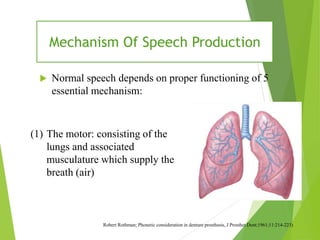
(1) The motor: consisting of the
lungs and associated
musculature which supply the
breath (air)
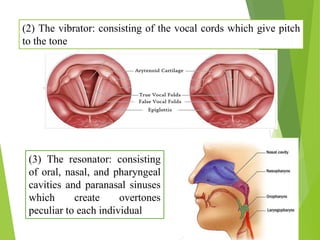
(2) The vibrator: consisting of the vocal cords which give pitch
to the tone
(3) The resonator: consisting
of oral, nasal, and pharyngeal
cavities and paranasal sinuses
which create overtones
peculiar to each individual
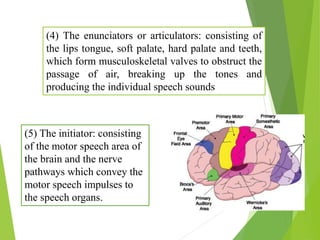
(4) The enunciators or articulators: consisting of
the lips tongue, soft palate, hard palate and teeth,
which form musculoskeletal valves to obstruct the
passage of air, breaking up the tones and
producing the individual speech sounds
(5) The initiator: consisting
of the motor speech area of
the brain and the nerve
pathways which convey the
motor speech impulses to
the speech organs.
Articulation
 Articulation, in phonetics, a configuration of the
vocal tract resulting from the positioning of the
mobile organs of the vocal tract (e.g., tongue) relative
to other parts of the vocal tract that may be rigid
(e.g., hard palate).
 This configuration modifies an airstream to produce
the sounds of speech.
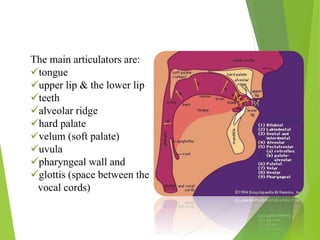
The main articulators are:
tongue
upper lip & the lower lip
teeth
alveolar ridge
hard palate
velum (soft palate)
uvula
pharyngeal wall and
glottis (space between the
vocal cords)
 The primary concern in phonetics is with the changes
in the stream of air as it passes through the oral
cavity. Of these, the tongue plays a major role.
 The tongue is the principal articulator and changes
position and shape for the pronunciation of each of
the vowels and consonant.
 In pronouncing, the tongue contacts a specific part of
the teeth, alveolar ridge, or hard palate.
Vowels are voiced sounds, that is, the vocal cords
are activated by vibration in their production.
They are the free emission of a speech sound
through the mouth and require subglottic pressure
for the production.
vowels in English: a, e, i, o, u
Zarb- Bolender:Speech consideration with complete dentures ;Prosthodontic treatment For Edentulous Patients
CLASSIFICATION OF SPEECH
A common test utilizing the vowel sound a as in
father is useful in locating the vibrating line for
correct placement of the posterior palatal seal.
The soft palate is raised when this vowel sound is
emitted, and a velopharyngeal sphincter is formed
permitting the vibrating column of air to pass only
through the oral cavity. The soft palate is activated,
and the vibrating line becomes clearly demarcated.
Roth, G. J.: Analysis of Articulate Sounds and Its Use and Application in the Art and
Science of Dentistry,
Consonants are produced as a result of the
airstream being impeded, diverted, or
interrupted before it is released,
such as p, g, m, b, s, t, r, and z.
Consonants may be either voiced sounds or
breathed sounds, which are produced without
vocal cord vibration.
Consonants are divided into 6 groups:
(depending on their characteristic production and
use of different articulators and valves)
Plosives (Stops)
Fricatives
Affricatives
Nasals
Liquids
Glides
CLASSIFICATION OF CONSONANTS
Zarb- Bolender:Speech consideration with complete dentures ;Prosthodontic treatment For Edentulous Patients
Plosive consonants: These sounds are produced
when overpressure of the air has been built up
by consonants between the soft palate and
pharyngeal wall and released in an explosive
way.
Ex: p, b, t, d
Fricatives: are also called sibilants and are
characterized by their sharp and whistling sound
quality created when air is squeezed through the
nearly obstructed articulators.
Ex: s, z
Affricative consonants: are a mix between plosive and
fricative ones.
Ex: c, j
Nasal consonants: are produced without oral exit of air.
Production involves the coupling of nasal cavity as
resonators.
Ex: m, n, ng
Liquid consonants(semi vowels): are , as the name
implies , produced with out friction.
Ex: r, l
Glides: that is sounds characterized by a gradually
changing articulator shape
Ex: w, y
CLASSIFICATION OF CONSONANTS BASED ON
THE PLACE OF THEIR PRODUCTION
Consonant sounds are most important from the dental
point of view. They may be classified according to the
anatomic parts involved in their formation:
(1) Palatolingual sounds: formed by tongue and hard or
soft palate
(2) Linguodental sounds: formed by the tongue and teeth
(3) Labiodental sounds: formed by the lips and teeth
(4) Bilabial sounds: formed by the lips.
Robert Rothman; Phonetic consideration in denture prosthesis, J Prosthet Dent;1961;11:214-223)
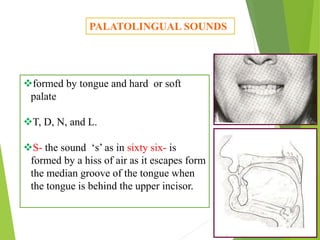
PALATOLINGUAL SOUNDS
formed by tongue and hard or soft
palate
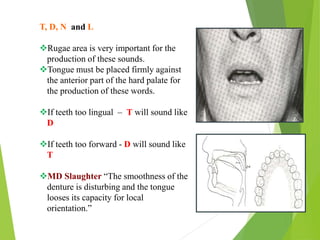
T, D, N, and L.
S- the sound ‘s’ as in sixty six- is
formed by a hiss of air as it escapes form
the median groove of the tongue when
the tongue is behind the upper incisor.
The essential factor in the production of a correct s is the
proper grooving of the tongue.
As the depth of this groove is decreased, s is softened
toward sh, and as the groove is further decreased, toward
th as a lisp.
Excessive thickness of the denture base in the anterior
part of the palate is often the cause of lisping.
Thus we can say that the sound S can be used to check
the proper placement of the anterior teeth
Clinical Significance
T, D, N and L
Rugae area is very important for the
production of these sounds.
Tongue must be placed firmly against
the anterior part of the hard palate for
the production of these words.
If teeth too lingual – T will sound like
D
If teeth too forward - D will sound like
T
MD Slaughter “The smoothness of the
denture is disturbing and the tongue
looses its capacity for local
orientation.”
PHONETICS IN RECORDING JAW RELATION
Meyer M Silverman :The speaking method in measuring vertical dimension; J prosthet dent 1953;3:193-199
Silverman uses the enunciation of the sibilant s as a
phonetic means for determining vertical dimension.
Also called as the speaking method,
When s is pronounced, the upper and lower teeth are
separated from each other by only 1 or 2 mm.
When the patient says “sixty-six” and the vertical dimension
of occlusion is too great, the teeth will come into contact,
causing clicking.
Discovery of this error in the wax trial denture gives the
dentist the opportunity to make the necessary corrections.
BILABIAL SOUNDS
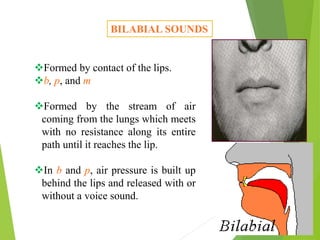
Formed by contact of the lips.
b, p, and m
Formed by the stream of air
coming from the lungs which meets
with no resistance along its entire
path until it reaches the lip.
In b and p, air pressure is built up
behind the lips and released with or
without a voice sound.
Insufficient support of the lips by the teeth or the
denture base can cause these sounds to be defective.
Therefore the antero-posterior position of the anterior
teeth and thickness of the labial flange can affect the
production of these sounds.
Used to asses the correct inter-arch space
Labial fullness of the rims can be checked
Clinical Significance
When the teeth are placed too far labially, the lips do not
meet comfortably; with a lingual displacement of the
anterior teeth, the lips meet prematurely. Therefore, the
pronunciation of the bilabial sounds should be used to
check the vertical jaw relation and to make sure that the
lips meet comfortably without premature contact of the
occlusion rims.
Similarly, the labial fullness of the occlusion rims should
be observed during the pronunciation of the bilabial
sounds so that a comfortable meeting of the lips can be
attained.
Landa, J. S.: Practical Full Denture Prosthesis, London, 1954, Dental Items of Interest Publishing Co.,
pp. 311-329.
LABIODENTAL SOUNDS
Formed between the upper incisors
and the labiolingual center to the
posterior third of the lower lip.
f and v
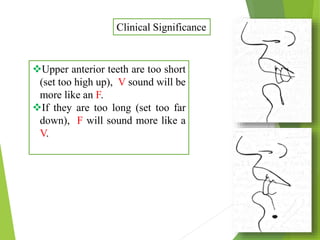
Upper anterior teeth are too short
(set too high up), V sound will be
more like an F.
If they are too long (set too far
down), F will sound more like a
V.
Clinical Significance
Labioldental sounds F and V are affected.
If occlusal plane is too high the correct positing of
the lower lip is difficult
If the occlusal plane is too low there is overlap of
the lower lip on the labial surface of upper teeth
Maxillary anterior teeth are placed so that their edges form a
seal at wet-dry line of vermillion border of the lower lip.
LINGUODENTAL SOUNDS
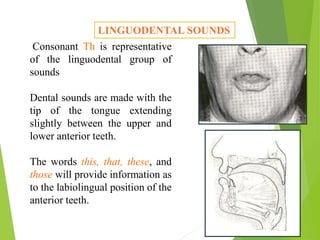
Consonant Th is representative
of the linguodental group of
sounds
Dental sounds are made with the
tip of the tongue extending
slightly between the upper and
lower anterior teeth.
The words this, that, these, and
those will provide information as
to the labiolingual position of the
anterior teeth.
 Careful observation of the amount of tongue that can
be seen with the words - this, that, these and those
will provide information as to the labio-lingual
position of the anterior teeth.
 If about 3mm of the tip of the tongue is not visible,
the anterior teeth are probably too far forwardly
placed.
 If more than 6mm of the tongue extends out between
the teeth when such sounds are made, the teeth are
probably too lingual.
Clinical Significance
LINGUOALVEOLAR SOUNDS
Alveolar sounds (e.g., t, d, s, z, n, and l) are made with
the valve formed by contact of the tip of the tongue
with the most anterior part of the palate (the alveolus)
or the lingual side of the anterior teeth.
The sibilants (sharp sounds) s, z, sh, ch, and j (with ch
and j being affricatives) are alveolar sounds because the
tongue and alveolus form the controlling valve.
Zarb- Bolender:Speech consideration with complete dentures ;Prosthodontic treatment For Edentulous Patients
The important observation when these sounds are
produced is the relationship of the anterior teeth to
each other. The upper and lower incisors should
approach end to end but not touch.
If the denture bases are too thick, Lisping will occur
with the linguoalveolar word like S C and Z
Conclusion
The proper knowledge of speech production and
phonetic parameters will enables the clinician in
fabrication of dentures with good phonetic capabilities.
In achieving the optimum phonetic potential by
providing correlation among three key objectives i.e.
(mechanics, aesthetics and phonetics) of dentistry is the
eventual goal of every dentist. Also we use phonetics as
a guideline for proper placement of artificial teeth.
References
 Zarb- Bolender:Speech consideration with complete
dentures; Prosthodontic treatment For Edentulous Patients
13th ed
 Robert Rothman; Phonetic consideration in denture
prosthesis, J Prosthet Dent;1961;11:214-223)
 Meyer M Silverman :The speaking method in measuring
vertical dimension; J prosthet dent 1953;3:193-199
 Pound E. Esthetic dentures and their phonetic values.Journal
of Prosthetic Dentistry 1951
 Fenn, Clinical dental prosthetics, 3rd edition
speech and phonetics

speech and phonetics

  • 1.
  • 2.
    Definition  Speech: The facultyor act of expressing or describing thoughts, feelings, or perceptions by the articulation of words.  Phonetics: 1. the science of speech sounds used in language. 2. a written code used by speech language pathologists and linguists to represent speech sounds. Mosby's Medical Dictionary, 9th edition. © 2009, Elsevier.
  • 3.
    HISTORY  In 1949‘Sears’ recommended grooving the palate just above the median sulcus of the patient.  In 1951 ‘Pound’ was successful in improving phonetics by contouring the entire palatal aspect of the maxillary denture to simulate the normal palate  ‘Landa’ suggested the use of ‘s’ sound to determine the adequacy of ‘free way space’ & ‘M’ sound to establish a desirable ‘rest position’.
  • 4.
     1953 &1956, ‘Silverman’ used ‘speaking method’ to measure patient’s vertical dimension in natural teeth with dentures & without dentures.  1959, ‘ML Morrison’ suggested the use of the word, ‘sixty six’ & ‘Mississippi’ to determine closest speaking space
  • 5.
    Speech  Speech isthe mechanical process of producing audible sounds to represent language.  The intrinsic muscles of the tongue enable the shaping of the tongue which facilitates speech.  Voice is mainly produced in larynx and modified by tongue by constantly altering its shape, position by contacting lips, teeth, alveolar processes, hard palate and soft palate.
  • 6.
    Mechanism Of SpeechProduction  Normal speech depends on proper functioning of 5 essential mechanism: Robert Rothman; Phonetic consideration in denture prosthesis, J Prosthet Dent;1961;11:214-223) (1) The motor: consisting of the lungs and associated musculature which supply the breath (air)
  • 7.
    (2) The vibrator:consisting of the vocal cords which give pitch to the tone (3) The resonator: consisting of oral, nasal, and pharyngeal cavities and paranasal sinuses which create overtones peculiar to each individual
  • 8.
    (4) The enunciatorsor articulators: consisting of the lips tongue, soft palate, hard palate and teeth, which form musculoskeletal valves to obstruct the passage of air, breaking up the tones and producing the individual speech sounds (5) The initiator: consisting of the motor speech area of the brain and the nerve pathways which convey the motor speech impulses to the speech organs.
  • 9.
    Articulation  Articulation, inphonetics, a configuration of the vocal tract resulting from the positioning of the mobile organs of the vocal tract (e.g., tongue) relative to other parts of the vocal tract that may be rigid (e.g., hard palate).  This configuration modifies an airstream to produce the sounds of speech.
  • 10.
    The main articulatorsare: tongue upper lip & the lower lip teeth alveolar ridge hard palate velum (soft palate) uvula pharyngeal wall and glottis (space between the vocal cords)
  • 11.
     The primaryconcern in phonetics is with the changes in the stream of air as it passes through the oral cavity. Of these, the tongue plays a major role.  The tongue is the principal articulator and changes position and shape for the pronunciation of each of the vowels and consonant.  In pronouncing, the tongue contacts a specific part of the teeth, alveolar ridge, or hard palate.
  • 12.
    Vowels are voicedsounds, that is, the vocal cords are activated by vibration in their production. They are the free emission of a speech sound through the mouth and require subglottic pressure for the production. vowels in English: a, e, i, o, u Zarb- Bolender:Speech consideration with complete dentures ;Prosthodontic treatment For Edentulous Patients CLASSIFICATION OF SPEECH
  • 13.
    A common testutilizing the vowel sound a as in father is useful in locating the vibrating line for correct placement of the posterior palatal seal. The soft palate is raised when this vowel sound is emitted, and a velopharyngeal sphincter is formed permitting the vibrating column of air to pass only through the oral cavity. The soft palate is activated, and the vibrating line becomes clearly demarcated. Roth, G. J.: Analysis of Articulate Sounds and Its Use and Application in the Art and Science of Dentistry,
  • 14.
    Consonants are producedas a result of the airstream being impeded, diverted, or interrupted before it is released, such as p, g, m, b, s, t, r, and z. Consonants may be either voiced sounds or breathed sounds, which are produced without vocal cord vibration.
  • 15.
    Consonants are dividedinto 6 groups: (depending on their characteristic production and use of different articulators and valves) Plosives (Stops) Fricatives Affricatives Nasals Liquids Glides CLASSIFICATION OF CONSONANTS Zarb- Bolender:Speech consideration with complete dentures ;Prosthodontic treatment For Edentulous Patients
  • 16.
    Plosive consonants: Thesesounds are produced when overpressure of the air has been built up by consonants between the soft palate and pharyngeal wall and released in an explosive way. Ex: p, b, t, d Fricatives: are also called sibilants and are characterized by their sharp and whistling sound quality created when air is squeezed through the nearly obstructed articulators. Ex: s, z
  • 17.
    Affricative consonants: area mix between plosive and fricative ones. Ex: c, j Nasal consonants: are produced without oral exit of air. Production involves the coupling of nasal cavity as resonators. Ex: m, n, ng Liquid consonants(semi vowels): are , as the name implies , produced with out friction. Ex: r, l Glides: that is sounds characterized by a gradually changing articulator shape Ex: w, y
  • 18.
    CLASSIFICATION OF CONSONANTSBASED ON THE PLACE OF THEIR PRODUCTION Consonant sounds are most important from the dental point of view. They may be classified according to the anatomic parts involved in their formation: (1) Palatolingual sounds: formed by tongue and hard or soft palate (2) Linguodental sounds: formed by the tongue and teeth (3) Labiodental sounds: formed by the lips and teeth (4) Bilabial sounds: formed by the lips. Robert Rothman; Phonetic consideration in denture prosthesis, J Prosthet Dent;1961;11:214-223)
  • 19.
    PALATOLINGUAL SOUNDS formed bytongue and hard or soft palate T, D, N, and L. S- the sound ‘s’ as in sixty six- is formed by a hiss of air as it escapes form the median groove of the tongue when the tongue is behind the upper incisor.
  • 20.
    The essential factorin the production of a correct s is the proper grooving of the tongue. As the depth of this groove is decreased, s is softened toward sh, and as the groove is further decreased, toward th as a lisp. Excessive thickness of the denture base in the anterior part of the palate is often the cause of lisping. Thus we can say that the sound S can be used to check the proper placement of the anterior teeth Clinical Significance
  • 21.
    T, D, Nand L Rugae area is very important for the production of these sounds. Tongue must be placed firmly against the anterior part of the hard palate for the production of these words. If teeth too lingual – T will sound like D If teeth too forward - D will sound like T MD Slaughter “The smoothness of the denture is disturbing and the tongue looses its capacity for local orientation.”
  • 22.
    PHONETICS IN RECORDINGJAW RELATION Meyer M Silverman :The speaking method in measuring vertical dimension; J prosthet dent 1953;3:193-199 Silverman uses the enunciation of the sibilant s as a phonetic means for determining vertical dimension. Also called as the speaking method, When s is pronounced, the upper and lower teeth are separated from each other by only 1 or 2 mm. When the patient says “sixty-six” and the vertical dimension of occlusion is too great, the teeth will come into contact, causing clicking. Discovery of this error in the wax trial denture gives the dentist the opportunity to make the necessary corrections.
  • 23.
    BILABIAL SOUNDS Formed bycontact of the lips. b, p, and m Formed by the stream of air coming from the lungs which meets with no resistance along its entire path until it reaches the lip. In b and p, air pressure is built up behind the lips and released with or without a voice sound.
  • 24.
    Insufficient support ofthe lips by the teeth or the denture base can cause these sounds to be defective. Therefore the antero-posterior position of the anterior teeth and thickness of the labial flange can affect the production of these sounds. Used to asses the correct inter-arch space Labial fullness of the rims can be checked Clinical Significance
  • 25.
    When the teethare placed too far labially, the lips do not meet comfortably; with a lingual displacement of the anterior teeth, the lips meet prematurely. Therefore, the pronunciation of the bilabial sounds should be used to check the vertical jaw relation and to make sure that the lips meet comfortably without premature contact of the occlusion rims. Similarly, the labial fullness of the occlusion rims should be observed during the pronunciation of the bilabial sounds so that a comfortable meeting of the lips can be attained. Landa, J. S.: Practical Full Denture Prosthesis, London, 1954, Dental Items of Interest Publishing Co., pp. 311-329.
  • 26.
    LABIODENTAL SOUNDS Formed betweenthe upper incisors and the labiolingual center to the posterior third of the lower lip. f and v
  • 27.
    Upper anterior teethare too short (set too high up), V sound will be more like an F. If they are too long (set too far down), F will sound more like a V. Clinical Significance
  • 28.
    Labioldental sounds Fand V are affected. If occlusal plane is too high the correct positing of the lower lip is difficult If the occlusal plane is too low there is overlap of the lower lip on the labial surface of upper teeth Maxillary anterior teeth are placed so that their edges form a seal at wet-dry line of vermillion border of the lower lip.
  • 29.
    LINGUODENTAL SOUNDS Consonant This representative of the linguodental group of sounds Dental sounds are made with the tip of the tongue extending slightly between the upper and lower anterior teeth. The words this, that, these, and those will provide information as to the labiolingual position of the anterior teeth.
  • 30.
     Careful observationof the amount of tongue that can be seen with the words - this, that, these and those will provide information as to the labio-lingual position of the anterior teeth.  If about 3mm of the tip of the tongue is not visible, the anterior teeth are probably too far forwardly placed.  If more than 6mm of the tongue extends out between the teeth when such sounds are made, the teeth are probably too lingual. Clinical Significance
  • 31.
    LINGUOALVEOLAR SOUNDS Alveolar sounds(e.g., t, d, s, z, n, and l) are made with the valve formed by contact of the tip of the tongue with the most anterior part of the palate (the alveolus) or the lingual side of the anterior teeth. The sibilants (sharp sounds) s, z, sh, ch, and j (with ch and j being affricatives) are alveolar sounds because the tongue and alveolus form the controlling valve. Zarb- Bolender:Speech consideration with complete dentures ;Prosthodontic treatment For Edentulous Patients
  • 32.
    The important observationwhen these sounds are produced is the relationship of the anterior teeth to each other. The upper and lower incisors should approach end to end but not touch. If the denture bases are too thick, Lisping will occur with the linguoalveolar word like S C and Z
  • 33.
    Conclusion The proper knowledgeof speech production and phonetic parameters will enables the clinician in fabrication of dentures with good phonetic capabilities. In achieving the optimum phonetic potential by providing correlation among three key objectives i.e. (mechanics, aesthetics and phonetics) of dentistry is the eventual goal of every dentist. Also we use phonetics as a guideline for proper placement of artificial teeth.
  • 34.
    References  Zarb- Bolender:Speechconsideration with complete dentures; Prosthodontic treatment For Edentulous Patients 13th ed  Robert Rothman; Phonetic consideration in denture prosthesis, J Prosthet Dent;1961;11:214-223)  Meyer M Silverman :The speaking method in measuring vertical dimension; J prosthet dent 1953;3:193-199  Pound E. Esthetic dentures and their phonetic values.Journal of Prosthetic Dentistry 1951  Fenn, Clinical dental prosthetics, 3rd edition

Editor's Notes

  • #5 Closet relationship of occlusal surfaces and incisal edges of the mandibular teeth to maxillary teeth during function and rapid speech
  • #6 Superior longitudinal, inferior longitudinal, transverse, vertical
  • #8 Pitch: the quality of a sound governed by the rate of vibrations producing it ie frequency Paranasal sinus: frontal,ethmoid, sphenoid,maxillary
  • #10 Static and dynamic contact relationship between occlusal surfaces of teeth during function
  • #17 Hissing sound… pay, bay, to, dot
  • #19 Consonant are produced by teeth hard palate and alveolar ridge
  • #32 Palato-lingual by roathmann