PHONETICS
CONTENTS
Introduction
Speech
production
Classification of
Speech sounds
Methods of
speech analysis
Prosthodontic
considerations
Presentation Title
2
Conclusion
INTRODUCTION
3
• Speech is a very sophisticated, autonomous and unconscious activity. Its production
involves neural, muscular, mechanical, aerodynamic, acoustic and auditory factors.
• As Oro-dental morphological features influence speech, the dentist should therefore
recognize the role of prosthetic treatment on speech activity.
• Phonetics, the production of speech sounds can be used as a guide to the positions of
teeth.
SPEECH PRODUCTION
4
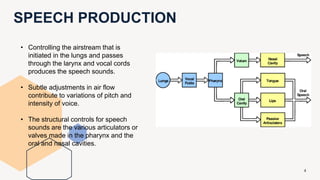
• Controlling the airstream that is
initiated in the lungs and passes
through the larynx and vocal cords
produces the speech sounds.
• Subtle adjustments in air flow
contribute to variations of pitch and
intensity of voice.
• The structural controls for speech
sounds are the various articulators or
valves made in the pharynx and the
oral and nasal cavities.
5
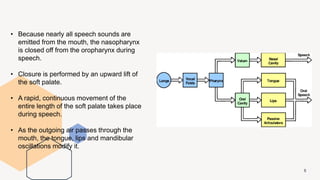
• Because nearly all speech sounds are
emitted from the mouth, the nasopharynx
is closed off from the oropharynx during
speech.
• Closure is performed by an upward lift of
the soft palate.
• A rapid, continuous movement of the
entire length of the soft palate takes place
during speech.
• As the outgoing air passes through the
mouth, the tongue, lips and mandibular
oscillations modify it.
6
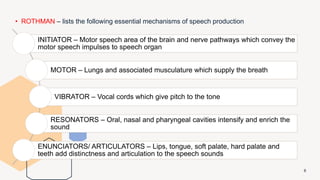
• ROTHMAN – lists the following essential mechanisms of speech production
INITIATOR – Motor speech area of the brain and nerve pathways which convey the
motor speech impulses to speech organ
MOTOR – Lungs and associated musculature which supply the breath
VIBRATOR – Vocal cords which give pitch to the tone
RESONATORS – Oral, nasal and pharyngeal cavities intensify and enrich the
sound
ENUNCIATORS/ ARTICULATORS – Lips, tongue, soft palate, hard palate and
teeth add distinctness and articulation to the speech sounds
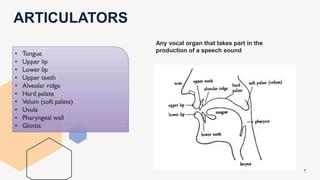
ARTICULATORS
7
Any vocal organ that takes part in the
production of a speech sound
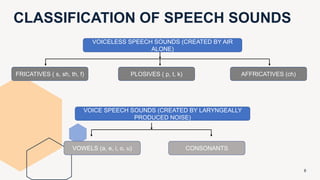
CLASSIFICATION OF SPEECH SOUNDS
8
VOICELESS SPEECH SOUNDS (CREATED BY AIR
ALONE)
PLOSIVES ( p, t, k) AFFRICATIVES (ch)
VOICE SPEECH SOUNDS (CREATED BY LARYNGEALLY
PRODUCED NOISE)
CONSONANTS
VOWELS (a, e, i, o, u)
FRICATIVES ( s, sh, th, f)
9
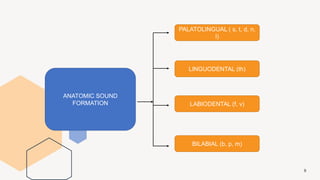
ANATOMIC SOUND
FORMATION
PALATOLINGUAL ( s, t, d, n,
l)
LINGUODENTAL (th)
LABIODENTAL (f, v)
BILABIAL (b, p, m)
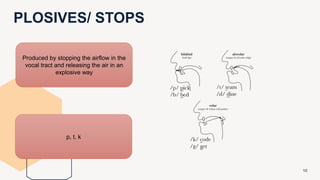
PLOSIVES/ STOPS
10
Produced by stopping the airflow in the
vocal tract and releasing the air in an
explosive way
p, t, k
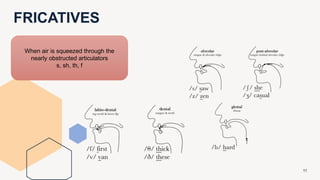
FRICATIVES
11
When air is squeezed through the
nearly obstructed articulators
s, sh, th, f
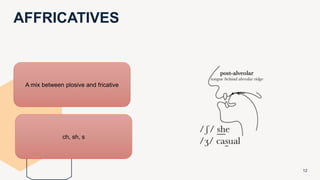
AFFRICATIVES
12
A mix between plosive and fricative
ch, sh, s
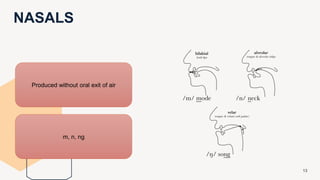
NASALS
13
m, n, ng
Produced without oral exit of air
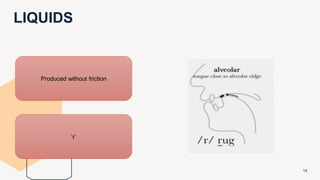
LIQUIDS
14
‘r’
Produced without friction
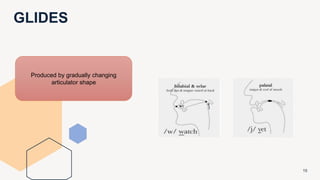
GLIDES
15
Produced by gradually changing
articulator shape
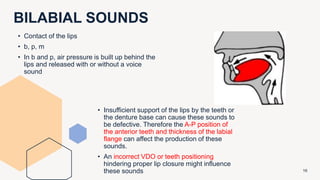
BILABIAL SOUNDS
16
• Contact of the lips
• b, p, m
• In b and p, air pressure is built up behind the
lips and released with or without a voice
sound
• Insufficient support of the lips by the teeth or
the denture base can cause these sounds to
be defective. Therefore the A-P position of
the anterior teeth and thickness of the labial
flange can affect the production of these
sounds.
• An incorrect VDO or teeth positioning
hindering proper lip closure might influence
these sounds
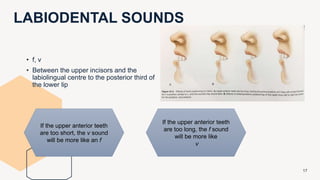
LABIODENTAL SOUNDS
17
• f, v
• Between the upper incisors and the
labiolingual centre to the posterior third of
the lower lip
If the upper anterior teeth
are too short, the v sound
will be more like an f
If the upper anterior teeth
are too long, the f sound
will be more like
v
LINGUODENTAL
18
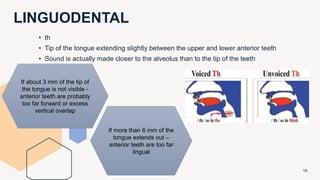
• th
• Tip of the tongue extending slightly between the upper and lower anterior teeth
• Sound is actually made closer to the alveolus than to the tip of the teeth
If about 3 mm of the tip of
the tongue is not visible -
anterior teeth are probably
too far forward or excess
vertical overlap
If more than 6 mm of the
tongue extends out –
anterior teeth are too far
lingual
LINGUO ALVEOLAR
19
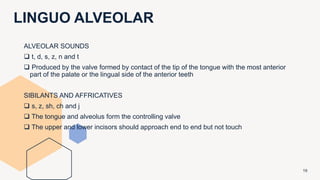
ALVEOLAR SOUNDS
 t, d, s, z, n and t
 Produced by the valve formed by contact of the tip of the tongue with the most anterior
part of the palate or the lingual side of the anterior teeth
SIBILANTS AND AFFRICATIVES
 s, z, sh, ch and j
 The tongue and alveolus form the controlling valve
 The upper and lower incisors should approach end to end but not touch
20
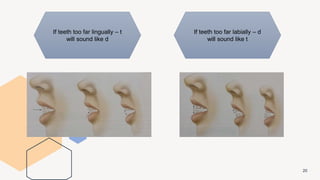
If teeth too far lingually – t
will sound like d
If teeth too far labially – d
will sound like t
PHONETIC PROPERTIES OF ‘S’ SOUND
21
ACOUSTIC CHARACTERISTICS
• The comparatively strong sound energy is
concentrated to a high-frequency range, with a
steep energy cutoff at about 3 to 4 kHz
AUDITORY CHARACTERISTICS
• The sound is fairly loud, with a light, sharp
(sibilant) quality
• The sound s can be considered dental and
alveolar speech sound because they are
produced equally well with two different tongue
positions, but there can be some variation even
behind the alveolus
ARTICULATORY CHARACTERISTICS
• The tip of the tongue is placed far forward,
coming close to but never touch the upper
front incisors
• A sagittal groove is made in the upper front
part of the tongue, with a small cross-
sectional area
• The tongue dorsum is flat
• Normally, the mandible will move forward
and upward, with the teeth almost in contact
LINGUOPALATAL AND LINGUOVELAR
SOUNDS
22
• The truly palatal sounds present less of a problem for dentures
• The velar sounds (k, g, ng) have no effect on dentures except when the posterior
palatal seal extension encroaches on the soft palate
METHODS FOR SPEECH ANALYSIS
23
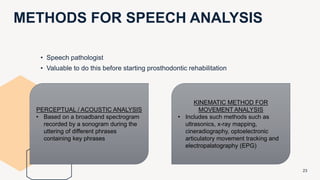
• Speech pathologist
• Valuable to do this before starting prosthodontic rehabilitation
PERCEPTUAL / ACOUSTIC ANALYSIS
• Based on a broadband spectrogram
recorded by a sonogram during the
uttering of different phrases
containing key phrases
KINEMATIC METHOD FOR
MOVEMENT ANALYSIS
• Includes such methods such as
ultrasonics, x-ray mapping,
cineradiography, optoelectronic
articulatory movement tracking and
electropalatography (EPG)
24
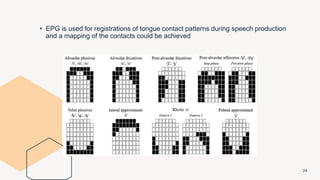
• EPG is used for registrations of tongue contact patterns during speech production
and a mapping of the contacts could be achieved
PROSTHODONTIC
CONSIDERATIONS
25
POSITIONING UPPER ANTERIOR TEETH
26
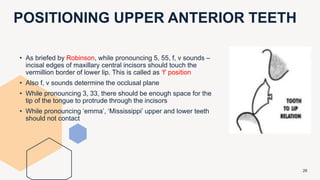
• As briefed by Robinson, while pronouncing 5, 55, f, v sounds –
incisal edges of maxillary central incisors should touch the
vermillion border of lower lip. This is called as ‘f’ position
• Also f, v sounds determine the occlusal plane
• While pronouncing 3, 33, there should be enough space for the
tip of the tongue to protrude through the incisors
• While pronouncing ‘emma’, ‘Mississippi’ upper and lower teeth
should not contact
POSITIONING LOWER ANTERIOR TEETH
27
• Incisal edges of lower 4 incisors should be slightly lingual to the labial incisal
edges of the upper incisors with a space of 1 – 1.5mm while pronouncing ‘s’ and
‘z’. This is called as ‘s’ position
POSITIONING OF POSTERIOR TEETH
28
• Enough space should be provided for dorsum of the tongue to make contact with
the palatal surfaces of upper posterior teeth while pronouncing t, d, s, n, k, e
sounds
• A cramped tongue space, especially in the premolar region, forces the dorsal
surface of the tongue to form too small an opening for the escape of air.
• The procedure for correction is to thicken the center of the palate so the tongue
doesnot have to extend up as far into the narrow palatal vault
RECORDING MAXILLO-MANDIBULAR
RELATIONSHIP
29
• Silverman’s closest speaking space measures the vertical dimension as the
patient says ‘s’
• Vertical dimension at rest measured by pronouncing ‘m’
• Clicking teeth in increased vertical dimension during ‘ch’, ‘j’, ‘s’, ‘z’ sounds
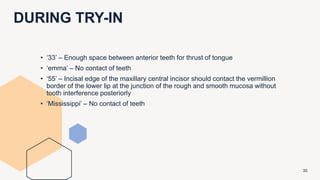
DURING TRY-IN
30
• ‘33’ – Enough space between anterior teeth for thrust of tongue
• ‘emma’ – No contact of teeth
• ‘55’ – Incisal edge of the maxillary central incisor should contact the vermillion
border of the lower lip at the junction of the rough and smooth mucosa without
tooth interference posteriorly
• ‘Mississippi’ – No contact of teeth
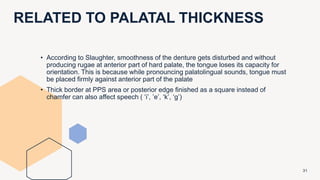
RELATED TO PALATAL THICKNESS
31
• According to Slaughter, smoothness of the denture gets disturbed and without
producing rugae at anterior part of hard palate, the tongue loses its capacity for
orientation. This is because while pronouncing palatolingual sounds, tongue must
be placed firmly against anterior part of the palate
• Thick border at PPS area or posterior edge finished as a square instead of
chamfer can also affect speech ( ‘i’, ’e’, ‘k’, ‘g’)
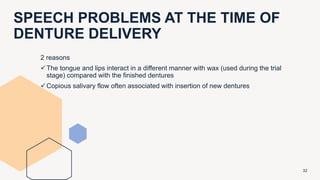
SPEECH PROBLEMS AT THE TIME OF
DENTURE DELIVERY
32
2 reasons
The tongue and lips interact in a different manner with wax (used during the trial
stage) compared with the finished dentures
Copious salivary flow often associated with insertion of new dentures
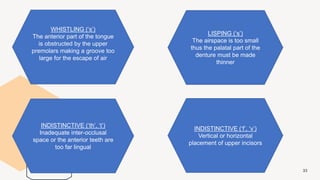
33
WHISTLING (‘s’)
The anterior part of the tongue
is obstructed by the upper
premolars making a groove too
large for the escape of air
INDISTINCTIVE (‘f’, ‘v’)
Vertical or horizontal
placement of upper incisors
INDISTINCTIVE (‘th’, ‘t’)
Inadequate inter-occlusal
space or the anterior teeth are
too far lingual
LISPING (‘s’)
The airspace is too small
thus the palatal part of the
denture must be made
thinner
PROTOCOL FOR DIFFICULTIES PERSIST
FOR MORE THAN 2 – 4 WEEKS
34
• If the patient has a previous denture experience, compare the new one with the
old to diagnose possible differences of significance for speech production
• If on the other hand, a remaining natural dentition is to be converted into a
complete denture, a transfer of the original position of the natural teeth to the
denture should facilitate adaptation
• Have the patient’s hearing checked. An auditory deficit will prolong the adaptation
period and render it more difficult
• If the problem cannot be resolved by dental methods, then patient should be
referred to a speech pathologist
CONCLUSIONS
35
• Speech difficulty as a sequel of oral rehabilitation with complete dentures is
generally a transient problem
• Therefore efforts should be made to avoid them by pretreatment records or
assessment of speech and provision of information to patients about likely initial
deviations from normal speech immediately after the oral rehabilitation
Thank you

PHONETICS.pptx

  • 1.
  • 2.
    CONTENTS Introduction Speech production Classification of Speech sounds Methodsof speech analysis Prosthodontic considerations Presentation Title 2 Conclusion
  • 3.
    INTRODUCTION 3 • Speech isa very sophisticated, autonomous and unconscious activity. Its production involves neural, muscular, mechanical, aerodynamic, acoustic and auditory factors. • As Oro-dental morphological features influence speech, the dentist should therefore recognize the role of prosthetic treatment on speech activity. • Phonetics, the production of speech sounds can be used as a guide to the positions of teeth.
  • 4.
    SPEECH PRODUCTION 4 • Controllingthe airstream that is initiated in the lungs and passes through the larynx and vocal cords produces the speech sounds. • Subtle adjustments in air flow contribute to variations of pitch and intensity of voice. • The structural controls for speech sounds are the various articulators or valves made in the pharynx and the oral and nasal cavities.
  • 5.
    5 • Because nearlyall speech sounds are emitted from the mouth, the nasopharynx is closed off from the oropharynx during speech. • Closure is performed by an upward lift of the soft palate. • A rapid, continuous movement of the entire length of the soft palate takes place during speech. • As the outgoing air passes through the mouth, the tongue, lips and mandibular oscillations modify it.
  • 6.
    6 • ROTHMAN –lists the following essential mechanisms of speech production INITIATOR – Motor speech area of the brain and nerve pathways which convey the motor speech impulses to speech organ MOTOR – Lungs and associated musculature which supply the breath VIBRATOR – Vocal cords which give pitch to the tone RESONATORS – Oral, nasal and pharyngeal cavities intensify and enrich the sound ENUNCIATORS/ ARTICULATORS – Lips, tongue, soft palate, hard palate and teeth add distinctness and articulation to the speech sounds
  • 7.
    ARTICULATORS 7 Any vocal organthat takes part in the production of a speech sound
  • 8.
    CLASSIFICATION OF SPEECHSOUNDS 8 VOICELESS SPEECH SOUNDS (CREATED BY AIR ALONE) PLOSIVES ( p, t, k) AFFRICATIVES (ch) VOICE SPEECH SOUNDS (CREATED BY LARYNGEALLY PRODUCED NOISE) CONSONANTS VOWELS (a, e, i, o, u) FRICATIVES ( s, sh, th, f)
  • 9.
    9 ANATOMIC SOUND FORMATION PALATOLINGUAL (s, t, d, n, l) LINGUODENTAL (th) LABIODENTAL (f, v) BILABIAL (b, p, m)
  • 10.
    PLOSIVES/ STOPS 10 Produced bystopping the airflow in the vocal tract and releasing the air in an explosive way p, t, k
  • 11.
    FRICATIVES 11 When air issqueezed through the nearly obstructed articulators s, sh, th, f
  • 12.
    AFFRICATIVES 12 A mix betweenplosive and fricative ch, sh, s
  • 13.
    NASALS 13 m, n, ng Producedwithout oral exit of air
  • 14.
  • 15.
    GLIDES 15 Produced by graduallychanging articulator shape
  • 16.
    BILABIAL SOUNDS 16 • Contactof the lips • b, p, m • In b and p, air pressure is built up behind the lips and released with or without a voice sound • Insufficient support of the lips by the teeth or the denture base can cause these sounds to be defective. Therefore the A-P position of the anterior teeth and thickness of the labial flange can affect the production of these sounds. • An incorrect VDO or teeth positioning hindering proper lip closure might influence these sounds
  • 17.
    LABIODENTAL SOUNDS 17 • f,v • Between the upper incisors and the labiolingual centre to the posterior third of the lower lip If the upper anterior teeth are too short, the v sound will be more like an f If the upper anterior teeth are too long, the f sound will be more like v
  • 18.
    LINGUODENTAL 18 • th • Tipof the tongue extending slightly between the upper and lower anterior teeth • Sound is actually made closer to the alveolus than to the tip of the teeth If about 3 mm of the tip of the tongue is not visible - anterior teeth are probably too far forward or excess vertical overlap If more than 6 mm of the tongue extends out – anterior teeth are too far lingual
  • 19.
    LINGUO ALVEOLAR 19 ALVEOLAR SOUNDS t, d, s, z, n and t  Produced by the valve formed by contact of the tip of the tongue with the most anterior part of the palate or the lingual side of the anterior teeth SIBILANTS AND AFFRICATIVES  s, z, sh, ch and j  The tongue and alveolus form the controlling valve  The upper and lower incisors should approach end to end but not touch
  • 20.
    20 If teeth toofar lingually – t will sound like d If teeth too far labially – d will sound like t
  • 21.
    PHONETIC PROPERTIES OF‘S’ SOUND 21 ACOUSTIC CHARACTERISTICS • The comparatively strong sound energy is concentrated to a high-frequency range, with a steep energy cutoff at about 3 to 4 kHz AUDITORY CHARACTERISTICS • The sound is fairly loud, with a light, sharp (sibilant) quality • The sound s can be considered dental and alveolar speech sound because they are produced equally well with two different tongue positions, but there can be some variation even behind the alveolus ARTICULATORY CHARACTERISTICS • The tip of the tongue is placed far forward, coming close to but never touch the upper front incisors • A sagittal groove is made in the upper front part of the tongue, with a small cross- sectional area • The tongue dorsum is flat • Normally, the mandible will move forward and upward, with the teeth almost in contact
  • 22.
    LINGUOPALATAL AND LINGUOVELAR SOUNDS 22 •The truly palatal sounds present less of a problem for dentures • The velar sounds (k, g, ng) have no effect on dentures except when the posterior palatal seal extension encroaches on the soft palate
  • 23.
    METHODS FOR SPEECHANALYSIS 23 • Speech pathologist • Valuable to do this before starting prosthodontic rehabilitation PERCEPTUAL / ACOUSTIC ANALYSIS • Based on a broadband spectrogram recorded by a sonogram during the uttering of different phrases containing key phrases KINEMATIC METHOD FOR MOVEMENT ANALYSIS • Includes such methods such as ultrasonics, x-ray mapping, cineradiography, optoelectronic articulatory movement tracking and electropalatography (EPG)
  • 24.
    24 • EPG isused for registrations of tongue contact patterns during speech production and a mapping of the contacts could be achieved
  • 25.
  • 26.
    POSITIONING UPPER ANTERIORTEETH 26 • As briefed by Robinson, while pronouncing 5, 55, f, v sounds – incisal edges of maxillary central incisors should touch the vermillion border of lower lip. This is called as ‘f’ position • Also f, v sounds determine the occlusal plane • While pronouncing 3, 33, there should be enough space for the tip of the tongue to protrude through the incisors • While pronouncing ‘emma’, ‘Mississippi’ upper and lower teeth should not contact
  • 27.
    POSITIONING LOWER ANTERIORTEETH 27 • Incisal edges of lower 4 incisors should be slightly lingual to the labial incisal edges of the upper incisors with a space of 1 – 1.5mm while pronouncing ‘s’ and ‘z’. This is called as ‘s’ position
  • 28.
    POSITIONING OF POSTERIORTEETH 28 • Enough space should be provided for dorsum of the tongue to make contact with the palatal surfaces of upper posterior teeth while pronouncing t, d, s, n, k, e sounds • A cramped tongue space, especially in the premolar region, forces the dorsal surface of the tongue to form too small an opening for the escape of air. • The procedure for correction is to thicken the center of the palate so the tongue doesnot have to extend up as far into the narrow palatal vault
  • 29.
    RECORDING MAXILLO-MANDIBULAR RELATIONSHIP 29 • Silverman’sclosest speaking space measures the vertical dimension as the patient says ‘s’ • Vertical dimension at rest measured by pronouncing ‘m’ • Clicking teeth in increased vertical dimension during ‘ch’, ‘j’, ‘s’, ‘z’ sounds
  • 30.
    DURING TRY-IN 30 • ‘33’– Enough space between anterior teeth for thrust of tongue • ‘emma’ – No contact of teeth • ‘55’ – Incisal edge of the maxillary central incisor should contact the vermillion border of the lower lip at the junction of the rough and smooth mucosa without tooth interference posteriorly • ‘Mississippi’ – No contact of teeth
  • 31.
    RELATED TO PALATALTHICKNESS 31 • According to Slaughter, smoothness of the denture gets disturbed and without producing rugae at anterior part of hard palate, the tongue loses its capacity for orientation. This is because while pronouncing palatolingual sounds, tongue must be placed firmly against anterior part of the palate • Thick border at PPS area or posterior edge finished as a square instead of chamfer can also affect speech ( ‘i’, ’e’, ‘k’, ‘g’)
  • 32.
    SPEECH PROBLEMS ATTHE TIME OF DENTURE DELIVERY 32 2 reasons The tongue and lips interact in a different manner with wax (used during the trial stage) compared with the finished dentures Copious salivary flow often associated with insertion of new dentures
  • 33.
    33 WHISTLING (‘s’) The anteriorpart of the tongue is obstructed by the upper premolars making a groove too large for the escape of air INDISTINCTIVE (‘f’, ‘v’) Vertical or horizontal placement of upper incisors INDISTINCTIVE (‘th’, ‘t’) Inadequate inter-occlusal space or the anterior teeth are too far lingual LISPING (‘s’) The airspace is too small thus the palatal part of the denture must be made thinner
  • 34.
    PROTOCOL FOR DIFFICULTIESPERSIST FOR MORE THAN 2 – 4 WEEKS 34 • If the patient has a previous denture experience, compare the new one with the old to diagnose possible differences of significance for speech production • If on the other hand, a remaining natural dentition is to be converted into a complete denture, a transfer of the original position of the natural teeth to the denture should facilitate adaptation • Have the patient’s hearing checked. An auditory deficit will prolong the adaptation period and render it more difficult • If the problem cannot be resolved by dental methods, then patient should be referred to a speech pathologist
  • 35.
    CONCLUSIONS 35 • Speech difficultyas a sequel of oral rehabilitation with complete dentures is generally a transient problem • Therefore efforts should be made to avoid them by pretreatment records or assessment of speech and provision of information to patients about likely initial deviations from normal speech immediately after the oral rehabilitation
  • 36.