Dr. Abhidha Tripathi
M.D.S First Year
Contents
Introduction
Definition
Types Of speech
Classification Of Speech
S sound and its prosthodontic consideration
Phonetics in Recording Jaw Relation
Phonetics during Trial Insertion
Prosthodontic Implication in Denture Designs affecting Speech
Speech tests
Speech Analysis
Definition
 Speech – is a learned function that requires adequately developed
nervous system, clear vision and hearing ability.
Phonetics – the branch of linguistics that deals with sound and their
production, combination, description and representation by written
symbols.
 A prosthesis fabricated for a patient should be mechanically
functional, aesthetically pleasing and should allow proper phonation.
History
In 1949 ‘Sears’ recommended grooving the palate just above the median
sulcus of the patient.
In 1951 ‘Pound’ was successful in improving phonetics by contouring the
entire palatal aspect of the maxillary denture to simulate the normal
palate
Landa suggested the use of S sound to determine the freeway space and
M sound to establish desirable rest position.
He uses labiodentals ( F and V) as an adjunct to arrangement of maxillary
anterior teeth.
 Silverman used speaking methods to measure patients vertical dimension
with or without denture.
Mechanism Of Speech Production
• Normal speech depends upon the proper functioning of five essential
mechanisms:
1. The Motor - consisting of the lungs and associated musculature of
larynx and muscles which supply the air,
2. The Vibrator - Vocal cords that give pitch to the tone
3. The Resonator – consists of oral, nasal, pharyngeal cavity and
paranasal sinuses
4. The enunciators or articulators – Lips, tongue, palate and teeth
5. The initiator – Motor area of the brain
Speech Articulation
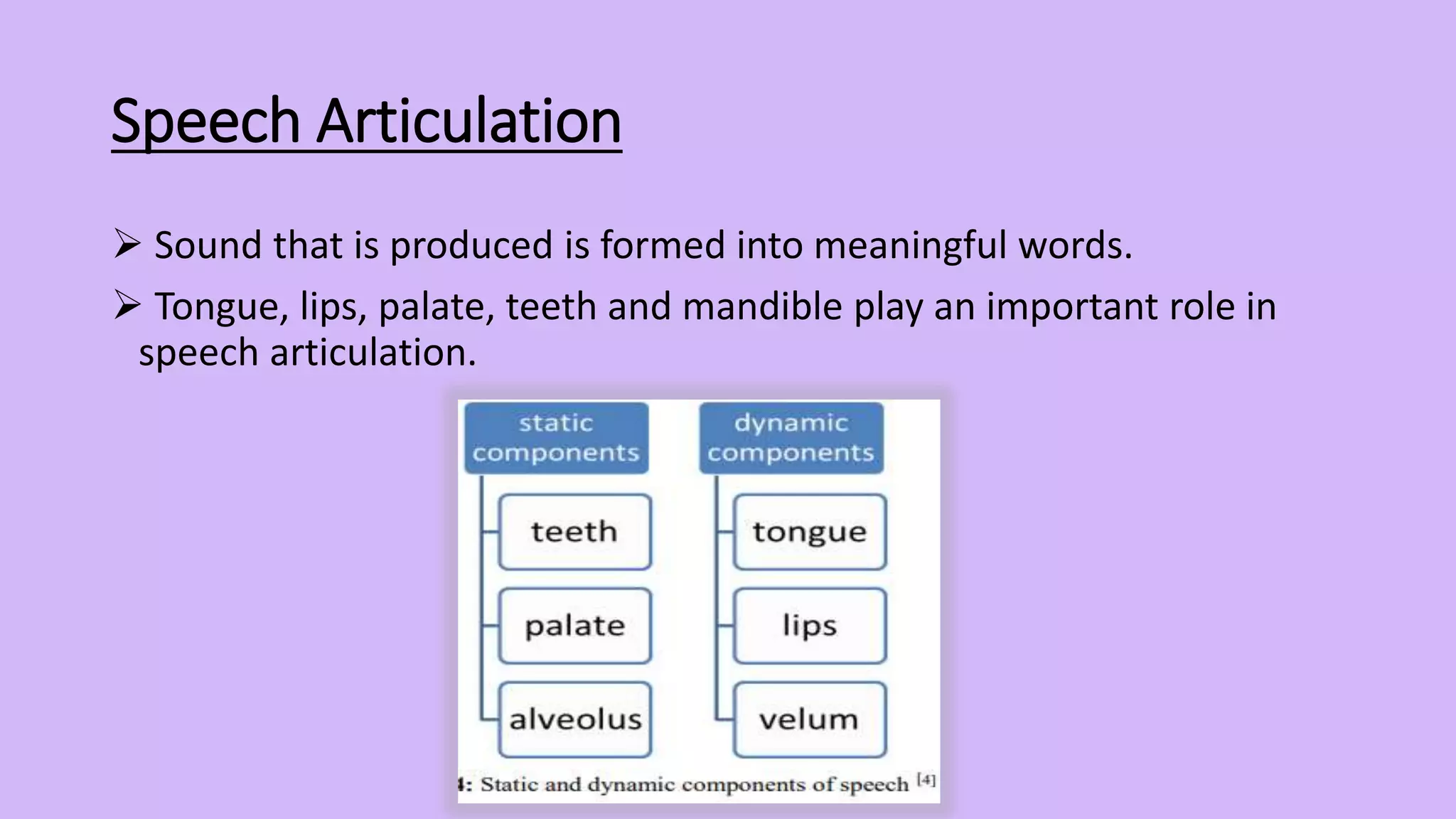
 Sound that is produced is formed into meaningful words.
 Tongue, lips, palate, teeth and mandible play an important role in
speech articulation.
Types Of Speech
1. Vowels – a,e,I,o,u they are voiced sounds
2. Consonants – either voiced or produced without vocal cord
vibration, in which case they are called breathed sounds. Eg: p, b,
m, s, t, r, z
3. Combination – is a blend of consonant and vowel, articulated in
quick succession that they are identified as single phonems. Eg;
Word
Classification Of Consonants Based On The
Place Of Their Production
• Consonant sounds are most important from dental point of view.
• They maybe clqassified according to anatomic parts involved in their
formation
1. Palatolingual sounds – formed by tongue and hard or soft palate
2. Linguodental sounds – formed by tongue and teeth
3. Labiodental sounds – formed by lips and teeth
4. Bilabial sounds – formed by lips
Tongue And Hard palate
• Word like S, T, D, N, and L belong to this category.
• S – the sound S as in sixty six is formed by a hiss of air as it escapes
from the median groove of the tongue when the tongue is behind the
upper incisors –Sears
• If the grove is deep a whistling will be heard when s is pronounced.
• If groove is decreased s is softened towards sh (Lisping)
Clinical Significance
 S sound is used to check the proper
placement of anterior teeth.
Also the thickness of the denture base
can be adjusted in case the sound S is
not correctly pronounced.
Silverman’s closest speaking space also
used this word to establish and check
proper vertical dimension of occlusion.
Rugae and Tongue
 Rugae area is very important for production of sounds like T, D, N
and L
Tongue must be placed firmly against the anterior part of the hard
palate for the production of these sounds
Clinical Significance
 If teeth are too lingual – T will sound like D
 If teeth are too forward – D will sound like T
Tongue and Soft Palate
 Consonants k, ng and g are representative of the palatolingual group
of sounds.
Sound is formed by raising the back of the tongue to occlude with the
soft palate and then suddenly depressing the middle portion of the
back of the tongue realising the air in a puff.
Clinical Significance
 If the posterior borders are over extended or if there is no tissue
contact K becomes Ch sound.
Linguodental Sounds
• Consonant Th is representative of the linguodental group of sounds.
 Dental sounds are made with the tip of the tongue extending slightly
between the upper and lower anterior teeth.
Sound is actually made closer to the alveolus (the ridge) than to the
tip of the teeth.
Careful observation of the amount of tongue that can be seen with
the words – this, that and those will provide information as to the
labio lingual position of the anterior teeth.
Clinical Significance
• If about 3mm of the tip of the tongue is not visible, the anterior teeth
are probably too far forward.
• If more than 6mm of the tongue extends out between the teeth when
such sounds are made, the teeth are probably too lingual.
Labiodental Sounds
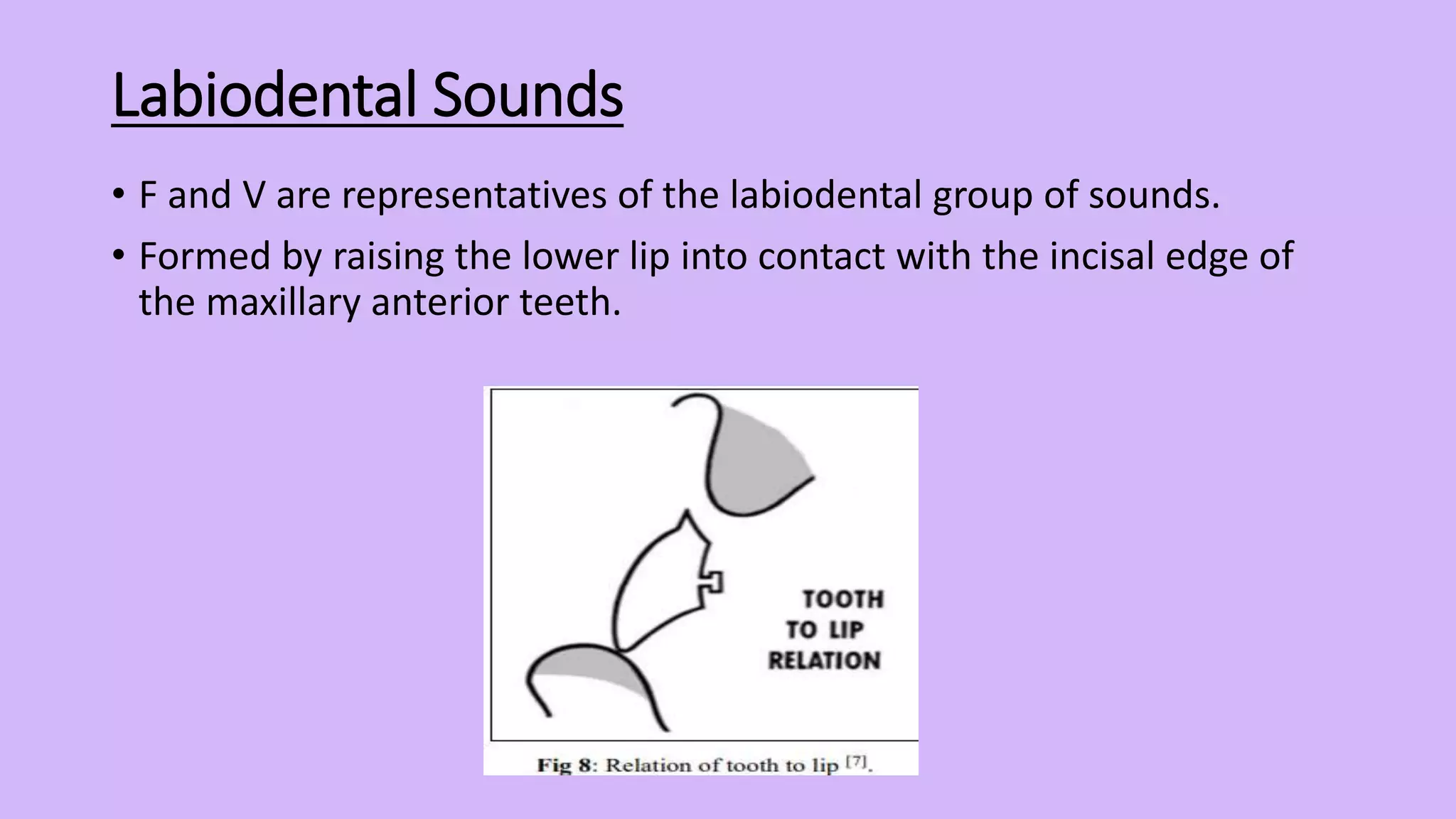
• F and V are representatives of the labiodental group of sounds.
• Formed by raising the lower lip into contact with the incisal edge of
the maxillary anterior teeth.
Clinical Significance
 Upper anterior teeth are too short (set too high up), V sound will be
more like an F.
 If they are too long (set too far down), F will sound like a V.
Bilabial Sounds
 B, p and m are representatives of the
bilabial group of sounds.
 Formed by the stream of air coming
from the lungs which meets with no
resistance along its entire path until it
reaches the lip.
Clinical Significance
 Used to asses the correct interarch space
 Correct labiolingual positioning of the anterior teeth.
 Labial fullness of the rims can also be checked
Phonetics in Recording Jaw Relation
 Also called as the speaking method determining silverman closest
speaking space.
 Sibilant sound like S and M is used
 S sound gives the approximate closest speaking space.
M sound gives us the freeway space
Approximately 2mm of space must be there between the two
occlusal rims.
Clinical significance of S sound
1. Thickness of denture
2. Antero posterior position of teeth
3. Vertical dimension of occlusion
4. Width of dental arch
5. Relationship of upper teeth to the lower anterior teeth by ‘S-
Position’
Prosthodontic Implication In Denture Design
Affecting Speech
1. Denture thickness and peripheral outline
2. Vertical dimension
3. Occlusal Plane
4. Relationship of the upper and lower teeth
5. Post dam area
6. Anteroposterior positioning of teeth
7. Width of the dental arch
Denture Thickness and Peripheral Outline
 If the denture bases are too thick
lisping will occur with words like S, C
and Z.
 Palatolingual sounds are most
affected.
Vertical Dimension
 Bilabials are mostly affected P, B and M.
If both rims touch prematurely it
indicated excessive vertical dimension.
In try in stage teeth clicking will be
heard.
Occlusal Plane
 Labiodental sounds F and V are affected.
 If occlusal plane is too high the correct
positioning of the lower lip is difficult.
 If the occlusal plane is too low there is
overlap of the lower lip on the labial
surface of upper teeth.
Anteriorposterior Positioning Of Teeth
 F and V sounds are hampered.
 Labiopalatal positions of the teeth is very important
 Teeth if placed tp palatally the lower lip will not meet the incisal
edge of the upper teeth.
Post Dam Area
 Palatolingual consonants are affected (K,
N, G)
 Thick post dam areas will irritate the
dorsum of the tongue.
Patient feels nausea like effect while
speaking
If inadequate the plosive sound of the
word is hampered.
This area is very important for singers who
wear complete denture
Width of Dental Arch
 If teeth are set into an arch that is too narrow the tongue will be
cramped.
 Consonants like T, D, N, K and S are affected.
Relationship of Upper and Lower Incisors
 The chief concern is the S, CH, J and Z
sound.
 These sounds need a near contact of
the upper and lower teeth so that the
air stream is allowed to pass.
Speech Test
• The speech test should be made after
1. Satisfactory esthetics
2. Correct centric relation
3. Proper Vertical Dimension and
4. Balanced Occlusion
TEST 1: TEST OF RANDOM SPEECH
• Engage the patient in a conversation and obtaining a subjective
speech analysis by asking the patient say how he feels, how his
speech sounds and what words seem difficult to pronounce.
TEST 2: TEST OF SPECIFIC SPEECH SOUNDS
• This is best accomplished by having the patient say 6-8 words
containing the sound and then combining these words into a
sentence. The following is list of sounds that should be tested
TEST 3: TEST OF READING A PARAGRAPH
• Make the patient read a paragraph containing abundance of S, Sh, Ch
sounds.
Palatograms
• Palatograms are the area of tongue contact for a given sound
displayed on an artificial palate through a medium of non scented
talcum powder.
• To learn the area of normal contact for the tongue in pronouncing the
various phonems, palatograms are made.
Pre-requisites for making a palatogram
• The artificial palate must be accurately adapted and refined so that it
can be worn comfortably without an adhesive until speech is normal
and natural.
• Subject who does not accommodate or who gags after a 15 minutes
practice speaking period should not be used.
• The subject should be trained to pronounce the sound distinctly, and
then to open his mouth with the tongue out of contact with the
palate and not to swallow until the palate is removed.
Pre-requisites for making a palatogram
• The tracing medium should not be distasteful, permit ease of
application and removal from the artificial palate.
• The colour of the medium should contrast with the palate sufficiently
to display area of tongue contact.
• The palate must be dried thoroughly before dusting with talc, and
care must be taken in inserting and removing the tracings
Conclusion
• The importance of phonetics in the field of prosthodontics is
undeniable.
• It is mandatory for a clinician to have a working knowledge of the
production of speech and the effect a prosthesis may have on proper
speech.
• The proper knowledge of speech production and phonetic
parameters will enable a clinician in fabrication of dentures with good
phonetic capabilities.
• Achievement of the optimum phonetic potential is possible by
providing correlation between mechanics, esthetics and phonetics.
References
1. Rothman R. Phonetic considerations in denture prosthesis. J
Prosthet Dent 1961;11(2):214-23.
2. Silverman MM. Determination of Vertical Dimension by Phonetics. J
Prosthet Dent 1956;6:465-471.
3. Sharry JJ. Complete denture Prosthodontics-Speech in
prosthodontics McGraw-Hill Inc 1962:127-30. 7.
4. Pound E. Utilizing speech to simplify a personalized denture service;
J Prosthet Dent 2006, 1-9
5. Pound E. Esthetic dentures and their phonetic values. J Prosthet
Dent 1951;1(2):98-111.

Phonetics in Complete Denture.pptx

  • 1.
  • 2.
    Contents Introduction Definition Types Of speech ClassificationOf Speech S sound and its prosthodontic consideration Phonetics in Recording Jaw Relation Phonetics during Trial Insertion Prosthodontic Implication in Denture Designs affecting Speech Speech tests Speech Analysis
  • 3.
    Definition  Speech –is a learned function that requires adequately developed nervous system, clear vision and hearing ability. Phonetics – the branch of linguistics that deals with sound and their production, combination, description and representation by written symbols.  A prosthesis fabricated for a patient should be mechanically functional, aesthetically pleasing and should allow proper phonation.
  • 4.
    History In 1949 ‘Sears’recommended grooving the palate just above the median sulcus of the patient. In 1951 ‘Pound’ was successful in improving phonetics by contouring the entire palatal aspect of the maxillary denture to simulate the normal palate Landa suggested the use of S sound to determine the freeway space and M sound to establish desirable rest position. He uses labiodentals ( F and V) as an adjunct to arrangement of maxillary anterior teeth.  Silverman used speaking methods to measure patients vertical dimension with or without denture.
  • 5.
    Mechanism Of SpeechProduction • Normal speech depends upon the proper functioning of five essential mechanisms: 1. The Motor - consisting of the lungs and associated musculature of larynx and muscles which supply the air, 2. The Vibrator - Vocal cords that give pitch to the tone 3. The Resonator – consists of oral, nasal, pharyngeal cavity and paranasal sinuses
  • 6.
    4. The enunciatorsor articulators – Lips, tongue, palate and teeth 5. The initiator – Motor area of the brain
  • 7.
    Speech Articulation  Soundthat is produced is formed into meaningful words.  Tongue, lips, palate, teeth and mandible play an important role in speech articulation.
  • 8.
    Types Of Speech 1.Vowels – a,e,I,o,u they are voiced sounds 2. Consonants – either voiced or produced without vocal cord vibration, in which case they are called breathed sounds. Eg: p, b, m, s, t, r, z 3. Combination – is a blend of consonant and vowel, articulated in quick succession that they are identified as single phonems. Eg; Word
  • 9.
    Classification Of ConsonantsBased On The Place Of Their Production • Consonant sounds are most important from dental point of view. • They maybe clqassified according to anatomic parts involved in their formation 1. Palatolingual sounds – formed by tongue and hard or soft palate 2. Linguodental sounds – formed by tongue and teeth 3. Labiodental sounds – formed by lips and teeth 4. Bilabial sounds – formed by lips
  • 10.
    Tongue And Hardpalate • Word like S, T, D, N, and L belong to this category. • S – the sound S as in sixty six is formed by a hiss of air as it escapes from the median groove of the tongue when the tongue is behind the upper incisors –Sears • If the grove is deep a whistling will be heard when s is pronounced. • If groove is decreased s is softened towards sh (Lisping)
  • 11.
    Clinical Significance  Ssound is used to check the proper placement of anterior teeth. Also the thickness of the denture base can be adjusted in case the sound S is not correctly pronounced. Silverman’s closest speaking space also used this word to establish and check proper vertical dimension of occlusion.
  • 12.
    Rugae and Tongue Rugae area is very important for production of sounds like T, D, N and L Tongue must be placed firmly against the anterior part of the hard palate for the production of these sounds
  • 13.
    Clinical Significance  Ifteeth are too lingual – T will sound like D  If teeth are too forward – D will sound like T
  • 14.
    Tongue and SoftPalate  Consonants k, ng and g are representative of the palatolingual group of sounds. Sound is formed by raising the back of the tongue to occlude with the soft palate and then suddenly depressing the middle portion of the back of the tongue realising the air in a puff.
  • 15.
    Clinical Significance  Ifthe posterior borders are over extended or if there is no tissue contact K becomes Ch sound.
  • 16.
    Linguodental Sounds • ConsonantTh is representative of the linguodental group of sounds.  Dental sounds are made with the tip of the tongue extending slightly between the upper and lower anterior teeth. Sound is actually made closer to the alveolus (the ridge) than to the tip of the teeth. Careful observation of the amount of tongue that can be seen with the words – this, that and those will provide information as to the labio lingual position of the anterior teeth.
  • 17.
    Clinical Significance • Ifabout 3mm of the tip of the tongue is not visible, the anterior teeth are probably too far forward. • If more than 6mm of the tongue extends out between the teeth when such sounds are made, the teeth are probably too lingual.
  • 18.
    Labiodental Sounds • Fand V are representatives of the labiodental group of sounds. • Formed by raising the lower lip into contact with the incisal edge of the maxillary anterior teeth.
  • 19.
    Clinical Significance  Upperanterior teeth are too short (set too high up), V sound will be more like an F.  If they are too long (set too far down), F will sound like a V.
  • 20.
    Bilabial Sounds  B,p and m are representatives of the bilabial group of sounds.  Formed by the stream of air coming from the lungs which meets with no resistance along its entire path until it reaches the lip.
  • 21.
    Clinical Significance  Usedto asses the correct interarch space  Correct labiolingual positioning of the anterior teeth.  Labial fullness of the rims can also be checked
  • 22.
    Phonetics in RecordingJaw Relation  Also called as the speaking method determining silverman closest speaking space.  Sibilant sound like S and M is used  S sound gives the approximate closest speaking space. M sound gives us the freeway space Approximately 2mm of space must be there between the two occlusal rims.
  • 23.
    Clinical significance ofS sound 1. Thickness of denture 2. Antero posterior position of teeth 3. Vertical dimension of occlusion 4. Width of dental arch 5. Relationship of upper teeth to the lower anterior teeth by ‘S- Position’
  • 24.
    Prosthodontic Implication InDenture Design Affecting Speech 1. Denture thickness and peripheral outline 2. Vertical dimension 3. Occlusal Plane 4. Relationship of the upper and lower teeth 5. Post dam area 6. Anteroposterior positioning of teeth 7. Width of the dental arch
  • 25.
    Denture Thickness andPeripheral Outline  If the denture bases are too thick lisping will occur with words like S, C and Z.  Palatolingual sounds are most affected.
  • 26.
    Vertical Dimension  Bilabialsare mostly affected P, B and M. If both rims touch prematurely it indicated excessive vertical dimension. In try in stage teeth clicking will be heard.
  • 27.
    Occlusal Plane  Labiodentalsounds F and V are affected.  If occlusal plane is too high the correct positioning of the lower lip is difficult.  If the occlusal plane is too low there is overlap of the lower lip on the labial surface of upper teeth.
  • 28.
    Anteriorposterior Positioning OfTeeth  F and V sounds are hampered.  Labiopalatal positions of the teeth is very important  Teeth if placed tp palatally the lower lip will not meet the incisal edge of the upper teeth.
  • 29.
    Post Dam Area Palatolingual consonants are affected (K, N, G)  Thick post dam areas will irritate the dorsum of the tongue. Patient feels nausea like effect while speaking If inadequate the plosive sound of the word is hampered. This area is very important for singers who wear complete denture
  • 30.
    Width of DentalArch  If teeth are set into an arch that is too narrow the tongue will be cramped.  Consonants like T, D, N, K and S are affected.
  • 31.
    Relationship of Upperand Lower Incisors  The chief concern is the S, CH, J and Z sound.  These sounds need a near contact of the upper and lower teeth so that the air stream is allowed to pass.
  • 32.
    Speech Test • Thespeech test should be made after 1. Satisfactory esthetics 2. Correct centric relation 3. Proper Vertical Dimension and 4. Balanced Occlusion
  • 33.
    TEST 1: TESTOF RANDOM SPEECH • Engage the patient in a conversation and obtaining a subjective speech analysis by asking the patient say how he feels, how his speech sounds and what words seem difficult to pronounce.
  • 34.
    TEST 2: TESTOF SPECIFIC SPEECH SOUNDS • This is best accomplished by having the patient say 6-8 words containing the sound and then combining these words into a sentence. The following is list of sounds that should be tested
  • 36.
    TEST 3: TESTOF READING A PARAGRAPH • Make the patient read a paragraph containing abundance of S, Sh, Ch sounds.
  • 37.
    Palatograms • Palatograms arethe area of tongue contact for a given sound displayed on an artificial palate through a medium of non scented talcum powder. • To learn the area of normal contact for the tongue in pronouncing the various phonems, palatograms are made.
  • 38.
    Pre-requisites for makinga palatogram • The artificial palate must be accurately adapted and refined so that it can be worn comfortably without an adhesive until speech is normal and natural. • Subject who does not accommodate or who gags after a 15 minutes practice speaking period should not be used. • The subject should be trained to pronounce the sound distinctly, and then to open his mouth with the tongue out of contact with the palate and not to swallow until the palate is removed.
  • 39.
    Pre-requisites for makinga palatogram • The tracing medium should not be distasteful, permit ease of application and removal from the artificial palate. • The colour of the medium should contrast with the palate sufficiently to display area of tongue contact. • The palate must be dried thoroughly before dusting with talc, and care must be taken in inserting and removing the tracings
  • 41.
    Conclusion • The importanceof phonetics in the field of prosthodontics is undeniable. • It is mandatory for a clinician to have a working knowledge of the production of speech and the effect a prosthesis may have on proper speech. • The proper knowledge of speech production and phonetic parameters will enable a clinician in fabrication of dentures with good phonetic capabilities. • Achievement of the optimum phonetic potential is possible by providing correlation between mechanics, esthetics and phonetics.
  • 42.
    References 1. Rothman R.Phonetic considerations in denture prosthesis. J Prosthet Dent 1961;11(2):214-23. 2. Silverman MM. Determination of Vertical Dimension by Phonetics. J Prosthet Dent 1956;6:465-471. 3. Sharry JJ. Complete denture Prosthodontics-Speech in prosthodontics McGraw-Hill Inc 1962:127-30. 7. 4. Pound E. Utilizing speech to simplify a personalized denture service; J Prosthet Dent 2006, 1-9 5. Pound E. Esthetic dentures and their phonetic values. J Prosthet Dent 1951;1(2):98-111.