WEEK 3
PHONETICS:
THE SOUNDS OF
LANGUAGE
Öğr. Gör. AYLİN AYDIN
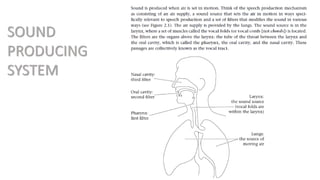
SOUND
PRODUCING
SYSTEM
Speech
Production
Process
In Brief
Speech
Production
Process
Detailed / 1
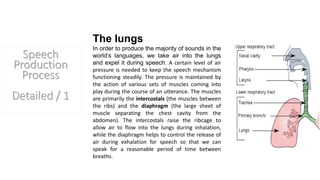
The lungs
In order to produce the majority of sounds in the
world’s languages, we take air into the lungs
and expel it during speech. A certain level of air
pressure is needed to keep the speech mechanism
functioning steadily. The pressure is maintained by
the action of various sets of muscles coming into
play during the course of an utterance. The muscles
are primarily the intercostals (the muscles between
the ribs) and the diaphragm (the large sheet of
muscle separating the chest cavity from the
abdomen). The intercostals raise the ribcage to
allow air to flow into the lungs during inhalation,
while the diaphragm helps to control the release of
air during exhalation for speech so that we can
speak for a reasonable period of time between
breaths.
The larynx
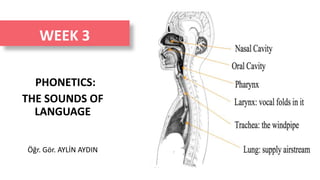
As air flows out of the lungs up the
trachea (windpipe), it passes through
a box-like structure made of cartilage
and muscle; this is the larynx.
As air passes through the space
between the vocal folds, which is
called the glottis, different glottal
states are produced, depending on
the positioning of the vocal folds.
Sound is produced in the larynx.
Speech
Production
Process
Detailed / 2
Glottal States:
space between the vocal folds
• In the most basic terms, a
sound produced while the
vocal folds are vibrating is
called a voiced sound.
• A sound produced while the
folds are not vibrating is
called a voiceless sound.
• All vowels are voiced, but
consonants can be either
voiced or voiceless.
Speech
Production
Process
Detailed / 3
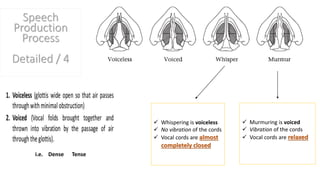
 Whispering is voiceless
 No vibration of the cords
 Vocal cords are almost
completely closed
 Murmuring is voiced
 Vibration of the cords
 Vocal cords are relaxed
i.e. Dense Tense
Speech
Production
Process
Detailed / 4
REVISION
In most speech sounds, including all the soun
producing ds used regularly in English, the air we
use comes from the lungs. This air travels up
from the lungs, passing through the trachea
(windpipe), until it reaches the larynx, where it
might be set into vibration. The larynx is commonly
known as the voice box. The air passes through the
larynx into the vocal tract, which is the air passages
of the head and neck.
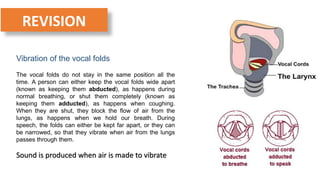
Vibration of the vocal folds
The vocal folds do not stay in the same position all the
time. A person can either keep the vocal folds wide apart
(known as keeping them abducted), as happens during
normal breathing, or shut them completely (known as
keeping them adducted), as happens when coughing.
When they are shut, they block the flow of air from the
lungs, as happens when we hold our breath. During
speech, the folds can either be kept far apart, or they can
be narrowed, so that they vibrate when air from the lungs
passes through them.
Sound is produced when air is made to vibrate
REVISION
REVISION
CONSONANT
ARTICULATION
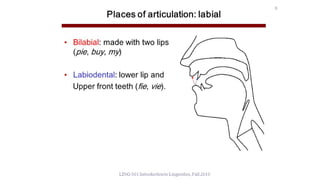
Lips
Lips and teeth
Between teeths
Tongue – ridge
Roof of the mouth
Towards the velum
Throaty
Phonetics
Phonetics
Phonetics
Phonetics
Phonetics
Phonetics
Phonetics
Phonetics

Phonetics

  • 1.
    WEEK 3 PHONETICS: THE SOUNDSOF LANGUAGE Öğr. Gör. AYLİN AYDIN
  • 4.
  • 5.
  • 6.
    Speech Production Process Detailed / 1 Thelungs In order to produce the majority of sounds in the world’s languages, we take air into the lungs and expel it during speech. A certain level of air pressure is needed to keep the speech mechanism functioning steadily. The pressure is maintained by the action of various sets of muscles coming into play during the course of an utterance. The muscles are primarily the intercostals (the muscles between the ribs) and the diaphragm (the large sheet of muscle separating the chest cavity from the abdomen). The intercostals raise the ribcage to allow air to flow into the lungs during inhalation, while the diaphragm helps to control the release of air during exhalation for speech so that we can speak for a reasonable period of time between breaths.
  • 7.
    The larynx As airflows out of the lungs up the trachea (windpipe), it passes through a box-like structure made of cartilage and muscle; this is the larynx. As air passes through the space between the vocal folds, which is called the glottis, different glottal states are produced, depending on the positioning of the vocal folds. Sound is produced in the larynx. Speech Production Process Detailed / 2
  • 8.
    Glottal States: space betweenthe vocal folds • In the most basic terms, a sound produced while the vocal folds are vibrating is called a voiced sound. • A sound produced while the folds are not vibrating is called a voiceless sound. • All vowels are voiced, but consonants can be either voiced or voiceless. Speech Production Process Detailed / 3
  • 9.
     Whispering isvoiceless  No vibration of the cords  Vocal cords are almost completely closed  Murmuring is voiced  Vibration of the cords  Vocal cords are relaxed i.e. Dense Tense Speech Production Process Detailed / 4
  • 10.
    REVISION In most speechsounds, including all the soun producing ds used regularly in English, the air we use comes from the lungs. This air travels up from the lungs, passing through the trachea (windpipe), until it reaches the larynx, where it might be set into vibration. The larynx is commonly known as the voice box. The air passes through the larynx into the vocal tract, which is the air passages of the head and neck.
  • 11.
    Vibration of thevocal folds The vocal folds do not stay in the same position all the time. A person can either keep the vocal folds wide apart (known as keeping them abducted), as happens during normal breathing, or shut them completely (known as keeping them adducted), as happens when coughing. When they are shut, they block the flow of air from the lungs, as happens when we hold our breath. During speech, the folds can either be kept far apart, or they can be narrowed, so that they vibrate when air from the lungs passes through them. Sound is produced when air is made to vibrate REVISION
  • 12.
  • 13.
  • 14.
    Lips Lips and teeth Betweenteeths Tongue – ridge Roof of the mouth Towards the velum Throaty