ULUDAG UNIVERSITY  ENGLISH LANGUAGE AND TEACHING DEPARTMENT APPROACHES IN ELT : TASK BASED INSTRUCTION Aylin Aydın Arzu Akgün Ayşegül Arslan Sevde İlhan  MARCH, 2011
TASK BASED LANGUAGE TEACHING
Task based instruction offers an alternative for language teachers. In a task based lesson, the lesson is organized around the  completion of a central task.
The language studied is determined by what happens as the students complete the task . Activities in which language is used for carrying out  meaningful tasks promote learning
Activities that involve  '' real communication ''  are essential for language learning. Language that is  meaningful  to the learner supports the learning process.
Tasks provide both  the input  and  the output  processing necessary for language process Task activiy and achievement are  motivational Meaningful  repetition leads to fluency
TBI emphasizes  meaning over form  but can also cater for learning form The focus is on  process  rather than product.
Learners can only gain in  FLUENCY  by attempting to use the L2 in real operating conditions In syllabus,  activities and tasks are sequenced according to difficulty
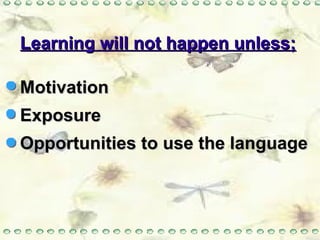
Learning will not happen unless; Motivation Exposure Opportunities to use the language
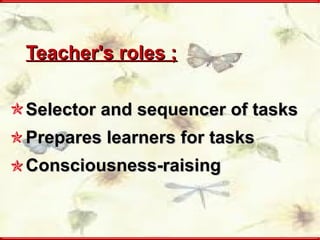
Teacher's roles ; Selector and sequencer of tasks Prepares learners for tasks Consciousness-raising
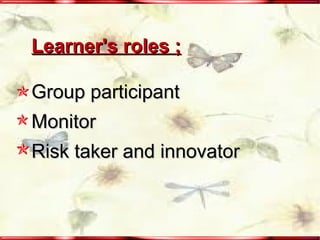
Learner's roles ; Group participant Monitor  Risk taker and innovator
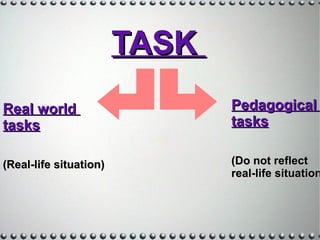
TASK  Real world  tasks (Real-life situation) Pedagogical  tasks (Do not reflect  real-life situation)
Application of Task-based Instruction: Pre-task : The teacher introduces the topic and gives the  students clear  instructions on what they will have to do at the task stage.  The students can take notes and spend time preparing for the task.
Task :   The students complete a task in pairs or groups using  the language resources that they have as the teacher monitors and offers encouragement. Students prepare a short oral or written report to tell the class what happened during their task.
Post-Task  (Analysis):   The teacher then highlights relevant  parts for the students to analyze.  The teacher can also highlight the language that the students used during the report phase for analysis. Finally, the teacher selects language areas to practice based upon the needs of the students and what emerged from the task and report phases. The students then do practice activities to increase their confidence and make a note of useful language.
ADVANTAGES OF TBI  The students are free of language control A natural context is developed from the students'  experiences.  The language arises from their needs The students will have much more exposure to language Students spend a lot of time communicating.
Thanks for  Listening

Task Based Instruction by Aylin Aydın, Uludag University

  • 1.
    ULUDAG UNIVERSITY ENGLISH LANGUAGE AND TEACHING DEPARTMENT APPROACHES IN ELT : TASK BASED INSTRUCTION Aylin Aydın Arzu Akgün Ayşegül Arslan Sevde İlhan MARCH, 2011
  • 2.
  • 3.
    Task based instructionoffers an alternative for language teachers. In a task based lesson, the lesson is organized around the completion of a central task.
  • 4.
    The language studiedis determined by what happens as the students complete the task . Activities in which language is used for carrying out meaningful tasks promote learning
  • 5.
    Activities that involve '' real communication '' are essential for language learning. Language that is meaningful to the learner supports the learning process.
  • 6.
    Tasks provide both the input and the output processing necessary for language process Task activiy and achievement are motivational Meaningful repetition leads to fluency
  • 7.
    TBI emphasizes meaning over form but can also cater for learning form The focus is on process rather than product.
  • 8.
    Learners can onlygain in FLUENCY by attempting to use the L2 in real operating conditions In syllabus, activities and tasks are sequenced according to difficulty
  • 9.
    Learning will nothappen unless; Motivation Exposure Opportunities to use the language
  • 10.
    Teacher's roles ;Selector and sequencer of tasks Prepares learners for tasks Consciousness-raising
  • 11.
    Learner's roles ;Group participant Monitor Risk taker and innovator
  • 12.
    TASK Realworld tasks (Real-life situation) Pedagogical tasks (Do not reflect real-life situation)
  • 13.
    Application of Task-basedInstruction: Pre-task : The teacher introduces the topic and gives the students clear instructions on what they will have to do at the task stage. The students can take notes and spend time preparing for the task.
  • 14.
    Task : The students complete a task in pairs or groups using the language resources that they have as the teacher monitors and offers encouragement. Students prepare a short oral or written report to tell the class what happened during their task.
  • 15.
    Post-Task (Analysis): The teacher then highlights relevant parts for the students to analyze. The teacher can also highlight the language that the students used during the report phase for analysis. Finally, the teacher selects language areas to practice based upon the needs of the students and what emerged from the task and report phases. The students then do practice activities to increase their confidence and make a note of useful language.
  • 16.
    ADVANTAGES OF TBI The students are free of language control A natural context is developed from the students' experiences. The language arises from their needs The students will have much more exposure to language Students spend a lot of time communicating.
  • 17.
    Thanks for Listening