Introduction to
Polybius
D Posker-Hill
History Extension
Who was Polybius?
Πολύβιος

200–118 BC

Greek - Arcadia

'His books are like the sun in the field of Roman
history; where they begin, the misty veils which
still cloak the Samnite and Pyrrhic wars are lifted,
where they finish, a new and if possible still more
vexatious twilight begins." Mommsen, Romische
Geschichte (gth ed, 1903).
Features of his Work
„causation‟:      3 tiered
the reasons       system
why
Eye-Witness       Written Sources

       Military-Political
       Focus
Thematic
Focus?

•   Rome‟s rise to power
     •   Only took “53 years”

•   Military and Political
    Systems
     •   Judgements are made throughout
     •   Lost text “Tactics”

•   Theory of „regular cycle[s]
    of constitutional revolutions‟
     •   kingship, aristocracy and democracy
Use of Evidence
Polybius used both written historical
records, personal experience and eye witnesses
to compile evidence for use in his histories.
     8 In the course of this work it will become more
     clearly intelligible by what steps this power was
     acquired, and it will also be seen how many and
     how great advantages accrue to the student from
     the systematic treatment of history.
                                          Polybius
Longue Duree?
Polybius extols a „general history‟
    3 As it is, I observe that while several modern writers deal with particular wars
    and certain matters connected with them, no one, as far as I am aware, has
    even attempted to inquire critically when and whence the general and
    comprehensive scheme of events originated and how it led up to the
    end. 4 I therefore thought it quite necessary not to leave unnoticed or allow to
    pass into oblivion this the finest and most beneficent of the performances of
    Fortune. 5 For though she is ever producing something new and ever playing a
    part in the lives of men, she has not in a single instance ever accomplished
    such a work, ever achieved such a triumph, as in our own times. 6 We can no
    more hope to perceive this from histories dealing with particular events than to
    get at once a notion of the form of the whole world, its disposition and order, by
    visiting, each in turn, the most famous cities, or indeed by looking at separate
    plans of each: a result by no means likely. 7 He indeed who believes p13that
    by studying isolated histories he can acquire a fairly just view of history as a
    whole, is, as it seems to me, much in the case of one, who, after having looked
    at the dissevered limbs of an animal once alive and beautiful, fancies he has
    been as good as an eyewitness of the creature itself in all its action and
    grace. 8 For could anyone put the creature together on the spot, restoring its
    form and the comeliness of life, and then show it to the same man, I think he
    would quickly avow that he was formerly very far away from the truth and more
    like one in a dream. 9 For we can get some idea of a whole from a part, but
    never knowledge or exact opinion. 10 Special histories therefore contribute
    very little to the knowledge of the whole and conviction of its truth. 11 It is only
    indeed by study of the interconnection of all the particulars, their resemblances
    and differences, that we are enabled at least to make a general survey, and
    thus derive both benefit and pleasure from history.
Aim and Purpose
The aim and purpose          A historian should
for Polybius for history     not willingly drop
was to make history          all pretence as to
practical so that it could   giving the „real
be utilized in military      words‟ and attempt
and political affairs        as best they can to
Works of the historian       give a verbatim
should not be like           account, but rather
those of a „poet‟ in         attempt to provide
exaggeration but             as    accurate    a
rather rooted in             recount          as
unbridled truth.             possible.
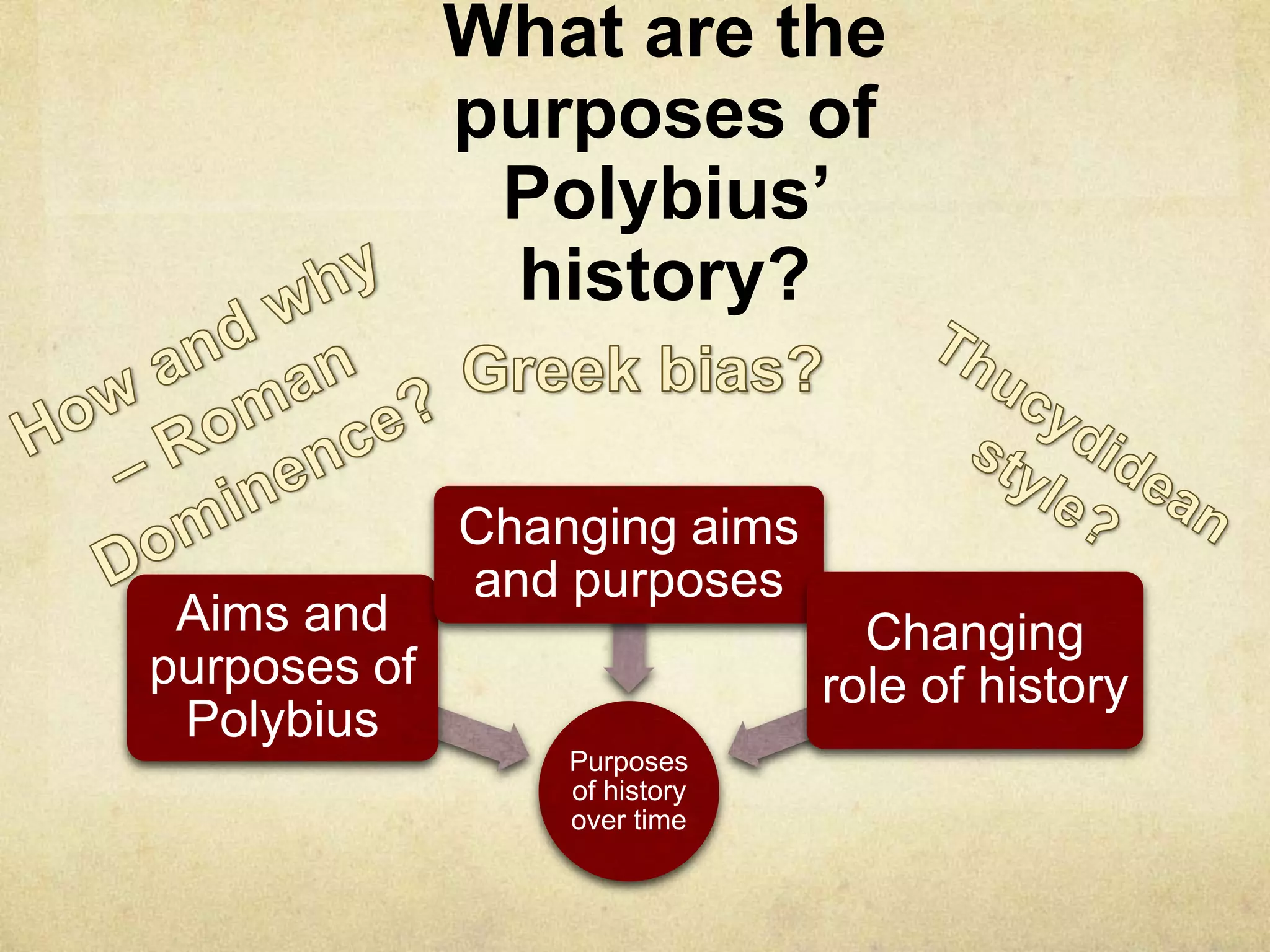
What are the
              purposes of
               Polybius’
               history?


              Changing aims
              and purposes
 Aims and                        Changing
purposes of                    role of history
 Polybius
                  Purposes
                  of history
                  over time
How has history been
constructed and recorded
 over time? Via Polybius
 Forms of historical   Types of history in
 communication         Polybius
    Written              Political
    Use of sources       Economic
    Lost works           Military
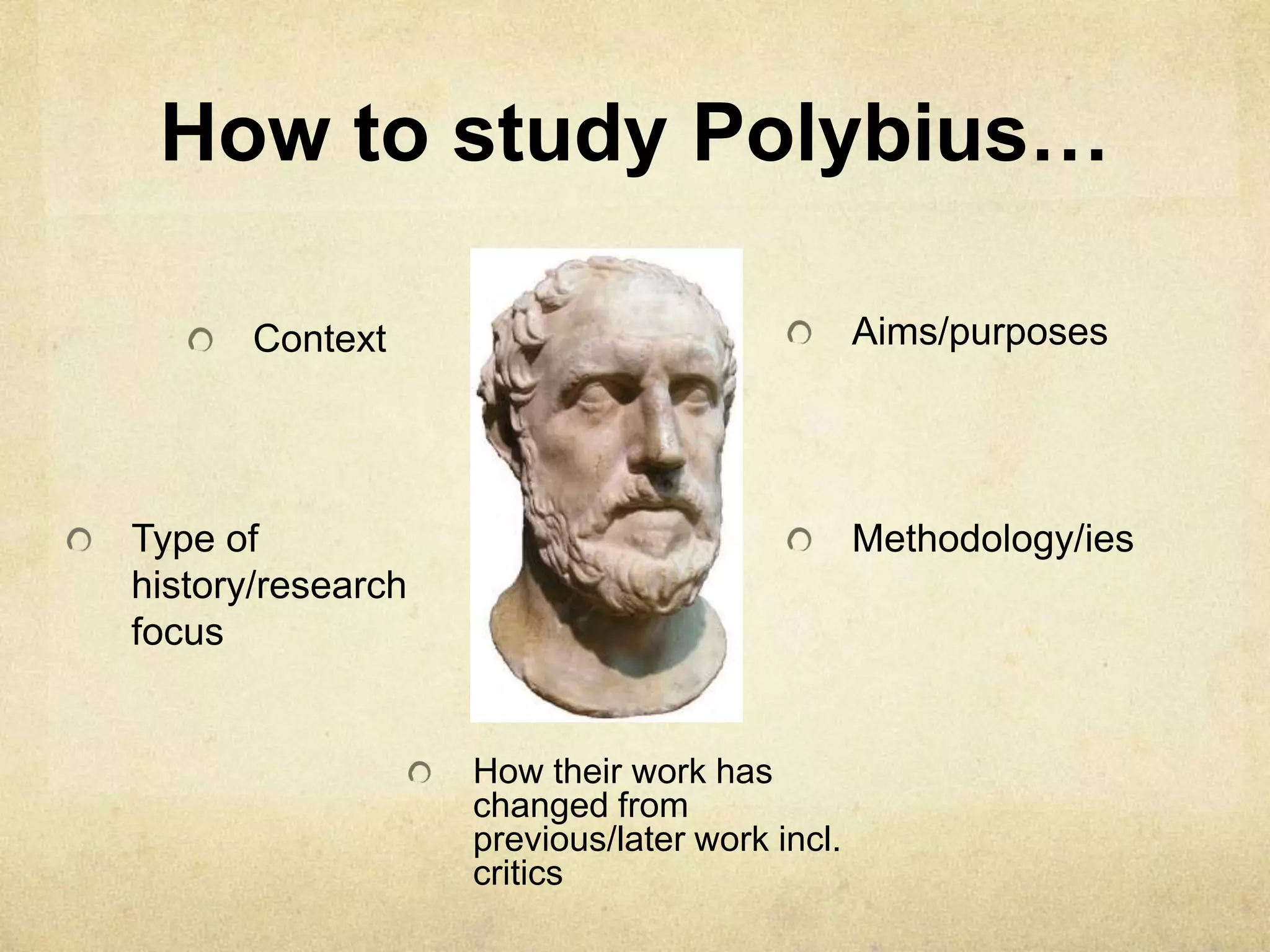
How to study Polybius…

       Context                                 Aims/purposes


Type of                                        Methodology/ies
history/research
focus


                   How their work has
                   changed from
                   previous/later work incl.
                   critics

Polybius intro

  • 1.
  • 2.
    Who was Polybius? Πολύβιος 200–118BC Greek - Arcadia 'His books are like the sun in the field of Roman history; where they begin, the misty veils which still cloak the Samnite and Pyrrhic wars are lifted, where they finish, a new and if possible still more vexatious twilight begins." Mommsen, Romische Geschichte (gth ed, 1903).
  • 3.
    Features of hisWork „causation‟: 3 tiered the reasons system why Eye-Witness Written Sources Military-Political Focus
  • 4.
    Thematic Focus? • Rome‟s rise to power • Only took “53 years” • Military and Political Systems • Judgements are made throughout • Lost text “Tactics” • Theory of „regular cycle[s] of constitutional revolutions‟ • kingship, aristocracy and democracy
  • 5.
    Use of Evidence Polybiusused both written historical records, personal experience and eye witnesses to compile evidence for use in his histories. 8 In the course of this work it will become more clearly intelligible by what steps this power was acquired, and it will also be seen how many and how great advantages accrue to the student from the systematic treatment of history. Polybius
  • 6.
    Longue Duree? Polybius extolsa „general history‟ 3 As it is, I observe that while several modern writers deal with particular wars and certain matters connected with them, no one, as far as I am aware, has even attempted to inquire critically when and whence the general and comprehensive scheme of events originated and how it led up to the end. 4 I therefore thought it quite necessary not to leave unnoticed or allow to pass into oblivion this the finest and most beneficent of the performances of Fortune. 5 For though she is ever producing something new and ever playing a part in the lives of men, she has not in a single instance ever accomplished such a work, ever achieved such a triumph, as in our own times. 6 We can no more hope to perceive this from histories dealing with particular events than to get at once a notion of the form of the whole world, its disposition and order, by visiting, each in turn, the most famous cities, or indeed by looking at separate plans of each: a result by no means likely. 7 He indeed who believes p13that by studying isolated histories he can acquire a fairly just view of history as a whole, is, as it seems to me, much in the case of one, who, after having looked at the dissevered limbs of an animal once alive and beautiful, fancies he has been as good as an eyewitness of the creature itself in all its action and grace. 8 For could anyone put the creature together on the spot, restoring its form and the comeliness of life, and then show it to the same man, I think he would quickly avow that he was formerly very far away from the truth and more like one in a dream. 9 For we can get some idea of a whole from a part, but never knowledge or exact opinion. 10 Special histories therefore contribute very little to the knowledge of the whole and conviction of its truth. 11 It is only indeed by study of the interconnection of all the particulars, their resemblances and differences, that we are enabled at least to make a general survey, and thus derive both benefit and pleasure from history.
  • 7.
    Aim and Purpose Theaim and purpose A historian should for Polybius for history not willingly drop was to make history all pretence as to practical so that it could giving the „real be utilized in military words‟ and attempt and political affairs as best they can to Works of the historian give a verbatim should not be like account, but rather those of a „poet‟ in attempt to provide exaggeration but as accurate a rather rooted in recount as unbridled truth. possible.
  • 8.
    What are the purposes of Polybius’ history? Changing aims and purposes Aims and Changing purposes of role of history Polybius Purposes of history over time
  • 9.
    How has historybeen constructed and recorded over time? Via Polybius Forms of historical Types of history in communication Polybius Written Political Use of sources Economic Lost works Military
  • 10.
    How to studyPolybius… Context Aims/purposes Type of Methodology/ies history/research focus How their work has changed from previous/later work incl. critics